
You're probably in the middle of it right now. The roadmap looks clean on the whiteboard, the founder wants speed, the CTO wants control, and somebody in the room is already saying, “We can tighten that up later.” That's how an 8-week MVP turns into a drawn-out build with rework, awkward handovers, and a team arguing over what was promised. Project scope definition is the point where grown-up delivery starts, because it turns an idea into a governed set of deliverables, exclusions, and acceptance rules that a team can ship against.
The hard truth is simple. If scope is vague, everyone fills the gaps with their own assumptions, and those assumptions become the backlog, the sprint plan, and the blame list. The right scope statement doesn't slow delivery down, it removes the garbage work that kills momentum. That's why a nearshore team with Extreme Ownership can outperform a founder trying to steer a build from scattered notes, because the team is working from a shared operating system, not vibes.
Why Most MVPs Drift and How Scope Definition Fixes It
A founder brings you a SaaS idea, a clean mock-up, and a deadline tied to an investor demo. The team starts well, then the first review turns into a debate about authentication, admin roles, reporting, onboarding emails, and a “small” settings page that somehow wants to become a platform. No one did anything malicious. They just never wrote down what was in, what was out, and who had the authority to say no.
That is how MVPs drift. Vague scope creates chaos disguised as progress. Work gets reworked because the team built the wrong thing first, and the delivery rhythm gets broken by decisions that should have been settled in week one. If you want a practical MVP build path, the process needs to start with a hard scope conversation, not a long backlog grooming exercise, and the MVP development process only works when that conversation is real.
Scope is the first control surface
In delivery terms, scope is the control surface that stops product ambition from leaking into unplanned work. The UK's Association for Project Management defines scope management as identifying, defining, and controlling a project's outputs, outcomes, and benefits, and it treats scope as the centre of governance, not a planning afterthought (APM scope management). That framing matters because it matches what founders need, a decision framework that keeps the build pointed at a shippable outcome.
A strong nearshore partner should behave like a delivery co-founder, not a ticket factory. That means challenging missing exclusions, forcing clarity on acceptance, and making trade-offs explicit before the first sprint starts. If a team can't do that, they are not reducing risk, they are hiding it.
Practical rule: if a scope item can't be explained in one sentence, it isn't ready for build.
The same discipline shows up in projects using Stripe and GitHub. The lesson is not the stack, it is the discipline. Good teams ship faster because they decide faster.
The Six Core Components of a Strong Scope Definition
A proper scope statement is a linked system where each part does a different job. Objectives define the destination, deliverables are the things you will ship, exclusions draw the boundary, constraints tell you what reality will not let you ignore, assumptions capture what you are trusting, and acceptance criteria define what “done” means in a way a sceptical stakeholder can verify.
The components that drive results
Objectives answer why the project exists. If your objective is “launch a beta that proves enterprise interest,” that is stronger than “build a dashboard.” It gives the team a decision lens from day one.
Deliverables are the concrete outputs. For a SaaS MVP, that might mean a login flow, a core workflow, and a basic admin view. Each deliverable should map to something a user or stakeholder can see, use, or approve.
Exclusions are what you refuse to do now. No billing portal. No multi-language support. No mobile app. Clear exclusions protect the team from quiet scope creep and give the founder a clean set of trade-offs.
Constraints are the hard limits. A fixed launch date, compliance requirements, a third-party API, or a shared infra environment all shape what is realistic. If you ignore constraints, you end up planning fantasy work and calling it delivery.
Assumptions are the beliefs you are planning around. For example, the client will provide brand assets, or the API will support the needed endpoints. Write them down early so nearshore teams do not build on guesswork that later turns into rework.
Acceptance criteria are the finish line. “Looks good” is useless. “User can create an account, verify email, and reach the dashboard without errors” is usable. If a sceptical stakeholder can test it and agree it is done, the criterion is strong enough.
| Component | Question It Answers | SaaS Example |
|---|---|---|
| Objective | Why are we building this? | Prove that trial users can reach value fast |
| Deliverables | What will we ship? | Sign-up, onboarding flow, core dashboard |
| Exclusions | What are we not doing? | No mobile app, no in-product chat |
| Constraints | What limits us? | Fixed beta date, third-party API limits |
| Assumptions | What are we trusting? | Design assets arrive before sprint 1 |
| Acceptance Criteria | What counts as done? | User completes onboarding with no blocked steps |
One page is enough if it is sharp
A lot of teams overcomplicate this because they confuse detail with clarity. One page can do the job if it forces discipline and accountability. The UK Government's Project Delivery Functional Standard calls for clearly defined outputs and outcomes, with benefits tracked through delivery, which is exactly why scope needs to connect to measurable purpose, not just feature lists (Project Delivery Functional Standard context).
Keep the scope tight enough to be signed, but rich enough to survive change control.
The Green Book guidance points in the same direction, assess options against strategic objectives and expected outcomes, identify benefits, quantify them where possible, and monitor them after implementation (Green Book guidance). That is the model. Scope should help you make better delivery decisions, not just document them.
Connecting Scope to Measurable Business Outcomes
Scope that cannot be tied to a business result is a build wishlist. That is the wrong standard. Founders care about activation, time to first value, retention, operational cost, and whether the beta proves enough to support the next decision. Scope has to point straight at those outcomes, or the team will drift into useful-looking waste.
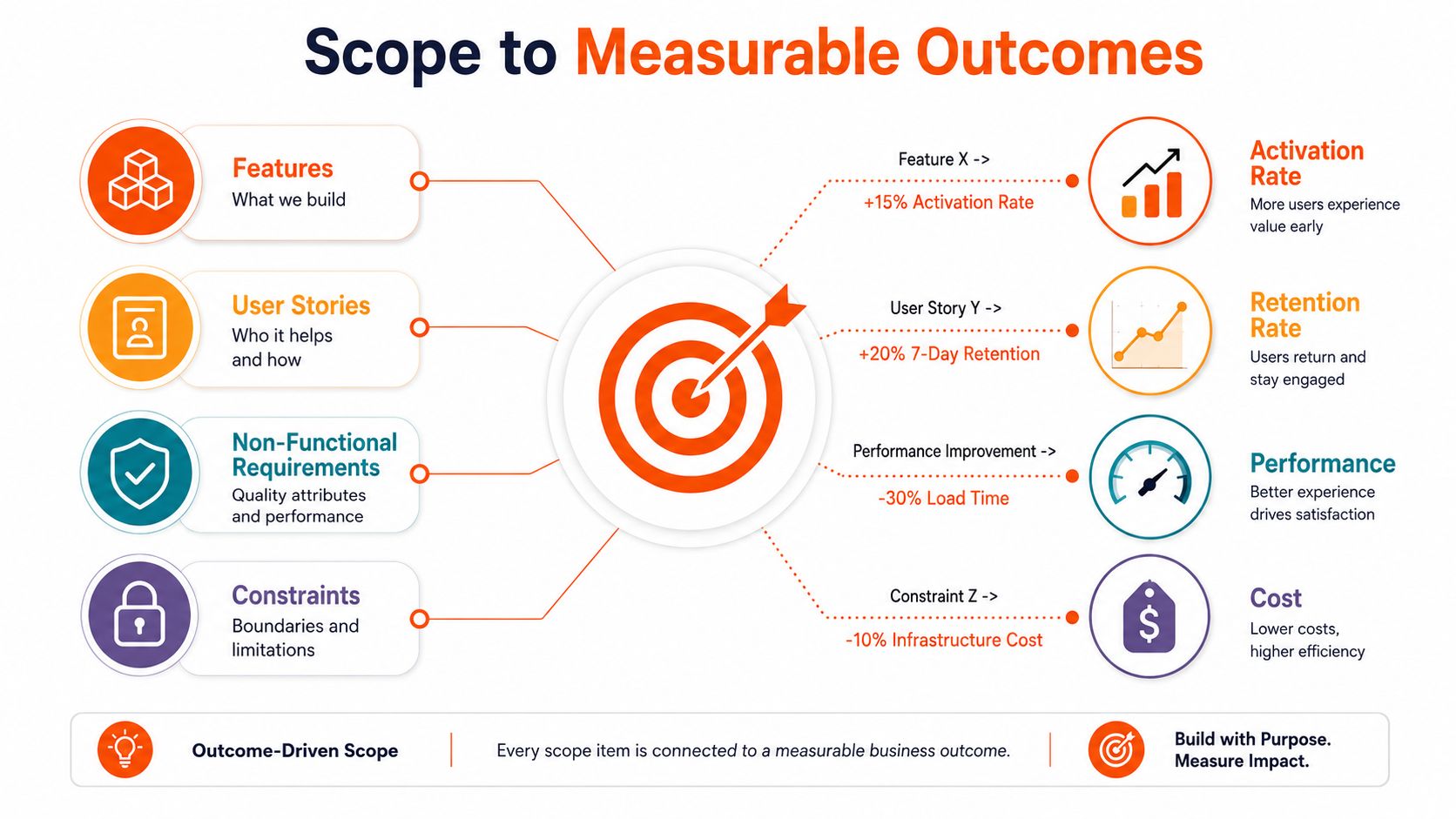
A good scope statement reads like a commitment, with no ambiguity about what the team owns. Under the Riteway mindset, the team owns the outcome first, then works backwards through deliverables, constraints, and acceptance rules until every trade-off is explicit. That is Extreme Ownership in delivery. It separates “we shipped the feature” from “we delivered the result the business needed.”
Translate every scope item into a decision metric
A feature by itself says very little. You need to know what it is meant to change. If onboarding is in scope, define the business behaviour it should improve. If observability is in scope, define the operational risk or response-time problem it should reduce.
The same logic applies to non-functional requirements. The UK Government Digital Service requires services to define service levels and publish operational performance measures, which is why scope should include response times, availability, resilience, and observability from the start rather than waiting until the build is nearly done. That is a product decision, because it protects the outcome and keeps delivery honest.
A founder or CTO should be able to write one short outcome statement and use it to test every later change request. If a proposed change does not improve the outcome or protect the launch, it needs a strong case.
A scope decision is valid only when it protects the outcome, the timeline, or the risk profile.
That is how a consulting partner should work. The job is not to pad the backlog. The job is to keep every discussion tied to the result that matters. In practice, that means you defend the business objective when someone pushes for a shiny extra feature that does not move the metric. It also means you choose the right delivery partner early, which is why a practical guide like how to choose a nearshore partner belongs in the same decision flow as scope itself.
A Practical Workflow for Defining Scope in a Nearshore Delivery Model
Nearshore delivery only works when both sides agree on how decisions get made. If the client team is in London and the delivery team is in Poland, or any other time-zone split, scope needs a clean workflow or the engagement will drown in async confusion. The point isn't to add bureaucracy. The point is to make approvals, exclusions, and acceptance criteria visible before anyone starts building.
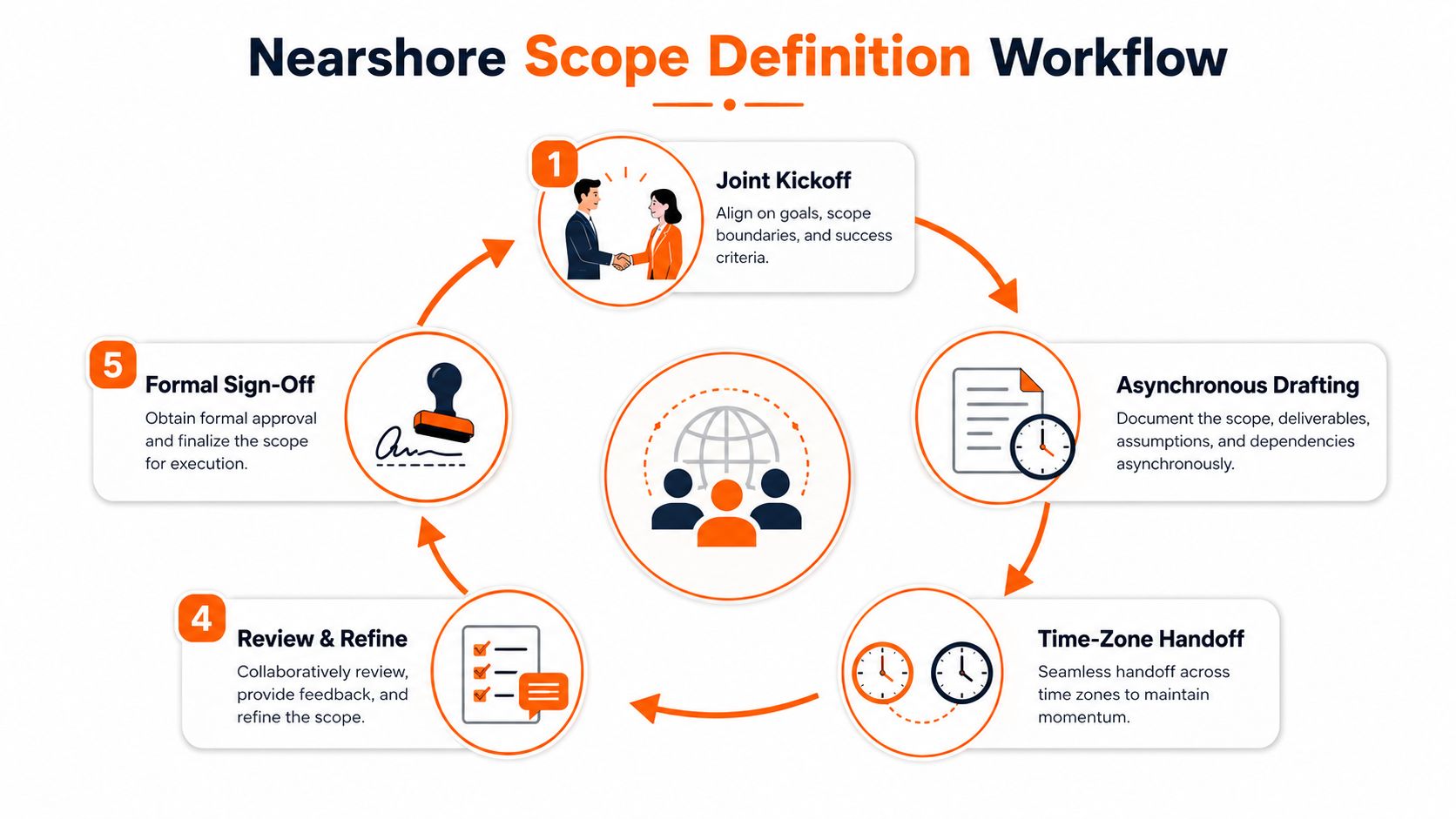
Run the scope workflow in five moves
1. Joint kickoff. The owner is the client sponsor with the delivery lead. The artefact is a discovery brief. The decision is whether the problem is worth scoping now.
2. Asynchronous drafting. The delivery partner drafts the first scope document, with objectives, deliverables, exclusions, constraints, assumptions, and acceptance criteria. A Dedicated Team model works well, because the team can absorb the detail without creating a dependency pile-up.
3. Time-zone handoff. The client reviews overnight, marks gaps, and flags approval risks. The decision here is not final agreement, it's whether the draft is sharp enough for review.
4. Review and refine. Both sides tighten exclusions, test assumptions, and convert vague statements into measurable acceptance checks. Use this moment to call out dependencies, because a late dependency is just a polite delay.
5. Formal sign-off. The sponsor approves the scope baseline, and the delivery lead records the control rules. No code starts before this, unless someone is happy to fund churn.
If you're choosing a partner for this model, use the same standards you'd use for any serious delivery relationship. The nearshore partner must be able to challenge scope, not just consume it.
Use AI to remove admin, not judgement
AI-powered process tooling can help draft meeting notes, surface missing fields, and flag contradictions in assumptions, but it can't decide trade-offs for you. Keep the human decisions human. The model should compress administration, not replace ownership.
Common Scope Pitfalls and How to Mitigate Them Early
The first two weeks of a build tell you almost everything. If the scope is weak, the warning signs show up fast. The founder keeps adding “just one more thing,” the team writes acceptance criteria that sound like compliments, and someone assumes a third-party integration will behave exactly as planned. That's where projects start losing shape.
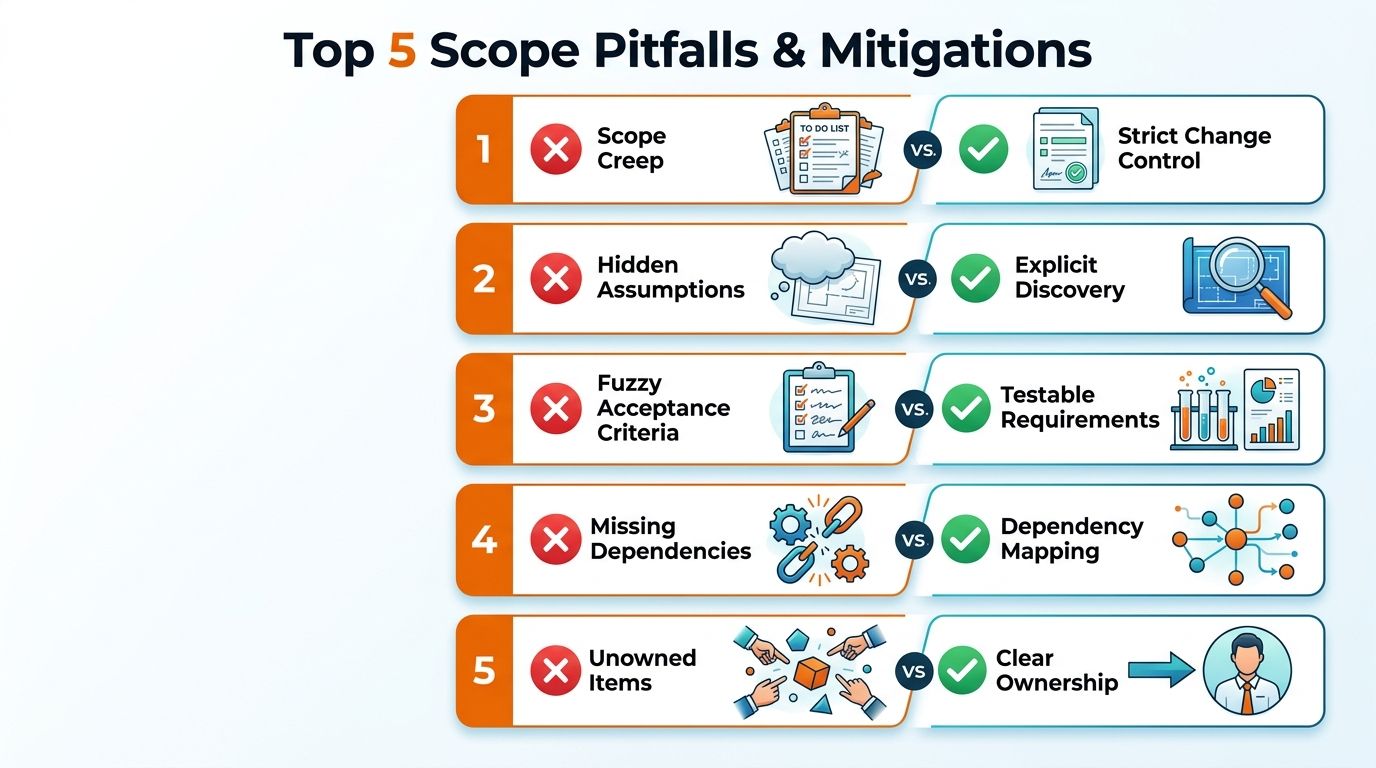
The five failures that keep showing up
Scope creep starts when small additions get approved informally. The fix is strict change control, with a written impact review before anything is added.
Hidden assumptions are dangerous because nobody challenges them until they break. The fix is explicit discovery, where every dependency and external condition is named out loud.
Fuzzy acceptance criteria create endless debate at review time. The fix is testable requirements, written so a QA engineer or sponsor can verify them without interpretation.
Missing exclusions are a silent budget killer. The fix is to write down what the project will not do, especially anything the founder says “we can probably add later.”
Unspoken constraints usually surface too late. The fix is dependency mapping, especially around APIs, security reviews, procurement steps, and internal availability.
Unowned items stall delivery because everyone thought someone else had it. The fix is clear ownership, one name next to each item, no ambiguity.
If a requirement can't be tested, it can't be signed off cleanly.
That's where a delivery partner earns trust. A strong team spots the drift early, raises the issue directly, and frames the trade-off in business language. You don't want a partner who smiles and absorbs risk. You want one who protects the launch by calling the problem before it spreads.
For a deeper look at the mechanics of drift, the project scope creep piece is worth reading alongside your internal checklist. The pattern is always the same, weak boundaries create expensive surprises.
Governance, Change Control, and Clean Handover as Scope Items
Governance sits inside scope. If the scope statement does not spell out who approves changes, what triggers re-scoping, and how handover will be managed, the project is already drifting. Scope is the full set of work tied to outputs, outcomes, verification, and approval, not a tidy feature list.
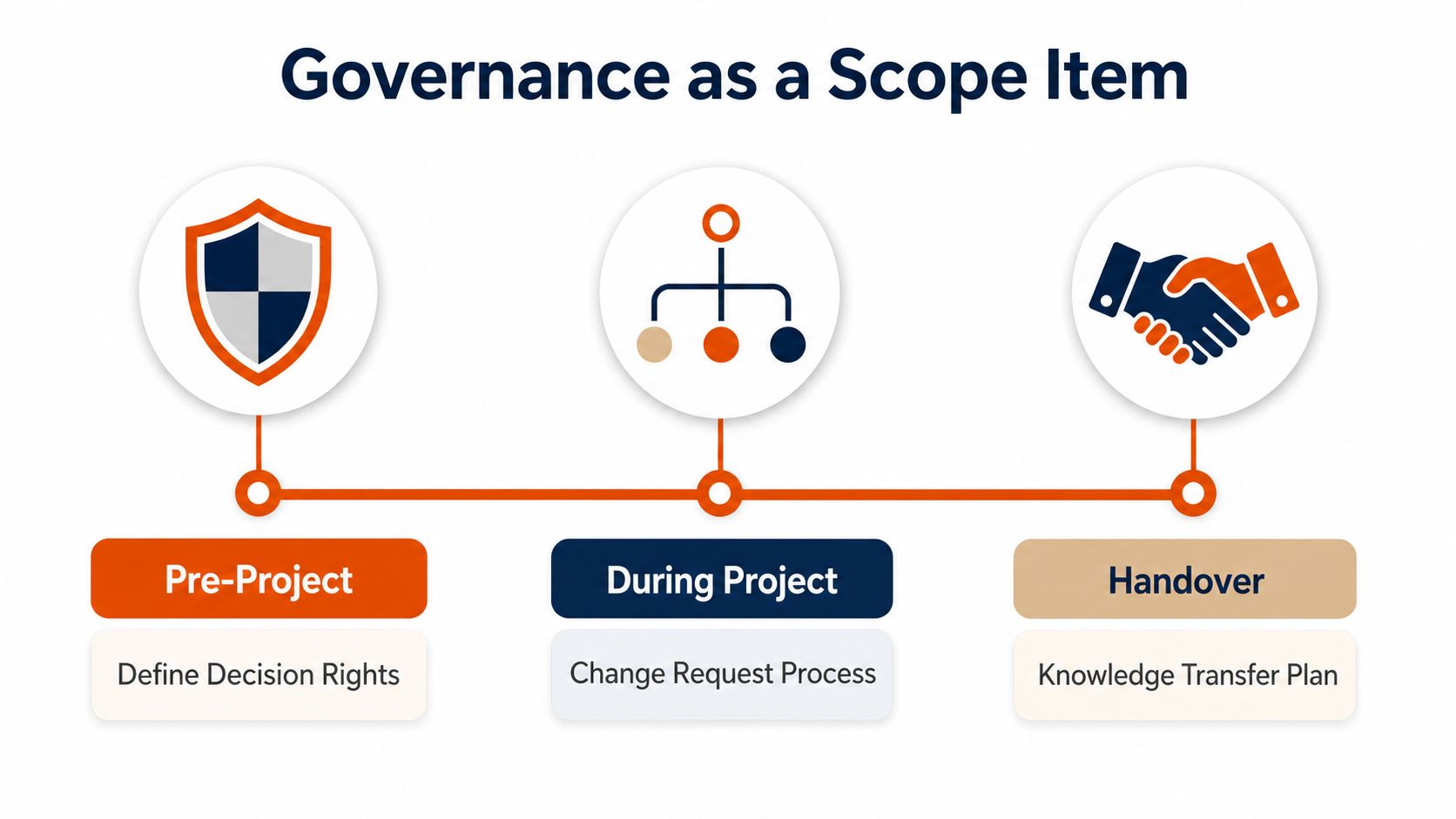
Make decision rights part of the baseline
Write decision rights into the baseline before delivery starts. The sponsor approves strategic changes, the delivery lead approves implementation trade-offs, and the product owner or founder approves scope changes that alter outcomes. If those rules are left vague, the team slides into committee mode and every decision takes longer than it should.
A clean Build-Operate-Transfer engagement needs handover in the scope statement from day one. Documentation, knowledge transfer, access handoff, and ownership transfer belong in the scope, not in a rushed wrap-up phase. If you want the receiving team to run the product with confidence, the handover plan has to be designed while the build is still active. That is the same discipline behind the physical preference AGM 2025 conversation, where approval paths and operating rules have to be clear before anyone assumes execution will sort itself out.
Treat change control as a delivery feature
A change request process is how you protect speed without losing control. It should state what triggers re-scoping, who reviews impact, and which trade-offs get reviewed when the request lands.
A confident partner does not leave undocumented decisions behind. It closes the loop, records what changed, and makes sure the client team can operate the product without reverse-engineering the build. That is what keeps nearshore delivery from turning into a handoff gap with no clear owner and no clean exit.
Your Scope Definition Checklist for the Next MVP
Use this before you brief a nearshore team, not after. If you do it up front, you'll spend the next sprint building instead of arguing.
- Objectives written as outcomes. State the business result, not just the feature.
- Deliverables named plainly. List what will be built and what will be handed over.
- Exclusions written down. Remove the tempting extras before they sneak in.
- Constraints surfaced early. Call out time, compliance, dependency, and team limits.
- Assumptions logged with owners. Every assumption needs someone responsible for confirming it.
- Acceptance criteria made measurable. “Looks good” doesn't count.
- Governance roles explicit. Say who approves changes and who signs off delivery.
- Handover plan agreed. Define documentation, transfer, and operational ownership.
That's the work. Project scope definition is not paperwork, it's the moment the team takes ownership of the outcome and stops guessing. If you get this right, the build gets calmer, the trade-offs get cleaner, and the MVP has a real chance of landing on time.
If you want a delivery partner that treats scope as a governance tool, not a slide deck, talk to Rite NRG. We help SaaS teams define the work, lock the boundaries, and ship with clarity through nearshore delivery, consulting, and dedicated teams. Visit Rite NRG if you want a scope conversation that leads to a shippable plan.