You're staring at an MVP that looked elegant in planning and messy in reality. The team has shipped something, the stakeholders want answers, and the only thing worse than slow delivery is launching fast and learning the wrong lesson. Build Measure Learn exists to stop that exact waste, and in SaaS it works best when the team treats every sprint as a business decision, not a coding exercise.
That shift matters in the UK market, where new firms need to validate demand quickly and keep costs low, while 99.9% of UK businesses are SMEs according to the British Business Bank in 2024. In other words, such businesses don't have the luxury of long, expensive guesses. They need a loop that forces evidence before scale, which is why MVPs, actionable metrics, and rapid iteration matter so much in practice. That's also where a #riteway approach fits naturally, because Extreme Ownership and proactive problem solving turn vague delivery into accountable execution.
Introduction to the Build Measure Learn Loop
A founder has a crisp idea, the product team has a backlog, and engineering is already under pressure to “just get it out.” Then the first release lands, usage is thin, feedback is contradictory, and nobody can say whether the problem is positioning, functionality, or targeting. That's the trap Build Measure Learn is meant to break.
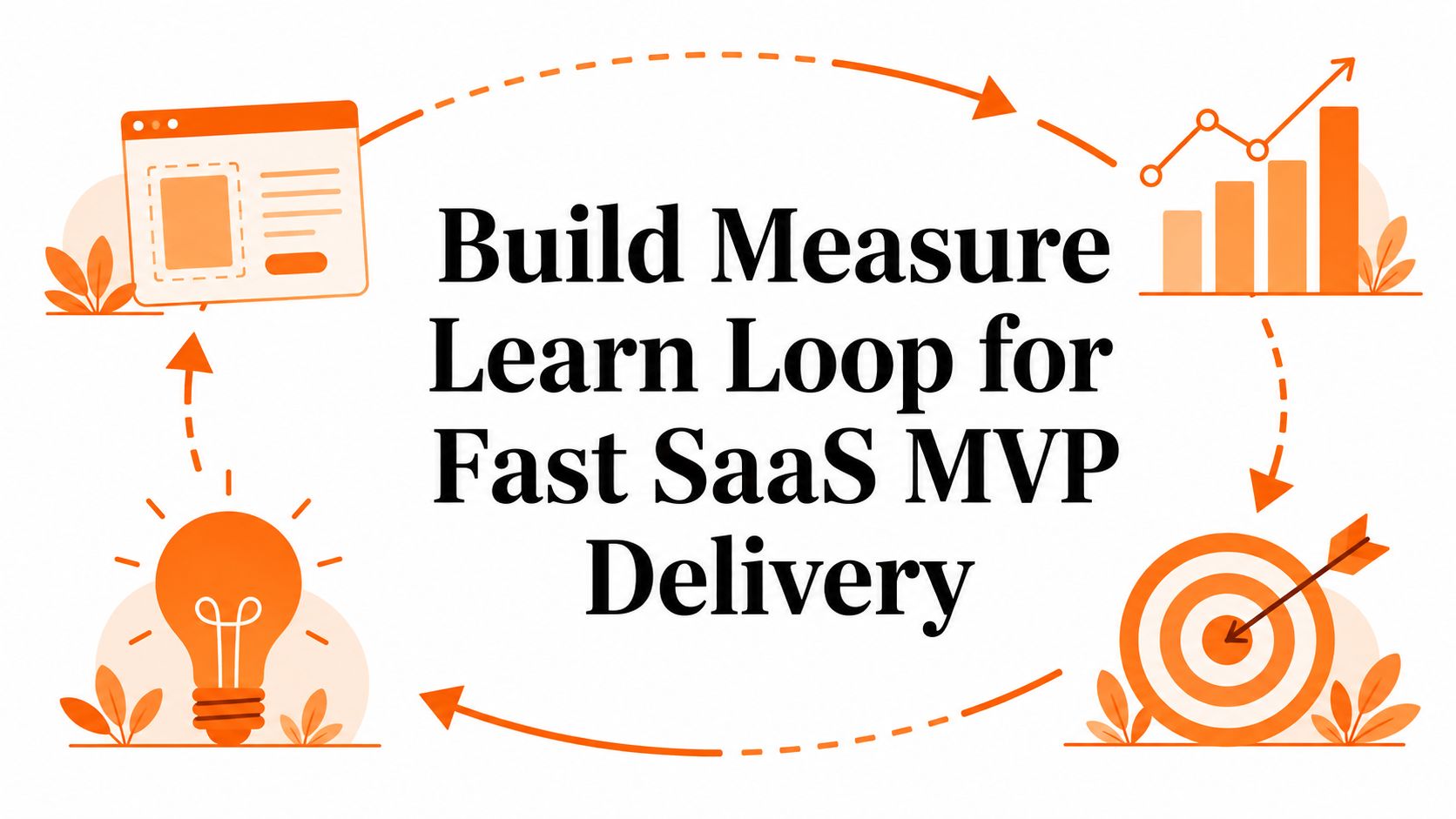
The loop's strength is simple. Build the smallest test, measure what real users do, then learn whether the idea deserves more investment. Eric Ries popularised this through The Lean Startup in 2011, but the practical value is still the same, small experiments beat expensive assumptions. Rite NRG's startup lean methodology guide fits that mindset because it treats learning as the point, not a side effect.
Why this loop beats heroic delivery
Traditional delivery teams often confuse motion with progress. They ship more screens, more tickets, and more releases, then discover the market never cared enough to convert. Build Measure Learn cuts through that noise by forcing a business question before every build.
Practical rule: if you can't explain what decision the experiment will unlock, you're not ready to build.
That matters even more for SaaS leaders working with tight runway and impatient buyers. In software and digital services, customers usually want measurable value before signing bigger contracts, so the team that learns faster often wins the deal. A senior nearshore team with strong ownership can compress that learning loop because the conversation stays close to outcomes, not handoffs.
Where #riteway changes the game
The #riteway Methodology is useful here because it rewards clarity, energy, and follow-through. Instead of waiting for disconnected functions to interpret a launch, the team owns the hypothesis, the data, and the decision. AI-enabled delivery adds another layer, because it can surface risk earlier, reduce manual triage, and keep the loop moving without pretending that speed alone equals value.
Understanding the Key Concepts
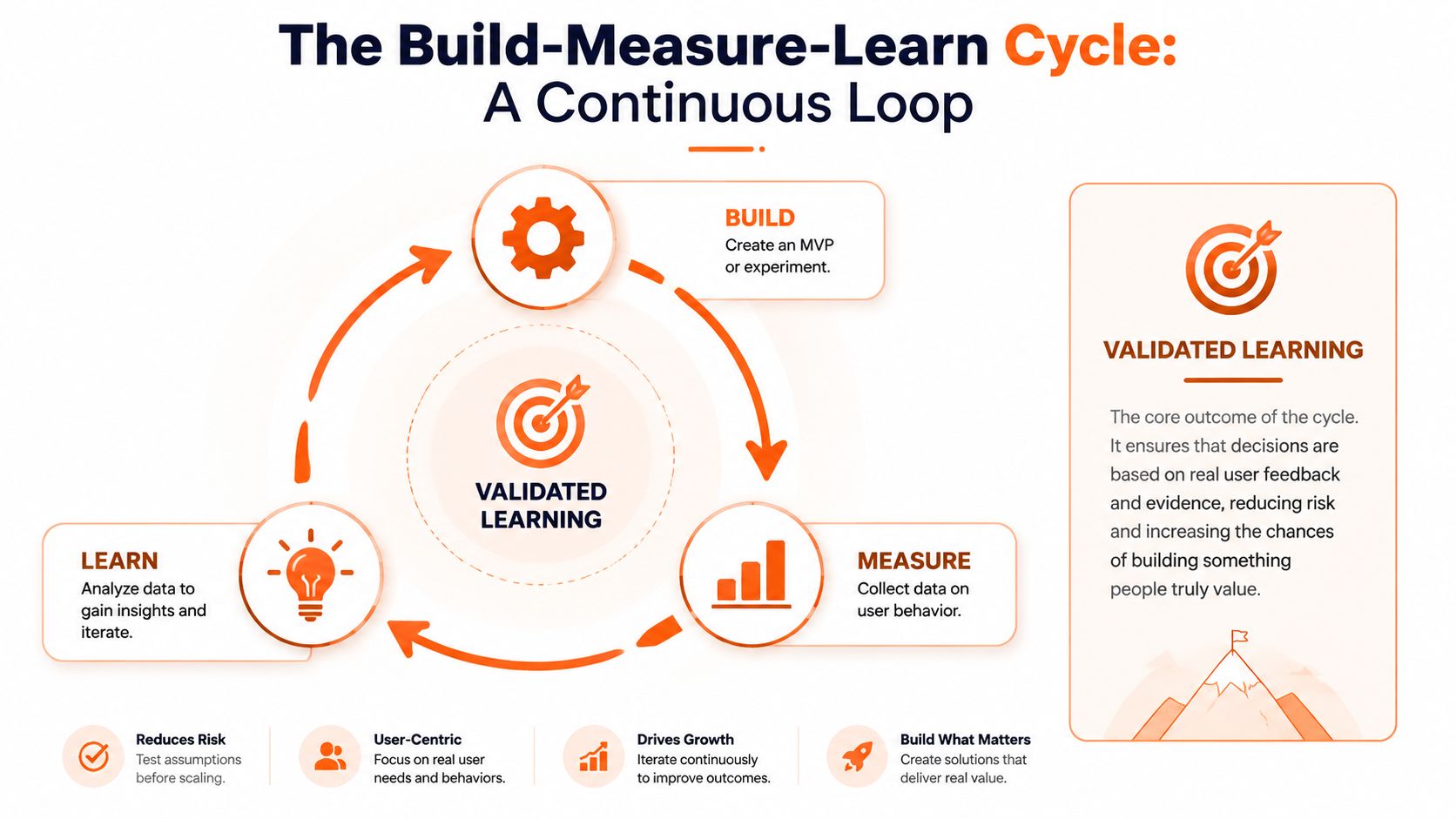
The loop has three parts, and each one has a job that the others can't replace. Build means creating the smallest viable test of a hypothesis. Measure means watching real behaviour, not just internal opinions. Learn means deciding whether to persevere, pivot, or stop based on what the evidence says.
Build is not about completeness
The point of build isn't to create a polished product. It's to reduce uncertainty with the smallest possible effort, so the team learns before it commits major resources. That's why MVP thinking matters. If you overbuild early, you bury the signal under features nobody asked for.
A waterfall culture does the opposite. It rewards planning, sign-offs, and long development cycles, then treats launch as the first real test. That creates sunk cost pressure, which makes people defend weak ideas longer than they should. The loop forces a different discipline, because the work starts with a hypothesis and ends with a decision.
Measure has to map to value
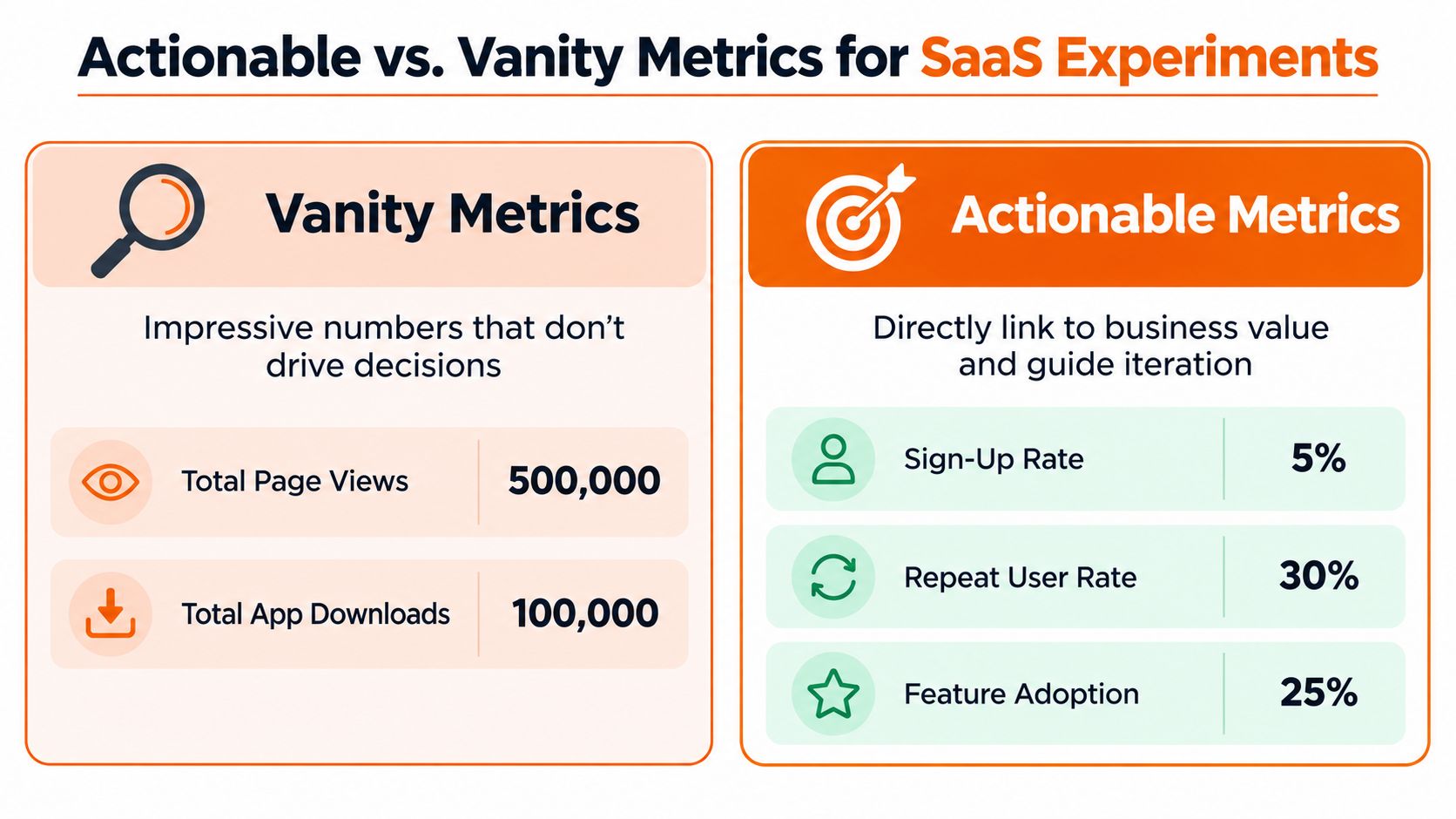
Eric Ries stresses actionable metrics, not vanity metrics, because the loop is about cause and effect, not theatre. A high page view count can look impressive while telling you nothing useful about conversion, retention, or product fit. The better question is whether people complete a core action, return, or move closer to revenue.
Direct advice: choose metrics that change the next decision. If the metric doesn't affect persevere, pivot, or stop, it's decoration.
That's why the framework becomes more useful as teams get more disciplined. Unified Product Graph's guidance to define success criteria before building makes the logic explicit, and the result is binary enough to act on, supported or not supported. That binary thinking is valuable for SaaS teams because it keeps the discussion tied to evidence instead of debate.
Learn is where strategy happens
Learning is not a retrospective after the work is done. It's the point where the team interprets what happened and decides whether the business case still holds. In a strong loop, learning produces a decision log, not a vague feeling.
That's the power of the cycle. Each iteration narrows uncertainty and pushes the product closer to a useful market fit. In a UK environment dominated by SMEs, that kind of discipline can influence most of the market, not just venture-backed outliers, which is exactly why the build measure learn loop remains a practical operating model.
Implementing Build Measure Learn for MVPs
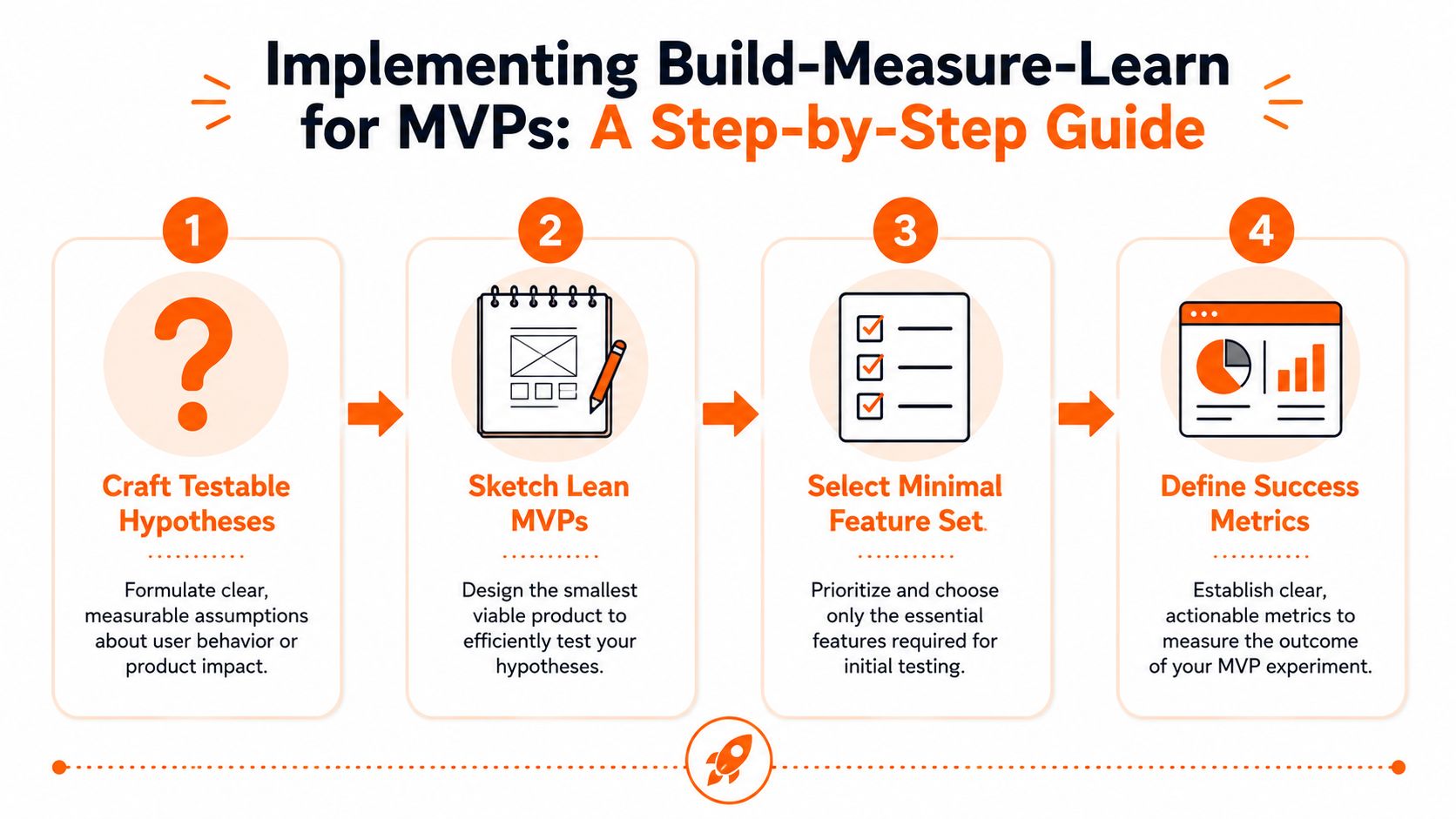
A good loop starts before anyone writes code. Teams should define the hypothesis, the expected behaviour, and the success criterion first, then build the smallest test that can confirm or reject it. That sequence sounds obvious, but groups commonly still reverse it and end up interpreting after the fact.
Start with the hypothesis
Write the assumption in plain language. For example, “If we offer a guided onboarding step for first-time users, more of them will complete the core workflow.” That gives the team something testable, something measurable, and something you can falsify.
Then define the success criterion before the build starts. Unified Product Graph's guidance is clear on this, success criteria come first, and the result is documented as supported or not supported. That discipline is what stops teams from moving the goalposts once a feature is live.
Build the smallest viable version
The MVP should be the smallest test that can produce a clear signal. That might be a landing page, a concierge flow, a manual back-end, or a stripped-down product screen. If you want a practical reference for implementation mechanics, Webtwizz's step-by-step MVP development guide is a useful companion to this approach.
Here, ownership matters. One person should own the experiment, one should own instrumentation, and one should own the decision log. That doesn't mean every role is siloed, it means no one can say later that they thought someone else was watching the signal.
Build for learning first, then improve only what the data justifies.
Measure and document honestly
The measurement plan needs to be written before launch. Decide what to collect, how often to review it, and what result will trigger a pivot or a persevere decision. If the signal is weak or confusing, log that too. Weak signals still tell you something about the hypothesis, the audience, or the workflow.
A solid shared template is simple:
- Hypothesis: what you expect to happen.
- Test: what minimal experience you'll ship.
- Success criteria: what outcome proves the idea has merit.
- Decision: persevere, pivot, or stop.
- Learning log: what changed in your understanding.
That structure keeps the team focused on the business outcome instead of the feature count. It also creates a clean paper trail for founders, product leaders, and investors who need to understand why the team kept going or changed direction.
A useful video explainer sits well alongside the practical process, so this build measure learn walkthrough can help teams align on the rhythm of the loop.
Measuring What Matters for SaaS Experiments
Measurement is where most loops succeed or fail. If the team tracks noisy numbers, it will make confident decisions for the wrong reasons. That's why actionable metrics matter more than impressive dashboards.
The clearest difference is simple. Vanity metrics make the product look active, while actionable metrics tell you whether the product is creating value. Startupik's examples point to sign-up rate, repeat usage, and completion of a key action as the kinds of signals that help the next decision. That's the standard SaaS leaders should use.
Measure outcomes, not noise
A dashboard full of activity can hide a weak product. If users click around but never complete the core workflow, the experiment hasn't validated anything useful. That's why the metric has to tie back to a business outcome like adoption, retention, or task completion.
The UK measurement problem makes this even sharper. The Agile Alliance's discussion of build measure learn highlights the harder question now, how to measure the right thing when product analytics are becoming harder to trust. That's the right concern. Privacy-conscious tracking means teams need cleaner experiment design, better first-party data, and a stronger view of consent.
Build your measurement around reality
In practice, teams should instrument events only where they matter. Track the moments that represent value creation, not every decorative click. Use feature flags to isolate experiments, first-party analytics to reduce reliance on shaky attribution, and support notes or surveys to explain what the numbers alone can't tell you.
If the signal depends on fragile tracking, the experiment isn't ready to be judged.
That's also why consent and privacy can't sit outside the product process. If the team loses trust in the data, the whole loop weakens. Better to run a smaller, cleaner experiment than a larger one built on unreliable tracking.
Keep the data defensible
CodeDesign.ai's analytics guidance is worth reading if your team wants a practical view of how to set up measurement without drowning in noise. The goal is not more data, it's better decisions. For SaaS leaders, that means one clear metric per hypothesis, one owner for the instrumentation, and one agreed review cadence.
Tooling and Partner Integration
The right tool stack should reduce friction, not create another layer of admin. For rapid prototyping, teams usually need a fast front-end build path, a simple experiment layer, user feedback capture, and clean analytics visualisation. The exact stack can vary, but the principle doesn't, every tool should support faster learning.

Pick tools that serve decisions
For SaaS experiments, a team might use one platform for event tracking, another for session replay, and another for feedback collection. That's fine as long as the tools are glued to a real decision path. If the stack produces more reports but no clearer judgement, it's too heavy.
AI-enabled tooling has changed the pace of delivery, but it hasn't removed the need for product judgement. In fact, it has made the loop more demanding, because teams can ship faster and therefore waste faster if they aren't disciplined. As noted in the earlier section, the challenge is to measure system-level outcomes like error rates, cycle time, and support load when the product includes AI behaviour, not just static features.
Senior nearshore teams make the loop operational
This is where the delivery model matters. A senior nearshore team can sit closer to the product owner, keep the communication tight, and own the full experiment cycle instead of waiting for a long chain of approvals. That's a better fit for Build Measure Learn than a team that only receives tickets and disappears behind a handoff.
Rite NRG is one option in this space. Its senior nearshore teams and AI-enabled processes are set up to help SaaS leaders move from hypothesis to release to learning with less drag, especially when the business needs transparent ownership and faster feedback. The value is operational, not magical, because the team still has to define the right metrics and keep the loop honest.
Operating rule: the partner should help you shorten the distance between signal and decision, not just write code faster.
Keep delivery connected to the loop
If your delivery pipeline is slow or unstable, the loop breaks before the learning begins. That's why technical delivery hygiene still matters, and why a strong CI/CD path supports experimentation rather than sitting beside it. Rite NRG's CI/CD pipeline guidance is relevant here because experimentation only works when release mechanics don't become the bottleneck.
Common Pitfalls in Feedback Loops
Teams often don't fail because they lack ideas. They fail because they turn the loop into theatre. The most common mistake is starting with a build before the hypothesis is written down, which makes the later measurement meaningless.
Another frequent failure is vanity metrics. Teams celebrate sign-ups, impressions, or activity spikes, then discover the product never produced real usage. Several sources explicitly warn against that pattern and point instead to metrics that map to business value, such as sign-up rate, repeat usage, and completion of a key action. That warning is right, because a loop without decision-grade data is just busy work.
Watch for these warning signs
- No decision rule: if the team can't say what result will trigger a pivot or persevere call, the experiment is too vague.
- Feature creep: if the MVP keeps expanding before release, the team is protecting assumptions instead of testing them.
- Late measurement design: if tracking is added after launch, the team usually misses the cleanest signal.
- Delayed ownership: if nobody owns the follow-up, the loop slows and the learning gets diluted.
The fix is blunt. Assign ownership early, keep the experiment small, and review the result quickly. That's where the #riteway mindset matters, because proactive teams don't wait for confusion to become a problem.
Treat feedback as input, not verdict
Customer feedback loops are useful, but they're only one part of the picture. As covered in the earlier sections, behavioural data should lead, and user comments should help explain the pattern. Rite NRG's customer feedback loops article aligns with that practical stance, because the point is to translate feedback into action, not collect it for its own sake.
If the team discusses the experiment more than it changes the product, the loop is stuck.
The strongest teams keep the rhythm tight. They define the test, run it, inspect the signal, and act. That's how the loop stays useful instead of becoming another meeting ritual.
Conclusion and Next Steps
Build Measure Learn works because it forces discipline where most SaaS teams drift into guesswork. It pushes the team to build smaller, measure cleaner, and learn faster, which is exactly what you need when budgets are tight and buyers expect proof before commitment. In a UK market full of SMEs and practical decision cycles, that discipline isn't academic, it's a competitive edge.
The real takeaway is this. Validated learning matters more than output, because output without evidence just creates expensive noise. If your MVP isn't tied to a hypothesis, a success criterion, and a decision rule, it's not a learning loop, it's an expensive demo.
A senior nearshore partner with AI-enabled delivery can make the loop faster without making it sloppy. The value comes from stronger ownership, tighter communication, and a delivery model that keeps product, engineering, and measurement moving together. That's the #riteway advantage, proactive execution with business outcomes at the centre.
Use this checklist for your next cycle:
- Write the hypothesis first.
- Define the success criteria before build starts.
- Keep the MVP small enough to learn from quickly.
- Measure one outcome that matters.
- Record the result accurately, then decide.
If you want your next MVP to move faster without losing control, partner with a team that treats every experiment like a business decision. Rite NRG helps SaaS leaders operationalise the loop with senior nearshore delivery, AI-enabled processes, and clear ownership from idea to outcome.
If you're ready to turn build measure learn into a repeatable delivery system, visit Rite NRG and talk to a team that can help you ship MVPs faster, measure what matters, and make the next decision with confidence.