
Your SaaS team already knows the painful version of this story. The product is solid, customers like it, the roadmap is moving, and yet the market keeps drifting towards louder, faster competitors. That gap is usually not a product problem alone. It's a delivery problem, a positioning problem, and an ownership problem all at once.
If you want to increase market share, stop treating it like a branding exercise or a vague growth ambition. Market share moves when you find a winnable segment, outmanoeuvre the incumbent, ship a sharper offer, and execute faster than everyone else in the category. In a concentrated market, small wins matter, because value shifts quickly when the leader is exposed in the right place. The UK market data makes that clear, from digital advertising concentration to grocery share movement over time, and the same logic applies to SaaS.
The teams that win don't wait for perfect conditions. They pick a wedge, own the outcome, and build the machine that turns insight into shipping speed.
Your High-Energy Blueprint for Market Dominance
A founder I spoke with recently had a familiar problem. Their churn was fine, their product reviews were strong, and their pipeline looked healthy on paper, but two smaller competitors kept winning the same prospects with narrower promises and cleaner execution. That's the moment one finally realises the market isn't rewarding effort, it's rewarding precision.
The wrong response is to launch a broad campaign and hope demand magically tilts your way. The right response is to go after a specific pocket of the market with a sharper offer, a clearer story, and a delivery engine that can move before the window closes. That's the heart of Extreme Ownership. You don't blame the market, you own the wedge, the message, the build, and the follow-through.
Practical rule: If your share isn't moving, don't add more noise. Narrow the target, tighten the value, and fix the speed of execution.
The rest of this blueprint is built for teams that want measurable business outcomes, not activity for its own sake. It's for leaders who understand that market share is earned by combining strategy, product, GTM, and delivery into one operating system. That means being opinionated about where to attack, ruthless about what to ship, and disciplined about how you re-measure the win.
Map Your Battlefield with Precision Sizing
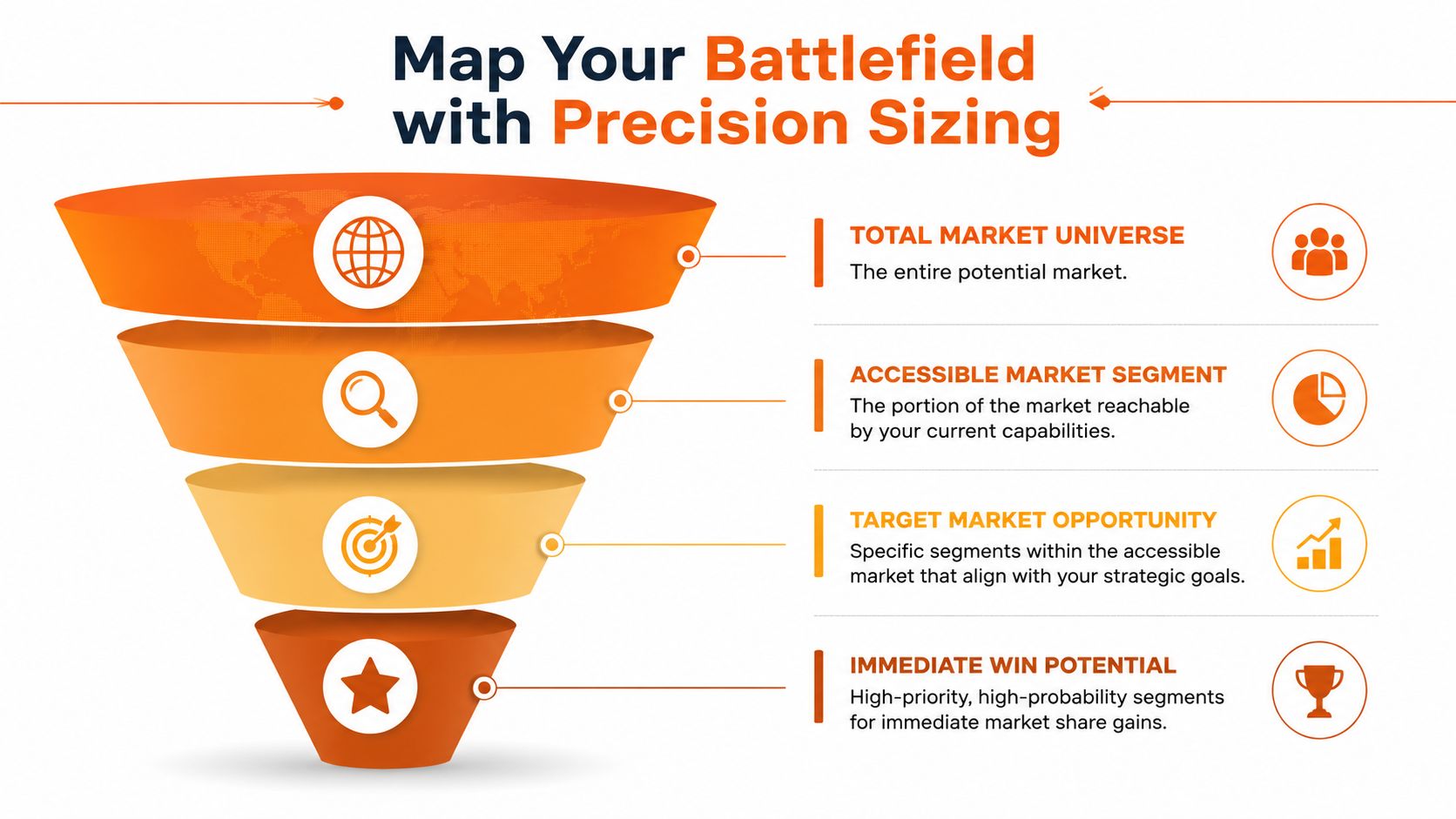
Many teams start with market sizing and stop at the wrong altitude. They build a broad TAM slide, then spend budget chasing buyers who were never going to convert quickly enough to matter. That burns time and weakens focus. The better move is to size the battlefield at segment level, where you can win and track movement.
Start with the simple formula, your sales divided by total industry sales × 100, then break the market down by geography, customer size, and product category. The goal is not a polished spreadsheet. The goal is to find the pockets where your offer already has a real path to winning before you spend more on acquisition. Define the time period first, then use both value and volume views so you do not confuse a broad market with a serviceable one. QuickBooks' market share guidance helps teams measure share in a way they can act on, and a funnel diagram illustrating the steps to identify and capture market share through precision sizing strategies. shows how precision sizing narrows the hunt.
Stop treating underserved segments as a slogan
A lot of strategy decks say “find underserved customers” and stop there. That is too vague to drive revenue. The real work is choosing the underserved micro-segment worth attacking, then proving it with evidence before you buy traffic or add more sales capacity. That gap matters because you can look busy and still fail to win a meaningful wedge.
Use a direct approach.
- Estimate current share by segment, not just in the total market.
- Map reachable demand with customer interviews, regional competitor mapping, and product gap analysis.
- Look for friction where competitors are slow, overpriced, complex, or weak on onboarding.
- Choose one micro-segment that fits your current capabilities.
- Run a low-risk pilot and re-measure after the pilot window.
That sequence separates a real share play from a generic segmentation workshop. It also makes room for qualitative evidence, which matters more than many teams admit. Interviews surface what surveys miss, especially when buyers are describing a workaround rather than a preference. For a sharper view on market gaps, Luth Research's framing on market gaps is useful because it pushes teams to prioritise the segment that is actually valuable, not just visible.
Once you know where the gap sits, connect the sizing work to the delivery engine immediately. A nearshore partner like Rite NRG helps teams move from segment choice to shipped execution faster, which is the difference between owning a wedge and watching someone else take it.
Do not confuse large addressable demand with winnable demand. If the segment cannot be reached, converted, or retained with your current model, it is not a beachhead.
Outmanoeuvre Competitors with Deep Analysis
The best competitor analysis doesn't start with feature tables. It starts with how your rival wins deals. That means pulling apart their pricing psychology, channel dependence, onboarding friction, proof points, and category positioning. Features matter, but they're rarely the primary reason a buyer chooses one vendor over another.
The UK competition data is a good reminder of how concentrated markets behave. The Competition and Markets Authority found that Google and Facebook together captured about 80% of the UK's £5.5 billion digital advertising market in 2019 in its digital advertising market study. That's the lesson for SaaS too. You don't always need to beat the whole market, you need to attack the dominant position where it's weakest and where your message lands cleanly.
A sharp analysis session should cover three things:
- Buying triggers, what forces a prospect to start looking now.
- Switching friction, what makes it hard to move away from the incumbent.
- Distribution advantage, where the competitor gets visibility before you do.

Once you understand those three, genuine openings become obvious. Maybe the competitor is strong on breadth but weak on setup speed. Maybe they look credible in enterprise but feel too generic for mid-market buyers. Maybe they're using channels that work for volume, not for the exact segment you chose earlier. That's where you win, not by saying “we're better”, but by being undeniably more relevant.
There's a useful internal resource here too, the competitive analysis framework. Use it to structure the work, then go deeper than the checklist. The goal is to find the competitor's assumptions, because assumptions are where market-share gains hide.
Sharpen Your Spear with Product and Positioning
Marketing cannot rescue weak positioning. It can amplify a product that already has a clear edge, but if the offer is fuzzy, the message only spreads the confusion faster. The fastest route to increase market share is to pair retention-first expansion with sharp differentiation, especially in mature UK markets where buyers have plenty of options and little patience for noise as Martal's guidance on market share levers argues.
The product roadmap should come straight out of the segment work and competitor analysis. Stop asking, “What should we build next?” Ask, “What would make this chosen segment switch, stay, and recommend us?” That question changes the work immediately. It pushes the team toward features that remove friction, make outcomes obvious, and create visible value fast.
Build the offer around the buying reason
If your message says one thing and the product delivers another, trust disappears fast. Tight positioning means the promise, the experience, and the proof all line up. A value proposition exercise should not sit with copy, it should drive product decisions.
Start with the value proposition canvas. Map pains, gains, and jobs-to-be-done, then turn that into roadmap priorities. If the segment cares about setup speed, cut implementation friction. If it cares about confidence, improve visibility and proof. If it cares about switching costs, build migration help into the offer from day one, not as a cleanup task later.
Delivery speed is paramount. A nearshore team like Rite NRG can turn those positioning choices into shipped work faster, which keeps the offer aligned with what the market is asking for. The product team gets room to refine the wedge while sales and marketing keep pressing the advantage.
Use the essential product launch checklist(https://www.saaspa.ge/product-launch-checklist) to pressure-test the release before it goes live. It keeps the launch grounded in execution, not wishful thinking.
Sainsbury's in the UK grocery market shows the same pattern. Aldi's share rose from low single digits in the early 2010s to around 10% in recent years according to UK market-share history tracked by CFI. That happened because the value proposition was sharp, the positioning was narrow enough to remember, and the operating model matched the promise. SaaS buyers respond the same way. They do not reward breadth for its own sake, they reward offers that solve a painful job with less friction.
Rule of thumb: If your roadmap does not change the buyer's decision, it is not a share play. It is just internal activity.
Fuel Growth with Smart Pricing and GTM
Pricing is a positioning decision with revenue consequences. If the price, package, and motion do not fit the target segment, you either leave money on the table or push away the buyers you need most. Strong teams shape the offer so it feels obvious to adopt and easy to explain inside the buying committee.
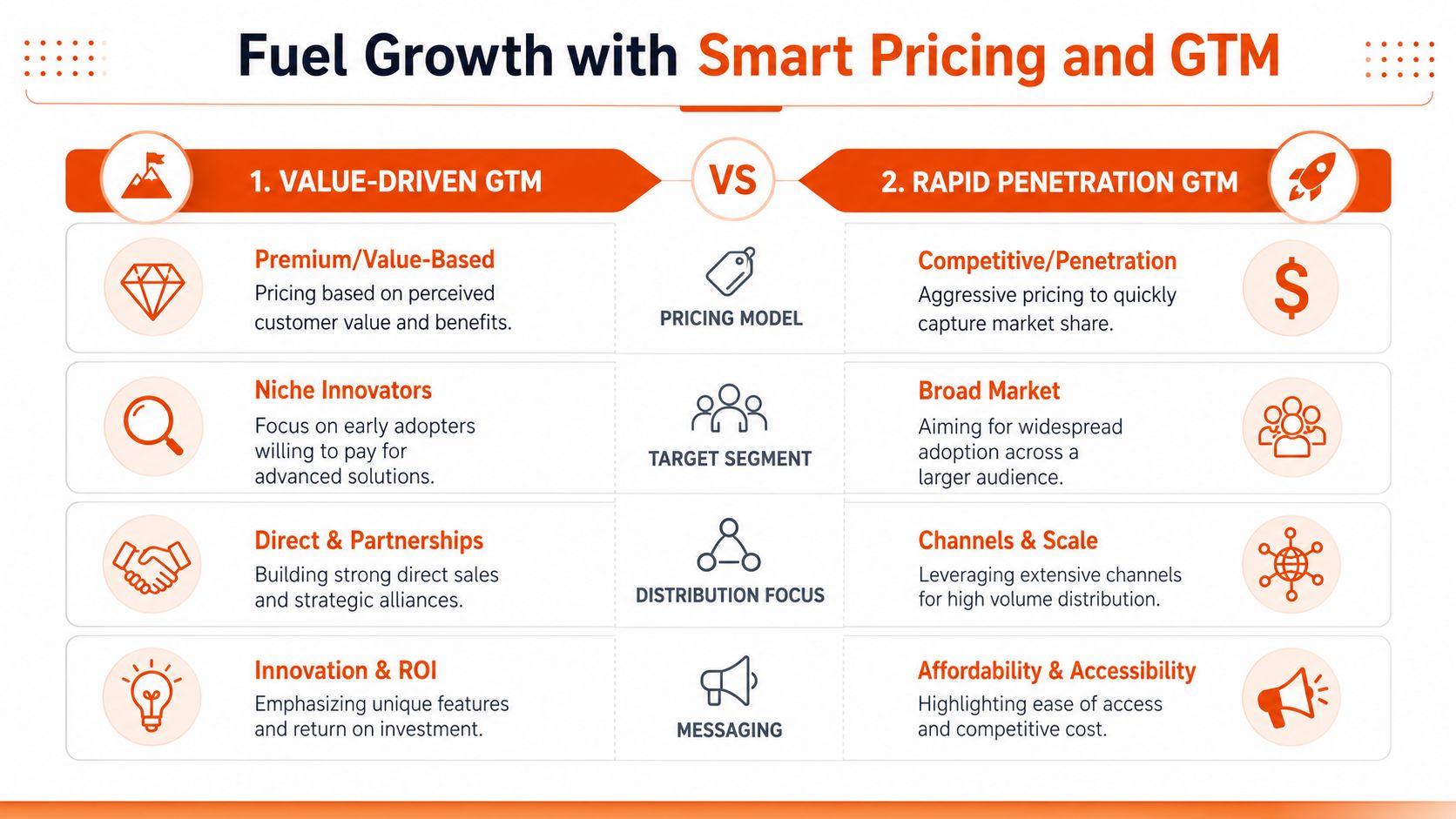
The right GTM motion depends on the wedge you are selling into. Value-Driven GTM wins through depth, while Rapid Penetration GTM wins through speed. Choose the first when your segment pays for confidence and clear outcomes. Choose the second when the category is crowded, switching is easy, and fast access matters more than premium framing.
Pick the motion that fits the wedge
Specialised, high-stakes segments usually respond better to value-based packaging. Crowded categories with low switching friction often reward penetration pricing and broad access because they create momentum faster. The mistake is mixed signals, premium language with bargain pricing, or enterprise promises wrapped in self-serve friction.
Distribution has to match the motion. Product-led growth works when the value is obvious inside the product. Sales-led works when the buyer wants reassurance, guidance, and support across multiple stakeholders. Partnerships work when another brand already has the trust and audience you need. Do not force all three at once. Pick the route that fits how the segment already buys.
Before you launch, use the essential product launch checklist to pressure-test the commercial setup, messaging, and release process. It keeps weak offers from going live with avoidable friction.
Delivery speed matters here too. A nearshore team like Rite NRG can turn pricing and GTM choices into shipped work faster, which keeps the offer aligned with what the market is asking for. That gives product room to refine the wedge while sales and marketing keep pushing the advantage. The same operating discipline supports retention work later, especially when customer retention strategies need to be built into the motion instead of patched on after the launch.
Sainsbury's in the UK grocery market shows the same pattern. Aldi's share rose from low single digits in the early 2010s to around 10% in recent years. The point is simple. A sharper value proposition, narrower positioning, and an operating model that matches the promise can move share. SaaS buyers respond the same way. They reward offers that solve a painful job with less friction, not broad messages that try to please everyone.
Rule of thumb: If your roadmap does not change the buyer's decision, it is not a share play. It is internal activity.
Build an Unbeatable Growth Engine
One-off campaigns do not create durable share gains. Systems do. If you want repeatable growth, build a loop that turns customer behaviour, competitor movement, and product feedback into faster decisions. Track the right metrics, run small experiments, and ship improvements with discipline.
Start with segment-level baseline measurement. Without it, you cannot tell whether you are winning or just getting busier. Estimate your current share, benchmark competitors, pick one underserved segment, run a low-risk pilot, then re-measure after the pilot window. That cadence keeps the team honest and stops vanity metrics from distracting the organisation from real movement.
Operate like a growth team, not a campaign team
Your KPI stack should cover three layers. First, market share by chosen segment. Second, the customer signals that drive it, such as retention, repeat purchase, and referral behaviour. Third, the operational signals that let you move faster, including cycle time from insight to release and the number of pilots you can run without creating chaos.
Build the loop like this:
- Collect data continuously, from customer feedback, sales calls, and competitor changes.
- Translate the signal into one decision, not five disconnected ideas.
- Ship the smallest test that proves or disproves the hypothesis.
- Measure the result against the chosen segment, not the whole market.
- Keep what works, kill what does not, and re-run the cycle.
That is the #riteway mindset in practice, even if you never call it that internally. Extreme ownership means the team does not wait for perfect alignment before acting. It makes the next move, tests it, and learns fast.
Speed matters because market share is a relative game. If your delivery engine is slow, your competitor gets more reps, more learning, and more wins.
A high-velocity nearshore team becomes a force multiplier here. When product, design, and engineering can move in tight loops, you can run more experiments per quarter, validate wedges sooner, and adjust positioning while the opportunity is still open. That is not about outsourcing ownership. It is about compressing the time between decision and market feedback so the business can learn faster than the competition.
For retention-led expansion, ground the work in customer retention strategies. Strong retention gives you more room to expand, more proof to sharpen positioning, and more customer evidence to feed the next set of experiments. That is how the growth engine compounds, through a tight operating rhythm that keeps the team pointed at measurable outcomes.
If you are serious about increase market share work, stop trying to do everything at once and build the wedge with discipline. Define the segment, expose the competitor's weakness, ship the sharper offer, and run the loop until the numbers move. If you want a partner that can help you turn that playbook into shipped product and faster market action, talk to Rite NRG and get the delivery engine moving.