You're probably dealing with one of two situations right now. Either your team is starting a new product and someone has reduced the stack discussion to “Java or JavaScript?”, or you're inheriting an existing platform and need to decide what to keep, what to replace, and what will hurt least over the next few years.
That decision isn't academic. It affects how fast you ship, who you can hire, how much operational complexity you absorb, and how much rework you'll pay for later. The difference between Java and JavaScript matters because each language pulls your architecture, team shape, and delivery model in a different direction.
I'm going to be blunt. Most content on the difference between Java and JavaScript wastes your time. It gets stuck on syntax, beginner examples, and trivia about the names. Leaders don't need trivia. They need a defensible decision tied to business outcomes.
At Rite NRG, we use an Extreme Ownership mindset. That means stack choices aren't treated as developer preference contests. They're treated as delivery decisions. If a language choice slows hiring, increases handoff friction, or creates avoidable maintenance drag, it's the wrong choice no matter how elegant the code looks.
Java vs JavaScript A Business Decision Not a Technical Quiz
The wrong question is “Which language is better?” The right question is “Which stack gives us the best speed, cost profile, and risk position for this product?”
A founder building a web-based SaaS MVP has a very different problem from a CTO modernising a complex backend platform. If both ask for a generic answer, both will get bad advice. The difference between Java and JavaScript only becomes useful when you tie it to product goals, team capability, and delivery pressure.
What leaders usually get wrong
Too many teams frame this as a pure engineering debate. They compare typing models, syntax style, or developer preference. That misses the actual cost drivers:
- Hiring reality: Can you staff the team you need without slowing delivery?
- Delivery cadence: Can the stack support quick iteration, testing, and release discipline?
- Operational risk: Will the language choice fit the system's performance, governance, and maintenance needs?
- Future flexibility: Can you evolve the product without a painful rewrite?
If you ignore those questions, you'll make a technically respectable choice that still fails commercially.
| Decision lens | Java usually fits better | JavaScript usually fits better | Business outcome |
|---|---|---|---|
| Core platform role | Complex backend services | Browser-first products and full-stack web apps | Better alignment between architecture and product need |
| Team structure | Specialist backend teams | Leaner cross-functional web teams | Faster staffing and clearer ownership |
| Delivery style | Deliberate, governed engineering | Rapid iteration and product experimentation | Better match to release pressure |
| Compute profile | CPU-heavy backend workloads | I/O-heavy, latency-sensitive web flows | Lower performance risk |
| Product stage | Scaling, hardening, enterprise integration | MVPs, feature discovery, fast web rollout | Better use of budget |
My recommendation up front
If you're building a web product and speed matters most, start from JavaScript or, more realistically, a JavaScript and TypeScript centred stack.
If you're building a backend-heavy platform where throughput, maintainability, and long-term system discipline matter most, default to Java.
Practical rule: choose the stack that removes the biggest delivery bottleneck, not the one that wins the loudest technical argument.
That's how senior leadership should approach the difference between Java and JavaScript. Not as a language quiz. As a business decision with consequences.
Origins and Philosophies Why They Are Fundamentally Different
Java and JavaScript share a naming accident and a release year. That's where the similarity starts and mostly ends.
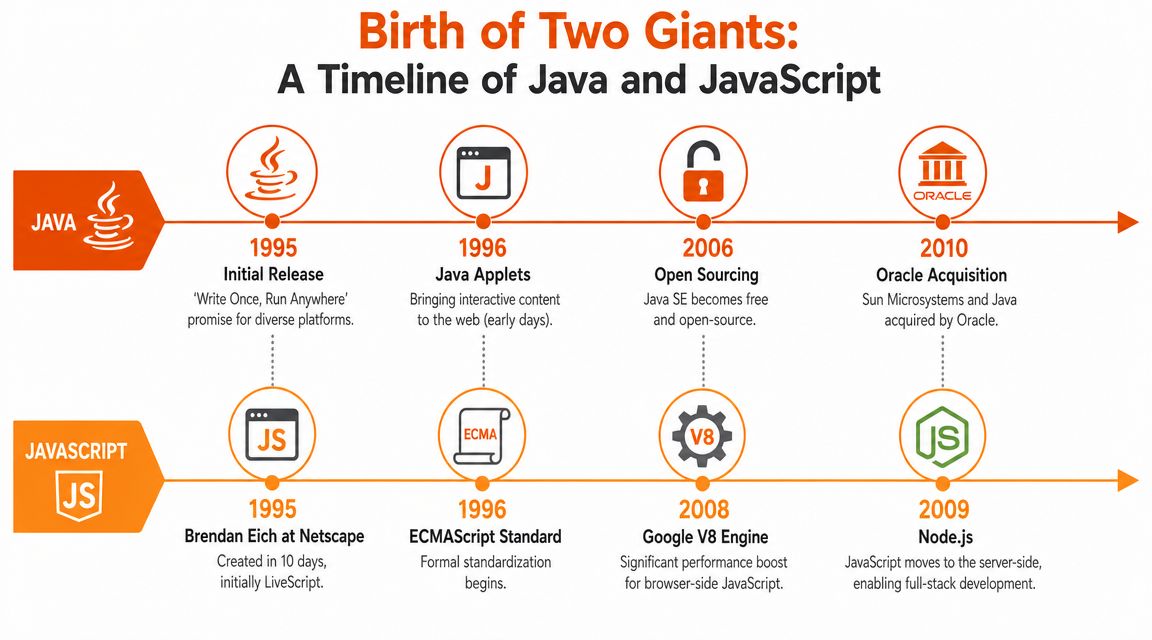
Both were released in 1995, but they were built for different jobs. Java was designed as a compiled, statically typed language running on the JVM, while JavaScript was created for client-side scripting in the browser and later became central to interactive web development, as outlined in this Java vs JavaScript history summary.
Java was built for system discipline
Java's philosophy is straightforward. Build software that behaves consistently across environments, enforce structure early, and make large systems easier to reason about over time.
That origin still shows up in how Java is used today. Teams pick it when they want strong boundaries, predictable behaviour, and architectures that can survive years of change, multiple contributors, and strict operational demands. Java tends to attract organisations that care about controlled release processes, explicit contracts, and long-lived backend services.
That matters commercially. Structure slows some decisions in the short term, but it often reduces chaos later.
JavaScript was built for interaction and speed
JavaScript started life much closer to the user. Its original mission was to make web pages do something. Not in the abstract. In the browser, in the interface, where customers click, type, browse, and abandon.
That history explains why JavaScript became the default language for web interactivity and then expanded outward. Once teams could use it beyond the browser, they gained a powerful delivery advantage. One language, one broad ecosystem, and one talent pathway across front-end and server-side web development.
Java wins when you need a language to support a system. JavaScript wins when you need a language to support a product interface moving at market speed.
Why the origin story still matters
This isn't history for history's sake. The original design goals still shape modern trade-offs.
Java tends to reward teams that optimise for:
- Strong backend architecture
- Clear contracts and maintainability
- Complex service estates
- Governance and operational control
JavaScript tends to reward teams that optimise for:
- Fast interface delivery
- Short feedback loops
- Web-native product development
- Cross-functional full-stack work
When leaders ignore those inherited strengths, they create friction. They force Java to behave like a rapid experimentation layer, or they force JavaScript to carry backend responsibilities that demand stricter operational discipline than the team is ready to enforce.
The names are confusing. The business implications aren't. These languages came from different worlds, and they still carry those instincts into your product roadmap.
Comparing Runtimes Performance and Concurrency
Let's get to the part that usually gets oversimplified. Performance.
People love sweeping claims here. “Java is faster.” “JavaScript is lighter.” “Node scales better.” None of those statements help unless you know what kind of work your product does.
Java and JavaScript differ in execution model and concurrency. Java is compiled to JVM bytecode and can use true multi-threading for parallel CPU work, while JavaScript runs in a single-threaded event loop with async callbacks. In performance-sensitive code, Java can better utilise multiple cores for backend throughput, whereas JavaScript typically optimises for responsiveness and fast startup rather than parallel compute scaling, as explained in this runtime and concurrency comparison.
Core technical differences that actually matter
| Criterion | Java | JavaScript | Business implication |
|---|---|---|---|
| Execution model | Compiled to JVM bytecode | Runs in browser engines or server-side runtimes with an event loop | Affects startup profile, runtime behaviour, and deployment choices |
| Typing style | Statically typed | Dynamically typed in core language | Changes how teams catch errors and manage complexity |
| Concurrency | True multi-threading | Single-threaded event loop with async callbacks | Changes fit for CPU-heavy vs I/O-heavy workloads |
| Typical strength | Complex backend processing | Web interactivity and fast iteration | Direct impact on product shape and team velocity |
| Operational profile | Strong fit for long-lived services | Strong fit for web-facing responsiveness | Influences scaling approach and maintenance patterns |
When Java earns its keep
Java is the safer choice when your backend does serious computational work, coordinates complex business logic, or needs to use multiple cores efficiently. If your system is expected to process large workloads consistently under pressure, Java gives engineering teams more direct tools for that job.
That doesn't mean every Java service is fast by default. It means the runtime model is better suited to sustained, compute-heavy backend behaviour when the team designs it well.
A lot of enterprise leaders already know this instinctively. They've seen what happens when core systems outgrow lightweight decisions made during MVP stage.
When JavaScript is the sharper tool
JavaScript shines when your product lives close to the browser, needs rapid interface iteration, or handles lots of asynchronous activity. Think dashboards, collaboration tools, customer portals, APIs serving web clients, or products where responsiveness and quick release cycles matter more than brute-force parallel computation.
That's why the difference between Java and JavaScript can't be reduced to raw speed. Responsiveness, startup characteristics, architecture simplicity, and developer throughput all matter.
Oracle's runtime comparison found that Java 19.0.1 on GraalVM Enterprise Edition 22.3 delivered the best results in two micro-benchmarks, with TypeScript and JavaScript close behind, which is a useful reminder that performance depends on workload rather than simplistic language rankings, as noted in Oracle's runtime benchmark discussion.
Performance is a product question before it's a language question. If you don't identify the dominant workload, the benchmark won't save you.
The leadership view on runtime choice
If your engineering roadmap includes any of the following, treat Java seriously:
- CPU-heavy services
- Complex transaction processing
- Backend systems with sustained throughput demands
- Platforms where operational predictability matters more than experimentation
If your roadmap leans toward these, JavaScript is often the more commercially efficient option:
- Web-first user experiences
- Fast product iteration
- Real-time interface updates
- Unified front-end and backend teams
Experienced delivery leadership is particularly important. The runtime choice doesn't just affect technical performance. It affects team design, incident patterns, quality control, and release confidence.
Mapping Technology to Use Cases and Product Goals
The fastest way to make a bad stack decision is to talk about languages in the abstract. Products aren't abstract. They have channels, users, constraints, release pressure, and integration pain.
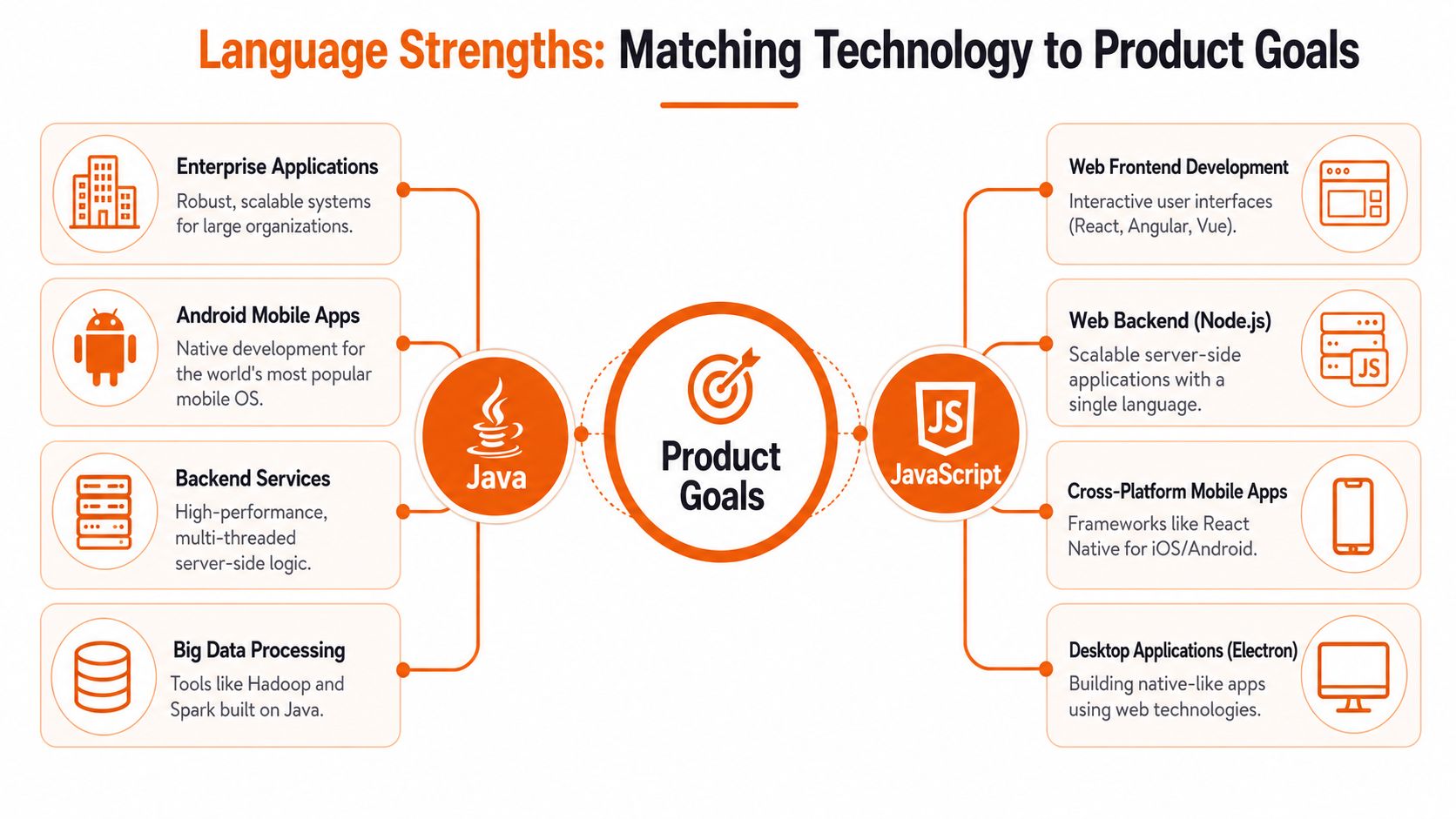
The practical difference between Java and JavaScript shows up in the kinds of products they naturally support.
Where JavaScript is the default choice
If the product is delivered through the browser, JavaScript is already in the room. In fact, JavaScript is used by 98.9% of all websites worldwide as of December 2024, according to W3Techs as cited in Coursera's comparison of Java and JavaScript. That isn't trivia. It explains why web teams in the UK lean on JavaScript for front-end interactivity and browser-based applications.
JavaScript is usually the right call for:
- Customer-facing web apps: SaaS interfaces, portals, admin panels, onboarding flows
- Real-time experiences: chat, notifications, collaborative editing, live dashboards
- Full-stack web teams: one language across front end and backend can reduce handoff friction
- Cross-platform delivery: where web technologies support web, mobile, and desktop-adjacent experiences
If your product roadmap is heavily interface-led, you should also evaluate modern front-end frameworks before locking the stack. React, Angular, and Vue create very different delivery dynamics even when JavaScript is the common foundation.
A useful reference point for leaders making adjacent architecture decisions is this guide to what a technology stack includes. The language is only one layer. Datastores, deployment model, testing strategy, and observability all affect whether the stack delivers.
Where Java still makes more sense
Java remains a strong fit for products where backend integrity matters more than front-end convenience. That includes platforms with heavier business rules, broader integration surfaces, or infrastructure that needs to scale under sustained load.
Java is usually the better fit for:
Enterprise backend platforms
Internal systems, service layers, and core business applications often benefit from Java's structured approach.Processing-heavy services
If the product spends more effort on backend computation than interface rendering, Java deserves serious weight.Long-horizon systems
Products expected to evolve over years, with multiple teams and stricter governance, often age better with stronger engineering constraints.
Here's a quick visual summary before the next step in the decision.
Don't choose Java because it feels “enterprise”. Choose it when the product's centre of gravity is backend complexity, not browser speed.
The blunt use-case rule
If the product's value is mostly delivered through the interface, JavaScript is usually the commercial default.
If the product's value is mostly delivered through backend computation, control, and long-term system integrity, Java is often the safer decision.
The True Cost Hiring Ecosystem and Delivery Speed
Most Java versus JavaScript articles falter on this particular aspect. They explain the languages and ignore the delivery model. That's a mistake.
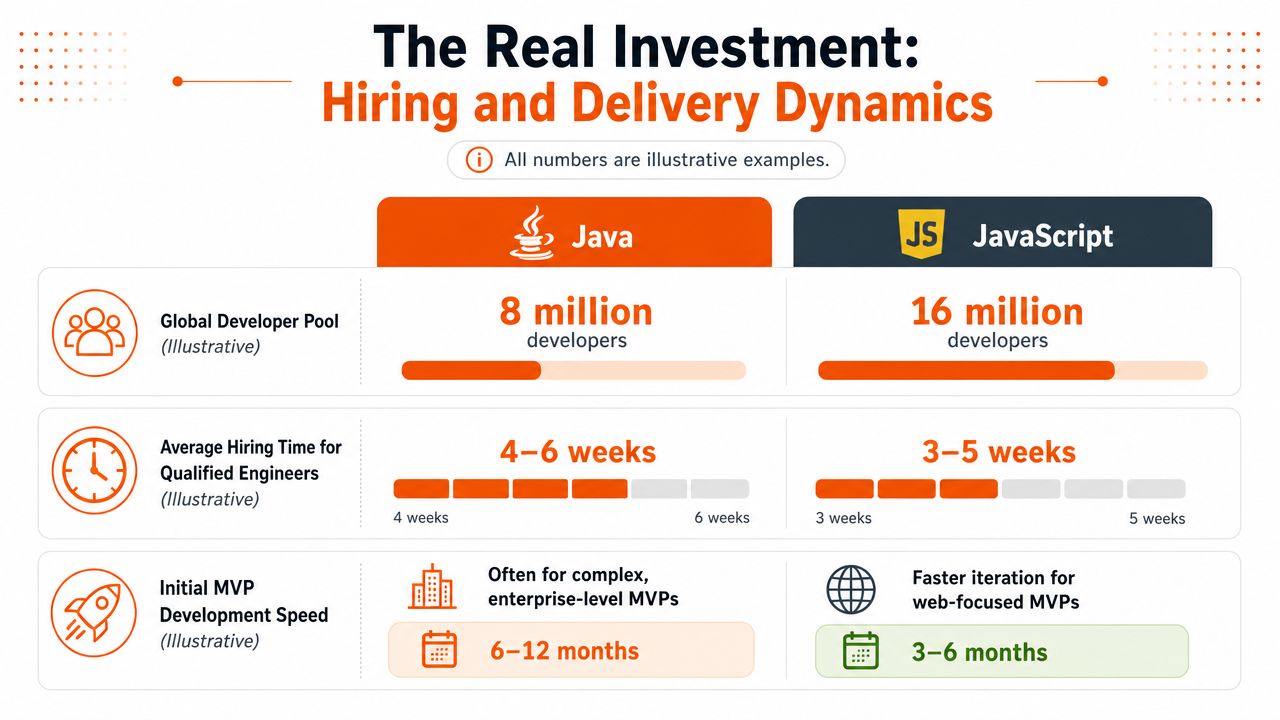
A stack is never just code. It's also your hiring funnel, onboarding speed, testing discipline, package management habits, release rhythm, and the number of avoidable decisions your team will fight about every sprint.
A frequently underexplained angle is how this choice affects hiring and delivery in the UK market. The UK has strong demand for both ecosystems, and LinkedIn's 2024 UK skills data shows software engineering and cloud-native delivery capabilities remain among the most sought-after skill sets, making stack choice a workforce-planning issue rather than language trivia, as noted in this market-focused comparison.
JavaScript often wins the first phase
For early-stage SaaS teams, JavaScript can reduce delivery friction because the same broad ecosystem can support front end, API development, and adjacent tooling. That usually means fewer language boundaries and simpler collaboration across a smaller team.
That doesn't mean “anything goes”. JavaScript projects become expensive when teams move fast without standards. Weak testing, inconsistent patterns, and dependency sprawl create hidden cost fast.
If your backend includes Java services, disciplined engineering matters even more. Teams improving coverage and release confidence often benefit from practical resources like this expert advice on JaCoCo Maven plugin, especially when quality gates need to support a more structured Java delivery setup.
Java often wins the scaling phase
Java tends to become more attractive as product complexity, integration overhead, and governance demands increase. It's not because Java magically lowers cost. It's because it can reduce expensive ambiguity in larger systems.
The cost advantage appears when you need:
- Clear service contracts
- Long-lived maintainability
- More predictable backend behaviour
- Tighter engineering discipline across multiple teams
If you're planning team shape around this decision, the capability mix matters as much as the language. This overview of back-end developers and their role in delivery is useful because many stack decisions fail at the staffing model, not the architecture diagram.
What leaders should optimise for
I'd make the call using these operational questions:
- Need fast MVP learning loops? JavaScript often gives you a cleaner path.
- Need a hard-working backend with growing complexity? Java becomes more attractive.
- Need one lean team across product and platform work? JavaScript can simplify team design.
- Need controlled engineering in a larger environment? Java usually supports that better.
Rite NRG works with teams on both sides of this decision, including dedicated delivery setups for web products and backend-heavy platforms. The right answer is usually the one that removes your current constraint without creating a bigger maintenance problem next year.
The cheapest stack on day one is often the most expensive stack by year two if governance never catches up.
The cost isn't licence fees or tutorial availability. It's whether the stack helps your team deliver predictably under pressure.
Making the Call A Framework for SaaS and Enterprise Leaders
At this point, you don't need another language comparison. You need a decision rule.
The future-facing part matters too. Existing explainers rarely deal with how JavaScript's dominance in web applications and rapid iteration compares with Java's strengths in stability when teams use AI tools to ship faster. That matters in the UK, where the government reported that the AI sector contributed about £3.7 billion in gross value added and supported around 86,000 jobs in 2024, as referenced in this AI-related Java and JavaScript note.
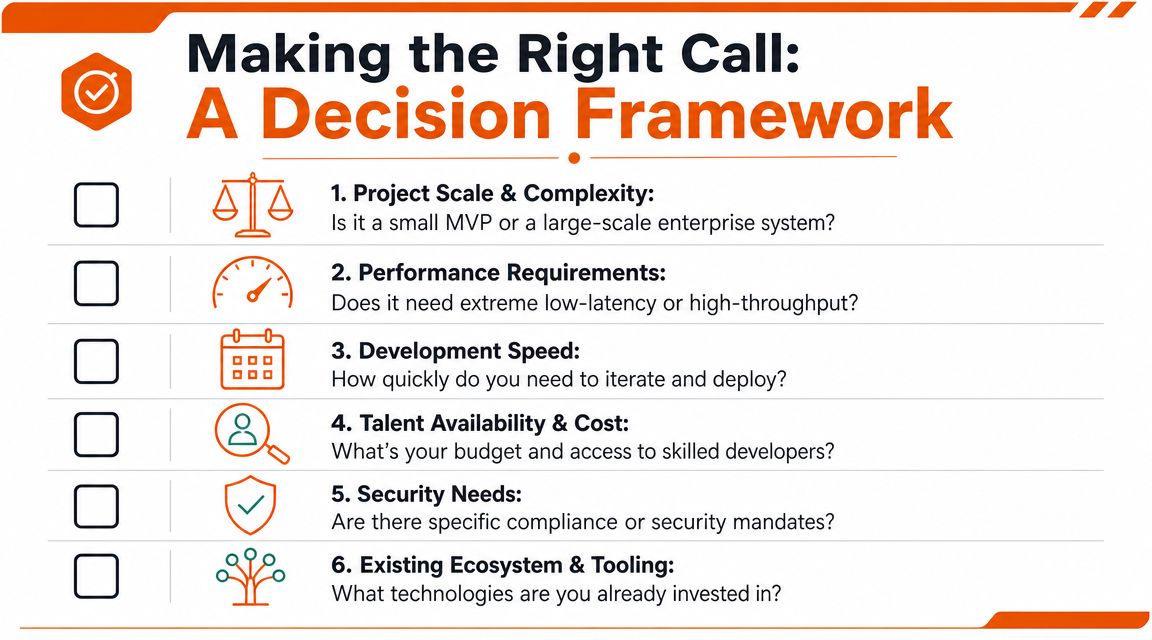
Use this decision framework
Choose JavaScript first when most of these are true:
- Your product is browser-first: the interface is the product.
- You need fast iteration: discovery speed matters more than backend formality.
- You want a leaner full-stack setup: fewer language boundaries can simplify execution.
- Your roadmap is web-heavy: customer-facing features dominate the backlog.
Choose Java first when these conditions dominate:
- Your backend does the heavy lifting: complex logic, processing, and system coordination matter most.
- You expect long service life: maintainability and control outrank raw iteration speed.
- You operate in a more governed environment: release discipline and explicit contracts matter.
- You're building for scale in the core platform, not just the UI: backend strength is the business asset.
My direct recommendation by scenario
For a SaaS MVP, start with JavaScript unless you have a very strong reason not to. Fast iteration wins early.
For a scaling SaaS platform, use JavaScript for the interface and consider Java for backend domains that are becoming operationally critical.
For an enterprise modernisation programme, don't default to JavaScript just because it feels current. If the centre of risk sits in backend services, Java is often the more defensible choice.
For teams also comparing adjacent JVM options, this look at Java vs Kotlin for product teams can help refine the backend side of the decision.
Pick the stack your team can operate well under pressure. AI can accelerate coding, but it won't fix poor architecture, unclear ownership, or weak engineering standards.
That's the difference between Java and JavaScript in practice. JavaScript usually gives you speed close to the user. Java usually gives you control deeper in the system. Smart leaders choose based on where the business can't afford failure.
If you're making a stack decision and want an experienced delivery partner to pressure-test the trade-offs, talk to Rite NRG. We help SaaS and enterprise teams align architecture, staffing, and delivery so the technology choice supports speed, cost control, and lower execution risk.