Your product probably works. Users can log in, complete the task, export the file, invite the teammate, close the tab.
And still they don't care.
That's the quiet failure mode most SaaS teams miss. Churn doesn't always come from broken features. It often comes from a product that feels interchangeable. Useful, yes. Memorable, no. In a market full of AI-assisted products, “good enough” UX is now the fastest path to becoming replaceable.
Lovable AI is the answer, but not in the soft, vague sense people usually mean. It's not a mascot, a friendlier chatbot, or a set of quirky microcopy lines. It's a business strategy for building software that feels assistive, competent, and worth returning to. If your AI helps users move faster, feel understood, and trust the system, you don't just improve the experience. You strengthen user retention.
That only happens when design theory meets delivery discipline. Many groups are still treating those as separate conversations. That's a mistake.
Your Users Are Bored Not Broken
Your users aren't leaving because they can't use the product. They're leaving because they can use it, finish the job, and feel absolutely nothing.
That's the danger zone for modern SaaS. Functional parity is getting cheaper. AI-generated interfaces, faster prototyping, and increasingly standard workflows mean competitors can copy surface-level capability quickly. If your product experience feels cold, generic, or passive, buyers won't describe it as bad. They'll describe it as replaceable.
The real problem is indifference
A lot of founders misread low engagement. They assume onboarding needs another checklist, the dashboard needs another widget, or support needs another bot. Sometimes those changes help. Often they just add noise.
The deeper issue is that the product behaves like a machine that waits for commands.
Users don't want another vending machine. They want a product that reduces effort, removes uncertainty, and helps them make progress without forcing them to think through every next step.
Bored users don't complain much. They just stop coming back.
That's why Lovable AI matters. Not as a design trend, but as a strategic response to user indifference. When AI makes your product more aware of context, more helpful in the flow of work, and more naturally aligned with user intent, the experience stops feeling transactional.
Working software isn't enough anymore
A product can be technically solid and commercially weak at the same time. Founders who win this cycle are the ones who stop asking, “Does it work?” and start asking, “Does it create preference?”
That's the shift. Lovable AI creates preference.
It helps users feel that the product “gets” them. It reduces dead clicks. It surfaces the next best action. It turns software from a place where work happens into a partner that helps work move.
If your team is still optimising only for completion rates, you're underplaying the opportunity. You should be optimising for confidence, momentum, and habit formation too. That's where lasting product advantage comes from.
A good starting point is tightening the experience around the moments where users stall, hesitate, or repeat work. In these instances, user experience optimisation for SaaS teams becomes commercially important, not cosmetic.
The strategic takeaway
Lovable AI isn't about making software cute. It's about making your product hard to quit.
That means you need to design for emotional clarity and operational usefulness at the same time. If your AI layer only answers questions after the user asks them, you're still playing defence.
The products people love don't just respond well. They help early, clearly, and credibly.
What Lovable AI Actually Means for Your Business
Often, teams define Lovable AI too loosely. They describe tone, friendliness, or delight. That's incomplete.
For a SaaS business, Lovable AI means your product behaves like an expert colleague instead of a passive interface. It helps without hovering, remembers context without becoming intrusive, and has enough personality to feel human without turning into theatre.
The easiest way to understand it is this. A vending machine gives you exactly what you request. A great barista notices what you usually order, spots that you're in a rush, and gets you moving faster without making a fuss. Functional AI is the vending machine. Lovable AI is the expert colleague.
The three pillars that matter
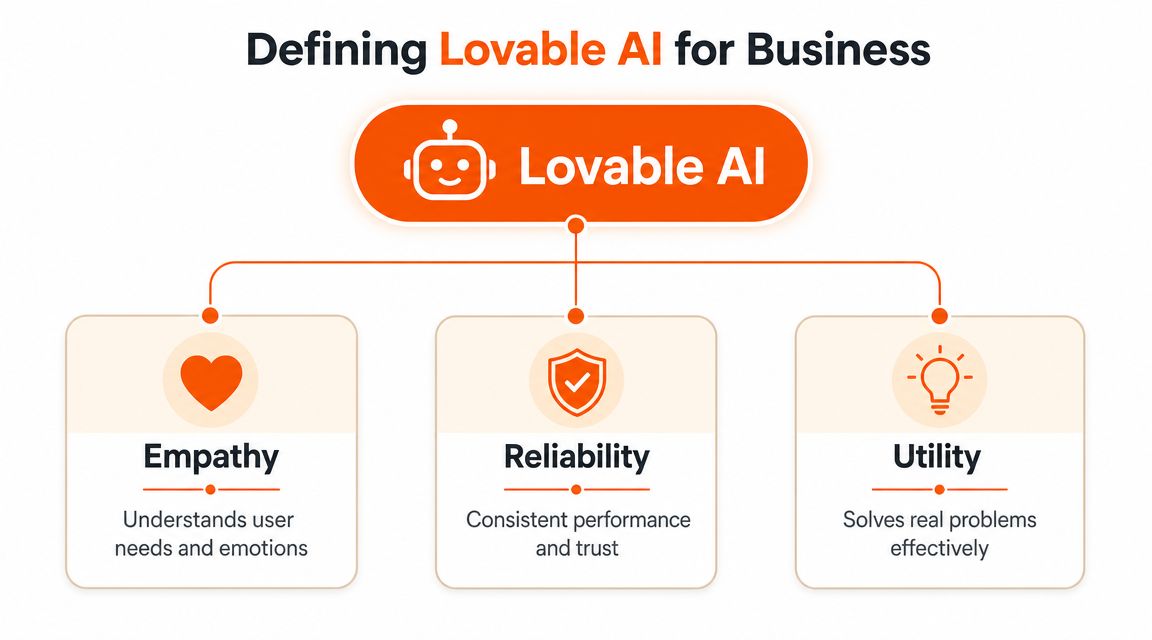
I'd define it through three business-critical qualities.
- Proactive helpfulness. The system doesn't wait for a perfect prompt. It sees what the user is trying to do and removes friction before the user gets stuck.
- Genuine personality. The product has a consistent voice and interaction style. Not gimmicks. Not fake charm. Just enough character to feel coherent and trustworthy.
- Intelligent personalisation. The experience adapts based on role, context, history, and likely next actions. It doesn't dump the same response on every user.
Many AI products fail. They possess output capability, but lack a point of view on experience design.
Functional AI vs Lovable AI
| Attribute | Functional AI (The Vending Machine) | Lovable AI (The Expert Colleague) |
|---|---|---|
| User interaction | Waits for a command | Anticipates likely intent |
| Tone | Generic and interchangeable | Consistent, clear, and product-specific |
| Context use | Limited to the current prompt | Uses recent activity and workflow context |
| Help style | Answers questions | Guides progress |
| Personalisation | Same experience for most users | Adapts to user role and behaviour |
| Trust | Often opaque | Explains actions and sets expectations |
| Business effect | Solves isolated tasks | Builds habit, confidence, and loyalty |
Practical rule: If your AI can be removed and replaced with a basic chatbot without changing retention, it isn't lovable. It's just functional.
Why this matters in execution
This isn't abstract. It affects roadmap decisions.
If you're building with tools such as Lovable, the platform itself is closer to an AI-assisted software engineering layer than a simple no-code builder. Its documentation describes it as a full-stack AI development platform that generates editable web applications from natural-language prompts, including frontend, backend, database, authentication, integrations, and deployable code, with GitHub sync built into the workflow through Lovable's platform introduction.
That matters because lovable experiences don't come from UI copy alone. They come from orchestration across product logic, data, backend behaviour, and delivery quality. Teams exploring AI-driven product development approaches need to think at that level from day one.
The Unmistakable Business Value of Lovable AI
Founders often frame Lovable AI as a UX upgrade. That undersells it. This is a commercial lever.
When your product becomes easier to trust, easier to use, and more effective in the moments that matter, users stay longer, expand usage faster, and recommend it more confidently. You don't need inflated claims to see the logic. Better guidance reduces confusion. Better context reduces wasted effort. Better product fit improves retention.
Early market momentum around Lovable shows why this category deserves attention. The company was founded in 2023, reached a $1.8 billion valuation, and reported crossing $100 million in ARR by mid-2025, with an industry summary saying it was nearing 8 million users and building about 100,000 products per day by late 2025. The same summary reports a $200 million Series A and $228 million in total funding, which helps explain how quickly it moved into mainstream app building for prototypes and internal tools, as outlined in this Lovable growth summary.
Where the value shows up first
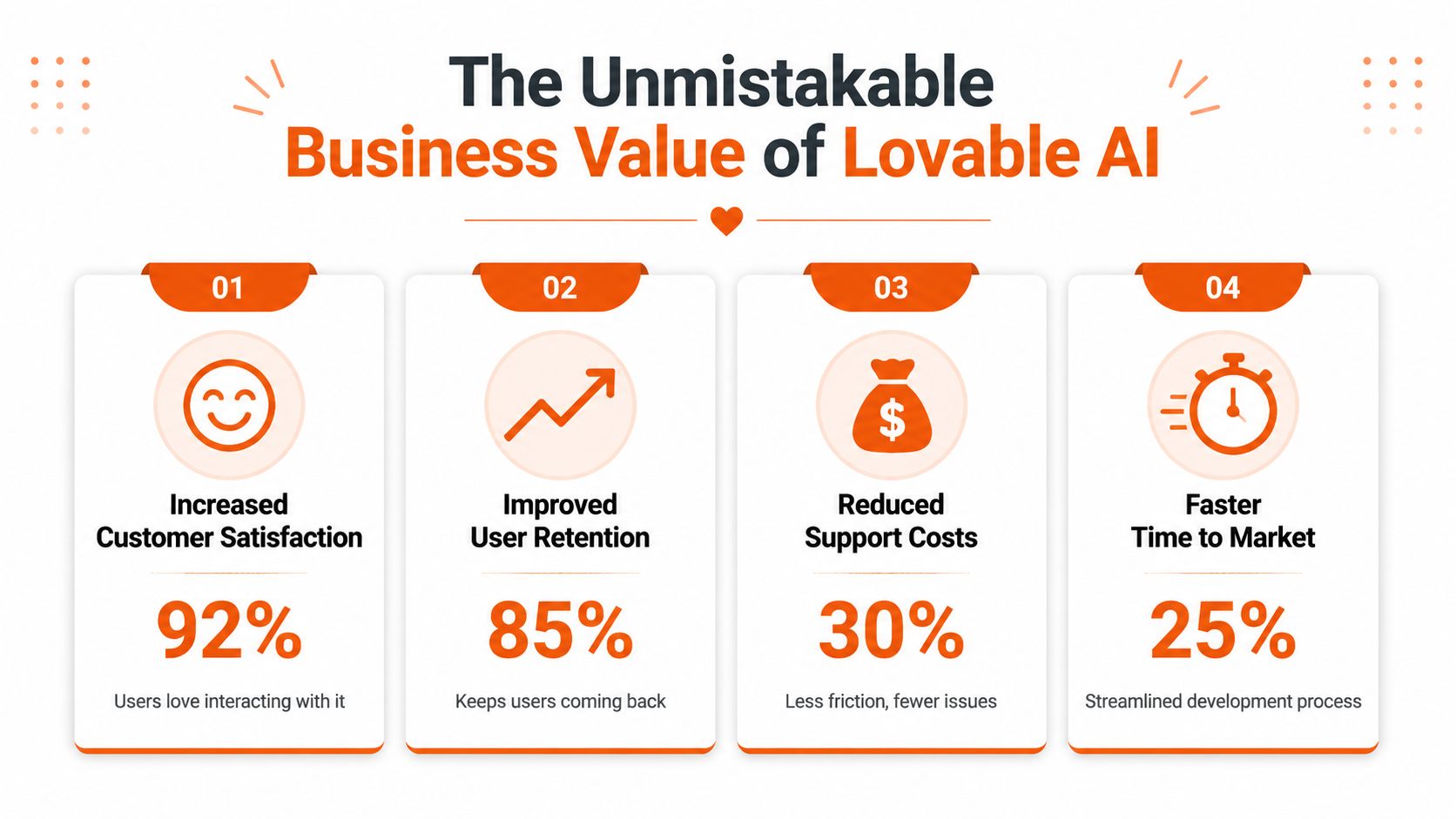
If you're deciding whether this belongs in your roadmap, look at four business outcomes.
- Retention gets stronger when users feel momentum instead of friction. A product that suggests the next step, fills in the blanks, or spots likely errors keeps people moving.
- Expansion becomes easier when the product helps users discover more advanced workflows naturally. Power users don't need to dig through documentation.
- Support load drops when the AI resolves uncertainty in context. Fewer “how do I do this?” tickets. More self-serve completion.
- Brand advocacy improves when the product feels unusually competent. Users talk about products that save them effort.
A founder should care because these aren't vanity improvements. They shape revenue durability.
Why functional parity no longer protects you
Here's the uncomfortable truth. Most SaaS categories are heading towards functional sameness. Buyers will still compare features, but the long-term winner often earns loyalty through quality of interaction and speed of progress.
That's why a lovable experience matters more than another checkbox on the pricing page.
For a quick visual perspective on the commercial case, this explainer is useful:
What to measure if you're serious
Don't measure Lovable AI by whether users say it's “cool”. Measure whether it changes behaviour.
Track things like:
- Activation quality. Are users reaching meaningful outcomes earlier?
- Repeat usage. Are they coming back because the product is helping them think less and achieve more?
- Support deflection. Are common blockers getting resolved inside the workflow?
- Customer advocacy. Are users recommending the product because it feels better, not just cheaper?
If your retention strategy still lives mostly in lifecycle emails and discount offers, you're too late in the funnel. The stronger move is building retention directly into product behaviour. This is the point where customer retention strategy in SaaS should connect with product design, not sit in a separate playbook.
Core Principles for Designing Lovable AI Experiences
A frequent pitfall is to overbuild the model and underdesign the behaviour.
Lovable AI doesn't come from adding more intelligence in the abstract. It comes from making the right interaction choices repeatedly. If the product is proactive in the wrong moment, users find it annoying. If it has personality without competence, users stop trusting it. If it personalises too aggressively, users get uneasy.
Use these principles as a design filter.
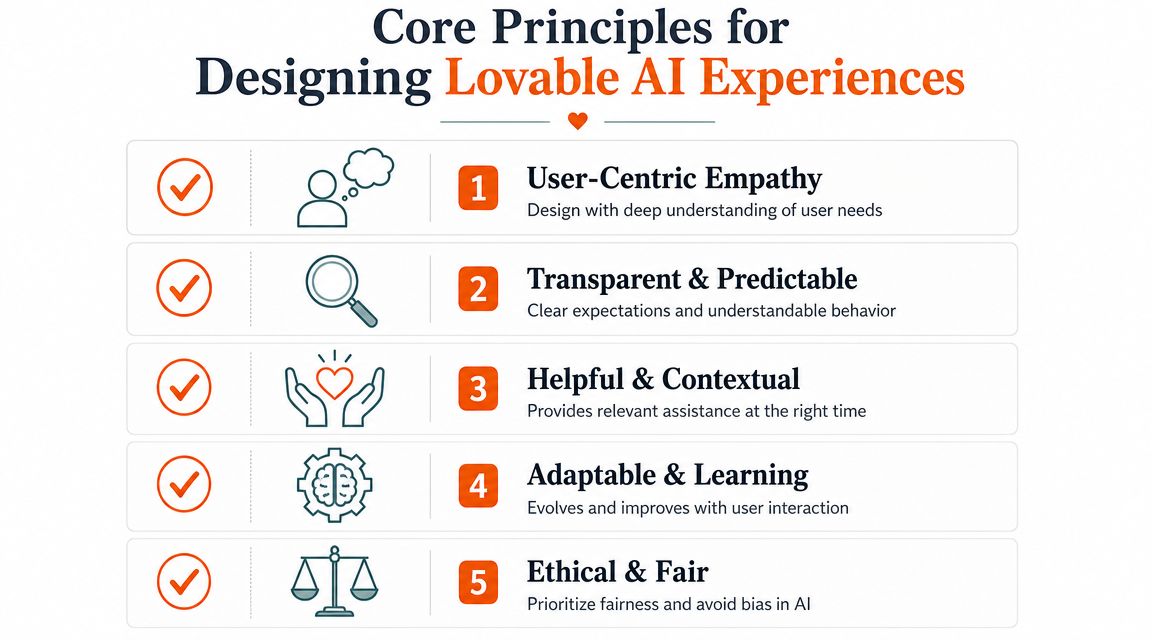
Anticipate needs, don't just react
Reactive AI is table stakes. Lovable AI earns attention by reducing the need to ask.
Do this: prompt based on context. If a user has imported data, offer to map fields, clean duplicates, or generate a summary.
Not that: show a static “How can I help?” box and wait.
The difference is simple. One saves effort. The other creates another decision.
Add personality, not performance
Most product teams get this wrong by pushing too far. They write the assistant like a stand-up comic or a lifestyle brand. It feels forced.
- Do this: create a clear voice. Calm, competent, concise. Match the stakes of the product.
- Not that: use jokes, slang, or artificial enthusiasm in every interaction.
- Do this: make the personality visible in wording, timing, and restraint.
- Not that: treat personality as a layer of decorative copy.
If the AI sounds clever but slows the user down, it's not lovable. It's indulgent.
Earn trust through transparency
Trust is a product behaviour, not a brand statement.
Users need to know what the AI is doing, why it suggested something, and what data it used. That matters even more for SaaS products handling commercial or personal data.
A useful rule is to explain actions at the point of impact. If the system drafts an email, tell the user it used prior campaign patterns. If it recommends a workflow, reference the signals that triggered the suggestion.
| Principle | Do this | Not that |
|---|---|---|
| Transparency | Explain recommendations in plain language | Hide logic behind generic confidence |
| Control | Let users edit, reject, or undo | Force automated changes without review |
| Feedback | Capture whether help was useful | Assume silence means success |
Learn continuously, but with discipline
Adaptive systems should improve. That doesn't mean every user interaction should rewrite the experience on the fly.
Use structured feedback loops. Track where users accept suggestions, where they override them, and where they drop off. Then tune the experience intentionally.
- Good pattern: review repeated failure points, then update prompts, rules, and interface logic.
- Bad pattern: keep adding model complexity because output quality feels inconsistent.
Design for real users, not ideal demos
A lovable demo often collapses in production because it was built around a clean path and a perfect prompt. Real users are distracted, rushed, sceptical, and inconsistent.
Design for that reality:
- Interruptions happen. Save progress and recover context.
- Skill levels vary. Give novices guidance without slowing experts.
- Errors will occur. Make correction painless and obvious.
The best Lovable AI experiences feel smooth because the team planned for messy behaviour, not because the AI looked impressive in a product review.
From Concept to Code Implementation Patterns
A lovable experience needs architecture behind it. Not exotic architecture. Purposeful architecture.
Founders often lose momentum here because the vision sounds clear in a product workshop but vague in engineering planning. “Make it proactive” is not a technical requirement. “Detect import friction and trigger an assistive mapping workflow” is.
That's the translation layer your team needs.

Pattern one builds contextual awareness
The first implementation pattern is a context engine.
This layer collects product signals such as recent actions, role, account state, workflow stage, and prior preferences. Then it turns those signals into usable context for the AI layer. Without this, your assistant is effectively stateless and generic.
A practical stack might combine application events, user profile data, embeddings for relevant documents, and retrieval logic so the system can respond with current, situation-aware output.
What this enables
- Smarter prompting based on actual user behaviour
- Better recommendations because the model sees workflow context
- Lower friction because the system remembers what matters
Pattern two triggers proactive nudges
Proactivity should never mean random interruption.
Use a nudge framework with clear trigger conditions, ranking rules, and suppression logic. In plain terms, the system should know when to help, what to suggest, and when to stay quiet.
For example:
- If a user repeats the same failed action, offer corrective guidance
- If an admin reaches a setup milestone, suggest the next high-value step
- If a power user starts an advanced workflow, surface shortcuts or automation options
Build intervention rules before you polish the language. Timing determines whether help feels useful or intrusive.
Pattern three adapts the interface
Lovable AI shouldn't live only in a chat window.
The strongest products use adaptive interface patterns. They change what the user sees based on context, familiarity, and likely intent. That might mean guided setup for a first-time admin, condensed controls for an expert, or dynamic summaries instead of raw tables for an executive user.
Engineering and product judgment must remain tightly connected. A team can use LLMs, vector databases, and retrieval-augmented generation, but those components only matter if they support a clearer, faster user path.
Pattern four keeps governance in the loop
This part gets ignored far too often, especially when teams move from prototype excitement to production pressure.
Lovable's own product milestone in 2025 introduced Lovable Cloud and Lovable AI, adding a built-in backend and AI features for full-stack app creation by prompting alone. Its security documentation also states that the platform runs four automated security scanners for RLS analysis, database security, code security, and dependency audit, with checks triggered when relevant files change or before publishing, according to Lovable Cloud product details.
That's useful because it signals operational guardrails. It does not remove the need for your own architecture decisions, review processes, and release governance. If the product is heading towards customer-facing production, your implementation pattern has to include code review, observability, access control, and rollback discipline.
Common Pitfalls and How to Avoid Them
More AI doesn't automatically make a product better. Sometimes it just makes the product louder.
The teams that get Lovable AI wrong usually fail in predictable ways. They confuse activity with value, personality with trust, and speed with readiness. If you want the upside without the mess, you need to challenge your own enthusiasm early.
The creepy assistant problem
An AI that sounds too human, too familiar, or too eager can trigger discomfort fast. Users don't want a product acting like a close friend when they're trying to finish a finance task or review customer data.
Avoid that by setting a narrow interaction style. Keep the voice competent, calm, and useful. Personality should support clarity, not compete with it.
The overreach problem
Personalisation becomes a liability when users can't tell why the product knows something or how far the system is going with their data.
That concern becomes more serious for UK-facing SaaS. Neutral coverage of Lovable points out limitations around security, scalability, and the need to move into professional engineering before production use. That matters because the ICO's guidance on AI and data protection expects organisations to assess lawful basis, transparency, security, and accountability when AI systems process personal data, as discussed in this analysis of Lovable AI's limitations and governance implications.
The demo trap
Founders love a fast prototype. Investors love a sharp demo. Teams start believing the first working version is closer to market-ready than it is.
It usually isn't.
- Prototype success doesn't equal production readiness. The handoff from generated product to governed software is where risk shows up.
- Fast output can hide weak architecture. If no one owns the transition plan, technical debt arrives early.
- Compliance doesn't appear by accident. Someone has to define controls, review flows, and decision accountability.
The highest-risk moment is right after the demo works. That's when teams start skipping the hard questions.
The fix is disciplined ownership
Use a simple filter before shipping any AI feature.
- Does it improve the core job to be done
- Can the user understand and control it
- Can the team support it under real production conditions
If the answer to any of those is no, pause. Lovable AI works when it sharpens product value. It fails when it becomes a distraction wrapped in novelty.
Build Your Lovable AI with a Proactive Partner
Lovable AI isn't a side experiment. It's a product and delivery challenge that cuts across UX, data, engineering, governance, and commercial strategy.
That's why so many teams stall after the initial burst of excitement. They can generate prototypes quickly, but they can't reliably turn those prototypes into durable product advantage. The gap isn't usually talent in the abstract. It's ownership.
What strong delivery looks like
You need a team that can make hard calls early.
- Product judgement first. The team should know which AI moments improve retention and which ones just add noise.
- Engineering discipline throughout. Generated output still needs architecture, review, security thinking, and maintainable workflows.
- Operational urgency. If the market window is open, delays cost more than code. The team has to move with energy and control at the same time.
That combination is rare. Plenty of vendors can build features. Fewer can help a founder decide what should exist, what shouldn't, and how to turn speed into a measurable business edge.
Why delivery partner choice matters
A passive delivery partner will wait for tickets. That's the wrong model for AI-led product work.
You need a partner that spots risk before it becomes rework, challenges weak assumptions, and treats business outcomes as part of the build. That's the only way lovable experiences make it from concept to production without collapsing under ambiguity.
A strong methodology matters here. Extreme Ownership, proactive communication, and fast decision loops aren't cultural extras. They are delivery requirements when the roadmap includes AI, user trust, and production risk in the same stream of work.
The standard to hold your partner to
Ask brutally direct questions.
| Question | What a weak partner does | What a strong partner does |
|---|---|---|
| How do we prioritise lovable AI features | Builds whatever is requested | Connects features to retention, activation, and expansion |
| How do we move from prototype to production | Focuses on velocity only | Plans architecture, governance, and handoff early |
| How do we reduce delivery risk | Reacts after issues appear | Surfaces trade-offs and blockers before they slow you down |
If you want lovable AI to become a real moat, not a flashy layer on top of a standard product, choose a team that works like a strategic operator. That means product-first thinking, senior engineering judgement, and the kind of high-energy execution that closes the gap between idea and business result.
If you're ready to turn Lovable AI from a concept into a product advantage, talk to Rite NRG. Their team combines senior engineering, product-first delivery, and the #riteway approach to help SaaS companies ship faster, reduce execution risk, and build products users don't just use, but prefer.