Most advice on how to build an MVP fast is wrong.
It treats speed like a coding contest. Ship something thin, cut a few corners, hope users forgive the gaps, and call it lean. That's how teams burn runway, confuse investors, and end up rebuilding the product they just rushed out.
Fast doesn't mean careless. It means decisive.
When we talk about building an MVP fast, we're talking about compressing learning, not just development. The advantage isn't getting code into production a few weeks earlier. It's getting proof earlier. Proof that users care. Proof that the problem is real. Proof that the business has a credible path forward. That's what changes funding conversations, roadmap decisions, and hiring plans.
That's the heart of the #riteway methodology. We run delivery with Extreme Ownership, high energy, and zero passenger mentality. The team doesn't sit back waiting for requirements to appear. They challenge weak assumptions, tighten scope, flag risks early, and keep every decision tied to a business outcome. That's the difference between a supplier and a strategic delivery partner.
Why Building an MVP Fast is Your Ultimate Competitive Edge
The speed versus quality debate is lazy thinking.
Strong teams don't choose between moving quickly and building well. They choose what matters now, protect what must not break, and stop wasting time on work that doesn't validate the business. That's how you build an MVP fast without creating chaos a month later.
A 2023 UK study found that companies shipping an MVP within 4–6 months were 2.3 times more likely to secure seed or Series A funding within 18 months (SDH Global coverage of the study). Investors aren't rewarding speed for its own sake. They're responding to evidence. A shipped product creates a sharper conversation than a polished deck ever will.
Speed creates leverage
A fast MVP changes four business outcomes at once:
- Customer learning moves earlier: you stop debating assumptions in meetings and start seeing behaviour in the product.
- Fundraising gets easier: investors can assess traction, clarity of problem, and team execution instead of betting on theory alone.
- Roadmaps get cleaner: real feedback kills weak ideas before they become expensive commitments.
- Teams stay aligned: everyone can point to one released experience instead of ten competing interpretations of the vision.
That's why we're opinionated about delivery. The fastest route usually isn't “build more people into the project” or “pick the fanciest stack”. It's narrower scope, clearer ownership, and faster decisions.
Practical rule: If a feature doesn't help you validate a business-critical assumption, it doesn't belong in the MVP.
Extreme Ownership beats fragmented delivery
Most MVPs slow down because no one owns the outcome end to end. Product writes a wish list. Engineering interprets it. Design tries to rescue the gaps. Leadership asks for extras. Then everyone acts surprised when the timeline slips.
That model fails because accountability is diluted.
The #riteway approach works differently. We expect the team to own trade-offs, not just tasks. That means asking hard questions early:
| Decision area | Weak delivery behaviour | #riteway behaviour |
|---|---|---|
| Scope | Accept everything | Cut to one core journey |
| Risk | Surface issues late | Raise blockers immediately |
| Feedback | Treat it as post-launch work | Build feedback loops from day one |
| Quality | Polish everything equally | Protect the parts that affect trust and learning |
A list of skills won't save a drifting MVP. Ownership will.
The real race is learning velocity
Your competitors aren't dangerous because they code faster. They're dangerous if they learn faster. If they get to user truth before you do, they'll shape the category while you're still refining backlog tickets.
So yes, build your MVP fast. But do it with discipline, commercial intent, and a team that treats delivery as a business system, not a sequence of isolated tasks.
The Discovery Blueprint Find Your Riskiest Assumptions First
The fastest teams slow down before they build.
That sounds contradictory until you've watched a team spend weeks building a feature that was solving the wrong problem. Discovery isn't a ceremony. It's a pressure test. If you want to build an MVP fast, you need to identify the assumptions that can kill the product and attack those first.
Start with the assumption map
Every MVP sits on three kinds of risk:
- Desirability. Do users want this?
- Viability. Will the business model work?
- Feasibility. Can the team deliver it easily enough and reliably enough?
If you don't separate those, everything feels equally important. It isn't.
Take a B2B SaaS workflow product. Founders often obsess over dashboard design, permissions, integrations, and reporting. However, the actual risk is usually smaller and sharper. Will a target user complete the core workflow often enough for the product to become part of their routine? That's the assumption worth testing first.
A quick round of focused interviews, lightweight prototypes, and direct behavioural questions usually tells you more than another sprint of speculative build work. If you need a practical starting point, these user research methods for early product discovery are a good way to structure that effort without turning discovery into theatre.
Turn ideas into kill-or-prove hypotheses
A vague statement like “users need better visibility” is useless. A decision-ready hypothesis is concrete: “Operations managers will return weekly to review a single exceptions queue because it saves them manual follow-up.”
That gives you something testable.
Use this filter:
- If this assumption is false, does the MVP fail? If yes, test it now.
- Can we test it without building the full product? If yes, don't build yet.
- Will the result change scope or positioning? If no, it's not urgent.
Teams lose months because they test preferences when they should be testing commitment.
Run cheap experiments before expensive delivery
You don't need a fully built platform to validate an MVP direction. You need evidence that the core interaction matters. That can come from clickable prototypes, manual service fulfilment, concierge workflows, landing pages tied to outreach, or even a simple internal tool used with a handful of design partners.
A good discovery sprint produces three outputs:
- A single core problem statement that the whole team can repeat.
- A ranked list of assumptions by business risk.
- A testable MVP hypothesis that defines what must be true after launch.
That's how you get speed with control. You stop treating discovery as pre-work and start using it as a scope weapon.
Ruthless Prioritisation Define Your Must Have Scope
Most MVPs don't fail because teams build too little. They fail because teams refuse to stop adding.
Founders call it ambition. Stakeholders call it future-proofing. Product teams call it flexibility. In practice, it's scope creep wearing a smarter outfit.
A better approach is brutal clarity. The MVP should do one meaningful thing well enough to trigger learning, trust, or commercial movement. If it tries to be a product suite on day one, it will almost always arrive late and muddy.
Use MoSCoW for the cut, RICE for the argument
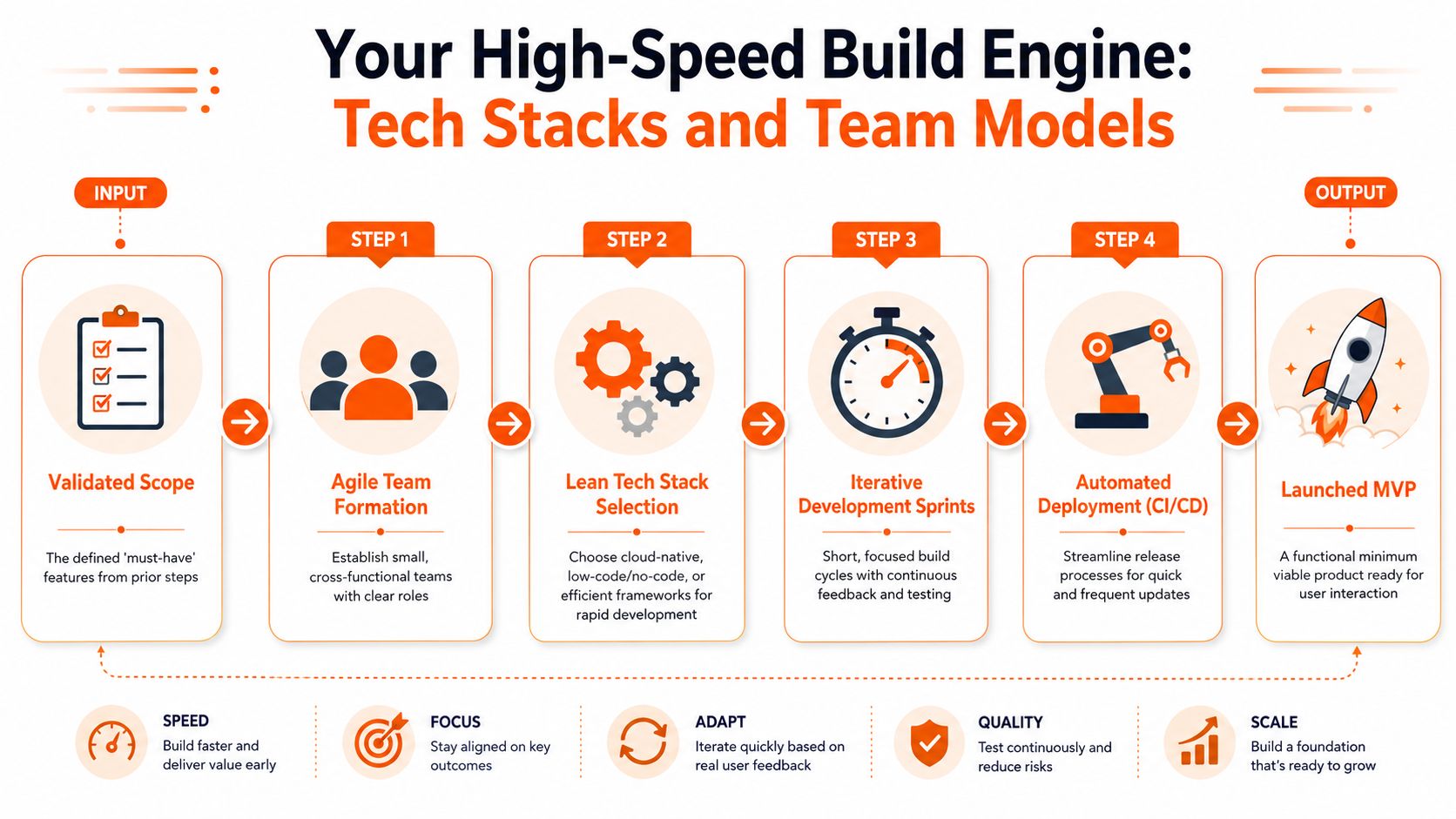
MoSCoW is useful because it forces a hard conversation. Must-have, should-have, could-have, won't-have. The mistake is using it as a labelling exercise after everyone has already fallen in love with the backlog.
RICE helps earlier. Reach, impact, confidence, effort. It gives you a way to challenge emotional requests with business logic. Used together, they create a disciplined decision loop.
A practical flow looks like this:
| Step | What to ask | What happens next |
|---|---|---|
| RICE screen | Does this feature move the core metric with enough confidence? | Low-value items drop out early |
| MoSCoW sort | Is this essential for first release? | Only genuine must-haves stay in scope |
| Journey check | Can a user complete the one critical path end to end? | Gaps become visible fast |
| Assumption check | Does this feature validate a core hypothesis? | Nice ideas get parked |
That's where teams usually realise they don't need five features. They need one complete user journey.
Build the one thing that proves the business
An MVP for a vertical SaaS product isn't “admin, analytics, notifications, billing, mobile support, and integrations”. It might be as narrow as “capture a request, route it correctly, and confirm completion”. If that loop works and users return, you've earned the right to expand.
Disciplined backlog control matters. A well-run product backlog should act like a filter, not a storage locker. Strong backlog management practices help teams keep decisions tied to outcomes instead of stakeholder volume.
The data backs the discipline. UK SaaS founders using a structured 6-step MVP methodology report a 40–50% reduction in wasted feature development, largely by enforcing a hard assumption-proof checklist before a single line of code is written (Mobisoft Infotech summary).
A ruthless scope test
If you're struggling to cut, use this checklist:
- Core path only: Can the user complete the main job without secondary screens or optional branches?
- Trust essentials included: Authentication, basic security, error handling, and visibility into failures are in. Decorative extras are out.
- No speculative depth: Features for future segments, imagined edge cases, or investor theatre don't make the first cut.
- Explicit won't-haves: Write down what's excluded. If you don't, it sneaks back in through meetings.
A strong MVP backlog is mostly a record of things you chose not to build yet.
The teams that build MVPs fast aren't more reckless. They're better at saying no with evidence.
Your High-Speed Build Engine Tech Stacks and Team Models
Founders waste weeks arguing about stack choices that will not matter this year, then lose months with a team model that was wrong from day one. Speed does not come from hustle. It comes from a build engine designed to produce usable software, clear evidence, and investor confidence without drama.
That is the job here.
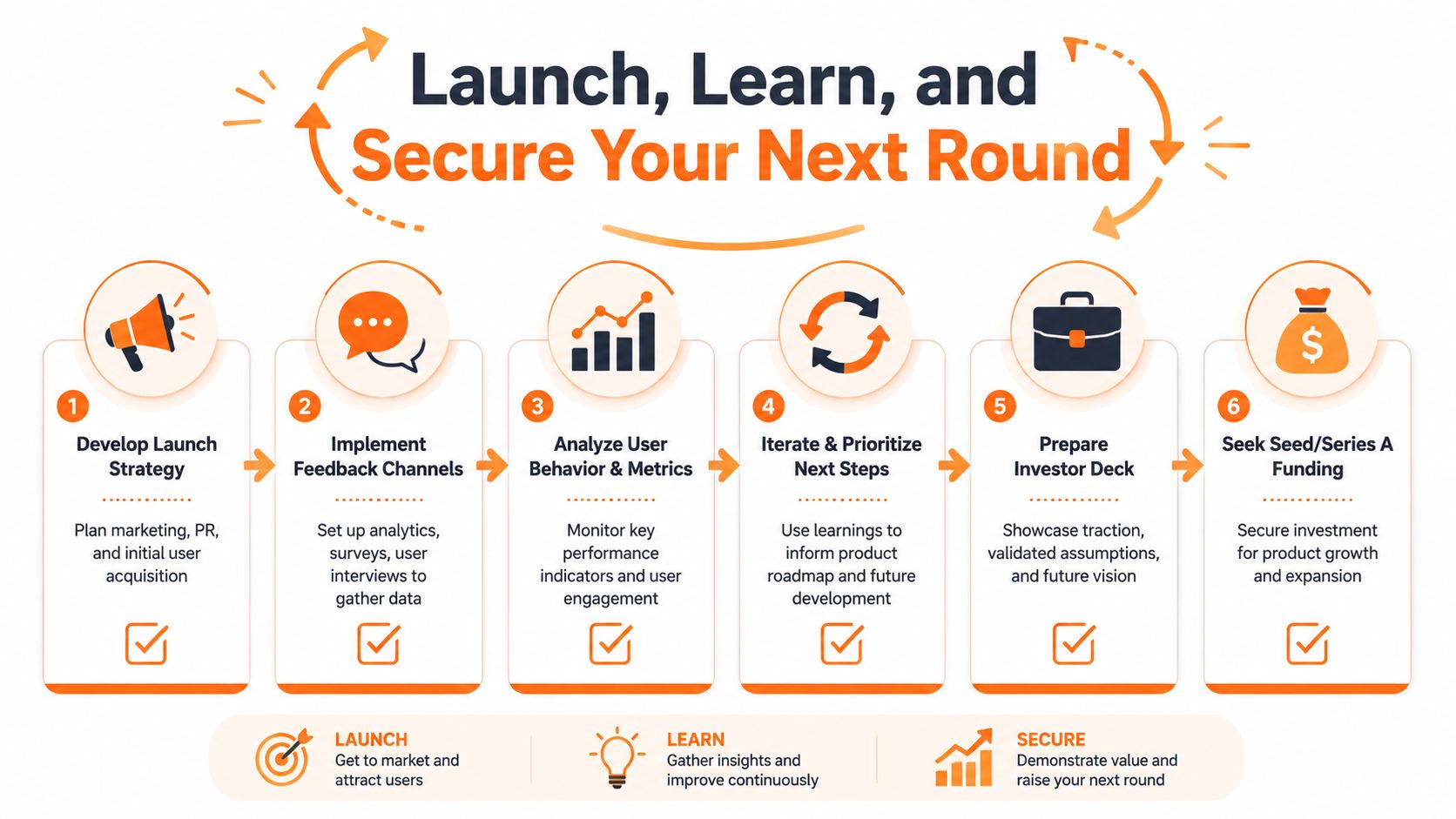
If you claim Extreme Ownership, prove it in delivery. Choose a stack your team can change quickly. Choose a team structure with clear accountability. Set up a release rhythm that turns decisions into shipped product every week. Every one of those choices affects burn, learning speed, and how credible you look when investors start asking how this company executes.
Pick a stack for speed, clarity, and proof
Early architecture should optimise for change, not technical vanity. You need a stack that lets a small team ship, fix, and extend the product without a rewrite every sprint.
For many MVPs, the right answer is boring on purpose. Managed infrastructure. Fewer moving parts. Straightforward APIs. A database model that can evolve without ceremony. If you are building a SaaS product with heavy CRUD workflows, auth, and admin logic, this guide to building SaaS products with Supabase is a strong reference for choosing managed backend tooling that keeps delivery fast.
The test is simple. Can this team release meaningful product changes in days, not weeks? Can you inspect failures quickly? Can you show investors a product that looks disciplined rather than fragile? If not, the stack is too clever for an MVP.
Compliance changes build speed more than founders expect
Plenty of MVP advice treats regulation as a cleanup task for later. In the UK, that is amateur hour.
Many MVP guides ignore UK-specific regulatory overhead like GDPR and ICO guidance. However, 29% of UK tech SMEs report compliance as their top barrier to speed-to-market (UK government survey collection). If your product touches payments, health data, employee records, student data, or any sensitive workflow, compliance shapes the build from the start. It affects what you collect, where data lives, who sees it, and how quickly an enterprise buyer will trust you.
Keep it practical:
- Collect less data: only store what the MVP needs to prove demand.
- Log the right events: support, audit, and due diligence all depend on this.
- Set access rules early: permissions added late create risk and rework.
- Keep regulated flows easy to inspect: complexity kills speed during reviews.
Fast teams do not skip compliance. They remove avoidable compliance debt before it blocks sales, due diligence, or procurement.
Team model decides whether the plan survives contact with reality
A weak team model destroys a good MVP plan. Here, strategy becomes operational truth.
Small, senior, cross-functional teams outperform larger junior-heavy groups in early-stage builds because they solve problems at the source. They challenge bad requirements, make tradeoffs fast, and keep accountability clear. That is what investor-ready execution looks like. One team. One owner. No excuses.
Here is the practical tradeoff:
| Team model | Good fit | Watch-out |
|---|---|---|
| In-house new hires | Long-term product ownership | Hiring speed can kill momentum |
| Freelance patchwork | Very narrow short-term tasks | Fragmented accountability |
| Dedicated nearshore team | Fast setup with delivery continuity | Needs strong integration and clear ownership |
| BOT model | Building a durable R&D footprint | Requires clear transition planning |
Choose based on your next business milestone, not ideology. If you need product in market quickly, a dedicated team can compress setup time. If your plan includes building a permanent engineering function after validation, BOT can create a cleaner path from MVP to owned capability.
That decision also affects fundraising. Investors do not just assess the product. They assess whether the company can keep shipping after the round. A credible operating model makes that conversation easier, especially once you start to filter and find investors who care about execution quality, not pitch theatrics.
Delivery rhythm is the engine
Ceremony does not create speed. Throughput does.
Your MVP team needs short sprints, visible priorities, CI/CD from the start, pragmatic QA, and one clear owner for every blocker. Releases should feel routine. If a minor product change needs a meeting chain, handoff maze, or executive rescue, the operating system is broken.
The best MVP teams look calm because the machine is doing its job. They ship, learn, fix, and ship again. That is how you turn a scoped product into a credible company.
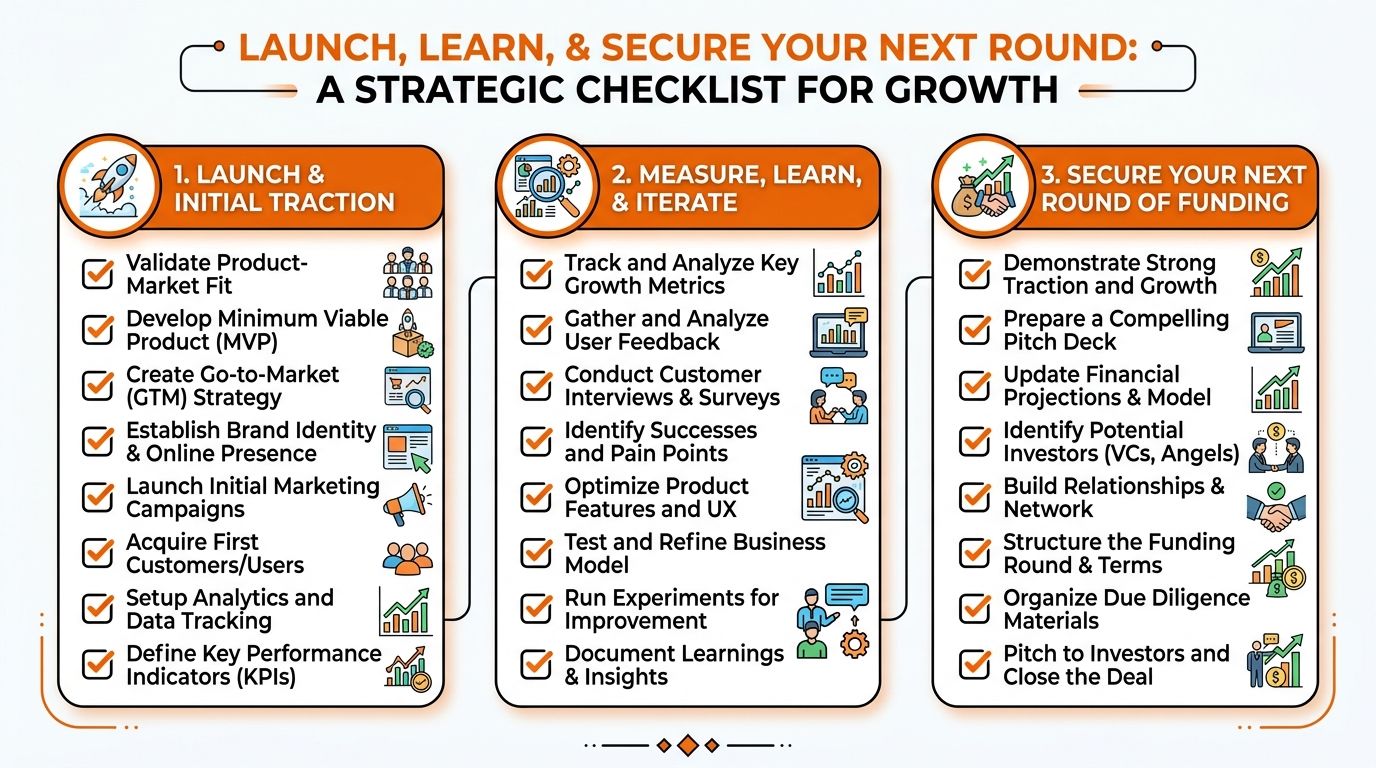
Launch Learn and Secure Your Next Round
Launch day matters less than the weeks after it.
A live MVP gives you one job. Turn product usage into evidence. Evidence for the roadmap, evidence for customers, and evidence for investors. If your team launches and then drifts into reactive bug fixing with no tight feedback loop, you haven't finished the MVP process. You've stalled it.
Track signals that prove the product is working
Investors don't need a parade of vanity metrics. They need proof that users are moving through the product in a way that supports a real business.
That usually comes down to a small set of signals:
- Activation: are users reaching the moment where the core value becomes obvious?
- Repeat usage: do they come back for the main workflow without being pushed?
- Conversion signals: are early customers willing to pay, trial, or commit time and process change?
- Retention pattern: do the right users stick, or does interest collapse after first contact?
- Feedback quality: are you hearing feature requests, or are you hearing confusion about the core value?
If you present those clearly, you sound like a company that understands its own engine.
Investor readiness is operational readiness
There's a reason speed matters after funding, not just before it. UK startup data shows that companies shipping an investor-ready MVP within 10–12 weeks of funding are 60% more likely to secure a follow-on round in the next 18 months (Beauhurst research reference). The implication is simple. Investors want to see that capital turns into product movement and market validation quickly.
An investor-ready MVP story needs to answer five things cleanly:
- What problem have you validated?
- What user behaviour proves the problem is painful enough?
- What have you learned that changed the roadmap?
- What part of the engine is repeatable?
- What does the next round enable?
That story gets stronger when fundraising is tightly targeted. If you need a practical way to filter and find investors by fit, stage, and thesis, tools like that can help founders avoid wasting time on misaligned outreach.
Launch isn't the milestone. Credible traction is.
A clean post-launch operating cadence
After release, run a simple loop every week:
- Review behaviour: look at activation, usage, and drop-off around the core workflow.
- Talk to users: not to collect polite compliments, but to identify blockers, workarounds, and moments of value.
- Cut roadmap noise: promote only the changes that strengthen the validated path.
- Refresh the investor narrative: keep proof points, risks, and next decisions current.
That cadence turns an MVP from a project into momentum.
Common Pitfalls and the #riteway Forward
Most MVP mistakes are predictable. Teams just keep making them because the pressure feels different inside the room than it does on paper.
The fix isn't another framework slide. It's stronger judgement and tighter ownership.
The polished façade
This is the team that spends too long perfecting visual detail while the business model is still unproven. The product looks confident. Underneath, nobody knows whether users care enough to return, pay, or change behaviour.
The correction is simple. Design for clarity and trust, not theatre.
Use decent UX, remove friction from the core path, and stop polishing secondary surfaces. A rough but usable workflow beats a beautiful dead end every time.
The Swiss Army knife
This one happens when every stakeholder gets a slice of the roadmap. Sales wants one thing. Ops wants another. A founder wants something “strategic”. Investors suggest an enterprise feature. Soon the MVP has five audiences and no sharp value proposition.
Fix it with one rule. One audience, one urgent problem, one primary workflow.
Use a visible won't-have list. Defend it. Revisit it only after the launch data tells you the first wedge is working.
If everything is important, your MVP has already lost shape.
The tech debt trap
Some teams hear “move fast” and translate it into “build anything that works”. Then the first real customer arrives, the app becomes fragile, releases slow down, and basic changes start breaking unrelated areas.
That's not MVP thinking. That's deferred accountability.
Protect a few core requirements from day one:
| Protect now | Why it matters |
|---|---|
| Basic observability | You can't fix what you can't see |
| Sensible security | Early trust is hard to win back |
| Reliable deployment flow | Frequent release is the whole point |
| Clean core domain boundaries | Future changes stay manageable |
Everything doesn't need to be scalable. Some things do need to be sane.
The #riteway forward
The teams that build MVPs fast and well tend to share the same habits:
- They own outcomes, not just output.
- They challenge requirements before building them.
- They cut scope without apology.
- They make evidence the centre of every roadmap decision.
- They stay commercially awake, not just technically busy.
That's the #riteway. Extreme Ownership. High energy. Proactive delivery. No passenger mentality.
If you want to build an MVP fast, stop asking how to cram more features into less time. Ask how to reach proof with the least waste, the clearest story, and the strongest execution discipline. That's how products get launched without the usual chaos. That's how teams earn investor confidence. And that's how you ship something that can grow.
If you need a delivery partner that can help shape scope, challenge assumptions, and turn MVP plans into predictable execution, talk to Rite NRG. They work with SaaS founders, product teams, and scaling companies that need senior engineering support, nearshore delivery, and a more accountable path from idea to launch.