You've got a senior engineering role open, a client milestone approaching, and a panel that keeps producing different answers about the same candidate. One interviewer rewards architectural depth, another reacts to communication style, and a third changes the bar halfway through the process. Meanwhile, the strongest people leave after the second round because your loop feels slow, improvised, or disconnected from the work they'd do.
I've seen this pattern repeatedly while hiring senior engineers for nearshore delivery teams. The fix isn't another clever brainteaser or a longer interview guide. Interviewing best practices are delivery practices. They determine who joins the team, how quickly that person contributes, whether the client trusts the team, and whether the hire stays long enough to create durable product value.
Why Your Interview Loop Is Costing You Senior Hires
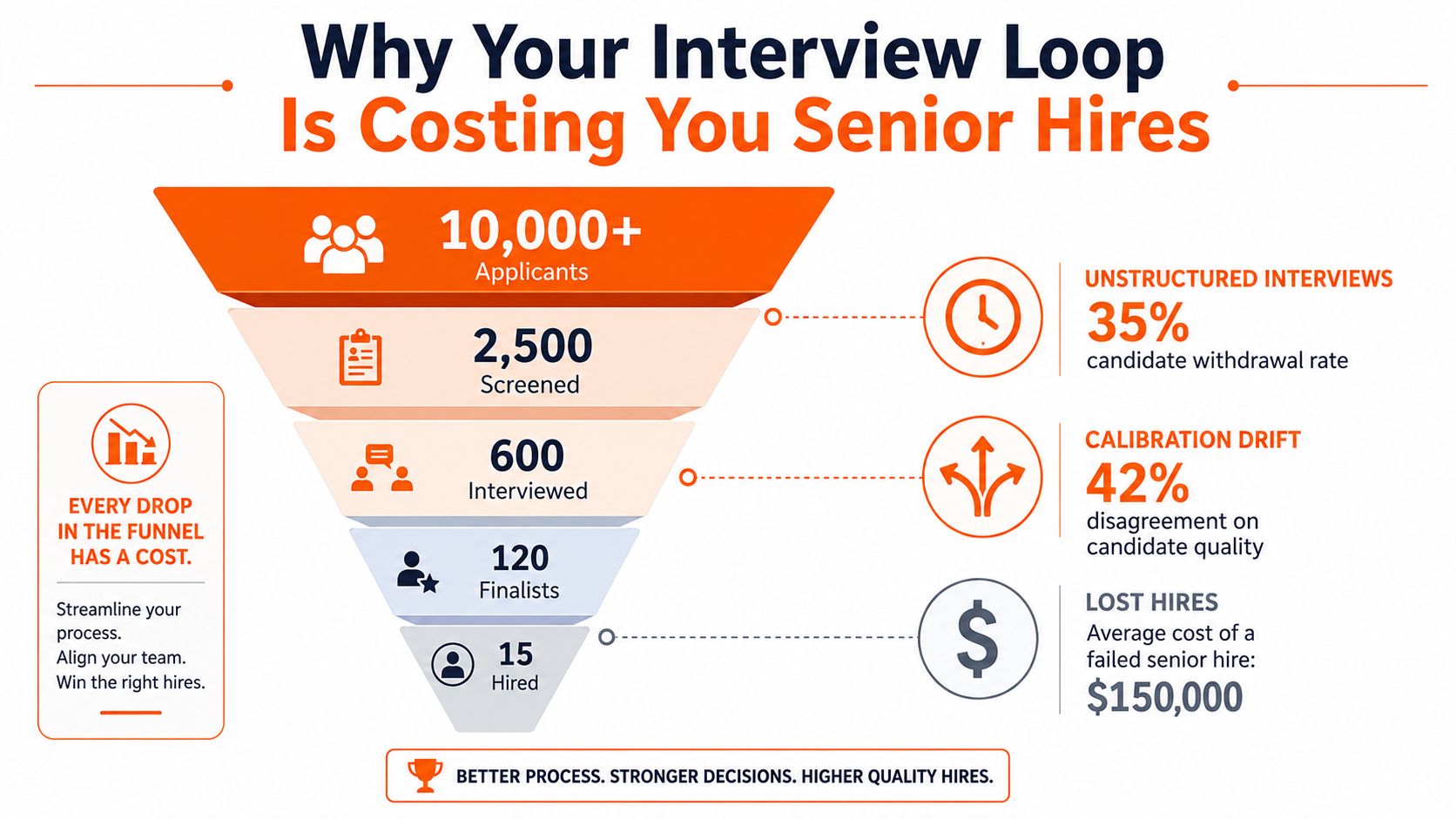
A senior engineer reaches the final round, then withdraws after another unexplained delay. The panel had different questions, no shared definition of strong, and no clear connection between the interviews and the delivery work. The candidate leaves with a poor impression, while the team loses time and capacity before anyone signs a contract.
A weak loop creates operational damage early. Hiring managers lose focus, senior interviewers lose productive hours, and delivery leaders inherit a hire whose capabilities were never tested against the engagement. Interviewing best practices are delivery practices. They shape retention, time-to-hire, client confidence, and team velocity.
The hidden delivery bill
Candidate withdrawal is the first warning sign. Senior engineers can recognise an organisation that has not decided what it needs. Repeated questions, technical exercises unrelated to the role, unexplained delays, and unprepared interviewers all communicate internal disorder. Strong candidates do not want to absorb that disorder after joining.
Calibration drift creates the second cost. One interviewer rewards technical breadth, another improvises behavioural questions, and a product leader tests commercial judgement without agreeing what strong evidence looks like. The candidate provides different signals to each person, while the panel compares impressions instead of comparable evidence.
Practical rule: If interviewers cannot explain which competency a question measures, remove the question from the loop.
The third cost appears after the hire. Someone may perform well in interviews yet struggle to move work forward in a SaaS engagement. Releases slow, escalations increase, stakeholder confidence weakens, and ramp time grows. Retention suffers when the person lacks the ownership, communication, or judgement that delivery requires.
A CTO sees the pattern when the team repeatedly hires “strong” people who need unexpected rescue. The panel approved the candidate, but delivery reveals that the person cannot make independent decisions, challenge unclear requirements, or raise risk early. That is a measurement problem, not a mysterious talent problem. The #riteway ownership mindset requires the loop to test responsibility for outcomes, including ambiguity and dependencies.
Hiring data shows why leaders should treat this as an operating issue. The CIPD's 2024 Resource and talent planning report reports that ninety per cent of organisations use some form of selection interview, while 55% use interviews based on CVs or applications, 52% use competency-based interviews, and 48% use skills-based interviews. Interviews sit at the centre of hiring decisions, so their design affects business results directly.
Candidates also need context before they enter the loop. A practical guide to how to research before an interview helps applicants understand the company, role, and engagement. That preparation gives interviewers a stronger basis for discussing real delivery conditions rather than testing memorised answers.
If your organisation already struggles to find senior technical talent, the wider engineering talent shortage makes every avoidable withdrawal more expensive. Set a clear bar, test evidence tied to delivery, and make each interviewer accountable for measuring it.
The Structured Interview Operating System
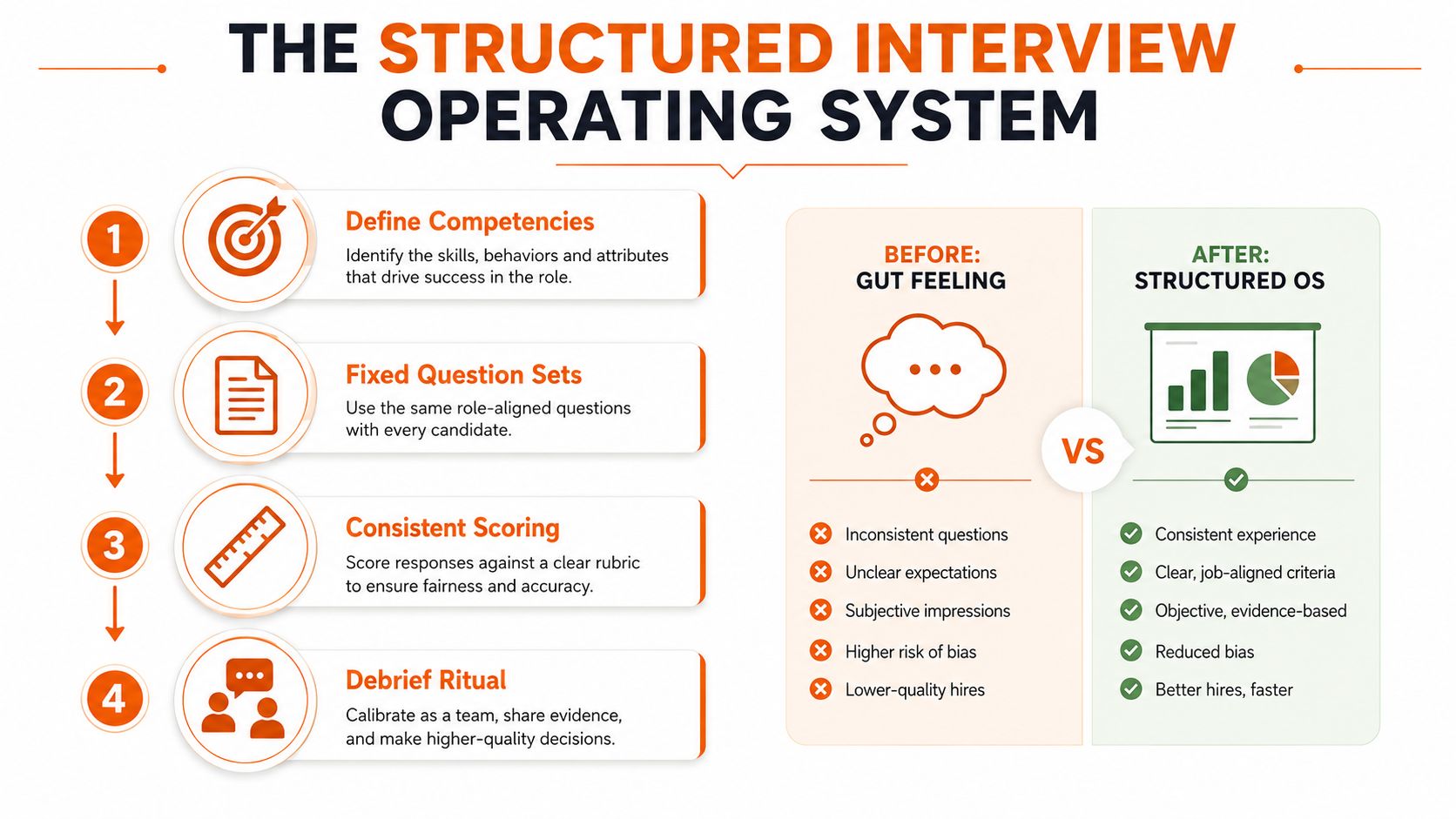
Structure is the operating system. Competencies are the data model, fixed questions are the interface, scoring is the quality control, and the debrief is the decision protocol. Remove any part and the panel falls back to instinct.
The UK government treats structured interviewing as a measurable fairness practice. Its guidance recommends tracking the proportion of hiring managers who use structured interviews, reviewing shortlisted and successful candidates by sex and other characteristics, and monitoring retention at milestones such as twelve months after starting. That approach matters because a process that isn't measured can't prove whether it is consistent, fair, or useful.
Build the loop around evidence
Start with the delivery outcomes for the role. A senior backend engineer might need to improve system reliability, reduce operational risk, and make sound trade-offs under product pressure. A product manager might need to create alignment, expose uncertainty, and protect customer value when priorities conflict.
Turn those outcomes into four to six competencies. Avoid vague labels such as “culture fit”. Use observable behaviours instead:
- Technical judgement: Explains trade-offs, identifies constraints, and chooses an approach proportionate to risk.
- Extreme Ownership: Takes responsibility for an outcome, including ambiguity, dependencies, and mistakes.
- Proactivity: Surfaces risks early and proposes a practical next action.
- Client collaboration: Makes complex decisions clear to non-technical stakeholders.
- Learning agility: Updates an approach when evidence changes.
Assign each competency to a specific interviewer. Give that interviewer a fixed question set, a follow-up guide, and a scoring rubric. Fixed doesn't mean robotic. Interviewers can probe for detail, but they shouldn't change the competency being assessed or introduce unrelated criteria.
Make debriefs disciplined
Require written scores before discussion. Otherwise, the first confident voice anchors the room and quieter interviewers adjust their views without examining the evidence. Each interviewer should provide a rating, supporting observations, unresolved concern, and recommendation.
A useful debrief asks:
- What evidence supports the score?
- Which evidence is missing?
- Is the concern about job performance or personal preference?
- What risk would this create in the first delivery cycle?
- Can the team mitigate the risk through onboarding, pairing, or clearer ownership?
Nearshore teams need this discipline because candidates and interviewers often hand work across time zones. A consistent scorecard prevents one location from inheriting an unexplained “strong yes” or “maybe” from another.
A structured loop can be assembled quickly if the hiring manager owns the first draft, a delivery leader validates the competencies, and interviewers test the questions against real work. For additional guidance on designing discovery conversations, conducting user interviews with Formbricks offers useful thinking on open questions, active listening, and avoiding leading prompts. Those habits transfer directly to candidate assessment.
Role-Specific Scorecards and Sample Questions
A scorecard should tell an interviewer what to listen for before the conversation begins. It must connect the role to business outcomes, not to the interviewer's memory of the last person who succeeded.
Use a 1 to 4 scale:
- 1, Below Bar: Evidence is absent, unclear, or materially below the role requirement.
- 2, Mixed Evidence: Some relevant experience appears, but important gaps remain.
- 3, Meets Bar: The candidate provides credible, role-relevant evidence with manageable risk.
- 4, Strong Hire: The candidate demonstrates depth, judgement, and repeatable ownership in comparable situations.
Senior backend engineer
Ask for a specific incident rather than a general philosophy. “Tell me about a time you changed a service under reliability pressure. What did you inspect first, what trade-offs did you make, and what happened afterwards?” The answer should reveal diagnostic method, risk management, communication, and accountability.
| Competency | What to Listen For | 1 (Below Bar) | 4 (Strong Hire) |
|---|---|---|---|
| System design | Clear trade-offs tied to product and operational needs | Lists technologies without explaining decisions | Connects architecture, constraints, reliability, cost, and delivery risk |
| Ownership | Personal responsibility for outcomes and follow-through | Blames dependencies or describes only assigned tasks | Shows how they identified the problem, acted, communicated, and closed the loop |
| Proactivity | Early risk detection and practical action | Waits for direction after problems emerge | Raises risks early and proposes proportionate mitigations |
| Collaboration | Clear communication with product and client stakeholders | Uses technical detail to avoid decisions | Makes trade-offs understandable and builds alignment |
Senior frontend engineer
Test the connection between user experience and engineering judgement. Ask, “Tell me about a time a frontend performance or accessibility issue threatened a product outcome. How did you prioritise the work, influence others, and verify the result?”
Listen for evidence that the candidate understands more than implementation. Strong answers connect interface decisions to customer experience, adoption, support burden, and maintainability. A candidate who can describe the technical fix but not the user or business consequence hasn't demonstrated complete delivery ownership.
Product role
Product interviews should expose how the candidate makes decisions with incomplete information. Ask, “Tell me about a time you stopped, changed, or narrowed a product initiative because the evidence didn't support the original plan.”
A strong answer includes the customer problem, competing priorities, evidence used, stakeholders affected, decision made, and learning that followed. Score the candidate on commercial judgement, customer reasoning, alignment, and decisiveness, not on whether they use the same product vocabulary as your current team.
Evidence prompt: “What did you personally decide, what changed because of it, and how did you know?”
For more examples of specific, evidence-led prompts, review these scenario interview questions for hiring. The important principle is simple: ask about a defined situation, then probe for action, trade-off, and outcome.
Bias Controls That Deliver Measurable Outcomes
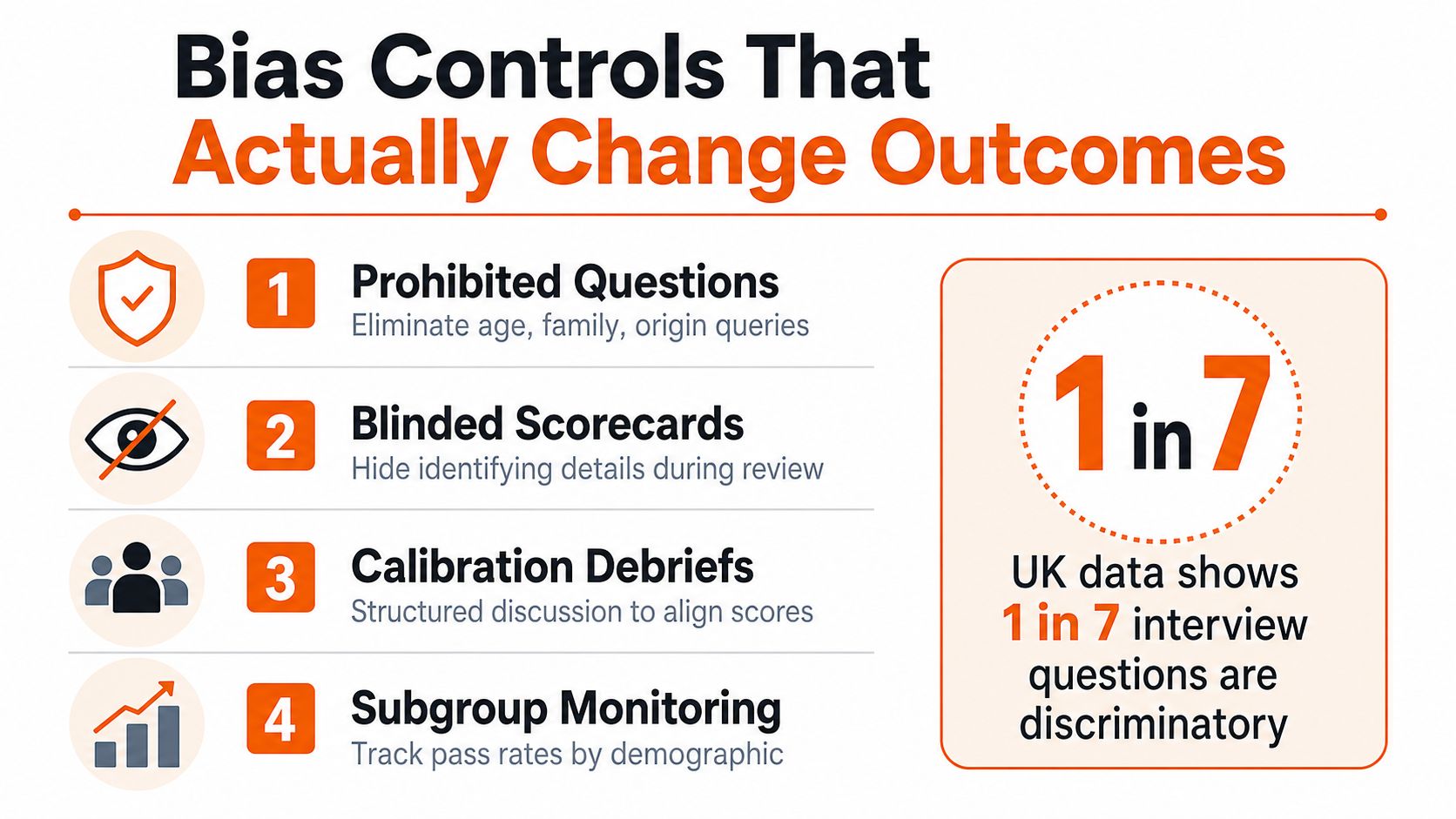
Awareness training is not a control. It can help interviewers recognise bias, but it will not stop an inappropriate question or prevent someone from favouring a familiar background. The process needs friction against bad decisions.
The UK risk is concrete. Sixty-three per cent of UK jobseekers reported facing discriminatory or biased interview questions, with age raised in 48% of reported cases, gender in 25%, and race in 23%, according to People Management's report on discriminatory interview questions. Interviewers must not seek personal information about protected characteristics or use family circumstances, origin, age, or health as an informal proxy for suitability.
Put controls into the workflow
Create a prohibited-question list with the people responsible for legal and people operations. Give interviewers compliant alternatives. Ask whether a candidate can meet the documented working requirements instead of asking about family responsibilities. Test experience and capability, and handle right-to-work checks through the correct channel instead of probing age or nationality.
Use blinded scorecards during the first review where practical. Remove unnecessary identifying details from written evidence, and require interviewers to score before seeing other feedback. This will not remove every source of bias, but it reduces the chance that prestige, familiarity, or personal resemblance controls the decision.
Training and review remain inconsistent across UK employers. The 2024 Resource and talent planning report reports that only 28% of UK employers train all interviewers on legal obligations and objective interview practice, while 18% test job-ad wording for bias and 17% check whether assessments are valid, reliable, and objective. Treat those gaps as workflow failures, not optional HR improvements.
Run this quarterly checklist:
- Question control: Review every question for job relevance and prohibited personal content.
- Interviewer readiness: Confirm that every panel member understands objective scoring before interviewing.
- Calibration: Compare evidence and ratings, not confidence, accent, charisma, or conversational similarity.
- Outcome monitoring: Review progression, offers, withdrawals, and retention by relevant subgroup where lawful and appropriate.
- Validity review: Remove exercises that do not resemble the work or produce reliable evidence.
#riteway's Extreme Ownership principle belongs here. Each interviewer owns the quality of their questions, notes, and reasoning. HR can provide governance, but delivery leaders must stop a weak control from entering the loop. A fair process protects retention, hiring speed, and team velocity because candidates receive a consistent signal about how the team operates.
Remote and Nearshore Interview Adaptations
A remote interview isn't an office interview transmitted through a camera. It's a different operating mode with different failure points.
A nearshore team once moved quickly on a senior candidate because the technical panel liked the architecture discussion. The process then exposed a problem during the collaboration round. The candidate's home setup made sustained participation difficult, and they had little experience working through written handoffs or asynchronous decisions. The issue wasn't the home environment itself. The issue was a mismatch between the role's collaboration demands and the evidence the initial panel had collected.
The structured process caught it because the team tested the actual working model. The candidate completed a short handoff exercise, explained a decision in writing, and discussed how they would raise a delivery risk when the client team was offline. The panel could then distinguish a solvable equipment issue from a deeper mismatch in communication habits.
Design for distance
Pair interviewers across relevant time zones where the role requires cross-border collaboration. If a team operates between Wrocław and London, candidates should experience the same clarity, responsiveness, and ownership expected after joining. Don't schedule a punishing sequence of calls and then claim to be assessing resilience.
Check the infrastructure without turning it into a socioeconomic test. Confirm audio, video, screen sharing, collaborative coding access, and backup communication channels. Offer reasonable alternatives when connectivity fails, and score the candidate on the competency being assessed, not on a transient technical fault.
Use asynchronous scorecard handoffs. Each interviewer submits evidence independently, with a clear competency label and delivery implication. The next interviewer reads the role context, not a leading verdict, so the candidate gets a fair chance to demonstrate the missing signal.
Test cultural fit as working behaviour
“Culture fit” is too vague to score safely. Replace it with behaviours such as:
- Clarifies ownership: Confirms who decides, who contributes, and when escalation is needed.
- Communicates early: Shares uncertainty before a missed milestone becomes a surprise.
- Works across boundaries: Documents decisions so another time zone can act without a meeting.
- Receives challenge: Responds to disagreement with evidence rather than status.
For practical guidance on hiring remote developers, focus on how candidates work when context is distributed. The interview should be the first proof that your delivery system can support that reality.
Using AI to Streamline Screening Without Breaking Trust
AI can remove administrative drag, but it can't own the hiring decision. The safe boundary is clear: use automation to organise evidence, never to replace accountable judgement.
The CIPD's 2025 briefing on interview trends notes that AI may support CV screening and interview auto-transcription, while current UK guidance increasingly discusses structured questions, consistent scoring, captions, and extra time. That creates a practical opportunity for teams to improve access and documentation, provided candidates understand how the process works.
Pilot low-risk use cases first
Start with tasks where AI supports an existing human-controlled process:
- CV parsing: Extract role-relevant experience into a standard template, then require a recruiter or hiring manager to verify it.
- Transcription: Capture the conversation so interviewers can focus on listening, but check the transcript for errors before using it as evidence.
- Evidence extraction: Highlight statements connected to defined competencies in a coding or product discussion.
- Scheduling logistics: Coordinate availability across candidates, interviewers, and time zones.
Don't ask an opaque system to decide who is employable. Don't let a chatbot conduct a senior engineering loop without human ownership. Don't treat generated summaries as facts, especially when accents, technical terminology, or context can affect transcription quality.
Use a trust checklist
Before adoption, answer five questions:
- What task does the system perform?
- What data does it process?
- Who verifies the output?
- What can the candidate ask about the process?
- What happens when the tool is wrong or unavailable?
Disclose the tools you use when they affect the candidate's experience. Offer accessible alternatives where appropriate, and make sure captions or additional time support the assessment rather than change its standard.
Rite NRG uses AI-powered processes across recruitment, delivery, and operations to automate workflows and surface risks early. That's the right model when technology compounds a structured system, while a named human remains responsible for the outcome.
For a separate perspective on conversational automation, see guidance on chatbots in recruitment. The test is not whether AI appears in the process. The test is whether candidates receive a fair, understandable assessment tied to the work.

From Offer to First 90 Days on the Delivery Team
The interview loop shouldn't end when the candidate accepts. It should hand ownership directly into delivery.
Start with an offer-to-start brief. Give the delivery lead the final scorecard, the candidate's evidence, the commitments made during interviews, and the risks that need support. Don't rewrite the person as a list of strengths. Explain how they make decisions, where they'll need context, and what kind of ownership they're ready to take.
The candidate should also receive a clear picture of the operating model. Explain how the team communicates, how decisions get documented, how risks escalate, how product and engineering share accountability, and how client feedback changes priorities. A structured interview sells the reality of the team, not an idealised employer brand.
Define success before the start date
Use the first ninety days to validate the same delivery behaviours assessed during hiring:
- Context acquisition: The new hire understands the product, architecture, users, and delivery constraints.
- Ownership transfer: They take responsibility for a defined outcome rather than waiting for a perfect task description.
- Communication quality: They make progress, uncertainty, and risk visible to the right people.
- Team contribution: They improve decisions, unblock colleagues, and strengthen the client relationship.
- Product impact: Their work connects to customer value, reliability, speed, or another agreed business outcome.
The manager should review these signals regularly and compare them with the original scorecard. If the team discovers a gap, it should ask whether onboarding failed, the role changed, or the interview produced weak evidence. That feedback improves the next loop instead of turning one person into the scapegoat.
This is the difference between a vendor and a delivery partner. A vendor fills a seat and reports activity. A partner owns the chain from assessment to integration to measurable value delivery. The interview is the first sprint of the engagement, and the candidate experience is the first demonstration of how your team will work with a client.
If your loop is slow, inconsistent, or disconnected from delivery, rebuild it around competencies, evidence, ownership, and transparent handoffs. That's how interviewing best practices become a reliable engine for retention, team velocity, and client trust.
Rite NRG advises SaaS founders, CTOs, and product leaders on technology delivery, structured nearshore hiring, and senior teams that take ownership from the first sprint. Visit Rite NRG to discuss a delivery model that connects fair interviewing with predictable product outcomes.