A projected shortage of 1.5 million engineers by 2030 should reset how every CTO, founder, and product leader thinks about hiring in the UK, according to the Royal Academy of Engineering's 2023 Engineers 2030 report cited by EIT. That's not a recruitment problem. It's an execution problem.
If you're building SaaS, modernising a platform, or trying to hit a board-level roadmap, the engineering talent shortage is already shaping your delivery risk. It decides whether your roadmap moves, whether your platform scales, and whether your best engineers spend their time building product or covering gaps.
The good news is that you don't have to accept the market as it is. The companies that win don't sit back and complain about candidate scarcity. They take ownership of delivery, redesign the talent model, and build systems that produce speed-to-market instead of excuses. That's the #riteway mindset. High energy, extreme ownership, and outcome-first thinking.
The Engineering Shortage Is a Business Emergency
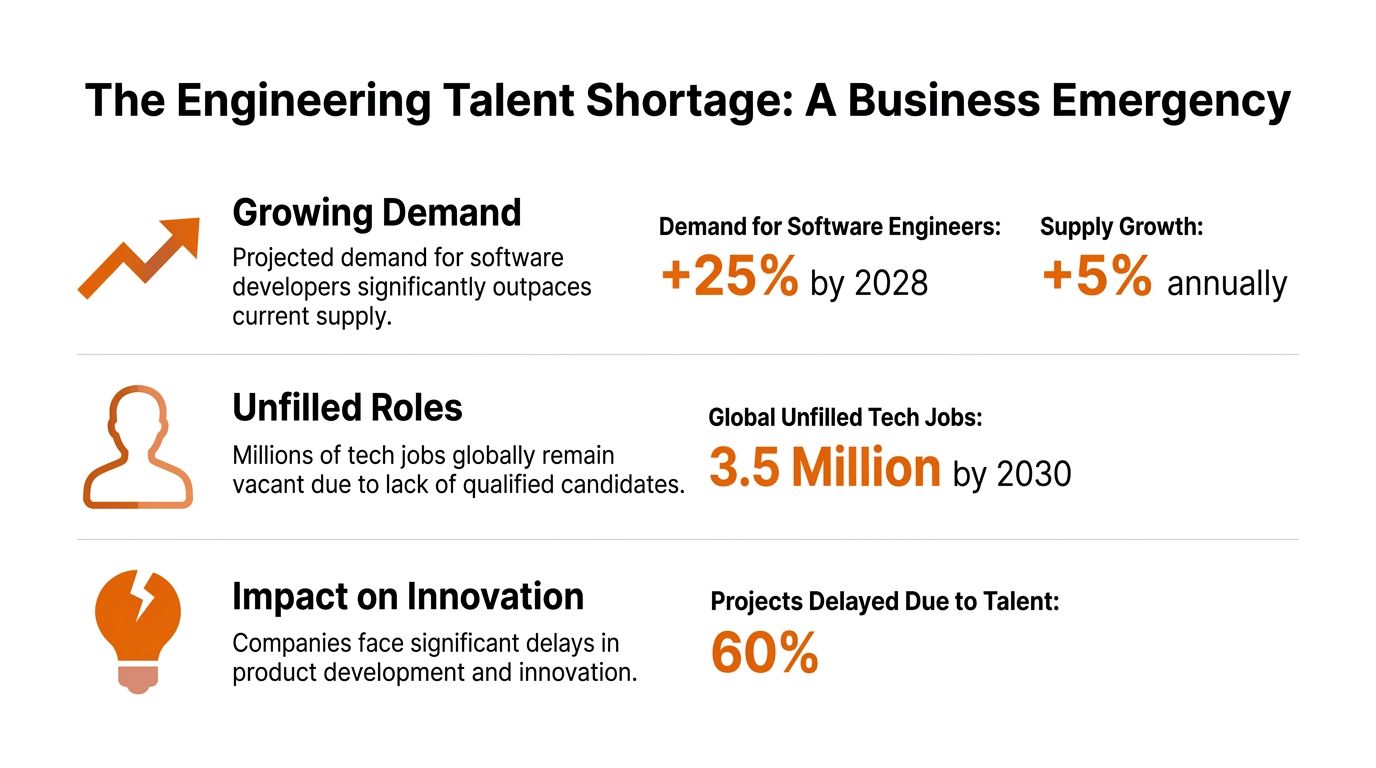
One-third of the current engineering workforce is expected to retire within the next decade. For a CTO, that is not background noise. It is a direct threat to delivery capacity, release confidence, and speed-to-market.
The immediate mistake is treating this like a standard hiring squeeze. It isn't. A structurally tight market changes how you plan roadmaps, staff teams, and protect execution. If your operating model still assumes you can open a req and solve the problem in a quarter, you are running delivery on hope.
Why the old hiring playbook breaks
Posting more roles, briefing more recruiters, and stretching compensation only works when the market has slack. Right now, it doesn't. The result is predictable. Time-to-hire expands, senior engineers get pulled into interviews instead of product work, and critical initiatives stall while leadership waits for a perfect candidate who may never arrive.
That delay hits the business fast. Product launches slip. Platform work gets deferred. Customer promises start depending on a hiring outcome you do not control.
A strong leadership team responds by changing the system, not by repeating the same hiring motions with more urgency.
Practical rule: Treat talent capacity like delivery infrastructure. Plan it, monitor it, and build redundancy before it fails.
What smart leaders do instead
The #riteway approach starts with ownership. Protect outcomes first, then choose the talent model that supports them. That means building a delivery plan that can absorb market scarcity instead of collapsing under it.
Start with three moves:
- Plan capacity against roadmap risk: Stop committing based on aspirational headcount. Tie delivery promises to real team throughput and dependency risk. A disciplined capacity planning approach keeps commercial ambition aligned with engineering reality.
- Run talent acquisition like an operating function: Measure funnel speed, conversion quality, and hiring manager responsiveness. This resource on talent acquisition roles and KPIs is useful because it frames hiring as a managed system, not an ad hoc support task.
- Expand beyond direct hiring: Nearshore teams, Build-Operate-Transfer models, and internal capability building give you more control over delivery than a domestic hiring strategy on its own.
This is the shift that matters. While other firms describe the shortage, strong operators redesign execution around it. That is how you protect speed-to-market, keep the roadmap moving, and turn a constrained talent market into an advantage.
The Real Cost of the Talent Gap for SaaS Teams
For a SaaS company, one missing senior engineer can delay a release, stall a key integration, and pull leadership out of strategy into staffing. That is why the talent gap hits product businesses harder than slower-moving enterprises.
Smaller firms carry the highest exposure. The 2025 Engineers 2030 report points to a chronic annual shortfall of engineers, and Energi People's engineering talent market update highlights how sharply that pressure lands on SMEs. If you run a scale-up, the market is not inconvenient. It is actively working against your delivery plan.

Where SaaS teams pay first
The first hit is usually speed-to-market.
Product teams start resequencing work around who is available, not what creates the most customer value. Important features slip behind lower-impact tasks. Integrations wait. Technical debt stays in the queue because the people who should resolve it are covering delivery gaps elsewhere.
Quality follows. Teams under pressure make trade-offs that feel reasonable in the moment and expensive a quarter later. They cut refactoring time, reduce test depth, and postpone platform hardening. You still ship. You just ship with more operational drag and less room for scale.
For SaaS companies, the pattern usually looks like this:
| Pressure point | Business impact |
|---|---|
| Roadmap execution | Product plans bend around missing capability instead of revenue priorities |
| Platform quality | Short-term workarounds stay in production longer and increase maintenance cost |
| Leadership focus | CTOs spend cycles filling seats instead of improving architecture, process, and delivery |
| Team health | Senior engineers absorb dependency risk, context switching, and support load |
| Commercial timing | Launches miss market windows and reduce the return on product investment |
Why smaller SaaS firms lose faster
SMEs do not just have a harder time hiring. They have less margin for error once a role stays open.
A larger enterprise can spread delivery risk across multiple teams, vendors, and budget buffers. A scale-up often has one squad carrying an entire product stream. If one critical hire slips, the effect is immediate. Roadmap confidence drops. Decision-making slows down. A few senior people become permanent bottlenecks.
That creates two costs at once:
- Visible cost: open vacancies, recruiter spend, delayed milestones, and management distraction.
- Hidden cost: overdependence on key individuals, slower execution, and a product organisation that starts reacting instead of leading.
If hiring delays are changing what your team can ship this quarter, you are not dealing with a recruiting issue. You are dealing with an operating model issue.
Treat the gap like a delivery problem
This is the point many leadership teams miss. Headcount is not the goal. Delivery capacity is the goal.
That shift matters because it changes the questions you ask. Which roadmap outcomes are exposed if a role stays open for 90 days? What work needs deep product context, and what work can an integrated nearshore team own now? Where are you relying on individual heroics instead of a system that can scale?
The #riteway approach starts there. Stop describing the shortage and start designing around it. High-performing SaaS leaders use nearshore capacity, Build-Operate-Transfer structures, and targeted capability building to protect speed-to-market and keep ownership of outcomes. That is how you turn a hiring constraint into a delivery advantage.
Adopt a High-Ownership Mindset to Win
Most companies respond to the engineering talent shortage with a procurement mindset. They define a role, hand it to recruitment, and wait. That's passive. Passive teams get passive outcomes.
The better approach is Extreme Ownership. That means leadership owns the result, not just the requisition. If the roadmap needs to move, you build the talent system that makes movement possible.
What high ownership looks like in practice
High-ownership teams don't obsess over CV collection. They obsess over delivery capability. They care about whether the team can ship, support, improve, and scale a product with consistency.
That shift changes the questions you ask.
- From role-first to outcome-first: Don't start with job titles. Start with what must be delivered.
- From local-only to best-team thinking: Don't restrict yourself to one postcode if the business needs senior capability now.
- From reactive hiring to active design: Shape the operating model around product goals, dependencies, and risk.
The #riteway mindset
The #riteway methodology is built on Extreme Ownership, proactive communication, and high energy. That combination matters because a team should be more than a list of skills. It should act like a delivery engine.
A strong delivery partner, or an internal leader with the right mindset, does a few things consistently:
| Mindset | Behaviour |
|---|---|
| Ownership | Spots delivery risk early and addresses it before it becomes a deadline problem |
| Energy | Pushes momentum through ambiguity instead of waiting for perfect conditions |
| Proactivity | Brings options, trade-offs, and next actions to the table |
| Business focus | Connects engineering decisions to launch timing, product quality, and revenue goals |
"Don't wait for the perfect candidate if the business needs a functioning delivery system."
Why this matters before any tactic
Nearshore teams, hiring process improvements, and Build-Operate-Transfer all fail if leadership still thinks in a low-ownership way. A weak operator uses external support to plug holes. A strong operator uses it to amplify their efforts.
That's the distinction. One model creates dependency. The other creates capacity.
If you want to win during an engineering talent shortage, stop acting like the market is in charge. It isn't. Your operating model is.
Deploy Nearshore Teams as a Strategic Weapon
The hiring market is still constraining delivery. The Institution of Engineering and Technology reported widespread recruitment pressure across engineering and technology roles in its 2024 skills statistics release. If your roadmap depends on backend, data, platform, or AI capability, waiting for local hiring to improve puts speed-to-market at risk.
Nearshore teams solve a business problem first. They give you access to production-ready capability in compatible time zones, with tighter collaboration and faster decision cycles than offshore models built around distance. Used well, nearshore is part of the operating model. That is the #riteway standard.

What good nearshore delivery actually looks like
A strong nearshore team is integrated into delivery from day one. They work in your systems, attend your planning and stand-ups, understand the product context, and own results instead of waiting for instructions.
You should expect four things:
- Shared operating rhythm: Jira, Slack, GitHub, Linear, Confluence, and the same ceremonies your internal team already uses.
- Defined ownership: services, features, or product areas with named accountability.
- Visible decision-making: risks raised early, trade-offs explained clearly, blockers surfaced fast.
- Business context: engineers know what the work changes for customers, revenue, release timing, or reliability.
A solid nearshore service model should behave like part of your engineering organisation, with the same standards and the same pressure for outcomes.
How to deploy nearshore without creating chaos
Nearshore fails when leaders add people faster than they define interfaces. The problem is rarely the engineers. The problem is weak integration.
Set it up properly:
Start with a business objective
Tie the team to a result. Shorter release cycles, faster MVP delivery, migration capacity, platform stabilisation, or a new data product all require different role mixes and delivery patterns.Assign real ownership early
Give the team a bounded domain they can improve, not a permanent queue of low-context tickets. Ownership increases quality, speed, and accountability.Name one accountable internal leader
One person should own priorities, architecture alignment, dependency management, and delivery standards across the blended team.Inspect the integration every week
Review throughput, cycle time, defect trends, decision latency, and communication quality. Fix friction fast. Small coordination problems become roadmap problems if you let them sit.
Here's a useful walkthrough of how strong distributed collaboration should feel in practice:
Why this works for business outcomes
Nearshore gives you more than extra capacity. It protects delivery momentum when local hiring stalls, shortens the gap between planning and execution, and reduces the load on senior internal engineers who are otherwise forced into constant rescue work.
That is why the #riteway approach matters here. You are not buying hours. You are building a delivery unit that can own scope, raise risk early, and move product work forward with discipline.
Leadership test: If a nearshore team cannot explain the business reason behind the work, you have not integrated them properly.
CTOs who treat nearshore as a strategic weapon get a direct business return: faster releases, steadier execution, and more control over speed-to-market during a talent shortage.
The Build-Operate-Transfer Playbook for Long-Term Scale
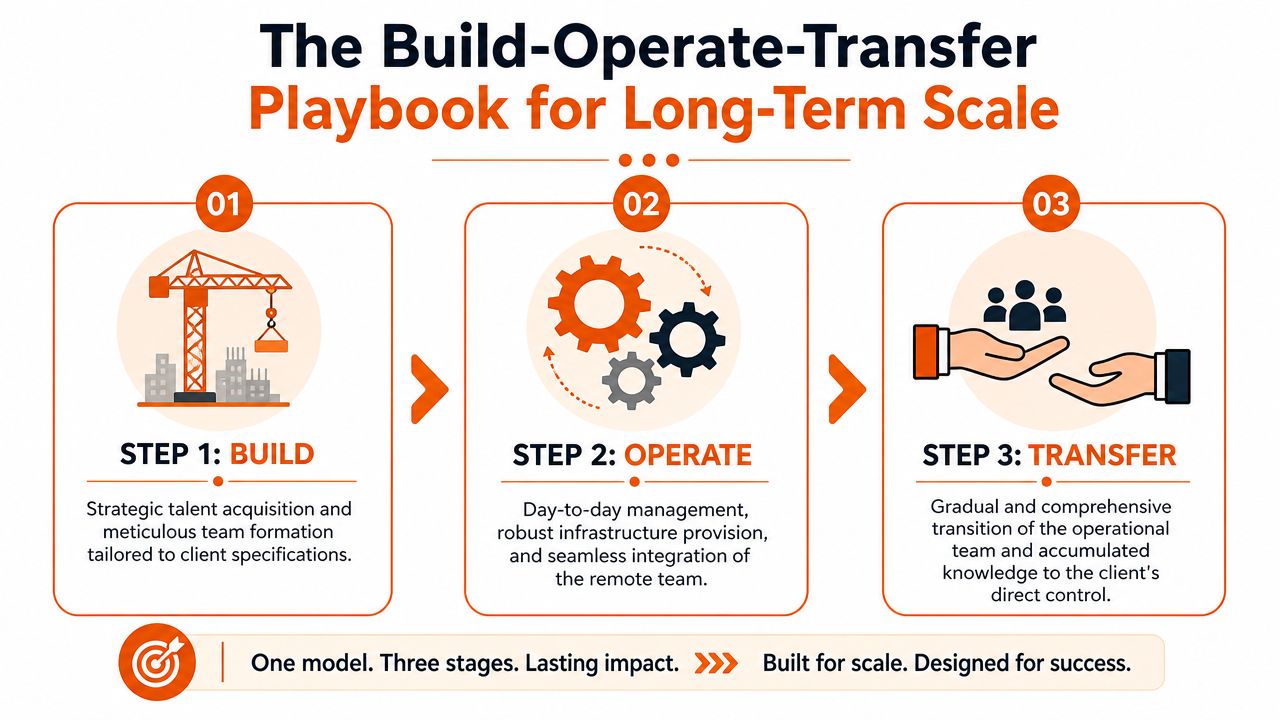
If nearshore helps you move fast, Build-Operate-Transfer helps you build permanence. This is the long game for CTOs who want more than emergency capacity. They want a durable R&D capability they can eventually own.
BoT works because it combines speed with control. You don't start from zero, but you also don't stay dependent forever. You build an operating asset.
Build the right thing
The first phase is Build. That means setting up the team, operating structure, hiring process, and local foundation around your goals. For many companies, that includes creating an R&D centre in a market like Poland where deep engineering capability is available.
This phase should answer practical questions fast:
- Which roles are core to the capability?
- What product areas will this team own?
- How will architecture, QA, DevOps, product, and delivery management interact?
- What standards are essential from day one?
A weak setup creates a group of disconnected hires. A strong setup creates a functioning unit.
Operate with discipline
The second phase is Operate. During this phase, the team stops being a staffing solution and starts becoming a high-performing system. Processes are embedded. Managers coach. Delivery routines harden. Knowledge accumulates.
A good operating phase includes more than sprint ceremonies. It includes culture transmission, engineering standards, documentation hygiene, security routines, and a clear escalation path when priorities clash.
| BoT phase | Leadership objective |
|---|---|
| Build | Form the team and establish the operating model |
| Operate | Prove performance, stability, and cultural alignment |
| Transfer | Move ownership without losing momentum or knowledge |
BoT is strongest when you treat it as capability design, not a legal handover exercise.
Transfer without disruption
The third phase is Transfer. At this point, the team is mature, delivery is stable, and the capability can move under your direct control. Contracts, management layers, operational knowledge, and local processes transfer in an orderly way.
Many leaders tend to overcomplicate things, assuming transfer is a dramatic switch. It shouldn't be. It should feel boring, because the system is already working.
BoT's value is strategic. You get an engine that supports future launches, platform work, customer commitments, and product expansion without rebuilding the talent strategy every year. For companies that need long-term resilience, that's a smarter response to the engineering talent shortage than endlessly reopening the same hard-to-fill roles.
Accelerate Your Talent Strategy with AI and Upskilling
External capacity matters. Internal capabilities matter just as much. If you want a resilient answer to the engineering talent shortage, combine both. Use AI to make hiring and team operations faster, and use upskilling to keep your current organisation from stagnating.
This isn't optional. Static teams lose momentum fast in a market where skill demands keep shifting.
Use AI to remove friction from recruitment
AI won't replace judgment. It will remove admin, shorten dead time, and make matching better when the process is designed properly.
Used well, AI can help teams:
- Screen faster: surface candidates against role criteria and delivery context
- Standardise communication: keep candidate experience consistent
- Spot patterns: identify where hiring stalls, where requirements are unrealistic, and where interview loops create waste
- Support recruiters and hiring managers: free them to spend more time evaluating capability and fit
A practical starting point is this look at AI in recruitment workflows, which shows how automation can support talent operations without turning the process into a black box.
Upskill the team you already trust
A CTO who only hires externally is always exposed. The stronger move is to turn your current team into a compounding asset. That means structured growth paths, better mentoring, and intentional skill development linked to product direction.
Focus on areas where your roadmap is clearly stretching capability. That may be platform engineering, data pipelines, testing maturity, AI integration, security, or product discovery. The exact topic matters less than the discipline.
Here is one pragmatic view:
Map delivery risk
Identify where the current team slows down because it lacks confidence or depth.Choose business-relevant learning
Train for what the product needs next, not what looks fashionable.Create visible ownership
Let engineers lead internal sessions, pilot tools, document patterns, and mentor others.
For leaders shaping broader workforce development around AI, Prometheus Agency's AI integration strategies offer useful context on connecting upskilling to operational change.
The best retention strategy isn't perks. It's giving strong people the chance to grow while doing meaningful work.
Combine both levers
AI-assisted hiring and internal upskilling work best together. One helps you access capability faster. The other helps you keep and deepen capability once you have it.
That combination changes the conversation. You stop chasing talent in the market and start building a talent ecosystem that supports delivery from multiple angles. That's how a reactive organisation becomes durable.
Turn Talent Scarcity into a Strategic Advantage
The engineering talent shortage is real, structural, and painful. But it doesn't have to control your roadmap. Companies lose when they treat talent scarcity as an excuse for slower execution. They win when they redesign their operating model around delivery outcomes.
The pattern is clear. High-performing leaders don't rely on one hiring channel or one lucky senior candidate. They combine ownership, nearshore resources, long-term capability building, AI-enabled hiring, and deliberate upskilling. They build systems that keep product development moving.
That's the strategic opportunity inside the shortage. While slower competitors keep waiting for the market to improve, disciplined teams build better delivery machinery. They become faster to launch, steadier under pressure, and less dependent on local bottlenecks.
There's also a human layer that too many technical leaders ignore. Distributed engineering works best when communication is sharp, confidence is high, and collaboration feels natural across client-facing situations. For globally distributed teams working with US companies, even targeted support like AI/ML engineer accent training can strengthen clarity and trust in daily delivery.
The #riteway mindset is simple. Own the outcome. Bring energy. Move early. Build teams that act like partners, not passengers. If you do that, the engineering talent shortage stops being a wall. It becomes a filter that removes weaker operators from the field.
If you need a partner that helps you move faster through the engineering talent shortage with senior nearshore teams, delivery consulting, and Build-Operate-Transfer capability, talk to Rite NRG. They help SaaS and product teams turn delivery pressure into predictable execution.