£149.0 billion is the size of the UK's digital sector GVA in 2022, and that scale is exactly why dev software services are a board-level decision, not a back-office purchase. If your team is missing release dates, fighting for senior engineers, or carrying too much delivery risk, the answer is usually not “hire more coders”, it's to bring in a partner that can own outcomes.
A founder usually feels this pressure first. The roadmap is slipping, the next investor update is close, and the internal team is already stretched across product, bugs, and cloud work. That's when people start asking for “dev software services”, but the question is sharper than that: it's whether you need extra hands, or extra control with more speed.
Why Founders Are Rethinking Dev Software Services Right Now
A SaaS founder doesn't wake up wanting outsourcing. They wake up looking at a board slide that still has a red line on it, and they need a path to a release they can defend. That's why dev software services have shifted from a procurement category to a delivery strategy, especially for teams under pressure to ship, stabilise, and keep investors confident.
The UK market makes that shift unavoidable. The digital sector contributed £149.0 billion in gross value added in 2022, which tells you this isn't a fringe spend category, it's part of a major national industry with deep delivery capacity and established norms for product engineering, cloud migration, and application support (UK digital sector GVA in 2022). The practical result is simple, buyers aren't just looking for “a team”, they're looking for a partner who can slot into a serious delivery environment and move the metric that matters.
What founders are actually buying
The strongest buyers don't buy headcount. They buy a way to reduce time-to-MVP, improve deployment frequency, and lower the cost of mistakes. That's why nearshore capacity keeps winning attention in the UK and Europe, because it gives founders a faster route to senior engineering input without waiting through a long local hiring cycle.
Practical rule: If a vendor talks mostly about skills, ask what business metric those skills will move in the first 30 days.
That's where the consulting mindset comes in. A serious partner should challenge roadmap shape, flag delivery risks early, and help you decide whether to build, rebuild, or stabilise first. If you want the plain-English version of the nearshore model behind that choice, this nearshoring overview is a useful starting point.
The old outsourcing frame is too weak for 2026. Founders need senior ownership, visible progress, and a delivery partner that treats speed and control as a trade-off to manage, not a slogan to repeat.
What Dev Software Services Really Cover
At the surface level, dev software services mean writing, testing, and shipping software. That's the visible part, but it's the least useful way to judge the work because code only matters when it changes the product, the release flow, or the customer experience.
From coding to operating a product
A better mental model is this, a strong delivery partner works like a fractional CTO function with hands on the keyboard. The scope reaches into discovery, architecture, DevOps, security, data, and ongoing optimisation, because the job is to turn an idea into software that ships safely and keeps improving.
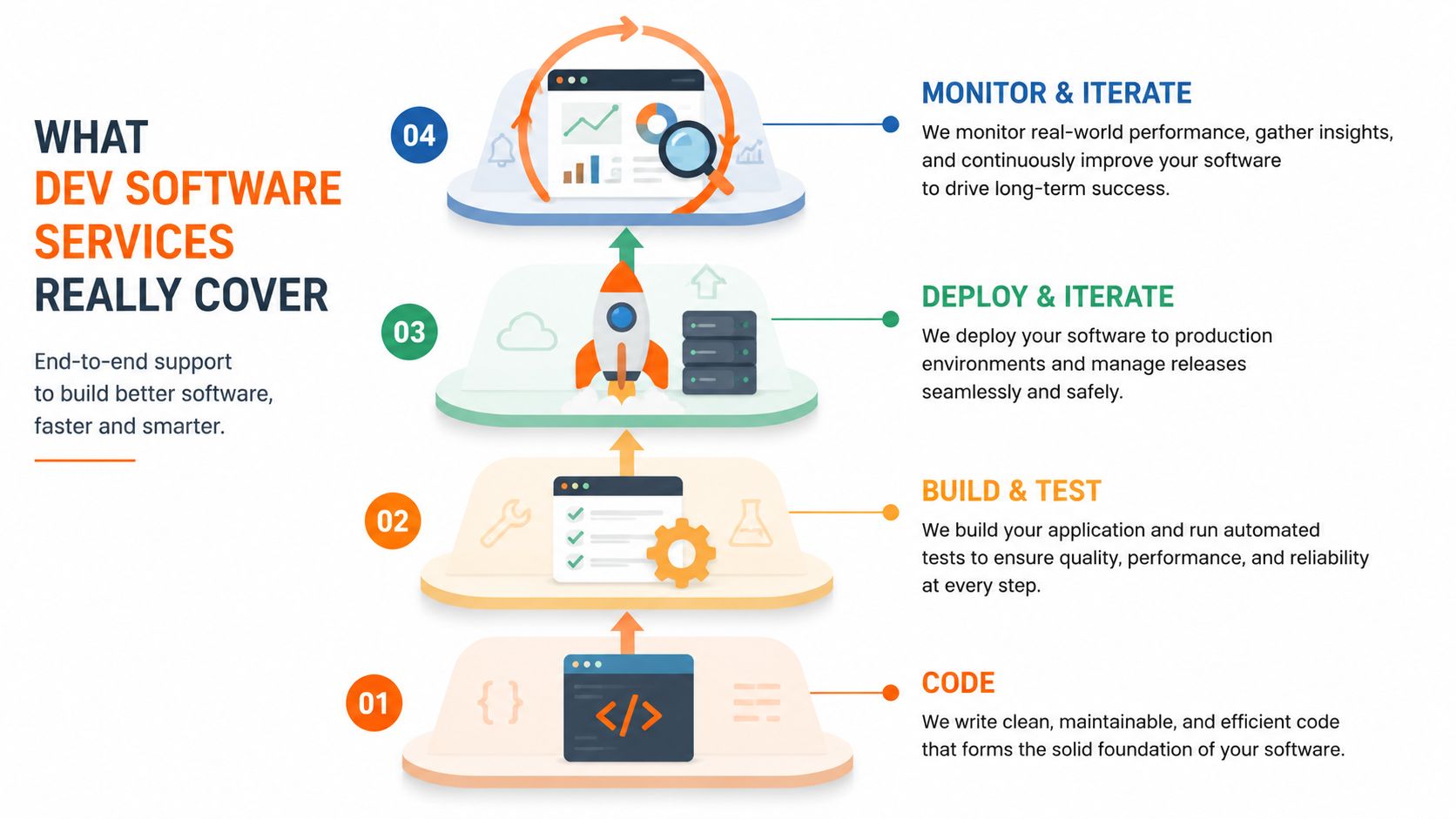
The four-stage flow matters because each layer changes the cost of the next one. Code without test discipline creates rework. Build and test without release automation slows you down. Deploy and release without monitoring turns every incident into a surprise. Monitor and iterate is what keeps the product aligned with the business instead of frozen after launch.
How the models differ in practice
This is why the next conversation should be about model, not just capacity. A consulting-led team helps define the shape of the problem. A dedicated team helps you extend your own product organisation. A project model suits bounded delivery. Build-Operate-Transfer fits companies that want to create a lasting R&D base without trying to stand it up alone.
If you strip away the jargon, the question is straightforward. Do you want someone to deliver tickets, or someone to help shape the delivery system that gets the right software out the door? The second option is harder to sell in a spreadsheet, but it's the one that usually protects time-to-market and product quality.
Engagement Models and How to Pick the Right One
The mistake buyers make is treating every engagement model like a version of staffing. That's lazy thinking. Each model changes how much control you keep, how fast you can start, and how much ownership you can expect from the partner.
Choosing the right fit
Here's the cleanest way to think about it. If you're an early-stage founder, speed and focus usually matter most. If you're a scale-up, senior capacity and stable delivery rituals matter more. If you're modernising legacy systems, you need a partner who can take operational responsibility without turning the work into a never-ending transformation programme. If you're opening an EU R&D centre, you need a path to structure, transfer, and governance.
| Model | Best Fit | Control | Time to Start | Outcome |
|---|---|---|---|---|
| Dedicated Teams | Scale-ups, product companies | High | Fast | Continuous delivery with embedded senior capacity |
| Project-based Delivery | Bounded builds, MVPs, feature launches | Medium | Fast | Defined scope delivered against agreed milestones |
| Consulting and Advisory | Founders, CTOs, legacy modernisation | High | Very fast | Clearer roadmap, better decisions, lower delivery risk |
| Build-Operate-Transfer | Companies building an R&D centre | High over time | Slower upfront | A transfer-ready team, process, and operating model |
The trade-off is always the same. More control usually means more involvement from your side. More speed usually means you need sharper alignment up front. That's where Extreme Ownership changes the game. A partner with that mindset doesn't wait for you to discover the problem in a status call. They surface it early, own the fix, and keep the conversation tied to outcome.
Decision rule: If your internal team can't absorb the work without dropping other priorities, use a model that brings senior ownership, not just extra capacity.
For a useful comparison of how partnership structures differ in practice, this partnership models guide is worth reading before you issue an RFP.
The right choice isn't the cheapest one on paper. It's the one that protects your delivery cadence and reduces the amount of management overhead you have to invent yourself.
Business Outcomes You Should Actually Measure
You can tell a lot about a software partner by the metrics they volunteer. If they lead with headcount, story points, or raw output, they're not thinking like a delivery partner. If they talk about lead time, deployment frequency, change failure rate, and time to restore service, they understand that software only matters when it moves business performance.
The metrics that belong on your weekly review
DORA-style metrics are the right starting point because they connect engineering behaviour to business outcomes. Lead time for changes tells you how quickly an idea becomes a production change. Deployment frequency shows whether your delivery system can ship regularly. Change failure rate reveals how often releases create damage. Time to restore service tells you how much pain an incident causes before the team recovers (DORA 2023 research).
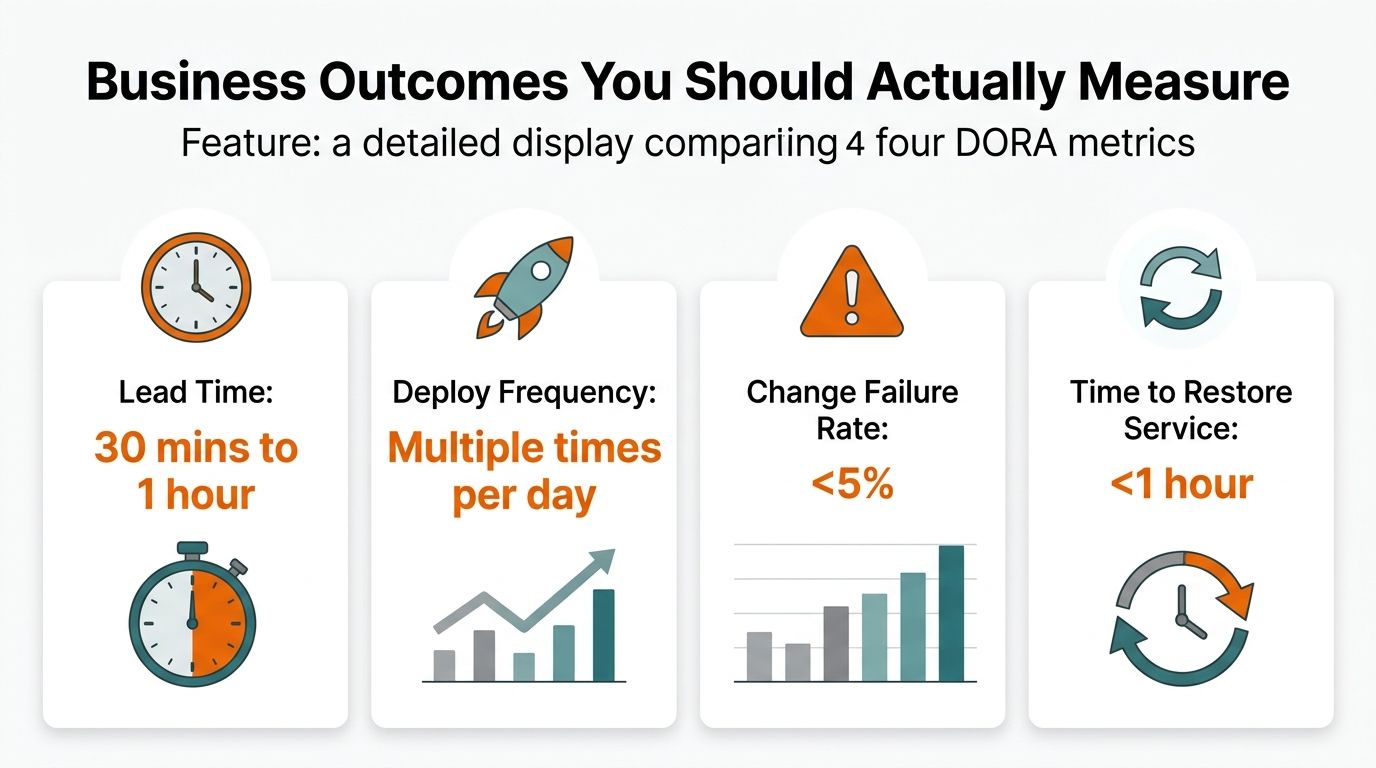
The important part isn't the metric itself, it's how you use it. A faster MVP matters only if the release process stays reliable. A higher deployment rate matters only if failure rates stay controlled. That's why business reviews should focus on a small set of delivery indicators, not a spreadsheet full of vanity measures that don't tell you whether customers are getting value.
Use this weekly: lead time, deployment frequency, change failure rate, and time to restore service.
The UK talent gap is the reason this approach matters so much. The UK Government's 2024 labour-market analysis estimated that around 48% of UK businesses experienced a digital skills gap, while the tech sector employed more than 1.7 million people and generated over £1 trillion in annual turnover (UK digital skills gap and tech sector size). That combination means demand for senior external capacity stays high, and good nearshore teams can make a measurable difference quickly.
A Founder-Ready Evaluation Checklist and RFP Criteria
A decent sales call can hide a weak delivery engine. Buyers get burned because they ask whether a team can code, but not whether it can own quality, surface risks, and fit into the way the business works.
What to score before you sign
Start with technical depth. Ask for architecture examples, code samples, and proof that the team can explain trade-offs, not just stack names. Then look at ownership culture, because a team that waits to be told what's broken will eventually cost you time.
Next, check communication cadence. You want a rhythm that matches your operating tempo, not a pile of status theatre. Then test security posture and ask how they handle data access, review gates, and incident response. For teams using automation or GenAI in delivery, ask what governs AI-assisted work and how they keep quality visible.
You should also ask about references and the specific shape of those engagements. A good reference from a startup doesn't prove enterprise readiness, and vice versa. If you're weighing a broader hiring strategy across regions, the LatoJobs guide to LATAM hiring is a useful comparison point for understanding how nearshore talent markets are typically evaluated.
RFP questions that expose weak vendors
- Technical depth: What codebase, architecture, or platform examples can you show that are close to our situation?
- Ownership culture: Who raises risks, and how early do they do it?
- Communication cadence: What does weekly delivery control look like in practice?
- Security posture: How do you handle access, review, and release governance?
- AI delivery maturity: Where does AI help, and where do you block it?
- References: Which client can speak to delivery quality under pressure?
Red flags show up fast if you listen. Vague SLAs, no named engineers, refusal to share code samples, and weak DevOps evidence usually mean the team looks better in the pitch than it performs in production. A partner working in the #riteway style treats proactive risk-raising as part of the job, not as a mood issue.
Realistic Timelines and Cost Expectations
Founders waste time when they ask for an exact price before they've defined the shape of the work. The right question is whether you're buying a sprint, a rebuild, or a lasting operating model, because each one has a different timeline and a different cost structure.
Three scenarios you can actually plan around
A six-to-ten-week MVP sprint is what you buy when the goal is to test market response quickly and with enough quality to survive early users. A four-to-nine-month platform rebuild is the right frame when the existing product has outgrown its architecture, release process, or internal skill set. A twelve-to-eighteen-month Build-Operate-Transfer is the serious option when you want a nearshore R&D centre that can be handed over cleanly rather than patched together later.
DevOps automation and infrastructure-as-code help compress those windows because they cut manual environment drift and make releases repeatable. AI-assisted workflows can also reduce friction in planning, testing, and maintenance, but only if the delivery team keeps governance tight. The business trap is buying speed and losing reliability, because broken releases erase the time you thought you saved.
| Scenario | Typical Shape | What Drives the Timeline |
|---|---|---|
| MVP sprint | Fast validation build | Scope discipline, integration complexity, release readiness |
| Platform rebuild | Modernisation and stabilisation | Legacy debt, security review, migration dependencies |
| Build-Operate-Transfer | Team and capability transfer | Hiring, operating model, handover quality |
Hidden costs founders forget
Onboarding always costs more than the sales deck suggests. Security review takes time, and handover takes more than a folder dump. Ongoing platform maintenance is not optional either, because a live system keeps creating work after launch.
If you want the blunt version, speed is only cheap when the release path is stable. That's why DORA-style metrics belong in the cost conversation from day one, not after the first ugly incident.
Risk, Security, and a Clean Handover
The idea that handover is the end of risk is wrong. In software delivery, handover is where bad assumptions become expensive, because the new owner has to operate what the old team built, and that only works if security, documentation, and access controls are deliberate from the start.
Security has to live inside delivery
The UK's NCSC guidance treats security as part of the delivery lifecycle, not a final sign-off. That means security review belongs in every phase, and security requirements should be tested through automated checks, not left to a late-stage audit (NCSC-style secure delivery guidance). For buyers, that's not theory, it's the difference between a predictable release train and a release process that gets blocked at the worst possible moment.
The legal side matters too. In the UK, the Information Commissioner's Office enforces GDPR-based data protection rules, and UK GDPR allows fines of up to £17.5 million or 4% of annual global turnover, whichever is higher, for the most serious infringements (UK GDPR enforcement threshold). If your partner touches client data, that risk belongs in the contract and the operating model, not buried in a security annex nobody reads.
The hygiene you need before transfer
Dependency hygiene is another area where teams get lazy. Datadog's 2025 DevSecOps research found the median dependency was 215 days behind its latest major version, and that services deployed less than once per month were 47% more outdated than those deployed daily (Datadog 2025 DevSecOps research). That's a direct warning that slow delivery and stale dependencies tend to travel together.
A clean handover should include runbooks, source-code transfer, monitoring access, and knowledge-transfer sessions. The point is to leave the receiving team able to operate the system without begging the original vendor for basic answers. If you've seen the opposite happen, the handover documentation guide is a good reminder of what good looks like.
A handover is only clean when the buyer can explain, deploy, monitor, and support the system without guesswork.
Build-Operate-Transfer exists because enterprises got tired of brittle exits. When it's done well, the transfer isn't a scramble, it's the result of a controlled operating model that was designed for ownership from the start.
Plugging a Partner Into Your Delivery Flow
The best onboarding starts small and stays sharp. Give a partner a discovery week, agree on a narrow set of business-outcome metrics, and put senior engineers into your normal rituals instead of inventing a parallel process that nobody trusts.
That's how the #riteway approach should work in practice. Extreme Ownership means the partner doesn't wait to be asked for risk updates. High energy means they move fast without turning chaotic. Proactivity means they flag issues early, write down decisions, and keep the delivery conversation focused on output that matters.
A nearshore partner can usually slot into a SaaS founder's flow inside one to two weeks when the fit is right. The right questions are no longer “can they code”, but “will they think like owners, communicate clearly, and help us ship with control?” If you want another useful filter while you compare options, this guide on how to choose a nearshore partner gives a practical external benchmark.
If you're at the point where the roadmap is real, the pressure is real, and the delivery gap is costing momentum, talk to a partner that works like an extension of your leadership team. Visit Rite NRG to discuss senior nearshore delivery, MVP acceleration, legacy modernisation, or a Build-Operate-Transfer path that's built around measurable outcomes.