You're probably closer to a risky handover than you think.
A release is landing. A supplier transition is underway. A nearshore team in Poland is getting ready to take ownership. Everyone says the same thing: “We've got documentation.” Then you open the folder and find outdated READMEs, half-finished runbooks, missing decisions, and no clear owner for what happens when production goes sideways.
That's not handover documentation. That's deferred risk.
I've seen the pattern too many times. Teams treat handover as admin at the end, when it's one of the sharpest instruments you have for protecting continuity, safeguarding delivery, and making sure the next team can produce business value fast. If your handover documentation doesn't help the receiving team make decisions, operate safely, and understand why the product exists, it will fail exactly when the pressure is highest.
From Asset to Afterthought The True Cost of a Bad Handover
The failure usually starts with confidence.
A CTO signs off because the codebase looks stable. The outgoing team says they're available for questions. The incoming team gets access to repositories, dashboards, and a pile of docs. Then a production issue hits outside office hours, the wrong service gets restarted, an undocumented dependency breaks the fix, and the new team spends hours reconstructing knowledge that should have been explicit.
That isn't a technical inconvenience. It's a business failure.
When handover documentation is weak, teams lose more than context. They lose operating rhythm, trust, and the ability to protect key outcomes under pressure. That's why I push a blunt position here: handover is not the final task of the old team. It's the first operational capability of the new one.
Documentation protects what the business paid for
Plenty of leaders still act as if handover can be handled with meetings and goodwill. It can't. In high-stakes environments, verbal transfer collapses fast. NHS England references a seminal study showing that after five verbal-only handover cycles, 97.5% of critical patient information was lost, while a simple printed handout retained 99% of the data in the same context (NHS England handover guidance).
That's the point most software teams need to hear. If critical information degrades that severely through verbal relay, your architecture lore, deployment quirks, recovery steps, and hidden business rules won't survive a loose transition either.
Practical rule: If the receiving team needs a call to understand something essential, the handover documentation isn't finished.
The cost shows up in places leaders already care about:
- Delayed recovery: Operators can't act decisively without trusted runbooks.
- Lower throughput: New engineers spend time decoding intent instead of shipping.
- Stakeholder anxiety: Product and commercial teams stop trusting delivery forecasts.
- Migration risk: Platform changes become more expensive because undocumented assumptions surface late.
That's also why broader transition planning matters. If you're weighing platform moves or restructuring delivery ownership, Ollo's migration cost analysis is a useful reminder that transition cost rarely sits in tooling alone. It sits in the hidden effort around knowledge, coordination, and operational readiness.
Extreme Ownership starts here
The #riteway mindset is simple. If your team built it, your team owns the clarity required for someone else to run it well.
That means handover documentation isn't a compliance box. It's an act of proactivity. It proves the team understands the business consequence of ambiguity and fixes it before the transfer, not after the outage. Teams with that mindset don't ask, “What's the minimum we need to upload?” They ask, “What does the next team need to protect value on day one?”
That's the right question. It changes everything.
The Essential Handover Artifacts That Drive Business Outcomes
Most handover packs fail because they're organised around files instead of decisions.
A receiving developer doesn't care that you've uploaded twelve documents. They care whether they can change a service safely. An operator cares whether they can restore service under pressure. A product owner cares whether the team understands what success looks like and why specific trade-offs were made.
That's why strong handover documentation should be built around roles and outcomes, not folders.
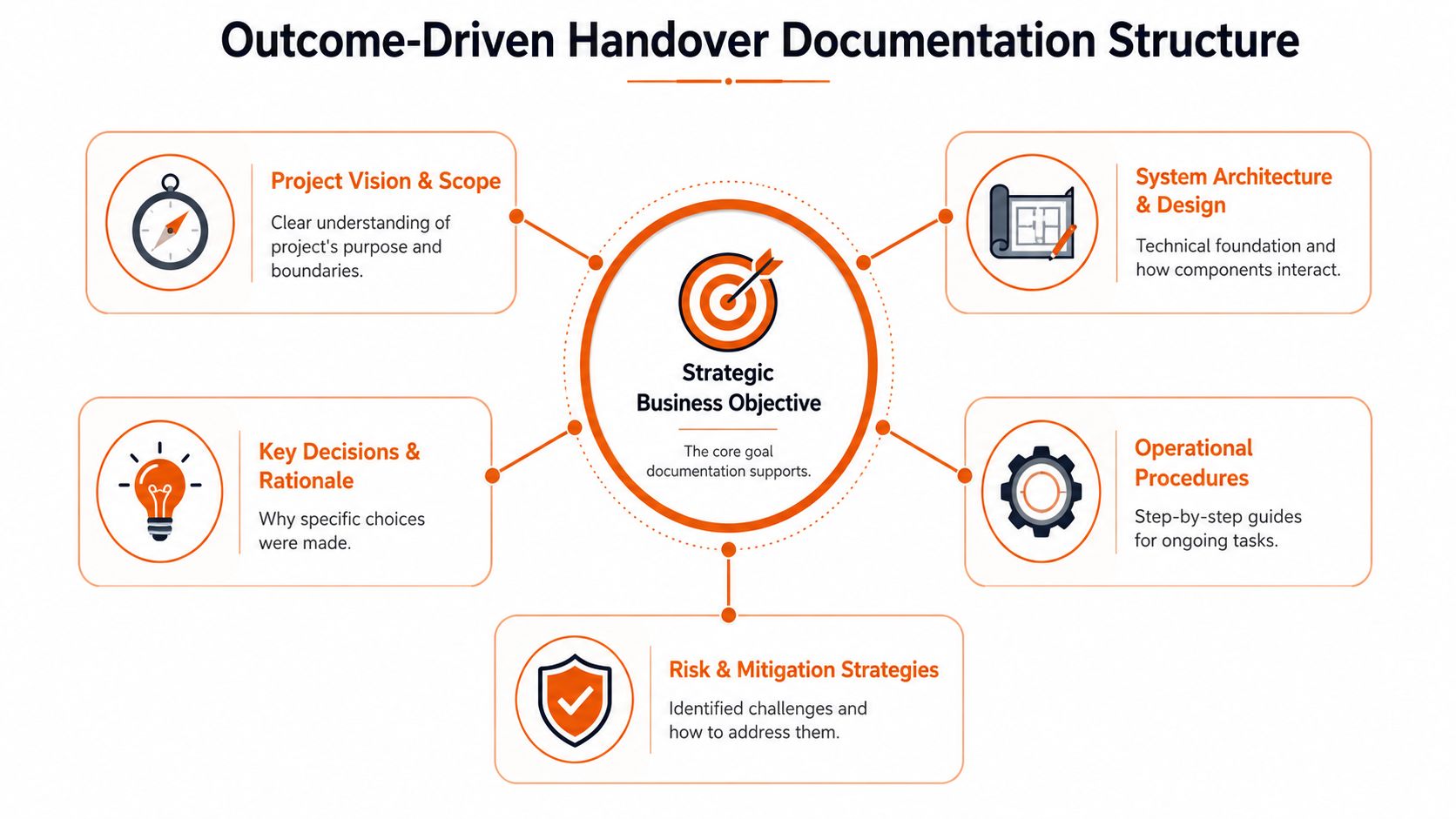
UK government service standards are right on this point. Teams should define benefits before defining metrics, so the work is measured against outcomes for users rather than activity. The example given is moving from a task like “launching a workstream” to an outcome like “improving enterprise onboarding reliability”, so every metric connects operational signals to a real business result (UK Government service manual on setting performance metrics).
The developer needs the how
Developers inherit systems through code, but they operate effectively through context.
Good handover documentation for developers should include:
- Architecture records: Service boundaries, integrations, dependencies, and data flow.
- Decision history: ADRs that explain why the team chose one path over another.
- Local setup and environments: What's required to run, test, and debug safely.
- Release path: CI/CD pipeline logic, approval points, rollback expectations.
- Known sharp edges: Legacy constraints, temporary workarounds, non-obvious failure modes.
Don't dump this into generic wiki pages. Tie each artefact to a business concern. If a service supports checkout, say that. If a pipeline gate protects regulated data handling, say that. Developers move faster when they know which parts of the system carry the heaviest business consequence.
A useful reference point is this piece on proof of concept documentation. The same principle applies at handover: a document earns its place when it helps the next team understand intent, assumptions, and the operational boundary of the work.
The operator needs the what if
Operations teams don't need essays. They need clarity under pressure.
Here's the difference between weak and strong handover documentation for operators:
| Need | Weak documentation | Strong documentation |
|---|---|---|
| Incident response | “Check logs and restart if needed” | Clear runbook with triggers, dependencies, and escalation path |
| Monitoring | Dashboard links only | What each alert means and what action is expected |
| Deployment risk | Generic release note | Known failure points and rollback conditions |
| Access | Shared credentials list | Named systems, access model, and approval owner |
A common pitfall for teams is being too technical and not operational enough. A receiving team needs to know what happens when a queue stalls, a third-party API degrades, or a deployment passes CI but still creates customer-facing issues.
Write runbooks for the worst Tuesday of the quarter, not the best demo of the month.
The product owner needs the why
This part gets ignored most often, and it creates expensive confusion later.
If the product owner doesn't inherit the commercial and strategic logic behind the backlog, the new team will optimise the wrong things. Handover documentation should make the following explicit:
- Business objective: What outcome the product or capability is meant to improve.
- Critical user journeys: Which flows matter most and why.
- Current risks: Where reliability, usability, or delivery confidence is vulnerable.
- Decision rationale: Why some issues are accepted and others are prioritised.
- Success signals: Which leading and lagging indicators matter to leadership.
This is what turns documentation into a delivery instrument. You're not just transferring technical assets. You're transferring judgement.
When these three perspectives align, handover documentation stops being static storage and starts functioning as an operating system for the next phase of delivery.
Building Your Proactive Handover Documentation Playbook
Last-minute documentation always looks complete from a distance.
It has folders. It has exported diagrams. It has pages with timestamps from the final sprint. Then the receiving team starts using it and finds stale assumptions, missing rationale, and no consistency in what “done” means. This often occurs because teams begin documenting at the point of transfer instead of embedding it into delivery from day one.
That's the wrong operating model.
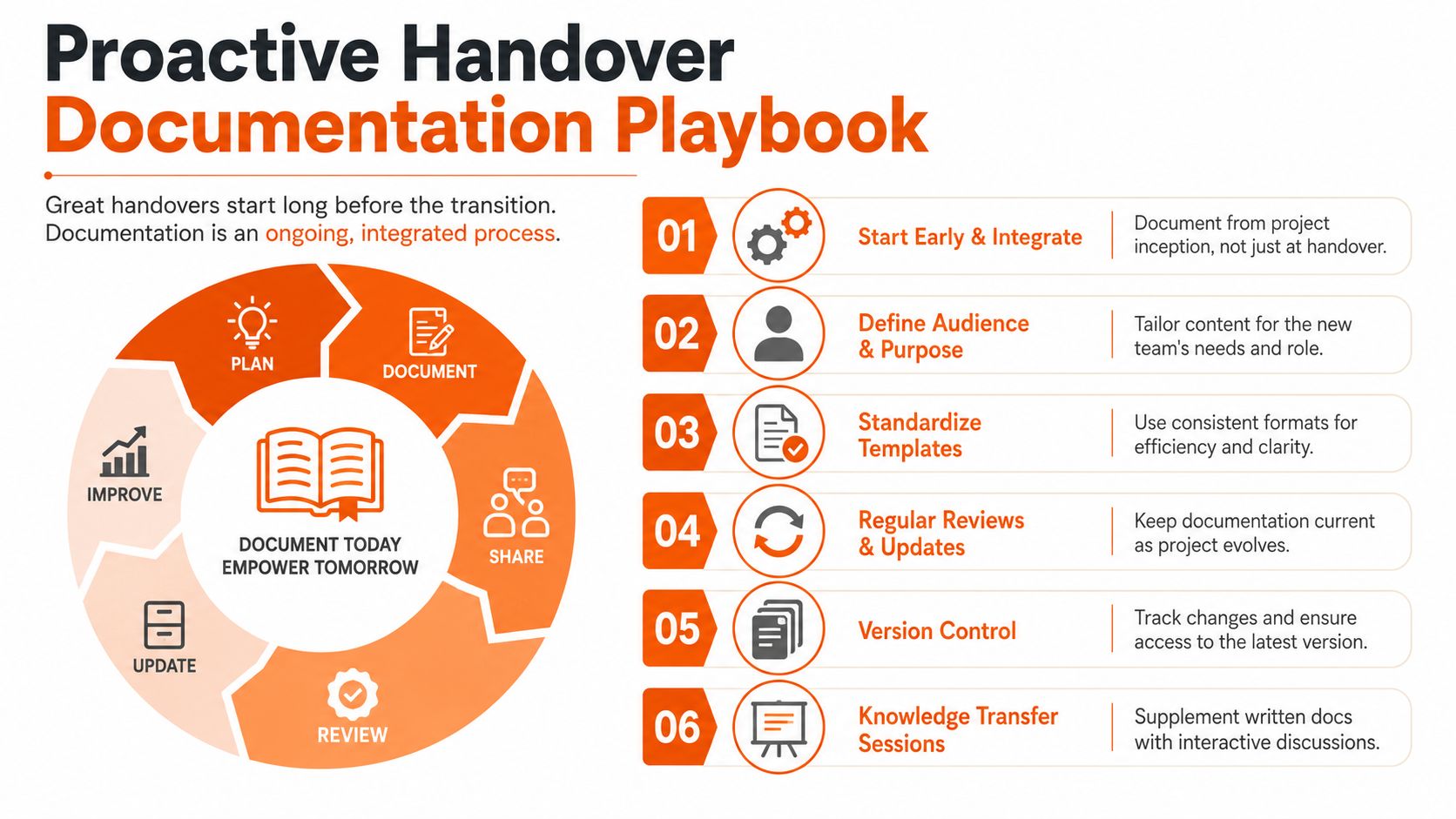
A proactive handover playbook treats documentation as a living system. It grows alongside the product, gets reviewed like code, and becomes part of team rhythm rather than end-stage clean-up.
A simple model helps. In healthcare, the NHS uses the SBAR framework, meaning situation, background, assessment, recommendation, as a standardised structure for handover. The guidance tied to that model expects handovers to cover a summary of the stay, diagnosis, treatment plans, infection status, and rehabilitation goals, which is exactly why the format is repeatable and auditable (UK handover template example using SBAR).
Build the playbook around repeatable moves
A handover playbook should answer six practical questions.
- What must always be documented: Architecture decisions, dependencies, operating procedures, business rationale.
- Who is the audience: Engineer, operator, product owner, compliance lead, executive sponsor.
- When is it updated: Sprint review, release prep, incident review, architecture change.
- Where does it live: Git, Confluence, Notion, internal docs portal, shared drive with version control.
- Who approves it: Named owner for each document type.
- How is it tested: Walkthroughs, shadow sessions, acceptance review.
The format matters less than the discipline. If your team updates tickets but never updates decision records, you don't have a playbook. If your runbooks live in a wiki no one reviews, you don't have a playbook. If nobody can tell a new engineer where the canonical version is, you definitely don't have a playbook.
Standardise without becoming bureaucratic
You don't need more templates than the team can maintain. You need the right ones.
A solid set usually includes:
- Service overview template: Purpose, dependencies, owner, failure impact.
- Runbook template: Trigger, checks, response steps, escalation, rollback.
- Decision record template: Context, options considered, decision made, consequence.
- Handover summary template: Current state, open risks, key contacts, unresolved questions.
If you want ideas for making process guidance easier to produce and maintain, this guide for efficient content production is worth a look because it shows how teams can create structured process content without drowning in admin.
Later in the delivery cycle, this kind of communication also works better when it's supported by live walkthroughs.
Make documentation part of delivery, not closure
The cleanest handovers happen when teams do three things consistently:
- Update docs in the same sprint as the change.
- Review operational content after incidents, not only after releases.
- Treat onboarding feedback as a test of documentation quality.
If a new joiner can't use your docs to become productive, the issue isn't the new joiner.
That's the shift. Documentation stops being a backlog chore and becomes a force multiplier for alignment, onboarding, and transfer readiness.
Implementing Quality Gates and Smart Tooling
Bad documentation is dangerous because it creates false confidence.
A missing document is visible. An inaccurate document is much worse. Teams act on it, automate around it, and make decisions based on assumptions that are already wrong. That's why handover documentation needs quality gates, not just storage.
The first gate is ownership. If nobody owns the accuracy of a document, it will decay. The cleanest rule I've seen comes from the UK Government Digital Service approach to KPIs: “If this number gets worse next week, who owns it and what do we do?” If a team can't answer that, the metric is vanity, not management (clear KPI ownership rule). The same standard should apply to handover assets.
Define what good looks like
A useful documentation quality gate checks five things:
| Gate | Question |
|---|---|
| Accuracy | Is this still true in the current environment? |
| Completeness | Can the receiving team act without chasing missing context? |
| Usability | Can someone find the answer fast under pressure? |
| Ownership | Is there a named person responsible for keeping it current? |
| Reviewability | Has another person validated that it works in practice? |
That means “done” for documentation should be explicit in your workflow. Don't close a feature if it changes architecture and the relevant decision record wasn't updated. Don't sign off a service transition if the runbook wasn't tested by someone outside the original team. Don't approve a final handover pack if links are broken, dependencies are vague, or open risks are hidden in chat history.
Use peer review and operational proof
The best teams review documentation the same way they review code. They look for ambiguity, outdated assumptions, and missing recovery paths.
A strong review pattern includes:
- Peer review: Another engineer validates technical clarity.
- Operational review: Someone responsible for support checks runbooks and alerts.
- Product review: Product or delivery leadership confirms the business context is accurate.
- Dry-run validation: The receiving team follows the docs and reports where they got stuck.
Smart tooling helps. Use tools that reduce friction and preserve version history. Git-based docs are excellent for technical records. Confluence and Notion work well when ownership is strong and page sprawl is controlled. Shared workspaces can also support light operational handover if the team defines one source of truth. For leaders trying to connect task tracking and documentation workflows, integrating project management in Workspace is a practical example of how everyday tools can be organised without adding unnecessary overhead.
Good tooling doesn't rescue weak discipline. It makes strong discipline easier to sustain.
The right setup is the one your team will maintain under delivery pressure. Choose that. Then enforce the gates.
Executing a Flawless Transfer and Acceptance Process
The final transfer shouldn't feel like a cliff edge.
If the receiving team only gets real exposure at the moment of ownership, you've already increased risk. A proper handover is staged, collaborative, and designed to build confidence before responsibility moves. The handover documentation supports that process, but it doesn't replace it.
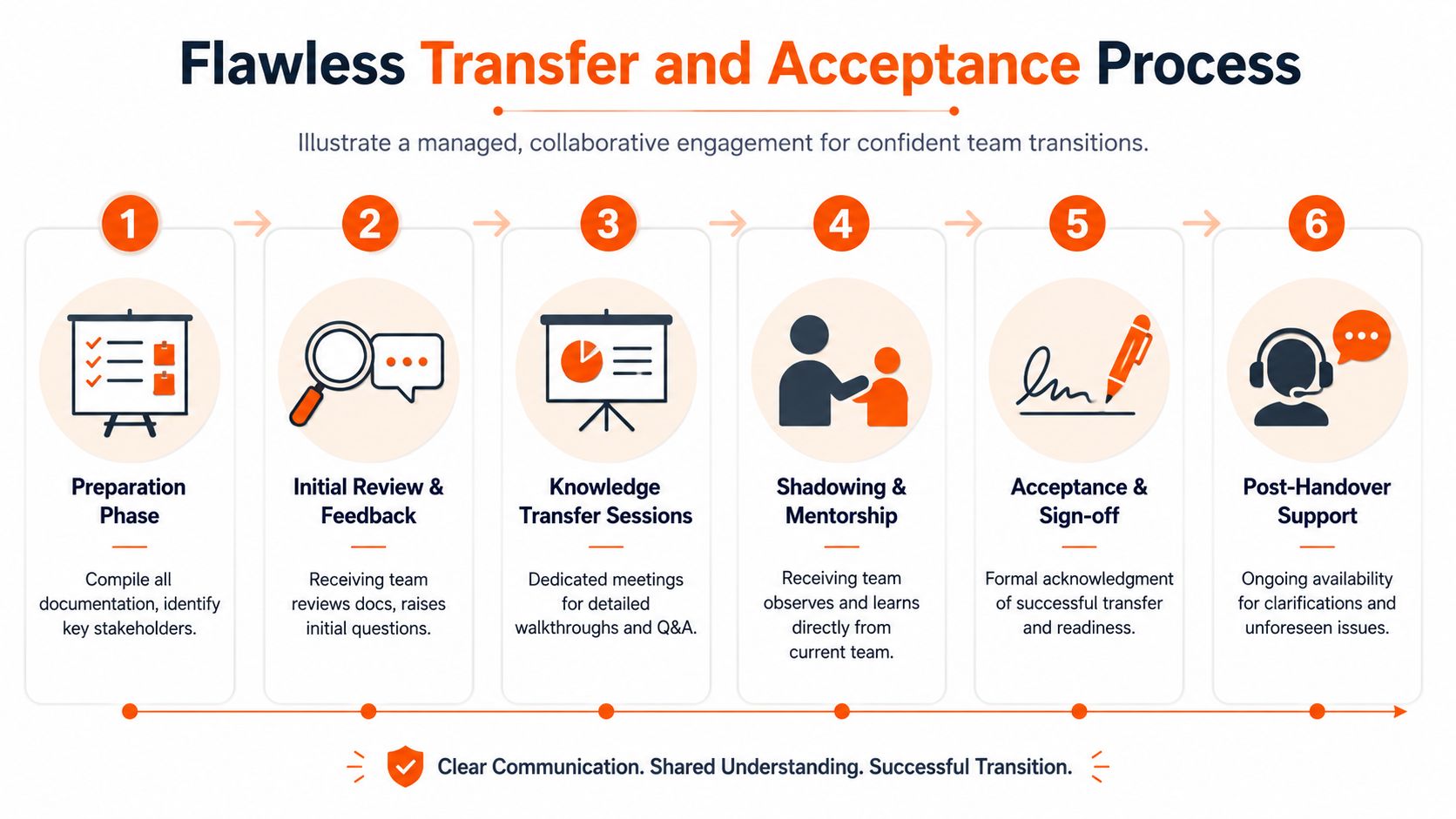
The strongest transfers I've seen all follow the same rhythm. The receiving team reviews the pack early. They ask awkward questions while the outgoing team is still accountable. They observe real operations before they're expected to lead them. And they sign acceptance when both sides can confidently say, “Yes, this team can run it.”
The transfer should happen in layers
Start with document review, but don't stop there.
The receiving team should first inspect architecture records, runbooks, open risk logs, and product context. That creates a baseline. After that, run structured walkthroughs where engineers explain system boundaries, deployment flow, integration constraints, and the business-critical areas that need extra care.
Then move into shadowing. Let the incoming team watch routine operations, release activities, and incident handling. Not as passive observers. As active participants who ask questions, challenge assumptions, and confirm they understand the logic behind each action.
A clean handover sequence usually looks like this:
- Preparation: Finalise artefacts, identify owners, confirm scope of transfer.
- Review: Receiving team reads the pack and logs questions.
- Walkthrough: Current team explains architecture, backlog context, and operating procedures.
- Shadowing: Receiving team observes real work in motion.
- Reverse demonstration: New team explains back what they'll do in key scenarios.
- Acceptance: Both sides confirm readiness, open issues, and support boundaries.
Acceptance is operational, not ceremonial
Too many organisations treat sign-off as legal theatre. That's weak leadership.
Acceptance should mean the new team can perform critical actions without improvising. They should be able to deploy safely, diagnose common incidents, understand unresolved risks, and explain how the product supports the business objective. If they can't, you're not at acceptance. You're at dependency.
For leaders working through a more formal transition model, this overview of the Build-Operate-Transfer model is useful because it highlights that transfer is the point where operational ownership becomes real, not symbolic.
Keep a short support window after transfer
Even excellent handovers surface edge cases once the new team is live. That's normal.
What matters is that post-handover support is time-boxed and structured. Keep a defined period for clarifications, not an open-ended safety blanket. Questions should be logged. Answers should update the documentation. If the same question gets asked twice, the handover pack wasn't clear enough.
A flawless transfer doesn't mean zero questions. It means no surprises about who owns the answer and where that answer belongs.
That's the standard worth holding.
Mastering Nearshore Handovers The Rite Way
Generic handover advice breaks down fast in nearshore delivery.
A domestic team transition is one thing. A UK company transferring delivery, knowledge, and operational control to a team in Poland is another. The distance isn't huge, but the complexity is. You're dealing with cross-border expectations, communication nuance, different operating habits, and in some cases a full Build-Operate-Transfer structure where the handover covers not just software, but recruitment, compliance, and the mechanics of an R&D centre.
That changes the bar.
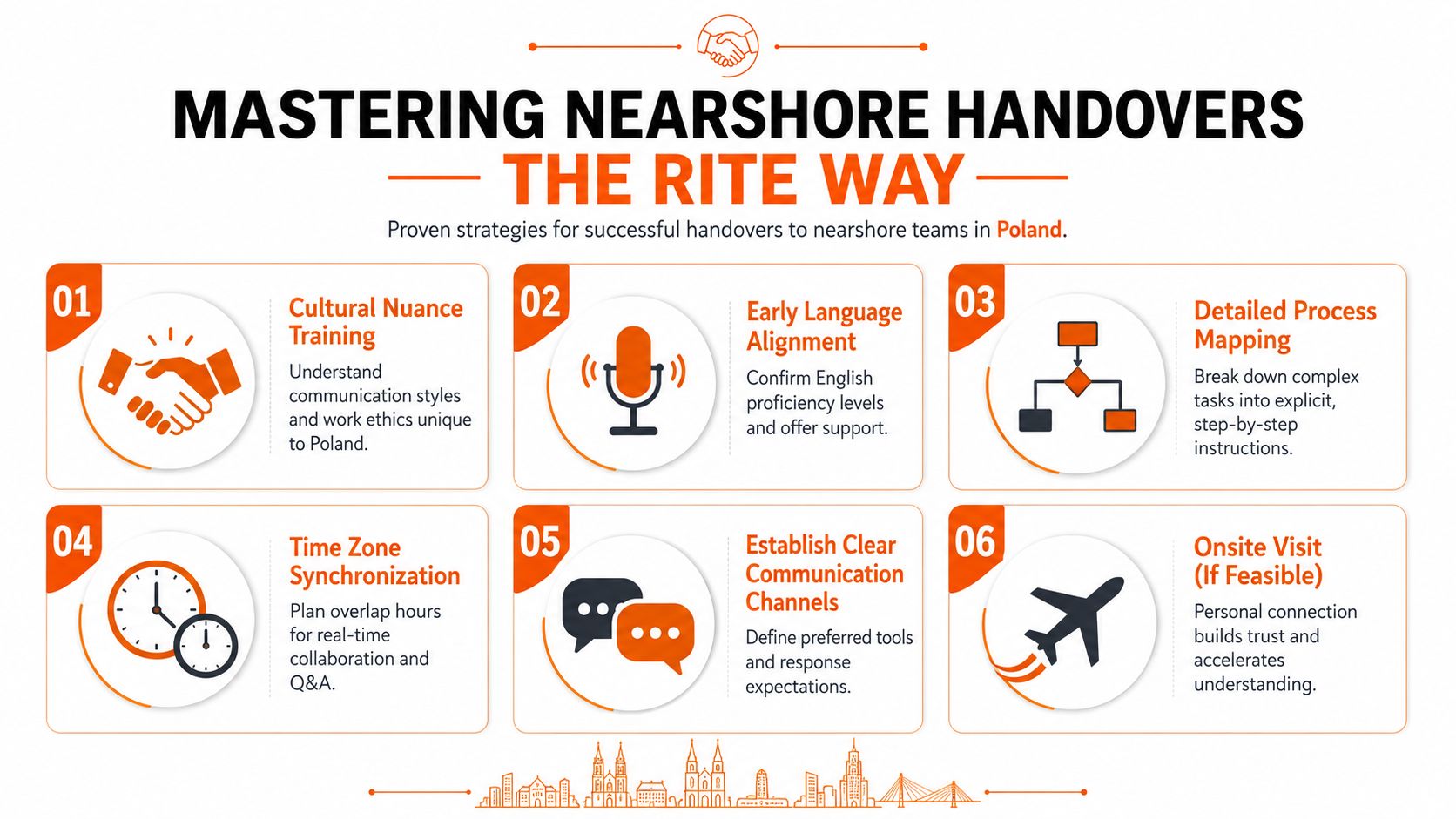
Standard handovers aren't enough for UK to Poland transfers
The common assumption is that if the code, tickets, and cloud access are documented, the transfer is covered. It isn't.
In nearshore models, the receiving team often needs a wider operational picture. That includes decision authority, escalation routes, hiring context, security expectations, vendor relationships, and local compliance records that a domestic handover might barely mention. In a BOT arrangement, those details stop being “nice to have” and start becoming part of the asset being transferred.
The risk is real. For UK companies building R&D centres in Poland through a Build-Operate-Transfer model, incomplete operational documentation, including missing compliance logs for Polish hiring or inadequate IP transfer records, is cited as a primary contributor to 30-40% of BOT failures in UK-EU tech migrations (BOT handover compliance risk).
That should change how you think about handover documentation. It's not just delivery admin. It's part legal shield, part continuity mechanism, part investor-confidence package.
The nearshore handover needs explicit operating rules
When I advise on UK-to-Poland transitions, I push teams to document the operational edges with unusual clarity:
- Communication norms: Which issues need synchronous discussion, which can stay async, and who makes the call when urgency rises.
- Decision rights: What the Polish team owns fully, what still needs UK stakeholder approval, and where escalation starts.
- Business language: Product terms, client vocabulary, regulated concepts, and naming that can't be interpreted loosely.
- Compliance trail: Hiring logs, IP assignment status, access control decisions, and policy acknowledgements where relevant.
- Relationship map: Internal sponsors, external vendors, platform owners, and commercial contacts.
These aren't soft extras. They remove hesitation. Nearshore teams perform best when ambiguity is stripped out early and replaced with explicit expectations.
If your organisation is preparing this kind of transition, a specialist nearshore delivery service perspective can help frame what needs to be transferred beyond the codebase itself.
Cultural fit doesn't happen by accident
Polish engineering teams often bring strong technical depth, direct communication, and a practical delivery mindset. That's an advantage, but only if the handover is designed for collaboration instead of assumption.
Use overlap hours deliberately. Record key walkthroughs. Confirm terminology. Write down business context that local team members wouldn't automatically infer from systems alone. If budget and timing allow, an onsite session still accelerates trust faster than another deck or wiki page.
The best nearshore handovers feel boring in the right way. No hidden dependencies. No compliance surprises. No confusion about who owns the next decision.
That's the bar. And if you're serious about predictable scaling, it's the only bar worth accepting.
If your team is planning a supplier transition, a nearshore handover, or a Build-Operate-Transfer move in Poland, Rite NRG can help you turn handover documentation into an operational asset, not a last-minute liability. The right handover protects continuity, accelerates ownership, and keeps delivery tied to business outcomes from day one.