Most advice about project management frameworks starts in the wrong place. It treats framework choice like a universal answer, then acts surprised when a SaaS team still misses launch dates, burns trust with investors, or turns a simple release into a governance mess.
The better question is blunt, context-led, and far more useful. How uncertain is the work, how mature is the team, and how much oversight do stakeholders need?
UK delivery culture makes that question even more important. PRINCE2 has been around since 1996, then evolved through PRINCE2 2009, PRINCE2 2017, and PRINCE2 7 in 2023, which shows how formal governance adapted from document-heavy control towards more flexible, principle-based delivery Ravetree's UK project management history overview. That matters because many UK teams still inherit stage gates, defined roles, and business-case discipline whether they want them or not. The job is not to worship a framework. The job is to make sure the framework helps you ship value without losing control.
Why Most Framework Advice Fails SaaS Teams
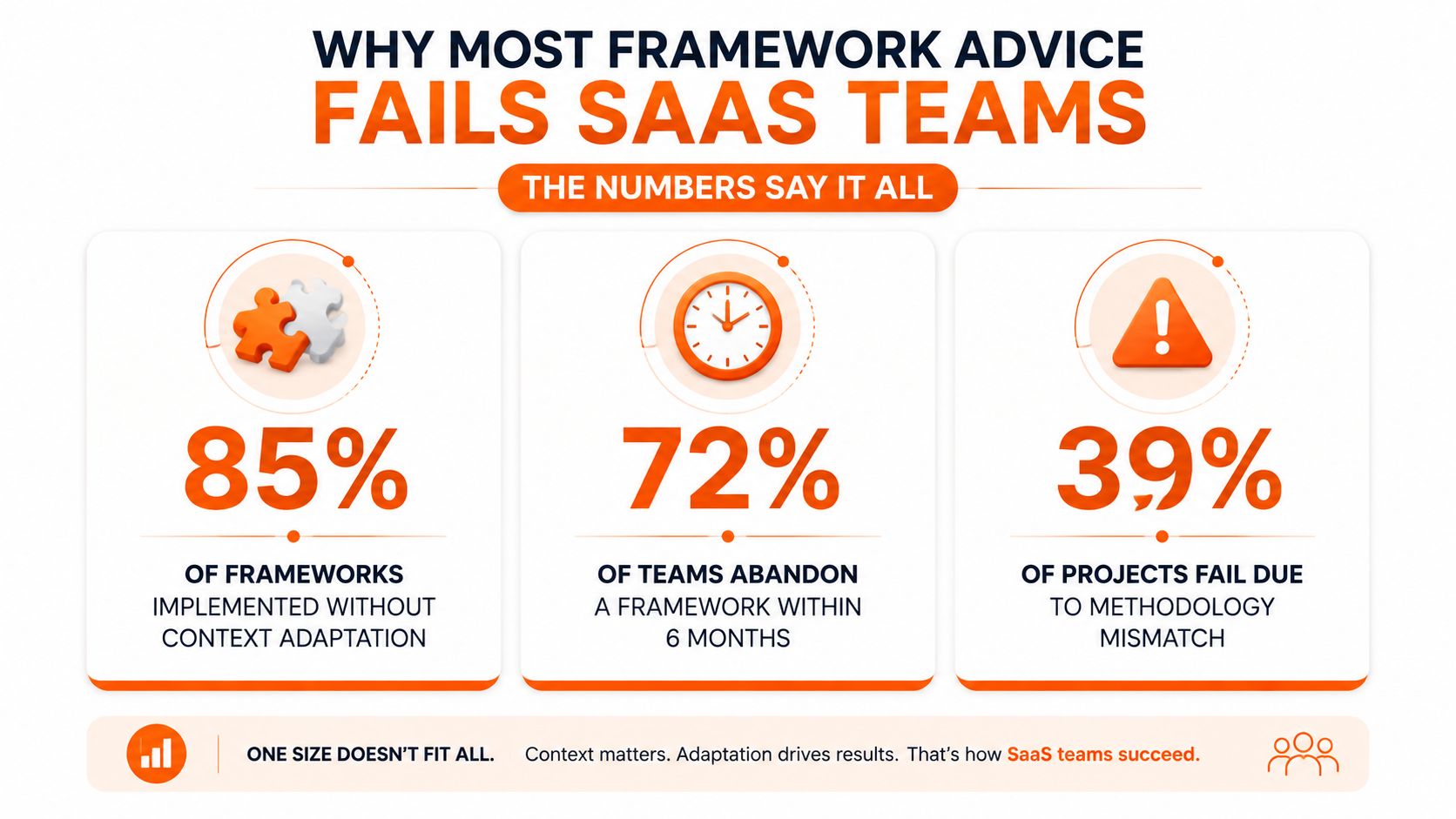
Most framework advice fails because it starts with labels, not delivery conditions. Teams get told to “use Agile” or “follow Waterfall” as if the name itself solves uncertainty, governance, or dependency management. It doesn't. A framework only works when it matches the reality of the product, the people, and the risk profile.
For SaaS founders, that reality is usually messy. Product-market fit may still be shifting, engineering might be split across time zones, and the board still wants evidence that delivery is under control. That's why the UK market has moved away from pure camps and towards mixed delivery models. In the Wellingtone 2024 survey, 58% of organisations mostly or always apply a defined methodology, 43.9% use predictive approaches, 24.6% use Agile, and 31.5% use a hybrid model project management statistics summary. The shift from 58% predictive in 2020 to 43.9% in 2024, and from 20% hybrid in 2020 to 31.5% in 2024, tells you where the market is heading, mixed delivery, not purity.
Choose by context, not by fashion
The right filter is simple. If the work is uncertain and cross-functional, you need a framework that can absorb change without creating chaos. If the work is tightly regulated, you need stronger control points, clearer accountability, and visible decision trails. If you're working with a nearshore team, you also need a model that survives distance, handovers, and time-zone friction.
Practical rule: Pick the framework that protects the business outcome you can't afford to miss, not the one that sounds most modern.
That's where a consulting mindset beats generic delivery advice. A good partner asks whether the framework reduces risk, clarifies ownership, and helps the team ship. A weak one talks about ceremonies and stops there. If you want a practical complement to this thinking, browse Talantrix book resource and compare it against the way your own team operates.
If investor updates, stakeholder alignment, or scope control are breaking down, fix the expectations layer too. The best frameworks can't rescue a team that hasn't defined what “done” means, and this guide on managing expectations is a useful companion for that part of the job.
Frameworks Versus Methodologies Explained
A lot of delivery confusion comes from mixing up frameworks and methodologies. They are not the same thing, and treating them as the same is how teams end up with noisy rituals and weak governance. The cleanest way to think about it is this, the framework is the control layer, and the methodology is the execution layer.
The UK public-sector view is consistent with that distinction. The National Audit Office describes a project management framework as a standard set of processes, templates, and tools used to initiate, plan, execute, control, and close projects, with the main technical value being better decision-making, communication, and coordination across a portfolio NAO framework definition. That's governance. It's not a daily stand-up.
Control layer versus delivery mechanics
A framework defines stage gates, roles, KPI tracking, and the rules for how decisions move. A methodology defines how the team gets work done inside that structure, through sprints, WIP limits, stand-ups, backlog refinement, or phase-based execution. In other words, the framework says what controls must exist, while the methodology says how the team delivers within them.
That distinction matters because it lets you mix control and flexibility without rebuilding the whole operating model. A regulated SaaS company can keep strong governance while using Agile execution. A discovery-heavy product team can move fast without pretending oversight is optional. The control layer stays stable, the delivery mechanics change as the work changes.
The mistake most teams make is trying to solve a governance problem with a ceremony problem. Those are not the same thing.
If you work in a nearshore setup, this is even more important. Distributed teams need clarity on ownership, escalation paths, and reporting. They also need enough room to execute without drowning in approval loops. That's why the decision-making language in this decision framework guide matters, good delivery choices come from structure, not improvisation.
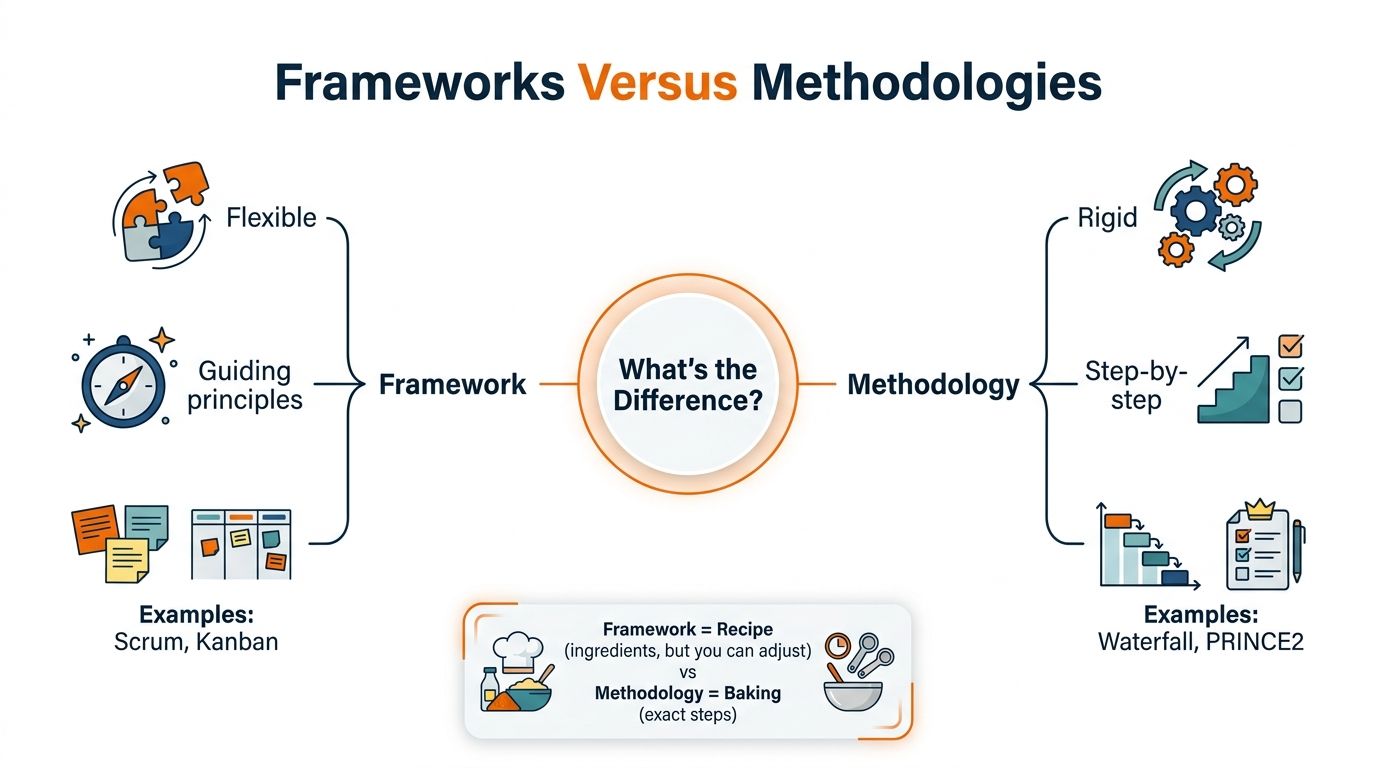
One more blunt truth. Teams often call Scrum, Kanban, or Waterfall a framework when they're really talking about delivery methods. That sloppy language leads to sloppy implementation. If you can't explain who owns the governance layer and who owns the execution layer, you don't have a framework choice yet.
Comparing Major Frameworks for SaaS and Nearshore Delivery
Waterfall still has a place, but only when requirements are stable and the cost of change is high. In SaaS, that usually means compliance-heavy work, migration work, or tightly specified internal tooling. It is rarely the right answer for fast-moving product discovery. For nearshore teams, Waterfall can help with clarity, but it also creates friction if the team needs to react quickly to new feedback or a shifting backlog.
Scrum works when a product team needs rhythm, focus, and frequent inspection. It fits bounded work best, especially when a product owner can make decisions quickly and clear priorities are in place. The downside shows up fast in distributed delivery. If the team runs Scrum ceremonies without real ownership, it turns into theatre. The business outcome it protects is momentum, but only when the backlog is healthy and the product direction is stable enough to support sprints. For teams comparing delivery models across regions, nearshore vs offshore delivery changes how much ceremony and handoff control you need.
Kanban is the cleanest fit for flow-heavy SaaS work. It helps teams visualise work, limit WIP, and keep delivery moving without forcing artificial sprint boundaries. That flexibility matters for nearshore teams handling support, operations, or continuous delivery. The trade-off is discipline. Mature teams need to manage flow properly or Kanban becomes a polite name for a queue.
PRINCE2 is still the strongest governance-oriented option for UK organisations that need stage gates, defined roles, and business-case discipline. Its long history, from 1996 to PRINCE2 7 in 2023, is part of why it remains a default in public-sector and enterprise environments Ravetree's UK project management history overview. It protects auditability and decision control, but it can slow MVP iteration if you apply it too rigidly. That is the trade-off.
PMBOK is not a delivery method in the day-to-day sense, it is a body of knowledge. It helps when an organisation needs a common language for scope, cost, time, quality, risk, and communications. For SaaS teams, that supports governance and portfolio alignment, but it will not tell you how to run your week. SAFe makes sense when multiple teams need coordinated alignment across a bigger product system, though it brings complexity of its own. Lean is strong when the priority is waste reduction and value flow. XP is the technical discipline option, especially where engineering quality and fast feedback matter more than process ceremony.
how to master PM interviews is useful here because strong interview answers show whether a candidate understands the trade-offs behind these choices, not just the vocabulary.
| Framework | Best For | Nearshore Fit | Governance Level | MVP Speed |
|---|---|---|---|---|
| Waterfall | Stable, well-defined work | Moderate | High | Low |
| Scrum | Bounded product increments | Good if ownership is strong | Medium | High |
| Kanban | Continuous flow and support work | Strong | Medium | High |
| PRINCE2 | Regulated UK delivery | Good for oversight-heavy teams | Very high | Low to medium |
| PMBOK | Shared governance language | Moderate | High | Indirect |
| SAFe | Multi-team alignment | Moderate to strong | High | Medium |
| Lean | Waste-sensitive delivery | Strong | Medium | High |
| XP | Engineering excellence and fast feedback | Strong | Lower on formal governance | High |
The right answer is usually not one framework. It is a governance layer with one or two execution styles underneath it, matched to the team's maturity and the product's uncertainty.
A Decision Matrix for Choosing Your Framework
Start with three inputs, uncertainty, team maturity, and governance requirement. A product still searching for fit needs a more adaptive execution style. A senior team that can self-direct can operate with lighter controls. If investors, auditors, or enterprise buyers expect traceability, the governance layer has to be stronger, whether the team wants it or not.
That is the context PMI keeps pointing to in its literature, where framework advice often skips factors like complexity, dynamics, and uncertainty PMI literature review. Generic guides miss the point because they describe methods in isolation. Real delivery teams do not work in isolation.
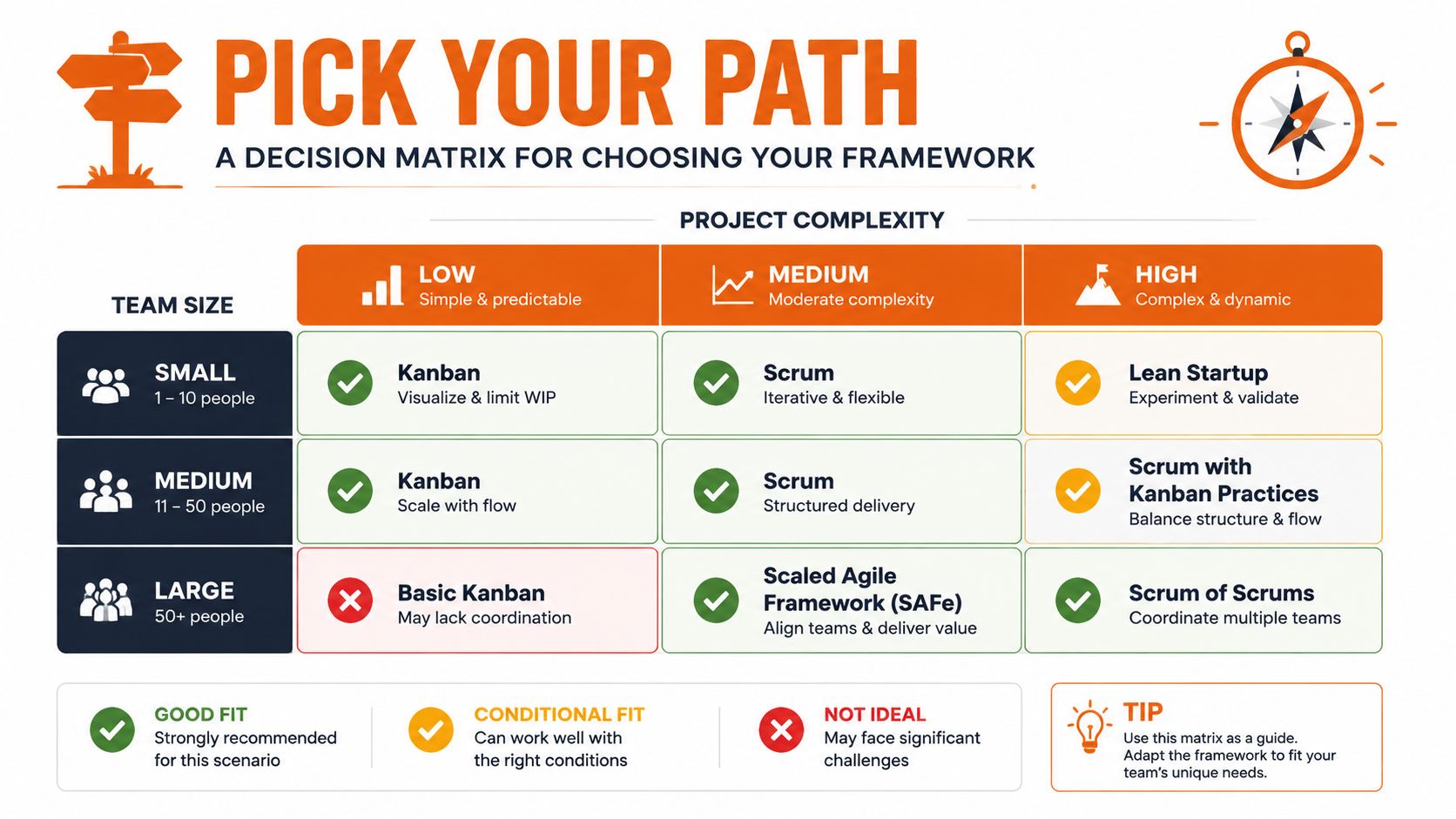
Use this scorecard before you commit
- Low uncertainty, high governance: Choose a controlled framework, then keep execution disciplined and visible.
- High uncertainty, medium governance: Use a flexible flow model or Agile execution, but keep reporting tight.
- Senior team, low governance: Kanban or XP-style execution usually gives the cleanest path.
- Junior or mixed team, high governance: Use a framework with clearer roles, tighter stage gates, and explicit decision ownership.
Test the framework on one real workstream before you roll it out across the team. A short pilot shows more than a slide deck ever will. That is why framework selection should feel closer to consulting than fashion. It is the same kind of judgment you need in how to master PM interviews, where strong candidates explain why a choice fits the situation instead of reciting labels.
My rule: If the framework cannot be explained to a founder in one minute, it is probably too complex for the job.
Treat the matrix as a decision aid, not a doctrine. The goal is to reduce the mismatch between the work and the operating model. If the work is uncertain, choose adaptability. If the stakes demand control, choose governance. If both are true, use a hybrid model and be explicit about where each part applies.
Real Delivery Scenarios and Framework Outcomes
A VC-backed startup needed to reach an MVP before a funding milestone. The team chose Scrum with a thin governance layer, because the core problem was focus, not bureaucracy. Short iterations kept the product moving, while the founder got regular visibility into scope trade-offs. The business win was not “better ceremonies”, it was a faster path to a usable release and a cleaner investor narrative.
A scale-up migrating a legacy monolith to microservices took a different route. The nearshore team used Kanban for the migration stream, because dependencies were fluid and new issues surfaced as the architecture changed. That kept work visible without forcing fixed-length cycles around uncertain technical tasks. The business outcome was steadier flow through the migration, fewer handoff surprises, and better coordination across regions.
An enterprise SaaS company with regulatory obligations went in the opposite direction and leaned on PRINCE2-style governance. The delivery team needed stage gates, formal ownership, and strong decision records because the cost of weak control was too high. Agile techniques still existed inside the delivery engine, but they sat within a stricter oversight model. That combination gave leadership more confidence that scope, risk, and accountability were being managed properly.
What these scenarios have in common
- MVP pressure rewards speed, but only if the team can separate must-have scope from noise.
- Migration work rewards flow visibility, because dependencies change too fast for rigid planning to stay useful.
- Regulated delivery rewards traceability, because stakeholders care about control as much as output.
In each case, the framework served the business context. None of the teams won because they picked a fashionable label. They won because they matched governance to uncertainty and execution to team reality. That's the kind of thinking a strong delivery partner brings to the table, whether the work is greenfield product build or a messy platform transition.
Implementation Steps and Common Pitfalls to Avoid
The cleanest way to adopt a framework is to treat it like a controlled rollout, not a company-wide personality change. Start by assessing the project constraints, then evaluate team capability, culture, and tooling. After that, pilot the framework on a real workstream and use the result to decide whether to scale it.
The five-step approach is straightforward. First, assess the workflow you already have. Second, choose the framework that matches uncertainty and governance. Third, train the people who will use it. Fourth, pilot it on one project. Fifth, scale only when the pilot shows the control layer is helping instead of slowing the team down Knowledge Train's framework selection guidance.
What usually goes wrong
- Skipping assessment, which forces teams to adopt a framework that conflicts with current delivery reality.
- Copy-pasting from other companies, which ignores culture, skill level, and tooling.
- Under-training the team, which turns good process into bad execution.
- Scaling too fast, which spreads confusion before the pilot proves value.
- Ignoring feedback, which traps the team in rituals that no longer fit the work.
That's where the Rite NRG mindset of Extreme Ownership matters. The framework is there to serve the team, not the other way around. If the controls are blocking delivery, the team should change the controls. If the team can't explain the controls, leadership should simplify them.
A two-week pilot is enough to get signal. You're looking for clarity on ownership, speed of decision-making, quality of handoffs, and whether the team can still ship without friction. Keep the experiment small, measure the behaviour, and adjust fast. A framework that can't survive a pilot probably isn't the right fit.
For teams that want a delivery partner with a consulting mindset, Rite NRG can also sit inside this conversation as one option among several, especially where SaaS delivery needs senior engineering, clear governance, and nearshore coordination. The point is not to sell process. The point is to build a delivery model that works.
Making Frameworks Deliver Business Value
Project management frameworks should do three things, reduce risk, improve decision-making, and help the team ship the right work at the right time. If they don't do that, they're just overhead with a nicer name. The strongest choice is always context-driven, pilot-tested, and adjusted as the product evolves.
Before you commit, ask four questions. Does this framework fit the uncertainty level of the work? Does it match the team's maturity? Does it satisfy governance requirements without slowing delivery to a crawl? Will it help us measure whether we met our objectives at closure, not just whether we completed tasks University of Wisconsin–Madison project management guidance?
Bottom line: Choose the framework that improves business outcomes, then keep refining it until it fits the way your team really delivers.
If you're a founder or CTO, don't let your framework become an inherited habit. Review the decision matrix, test your current operating model against it, and be honest about whether your process is helping or slowing you down. If you want a delivery partner that treats framework choice as a business decision, not a ceremony exercise, talk to Rite NRG and see how strategic software delivery support can fit your product roadmap.