A founder loses three weeks to black-box development, and the fix isn't more status updates. Communication transparency is about sharing the right information at the right time, and when nearshore partnerships master it, teams can ship up to 50% faster without losing control or quality.
That speed comes from a simple shift in behaviour. The team stops hiding work behind vague progress claims, starts surfacing decisions early, and builds a rhythm where risks, blockers, and trade-offs are visible before they turn into rework.
The Nearshore Speed Trap and How Transparency Breaks It
The first sign of trouble is usually quiet. The kickoff looked strong, the roadmap sounded realistic, and everyone left the first call feeling aligned. Then the updates thin out, the next demo arrives with surprises, and the founder realises the team has been building in the dark.
That pattern kills delivery speed because it turns software work into guesswork. When a nearshore team only reports at the end of a sprint, product decisions harden too late, dependencies get discovered in the wrong order, and the business pays for avoidable rework.
The real issue is not capacity, it's visibility
A lot of founders try to solve this by adding more meetings or hiring more people. That usually misses the point. The friction is rarely raw engineering capacity, it's the lack of a shared operating picture.
Practical rule: if the team can't show what changed, why it changed, and what it means for the release, you don't have a delivery system, you have a waiting room.
In nearshore SaaS delivery, communication transparency becomes the gear that connects daily engineering effort to business outcomes. It lets a product owner see whether a feature is blocked by scope, design, API readiness, or a decision that still needs to be made. It also gives senior engineers room to own the outcome, not just complete assigned tickets.
That's where trust and speed start to reinforce each other. The more visible the work, the less time leaders waste chasing context, and the more quickly the team can make sound calls. If you're still comparing partners, this guide to choosing a nearshore partner is worth a look before you commit to a delivery model.
Transparency turns ambiguity into momentum
The strongest nearshore teams don't promise silence and then surprise you with progress. They create a pattern where uncertainty appears early, gets discussed openly, and is tied to a clear decision path. That's what makes delivery predictable.
When people know the current state, the next decision, and the risk behind that decision, they stop guessing and start moving. That shift is cultural, but it's also operational. It's the difference between a team that “builds features” and a team that ships product.
What Communication Transparency Really Means for Delivery
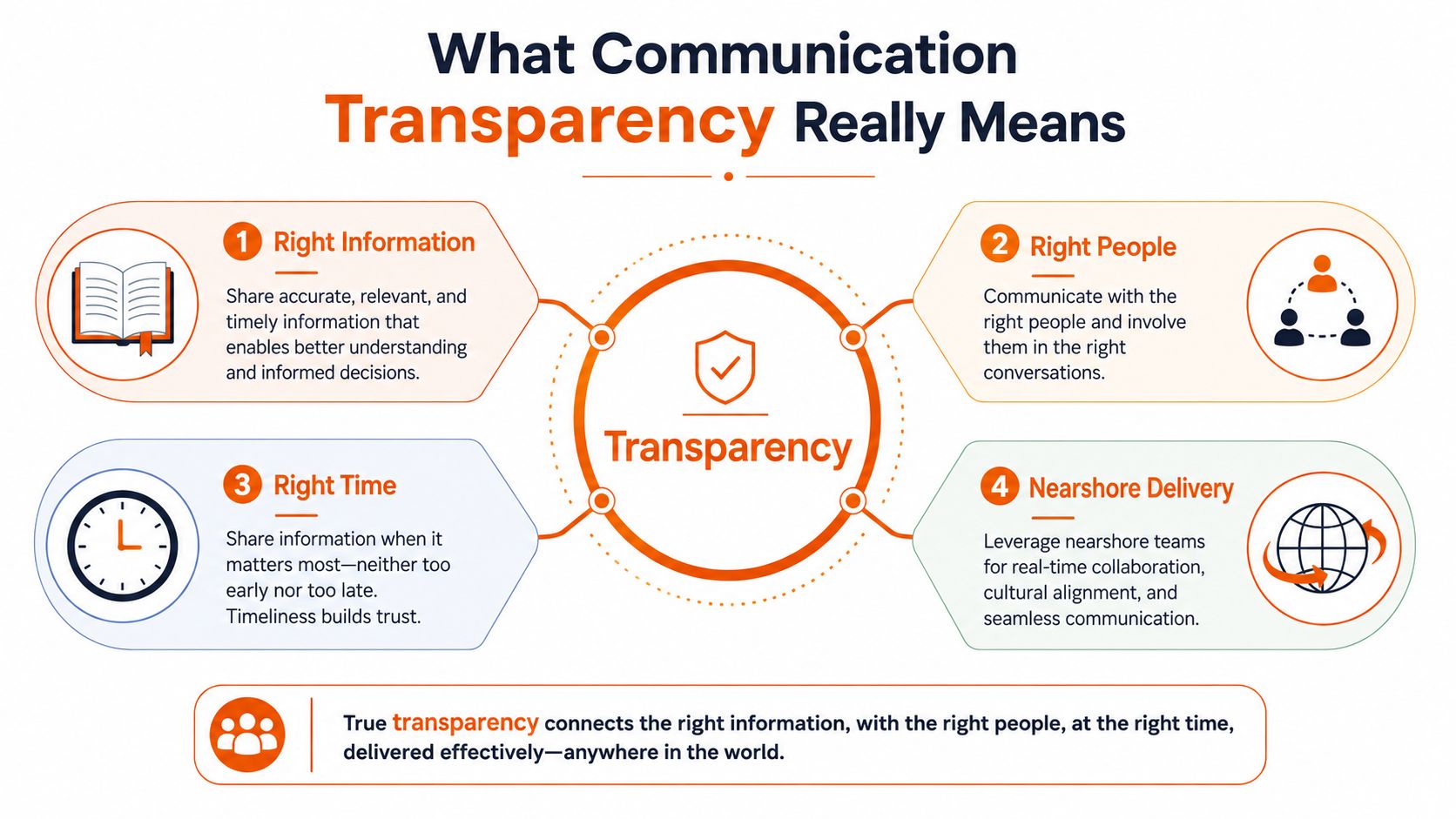
Communication transparency in software delivery is not about publishing every Slack message or opening every internal thread. It's the disciplined practice of making the right information visible to the right people at the right time, so decisions can be traced, risks can be spotted early, and work stays tied to business outcomes.
That definition lines up with the UK public sector's move toward intelligent transparency, where the default is proactive, open, clear, and accessible communication of statistics and analysis. The practical lesson is useful outside government too. Information should be traceable, contextualised, and understandable in isolation, not just dropped into a dashboard and left there. The UK guidance also expects communicators to cite sources, include caveats, and make visuals understandable on their own, which is exactly the discipline delivery teams need when they brief founders, investors, and internal stakeholders. See the UK's Intelligent Transparency 2025 review for the formal standard.
The operational side matters just as much. The CHAOSS communication-transparency metric looks at whether channels are accessible to all members, whether decision-making is open, and whether content is archived and discoverable. It also pushes teams to measure how much communication happens in private channels, because hidden work creates traceability problems and makes governance harder to audit. That is a useful lens for any SaaS delivery team that wants fewer surprises and cleaner handoffs. A practical companion to that framing is the internal stakeholder view in Rite NRG's stakeholder communication article.
Selective disclosure beats oversharing
Transparency is not maximal disclosure. That's where a lot of teams get it wrong. If you dump raw updates without context, you create noise, confusion, and sometimes legal or privacy risk.
The better model is selective, explainable disclosure. Share what affects decisions, explain why it matters, and be explicit about what is still uncertain. The WHO's transparency guidance says communication should be honest about what is known and unknown, and that information should be timely, reliable, and understandable so people can make informed decisions. That principle maps directly to delivery: don't hide uncertainty, frame it.
Transparency is strongest when it makes the next decision easier, not when it simply adds more text.
That distinction is what turns transparency from a soft skill into a delivery control. In a nearshore setup, it helps both sides know when to escalate, when to wait, and when to adjust scope before the schedule takes a hit.
The Business Outcomes You Actually Care About
Founders do not invest in transparency because it sounds mature. They invest because it changes what the business can predict, absorb, and ship. The payoff shows up in predictable delivery cycles, lower risk exposure, stronger stakeholder trust, and faster time to market.
Predictability comes from fewer hidden moves
When updates live in open channels and decisions are logged, teams stop relying on memory and side conversations. That matters because surprises are what blow up roadmaps. If the product owner, designer, and engineers all see the same decision trail, the release plan becomes easier to defend and easier to change without chaos.
The broader research points in the same direction. Communication guidance in the workplace consistently frames transparency as a way to reduce confusion and improve coordination, and international evidence used in public institutions suggests that being open about uncertainty does not automatically destroy trust. In fact, communicating uncertainty in numeric form produced only a small decrease in trust, and in some cases did not significantly reduce trust in the numbers or the source, which supports the idea that credibility and honesty can coexist. That finding is discussed in the medical preprint linked in the verified data, and it's especially relevant when product teams need to communicate risk without making false promises. See the evidence base in the research on uncertainty and trust.
Trust grows when leaders explain what they know and what they don't
Trust in delivery does not come from polished updates. It comes from honest ones. The WHO's guidance is blunt about this, communication should be honest about what is known and unknown, and it should help audiences make informed decisions with timely, reliable, understandable information.
That matters in SaaS delivery because founders don't need theatre, they need judgment. If a scope change will push a release, say it early. If the team is still assessing whether a dependency will land on time, say that too. Transparency gives stakeholders enough context to plan, and planning is what protects revenue and release confidence.
Speed improves when rework goes down
The fastest teams are not the ones that talk the least. They are the ones that remove avoidable churn. When context is visible, engineers stop building the wrong thing, product stops approving incomplete work, and handoffs stop creating duplicate effort.
A useful way to think about it is this, every hidden assumption is a future delay. Every clear decision log removes one. That's why transparent communication acts like a multiplier on execution. It reduces the cost of coordination, which is often the tax on delivery.
For teams building reporting culture around this, audit-ready KPIs for SaaS founders can also help shape what gets measured and discussed at the leadership layer.
Concrete Practices That Turn Transparency into a Daily Rhythm
Good intentions don't create transparency, routines do. The teams that get this right design a working cadence where information flows naturally, updates stay short, and decisions are easy to find later.
Build a cadence that matches decision speed
Start with the simplest rhythm that keeps the work moving. Daily stand-ups should be about blockers, dependencies, and changes in priority, not status theatre. Weekly syncs should handle scope, risk, and stakeholder questions. Monthly reviews should look at delivery patterns, not just output.
The point is to make each meeting answer a different question. Daily means, “what's stopped or changed.” Weekly means, “what do we need to decide.” Monthly means, “what's improving, what's slipping, and what needs an adjustment.”
Make the decision trail impossible to lose
If a team says something matters but never writes it down, it usually gets lost. A short decision log solves that. So do lightweight architecture notes, change records, and visible ownership on major items.
A good log doesn't need ceremony. It needs date, decision, owner, reason, and follow-up. That's enough to stop the classic “I thought we agreed” loop that burns time in remote teams.
Practical rule: if a decision can affect scope, cost, timing, or user experience, it belongs in an open log, not in someone's head.
Use a noise filter before every update
The University of Florida's guidance is useful because it turns transparency into a simple editorial check. Before sending an update, ask four things, is it relevant, actionable, needed now, and does it need extra context to prevent misinterpretation? That checklist keeps updates lean and useful instead of turning every message into a broadcast.
That means a bug report should not read like a status essay. It should say what broke, what it affects, what the team is doing, and when the next update arrives. A release note should make the impact and next step obvious. A dependency warning should name the blocker and the decision required.
Tie reporting to outcomes, not activity
SaaS delivery gets clearer when reporting focuses on consequences. “We closed 18 tickets” is not enough if the release is still blocked. A better report says what changed in the product, what risk is still open, and which decision is needed from leadership.
That's why reporting templates matter. They force consistency across teams, especially when a nearshore group is acting as an extension of the product organisation rather than an isolated vendor. The practical target is simple, every update should help someone make a decision faster.
Measuring What Matters for Transparent Delivery
If transparency is working, you should see it in the delivery data. The point is not to measure communication for its own sake, it's to measure whether visibility is reducing friction and improving decision quality.
Compare the engagement models side by side
| KPI | Transparent Engagement | Opaque Engagement |
|---|---|---|
| Cycle time variance | More stable because blockers are surfaced early | More volatile because surprises appear late |
| Risk hit rate | Lower because uncertainty is discussed before it becomes a blocker | Higher because issues stay hidden until they affect delivery |
| Stakeholder satisfaction | Stronger because updates are traceable and contextual | Weaker because stakeholders keep chasing answers |
| Decisions documented in open logs | Higher because ownership and rationale are visible | Lower because decisions live in chats or memory |
The table is not a promise of exact numbers, it is the pattern to watch. Transparent teams usually look calmer because they spend less time reconstructing context. Opaque teams often look busy because they spend more time recovering from misalignment.
Choose tools that preserve the trail
The right stack makes communication easier to find, not harder to manage. Open Slack or Teams channels with searchable history help. Confluence-style wikis or Notion pages give decisions and requirements a home. Decision-tracking apps make ownership visible. Dashboards can surface early warning signals when a dependency starts slipping.
The tool choice matters less than the discipline around it. A shiny stack with private threads and scattered updates still produces blind spots. The useful rule is simple, if someone joins the project midstream, they should be able to reconstruct the current state without asking five people.
For teams building their governance layer, software delivery metrics is a practical companion to this approach because the metrics only help when the communication around them is clean.
Metrics don't create transparency by themselves, they only expose whether the team has it.
Your 90-Day Roadmap to Transparent Nearshore Partnership
The fastest way to make transparency real is to treat it like a delivery rollout, not a culture slogan. A 90-day plan gives the team enough structure to change habits without drowning in process.
Weeks 1 to 2 establish the baseline
Start by agreeing on what transparency means in your partnership. Write a short charter that states where decisions live, who needs to see what, and which updates must always be public to the team.
Then capture the baseline. Look at current cycle time behaviour, recurring blockers, open decisions, and how often stakeholders have to ask for clarification. You don't need perfect data to begin, you need a starting point that shows where the blind spots are.
A good quick win is to create one shared space for decisions and one shared space for risks. That alone cuts down on the scavenger hunt that destroys momentum.
Weeks 3 to 6 install the operating rhythm
Now put the rituals in place. Daily stand-ups should surface blockers. Weekly syncs should review risks and upcoming decisions. A simple decision log should track what was decided, who owns it, and why it mattered.
This is also the right time to choose the tooling stack. Pick what your team will use, not what looks impressive in a demo. If updates are spread across email, chat, and random documents, the system is already leaking.
Watch for the common trap, over-communicating noise. If every message is long and low-value, people stop reading. Keep the updates short, contextual, and tied to action.
Weeks 7 to 12 optimise and scale
Once the rhythm is stable, move to the more advanced habits. Make architecture diagrams easy to find. Surface risks earlier, especially where a dependency could shift scope or timing. Publish the decisions that matter most to delivery, not just the ones that are convenient to record.
The Extreme Ownership mindset becomes the cultural glue. People don't wait to be asked for clarity, they provide it. They flag risk early, explain trade-offs plainly, and own the next step without hiding behind vague progress language.
The best exit criterion is simple, stakeholders stop chasing for context. The team can explain status, risk, and next action without scramble. At that point, transparency isn't a project, it's how the partnership operates.
If you're building a SaaS product and the current delivery model keeps producing surprises, Rite NRG can help you design a nearshore operating rhythm that's built for clarity, ownership, and speed. Visit Rite NRG to see how a transparent delivery partnership can help your team ship with more predictability and less friction.