You're probably living this already. Monday says the sprint is on track. Tuesday says design is blocked. Wednesday says engineering “just needs clarification”. Thursday your founder asks the only question that matters: are we moving the business forward or just moving tickets around?
That's where most SaaS teams get exposed. They don't have a progress problem. They have a truth problem. Too many dashboards report effort. Too few reveal whether the work is creating value, reducing risk, or improving confidence across the team.
At #riteway, we treat progress tracking as a business operating system, not a reporting ritual. If your tracking creates noise, drains energy, and still leaves leadership guessing, it's broken. Fixing it starts with ownership, clarity, and a hard pivot away from vanity metrics.
Stop Guessing Start Delivering
A founder walks into the weekly review. Product says the release is “close”. Engineering says the API work is “mostly done”. Sales says the promised feature still isn't demo-ready. Customer success says churn risk is rising because key accounts keep asking for the same thing.
Everyone is busy. Nobody is aligned. That's the trap.
Bad progress tracking creates a false sense of control. Teams produce stand-ups, status updates, and traffic-light reports, but leadership still can't answer basic questions. What changed this week? What risk got reduced? What business outcome moved? What decision do we need to make now?
Worse, the cost isn't only operational. It's human. In the UK, 3.3 million working days were lost to work-related stress, depression or anxiety in 2023/24 according to this UK-relevant discussion of tracking, transparency, and management burden. If your reporting system increases anxiety instead of clarity, you're not managing performance. You're manufacturing drag.
Activity is not progress
I've seen teams celebrate velocity while missing revenue goals. I've seen roadmaps hit delivery dates and still fail because nobody tied the work to adoption, retention, or customer behaviour. That's not discipline. That's theatre.
Poor progress tracking doesn't just hide delivery issues. It teaches teams that looking busy is safer than being honest.
The #riteway response is simple. We don't ask whether the team is active. We ask whether the team is removing uncertainty and creating measurable business movement. That changes the room immediately.
A useful review meeting should surface three things:
- What outcome are we trying to change: Revenue, retention, activation, onboarding speed, support load, or another business result.
- What evidence says we're moving: Not opinions. Observable signals from product, delivery, and customer data.
- What needs intervention now: A decision, a dependency, a trade-off, or a resource move.
Ownership beats reporting
Progress tracking should help people act. That's why I push leaders to connect it with benefits realization management strategies, because the discipline forces a better question than “did we ship it?” It asks “did we get the result we funded?”
That's the shift. Reporting looks backward. Ownership works the problem.
When teams adopt that mindset, status meetings stop being defensive. Product managers stop hiding behind roadmap language. Engineers stop being measured by output alone. Leaders stop getting surprised late. Energy goes up because people finally know what good looks like and what to do next.
Define What Actually Matters for Progress
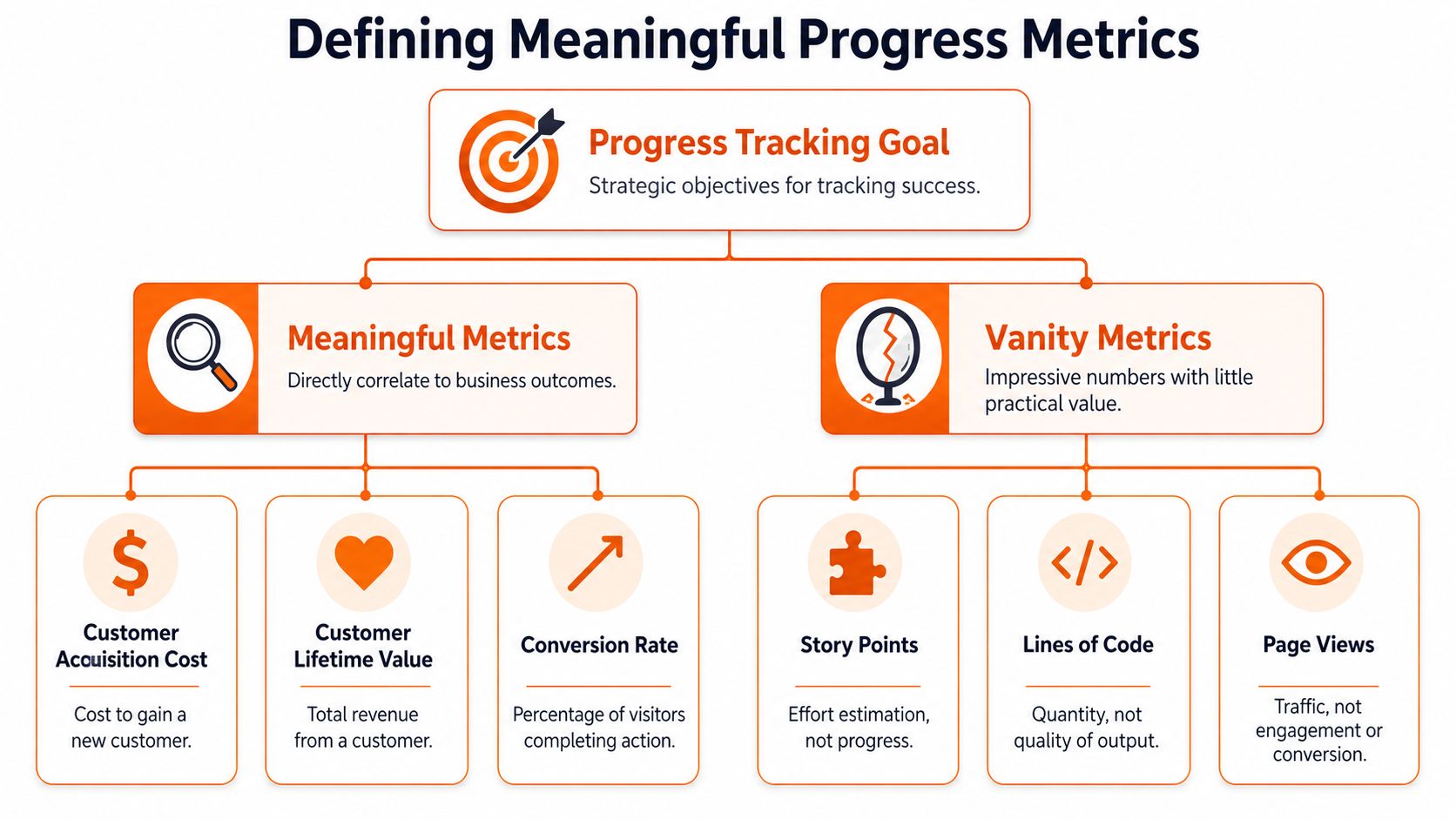
If your main delivery metrics are story points closed, lines of code, and number of tickets resolved, you're not tracking progress. You're tracking motion.
The fix is brutally practical. Start with the business outcome. Then work backwards until every team metric has a reason to exist. If a metric can't inform a decision, remove it.
Build the KPI chain from outcome to delivery signal
A solid progress-tracking method starts with a small set of outcome-linked KPIs connected to a single source of truth. It also requires governance, because inconsistent tagging and duplicate data distort trends and create false confidence, as outlined in this guidance on data tracking and accuracy controls.
Here's the model I use with SaaS teams:
Pick the commercial objective
Example: improve user retention after onboarding.
Define the product outcome
Example: more users complete the setup flow and return to use the feature again.
Choose the operational signals
Example: setup completion events, support issues linked to onboarding, release readiness, defect patterns, and blocked dependencies.
Assign ownership
Product owns behavioural change. Engineering owns delivery health. Leadership owns prioritisation and trade-offs.
Set review cadence
Review often enough to steer, not so often that the team starts feeding the dashboard instead of the product.
Kill vanity metrics early
Some metrics belong in planning discussions but should never sit at the centre of executive progress tracking.
- Story points: Useful for internal estimation. Useless as proof of market impact.
- Lines of code: More code can mean more complexity, not more value.
- Page views: Attention isn't the same as adoption, conversion, or retention.
A better structure is an opportunity tree that links customer pain, solution bets, and measurable outcomes. If you need a practical way to map that logic, use an opportunity solution tree approach to connect roadmap items to the result you care about.
A feature example that keeps teams honest
Say you're launching self-serve billing changes for a SaaS platform. The lazy version of progress tracking says:
- designs approved
- backend complete
- frontend complete
- QA in progress
That tells me almost nothing.
A serious version says:
| Layer | What to track | Why it matters |
|---|---|---|
| Business | Retention and expansion signals after launch | Confirms the change solves a commercial problem |
| Product | Billing flow completion and failed step patterns | Shows whether customers can use the feature |
| Delivery | Dependency blockers, test coverage confidence, release readiness | Tells leadership if launch risk is increasing |
| Customer | Support themes and sales objections | Reveals friction before it damages trust |
Practical rule: Every delivery metric should either predict a business result, explain a business result, or trigger a decision.
That's how you stop teams from building the thing right while missing the point entirely.
Build Dashboards That Answer Business Questions
Most dashboards are data graveyards. They collect charts, colours, and trend lines, then leave the reader to do the hard work of interpretation. That's lazy.
A dashboard should answer a business question in seconds. If the CEO, CTO, and product lead all leave with different interpretations, the dashboard failed.

Live visibility beats static reporting
Modern progress tracking at scale depends on live data. The UK's Census 2021 was 89.8% digital, covered more than 22 million households, and enabled initial results to be released on 28 June 2022 after Census Day on 21 March 2021, as described in this discussion of digital-first progress reporting. That matters because it shows what good systems do. They reduce lag between reality and action.
SaaS teams should hold themselves to the same standard. If your reporting depends on someone manually assembling slide decks every Friday, you're already too late.
Build for decisions, not decoration
The tool matters less than the architecture. Jira, Linear, GitHub, HubSpot, Salesforce, Mixpanel, PostHog, Looker, Power BI, Notion. Use what fits your stack. Just don't let each system tell a different story.
A strong dashboard setup has three traits:
- One source of truth for each signal: One owner, one metric definition, one place to validate it.
- Automated data flow where possible: Teams should spend time resolving issues, not copying updates between tools.
- Views by decision level: Executives need outcome and risk visibility. Delivery teams need bottlenecks, blockers, and trend context.
If you want a useful companion for sprint-level visibility, mastering burndown charts can help teams interpret one delivery signal correctly. Just don't confuse a healthy burndown with business success.
The dashboard questions that matter
Don't ask your dashboard to “show progress”. That's vague. Ask it to answer:
- Are we on track for the release we promised
- What is making this initiative slower than expected
- Has product behaviour changed since the launch
- Which dependency now threatens value delivery
- Where do leaders need to intervene
One practical route is to combine engineering telemetry, roadmap status, and product usage into a shared operating view. That's the philosophy behind approaches such as improving engineering productivity with measurable visibility. The point isn't more charts. It's faster, cleaner decision-making.
A dashboard should reduce argument. If it creates more of it, your definitions are weak or your data is fragmented.
Empower Your Nearshore Team with Transparency
Leaders often say they want transparency. Their underlying desire is reassurance. Teams can feel the difference immediately.
If progress tracking is used to inspect people, your nearshore team will protect itself. Updates become cautious. Risks surface late. Ownership drops because nobody wants to be the first person associated with bad news.
If progress tracking is used to remove blockers and sharpen decisions, the opposite happens. Teams flag issues earlier. Product trade-offs get cleaner. Engineers contribute context, not just task status. That's the culture you want.
Track the journey, not just the finish line
Effective tracking captures change over time, not only final outcomes. EU guidance on graduate tracking emphasises monitoring transitions and returns to understand the journey, and that principle is highly relevant in delivery work, as noted in this EU guidance on tracking development over time.
That means your team dashboard should show progression, not just completion. A task marked done tells me very little. I want to know whether the team is resolving uncertainty faster, reducing rework, improving handoffs, and learning from blockers.
For nearshore delivery, that matters even more. Distributed teams need context to make independent decisions without drifting away from the business intent.
What Extreme Ownership looks like in practice
At #riteway, transparency serves ownership. It doesn't replace it.
Use a weekly operating rhythm that forces shared understanding:
- Start with the outcome: What business result is this initiative meant to influence right now?
- Review movement, not narration: Show what changed in customer behaviour, delivery confidence, or risk posture.
- Name blockers in plain language: Don't bury uncertainty under polite status phrasing.
- Leave with actions and owners: Every concern needs a decision, an experiment, or an escalation path.
Here's what good sounds like in a healthy nearshore setup:
“The integration isn't stable enough for the planned release. We've isolated the issue, proposed two options, and need a priority call today.”
That's ownership. Not “we might have some challenges”.
A transparent nearshore model also depends on structural integration. The team needs the same visibility, planning context, and accountability mechanisms as the in-house group. That's why delivery leaders often rethink their model using a more embedded nearshore service structure instead of treating external teams as execution capacity on the edge.
Use data to build trust
The fastest way to kill team energy is to weaponise metrics. Don't rank developers by shallow output. Don't turn every dashboard into surveillance. Don't ask for manual updates that duplicate what tools already know.
Use tracking to support better conversations:
| Situation | Bad response | Better response |
|---|---|---|
| Velocity drops | Pressure the team for more output | Inspect blockers, scope, and handoffs |
| Milestone slips | Ask who missed | Ask what changed and what decision is needed |
| Defects rise | Demand extra reporting | Review quality gates and release assumptions |
Trust grows when people see that transparency leads to support, not punishment.
Use AI for Predictive Risk Detection
For many, progress tracking still functions like a rear-view mirror. They collect yesterday's updates, summarise last week's movement, then act surprised when the release goes off course.
That model is obsolete.
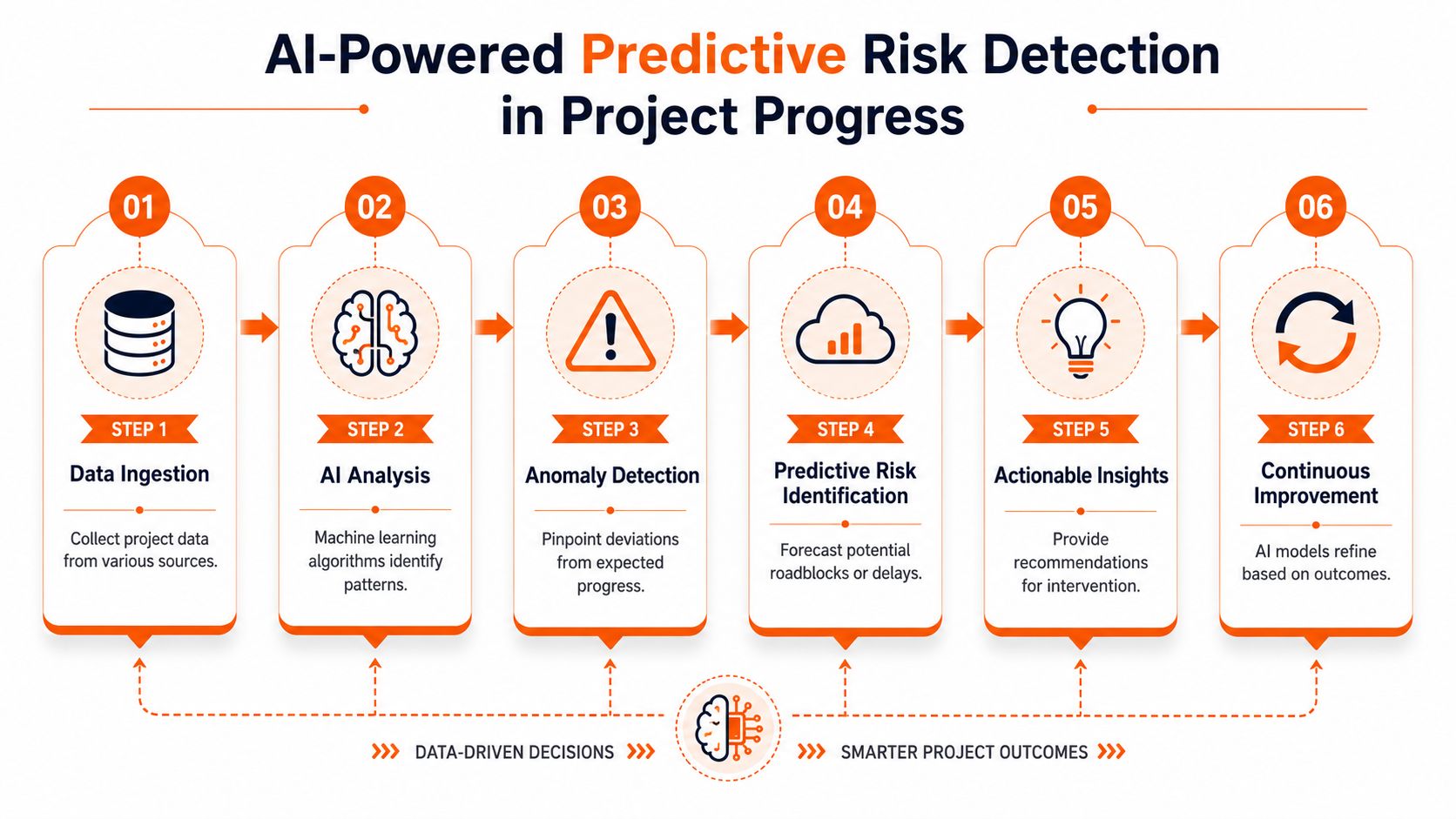
AI changes the role of progress tracking from historical reporting to pattern detection and forward-looking intervention. The value isn't magic. The value is speed. AI can process issue history, pull request flow, test signals, handoff delays, meeting patterns, and communication noise faster than a human lead trying to hold the whole system in their head.
What AI should actually do in delivery
I'm not interested in AI writing prettier status updates. I want it to surface risk before a stakeholder meeting turns ugly.
The useful applications are straightforward:
- Signal overload detection: Spot when one engineer, product manager, or QA lead is becoming a bottleneck.
- Delivery drift alerts: Flag when issue ageing, dependency churn, or repeated carry-over points to a likely miss.
- Quality risk patterns: Surface combinations of rushed merges, unstable test areas, and recurring defects.
- Communication gaps: Identify when critical work is moving without enough shared visibility across product and engineering.
These systems work best when connected to tools teams already use, such as Jira, GitHub, Slack, Linear, or release pipelines. One option in that category is Rite NRG, which applies AI across delivery workflows to automate status capture and surface risks earlier within software delivery operations.
Predict first, report second
Use AI to answer a different class of question:
- What's likely to break next?
- Which initiative is showing early signs of drift?
- Where is overload creating hidden risk?
- Which blockers repeat often enough to justify a process fix?
That's the leap from passive reporting to active delivery management.
Here's a useful visual summary of the workflow teams should be aiming for.
Keep humans in charge
AI should support judgement, not replace it. Leaders still need to validate context, make trade-offs, and talk to people. A model can flag a likely schedule risk. It can't decide whether to cut scope, add review depth, or delay a launch for strategic reasons.
The win isn't automation for its own sake. The win is getting earlier warning with enough clarity to act before the damage spreads.
That's the #riteway mindset in modern form. Use AI to shorten the distance between signal and response.
Your Progress Tracking Governance Checklist
Progress tracking fails when teams treat it as setup work. Build dashboard. Pick metrics. Job done. Then six months later nobody trusts the numbers, half the definitions changed, and leadership is back to asking for manual status reports.
Governance keeps the system honest.
The UK's move from a single economic score toward broader outcome monitoring is a useful model. After the Statistics and Registration Service Act 2007, the ONS launched a national well-being measurement programme in 2011 with 10 headline measures, later expanding to more than 40 indicators, as described in this summary of the UK's multi-metric approach to performance monitoring. That's the right lesson for SaaS delivery. Don't reduce progress to one score. Measure it holistically, but keep it governable.
Quarterly Progress Tracking Health Check
Use this as a practical operating checklist.
| Area | Check | Action if 'No' |
|---|---|---|
| Outcomes | Is every major initiative linked to a business outcome? | Stop reporting task completion as progress. Reconnect work to revenue, retention, adoption, or cost outcomes. |
| Metrics | Do we have a small set of stable metrics people understand? | Remove clutter. Redefine unclear metrics and document ownership. |
| Data quality | Do key dashboards pull from trusted systems with clear definitions? | Fix naming, tagging, and duplicate data issues before using trends in decisions. |
| Cadence | Are metrics reviewed on a consistent rhythm with decisions attached? | Set a recurring operating review and require actions, not passive updates. |
| Team behaviour | Do teams raise risk early without fear? | Change meeting behaviour. Reward early escalation and problem-solving. |
| Dashboard design | Does each dashboard answer a real business question? | Redesign around executive and delivery decisions, not chart volume. |
| AI support | Are we using automation to surface drift and bottlenecks early? | Start with one workflow, such as release risk or blocker detection, and expand from there. |
| Governance | Do we review whether metrics still fit the current strategy? | Run a quarterly reset. Retire stale measures and align with current priorities. |
Keep the system lean
Good governance is not heavy governance. It's disciplined review, clear ownership, and the courage to delete metrics that no longer help.
If your leadership team also uses OKRs, a practical OKR checklist can help tighten alignment between strategic goals and the measures that appear in delivery dashboards. That connection matters. Otherwise teams chase local progress while the business misses the bigger target.
Progress tracking should create confidence, focus, and energy. If it creates ambiguity, admin, or blame, rebuild it. Fast.
Rite NRG helps SaaS companies build predictable delivery systems with nearshore teams, product-first thinking, and AI-supported visibility across execution. If your roadmap looks busy but leadership still can't see real business progress, talk to Rite NRG about creating a delivery model that turns reporting into action.