Your backlog is swelling. Your roadmap looks strong in the board deck. Your team is busy every day. Yet competitors keep landing updates, closing deals, and getting to market before you.
That gap hurts because it's rarely caused by a lack of ideas. It's caused by delivery drag. Decisions sit too long. Handoffs pile up. Priorities change faster than the team can absorb them. Features ship late, quality slips, and suddenly “strategy” becomes a polite word for delay.
For SaaS companies, competitive advantage in 2026 isn't a slogan, a feature list, or a cheaper monthly plan. It's the ability to turn decisions into shipped customer value with speed, control, and consistency. That's what buyers feel. That's what investors trust. That's what your team can build on.
The UK market makes this even sharper. In the UK government's 2025 Cyber Security Breaches Survey, 43% of businesses reported a cyber breach or attack in the previous 12 months, rising to 52% among medium businesses and 70% among large businesses, with the average annual cost of a breach at £1,600 for businesses and £10,830 for charities in the same survey, as cited in this UK competitive intelligence statistics roundup. If your product delivery creates instability, weak governance, or customer risk, that cost lands right on your growth plan.
Introduction From Frustration to Forward Momentum
You probably don't need another theory-heavy article telling you to “differentiate” or “innovate”. You already know that. The issue is simpler and more brutal. Can your team ship the right thing fast enough, reliably enough, and clearly enough that customers choose you over the next option?
Most SaaS leaders get stuck in the same pattern. They treat competitive advantage as a positioning exercise while delivery runs as a separate operational concern. That split is a mistake. Customers don't buy your strategy slides. They buy outcomes, confidence, and momentum.
What founders actually lose to
A competitor doesn't need a better product to beat you. They just need to:
- Respond faster: Turn customer feedback into working product before you do.
- Reduce buyer anxiety: Show a cleaner implementation path, clearer ownership, and fewer surprises.
- Protect continuity: Deliver without avoidable outages, messy releases, or trust-killing mistakes.
That's why delivery execution matters so much. It shapes product quality, release confidence, implementation speed, and customer trust all at once.
Practical rule: If your roadmap depends on heroics, your advantage isn't real yet.
The shift that changes everything
The strongest SaaS businesses don't win because they guessed right once. They win because they built a machine that keeps learning, shipping, and adapting. That machine includes product, engineering, delivery management, quality standards, and decision-making discipline.
A high-energy operating model is particularly important. Teams that act with Extreme Ownership don't wait for perfect clarity. They surface blockers early, make trade-offs visible, protect momentum, and keep the business outcome in focus. That isn't culture theatre. It's an operating advantage.
If you want forward momentum, start with a hard reset. Stop asking, “What feature gives us a moat?” Start asking, “How do we become the team that delivers value faster, safer, and more predictably than anyone else in our category?”
Redefining Advantage for the Modern SaaS Playbook
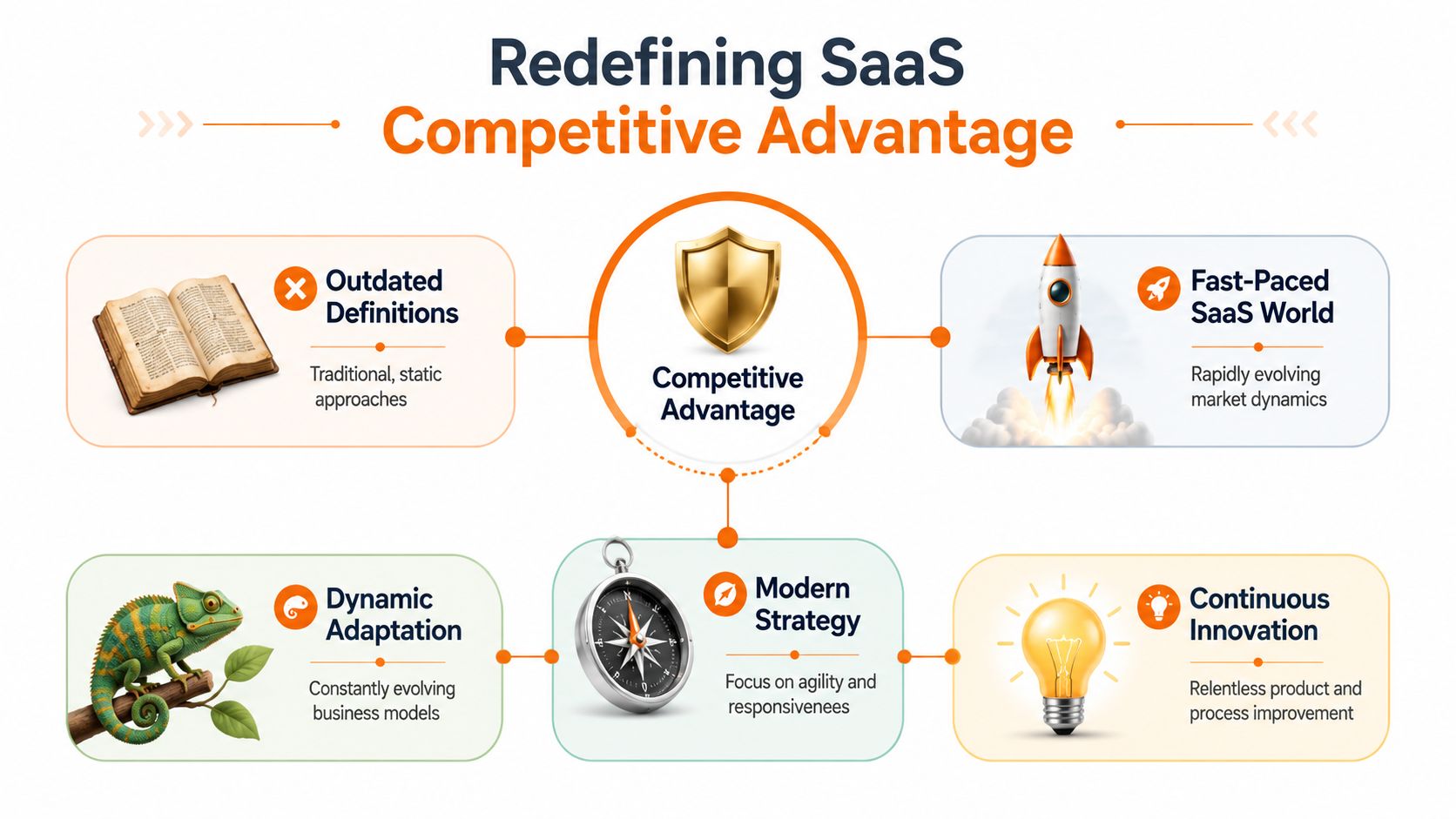
Textbook strategy still talks like markets are stable and moats stay put. SaaS doesn't work like that. Features get copied. Messaging gets copied. Pricing gets copied even faster. Your edge comes from your ability to keep moving while other teams slow down.
That means competitive advantage is no longer something you own once. It's something you recreate weekly through execution quality.
Why delivery capability now matters more
The UK economy has already moved in this direction. The Office for National Statistics reported that UK investment in intangible assets reached £137.6 billion in 2022, meaning competitive advantage increasingly comes from scalable know-how and software assets rather than physical infrastructure, as referenced in this market research and competitive analysis guide. For SaaS leaders, that should be a wake-up call. Your process is an asset. Your engineering discipline is an asset. Your release model is an asset.
If your internal operating system is weak, your market position won't hold. A polished brand can hide poor delivery for a while. It can't hide it for long.
The new definition that actually works
For a modern SaaS company, competitive advantage comes from a few repeatable behaviours:
- Learning faster than rivals
- Shipping with fewer avoidable delays
- Adapting without chaos
- Protecting trust while moving quickly
- Turning complexity into clarity for customers
The #riteway mindset is useful even beyond one company. High energy, proactivity, and Extreme Ownership sound cultural, but they produce hard business results when applied properly. Teams with those habits escalate earlier, unblock faster, and stop wasting time on performative busyness.
A lot of leaders still separate “strategy” from “delivery”. Don't. If you want a sharper lens for understanding where rivals are vulnerable, this guide to a competitive analysis framework is a useful companion because it helps translate market observation into operational choices.
Competitive advantage in SaaS is a moving target. The team that adapts fastest usually takes it.
What to stop doing
Drop the old assumption that advantage lives in a static moat. In SaaS, the moat leaks. The smarter move is to build an organisation that can respond before competitors finish their internal debate.
That's why the best operators focus less on abstract positioning language and more on how work flows from idea to release. That flow is where advantage gets built or lost.
Choosing Your Battleground Key Delivery Strategies
You can't be best at everything. Trying to win on product richness, speed, service depth, customisation, and low price at the same time usually creates a confused offer and an exhausted team.
Pick your battleground. Then organise delivery around it.
The three battlegrounds that matter
For most SaaS companies, the primary options narrow down to three:
| Strategy | Primary Goal | Example Metric | When to Use It |
|---|---|---|---|
| Superior product experience | Make the product easier, clearer, and more valuable to use | Activation success, support theme reduction, feature adoption | Use it when your market is crowded and usability decides renewals |
| Delivery speed and predictability | Ship useful improvements quickly and reliably | Cycle time, release reliability, implementation lead time | Use it when buyers need momentum and your category changes fast |
| Optimised cost-to-performance ratio | Deliver strong value without bloated cost | Gross margin confidence, onboarding efficiency, service effort per customer | Use it when budgets are tight and buyers scrutinise value hard |
Classic frameworks like cost leadership and differentiation still matter. But for SaaS, they only become useful when translated into day-to-day delivery choices. A strategy that doesn't affect backlog priority, staffing, quality gates, and release cadence isn't a strategy. It's decoration.
Use data to choose, not opinion
UK-based SaaS enterprises that implement data-driven cultures achieve a 40% higher competitive advantage margin compared to peers, with a 25% increase in customer retention rates and performance that outpaces competitors by 30%, according to the verified data provided for this brief. That matters because it shows the battleground shouldn't be selected by instinct alone. It should be tested against what customers do.
Use your own signals:
- Sales friction: Where do deals stall?
- Customer success pain: Where does value take too long to show up?
- Engineering bottlenecks: What repeatedly slows release confidence?
- Support patterns: Which issues expose weak product decisions or weak execution?
Don't confuse strategy with wishful thinking
A founder says, “We win on quality,” but releases are delayed and onboarding is messy. That's not quality. That's aspiration.
A product leader says, “We're premium,” but buyers can't see implementation certainty. That's not premium either. Premium requires confidence.
If you're preparing a launch and want a useful operational lens, this practical guide on how to launch a new product is worth reviewing because it forces strategy into concrete launch decisions rather than vague goals.
The right strategy is the one your team can support operationally every week, not the one that sounds best in a pitch.
A sharper way to decide
Ask these questions:
- What do buyers reward fastest in our category?
- Where does our team already have natural strength?
- What can we prove consistently, not occasionally?
- Which promise can delivery sustain under pressure?
Then commit. A focused delivery model beats a broad, unfocused promise every time.
The Engine of Advantage Unlocking Delivery Velocity
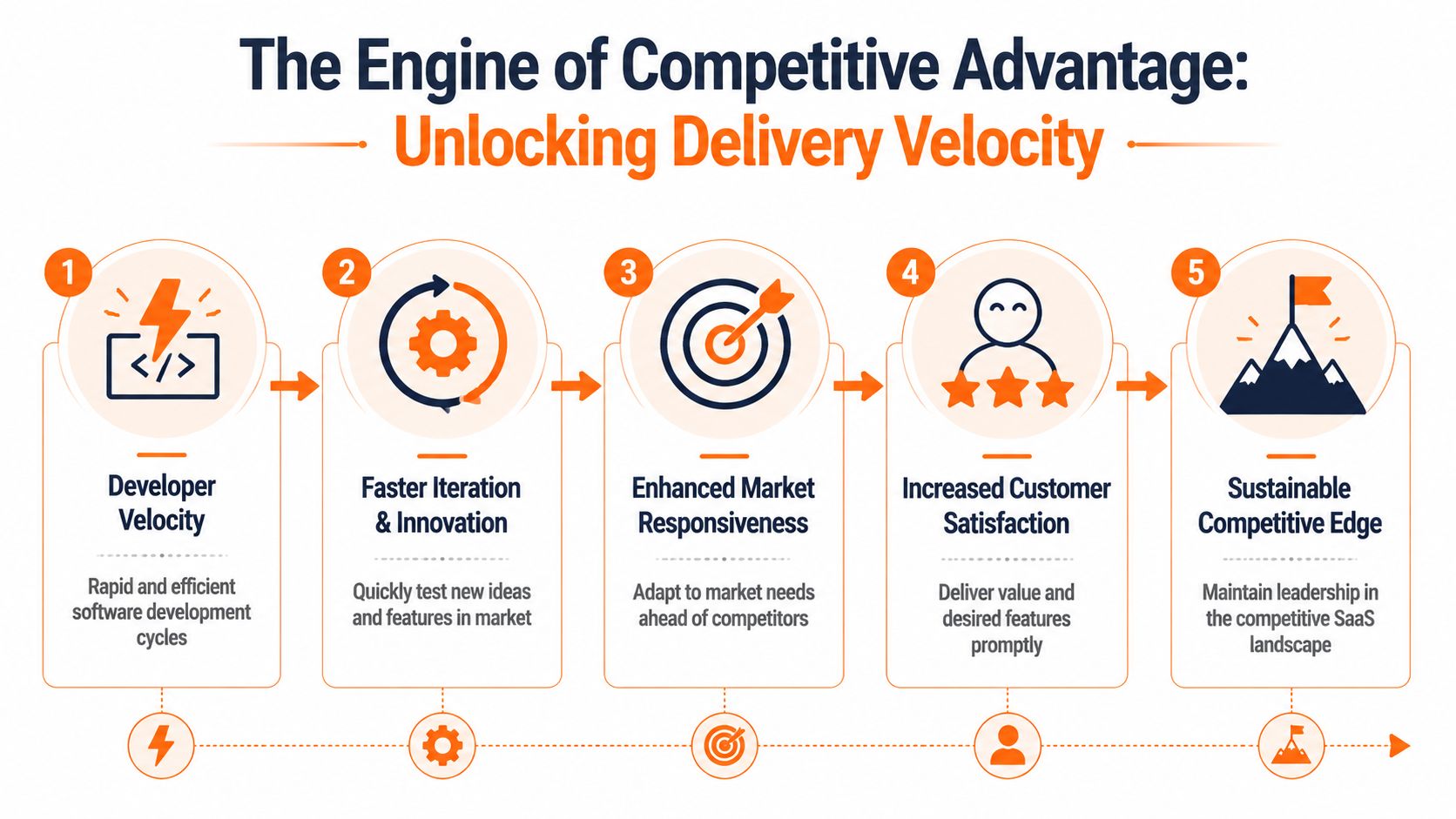
If you want one lever with outsized impact, it's delivery velocity. Not speed for speed's sake. Not reckless shipping. Delivery velocity means your team can turn a business idea into a secure, reliable, customer-facing outcome without getting trapped in friction.
That's the engine behind competitive advantage.
Velocity is a business metric
Too many teams talk about productivity as if it belongs only to engineering. It doesn't. Velocity affects revenue timing, customer trust, implementation confidence, and how fast leadership can test strategic bets.
In the UK, 39% of senior technology leaders strongly agree that “we are using technology to drive our business outcomes”, and firms using modern tech achieve operational excellence 2.5x faster, according to the verified data in this brief. That's the shift. Technology isn't support work. It's an operational advantage.
What high velocity actually looks like
You don't need a buzzword list. You need observable signs:
- Shorter cycle time: Work moves from decision to production without sitting idle for days.
- Stable releases: Teams ship without turning every deployment into a risk event.
- Visible ownership: Everyone knows who is driving a blocker to resolution.
- Fast feedback loops: Product, engineering, and commercial teams learn quickly from what ships.
- Low coordination drag: Fewer meetings, fewer handoff delays, fewer status theatre rituals.
Here's a solid reference point on improving engineering productivity if you want to diagnose where your flow is being throttled.
The friction you need to remove first
Most delivery slowdowns aren't caused by weak developers. They're caused by weak systems around them.
Common examples include:
- Bloated backlog intake: Everything enters the queue with equal emotional weight.
- Unclear acceptance criteria: Engineers start building before the outcome is properly framed.
- Late QA involvement: Problems surface when fixing them is expensive.
- Fragmented tooling: Context lives across Slack, Jira, Notion, email, and someone's memory.
- Hiring lag: Critical roles stay open too long, so the team works around capability gaps.
If hiring capacity is slowing your product momentum, this outsourced recruiting guide is useful because it shows how companies reduce recruitment drag without treating hiring like an afterthought.
A short explainer can help anchor the point:
How to build velocity with Extreme Ownership
Attitude becomes execution. Extreme Ownership means nobody hides behind process gaps. If a dependency is unclear, someone drives clarity. If quality risk appears, someone raises it early. If priorities clash, leadership resolves it fast instead of forcing the team to absorb ambiguity.
Use this operating standard:
- Make work smaller. Smaller bets move faster and expose risk earlier.
- Push decision-making closer to the work. Senior teams don't need permission for every move.
- Instrument delivery. Measure flow, blocked work, release confidence, and rework themes.
- Review blockers weekly. Not in abstract. Name them, assign them, remove them.
- Protect shipping cadence. Urgency without rhythm creates churn, not velocity.
If your team can't predictably ship, your strategy is still trapped in planning mode.
The Accelerant AI and Nearshore Senior Teams
Once you've tightened your delivery engine, the next question is obvious. How do you increase capacity without adding chaos?
The best answer isn't “hire faster at any cost” or “sprinkle AI on everything”. It's combining senior nearshore teams with AI-augmented delivery in a controlled way. That pairing gives you speed without losing judgement.

AI is useful when it's embedded in the workflow
The question in the UK isn't whether AI matters. It does. The more important question is whether you can operationalise it responsibly. The verified data for this brief makes that clear: with the UK Information Commissioner's Office emphasising governance, the advantage comes from embedding AI responsibly inside delivery, recruitment, and risk management to prove maturity and build trust, as discussed in this piece on sustained competitive advantage.
That's the standard to follow. Use AI where it improves execution quality:
- Backlog triage: Group duplicate requests, highlight missing context, and flag unclear tickets.
- Risk surfacing: Detect likely blockers across dependencies, scope changes, and delivery plans.
- Reporting automation: Turn noisy project data into clean stakeholder summaries.
- Recruitment support: Speed up sourcing and screening while keeping senior judgement in the loop.
- Documentation support: Draft release notes, implementation summaries, and internal handover material.
What you shouldn't do is let AI make unchecked decisions in sensitive workflows. That creates governance debt fast.
Why nearshore senior teams outperform generic augmentation
A nearshore senior team gives you overlapping time zones, stronger communication rhythm, and faster integration into product decisions. But seniority matters more than geography alone. You need people who can challenge assumptions, reduce ambiguity, and own outcomes from day one.
That's especially important in fast-moving SaaS environments where delay usually comes from unclear choices, not raw coding effort.
For leaders comparing operating models, this breakdown of nearshore vs offshore helps clarify where collaboration quality, responsiveness, and control start to diverge.
The compounding effect
AI plus senior nearshore talent works because each offsets the other's weakness.
| Component | What it does well | What it still needs |
|---|---|---|
| AI inside delivery | Speeds up analysis, admin, surfacing patterns, and repetitive coordination | Human judgement, governance, prioritisation |
| Senior nearshore team | Drives decisions, handles complexity, communicates clearly, owns results | Leverage from automation and good operating data |
That's why the combination is so effective. AI reduces grunt work. Senior operators use the freed capacity to solve harder business problems.
If you're also tightening commercial execution, this guide on building automated revenue systems is useful because it shows the same principle on the go-to-market side. Better systems create better outcomes when experienced people run them well.
Raw capability isn't enough. Controlled capability wins.
Your Action Plan A Checklist for Extreme Ownership
You don't need a twelve-month transformation programme to build competitive advantage. You need disciplined action on the few things that change delivery performance quickly.
The UK challenge is clear. In a price-sensitive market, advantage doesn't come from features alone. It comes from speed, transparency, and implementation certainty that answer the buyer's real question: can you reduce risk and save time fast enough to justify the spend? That framing is captured in this discussion of underserved market questions around price-sensitive buyers.
Start with the bottlenecks, not the buzzwords
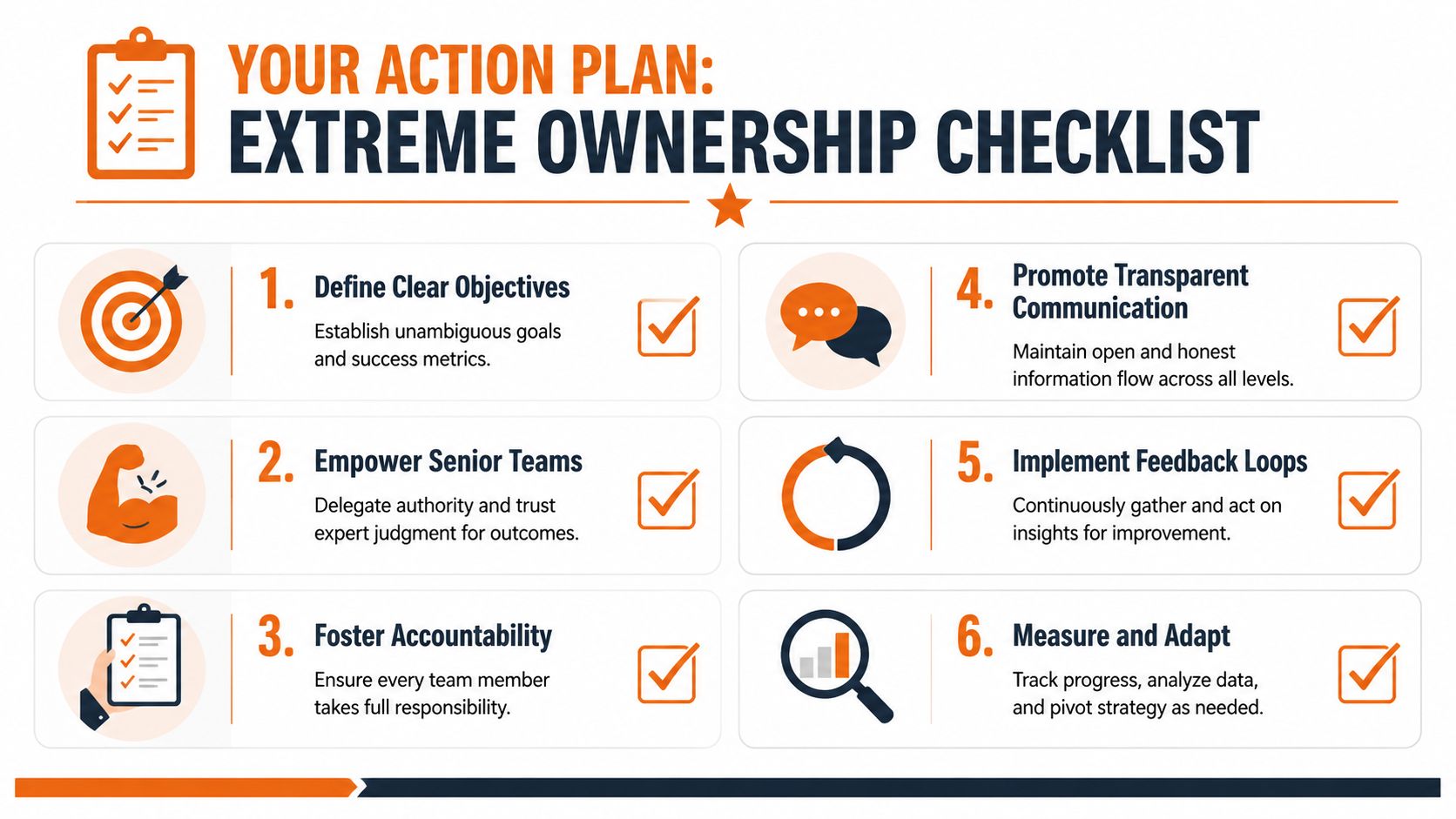
Run this checklist with your leadership team and be honest:
- Define the battleground. Decide whether you're really competing on product experience, delivery speed, or cost-to-performance. If you can't name it clearly, your team can't support it consistently.
- Map delivery friction. Identify where work stalls. Look at prioritisation, specification quality, testing flow, approval delays, and release management.
- Audit ownership. Find every recurring issue that “belongs to everyone”. Those are usually the issues nobody resolves properly.
- Tighten feedback loops. Connect product, engineering, sales, and customer success around the same signals so decisions reflect reality, not department bias.
Build the operating system your buyers can feel
Then move from diagnosis to execution:
- Set outcome-based metrics: Track the few indicators that show whether delivery is improving customer value and commercial momentum.
- Use senior decision-makers: Put experienced people close to the work so ambiguity gets resolved early.
- Standardise communication: Keep updates clear, short, and honest. Buyers and internal teams both trust predictability.
- Add automation selectively: Use AI and tooling to remove repetitive drag, not to hide weak leadership.
- Rehearse implementation certainty: Make onboarding, release communication, and change management part of the product experience.
Hold the line on standards
Extreme Ownership is not motivational wallpaper. It's a management discipline. It means leaders stop tolerating avoidable ambiguity, delayed escalation, and vague accountability.
Use this review cadence every month:
| Checkpoint | What to ask |
|---|---|
| Strategy fit | Are we still delivering against the battleground we chose? |
| Flow health | Where is work slowing down right now? |
| Team capability | Do we have enough seniority in the right places? |
| Customer proof | Can we clearly show speed, trust, and value delivery? |
Buyers may compare your pricing first. They decide based on confidence.
The #riteway mindset in practice
If you want a durable competitive advantage, build it into how your team works every day:
- Own problems early
- Escalate with options
- Reduce wait states
- Make progress visible
- Protect quality while moving fast
- Treat delivery as a strategic weapon
That's how you stop reacting and start pulling ahead.
If your SaaS team needs to ship faster without losing control, Rite NRG is built for exactly that. They combine senior nearshore engineering, product-first thinking, and AI-powered delivery processes to help companies turn roadmap pressure into measurable business outcomes. If you want a partner that brings energy, ownership, and execution discipline instead of just extra hands, they're worth talking to.