Most advice on cross functional collaboration is weak. It tells you to improve communication, run more meetings, and align stakeholders. That sounds sensible. It also produces bloated calendars, slower decisions, and roadmaps nobody trusts.
Collaboration isn't valuable because it feels inclusive. It's valuable when product, engineering, design, data, and commercial teams help the business ship faster with fewer surprises. If that doesn't happen, you don't have collaboration. You have ceremony.
Many teams are performing collaboration rather than practising it. They talk often, but they don't decide clearly. They involve many functions, but nobody owns the outcome. They say they're aligned, but each function still optimises for its own local target.
That's why strong delivery leaders treat cross functional collaboration as an operating system for speed and predictability. Not as culture theatre. Not as a morale initiative. As a hard business discipline.
Why Most Cross Functional Collaboration Fails
The default assumption is wrong. Bringing more functions into the room does not automatically improve delivery. In many SaaS organisations, it does the opposite.
A Harvard Business Review study cited by EIMF reveals that nearly 75% of cross-functional teams are dysfunctional, often failing to meet key objectives, deadlines, or quality standards due to poor coordination and unshared objectives. That should reset the conversation immediately.

Fake collaboration looks busy
I've seen the same failure pattern repeatedly in product delivery.
- More attendees, less accountability. Product thinks engineering owns delivery risk. Engineering thinks product owns scope clarity. Design thinks decisions were already made elsewhere.
- Shared meetings, private agendas. Sales wants launch dates. Product wants discovery time. Engineering wants technical stability. Nobody translates those trade-offs into one business decision.
- Constant updates, weak decisions. Teams post in Slack, comment in Jira, and write in Confluence. Then they still escalate basic questions because the responsible party was never specified.
This is why “better communication” is lazy advice. Communication is only useful if it reduces ambiguity, resolves dependency risk, and sharpens ownership.
Cross functional collaboration fails when teams share information without sharing responsibility.
The root problem is structural
Most organisations don't have a collaboration problem. They have a design problem.
People are asked to work cross functionally while incentives, planning cycles, and decision rights stay function-specific. That creates friction by default. Product commits to one thing, engineering is measured on another, and operations enters the discussion after the expensive choices are already locked in.
A 2024 Deloitte survey of UK executives found that 54% say cross-functional collaboration is “often occurring” or “always occurring” at the worker level. That means a large share of organisations still experience collaboration as inconsistent rather than normal. The gap isn't aspiration. It's execution.
What high-performing teams do differently
Real cross functional collaboration is disciplined and outcome-led.
- They define one shared outcome before discussing tasks.
- They make decision ownership explicit instead of assuming goodwill will sort it out.
- They expose risks early instead of saving face in status meetings.
- They treat missed hand-offs as delivery failures, not personality clashes.
If your collaboration model creates more motion than momentum, fix the model. Don't add another workshop and hope people become magically aligned.
The Real Prize Faster Time-to-Market and Predictability
The value of cross functional collaboration isn't harmony. It's speed you can trust.
Founders don't care that teams had a productive planning session. CTOs don't care that Slack channels are lively. Product leaders care whether ideas move from decision to delivery without getting trapped in rework, hand-off delays, and last-minute surprises.
Align around business outcomes first
Teams move faster when they stop treating functions as separate lanes and start treating delivery as one joined-up system.
According to Forrester, organisations that clarify a small set of enterprise outcomes and align them across functions can reduce time-to-market by up to 40% and achieve 25% higher business agility. That's the payoff. Not nicer workshops. Faster execution and better response to change.
That shift matters in SaaS because delay compounds. When product waits on engineering clarification, engineering waits on design decisions, and go-to-market waits on release confidence, your roadmap slips one “small” dependency at a time.
Predictability beats raw activity
A busy team isn't a predictable team. Predictable teams do a few things relentlessly well:
- They decide what matters most. Not ten priorities. A tight set of outcomes.
- They involve the right functions early. Not for ceremony, but to kill avoidable rework.
- They convert ambiguity into decisions quickly. Open questions don't sit around for a week.
- They surface delivery risk in plain language. No one hides behind technical jargon or vague product speak.
This matters even more when you're shipping MVPs, scaling a platform, or integrating a nearshore team into the mix. In those settings, collaboration has to improve delivery confidence from day one. If it doesn't, you've added cost and coordination overhead without improving output.
Practical rule: If a collaboration habit doesn't shorten decision cycles or improve delivery confidence, cut it.
What leaders should demand
If you lead a SaaS product, stop asking whether teams are collaborating well. Ask sharper questions.
- Did alignment reduce time between idea and committed work?
- Did shared ownership reduce avoidable rework?
- Did earlier input from engineering, design, or data improve delivery confidence?
- Can the team explain trade-offs in terms of customer value and business timing?
Those questions force teams to connect collaboration to commercial reality.
The strongest cross functional collaboration models also remove a common trap. They stop functions from protecting their own workload at the expense of business flow. Product doesn't throw half-shaped ideas over the wall. Engineering doesn't disappear into implementation. Design doesn't become a late-stage approval gate. Everyone works against one delivery outcome, with one definition of success.
That's the prize. Faster time-to-market is the headline. Predictability is the advantage that keeps paying back after the launch.
The #riteway Framework for High-Energy Teams
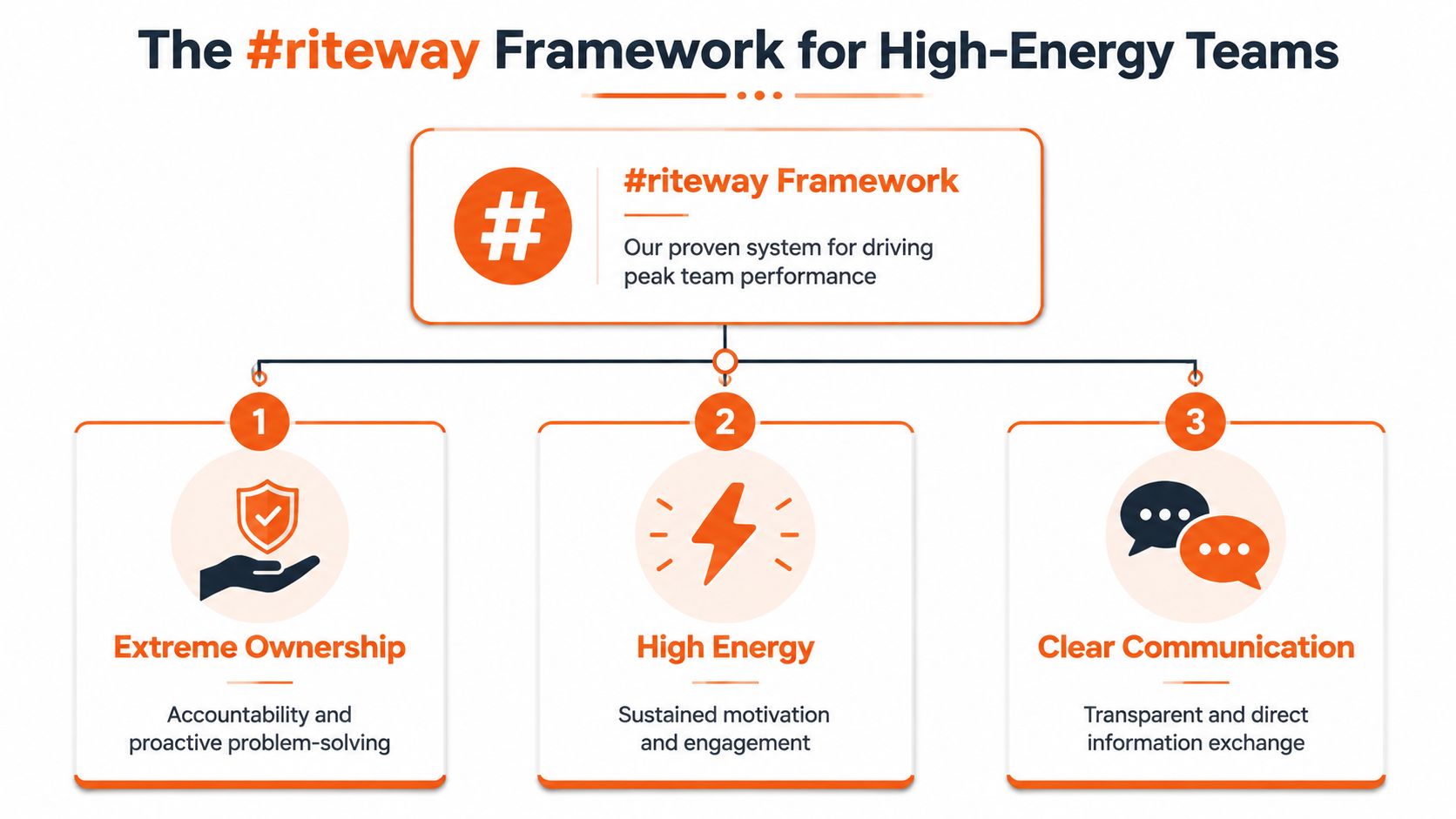
Good intentions don't create a high-performing team. Operating habits do. The #riteway methodology works because it makes ownership visible, energy practical, and communication direct enough to keep work moving.
Extreme Ownership removes the blame game
Extreme Ownership means nobody says, “That wasn't my part.” If a dependency is slipping, a decision is blocked, or a requirement is unclear, the team member who sees it acts. They don't wait for permission to be responsible.
In practice, that means product managers clarify assumptions early. Engineers raise delivery risk before sprint plans collapse. Designers challenge unclear problem framing instead of polishing weak ideas. Delivery leads make trade-offs visible before they become deadline drama.
This mindset is hard for teams that are used to role protection. It is exactly what makes delivery predictable.
High energy is disciplined, not loud
High energy doesn't mean forced enthusiasm. It means the team maintains momentum under pressure. People respond quickly, communicate clearly, and keep a constructive tone when the work gets messy.
A useful rule here is feedback quality. According to USCCG, 78% of professionals do not respond well to overly negative feedback, which is why constructive framing matters if you want accountability without draining ownership. In strong teams, peer reviews are mandatory, specific, and aimed at improving the work rather than scoring points.
- Use direct comments when scope is vague or quality is weak.
- Frame criticism around outcomes so the team can act on it.
- Expect peers to review each other's work before issues become leadership escalations.
Clear communication keeps work moving
Most delivery friction comes from soft language. “We should be fine.” “This might be tricky.” “I thought someone else had it.” That language kills timing.
Clear communication sounds different. It names the owner, the risk, the deadline, and the consequence. That's why high-performing leaders invest in communication habits, not just communication tools.
If you're shaping that capability at leadership level, this guide to AI tools for business leaders is useful because it shows where AI can support sharper thinking, faster synthesis, and more focused execution rather than adding noise.
For team design habits, the thinking behind building high-performing teams is simple and right. Build around ownership, fit, and delivery behaviour, not a shopping list of technical skills.
Leadership test: Ask any team member what the top outcome is, what could stop it, and who owns the next decision. If answers vary, your collaboration model is weak.
Your Implementation Roadmap to Seamless Collaboration
Cross functional collaboration becomes real when you turn principles into operating rules. Most companies skip that part. They announce a new way of working, hold a kickoff, then drop people back into the same unclear system.
Start with a practical implementation path instead.
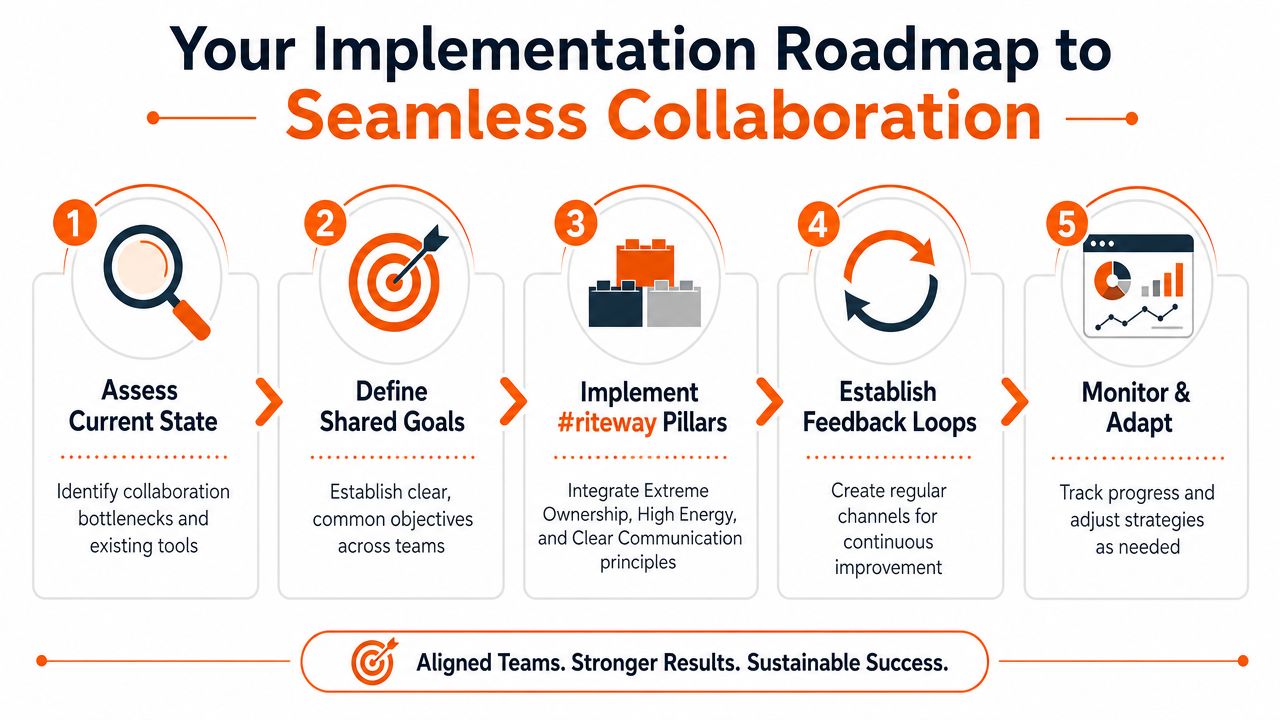
Step one and two set the foundation
Assess the current state
Don't start with tooling. Start with friction. Map where work slows down, where approvals pile up, and where dependencies routinely surprise the team. Look at hand-offs between product, engineering, design, QA, data, and commercial stakeholders.Define one shared outcome per initiative
Every cross-functional effort needs a business result that all functions can recognise. If product is chasing adoption, engineering is chasing refactoring, and sales is chasing launch dates, you don't have collaboration. You have parallel agendas.
The first workshop should answer three things: what outcome matters, what assumptions sit underneath it, and who decides when trade-offs appear.
A resource model matters here too. A consulting mindset means you don't rely on vague promises like “engineering will support when needed”. According to LinkedIn's cross-functional KPI guidance, formalising contributions through a Resource Exchange Agreement turns loose expectations into commitments and increases cross-partnership success rates by 35% when early wins are demonstrated.
Step three and four make it operational
Implement explicit working agreements
Decide where truth lives. In many teams, Slack becomes discussion, Jira becomes partial status, and Confluence becomes stale documentation. That's a recipe for conflict. Pick a single source of truth for goals, decisions, owners, and open risks.Create feedback loops that improve delivery, not reporting
Weekly check-ins should answer: what changed, what's blocked, and what decision is needed now. Not a tour of every task. Not a performance ritual.
This is also where nearshore and distributed teams either become a force multiplier or a headache. The operating model has to make time zones, ownership, and escalation paths obvious. Strong remote habits matter more than team location. The ideas in these best practices for remote team collaboration are useful because they focus on visibility and rhythm rather than generic remote-work slogans.
A product roadmap also needs to reflect these decisions. For a sensible view on keeping roadmap work tied to strategic direction, these SigOS product roadmap insights are worth reading.
Here's a practical discussion worth watching before you formalise your own delivery setup:
Step five proves the model
- Run a pilot with visible, measurable wins
Don't try to transform the whole organisation in one move. Pick a product area with real business relevance, clear stakeholders, and manageable complexity. Then prove the model works.
Good pilots share a few traits:
- Tight scope so the team can learn fast.
- Named decision makers so blockers don't drift.
- Visible outcomes so leadership can judge whether the approach improved speed and confidence.
- Retrospectives with teeth so the next team starts stronger.
That's how smooth collaboration is built. Not with slogans. With designed commitments, sharp cadences, and proof.
Essential Tooling for Unified and Transparent Workflows
Tools don't fix weak collaboration. They expose it.
If your Slack is full of unresolved questions, your Jira board is a graveyard of stale tickets, and your Confluence pages read like archaeological layers, the problem isn't software choice. The problem is that nobody designed a workflow that makes ownership and decisions visible.
Build a single source of truth
Every serious cross functional collaboration model needs one place where the team can answer four questions fast:
- What are we trying to achieve
- Who owns each decision
- What is blocked right now
- What changed since the last checkpoint
That may involve Jira for delivery flow, Confluence for decision logs, Slack for fast coordination, and a product analytics tool for customer evidence. Fine. But each tool needs a job. Once tools overlap without rules, teams start arguing about interpretation instead of executing.
A centralised data layer matters even more when functions use different language for the same reality. According to Fullstory, UK-based data teams implementing centralized data platforms with data mesh architectures see 41% faster cross-departmental decision-making because a single source of truth removes redundant data assets and jargon barriers.
Audit your stack by workflow, not by feature list
Most software evaluations are misguided because leaders ask, “What can this tool do?” Better question: “What friction in our workflow should this tool remove?”
Run a blunt audit.
| Workflow area | Good sign | Warning sign |
|---|---|---|
| Decision tracking | Owners and dates are easy to find | Decisions live in chat threads |
| Task flow | Priorities reflect current business goals | Old tickets obscure what matters now |
| Documentation | Teams can find the latest operating context quickly | Multiple pages say different things |
| Data access | Product, engineering, and commercial teams use shared definitions | Each function brings its own numbers |
If you hire or promote people into cross-functional roles, evaluate them for judgement and collaboration behaviour, not just credentials. A practical resource for interview design is this Talantrix bar raiser template, especially if you want to assess whether someone can operate across functions without creating drag.
Tooling should reduce interpretation debt. If a system creates more clarification work, redesign the workflow around it or replace it.
Don't let tools become digital silos
Strong teams configure tools around decision velocity. Weak teams configure them around departmental comfort.
That's why product should see delivery risk early, engineering should see business priority clearly, and go-to-market teams should see release confidence without chasing updates through six channels. The right stack supports transparent work. It doesn't require detective work.
Measuring What Matters KPIs for Predictable Delivery
Many teams claim they care about outcomes, then report on activity. Number of meetings. Number of updates. Number of tickets moved. None of that proves cross functional collaboration is improving delivery.
Leadership needs to get stricter.
According to Conflux Co-Learning, 74% of UK tech firms struggle to define outcome-oriented metrics that reflect collaboration's impact on speed-to-market, often measuring activity like meeting frequency instead of outcomes like MVP delivery time.
Stop tracking motion
If your dashboard rewards visible effort rather than business movement, teams will optimise for appearances. They'll create more status updates, more alignment calls, and more “collaborative” rituals that never shorten the path to release.
Use a simple rule. Every KPI should tell you whether collaboration improved speed, confidence, quality, or customer value.
The best collaboration metric is the one that changes a leadership decision.
Vanity Metrics vs. Value-Driving KPIs for Collaboration
| Vanity Metric (What to Avoid) | Value-Driving KPI (What to Track) | Why It Matters |
|---|---|---|
| Number of cross-functional meetings | Cycle time from idea to production | Shows whether collaboration speeds delivery |
| Slack message volume | Time to resolve blockers | Reveals whether communication is useful or noisy |
| Number of stakeholders attending planning | Decision turnaround time | Exposes whether the team can convert discussion into movement |
| Tickets created per sprint | Percentage of work delivered as planned | Indicates planning quality and cross-team reliability |
| Documentation page count | Rework caused by late clarification | Measures whether teams aligned early enough |
| Status report frequency | MVP delivery time | Connects collaboration to speed-to-market |
Build a dashboard leaders can trust
A useful delivery dashboard is lean. It should help product and engineering leaders see whether shared work is becoming more predictable.
Focus on a handful of measures:
- Cycle time from idea to production to expose delay across functions
- Decision turnaround time to show whether ownership is clear
- Blocker resolution time to reveal escalation health
- Rework due to missed assumptions to surface poor alignment
- MVP delivery time to connect collaboration with business outcomes
Don't bury these inside technical reporting. Put them where product, engineering, and business stakeholders can review them together. A strong practice is to tie each KPI to one operating behaviour the team can improve.
If you need a simple way to keep that visible, this guide to progress tracking is useful because it frames tracking as decision support, not administrative overhead.
The point isn't to create a perfect dashboard. The point is to stop rewarding busyness and start managing for predictable delivery.
Avoiding Collaboration Traps and Cognitive Biases
Process failures are obvious. Psychological failures are quieter and more dangerous.
Teams often think they're aligned because nobody is openly disagreeing. In reality, each function may hold a different belief about the customer problem, the technical risk, the acceptable trade-off, or the urgency of the release. Those beliefs stay hidden until the roadmap stalls.
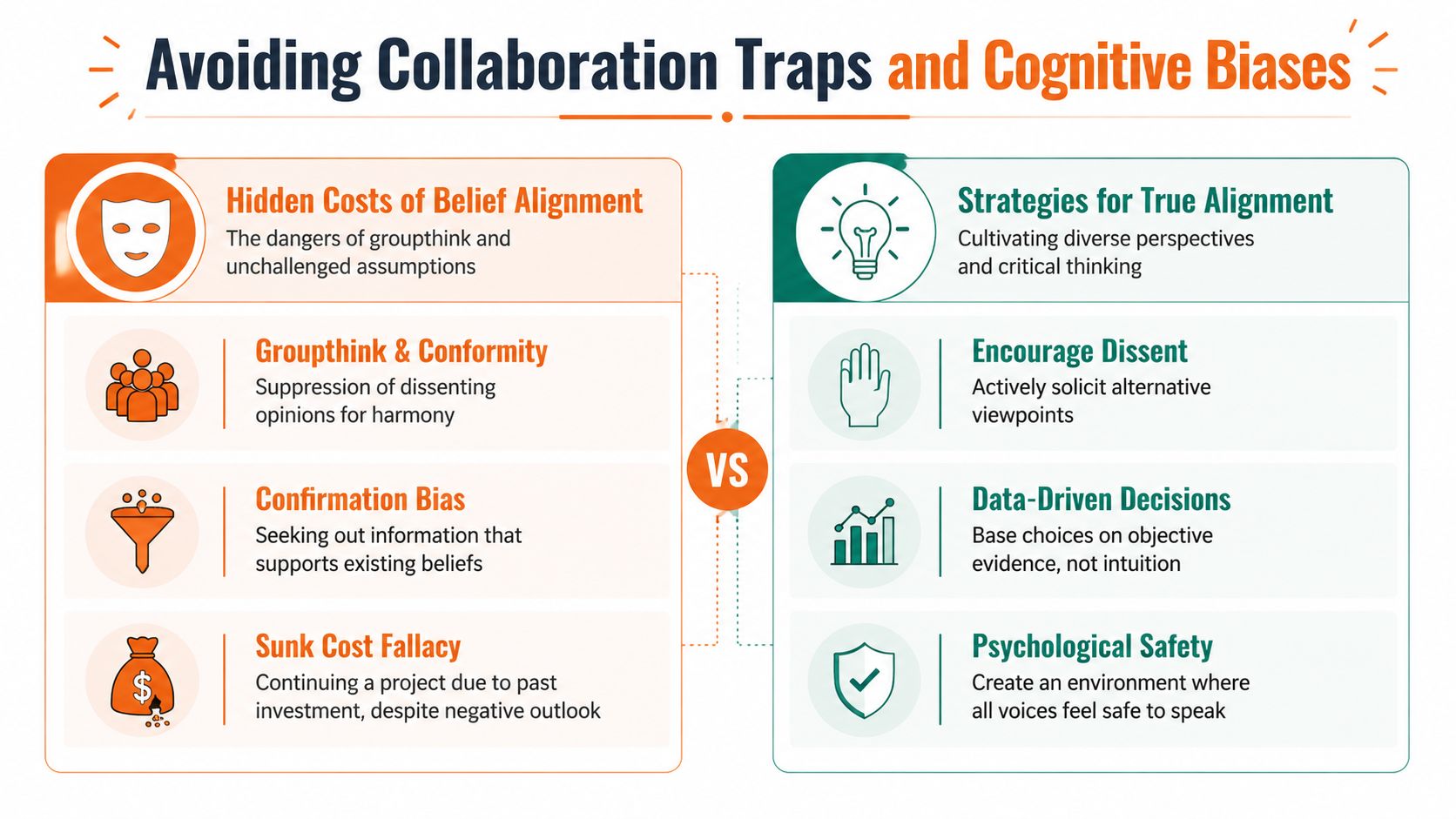
The hidden cost of belief alignment
This is the failure most guides ignore. They focus on tools, rituals, and roles. They don't ask people to state why they believe what they believe.
That omission is expensive. A 2025 CIPD report referenced in a Product Talk discussion found that 68% of UK people professionals report cross-functional projects stall due to unspoken cognitive biases, not process gaps.
The three bias patterns that show up constantly are familiar:
- Confirmation bias. Teams favour evidence that supports the roadmap already in motion.
- Groupthink. People avoid dissent because speed feels more important than scrutiny.
- Sunk cost thinking. Leaders keep defending a weak direction because too much effort has already gone into it.
Two short examples
Team A looked organised on paper. Product had a roadmap. Engineering had estimates. Leadership had confidence. But nobody surfaced the core disagreement. Product believed customers needed feature breadth. Engineering believed reliability was the commercial priority. Design assumed usability debt could wait. The project didn't collapse because people failed to collaborate. It stalled because they never aligned on the beliefs underneath the plan.
Team B handled the same kind of tension differently. In the first alignment session, they forced each function to state assumptions, risks, and absolute needs in plain language. They challenged weak evidence, documented trade-offs, and agreed who would decide if those assumptions changed. That team moved with less friction because disagreement was surfaced early, not discovered late.
Ask every function to write down its top three assumptions before planning begins. Then review conflicts before committing delivery dates.
How to reduce bias in real delivery work
Use practical habits, not abstract culture talk.
- Run assumption reviews before roadmap commitments.
- Invite dissent explicitly in planning and retrospective sessions.
- Separate evidence from opinion in product and delivery discussions.
- Document decision rationale so the team can revisit logic, not memory.
- Create psychological safety through clarity. People speak up more when the team values candour over politics.
Cross functional collaboration gets stronger when teams stop pretending alignment exists and start testing it.
If you want a delivery partner that treats cross functional collaboration as a hard business discipline, not a workshop topic, talk to Rite NRG. They help SaaS teams build faster, work with more ownership, and make delivery more predictable through senior nearshore teams, product-first thinking, and an operating model built for outcomes.