Your platform probably felt tidy when it lived on a single VM or a neat little Docker Compose setup. Then the product took off, the team added services, releases got faster, and the real problem changed, it wasn't code quality anymore, it was coordination. That's where container orchestration stops being a platform trend and becomes a business decision about cost, reliability, and how much operational drag you're willing to carry.
If you're already solid on container basics, a practical guide to Docker for DevOps teams is useful background before you commit to a real orchestration path. For teams redesigning the broader platform, the architecture choices in this SaaS platform architecture overview are the right companion reading. The hard truth is simple, the orchestration choice you make now will shape how quickly you can ship, how cleanly you can scale, and how much of your future engineering time gets burned on avoidable operations.
The Moment Your SaaS Platform Outgrows Its Cluster
The warning signs usually show up in ordinary ways. A founder notices deploys taking longer. An engineer sees one service consuming all the headroom. Customer support starts hearing about slowdowns after release windows. Nobody says “we need container orchestration” in that moment, they say the system feels fragile.
That fragility is the key trigger. When you have more services, more environments, and more people touching the platform, the bottleneck shifts from writing features to running them cleanly. Manual coordination doesn't scale, and the business ends up paying for it through slower releases, more interruptions, and more infrastructure waste.
A lot of SaaS teams waste time debating tooling before they've admitted the operating model is broken. The right question is not “Should we use Kubernetes?” The right question is “How do we stop promising customers speed while the platform keeps demanding hand-holding?” That's where orchestration earns its keep, because it turns deployment, scheduling, scaling, and recovery into repeatable system behaviour, not tribal knowledge.
The UK context makes this especially relevant. The UK government's Cloud First policy has pushed public sector teams to consider cloud services first, and that mindset has helped container-based delivery patterns spread across digital services. If you want the operational side of that shift, it's worth reading how the same thinking shows up in modern infrastructure practice through infrastructure as code, because orchestration and repeatability go hand in hand.
Practical rule: if a release needs several people to babysit it, your platform is already past the point where manual coordination is cheap.
Orchestration is not a vanity upgrade. It's the point where a SaaS founder decides whether the company wants an operating model that can absorb growth, or one that turns every new customer into more infrastructure debt.
The Core Mechanics That Make Orchestration Work
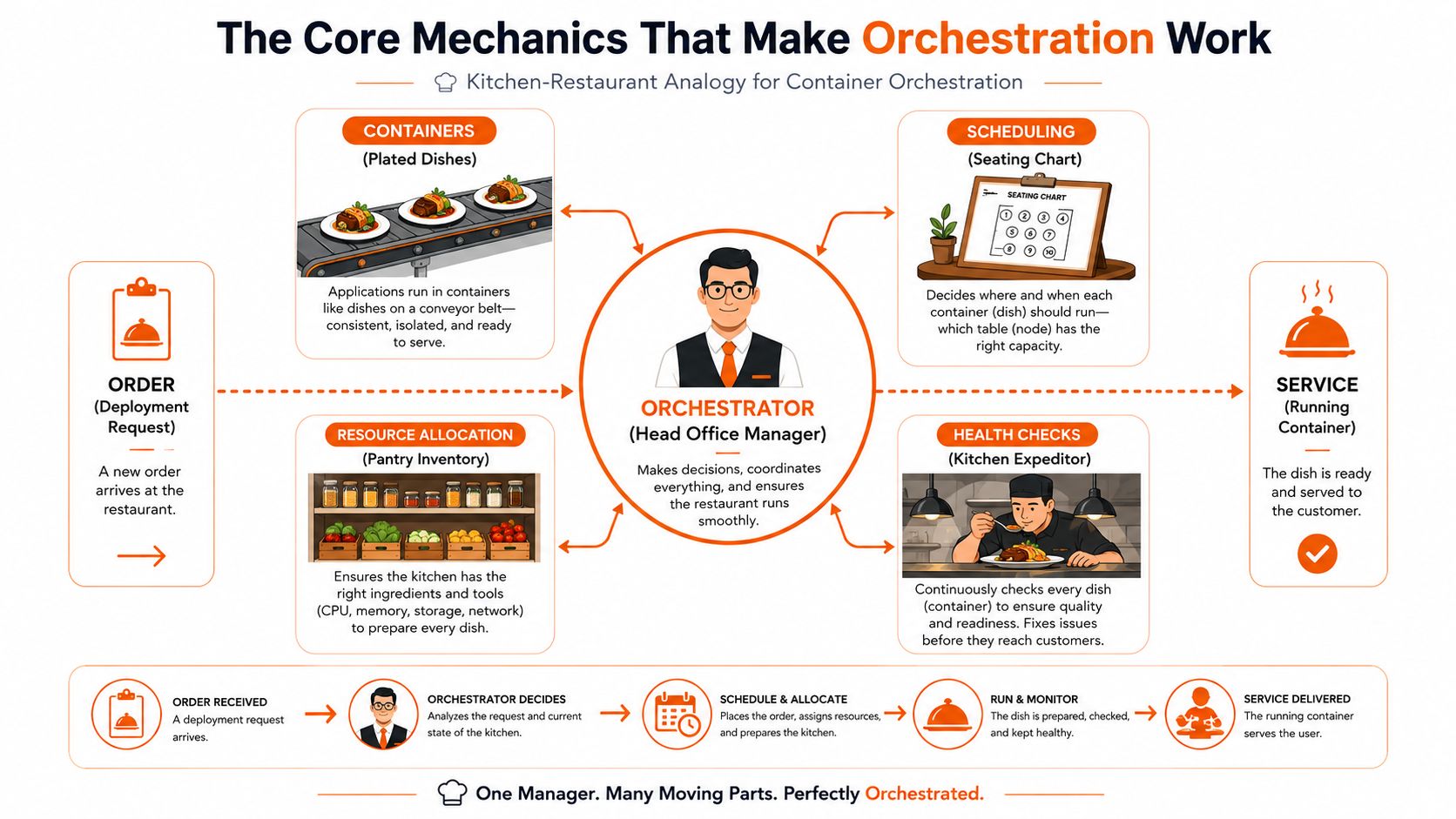
A good restaurant does not succeed because every plate is a masterpiece in isolation. It succeeds because the kitchen, the floor staff, the pantry, and the manager all work from the same system. Container orchestration works the same way, it keeps containers moving through the right steps so the whole service runs predictably.
The kitchen analogy that actually maps to production
Think of containers as plated dishes. The orchestrator is head office, it decides where the work goes, what stays available, and what gets replaced if something fails. Scheduling is the host stand, it seats each guest at the right table. Service discovery is the menu, it tells staff what exists and how to reach it. Networking is the wait staff, it carries the order between stations. Storage is the pantry, it holds the ingredients the kitchen needs to keep working.
When a container fails, self-healing is the sous-chef replacing the burnt plate before the customer notices. Mirantis describes this replacement behaviour clearly, orchestration tools determine resources, choose nodes, allocate storage and networking, and replace failed containers automatically. Red Hat also frames orchestration around availability, scaling, load balancing, and health monitoring, which is the business value SaaS teams care about.
The practical sequence is straightforward in a product environment:
- A deployment request comes in.
- The scheduler chooses a node with enough CPU and memory.
- Networking and service discovery make the app reachable.
- Storage volumes mount the data the workload needs.
- Health checks keep watching, and unhealthy containers get replaced.
A failed pod should not become a team-wide incident. It should become a routine recovery event.
Why the lifecycle matters more than deployment alone
Orchestration is about the full runtime lifecycle, not just launch day. A Mississippi State University technical report frames orchestration as runtime management across the Deploy, Run, and Maintain phases of multi-container packaged applications. Cisco says the tool uses configuration files to find resources, establish networking, and manage logs, then schedules containers based on CPU, memory, and other constraints.
That lifecycle view matters because the true cost of a bad platform is usually not the initial deployment. It's the support burden, the awkward restarts, the slow incident recovery, and the engineering time lost to avoidable manual checks. For a SaaS founder, that translates directly into lower release confidence and higher delivery friction.
Kubernetes, Nomad and Docker Swarm Compared
There's no prize for choosing the most powerful platform if your team can't operate it. I'd rather see a founder choose the right delivery profile than force Kubernetes into a small team that just needs sane scheduling and a clean release path. Kubernetes, Nomad, and Docker Swarm solve the same business problem, but they do it with very different operating assumptions.
| Platform | Best fit | Learning curve | Ecosystem | Operational overhead |
|---|---|---|---|---|
| Kubernetes | Scale-ups, platform-heavy SaaS, regulated environments | High | Largest, widest managed support | Highest |
| Nomad | Mixed workloads, lean teams, pragmatic orchestration | Moderate | Smaller, focused ecosystem | Lower |
| Docker Swarm | Small teams already deep in Docker | Low | Limited compared with Kubernetes | Lowest |
Kubernetes is the serious-scale option. It's the dominant orchestration layer in mainstream cloud-native practice, and the wider ecosystem around it makes it the safest long-term bet for complex SaaS platforms. Datadog notes that engineering teams use orchestration technologies such as Kubernetes across development, deployment, testing, and monitoring, and LaunchDarkly calls Kubernetes the most common orchestration platform in the cloud-native world. Cisco also points out that Kubernetes-based orchestration is widely available as a service from major cloud providers.
Nomad is the pragmatic middle ground. It's a strong choice when you want one scheduler for containers and other workload types without taking on the full operational weight of Kubernetes. If your team values flexibility and low overhead more than deep ecosystem breadth, Nomad deserves serious consideration.
Docker Swarm is the simplest path, and that's exactly why some teams should still use it. If you're already in Docker, your workloads are modest, and the business doesn't need Kubernetes-level control, Swarm can keep you moving without forcing a platform project too early.
Opinionated recommendation: if you're a SaaS founder with a small engineering team and no platform function, start with the simplest thing that meets your reliability needs. Move to Kubernetes when scale or governance demands it, not because the industry likes saying Kubernetes.
Kubernetes wins for long-term standardisation. Nomad wins for pragmatic mixed workloads. Docker Swarm wins when simplicity matters more than ecosystem depth. The wrong move is pretending those trade-offs don't exist.
Scaling and Cost Levers That Decide Your P&L
Only a small percentage of teams recognize that orchestration has financial consequences until the cloud bill becomes problematic. That typically occurs because they viewed scaling as a feature and cost as an afterthought. In reality, the gap between requested and actually used resources is one of the clearest indicators you have for whether the platform is helping or wasting money.
Requested resources versus actual use
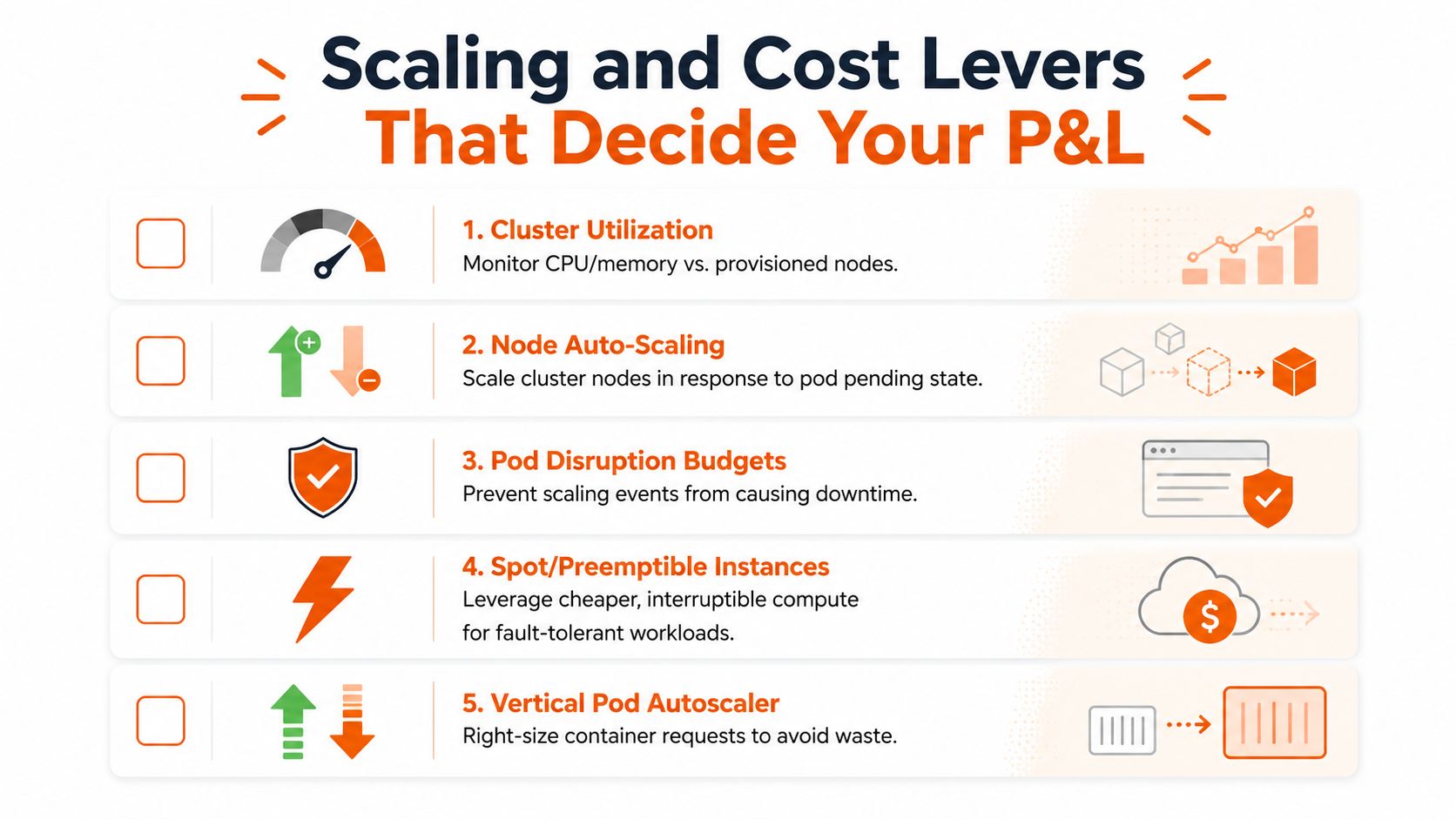
Kubernetes and similar systems schedule from requests, not from wishful thinking. If you ask for more CPU and memory than the container uses, you lower pod density, which means fewer pods fit on each node. That forces you to run more nodes than you really need, and that's where inefficiency turns into spend.
Enterprise monitoring guidance recommends watching real per-container CPU, memory, and network I/O so you can spot chronic over-requesting. It also calls out pod density, cluster resource utilisation, and autoscaler triggers as core KPIs. Those are the numbers that show whether your scheduler is creating avoidable fragmentation or whether your platform is handling demand spikes by scaling properly.
Recent research on orchestration resource optimisation identifies patterns such as preemptive scheduling, service balancing, and garbage collection. The point isn't that every team should jump to those techniques immediately, it's that resource efficiency is its own discipline, not a by-product of adopting a platform.
Three mistakes that usually hurt SaaS teams first
- Oversized requests: Engineers set requests high “just to be safe”, then nobody comes back to tune them. The cluster runs with wasted headroom.
- Ignoring real usage: Teams look at deployment success and uptime, but not at whether they're burning capacity on underused pods.
- Treating autoscaling as optional: If autoscaler triggers are unclear, teams overprovision instead of letting demand drive capacity.
The cost story is not abstract. It's a design choice made in every deployment manifest and every capacity review. If you don't control requests, you're choosing waste by default.
What to do before the cloud bill gets ugly
Start with container-level usage review, not heroic replatforming. Tighten requests based on actual data, watch pod density, and track whether your cluster is scaling because demand requires it or because your requests are bloated. That's how you get orchestration to support margin instead of undermining it.
Security and Observability as One Operational Discipline
A platform is only trustworthy if you can explain what it's doing and control who can touch it. Security and observability belong together because both are about reducing unknowns. If you split them into separate initiatives, you usually end up with blind spots, then incidents, then long audit conversations.
The checks that matter in real delivery
Start with image scanning in CI/CD, so you're not shipping known vulnerabilities into production. Add supply-chain integrity by signing images and verifying provenance, because trust in your pipeline matters as much as trust in your code. Apply runtime hardening with Pod Security Standards and network policies, then keep secrets in an external vault rather than environment variables.
RBAC should be strict, not decorative. Give people the least privilege they need, keep audit logs on, and treat every access path as something you may need to explain later. That's not bureaucracy, it's the price of running customer systems with confidence.
Observability has the same logic. Metrics tell you whether the system is healthy, logs tell you what happened, and traces tell you where time went. A unified dashboard gives your engineers enough context to make decisions without stitching together half a dozen tools during an incident.
Don't separate “security work” from “platform work”. In production, the same failure that breaks trust usually breaks visibility too.
For teams needing a deeper operational view, this monitoring and observability guide is a good companion to the controls above. It helps anchor the idea that you can't protect what you can't see, and you can't investigate what you never instrumented.
SLOs turn reliability into a product conversation
Service Level Objectives are the bridge between engineering and the customer experience. They let you define what “good enough” means in operational terms, then hold the platform to that standard. That's where security, monitoring, and compliance stop being background work and start becoming part of the product promise.
Team Shape and Delivery Cadence Behind the Platform
The platform only works if the team behaves like owners. Orchestration doesn't rescue a delivery culture that waits to be told what to do. It rewards engineers who think in outcomes, notice risk early, and move before the system forces their hand.
That's where Extreme Ownership matters. Senior engineers should own service health, release quality, and operational readiness, not just tickets. Product-first thinking keeps the team focused on what customers feel, not just what gets merged. AI-augmented workflows help when they surface risks earlier, but they're useful only if the team is already disciplined about acting on them.
A strong delivery cadence around containerised SaaS usually has three features. First, decision-making is close to the work. Second, incidents are treated as design feedback, not blame opportunities. Third, the team can move fast without becoming noisy or reckless. That combination is what makes container orchestration valuable commercially, because it turns platform control into repeatable shipping confidence.
Nearshore partnerships work when they bring consulting judgement, not just extra hands. Transparent collaboration reduces the friction that usually comes with distributed delivery, especially when modernisation work has to coexist with legacy systems. The right partner doesn't just execute tasks, it helps shape the operating model so the client's team can keep ownership without burning out.
Delivery rule: if the team can't explain who owns a failure, they don't really own the platform yet.
That's the fit between orchestration and team design. A better platform without a stronger ownership culture just gives you faster ways to make the same mistakes. A better team with the right delivery model makes the platform easier to trust, easier to scale, and much easier to hand over cleanly later.
A Pragmatic Path Forward and Migration Checklist
Not every workload needs full Kubernetes. That assumption wastes time, especially in edge, hybrid, and legacy environments where operational complexity can matter more than feature depth. A state-of-the-art review found that container orchestration tools are not yet widely utilised in edge orchestration works, which tells you plenty of practical deployments still need lighter-weight or custom approaches instead of defaulting to the biggest platform in the room.
That's the right way to think about platform choice. If you need deep control, policy, and ecosystem support, Kubernetes is the obvious answer. If you need simplicity and mixed-workload flexibility, Nomad or Swarm can be the better commercial move. If you want to stay out of orchestration management entirely, a fully managed cloud platform may be the cleanest path.
The migration path should be controlled, not dramatic. Start by moving one non-critical service, not the whole estate. Get the CI/CD pipeline stable before you chase platform perfection. Define success in business terms, then verify the platform against those outcomes.
- Pilot one service: Choose something low-risk but real, so you can test deployment, health checks, and rollback behaviour without gambling the core product.
- Lock the delivery pipeline: Make sure build, test, and release steps are boring before you add orchestration complexity.
- Measure the outcome: Track whether the new setup improves release confidence, recovery, and operational clarity.
The gap between “we should modernise” and “we've modernised profitably” is usually filled by good sequencing, not grand rewrites. That's why founders and CTOs need a delivery partner who can challenge assumptions, de-risk the path, and keep ownership close to the outcome.
If you want a team that can help you make container orchestration a business advantage instead of a platform headache, Rite NRG can design the migration, build the delivery discipline, and support the operating model around it. Visit Rite NRG if you want senior nearshore engineers who'll own the outcome with you, not just deliver tickets and disappear.