A product manager wants Feature A. Sales is pushing Feature B because a prospect asked for it. Engineering wants to pause everything and clean up the platform. The data team says nobody can decide until the tracking is fixed. Two meetings later, nothing has shipped.
That's how teams lose momentum. Not because they lack talent, but because they lack a shared way to make decisions under pressure.
Decision making frameworks fix that problem when you use them properly. They are not corporate theatre. They are operating tools for speed, ownership, and predictable delivery. A good framework tells your team who decides, what criteria matter, how risk is handled, and when to move. That's how you stop recycling the same conversation every week.
For fast-moving SaaS teams, especially those working across distributed and nearshore setups, this matters even more. Distance amplifies ambiguity. If ownership is fuzzy, delays spread quickly across product, engineering, design, QA, and stakeholders. The answer isn't more meetings. It's a sharper decision system.
Stop the Decision Gridlock and Start Delivering Value
You've probably seen this play out already. The roadmap looks full, the team looks busy, and the outcome still feels soft. Work starts, pauses, gets re-scoped, escalates, and comes back for “alignment”. Nobody owns the final call, so everyone keeps talking.
That's not collaboration. That's drift.
Why structure now matters more than ever
The need for structured decisions has grown because the evidence base is bigger than ever. The UK's Office for National Statistics publishes more than 7,000 statistical releases and updates each year, and the UK's evidence-based public decision tradition traces back to 1836, which gives modern teams a deep statistical infrastructure to support rational, repeatable choices instead of gut feel alone, as outlined by the Office for Statistics Regulation on statistics in personal decision making.
That matters for product and delivery leaders. You don't need to guess your way through prioritisation, market timing, hiring plans, or platform investment. There is more than enough information available. The true challenge is turning information into action without creating bureaucracy.
Practical rule: If your team debates the same decision twice, your framework is broken or missing.
Frameworks are speed tools, not paperwork
The wrong mindset says frameworks slow teams down. The right mindset says a framework removes low-value discussion so the team can move faster on the work that matters.
Use them to answer four hard questions quickly:
- Who decides: One owner, not a committee.
- What matters: Clear criteria such as user impact, delivery risk, cost, and reversibility.
- What happens if we're wrong: A defined review point or rollback path.
- When we escalate: A threshold, not a mood.
That's the operating model behind high-accountability teams. It's also how you build a culture of Extreme Ownership. People stop waiting for perfect certainty and start making strong calls with visible assumptions.
If your product organisation feels stuck, don't add another planning ritual. Install a decision system and use it relentlessly.
Your Toolkit for Decisive Product and Engineering Teams
Not every decision needs the same tool. If you use one framework for every problem, you'll either overcomplicate small calls or oversimplify expensive ones.
Accountability frameworks for cross-functional delivery
RACI is the classic. It clarifies who is Responsible, Accountable, Consulted, and Informed. Use it when work crosses functions and people keep stepping on each other.
DACI is useful when a decision needs one clear driver and one approver, with contributors around them. It works well for product-led feature decisions.
RAPID is stronger when you need tighter governance. It separates who recommends, who agrees, who performs, who gives input, and who decides. Use it when decisions have serious implications and stakeholder confusion is killing momentum.
Use these when your biggest issue isn't choosing between options. It's getting clear on ownership.
Prioritisation frameworks for product bets
Weighted scoring is your practical workhorse. List your options, choose the criteria, assign weights, score each option, and rank them. It's ideal for backlog pruning, vendor selection, or platform trade-offs.
RICE helps when you need a quick product prioritisation method. It forces a conversation around likely reach, expected impact, confidence, and effort. It's useful when feature requests are piling up and every team thinks their item is urgent.
If you're already using discovery practices, pair prioritisation with an opportunity solution tree approach so scoring doesn't happen in a vacuum.
Decision models for speed and complexity
Decision matrices are best when you have multiple viable options and need an auditable choice. This is the right tool for selecting a cloud architecture, integration pattern, or analytics platform.
OODA stands for Observe, Orient, Decide, Act. It's built for pace. Use it in fast feedback environments where waiting for complete certainty would be more dangerous than acting with partial information.
Cost-benefit analysis belongs in bigger investment decisions. If you're deciding on a migration, a major tooling shift, or a new product line, you need to think beyond immediate gains.
If a decision changes your operating costs, delivery risk, or compliance posture for months, don't treat it like a backlog item.
Focus tools for overloaded leaders
The Eisenhower Matrix is simple and brutally effective. Separate urgent from important. It helps founders, heads of product, and engineering leads stop confusing noise with substance.
Here's the fastest way to think about the toolkit:
- Use RACI, DACI, or RAPID when ownership is unclear.
- Use weighted scoring or RICE when priorities are fighting for attention.
- Use a decision matrix when several options look plausible.
- Use OODA when timing matters more than perfect analysis.
- Use cost-benefit analysis when the decision has long-term financial or operational consequences.
- Use Eisenhower when your leadership team is drowning in reactive work.
A common mistake is asking, “What's the best framework?” That's the wrong question. Ask, “What kind of decision are we making, and what failure mode are we trying to prevent?”
How to Select the Right Framework for Any Challenge
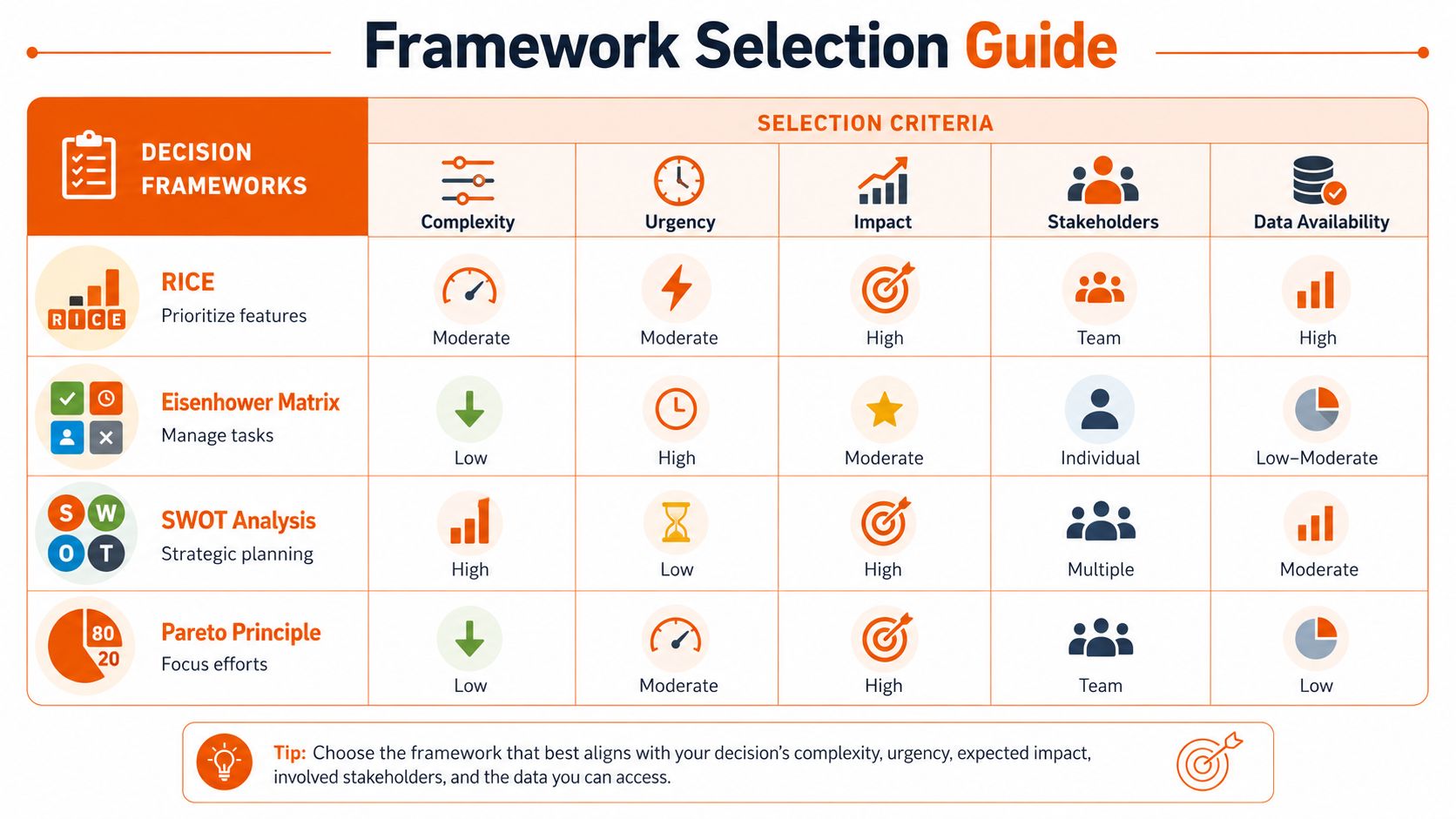
Framework selection should be blunt, not philosophical. Start with the type of decision, the speed required, and the consequences of getting it wrong. Then look at team shape. A founder-led startup, a regulated SaaS platform, and a distributed product team do not need the same level of decision structure.
Start with the decision, not the framework
Use these filters first:
Is this a prioritisation problem or an accountability problem?
If people disagree on what to do next, use prioritisation tools. If nobody knows who owns the call, use RACI, DACI, or RAPID.How reversible is the decision?
Reversible decisions should move fast. Irreversible or expensive decisions need stronger criteria and more explicit risk review.How many teams are affected?
A single squad can work with lighter tools. Cross-functional or nearshore teams need more visible ownership and cleaner handoffs.Is regulation involved?
If personal data, AI, or security risk is part of the decision, generic scoring alone isn't enough.
Compliance changes the framework
In the UK, framework selection has to account for regulation. The ICO may require a Data Protection Impact Assessment for high-risk processing, which means a simple scoring model can miss the actual risk. The bigger point is operational: your framework has to include compliance and risk controls, and you should ask what metrics prove the framework is helping productivity rather than adding drag, as discussed in this decision making framework analysis.
That's especially important in AI-enabled products. A feature can score well on impact and effort while still creating legal or governance exposure. If your framework can't capture that, it's incomplete.
Decision Making Frameworks At a Glance
| Framework | Best For | Key Benefit | Best in Nearshore Teams? |
|---|---|---|---|
| RACI | Delivery ownership across functions | Removes role confusion | Yes |
| DACI | Product and stakeholder decisions | Clarifies driver and approver | Yes |
| RAPID | High-stakes governance decisions | Strong accountability | Yes |
| Weighted scoring | Backlog and vendor prioritisation | Flexible criteria | Yes |
| RICE | Fast feature prioritisation | Quick ranking for product bets | Yes, if scoring rules are shared |
| Decision matrix | Complex technical choices | Makes trade-offs visible | Yes |
| OODA | Fast-moving environments | Speeds action under uncertainty | Yes, especially with live telemetry |
| Cost-benefit analysis | Investment and platform decisions | Forces long-term thinking | Yes |
| Eisenhower Matrix | Leadership focus | Cuts reactive noise | Less team-wide, better for leaders |
The best framework is the one your team can apply consistently under pressure.
A simple selection rule
If you're working with distributed or nearshore teams, favour frameworks that make ownership explicit and decisions visible in writing. Verbal alignment fades fast across time zones, functions, and sprint boundaries.
Choose like this:
- Need speed: OODA or RICE.
- Need traceability: decision matrix or weighted scoring.
- Need governance: RAPID or RACI.
- Need leadership focus: Eisenhower.
- Need risk-aware investment logic: cost-benefit analysis plus gate criteria.
Then do one more thing often overlooked. Measure whether the framework is helping. If cycle time slows, rework rises, or approvals multiply, the process is failing even if the spreadsheet looks tidy.
A Step-by-Step Implementation Guide
Good frameworks fail when teams keep them abstract. The fix is simple. Turn them into rituals, templates, and decision gates that people can run without a workshop every time.
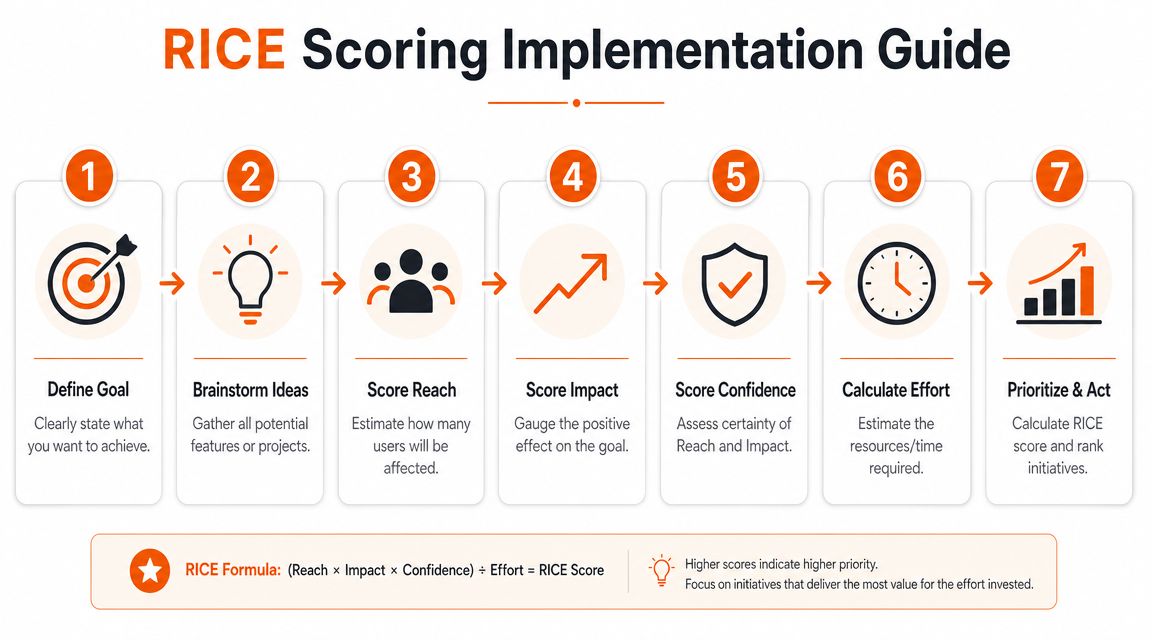
Run a RICE session that ends in a decision
Use one shared document. Put every candidate feature or initiative on the page. Give the session one owner.
Define the outcome
Name the business result you're trying to influence. Trial conversion, activation, retention, support load, delivery speed. Pick one primary outcome.List the options
Don't score vague ideas. Score concrete initiatives with enough detail to estimate effort and likely effect.Score consistently
The point is not mathematical perfection. The point is relative comparison. Use one scoring rule for all items in that session.Challenge confidence openly
Weak assumptions surface when confidence is challenged openly. If confidence is low, either lower the ranking or turn the item into a discovery task.Decide in the room
Don't end with “we'll revisit next week”. Rank, cut, and commit.
For teams validating uncertain ideas, it helps to pair scoring with disciplined proof of concept documentation so assumptions, risks, and success criteria stay visible.
A practical explainer can help if the team is new to the method:
Set up a RACI for a new initiative
Teams typically fill in a RACI after confusion has already caused damage. Do it at kickoff.
Use four rows at minimum:
- Product scope
- Technical design
- Release readiness
- Stakeholder communication
Then assign one accountable person per row. One. Not two. Not “shared”.
According to UK government guidance, strong business cases should evaluate whole-life costs, benefits, and risks, not just initial upside. Applied to SaaS delivery, frameworks like RACI or RAPID become far more useful when paired with measurable gate criteria such as user impact and delivery risk, which helps prevent decision drift and addresses the accountability weaknesses highlighted in this technology project decision framework discussion.
Build a weighted decision matrix for technical choices
This is the fastest serious tool for architecture and vendor decisions.
Create a table with options across the top and criteria down the side. Typical criteria include:
- User impact
- Delivery risk
- Operational cost
- Compliance fit
- Integration complexity
- Reversibility
Then weight the criteria. If compliance matters more than convenience, reflect that. If speed to market is the main priority, weight it properly.
Working rule: If your weights don't reflect business reality, the matrix will give you a polished but useless answer.
Score the options, review the outliers, and document the final call with the trade-offs accepted. That last step matters. Teams move faster when they can see why a choice was made and what was consciously deprioritised.
Accelerating Decisions for Fast MVP Delivery and AI Workflows
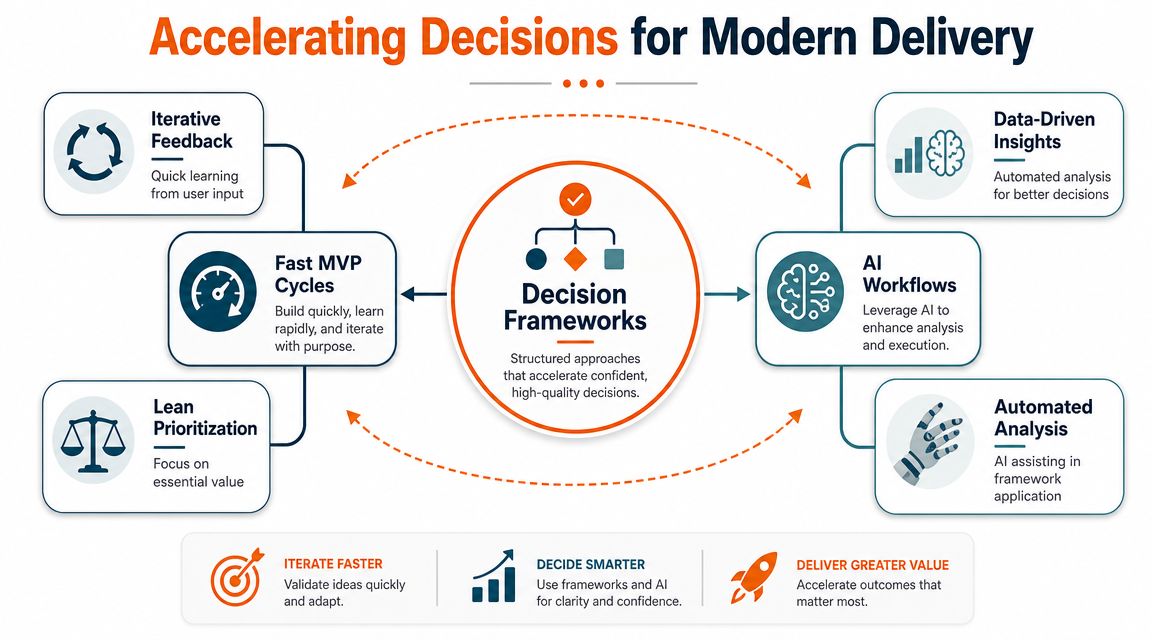
Fast MVP delivery doesn't mean chaotic delivery. It means making smaller decisions, more often, with better feedback. That's where decision making frameworks become far more valuable, not less.
Use frameworks to shorten feedback loops
In MVP work, the enemy is oversized commitment. Teams lock into a feature set, overbuild, then discover key learning arrived in the first release. A better pattern is to use lightweight frameworks to keep bets small and explicit.
That means:
- RICE for sequencing early experiments
- OODA for rapid adjustment once real user behaviour starts showing up
- Decision matrices for platform calls that could limit future iteration
- RACI for handoffs between product, engineering, design, and external stakeholders
If you're building lean products, this guide to agile MVP development fits naturally with that operating model.
AI should support judgement, not replace it
In the UK, 14.2% of businesses used AI in at least one business function in 2023, which means AI-assisted decision support is already practical, not hypothetical, according to this UK business AI adoption evidence.
For SaaS teams, the smart move is to use AI to improve decision inputs. Let it help gather evidence, cluster feedback themes, summarise support issues, flag anomalies, or draft option comparisons. Then let humans decide the trade-offs.
This gets powerful when you connect frameworks to live operational telemetry such as lead time, deployment frequency, customer churn signals, and support-ticket severity. OODA becomes faster because observation isn't delayed by manual reporting. Weighted scoring improves because effort and risk inputs are grounded in delivery data. Escalation becomes cleaner because thresholds are defined before the argument starts.
What high-velocity teams do differently
They don't wait for certainty. They define trigger points.
For example:
- Escalate when incident impact crosses a service boundary
- Pause when delivery risk invalidates the original assumption set
- Proceed when the decision is reversible and the learning value is high
That's how modern teams combine speed with control. AI helps collect and organise the signal. Decision frameworks turn that signal into action. Without the framework, AI just gives you faster confusion.
Real-World Examples from the Product Trenches
A B2B SaaS company was stuck on a cloud tooling decision. Engineering wanted flexibility. Finance wanted predictability. Security wanted tighter controls. Every meeting ended with “we need more input”.
The team used a weighted decision matrix with explicit criteria: operational cost, compliance fit, migration risk, integration complexity, and reversibility. The breakthrough wasn't the spreadsheet. It was the agreement on what mattered most before scoring began. Once the criteria were visible, the strongest option became obvious enough to approve and execute.
When ownership, not strategy, is the real problem
A scale-up with a distributed product team had constant friction between product, engineering, and QA. Tickets moved, but decisions didn't. Features were “almost ready” for days because nobody knew who had the final say on scope changes or release acceptance.
They introduced a RACI for release governance. Product owned scope. Engineering owned technical readiness. QA owned acceptance evidence. One delivery lead was accountable for the final release call. The result was cleaner handoffs, fewer late surprises, and much less theatre in stand-ups and planning sessions.
Most delivery problems presented as prioritisation issues are actually ownership issues.
Fast MVP work needs fast frameworks
An early-stage team building an AI-assisted workflow product kept overanalysing feature ideas. They wanted certainty before launch, but every delay made the product less testable in practical settings.
They switched to a simple combination: RICE for feature ordering and OODA after release. That changed behaviour quickly. Instead of trying to perfect a large release, they shipped smaller slices, watched live usage and support signals, and adjusted based on what users did. Decisions became easier because the team stopped arguing about imagined outcomes and started reacting to evidence.
The common thread in all three examples is simple. Teams moved faster when they reduced ambiguity. Not when they worked harder. Not when they added more stakeholder reviews. They got traction when they made ownership, criteria, and thresholds explicit.
Make Your Next Decision Your Best Decision
Great product teams are not the teams with the most ideas. They're the teams that can decide, commit, learn, and adjust without drama.
That doesn't happen by accident. It happens when you treat decision making frameworks as part of delivery infrastructure. The same way you care about architecture, QA, or release management, you should care about how decisions get made. Because that process determines how quickly value reaches users.
If your team is stuck in analysis paralysis, don't ask for more patience. Ask for clearer ownership. Stronger criteria. Smaller bets. Faster feedback. That's how you get out of debate mode and back into shipping mode.
The hard truth is that indecision is still a decision. It's a decision to delay learning, delay value, and let ambiguity spread through the team. Leaders who take Extreme Ownership don't tolerate that for long. They build a system that helps people act with clarity.
Your next decision doesn't need more opinions. It needs a framework that fits the stakes, the speed, and the business outcome you're chasing.
If you want a partner that helps you turn decision gridlock into predictable product delivery, talk to Rite NRG. Their teams combine senior engineering, product-first thinking, and high-ownership delivery practices to help SaaS companies ship faster without losing control.