Your team knows the feeling. A rival ships a feature you discussed six months ago. Sales starts hearing the same objection in every demo. Your roadmap gets noisy, everyone wants answers, and someone opens an ageing spreadsheet that nobody trusts.
That's where most competitor work dies. It becomes documentation instead of direction.
A competitive analysis framework should do the opposite. It should increase decision speed, sharpen product bets, and help your team ship the right thing before the market forces your hand. If it doesn't change backlog priorities, sales responses, pricing conversations, or MVP scope, it's admin.
Beyond Spreadsheets A Framework for Decision Velocity
Monday morning. Sales has lost two deals to the same rival. Your product lead has a backlog full of feature requests copied from competitor websites. Engineering is waiting for a decision, not another research task.
A competitive analysis framework fixes that only if it drives action fast. Treat it as a delivery tool. Your team should use it to decide what to build, what to ignore, and what to ship first in the next MVP cycle. That is the standard.
For SaaS founders, the right model looks less like a static report and more like an execution loop shared by product, sales, and delivery. Good teams use strategic competitive analysis to compare pricing, retention signals, positioning, product scope, and category pressure, then turn those findings into roadmap calls. The strongest methods also use frameworks such as SWOT, Porter's Five Forces, strategic group mapping, and perceptual mapping to support a real decision process, not just a research file. Our own work with product teams follows the same principle as these broader decision-making frameworks. Shorten the gap between signal, decision, and shipped code.
Why most frameworks fail
Founder-led SaaS teams usually fail in execution, not effort. They track too many rivals, save too many screenshots, and hand over a document nobody uses once sprint planning starts.
A framework earns its place when it does four jobs repeatedly:
- Names the rivals that affect deals and retention. Direct competitors matter, but so do substitutes and workarounds.
- Uses current evidence from pricing pages, release notes, customer reviews, sales calls, and hiring activity.
- Compares everything to your offer so gaps are tied to your product strategy, not generic commentary.
- Forces a delivery choice such as changing MVP scope, adjusting packaging, rewriting sales proof points, or killing a low-value feature request.
The last point is where teams either gain speed or waste a quarter. If analysis does not produce an owner, a sprint-level action, and a deadline, it is admin.
The UK market punishes stale assumptions
UK SaaS teams cannot run on old assumptions. Since Brexit, companies have had to reassess customer segments, supplier and buyer pressure, and market structure using current evidence, as discussed in this competitive analysis overview.
That matters at product-team speed. Pricing shifts faster. Buyer objections change faster. Hiring patterns reveal strategic moves earlier. Your framework should sit inside your build cycle, especially if you are working with a nearshore team that can turn a decision into a tested feature within weeks.
That is a genuine upgrade. Stop treating competitor work as a spreadsheet exercise. Use it as a decision engine that helps your team choose faster, scope cleaner MVPs, and out-execute slower rivals.
Define Your Battlefield and Business Objectives
Before you benchmark anyone, define what winning looks like for your company. Not for “the business” in abstract terms. For your product, your next release cycle, and your next revenue conversation.

A founder who says, “we need to understand the market better,” usually ends up with a bloated document. A founder who says, “we need the next-quarter roadmap to improve enterprise win quality,” gets a usable framework.
Start with a business outcome, not a competitor list
Use objectives that can change behaviour across product, sales, or delivery. Good examples include:
- Refining an MVP wedge so your first release solves a clear pain that incumbents ignore
- Supporting a vertical pivot where a niche has better fit, less friction, or stronger margins
- Improving competitive deal execution by tightening objections, proof points, and product gaps
- Reworking packaging when buyer confusion or discount pressure keeps showing up in sales calls
One expert methodology recommends combining primary and secondary research after the initial market survey, then narrowing to the top 3–5 competitors for deep-dive profiles. It also recommends measuring outcomes like win-rate on competitive deals, battlecard adoption, and response time so you can tell whether the framework is changing sales or product decisions, not just documenting the market, according to this competitive analysis framework and template.
Translate vague goals into operating questions
Founders either achieve clarity or remain vague. Replace broad intent with decision-grade questions.
| Vague goal | Better operating question |
|---|---|
| Understand the market | Which buyer segment is most underserved by current packaging and onboarding? |
| Check competitors | Which 3 rivals most often appear in sales conversations and why do buyers shortlist them? |
| Improve the product | Which feature gaps block us from winning our target use case today? |
| Enter enterprise | What proof, controls, and workflow depth do enterprise buyers expect before they'll switch? |
That's the heart of strategic competitive analysis. You're not collecting facts for curiosity. You're collecting evidence to support product, GTM, and investment decisions.
Anchor analysis to delivery decisions
Your framework should connect directly to prioritisation tools, not live in a slide deck. If a finding doesn't affect backlog order, pricing tests, messaging, or sales enablement, challenge whether it belongs in the first place.
A simple way to keep the analysis useful is to connect every insight to one of three actions:
- Ship a feature, integration, or workflow improvement.
- Sell with sharper positioning, battlecards, or objection handling.
- Stop wasting time on parity work that doesn't change buyer behaviour.
For product teams, the cleanest bridge is to tie competitor insight into an opportunity solution tree. That forces discipline. A competitor move is not automatically a roadmap item. It's only relevant if it points to a real customer opportunity worth solving better.
The strongest objective is the one that makes your next roadmap review easier, not longer.
Choose Your Rivals and Decisive Metrics
You don't need to monitor the whole market with equal intensity. That's how teams burn out and still miss the signal.
You need two lists. A track list for active rivals that affect deals now. A watch list for emerging players, adjacent tools, and substitutes that could matter soon.
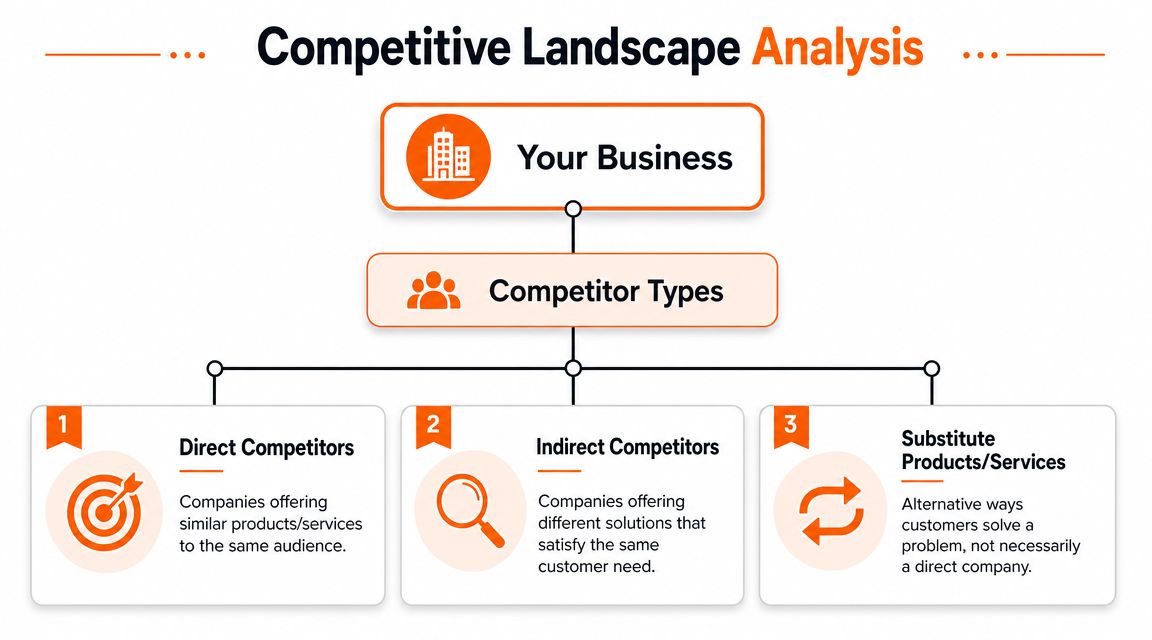
A practical framework for UK SaaS teams recommends exactly that split. It suggests benchmarking only 5–8 active competitors across 5–6 dimensions such as product, pricing, positioning, GTM, momentum, and customer base, with a rhythm of 30 minutes weekly, 2–3 hours monthly, and a quarterly executive brief, based on this UK SaaS competitive analysis framework.
Build the track list with discipline
Your track list should be small enough to maintain and important enough to matter. Use these filters:
- Revenue relevance. They appear in live deals, procurement discussions, or renewal threats.
- Audience overlap. They sell to the same buyer, team, or budget owner.
- Use-case overlap. They solve the same immediate problem, even if the product looks different.
- Strategic threat. They're moving into your category through packaging, integrations, or messaging.
The watch list is broader. Include indirect competitors, substitute workflows, and specialist tools creeping upmarket. A spreadsheet, agency service, or internal workflow can be just as dangerous as a polished SaaS competitor if it solves the job cheaply enough.
Pick metrics that force useful conversations
A common mistake is tracking what's easy instead of what's decisive. “Feature count” tells you almost nothing. So does a giant comparison matrix with no weighting.
Track evidence across a handful of categories:
Product signals
- Workflow depth. Does the rival solve the full job or only a visible slice of it?
- UX clarity. Is the product easier to understand, demo, and adopt?
- Integration fit. Which systems does it connect to that your buyer already uses?
Commercial signals
- Pricing model. Is the value framed by seats, usage, outcomes, or tiers?
- Positioning. Who do they claim to serve, and how narrow is that promise?
- Sales motion. Self-serve, sales-led, partner-led, or hybrid?
Market signals
- Hiring patterns. New roles often reveal strategy before product launches do.
- Review patterns. Repeated complaints are often more useful than polished testimonials.
- Channel activity. Content, partnerships, and launch messaging show where they're pushing.
Don't ask, “What features do they have?” Ask, “What evidence shows they're becoming harder to beat in our target deal?”
Use one scorecard, not five dashboards
Keep the scoring coarse. Green, amber, red across your chosen dimensions is enough for weekly use. Save nuance for monthly reviews.
Your framework should help a founder, product lead, and sales lead answer one question quickly: where are we exposed, and where can we win without bloating the roadmap?
Gather Actionable Intel Like a Pro
Your competitor ships a new feature on Tuesday. By Friday, your sales team has lost two demos because nobody spotted the change, nobody updated the talk track, and nobody turned the signal into a delivery decision. That is what weak intel looks like.
Fast teams build a collection system that feeds product, sales, and delivery every week. The point is speed to decision, then speed to release. If you work with a nearshore product team, this matters even more because good intel can go straight into discovery, scoping, and the next MVP sprint instead of dying in a slide deck.

Focus on changing signals, not static pages
Start with sources that change often and reveal intent. Public filings, job posts, review sites, release notes, changelogs, ad libraries, partner pages, and SEO shifts give you a faster read than polished homepage copy.
Then bring in the signals your own team sees first. Sales calls expose objection patterns. Support tickets expose product gaps. Lost deals expose where your story or delivery model breaks down. Customer migration stories expose what buyers expected to get and did not.
Use a collection rhythm your team can maintain:
- Weekly scan for release notes, homepage messaging changes, LinkedIn activity, new landing pages, and integration announcements
- Monthly capture of pricing pages, plan names, feature limits, trial terms, and enterprise call-to-action changes
- Quarterly review of review themes, churn reasons, procurement blockers, and category shifts that should shape the roadmap
Track pricing drift like a product manager, not a shopper
Pricing pages are product strategy in public. Track them with discipline.
Capture screenshots every month. Log tier names, usage thresholds, feature gates, free trial rules, and any move from transparent pricing to “talk to sales.” Buyers do not compare your list price to theirs. They compare the package they think they'll need.
Focus on the mechanics that change deal shape:
- Tier logic. What separates basic, pro, and enterprise?
- Usage limits. Seats, records, API calls, storage, or workflow caps
- Bundling changes. Which capabilities moved into higher tiers?
- Discount clues. Where does the sales motion suggest heavy negotiation?
- Add-ons. Which features are sold separately to lift ACV?
For AI-heavy categories, track adjacent entrants too. Funding noise, new wrappers, and rebundled features can shift buyer expectations fast. A resource like The Updait's AI news sources can help you spot emerging pressure before it shows up in your pipeline.
Don't ignore regulatory and procurement fitness
A rival can win the demo and still lose the deal in security review. That gap is where disciplined SaaS teams steal enterprise revenue.
For UK buyers, public guidance from the National Cyber Security Centre pushes companies to examine how suppliers handle security basics and risk controls. Use that standard in your competitor research. Check what a rival makes easy for procurement to validate and what they leave vague.
Use a simple checklist:
| Area | What to look for |
|---|---|
| Security posture | Trust centre, certifications, incident communication, access controls |
| Data handling | Privacy terms, data residency options, GDPR clarity |
| Procurement readiness | MSA maturity, DPA availability, security questionnaire support |
| Delivery credibility | Release discipline, status communication, onboarding and implementation support |
At this stage, analysis becomes execution. If a competitor is weak on procurement readiness and your nearshore team can ship audit logs, role controls, or admin reporting in one MVP cycle, that is not research. That is a wedge.
Later in your review cycle, this explainer is worth sharing with the team before discussion:
Treat compliance and delivery assurance as product inputs. Teams that do this close risk-sensitive buyers faster and waste less time building features that do not move deals.
Synthesise Data into Decisive Action
Your team finishes the competitor review. Fifteen tabs are open, the matrix is full, and nobody can say what should ship next. That is a failure of synthesis, not a shortage of data.
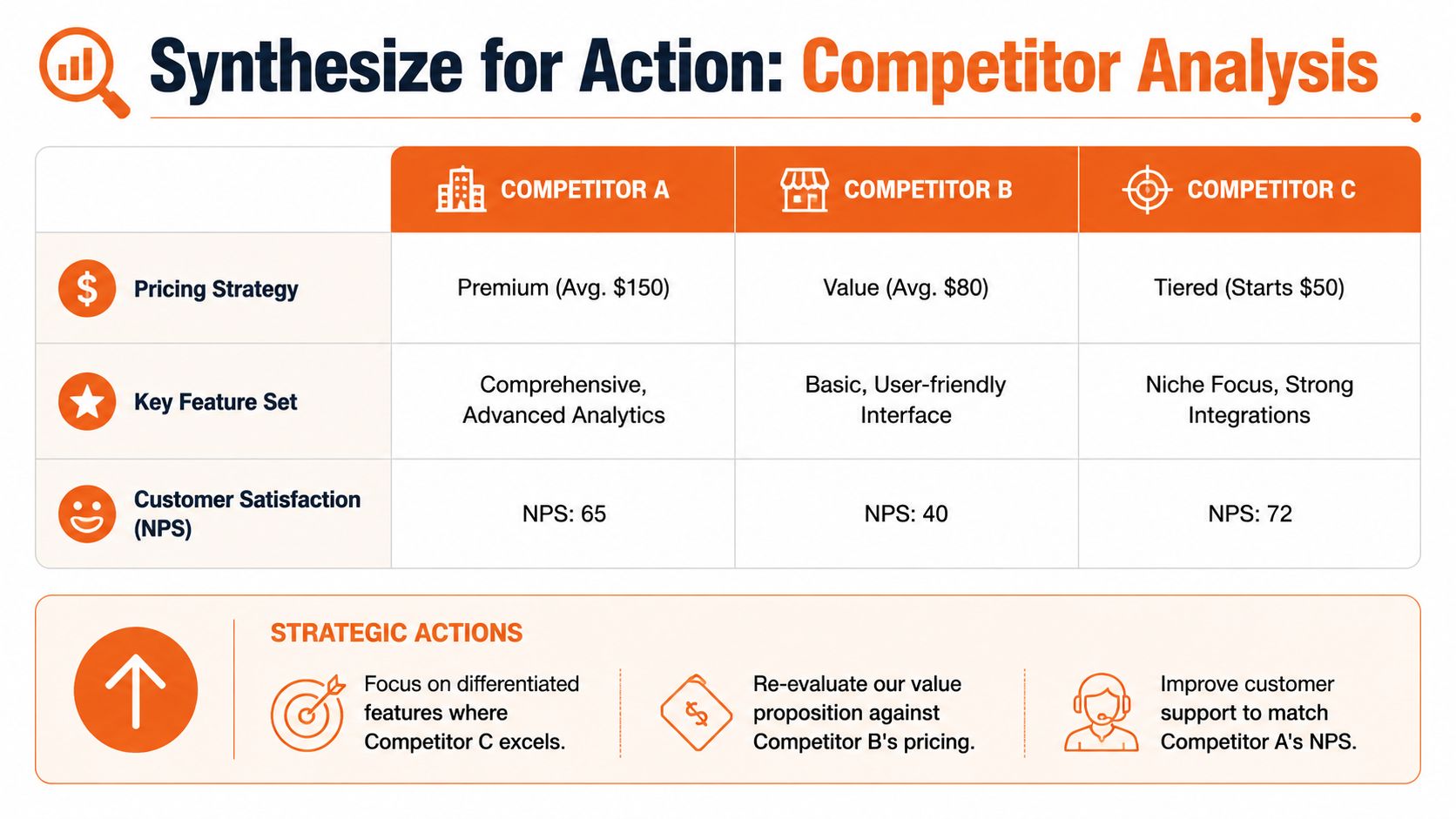
The point of a competitive analysis framework is decision velocity. You need a short list of moves your product team can deliver in the next MVP cycle with your nearshore engineers, then validate in pipeline, activation, and retention. Tools like SWOT, Porter's Five Forces, and perceptual mapping help only if they force a choice. Use them to expose where you can win fast, where you should ignore noise, and where a rival has built a lead that is not worth chasing feature for feature.
Use weighting to force priority
Every competitor weakness looks tempting. Treating all of them as roadmap inputs is how founders waste quarters.
Score each issue against your current business objective. If you are pushing upmarket, buyer assurance, admin control, and implementation friction deserve more weight than visual polish or long-tail integrations. If you need faster self-serve growth, pricing clarity, onboarding speed, and first-value workflow matter more.
A simple internal matrix is enough:
- Revenue impact
- Buyer importance
- Speed to ship
- Strategic fit
- Operational cost
That last factor matters. A feature that looks attractive in a slide deck can still slow support, increase complexity, and drag the team away from higher-yield work. Tie the scoring to delivery capacity and product-led operational efficiency gains, not just market visibility.
Plot the market on buyer-relevant axes
Perceptual maps are useful because they remove storytelling. Put competitors on two variables that matter to buyers. Good options include:
- Price and simplicity
- Breadth and depth
- Enterprise control and speed to value
- Flexibility and ease of adoption
Then look for one of two conditions. A crowded cluster means the category is repeating itself. An open gap means there may be room for a sharper offer, but only if you can support it with product, onboarding, and messaging.
Do not choose flattering axes just to make your product look differentiated. Choose the axes that affect deals.
Turn synthesis into a shipment plan
The output should be three to five decisions, each tied to an owner, a deadline, and a success metric. If it does not change backlog order, sales positioning, or release scope, it is still research.
| Insight | Action |
|---|---|
| Rival pricing is rising while packaging gets harder to understand | Test a simpler package and rewrite the pricing page around faster buyer comprehension |
| Enterprise competitors lead on assurance and procurement support | Ship trust assets, approval workflows, and admin controls in the next delivery cycle |
| Mid-market teams sit between lightweight and heavyweight tools | Launch an MVP focused on one painful workflow with fast setup and clear ROI |
This is how strong teams out-execute bigger rivals. They do not admire the market. They pick one gap, build the response quickly, and measure whether it changes win rate or expansion.
If your commercial team is also tightening positioning, use this marketing automation success guide to align follow-up, segmentation, and campaign response with the product moves you choose here.
Integrate Iterate and Out-execute the Market
A competitive analysis framework only matters when it's embedded in how your team works. Not as a quarterly ritual. As part of backlog shaping, sprint planning, and release review.
Founders often separate strategy from delivery. That's a mistake. The market doesn't care whether the delay came from weak analysis or weak execution. Buyers just see a slower product and a fuzzier value proposition.
Build the framework into your operating rhythm
Use a lightweight cadence that supports speed:
- Weekly. Review major competitor changes and update the track list.
- Monthly. Refresh pricing, positioning, and objection patterns.
- Quarterly. Reassess strategic bets, market gaps, and roadmap implications.
Then assign ownership. Product should own synthesis. Sales should contribute field evidence. Engineering should understand where competitive context affects scope, architecture, or implementation priority.
One practical way to keep the loop tight is to attach competitive context directly to backlog items. A story shouldn't just say what to build. It should state why the change matters in the current market.
Make every insight earn its place in delivery
Use a hard filter before anything enters the roadmap:
- Does this change improve a business outcome we care about now?
- Is the signal strong enough to justify engineering time?
- Can we deliver a meaningful response quickly?
If the answer is no, park it. You don't win by copying faster. You win by choosing better and executing with more discipline.
Operational maturity matters here. Teams that already run clean planning and review cycles can absorb competitor insight without chaos. Teams that don't should fix the operating model first. This article on operational efficiency is a useful starting point if execution still feels heavier than it should.
For GTM leaders, there's also value in studying adjacent systems that turn insight into action quickly. This marketing automation success guide is useful because it shows the same underlying principle. Faster feedback loops beat slower teams with larger plans.
Competitive analysis is not a research project. It's an execution advantage. The teams that win use it to choose faster, ship cleaner, and avoid wasting months on work the market won't reward.
If you want a delivery partner that treats market insight as an input to shipped software, not just strategy slides, talk to Rite NRG. We help SaaS teams move from competitive signal to MVP scope, roadmap priorities, and predictable release execution with senior product and engineering support.