
Your roadmap looks solid. The sprint board is moving. Engineers are shipping. Then the launch starts slipping anyway.
Sales says the product story changed without warning. The CTO thinks risk is under control, right until security raises a late objection. Customer success hears one thing from product and another from delivery. Your investor update becomes defensive instead of confident. Nothing is technically “on fire”, but trust is leaking from every direction.
That's a stakeholder communication problem, and it kills SaaS momentum faster than most technical debt ever will.
We see this constantly in delivery. Teams obsess over velocity, architecture, backlog hygiene, and release process. All important. None of them save a programme when the wrong people are surprised at the wrong moment. In nearshore SaaS delivery, distance amplifies that risk. You can't rely on hallway fixes, casual readouts, or tribal knowledge. If you want speed, control, and predictable outcomes, you need a communication system that surfaces risk early and keeps decision-makers aligned before they drift apart.
Your SaaS Launch Is at Risk and It's Not the Code
Most failing launches don't look dramatic at first. They look busy.
The team is working hard. Status meetings happen. Slack is active. Jira is full. Everyone assumes communication is “good enough” because information exists somewhere. It isn't. If the sponsor doesn't know what decision is needed, if compliance hears about a change too late, or if a key customer-facing team can't explain what's coming, the delivery engine slows down whether the code is clean or not.
Communication is a delivery discipline
Treating stakeholder communication like a soft skill is a leadership mistake. Strong teams don't communicate more for the sake of it. They communicate with intent. They reduce ambiguity, shorten decision loops, and stop avoidable escalation.
That view isn't just common sense. In the UK, stakeholder communication is treated as a governance discipline in major public-project delivery, not an optional extra. The Government Major Projects Portfolio includes 200-plus major projects and programmes at any one time, and the expectation is structured engagement throughout the lifecycle, not ad hoc updates at kickoff or crisis points, as noted in the World Bank guidance on stakeholder communication and engagement.
For SaaS leaders, the lesson is obvious. If highly complex delivery environments formalise communication because it reduces risk and improves accountability, your product launch should too.
Practical rule: If a stakeholder can still say “I didn't know” late in delivery, your communication process is broken.
What Extreme Ownership looks like in communication
At Rite NRG, we think about delivery through Extreme Ownership. That means nobody hides behind process, tooling, timezone gaps, or “they should have asked”. If confusion exists, the team owns clearing it up. If risk is emerging, the team surfaces it early. If a stakeholder is drifting, someone re-engages them before it turns into a blocker.
That mindset changes behaviour fast:
- We don't wait for questions. We send the update before the stakeholder asks.
- We don't dress up bad news. We explain the issue, the impact, and the recovery path.
- We don't confuse activity with alignment. A full calendar isn't proof that the right people understand the right things.
The business outcome is predictability
Fast SaaS delivery isn't just about writing and releasing software. It's about helping commercial, technical, and operational stakeholders make confident decisions without friction.
When stakeholder communication works, launches move with less hesitation. Priorities stay cleaner. Board conversations get sharper. Teams spend less time re-explaining old decisions and more time executing the current plan.
That's not admin. That's delivery advantage.
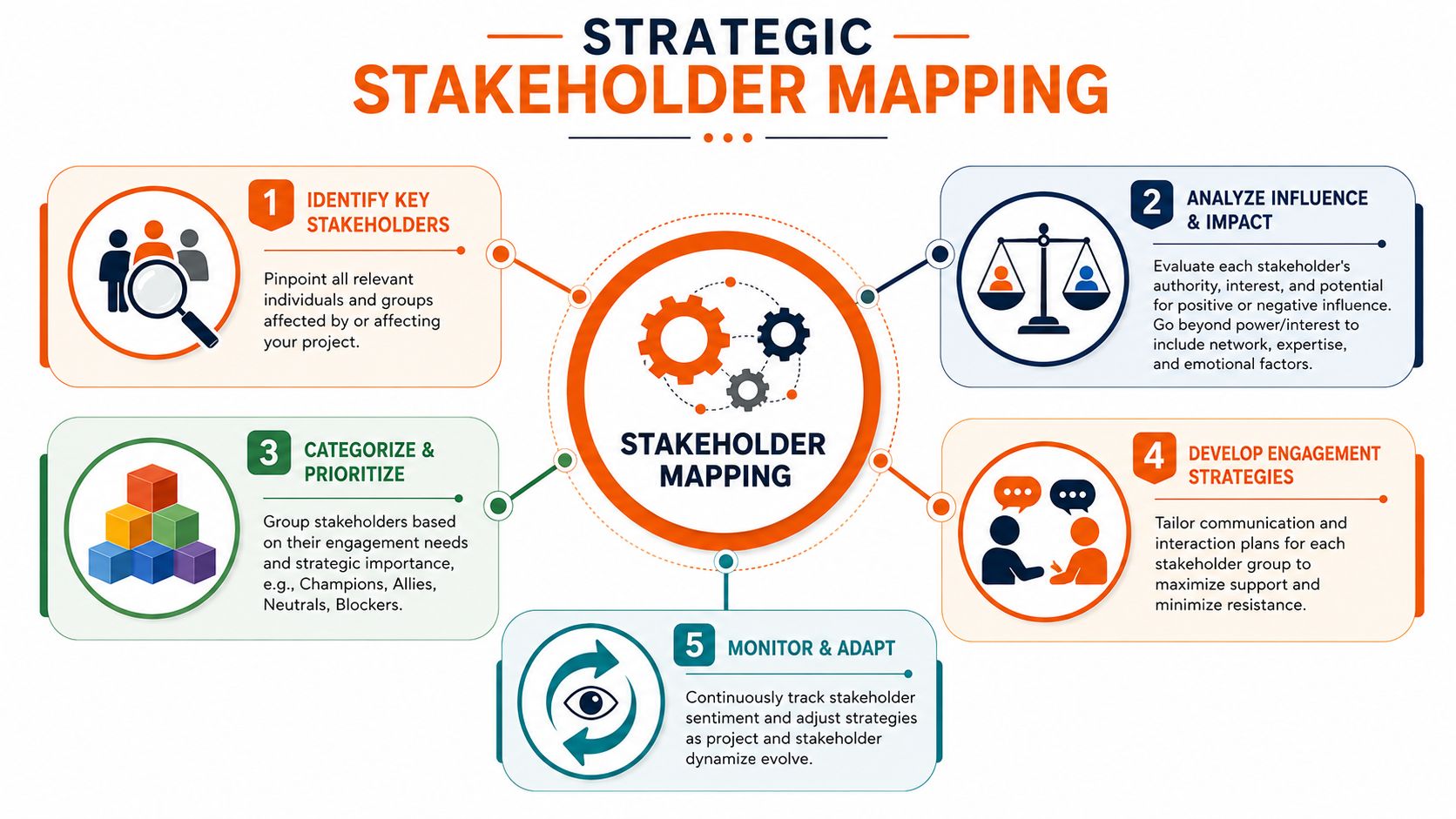
Map Your Stakeholders for Maximum Impact
If your stakeholder list is just names and job titles, you're not managing communication. You're maintaining a contact sheet.
Real stakeholder mapping goes deeper. You need to know who can approve, who can delay, who influences decisions informally, and who gets nervous when uncertainty rises. In nearshore SaaS delivery, that work matters even more because you can't rely on physical proximity to spot tension early.
Start with pressure, not org charts
Org charts tell you reporting lines. They don't tell you what can derail a launch.
Map stakeholders around pressure points instead. Ask:
- Who signs off? These people control movement.
- Who absorbs operational fallout? Customer success, support, sales enablement, and compliance often carry hidden risk.
- Who shapes opinion behind the scenes? Sometimes the architect, programme manager, or head of operations has more real influence than the formal sponsor.
- Who will feel the impact first? End users, client teams, and internal adoption owners see problems before the board does.
A useful stakeholder map captures role, influence, preferred channel, likely concerns, and what “success” means from their perspective.
Four stakeholder archetypes in SaaS delivery
Most SaaS programmes include a version of these groups:
- The C-level sponsor wants confidence, clarity, and movement. Don't swamp them with implementation detail. Give them decision-ready updates.
- The technical gatekeeper cares about architecture, security, scalability, and integration risk. If you oversimplify, you lose credibility.
- The end-user advocate wants usability, adoption, and operational fit. This person often spots rollout problems before engineering does.
- The commercial stakeholder needs timing, messaging, and market readiness aligned. If release communication drifts from GTM planning, friction appears fast.
That last point matters more than many product teams admit. If you're preparing launch motions in parallel, this guide on creating a GTM foundation is a useful companion because it forces commercial readiness into the same planning conversation as delivery readiness.
A stakeholder with low formal authority can still stop progress if they own a dependency nobody else sees.
Build a living map
Static mapping dies the moment delivery gets real. Stakeholder communication only works when the map evolves with the programme.
Use a simple review rhythm:
| Review trigger | What to check |
|---|---|
| Scope change | Who now needs deeper involvement |
| Timeline pressure | Which stakeholders need more frequent updates |
| Organisational change | Whether influence has shifted |
| Launch preparation | Whether customer-facing teams are fully aligned |
Video can help your team build that habit consistently. This walkthrough is a strong primer for getting everyone to think visually and strategically about stakeholder alignment.
What good mapping produces
A strong stakeholder map doesn't sit in Confluence collecting dust. It changes how your team behaves.
It tells you who needs reassurance before a risky change lands. It tells you which update should go to Slack, which should go to a board summary, and which needs a direct call. It tells you whose silence is harmless and whose silence is dangerous.
That's how you prevent blind spots. Not by talking to everyone equally, but by engaging the right people with the right message before uncertainty turns into resistance.
Design Your Proactive Communication Plan
A communication plan shouldn't read like governance theatre. It should operate like a control system.
Weak plans say everyone should stay informed. Strong plans define who needs what, why they need it, how often they need it, and who owns the relationship. That's the difference between passive reporting and proactive stakeholder communication.
Build it as a tiered plan
UK project guidance is clear on this point. Communication should be built as a tiered plan that defines message purpose, frequency, channel, and audience, and it should assign a relationship lead plus a maintained stakeholder database so engagement stays consistent and trackable, as set out in the APM guidance on stakeholder communication.
That's the right model for SaaS delivery too.
Different stakeholders need different layers of information:
- Executive layer for decisions, risks, timeline confidence, and commercial impact
- Operational layer for dependencies, readiness, and cross-functional actions
- Delivery layer for day-to-day execution, blockers, and implementation detail
- External or customer-facing layer for launch timing, user impact, training, and support readiness
If you send the same update to everyone, you satisfy nobody.
Use one owner per important relationship
Teams frequently create avoidable confusion. Three people speak to the same stakeholder. Nobody owns the narrative. Messages drift.
Assign one named person as the relationship lead for each critical stakeholder or stakeholder group. That person doesn't have to send every message, but they do own context, continuity, and follow-up.
Operator's view: Stakeholders don't care how your team is structured internally. They care whether communication feels coherent.
Keep that ownership visible in your delivery operating model. If your roadmap process needs tightening as well, this piece on roadmap and strategy alignment helps connect communication cadence to actual product direction.
A practical template you can use
Don't overcomplicate the artefact. A good plan is easy to maintain and impossible to misread.
| Stakeholder/Group | Key Interest/Goal | Communication Purpose | Channel | Frequency | Owner |
|---|---|---|---|---|---|
| Executive sponsor | Delivery confidence and business impact | Decisions, risks, milestone confidence | Summary email plus live review | Weekly or by milestone | Relationship lead |
| CTO or engineering leader | Technical quality and risk control | Architecture, blockers, trade-offs | Technical review, written recap | Weekly | Engineering lead |
| Sales and marketing | Launch readiness and message clarity | Release scope, timing, enablement | Planning call, launch notes | Fortnightly, then tighter near launch | Product or GTM lead |
| Customer success and support | User impact and rollout readiness | Training needs, change impact, support preparation | Workshop, FAQ, written updates | By milestone | Operations lead |
| Delivery team | Execution clarity | Priorities, dependencies, decisions | Stand-up, board, recap notes | Daily and weekly | Delivery lead |
You can also sharpen this with a broader framework if you want a companion resource to develop your communication strategy beyond the project layer.
What the plan must include
At minimum, your communication plan should answer these questions:
- Purpose. Why does this message exist? Approval, awareness, reassurance, action, or escalation?
- Audience. Who needs it? Not who might find it interesting.
- Channel. Email, Slack, dashboard, workshop, call, document, or board review?
- Cadence. Event-based, weekly, fortnightly, monthly, or only on trigger?
- Owner. Who sends it, tracks response, and closes the loop?
Plan for moments, not just meetings
The best stakeholder communication plans aren't built only around recurring calendar invites. They're built around moments that create risk.
Examples include scope changes, delivery slippage, security concerns, handover periods, launch readiness, and customer-facing impacts. Those moments need pre-agreed communication paths. If you invent them under pressure, you're already late.
A proactive communication plan doesn't add bureaucracy. It removes hesitation. It gives your team a repeatable way to keep confidence high while the product moves fast.
Execute Flawlessly with Extreme Ownership
A plan on paper means nothing if execution is timid.
Delivery teams either build trust or burn it through their communication. You don't earn stakeholder confidence by sounding polished in a status meeting. You earn it by communicating early, clearly, and consistently when reality changes.

Own the message before it becomes a problem
A nearshore SaaS team discovers that a third-party integration won't support a planned release flow. The weak version of communication looks like this: engineering discusses it internally for days, product assumes it's manageable, and the sponsor hears about it only when the date is already under pressure.
The strong version is different. The team surfaces the issue immediately, frames the impact in business terms, proposes options, and recommends a path. That's Extreme Ownership in action.
A useful pattern looks like this:
- State the issue clearly so nobody has to decode technical jargon
- Explain the business impact on scope, timing, user experience, or launch readiness
- Recommend next steps instead of pushing the problem upward with no proposal
- Confirm the decision in writing after discussion
That approach protects momentum because it gives stakeholders something they can act on.
Use closed-loop communication every time
For distributed teams, ambiguity is expensive. Different contexts, cultures, and assumptions can make even simple updates land badly.
That's why a closed-loop method works so well. PMI describes reducing communication failure by identifying stakeholder preferences, agreeing the channel and purpose, sending a clear summary, and then seeking validation or corrections through clarification and written recap in its guidance on communicating with project stakeholders.
In practical terms, the loop is simple:
Send the message with intent
Don't dump information. Say what changed, what matters, and what response is needed.Recap in writing
After a call or workshop, send a short written summary with decisions, actions, and open questions.Ask for validation
“Please confirm this matches your understanding” is stronger than assuming silence means agreement.Correct fast
If a stakeholder interpreted the message differently, fix it immediately. Don't let divergence sit.
Match the format to the person
One reason stakeholder communication breaks down is that teams become loyal to their own preferred channels instead of the stakeholder's actual needs.
A CEO may want a concise dashboard and a direct note on delivery confidence. An engineering lead may need a detailed change log, dependency view, and architecture decision record. A customer success manager may need rollout messaging, support scripts, and clear user impact summaries.
If you want more clarity on ownership at the technical leadership layer, this breakdown of tech lead responsibilities in modern delivery is worth reading because tech communication often fails when nobody owns translation between engineering reality and business expectation.
Send fewer messages. Make each one easier to act on.
Don't hide bad news
Many teams think they're protecting confidence by waiting until they know more. Usually they're protecting themselves.
Stakeholders trust teams that raise issues early and bring a plan. They lose trust in teams that create surprise. If the release date is at risk, say it. If a dependency has gone unstable, say it. If a decision is blocked because an executive hasn't responded, say it.
The key is delivery discipline, not panic. Present bad news with structure:
| Situation | Weak response | Strong response |
|---|---|---|
| Timeline risk | “We may have some delays” | “This dependency threatens the milestone. We recommend option B to protect launch scope.” |
| Scope conflict | “Teams are still aligning” | “Two functions want different outcomes. We need a decision by Friday to prevent rework.” |
| Quality concern | “QA found some issues” | “This defect affects user onboarding. We propose delaying this feature, not the full release.” |
Build trust through unsolicited clarity
The best delivery leads don't wait to be chased. They send the note after the workshop. They summarise decisions after the steering call. They flag risk before it appears in a board pack. They update stakeholders with private anxiety before anxiety hardens into resistance.
That habit creates calm. Not because problems disappear, but because nobody feels blind.
In stakeholder communication, that's what flawless execution looks like.
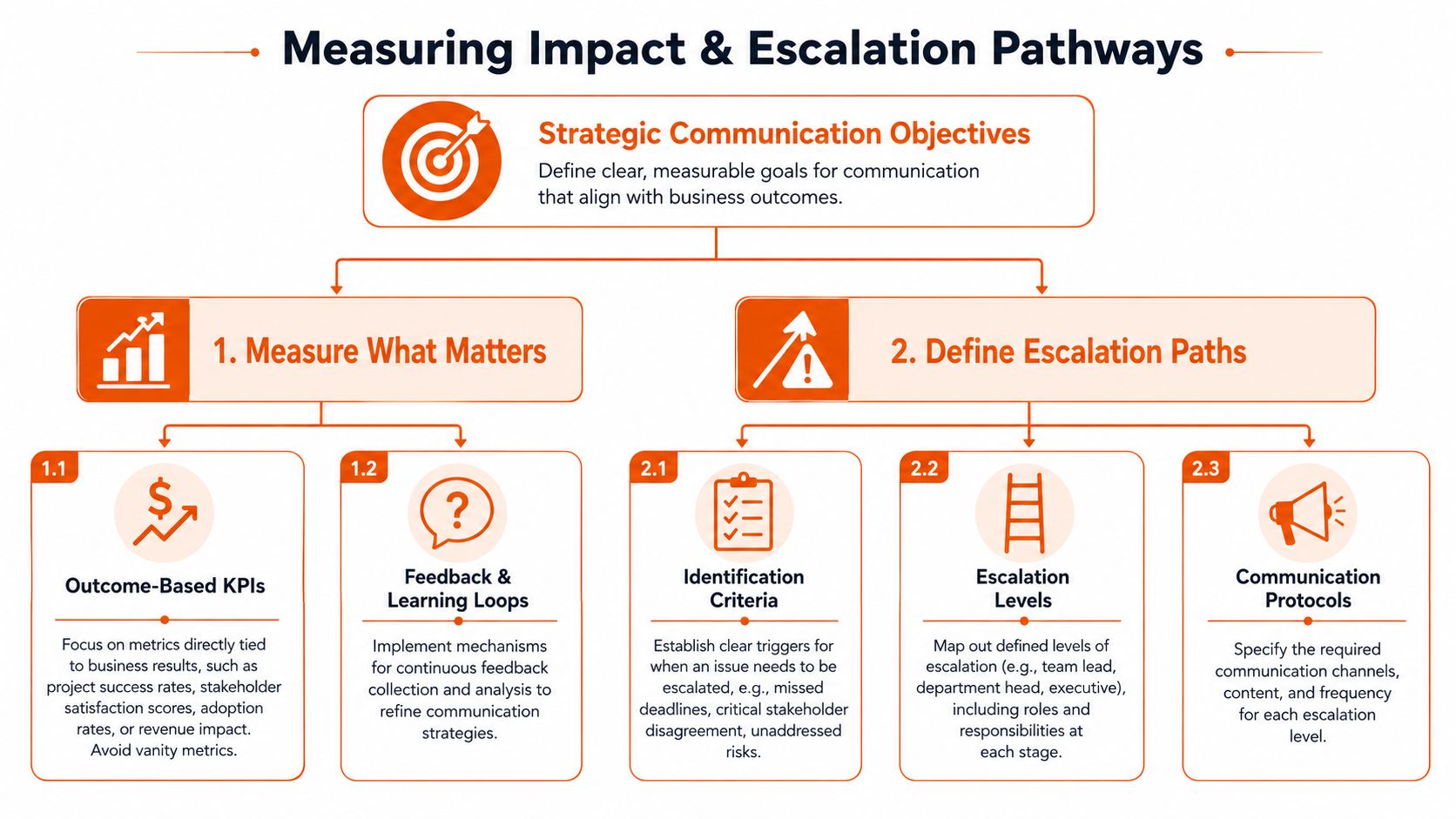
Measure What Matters and Define Escalation Paths
If you can't tell whether communication is improving delivery, you're measuring the wrong thing.
Too many teams track easy activity metrics. Number of meetings. Number of emails sent. Attendance. None of that proves alignment. A packed calendar can still produce a confused organisation.
Focus on outcome signals
Measure communication through delivery outcomes and stakeholder behaviour.
Useful indicators include:
- Decision speed. Are key decisions getting made quickly enough to protect flow?
- Late-stage change pressure. Are major misunderstandings surfacing too late in the cycle?
- Issue resolution time. When a risk is flagged, how quickly does the team resolve or escalate it?
- Stakeholder confidence. Do sponsors and partner teams feel informed, or do they keep asking for the same context again?
These aren't vanity measures. They show whether communication is reducing friction or creating it.
Good stakeholder communication lowers confusion before it lowers cost. Watch for that signal first.
Treat channel choice as an accessibility decision
This point is still underplayed in many delivery environments. Teams often assume digital-first updates are enough because they're efficient. They aren't always effective.
Guidance on inclusive engagement warns that some under-served groups may not access websites or digital-first channels consistently, so teams may need printed materials, regular meetings, or other non-digital methods. The wider takeaway from the Global Infrastructure Hub guidance on inclusive stakeholder engagement is that channel selection should be treated as an accessibility decision, not just a style preference.
That applies inside SaaS organisations too. Not every stakeholder consumes information the same way. Some need async written summaries. Some need live discussion. Some need visuals. Some need repetition in a structured format. Coverage matters more than convenience.
Create a no-blame escalation path
Communication systems fail when people are afraid to escalate. If raising risk feels political, teams wait too long.
Build a simple path with clear triggers:
| Escalation level | Trigger | Owner | Expected action |
|---|---|---|---|
| Team level | Blocker or misalignment affecting current work | Delivery lead | Resolve within team or re-route quickly |
| Functional lead level | Cross-team dependency, unresolved decision, repeated confusion | Product, engineering, or operations lead | Decide, unblock, or set deadline for resolution |
| Executive level | Commercial risk, major milestone threat, stakeholder conflict with business impact | Sponsor or leadership owner | Make trade-off decision and communicate direction |
Support that path with one rule. Escalation is not blame. It's a control mechanism.
That mindset is identical to strong operational response patterns. If your organisation needs a sharper model for urgent issue handling, these incident response procedures for delivery teams offer a useful parallel.
What to review regularly
A monthly communication review is usually enough to spot drift if the programme is stable. During launch windows or high-risk phases, review more often.
Check for:
- Repeated stakeholder questions that signal poor clarity
- Silent stakeholders who should be actively engaged
- Escalations that arrived late because triggers were fuzzy
- Channels that aren't landing with the intended audience
Measure the impact. Tighten the route. Remove ambiguity.
That's how stakeholder communication becomes operationally reliable instead of personality-dependent.
Beyond Delivery Turn Communication into Your Competitive Edge
Teams that communicate well don't just avoid failure. They become easier to trust.
That trust changes everything. Sponsors make decisions faster. Cross-functional teams cooperate earlier. Investors hear a coherent story. Delivery risk feels managed, not mysterious. Product launches stop behaving like stressful improvisation and start behaving like controlled execution.
This is why stakeholder communication deserves board-level attention in growth-stage SaaS. It isn't a support activity around delivery. It is part of delivery. The team that keeps people aligned under pressure will ship with more predictability than the team with the flashier process deck and weaker follow-through.
The advantage compounds. Strong communication improves decision quality, de-risks launches, and creates a reputation for control. That reputation matters when you're hiring, fundraising, entering new markets, or replacing an underperforming delivery model.
Own the narrative. Own the risk. Own the follow-up.
Do that consistently, and stakeholder communication stops being a project-management obligation. It becomes one of the clearest competitive edges your business has.
If you want a delivery partner that treats stakeholder communication as a control system, not an afterthought, talk to Rite NRG. We help SaaS teams build faster, communicate earlier, and deliver with the kind of ownership that keeps launches predictable.