Most advice on voice user interfaces is wrong for SaaS founders.
It treats voice like a brand signal, a novelty feature, or a vague AI upgrade. That's how teams burn budget. A voice layer only earns its place when it removes friction from a workflow that users already repeat, struggle with, or need to complete while their hands and eyes are busy.
The market signal is real. UK users already understand assistant-style interaction. Grand View Research's summary of Ofcom data notes that in 2021, 60% of UK internet users aged 16+ had used a smart speaker, 29% used one daily, and ownership was especially high among younger adults, with 73% of 16–24s and 69% of 25–34s compared with 41% of all UK adults. That means you don't need to teach the market what voice is. You do need to prove why voice belongs in your product.
That's the right starting point. Not “Can we add voice?” but “Which workflow gets faster, easier, or more defensible if we add voice?”
A founder who thinks this way makes better product bets. A product leader who thinks this way cuts through hype. A delivery partner who thinks this way owns outcomes instead of shipping features and walking away.
Beyond the Hype When Voice User Interfaces Drive Real Business Value
Voice user interfaces don't deserve a place in your roadmap just because AI is hot. They deserve a place when they reduce effort in a critical workflow and create a business outcome you can defend.
For SaaS, that usually means one of three things. The feature shortens time to action, reduces interaction friction in repetitive tasks, or makes your product more usable in moments where typing and clicking are awkward. If it doesn't do one of those, skip it.
Stop treating voice as a universal interface
Founders get pulled into a bad assumption. If voice feels natural, it must be useful everywhere. It isn't. Broad product navigation through voice is often clumsy, slow, and fragile. Narrow intent-based actions are where voice starts to make commercial sense.
Think about the difference between these two ideas:
- Weak idea: “Let users control the whole app with voice.”
- Strong idea: “Let users dictate notes, trigger a repeat workflow, or retrieve a specific record while multitasking.”
The second one is focused. It's easier to design, test, support, and justify.
Practical rule: If your team can't name the exact workflow, user moment, and expected business win, you're not ready to build voice.
The right ROI question
A voice feature isn't valuable because it exists. It's valuable because it changes user behaviour in a way that matters to the business. Better retention. Faster workflow completion. Stronger differentiation in a crowded category. Less operational friction for the user.
That's where the #riteway mindset matters. Extreme Ownership means you don't ship a voice experiment and hope users figure it out. You define the commercial reason first, then build the smallest version that proves it.
Use this filter before you approve anything:
| Question | If the answer is yes | If the answer is no |
|---|---|---|
| Is the task repeated often? | Voice may save effort | Voice may become a gimmick |
| Is the user often mobile, multitasking, or hands-busy? | Voice may fit the context | Screen input is probably enough |
| Is the intent narrow and predictable? | MVP scope stays controlled | Error handling gets expensive |
| Can success be measured inside one workflow? | ROI can be validated quickly | You're building blind |
Most SaaS products don't need voice everywhere. Some need it in one place badly. That's the opportunity.
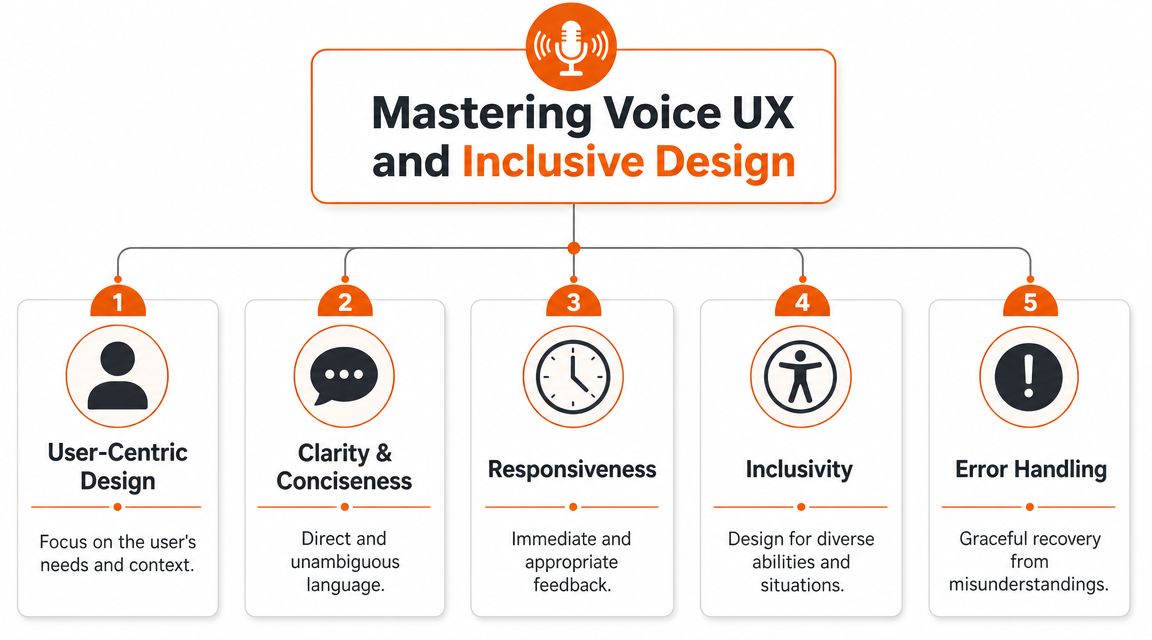
Mastering Voice UX and Inclusive Design Principles
A good voice experience doesn't feel like software talking. It feels like a competent assistant helping the user finish a job.
That changes how you design. You're not arranging screens. You're scripting interaction, managing ambiguity, and guiding the user back on track when the system gets it wrong.
Design for conversation, not command syntax
A weak VUI makes the user guess what to say. A strong one gives them confidence. That means clear prompts, short responses, and obvious recovery paths.
Treat it like front-desk staff training. If a user asks for something unclear, the system shouldn't freeze or dump a generic failure message. It should narrow the choice. “Did you mean the latest invoice or the last paid invoice?” is useful. “I didn't understand” is lazy design.
Use these principles early:
- Discoverability matters: users need cues about what voice can do.
- Brevity wins: long spoken replies frustrate people faster than long text.
- Turn-taking must feel natural: users need immediate confirmation that the system heard them.
- Recovery is part of the core flow: misunderstanding isn't an edge case. It's a design condition.
If your product team needs a stronger foundation in user-centred product thinking, this guide to digital product design is a useful companion to voice work.
Inclusive design in the UK is not optional
The accessibility promise around voice gets oversold and under-tested. Voice can improve access. It can also fail the people who need it most if the model handles only a narrow range of speech patterns.
Webskitters' discussion of voice user interface design highlights a core problem: accuracy drops with accents and background noise. In the UK, that's a big deal. Accent and dialect diversity is broad enough that a single “English” voice model is not a serious testing strategy.
A VUI that works for your internal demo team but struggles with regional accents is not inclusive. It's unfinished.
What to do instead
Don't rely on a polished prototype and optimistic assumptions. Stress the system where it will break.
Run design and test reviews around real variation:
- Regional speech variation: include users from different parts of the UK, not just one office or one customer segment.
- Environmental noise: test in homes, shared offices, transit contexts, and other imperfect settings.
- Prompt ambiguity: rewrite prompts that encourage overly broad or inconsistent replies.
- Fallback design: always provide a visible or tactile alternative when voice confidence is low.
The best voice UX teams think like conversation designers and service operators at the same time. They script the ideal path, then take equal ownership of the messy one.
Deconstructing the VUI Technology Stack
Too many leaders treat voice as one black box called “AI”. That's a mistake. If you want predictable delivery, you need to know where failure happens.
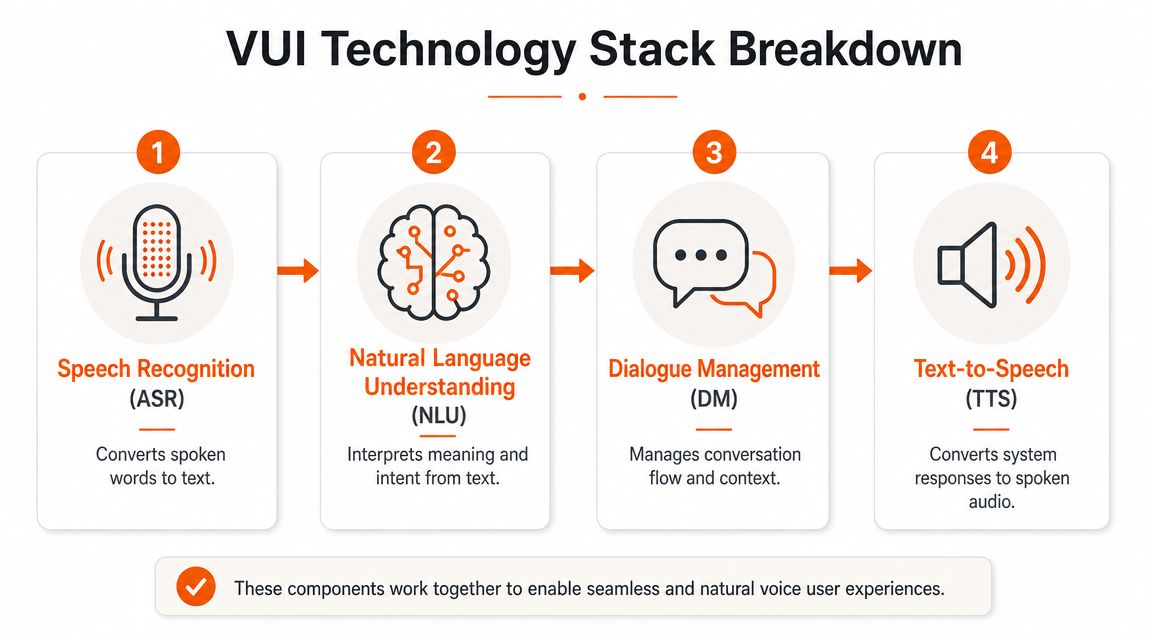
A well-engineered VUI architecture is typically split into four layers: speech recognition, natural language understanding, dialog management, and text-to-speech. Lollypop's breakdown of voice user interface architecture makes the key point clearly: each layer has its own failure mode, and engineers should instrument each stage separately instead of tracking only end-to-end task success.
Think of it like an engine, not a feature
A car doesn't move because “transport” works. It moves because fuel delivery, ignition, timing, and braking all do their jobs. Voice works the same way.
Here's the stack in plain language:
| Layer | What it does | What breaks when it fails |
|---|---|---|
| Speech recognition | Converts spoken input into text | The system hears the wrong words |
| Natural language understanding | Interprets intent and entities | The system hears the words but misreads the meaning |
| Dialog management | Decides the next step in the conversation | The flow becomes confusing, repetitive, or context-blind |
| Text-to-speech | Delivers the system response aloud | The output sounds unnatural, unclear, or poorly timed |
If your analytics only show “task failed”, you won't know whether the user mumbled, the model guessed wrong, the dialogue logic lost context, or the spoken response created confusion. That's not observability. That's guessing.
Instrument each layer or expect slow debugging
Many teams lose months when they build a promising demo, launch a pilot, then realise they can't isolate what's going wrong in production.
Track each layer with intent. Review transcripts, confidence thresholds, slot-filling failures, repeat prompts, and abandonment points. Even basic logging discipline will save you from expensive argument loops between product, engineering, and support.
If you're mapping technical decisions at the architecture level, this overview of what a technology stack includes is worth keeping close.
Audio quality also matters earlier than often anticipated. If your users speak in noisy environments, cleaning source audio before it hits recognition can improve the conditions your stack has to handle. This practical guide to Isolate Audio's AI cleanup methods is a useful reference for teams working on speech-heavy flows.
The fastest way to waste money on voice is to monitor only the final outcome. The stack needs stage-by-stage accountability.
Strategic VUI Integration for Your SaaS Platform
The smartest voice decision is often saying no to most of your own ideas.
If your product already has screens, forms, dashboards, and navigation, voice shouldn't compete with them. It should handle the moments where speech beats touch and typing. Anything else adds cost without adding enough value.

Where voice actually fits
Bentley University's voice design guidance points to the right commercial lens: voice is strongest for narrow, repetitive, or hands-busy tasks, not broad navigation. That's the key filter for SaaS leaders.
Good candidates usually look like this:
- Input-heavy shortcuts: dictating notes, logging updates, creating quick records
- Status retrieval: asking for one clear piece of information without opening multiple screens
- Operational actions: triggering a routine step in a fixed workflow
- Field or mobile use: moments where the user can speak more easily than they can type
Bad candidates are usually obvious once you stop pretending voice is magic. Open-ended browsing. Dense analytics exploration. Multi-branch product settings. Anything that needs visual comparison across many options.
A founder-level checklist
Before you greenlight a VUI feature, ask these questions:
Does this workflow already matter?
Don't build voice for an underused path. Improve a path users already care about.Can the task be expressed in a short utterance?
If users need long, careful phrasing, the interaction will feel fragile.Is failure recoverable without frustration?
If one misunderstanding creates a dead end, your support burden will rise.Will voice complement the screen, not fight it?
Multimodal experiences are usually stronger than voice-only experiences in SaaS.Can the business value be seen quickly?
If your team can't define what success looks like in one workflow, don't build the feature yet.
Teams adding AI features across SaaS products often make the same mistake with voice that they make elsewhere. They start with capability, not workflow value. This practical guide to building AI-powered SaaS is useful because it keeps the product and monetisation lens in view.
Prioritise one wedge, not a platform fantasy
The best VUI MVP is rarely a platform-wide initiative. It's a wedge. One workflow. One user group. One measurable job.
That gives you a clean decision after launch. Expand, refine, or kill it. Founders need more features with that kind of honesty.
Your High-Speed VUI MVP Roadmap with a Nearshore Team
Voice projects slow down when teams try to solve everything at once. They speed up when scope stays tight, ownership is clear, and every phase produces a decision, not just output.
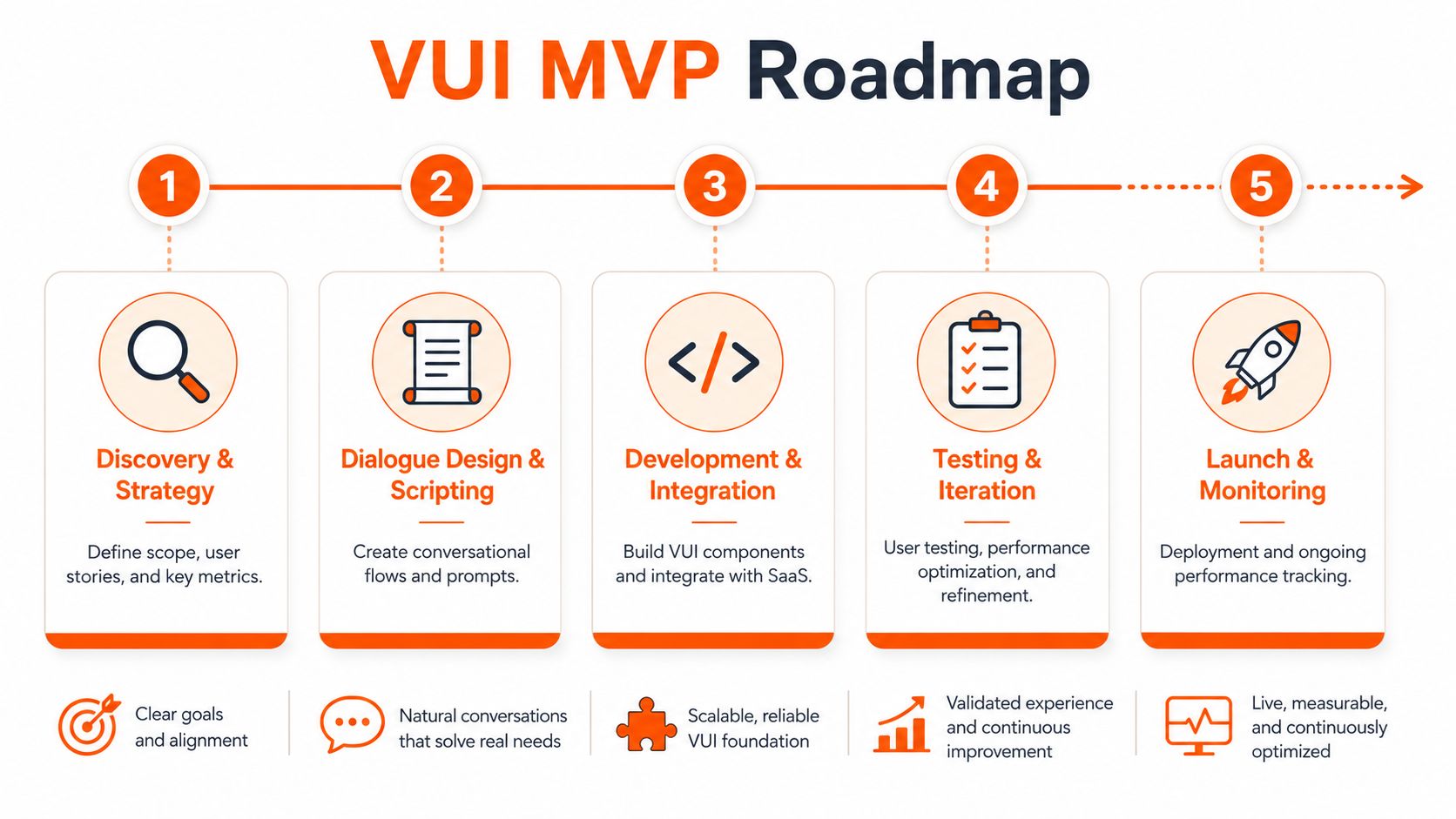
That's why a strong MVP roadmap matters. It protects the budget, shortens the feedback loop, and gives the team a realistic path from idea to pilot.
Phase one and two define whether the build is worth doing
The first phase is discovery and strategy. Pick one workflow, define the user moment, identify likely failure points, and agree on what success looks like. If your team can't align here, the rest will wobble.
The second phase is dialogue design and scripting. Weak teams often rush this part. Don't. Write the prompts, clarifications, fallback responses, and handoff conditions before code gets deep. Voice products fail in words before they fail in software.
Build the conversation on paper first. It's cheaper to rewrite a prompt than unwind the wrong architecture later.
Phase three and four turn assumptions into product reality
Next comes development and integration. Connect the voice layer to the underlying workflow, permissions, data model, and interface states. Keep the first version narrow. If the MVP can't complete one valuable task cleanly, adding more intents won't save it.
Then move into testing and iteration. Run real-user sessions, inspect failed turns, refine prompts, and adjust confidence thresholds. Treat every misunderstood utterance as product feedback, not just a model issue.
A nearshore team can accelerate this stage if they work as part of your product rhythm rather than as an outsourced factory. The difference is ownership. Fast stand-ups, direct access to decision-makers, shared tooling, and proactive risk-flagging beat bloated handovers every time. If you're weighing delivery models, this comparison of nearshore vs offshore software development helps frame the trade-offs.
Phase five is where discipline shows
The last phase is launch and monitoring. Not a big reveal. A controlled rollout with logs, support feedback, and clear review points.
A founder-friendly MVP roadmap looks like this:
- Constrain the scope: one workflow, one persona, one business outcome
- Script before building: prompts, errors, confirmations, and exit routes
- Integrate only what matters: connect the minimum systems needed for the use case
- Test in realistic conditions: include actual customer language and usage context
- Review with ownership: decide whether to expand, revise, or stop
That's the #riteway mindset in practice. High energy, zero passivity, and full accountability for what ships and what it proves.
Testing and Analysing Your VUI for Market Success
Traditional UI testing asks whether users can find the button and finish the flow. Voice testing is tougher. You need to know whether users were understood, whether the system chose the right intent, whether the conversation recovered when it didn't, and whether the whole exchange was still worth the effort.
If you skip serious analysis, your VUI becomes one of those features everyone demoed and nobody trusts.
What to test that teams often miss
Start with functional correctness, then move immediately into conversational performance. A voice feature can be technically “working” and still be commercially weak if users repeat themselves, hesitate, or drop back to the screen every time something gets fuzzy.
Test under pressure, not just in ideal conditions:
- Accent variation: include the range of speech patterns your market uses
- Noisy environments: test beyond quiet meeting rooms
- Intent confusion: inspect where the system chooses the wrong action for similar requests
- Recovery paths: verify that fallback prompts help users continue
- Channel switching: watch how smoothly users move between voice and screen when needed
Metrics that tie back to business value
You should track operational metrics inside the voice flow. The exact definitions can vary by product, but the categories matter.
| Metric | What it tells you | Business relevance |
|---|---|---|
| Task completion rate | Whether users finish the target workflow | Shows if the feature creates usable value |
| Word error rate | How often spoken input is transcribed incorrectly | Helps isolate recognition problems |
| Intent recognition rate | How often the system maps input to the right intent | Reflects understanding quality |
| Fallback rate | How often users hit clarification or failure states | Signals friction and support risk |
| Abandonment points | Where users quit the interaction | Reveals weak prompts or broken flow logic |
Analyse behaviour, not just outputs
Read transcripts. Review failed sessions. Compare what users said with what they meant and what the system did. That's where the product insight lives.
A VUI succeeds when users trust it enough to use it again without thinking twice.
That trust is earned through repeated testing, fast iteration, and the discipline to fix the small misunderstandings that compound into feature rejection.
Your Next Move in Voice-Enabled SaaS
Voice user interfaces are powerful when they're treated like a business tool, not a trend response.
The winning pattern is clear. Start with one workflow where speech has an obvious advantage. Design the conversation with the same care you'd give a core onboarding flow. Build the stack so you can see where it fails. Test it in the messy conditions your users live in. Then decide whether it deserves expansion.
What founders should do now
If you're serious about voice, don't open a giant innovation track. Run a sharp product decision process.
Ask your team three questions:
- Which user action is repetitive enough to justify a voice shortcut?
- Where is the user context awkward for typing or clicking?
- What evidence would prove this feature deserves the next round of investment?
That approach gives you an advantage. It turns voice from vague innovation theatre into a focused product bet.
The future matters, but the current decision matters more
Multimodal interfaces will keep growing. Proactive assistance will get better. Voice will become more embedded in everyday software, especially where speed and convenience matter.
But none of that changes the immediate rule. Your next move should be small, strategic, and measurable. Founders who win with voice won't be the ones who bolt it onto everything. They'll be the ones who choose one meaningful use case, deliver it cleanly, and learn faster than everyone else.
That's how you build confidence in the product, confidence in the roadmap, and confidence from investors and customers who care about outcomes more than buzzwords.
If you want a delivery partner that treats voice user interfaces like a product decision instead of a novelty build, talk to Rite NRG. Their team brings senior product and engineering talent, nearshore speed, and the #riteway mindset of Extreme Ownership, proactive communication, and outcome-first delivery so you can validate a voice MVP fast without losing control of quality or roadmap clarity.