
A lot of founders end up in the same mess. The sprint board looks busy, the team sounds committed, and the codebase isn't on fire. Yet delivery keeps slipping, product decisions keep getting re-litigated, and every release feels harder than it should.
That isn't usually a coding problem. It's a leadership problem.
When nobody owns the technical path from product intent to working software, teams drift. Developers make local decisions. Product keeps asking for certainty nobody can give. Architecture becomes reactive. Morale drops because people are working hard without seeing clean progress. You don't fix that by hiring “a stronger coder”. You fix it by putting real technical leadership into the system.
Introduction The Difference Between a Coder and a Leader
A senior developer can write excellent code and still fail as a tech lead.
That sounds harsh, but founders need to hear it clearly. Tech lead responsibilities are not a reward for technical brilliance. They are a business-critical function. A real tech lead turns ambiguity into direction, protects delivery flow, and makes sure engineering effort produces usable commercial outcomes.
I've seen projects stall in a very predictable way. Product has a roadmap. Engineers are capable. The backlog is full. But nobody is making the hard calls early enough. Which trade-off matters most? What gets simplified? Where are the architectural boundaries? Which dependency can break the release? If nobody owns those questions, the team keeps moving and still doesn't get where it needs to go.
That's where leadership differs from management. If you want a useful framing, Aakash Gupta's piece on differentiating leadership and management is worth your time. The distinction matters because a tech lead isn't there to supervise activity. They're there to create clarity and momentum.
At Rite NRG, we'd call that the #riteway mindset. Extreme Ownership. Proactivity. No waiting for permission to solve the delivery problem that's obvious to everyone in the room.
Practical rule: If your most senior engineer can explain the code but can't explain how the team will ship predictably, you don't have a tech lead yet.
That's also why culture matters more than many founders admit. Teams that care about collaboration, ownership, and product impact deliver better. This is the same principle behind why a lovable dev delivers more business value. Technical strength matters. But the multiplier is how that strength gets translated into team progress.
Redefining the Role The Four Pillars of Tech Leadership
The role has changed. UK employer guidance shows that tech lead responsibilities have broadened beyond code-focused leadership into a hybrid role covering hiring, mentoring, planning, and technical governance, reflecting the need for leaders who bridge product requirements and engineering execution while reducing technical risk, as outlined in Société Générale's technical leader guidance.
That shift is healthy. SaaS teams don't need another isolated expert. They need someone who keeps the whole engine moving.
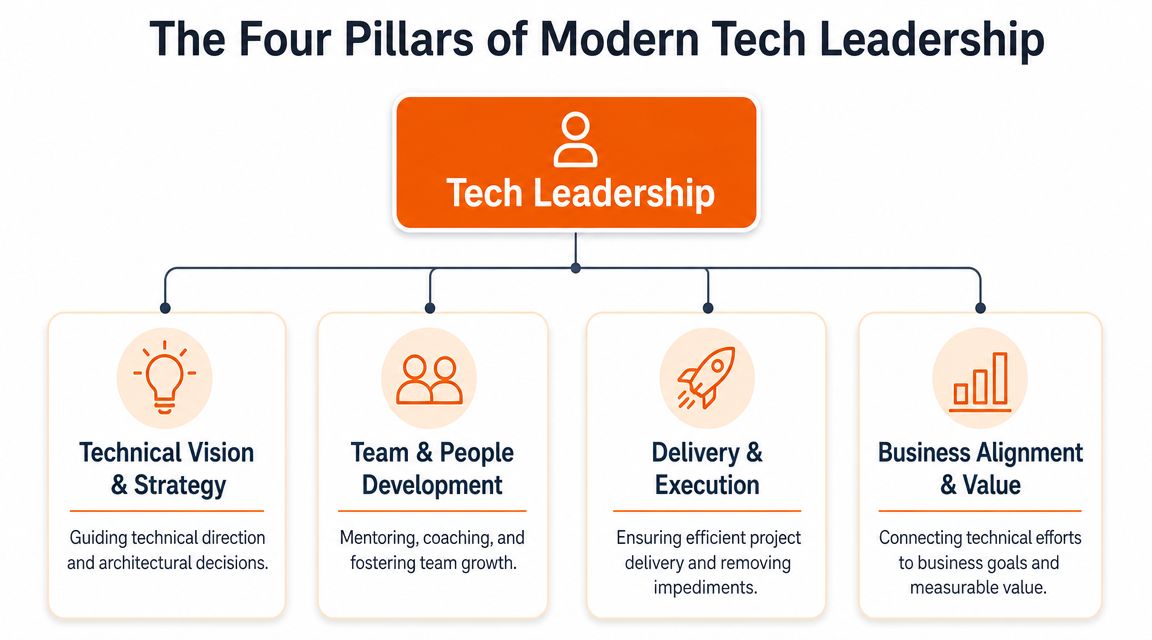
Technical vision and strategy
Here, weak teams lose months.
A tech lead should turn product goals into technical direction early, while options are still cheap. They decide where to standardise, where to simplify, and where to leave room for change. They don't hide behind “it depends” for every decision. They make the trade-offs visible and move the team forward.
For a founder, this means fewer late rewrites and fewer nasty surprises when the team starts integrating real features with real constraints.
Team and people development
A strong lead doesn't hoard complexity. They distribute capability.
That means mentoring, pairing, reviewing code in a way that teaches, and raising the technical judgement of the whole team. If one senior engineer is the only person who understands the risky parts of the system, delivery is fragile. The lead's job is to remove that fragility.
A practical sign you've got the right person is simple. Other developers get faster around them.
Delivery and execution
This is the pillar most companies underweight.
The tech lead owns technical execution quality. Not every project plan, not every HR conversation, but the actual path by which software gets shipped. They identify blockers early, sequence work intelligently, and prevent architecture churn from derailing a release.
Great tech leads don't just answer technical questions. They reduce the number of emergencies the team has to answer later.
Business alignment and value
The strongest leads think like delivery partners, not code custodians.
They understand what the business is trying to achieve, what can be deferred, and which technical choices support speed without creating chaos later. That's pure #riteway. Ownership means taking responsibility for outcomes, not just output. Proactivity means surfacing risks before they become founder problems.
Here's the operating model I recommend:
- Translate goals into constraints: Convert vague product ambition into specific architectural choices.
- Raise the floor of the team: Make the average developer more effective through mentoring and standards.
- Protect flow: Stop unnecessary rework, confusion, and dependency collisions.
- Connect effort to value: Keep technical decisions tied to customer impact and delivery predictability.
Tech Lead vs Engineering Manager Clarifying the Partnership
Founders often blur these roles. That causes confusion fast.
A tech lead and an engineering manager are not competing for the same space. They should form a tight partnership. One drives technical execution. The other drives people systems, team health, and broader operational support.
If you force one person to cover both without the maturity or capacity to do it, something will suffer. Usually delivery first, then morale.
The clean split
| Aspect | Tech Lead Focus ('The How') | Engineering Manager Focus ('The Who') |
|---|---|---|
| Core responsibility | Technical direction and execution quality | People leadership and team environment |
| Primary questions | How will we build this safely and efficiently? | Who needs support, growth, or role clarity? |
| Day-to-day work | Architecture decisions, code reviews, unblocking, implementation guidance | Coaching, hiring, feedback, staffing, process health |
| Team interaction | Deep involvement in technical choices and delivery risks | Deep involvement in career growth and performance |
| Stakeholder role | Translates product intent into technical action | Aligns team capacity, expectations, and cross-team process |
| Success signal | Predictable implementation and strong technical judgement | Stable team, healthy culture, and sustained performance |
Where founders get this wrong
The usual mistake is expecting the engineering manager to rescue technical ambiguity, or expecting the tech lead to absorb every people issue.
That muddies accountability. Your tech lead should be able to say, “Here's how we'll execute, where the risks are, and what trade-offs we're making.” Your engineering manager should be able to say, “Here's how we're supporting the team to perform consistently.”
If nobody owns the technical path, product gets uncertainty. If nobody owns the people system, the team burns out.
What a strong partnership looks like
The pair works best when they stay in their lane and communicate constantly.
- The tech lead brings decision clarity on architecture, sequencing, and code quality.
- The engineering manager ensures the team has capacity, feedback, support, and sustainable ways of working.
- Together they remove friction between product ambition and engineering reality.
For SaaS founders, this is the combination that creates an environment where speed and quality stop fighting each other.
From Strategy to Action A Tech Lead's Daily Impact
A good tech lead doesn't spend the day admiring architecture diagrams. They make delivery easier today.
In UK public sector guidance, a tech lead's most impactful responsibility is converting product goals into an executable technical plan with explicit architectural constraints. They work with product and delivery managers to identify and plan relevant technical work, advise on technical direction, and tailor work based on team capability. When technical direction is clarified up front, teams can reduce rework and preserve delivery flow, as described in GOV.UK's tech lead responsibilities guidance.
What that looks like in practice
Monday morning, product wants a new customer-facing feature. A weak lead says, “We'll investigate.” A strong lead breaks the request apart quickly.
They define what services change, what integrations are risky, what can be staged, what needs a spike, and what can be shipped behind a feature flag. That gives product and delivery something they can plan around.
By midday, they're in code review. Not rubber-stamping pull requests. Teaching through them. They're catching coupling problems, spotting inconsistency, and protecting maintainability before debt compounds. Sometimes that means recommending cleanup work, and sometimes it means making a surgical call to ship now and schedule refactoring deliberately. If your team needs a useful primer on that discipline, this piece on what code refactoring is helps frame the conversation properly.
The highest-leverage daily habits
The most effective leads tend to repeat the same behaviours:
- Run design sessions with intent: Keep discussions short, decision-based, and tied to delivery needs.
- Pair on hard problems: Don't let developers sit blocked for days on a risky integration or flaky behaviour.
- Translate business language: Turn “we need this for customers next sprint” into technical tickets with boundaries and assumptions.
- Surface risks early: Raise concerns when dependencies, architecture, or scope create delivery danger.
- Protect standards without slowing the team: Enforce consistency, but don't turn process into theatre.
Ownership in motion
At this point, #riteway becomes visible.
Extreme Ownership means the lead doesn't say, “Nobody told me product changed priorities.” They respond by re-planning the technical path and making the consequences visible immediately. Proactivity means they don't wait for a failed sprint review to mention a hidden dependency. They call it out when there's still time to act.
A founder should never be surprised by a technical risk that the tech lead could have seen a week earlier.
That's the daily value of the role. Less drift. Better sequencing. Cleaner communication. More software moving through the system with fewer avoidable collisions.
Measuring What Matters Success Metrics for Predictable Delivery
If you can't measure delivery health, you're managing on vibes.
That's not good enough once your SaaS product has customers, deadlines, and revenue pressure. A tech lead needs objective indicators that show whether the team is getting faster and more reliable, or just getting busier.
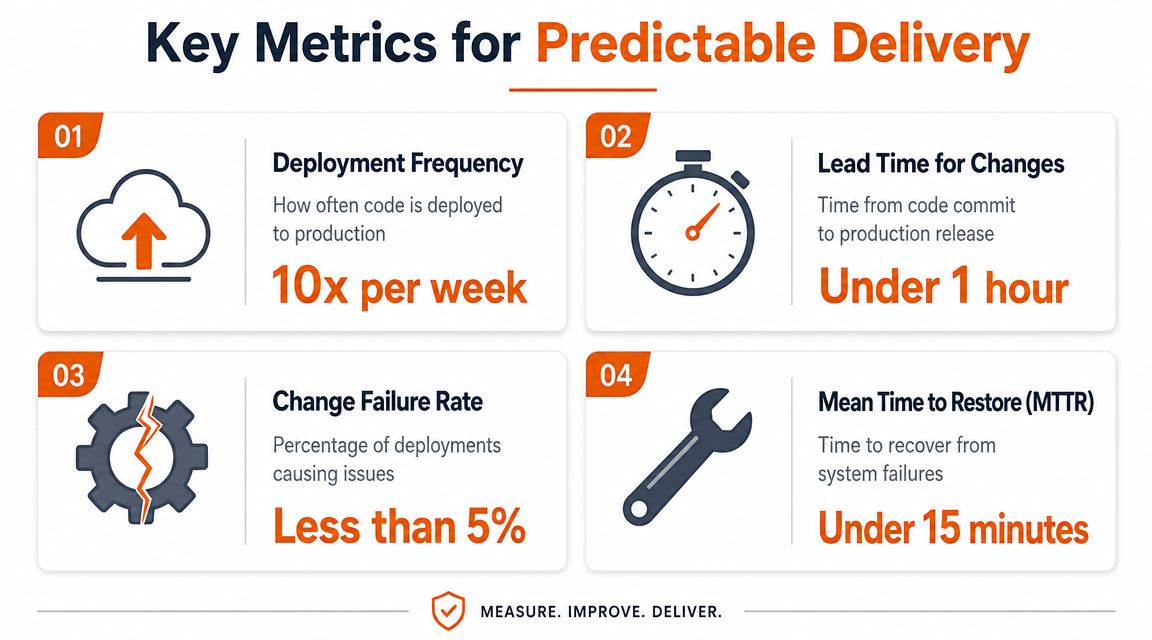
The most useful baseline is the DORA framework. Its four core delivery indicators are deployment frequency, lead time for changes, mean time to recovery, and change failure rate, and these are treated as the industry standard for measuring DevOps performance. In the UK context, tech leads are increasingly expected to monitor and improve these metrics to connect engineering work with throughput and stability, as noted in Waydev's overview of tech lead responsibilities and DORA metrics.
A quick visual makes the point clearly.
What each metric tells you
- Deployment frequency: How often the team gets changes into production. Higher cadence usually means smaller batches and less release friction.
- Lead time for changes: How long it takes to move work from code change to live release. This exposes pipeline drag, handoff delays, and unclear implementation paths.
- Mean time to recovery: How quickly the team restores service after an issue. This reflects operational readiness and system resilience.
- Change failure rate: How often releases create incidents or defects that need remediation. This shows whether speed is being bought at the cost of quality.
A broader view of engineering performance can also help. If you want another practical perspective on operating indicators, this guide to kpi for software development is a decent companion read.
What a tech lead should actually do with the metrics
Metrics matter only if they change behaviour.
A strong lead uses them to ask better questions:
- Why is lead time growing? Maybe reviews are slow, stories are oversized, or dependencies keep arriving late.
- Why is recovery painful? Maybe the system lacks observability, rollback discipline, or clear ownership during incidents.
- Why are failures recurring? Maybe the architecture is too coupled, testing is weak, or release criteria are vague.
Key insight: Delivery metrics are not a dashboard for leadership theatre. They are a way to identify where technical decisions are helping or hurting the business.
For founders, this is the payoff. Better metrics usually mean faster releases, less avoidable downtime, and more confidence when committing to roadmap dates.
Embedding Leadership with a Proactive Nearshore Partner
Some companies know exactly what they need and still can't hire it quickly. They need senior technical leadership now, but the local market is slow, expensive, or thin.
That's where a nearshore model can work, if you use it properly. Not as body leasing. Not as a pile of tickets handed to anonymous developers. As an embedded delivery capability with real ownership.
What good partnership looks like
A credible partner should bring more than engineers. They should bring the behaviours of a strong tech lead into the team from day one. That means clarifying architecture, tightening technical decisions, making handovers less chaotic, and helping product and engineering operate from the same map.
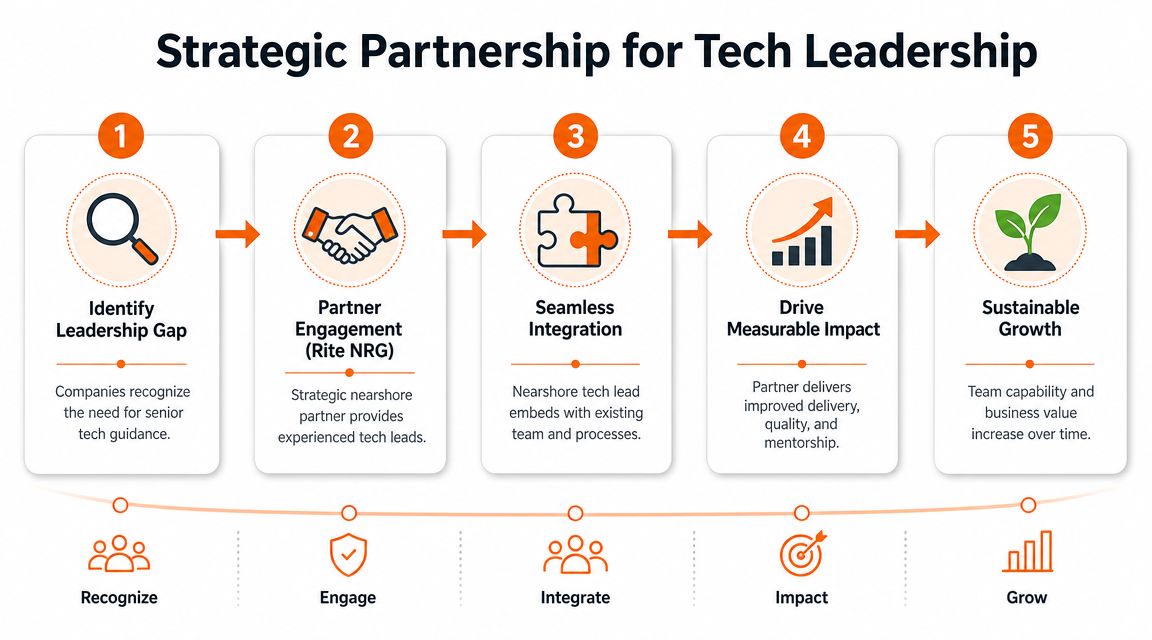
A practical nearshore setup often helps in three situations:
Vendor handoff chaos
The outgoing supplier leaves partial documentation, tribal knowledge, and unresolved defects. A lead-level engineer has to reconstruct the system, stabilise ownership, and prioritise what matters first.MVP pressure
Founders want speed, but speed without technical direction creates expensive rework. The lead has to keep scope lean and architecture sensible.Scaling pains
The product starts growing, more developers join, and previously informal decisions become bottlenecks. The team needs explicit standards and stronger technical coordination.
If you're evaluating delivery models, this overview of nearshore service options is useful context for how these engagements typically work.
AI governance is now part of the job
This area is getting overlooked by too many leadership teams.
A modern tech lead now has to govern how AI tools are used in delivery. Verified guidance highlights that this includes deciding where AI coding assistants can safely accelerate development, while many UK firms still cite uncertainty around skills and data protection as barriers. The lead must define policies, review thresholds, and compliance controls so accountability and quality remain intact, as discussed in Axify's article on modern tech lead responsibilities.
That changes the standard for technical leadership. A lead can't just say, “Use Copilot” or “Try an AI code tool.” They need rules.
- Where AI is allowed: Drafting tests, boilerplate, documentation support, and low-risk scaffolding.
- Where human review is mandatory: Security-sensitive logic, data handling, architectural changes, and production-critical paths.
- What must remain traceable: Decision ownership, review evidence, and rationale for accepting generated output.
Rite NRG is one example of a nearshore partner that builds dedicated teams and delivery consulting around product alignment, senior engineering, and AI-powered processes. That matters when a client needs embedded technical leadership rather than just extra development capacity.
The right partner reduces ambiguity. The wrong partner adds more people to it.
Your Tech Leadership Blueprint Frequently Asked Questions
Founders usually ask the same practical questions once they realise the gap is leadership, not headcount. Good. Those are the right questions.
What should a strong tech lead job description include
Don't write a shopping list of frameworks.
Write the role around outcomes. A strong description should say the person is accountable for technical direction, delivery predictability, code quality, architectural decisions, mentoring, and risk visibility. It should also make clear that they work across product, delivery, and engineering rather than operating as an isolated senior developer.
Include expectations like these:
- Own technical execution: Turn product goals into workable engineering plans.
- Guide architecture: Make design decisions that fit current needs without creating avoidable drag later.
- Develop the team: Improve judgement, not just output.
- Protect delivery quality: Keep standards high while maintaining momentum.
What interview questions actually expose strong ownership
Skip trivia. Ask about behaviour under pressure.
Try questions like:
- Tell me about a project that was drifting. What did you do first?
- Describe a technical decision that reduced delivery risk. How did you explain the trade-offs?
- When did you push back on scope or approach? What was the business context?
- How do you use code review to improve team capability, not just correctness?
- Where would you allow AI assistance, and where would you block it? Why?
These questions force candidates to show judgement, communication, and delivery thinking.
What belongs on a tech lead handoff checklist
A handoff fails when knowledge stays in people's heads.
Your checklist should cover:
- Architecture decisions: Core services, dependencies, known constraints.
- Delivery risks: Current blockers, unstable areas, upcoming technical decisions.
- Quality controls: Testing approach, release expectations, review standards.
- Operational context: Ownership during incidents, escalation paths, observability gaps.
- Team capability: Who owns what, where coaching is needed, and where single points of failure still exist.
What should a founder do first if this role is missing
Pick one product stream that matters and assign explicit technical ownership now.
Don't wait for the perfect re-org. Don't bury the problem under another sprint cycle. If the roadmap matters, the technical path needs a named owner who can make decisions, unblock execution, and be accountable for delivery quality.
That's the core of tech lead responsibilities. Not status. Not title inflation. Predictable business outcomes from engineering work.
If your product roadmap is moving faster than your technical leadership capability, talk to Rite NRG. They work with SaaS teams on delivery consulting, dedicated engineering teams, and nearshore product development so founders can turn technical effort into predictable shipping, cleaner execution, and stronger commercial momentum.