
You're probably in one of two situations right now. Either your roadmap is bloated, your team is busy, and launch keeps drifting. Or you've got investor pressure, customer pressure, and internal pressure all landing at once, and everyone wants speed without accepting chaos.
That's the wrong trade-off.
Reducing time to market isn't about telling engineers to move faster. It's about building a delivery system that turns decisions into shipped value, with less waste, fewer handoffs, and stronger ownership. If you want predictable SaaS growth in 2026, speed has to come from focus, structure, and people who act like owners.
Your Competitors Are Shipping Now What Is Your Plan
The window for slow decision-making has closed. With 71,935 new businesses added to the UK's Inter-Departmental Business Register in Q4 2025 alone, the pressure to ship quickly has intensified, pushing companies toward delivery models that can deliver SaaS products 50% faster without quality loss.
That changes the conversation. Time to market is no longer a nice metric for the board deck. It's a live operating constraint. If your team spends months debating architecture, polishing non-essential features, or waiting for perfect alignment, someone else gets to market first and starts learning before you do.
Speed is a business capability
Founders often frame delivery as a resourcing problem. It usually isn't. It's an ownership problem.
When nobody owns outcomes end to end, work fragments. Product writes tickets. Engineering waits for clarification. Design refines screens that don't affect adoption. Leadership asks for updates instead of decisions. Progress looks busy, but the product doesn't move.
Practical rule: If your team can't explain what must ship this quarter in one sentence, your delivery problem starts before engineering.
The #riteway mindset is particularly important. It's built on Extreme Ownership, high energy, and proactive delivery behaviour. That means the team doesn't just complete tasks. They remove blockers, challenge weak priorities, flag risks early, and stay locked on business outcomes.
A strong partner should work like an extension of your leadership group, not a passive supplier. That's the difference between adding capacity and creating momentum. If you're serious about protecting your competitive advantage in software delivery, you need people who push the product forward even when the path isn't perfectly mapped.
What a real plan looks like
A credible speed plan has three parts:
- Clear commercial intent: Know what outcome matters first. Revenue validation, user adoption, compliance readiness, or investor traction.
- Ruthless scope discipline: Cut anything that doesn't directly support that first outcome.
- Operational ownership: Put senior people in place who can make decisions without waiting for a committee.
That's the standard. Not velocity theatre. Not endless agile rituals. Not a backlog with two hundred “priorities”.
If your competitors are shipping now, your plan can't be “work harder”. Your plan has to be “build less, decide faster, and own the result”.
The Blueprint for Speed Prioritisation and MVP Design
Most SaaS teams don't lose time because they lack ideas. They lose time because they refuse to kill them.
The fastest route to market is still the simplest one. Successful UK SaaS firms launch an MVP with core features first, avoiding overbuilding, which affects 40% of UK startups that delay launch due to feature creep. If you're trying to reduce time to market, feature creep is your first enemy.
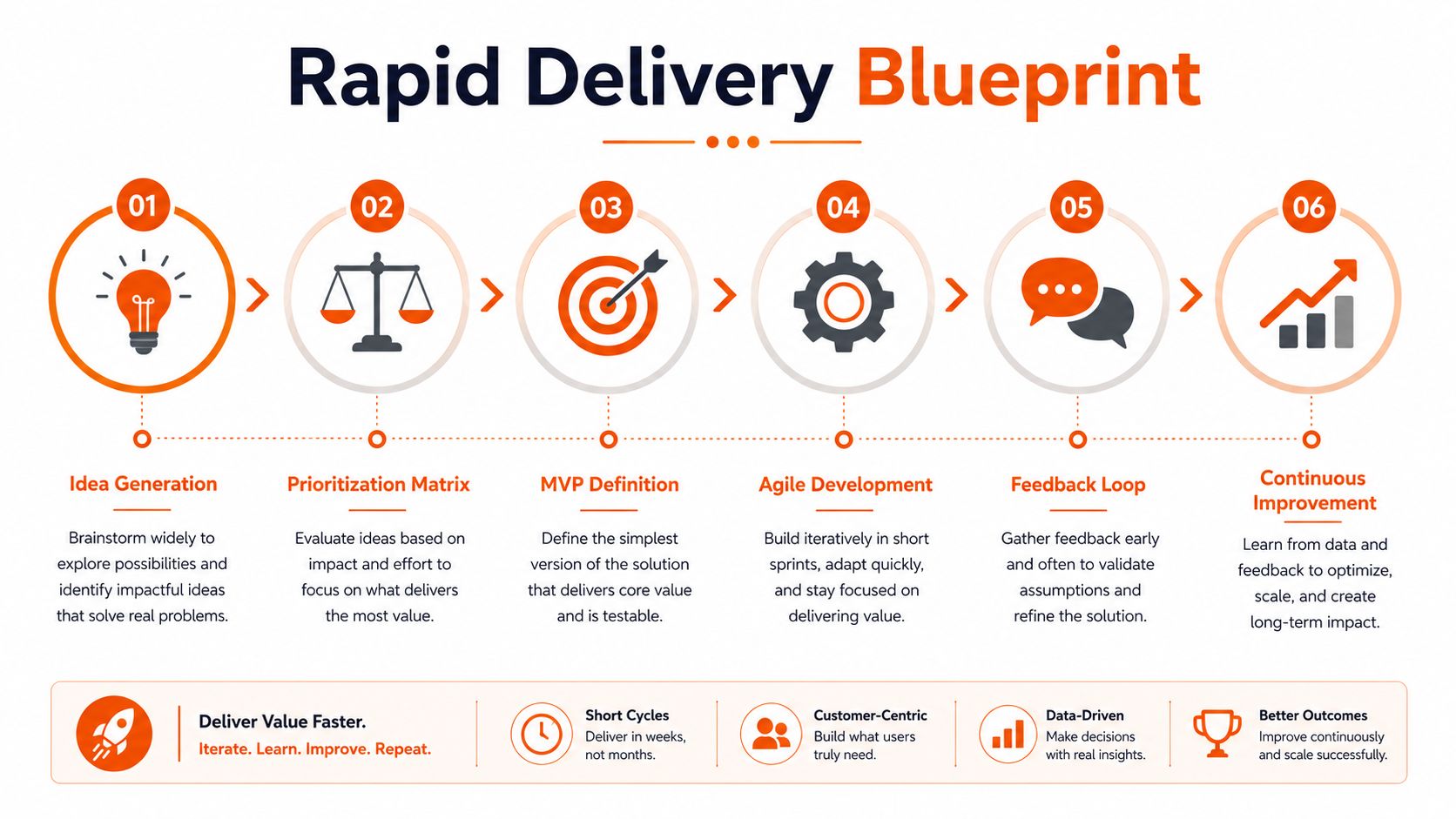
Define viable properly
A real MVP isn't a cheap version of the final product. It's the smallest release that proves a business assumption with real users.
That means your first version should answer one hard question. Can a specific user solve a meaningful problem with this product and come back for more?
If the answer is unclear, don't add features. Tighten the problem definition.
Use this filter before approving any item for the MVP:
- Does it solve the core pain point? If not, it waits.
- Can we validate value without it? If yes, it waits.
- Will it block onboarding, payment, activation, or compliance? If yes, it probably stays.
- Would a founder defend this feature in front of an investor or first customer? If not, cut it.
Prioritise by outcome, not opinion
Teams get slow when every stakeholder gets equal voting rights on scope. That approach always produces a bloated first release.
A better method is to map user journeys, identify the moment of first value, and prioritise only what gets users there faster. Tools such as story mapping, impact versus effort scoring, and an opportunity solution tree for product decisions help you expose what's essential and what's just attractive.
Here's a simple way to think about it:
| Decision area | Keep in the MVP | Push to later |
|---|---|---|
| User onboarding | What gets users to first value quickly | Edge-case flows and advanced settings |
| Core workflow | The one action users came for | Secondary workflows and admin extras |
| Reporting | Only what proves usefulness | Nice dashboards and export variations |
| Integrations | Only blockers to adoption | Broad ecosystem coverage |
Strip the product to the point where every remaining feature earns its place.
Build for learning, not ego
You don't need a polished empire on day one. You need signal.
That's why I advise founders to treat the MVP like a learning engine. Instrument the key journey. Watch onboarding friction. Talk to users quickly. Then iterate in short cycles based on what people do in practice, not what internal stakeholders imagined they might want.
Use phased rollouts, limited access cohorts, and tight feedback loops. Keep design strong, but don't confuse visual completeness with market readiness. Plenty of attractive products fail because they shipped too late.
The sharpest teams say no more often than they say yes. That discipline is what makes reducing time to market possible.
Assembling Your A-Team The Nearshore Delivery Advantage
Nearshore isn't a shortcut. It's a strategic approach. Used well, it compresses feedback loops, adds senior capability, and gives your product room to move. Used badly, it creates a second team that waits for instructions and blames the brief.
That's why the cheap narrative around nearshore misses the point. The issue isn't hourly rate. It's whether the team can think, decide, and deliver like owners.

Why nearshore fails
A lot of nearshore engagements underperform for the same reason. The client buys technical execution when they need delivery leadership. Contrarian data from UK CTOs shows that 48% of nearshore engagements fail to accelerate delivery due to misaligned workflows or lack of ownership culture, not technical capability.
That aligns with what I see in practice. Teams don't slow down because they can't code. They slow down because nobody owns ambiguity. Work gets passed around. Requirements get translated three times. Risks surface late because people are trying to stay “within scope” instead of protecting the outcome.
If your nearshore team waits to be told what to do next, you haven't extended your product capability. You've outsourced hesitation.
What to look for instead
You want a team that behaves like a product organisation, not a staffing layer. That means:
- Senior judgement: Engineers and delivery leads who can challenge weak assumptions and suggest better paths.
- Embedded collaboration: Product, design, and engineering working in one rhythm, not separate lanes.
- Ownership culture: People who raise risks early, fix the issue, and communicate clearly.
- Commercial awareness: A team that understands launch windows, customer impact, and why delays matter.
If you're comparing global talent models, this LatoJobs guide to LATAM talent is useful because it frames hiring around operational fit, not just location. That's the right lens. Geography matters less than overlap, communication quality, and decision-making maturity.
The #riteway standard for nearshore teams
Extreme Ownership stops being a slogan and becomes a delivery mechanism.
The #riteway approach demands that every team member asks a different question. Not “was this in the brief?” but “what will get this product shipped, adopted, and improved fastest?” That creates a different operating rhythm. Risks come up earlier. Trade-offs get made faster. Clients spend less time managing the team and more time steering the business.
That's also why I'd choose a smaller, senior nearshore team over a larger, mixed-experience team almost every time. Seniority shortens discussion cycles. Ownership cuts rework. Product-first thinking protects momentum.
If you want nearshore to accelerate reducing time to market, don't buy capacity. Build an A-team.
High-Velocity Engineering Practices That Actually Work
Engineering speed doesn't come from rushing commits. It comes from creating conditions where the team can release confidently, often, and without drama.
That requires discipline. Not heavyweight process. Not architecture theatre. Discipline.
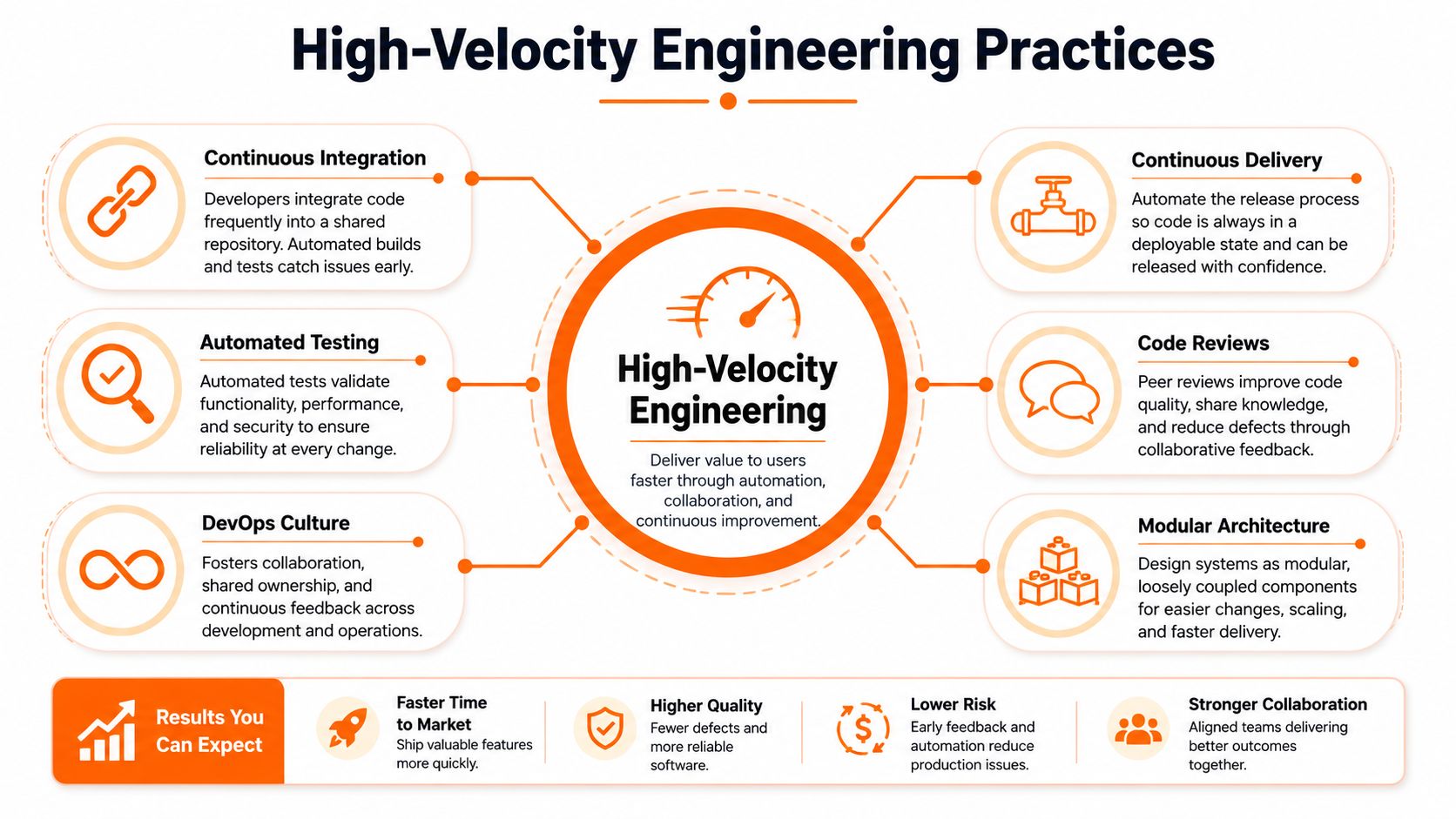
The practices worth enforcing
I'd insist on five things from the start:
- Continuous integration: Small, frequent merges keep integration pain low and expose problems early.
- Automated test coverage on critical paths: Not everything needs the same depth, but payments, authentication, onboarding, and core workflows do.
- Code review discipline: Reviews should protect clarity, risk, and maintainability. A defined code review process for engineering teams prevents endless subjective debate.
- Feature flags: Roll out safely, test with selected users, and learn without forcing all-or-nothing releases.
- Modular architecture: Keep boundaries clean so the product can evolve without rewrites.
Here's the business point. CI/CD isn't useful because it sounds modern. It matters because it shortens the path from decision to user feedback. Automated tests matter because they give the team the confidence to move. Feature flags matter because they reduce release risk while preserving momentum.
Release in slices
One of the most effective habits in fast SaaS delivery is phased release management. UK CTOs validate MVPs early with real users, using feature flags for phased rollouts that reduce risk and gather insights quickly. That practice also accelerates delivery by 35% in nearshore teams operating in Poland for UK clients, as noted earlier.
This short video gives a practical view of how modern delivery teams think about faster release cycles:
Automate your environment, not just your app
A lot of teams automate builds but still treat infrastructure like manual admin. That's a mistake. If environments are inconsistent, releases slow down and debugging gets messy fast.
A practical reference on implementing infrastructure as code with Terraform is useful here because it shows how teams can standardise environments and reduce deployment friction. You don't need massive platform engineering to benefit. You need repeatability.
One more point. Architecture for an MVP should be scalable enough, not infinitely flexible. Don't design for every hypothetical enterprise need before you've earned usage. Build something clean, testable, observable, and easy to change. That's what high-velocity engineering looks like.
Supercharging Delivery with AI and Automation
AI should remove friction from delivery. If it's just generating code snippets with no control, it creates noise, not speed.
The reason this matters now is simple. With 52% of all UK businesses now actively using AI, and 46% specifically applying it to analytics, the technology is directly contributing to faster MVP delivery and outcome-oriented decision-making. AI has moved from experiment to operating layer.
Where AI helps immediately
The strongest delivery teams use AI in three places.
First, they use it to clear repetitive work. Drafting boilerplate, generating test cases, summarising tickets, and supporting documentation are all fair uses. Senior engineers should spend their energy on architecture choices, edge cases, and product-critical logic.
Second, they use AI to improve visibility. Delivery leaders need earlier signals on risk. AI can help surface sprint drift, unusual ticket patterns, missed dependencies, and quality hotspots before they become deadline problems.
Third, they use AI in analytics and decision support. If usage data, support trends, and delivery telemetry are fragmented, teams react late. AI helps turn those inputs into actionable signals so product and engineering can make sharper calls faster.
AI should increase the quality of decisions, not just the volume of output.
What good AI usage looks like
Used properly, AI sits inside an existing delivery system. It doesn't replace product thinking, user research, architecture judgement, or accountable leadership.
That means your team still needs:
- Strong review habits: Generated output must be checked by engineers who understand the product.
- Clear guardrails: Define where AI is allowed to assist and where human approval is mandatory.
- Operational ownership: Someone must own tool selection, workflow fit, and expected impact.
This is also one area where using a delivery partner can be practical. For example, Rite NRG applies AI across recruitment, delivery, and operations to automate workflows and surface risks earlier. That's useful when AI is treated as embedded support for execution, not marketing gloss.
Don't let AI distract you from the real bottleneck
Many teams don't need more code generation. They need faster decisions, cleaner priorities, and better handoffs.
So use AI where it strengthens flow. Summarise discovery calls. Spot delivery risk. Support test creation. Structure backlog data. Tighten reporting. But keep humans responsible for product judgement. That's how AI helps with reducing time to market without creating a second wave of rework later.
Measure What Matters From Code to Cash
If you only measure output, your team will optimise for output. More tickets closed. More story points burned. More activity. None of that guarantees faster learning, happier users, or stronger revenue.
The right question is simpler. Is your delivery system turning work into commercial progress?
Track the chain from release to result
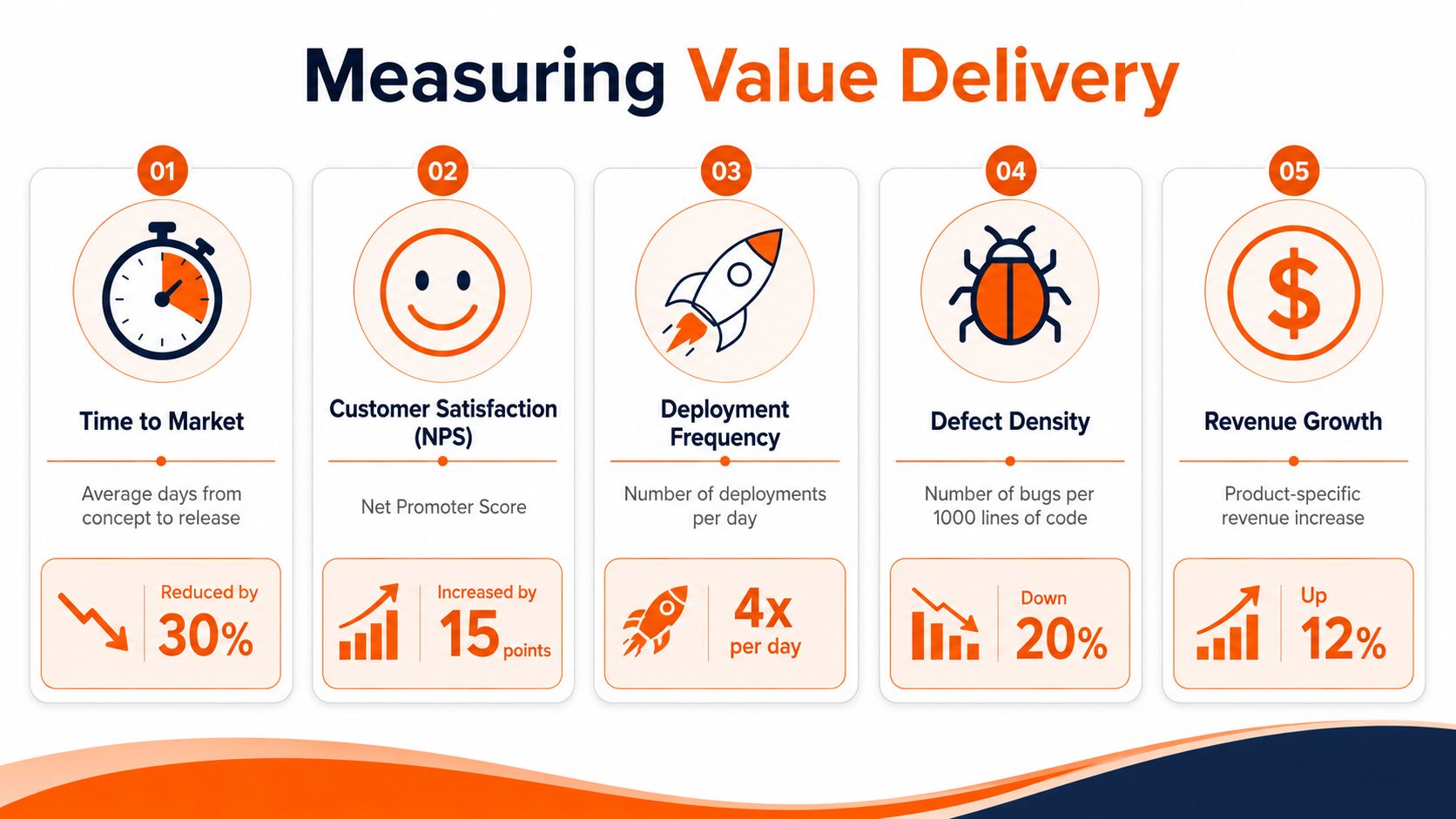
You need a compact scorecard that links engineering behaviour to business outcomes.
Start with delivery flow:
- Lead time for changes: How quickly a decision becomes working software.
- Cycle time: How long work spends in motion once it starts.
- Deployment frequency: How often you can release safely.
- Change failure rate: How often releases create incidents, rollback, or urgent rework.
Then connect those metrics to product and commercial signals:
- Activation quality
- Time to first value
- Trial conversion
- Retention patterns
- Expansion opportunities
Don't separate speed from finance
Many leadership teams often make a basic mistake. They talk about delivery in one meeting and valuation in another, as if they're unrelated.
They're not. In the UK market, high-growth SaaS companies achieving a Rule of 40 score can command 10x+ ARR valuation multiples, linking faster time-to-market and stronger growth metrics to better financial outcomes. Speed matters because it affects learning speed, customer acquisition speed, revenue speed, and investor confidence.
Here's the practical relationship:
| Delivery signal | Business meaning |
|---|---|
| Faster release cycles | You learn sooner what customers value |
| Lower failure rates | You preserve trust and reduce recovery drag |
| Tighter feedback loops | You refine pricing, onboarding, and positioning earlier |
| Better ownership | You waste less time in escalation and rework |
Teams don't create enterprise value by shipping more software. They create it by shipping the right software sooner and compounding what they learn.
Use Extreme Ownership to handle the hidden blockers
Reducing time to market also means dealing with the issues teams prefer to postpone. Compliance readiness. Handover gaps. Legacy constraints. Unclear accountability. These aren't side topics. They affect launch timing directly.
An ownership culture changes how these risks are handled. Instead of waiting for a late-stage surprise, the team brings the issue forward, frames the impact, and proposes the path through it. That's the operational difference between a team that reports problems and a team that solves them.
If you want a useful test, ask your delivery lead three questions:
- What is the biggest risk to the next release?
- What decision would reduce that risk today?
- Who owns making that happen?
If the answers are vague, your system is vague.
The companies that win don't just move faster. They measure better, decide earlier, and treat delivery as a business discipline. That's the #riteway in practice. High energy. Clear ownership. Real outcomes.
If you want a delivery partner that thinks like an advisor, not a ticket-taking vendor, talk to Rite NRG. We help SaaS teams reduce time to market with senior nearshore engineering, product-first delivery, and an Extreme Ownership mindset that keeps momentum high and risk visible.