

Strategy & Transformation
How to Calculate ROI for AI and Software Modernization
A practical, finance-ready framework for comparing AI and modernization investment with the current-state cost, realistic benefits, delivery risk and time to value.
operationalwrocław--:-- cet
∕ insights / startup-mvp-development.md
Mvp
A practical playbook for startup MVP development covering validation, scope, prioritization, delivery timeline, and metrics that move the business forward.
>_article.meta
You're probably staring at a feature list, a rough budget, and a launch date that keeps moving. The team wants to build accounts, dashboards, integrations, notifications, billing, and a polished mobile experience. Meanwhile, nobody has proved that a specific customer has a painful enough problem to change behavior or pay for a solution.
That's the expensive version of startup MVP development. A strong MVP is not a smaller full product. It's a controlled business experiment that helps you decide whether to continue, change direction, or stop before you spend the money reserved for growth. The work should produce evidence, not just code.
An MVP has three jobs. It must de-risk the riskiest assumption, create a signal you can defend with investors or internal stakeholders, and put a usable solution in front of first users within a defined time window. For many startups, 60 to 90 days is a sensible decision horizon for the first experiment, not a promise that the final product will be complete.
The important question isn't “What can we build?” It's “What must we learn before we commit to the next stage?” That question changes the budget, team composition, architecture, and definition of success.
A widely cited startup benchmark estimates that only about 10% of startups reach durable product-market fit, while poor product-market fit appears in 42% to 43% of startup failure post-mortems (startup product-market fit statistics). Those figures point to a practical conclusion: the most costly mistake is building too much before testing whether the problem and audience are real.
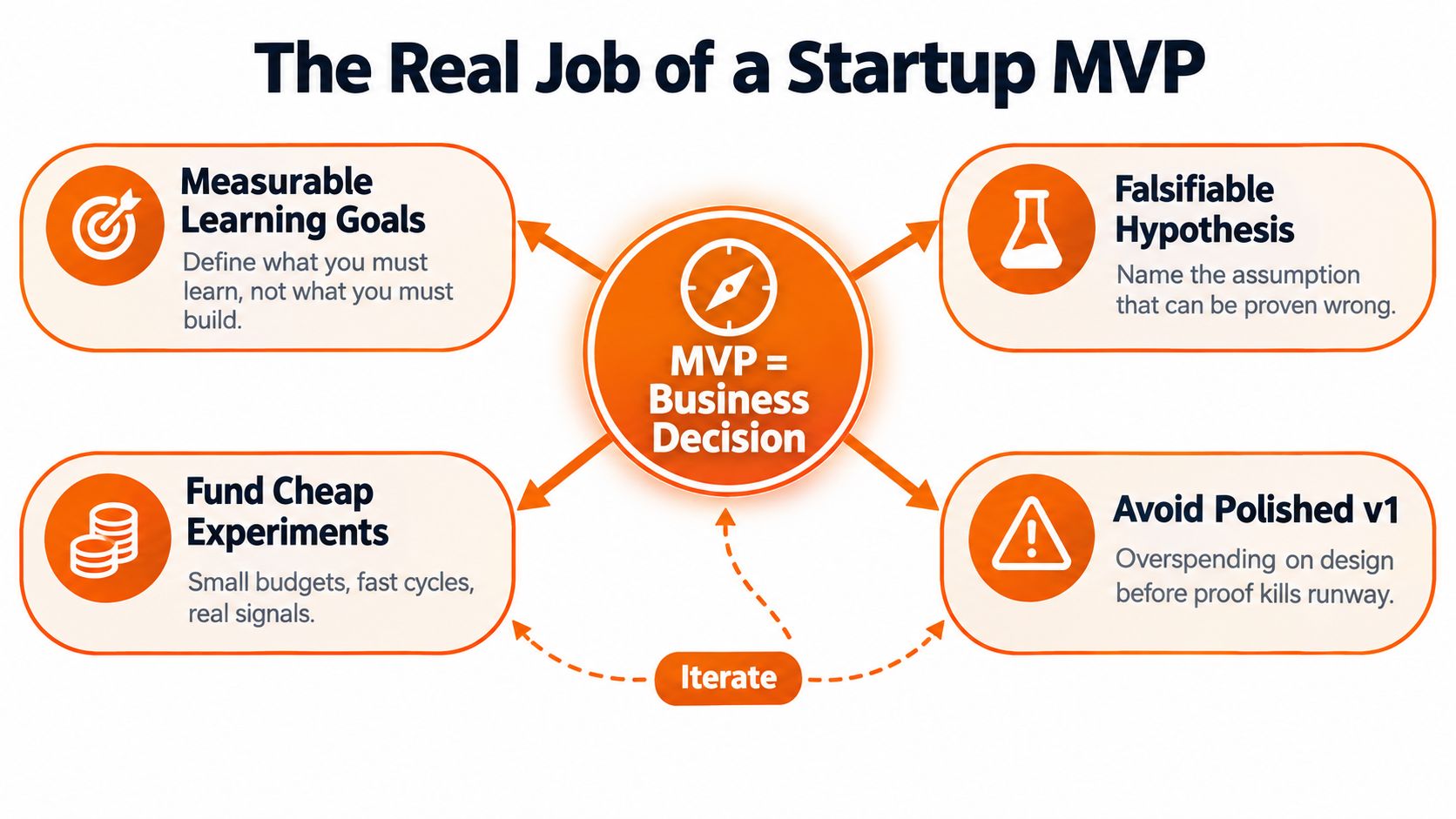
A learn-it-fast MVP might be a concierge workflow, a landing page, a clickable prototype, or a narrow production release. A build-it-right version one includes the reliability, breadth, automation, and operational depth that make sense after demand is proven. Both can be valuable, but they answer different business questions.
The first version should answer one sharp question:
Industry benchmarks describe focused MVPs shipping in 15 to 30 days at a fixed price of $8,000 to $25,000, while a standard MVP with 6 to 10 features may take 12 to 16 weeks (MVP development statistics). Those ranges aren't universal quotes, but they illustrate the economic difference between testing a narrow hypothesis and constructing a broad first release.
Practical rule: If a feature can't change the decision you need to make, it doesn't belong in the first experiment.
Treat the MVP as a hypothesis test with a budget. Set a time box, name the decision it must drive, define the evidence you'll accept, and assign one accountable senior person to protect the outcome. A useful step-by-step MVP development process can help turn that decision into discovery, scope, delivery, launch, and learning activities.
This week, write one sentence that completes the following structure: “If we solve this problem for this user, we expect this measurable behavior, which will let us decide this next investment.” Then remove every planned activity that doesn't support that sentence.
Engineering shouldn't be the first expensive action. Run a short validation sequence before you ask developers to commit to architecture, integrations, and a backlog.
Write one problem statement with four parts:
“People need better reporting” is not testable. “Operations managers manually combine shipment updates from several systems before customer meetings” is specific enough to investigate.
Recruit 8 to 12 target users as an initial discovery set. Treat that as a working recommendation, not proof of demand. Ask what they did the last time the problem occurred, what tool they used, who approved the spend, and what happened when they ignored it.
Don't pitch the product. Compliments are cheap and often polite. Record exact language, repeated workarounds, existing purchases, and moments where the problem caused a measurable consequence. A structured validation process matters because one 2026 survey found that 67% of founders said they validated before building, but only 23% used structured research with their actual target market (startup idea-validation survey).
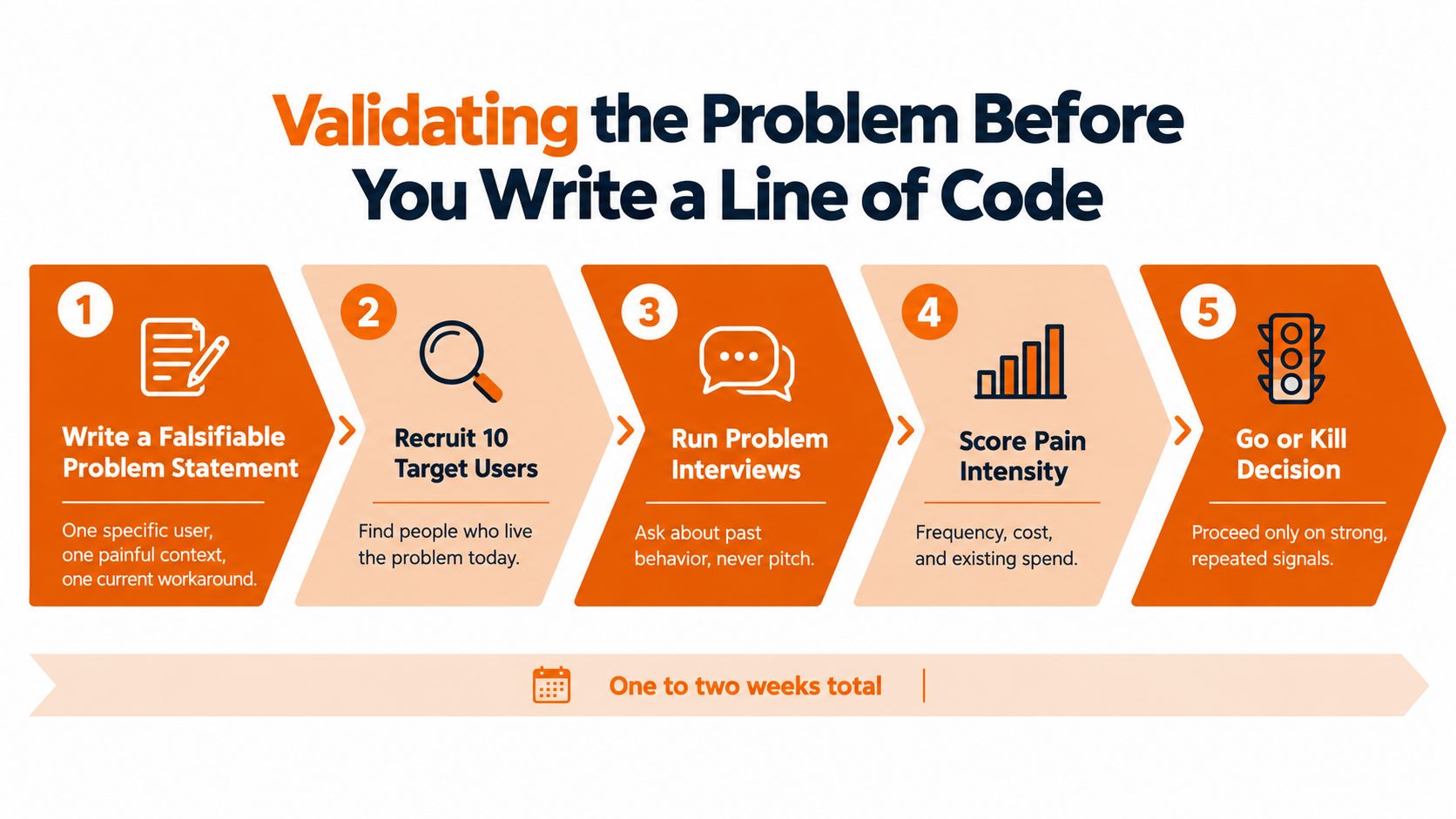
Rank the assumptions by potential damage, not convenience. A technical assumption may be difficult, but a customer assumption can invalidate the entire business. Test the most dangerous one with the lightest credible method:
Set the pass or fail threshold before launching the test. For example, you might define 5% email-to-paid conversion or 30% willingness to switch as a decision rule for your particular audience. Those are proposed gates, not market benchmarks. The point is to prevent the team from changing the definition of success after seeing weak results.
A useful validation record contains the assumption, audience, test method, threshold, evidence, decision, and next action. That document protects the development budget and gives investors a credible story. You can show what customers said, what they did, which assumption survived, and why the first release contains exactly the features it contains.
Feature prioritization fails when it becomes a debate between the loudest stakeholders. Use a scoring system to expose trade-offs, then use a hard bucket system to make the release decision.
Start with one backlog. Put search, listing creation, payments, chat, reviews, analytics, administration, notifications, and every other request in the same place. Score each item on Reach, Impact, Confidence, and Effort, the four inputs in RICE. Use your own planning scale and label it clearly as an internal decision tool. The score isn't truth. It's a way to compare competing assumptions consistently.
Then move the shortlist into MoSCoW:
For a marketplace, listing creation and payments usually deserve serious scrutiny because they connect supply, transaction value, and willingness to pay. Search may also be essential if buyers can't discover inventory through another simple route. Chat can be replaced by a structured contact request or manual coordination, while reviews and advanced analytics can wait until there is enough usage to generate meaningful signal.
The scores below are illustrative planning values, not external benchmarks. Their purpose is to show how a team can make its reasoning visible rather than pretend that prioritization is objective.
| Feature | RICE Score | MoSCoW Bucket | Reasoning |
|---|---|---|---|
| Listing creation | 80 | Must | Without supply, the marketplace cannot test whether sellers will provide inventory. |
| Payments | 72 | Must | Tests the commercial transaction and creates a path to revenue evidence. |
| Search | 64 | Must | Buyers need a direct route to relevant listings and the core discovery behavior. |
| Chat | 36 | Should | Important for trust and negotiation, but a manual contact workflow can test the need first. |
| Reviews | 18 | Won't | Requires completed transactions and a user base large enough to create useful trust signal. |
| Advanced analytics | 12 | Won't | Internal reporting can start with event tracking and a simple operational dashboard. |
The hard cap should be 3 to 5 Must-Haves for the first release. A practical guide recommends a lean MVP scope of roughly 3 to 7 features and stresses that unclear objectives and feature creep are common causes of failure (how to build an MVP). Your exact count matters less than your willingness to cut.
Before approving a Must-Have, ask three questions:
If the answer to any question is vague, move the feature out. A small release with a visible learning purpose beats a broad release that leaves every question unresolved.
The right team depends on what you're building, how long you need to own it, and how much accountability you require. Don't choose a staffing model because it sounds familiar. Choose it because it fits the risk.
| Model | Typical Monthly Cost | Time to First Commit | Accountability | Best For |
|---|---|---|---|---|
| In-house hires | Varies by role and market | Usually delayed by recruiting and onboarding | High after the team is established | Products where technology is a long-term moat |
| Product agency | Contract-specific | Often fast once discovery begins | Can be clear, but depends on scope and governance | Speed when continuity matters less than launch |
| Freelance specialists | Contract-specific | Fast for narrow tasks | Uneven across contributors | Focused bursts, integrations, design, or audits |
| Nearshore team | Often lower than equivalent US delivery, depending on structure | Fast with an available team | Strong when one partner owns delivery | Full-stack velocity with overlapping working hours |
In-house teams give you long-term context and ownership, but slow hiring can consume the window in which the market is changing. Agencies can move quickly, yet founders often encounter scope creep when requirements remain ambiguous. Freelancers are effective for a defined task, but the bus factor, fragmented documentation, and coordination burden can become serious problems. Nearshore teams can provide a complete delivery unit with timezone overlap, but only if the partner supplies senior leadership rather than a collection of disconnected contractors.
Choose in-house when the product and engineering capability are central to your long-term moat. Choose an agency when speed outweighs continuity and you can define the result clearly. Choose freelancers for narrow, bounded work. Choose nearshore when you need full-stack velocity at 40% to 60% of US cost, with overlapping hours and a partner capable of owning delivery. That cost range is a decision assumption to verify for your market and team structure, not a guaranteed quote.
Senior accountability matters more than the label. Outcome-driven consulting makes the partner responsible for architectural decisions, delivery execution, and knowledge transfer, with risks acknowledged and owned early (software development consulting).
For a deeper view of comparing development methods, compare no-code, custom development, and hybrid delivery against your product's actual risk. Also clarify whether you need a staff augmentation, dedicated team, or project delivery model.
Apply two questions this week:
If you can't answer both, don't sign a build contract yet. Resolve the ownership question first.
A credible MVP timeline has decision gates, not just a collection of development tasks. For many focused products, plan around 10 to 14 weeks, with the scope adjusted to the actual risk and complexity. A focused MVP can ship faster, while a product involving payments, regulated data, complex integrations, or app stores needs more preparation.
The phases should work like this:
The first gate is a scope lock after week 2. New requests must displace an existing item. The second is a demo gate after Sprint 1, where the team proves that the main workflow works end to end, not that isolated screens look complete. The third is a go or no-go review in week 10, based on launch readiness and an explicit path to the first paying user or qualified pilot.
Reserve time for app store review, third-party API approvals, payment-provider checks, and the mid-build redesign of one core flow. These aren't signs of poor execution. They're normal sources of uncertainty that should be visible in the plan.
Delivery standard: Every sprint should end with a demonstrated business capability, a known risk status, and a decision about what happens next.
Use a written prototype-to-production software delivery checklist to keep product, engineering, security, analytics, and ownership concerns in one place.
This short video provides another perspective on moving from an initial product concept toward delivery:
The timeline should end with a decision, not a ceremonial launch. Continue if users perform the core behavior and the evidence supports the business model. Change the workflow if users arrive but fail to activate. Stop or reposition the idea if the problem doesn't produce enough urgency.
A large sign-up count can hide a broken product. At MVP stage, the useful metric is the one that changes your next decision.
Define one core action that represents value. For a marketplace, it might be a buyer contacting a seller about a relevant listing. For a workflow product, it might be completing the first automated report. For a collaboration tool, it might be inviting a teammate and completing a shared task.
Track:
The source of these targets is your business hypothesis. State the event, cohort, time window, and decision rule before collecting data. Then keep a simple dashboard that separates acquisition from activation, retention, and commercial evidence.
The first 10 user interviews after launch can reveal why users behave differently from your assumptions. Ask what they expected, where they hesitated, what they did manually, and what would make them return. Support tickets should become a tagged backlog of recurring friction, not a queue that disappears after someone replies.
Also measure the manual-to-product ratio. If people receive value because your team performs most of the work behind the interface, that isn't automatically bad. A concierge model can teach you what to automate. But you need to know how much of the current value is delivered by people and how much by the product.
A red flag is activation below 20% after 200 signups. Treat that as a stop-coding trigger for your current scope, not proof that the entire company should close. Recheck audience quality, onboarding, the core workflow, and the problem statement before adding features. For engineering leaders, a practical engineering efficiency view should connect delivery output to product outcomes, not merely count tickets or lines of generated code.
If a metric can't change a decision, it's decoration.
AI can accelerate delivery, but it doesn't make weak measurement useful. AI-assisted engineering has been reported to compress MVP timelines by roughly 40% to 60% when automation is paired with real engineering (MVP development trends). That speed only creates value when the team validates the right workflow and preserves quality.
An investor-ready MVP is not defined by feature volume. It shows that the team understands the problem, made deliberate trade-offs, shipped something real, and learned from actual behavior.
Use this one-page checklist:
These are readiness criteria for a founder's decision process, not universal investor requirements. Investors will evaluate the quality of evidence, the market, the team, and the opportunity in context. Your job is to remove avoidable uncertainty before the conversation.
Book five customer discovery calls. Put every conversation in a shared tracker. Capture the user's current workaround, the cost of delay, the tools already used, and the exact language they use to describe the problem.
Publish a 90-second product demo. It can show a clickable prototype, concierge workflow, or narrow working release. Send it to a curated list of 20 target users and ask for one action, such as a call, sign-up, pilot commitment, or pre-order.
Write a one-page metrics memo. Define activation rate, week-4 retention, and a CAC proxy. State the data source, cohort, time window, and decision each metric will influence. If you can't explain how a metric changes the roadmap, remove it.
AI-native delivery belongs inside this discipline, not outside it. Production AI systems need architecture decisions before coding, including components, data flows, trust boundaries, security model, and deployment strategy. They also need labeled benchmarks, adversarial inputs, and regression gates before changes reach production (AI engineering practices). Your architects and engineers remain accountable for the result while agentic tools accelerate analysis, implementation, testing, documentation, and migration work.
End every investor conversation with the same gating questions: What did you learn? What changed in the product? What is the next bet? A credible MVP leaves you with answers, evidence, and a controlled next step. It doesn't leave you with a longer backlog and a larger burn rate.
Rite NRG helps founders turn validated product hypotheses into focused, production-ready MVPs through software consulting, AI-native engineering, senior nearshore teams, and accountable delivery. If you need to decide what to build, set a defensible scope, or move from prototype to first users without sacrificing architecture and quality, visit Rite NRG to discuss the next step.
/ about the author
Written by the RITE NRG editorial team — the architects, engineers and delivery leads who build and operate AI-era software for our clients.
Strategy & Transformation
A practical, finance-ready framework for comparing AI and modernization investment with the current-state cost, realistic benefits, delivery risk and time to value.
AI Consulting & Automation
A practical framework for choosing and deploying transport or logistics AI agents around real exceptions, reliable data and controlled operational authority.
Industry Solutions
A practical roadmap for improving manufacturing systems and introducing AI without destabilising production, data integrity or operational control.
More guidance: all insights articles
We can help you apply this thinking to the systems and teams you actually have.