

Strategy & Transformation
How to Calculate ROI for AI and Software Modernization
A practical, finance-ready framework for comparing AI and modernization investment with the current-state cost, realistic benefits, delivery risk and time to value.
operationalwrocław--:-- cet
∕ insights / rag-vs-fine-tuning.md
RAG Vs Fine Tuning
RAG vs Fine Tuning compared on accuracy, cost, latency, privacy and maintenance, with a practical decision guide for enterprise AI delivery.
>_article.meta
Your support assistant gives a customer the return policy that changed last month. An agent corrects the answer, processes an exception, and checks whether other customers received the same advice. The assistant still responds quickly, but your team now has more work and more risk.
That's the business problem behind RAG vs fine tuning. You're not choosing a fashionable architecture. You're choosing how to deliver reliable answers at an acceptable cost, with an operating model your team can maintain. Start with the failure you need to fix, then make the technology earn its place.
Retrieval-augmented generation, or RAG, connects a language model to a searchable index of your documents. Before answering, the system retrieves relevant passages and supplies them as context. Fine-tuning changes the model's parameters through training on curated examples, teaching patterns such as terminology, tone, task behavior, and output structure.
RAG vs fine tuning at a glance
| Criterion | RAG | Fine-tuning |
|---|---|---|
| Where knowledge lives | External, searchable document index | Inside the model weights |
| Handling changing facts | Update or re-index documents | Requires a new training run |
| Source citations | Built in, traceable to retrieved passages | Not native, needs extra design |
| Control over tone and output format | Limited, mostly through prompts | Strong, learned from examples |
| Time to first working version | Fast for document-based Q&A | Slower, curated training data comes first |
Use RAG to change what the model can look up, and fine-tuning to change how it behaves.
The distinction is easiest to see side by side.
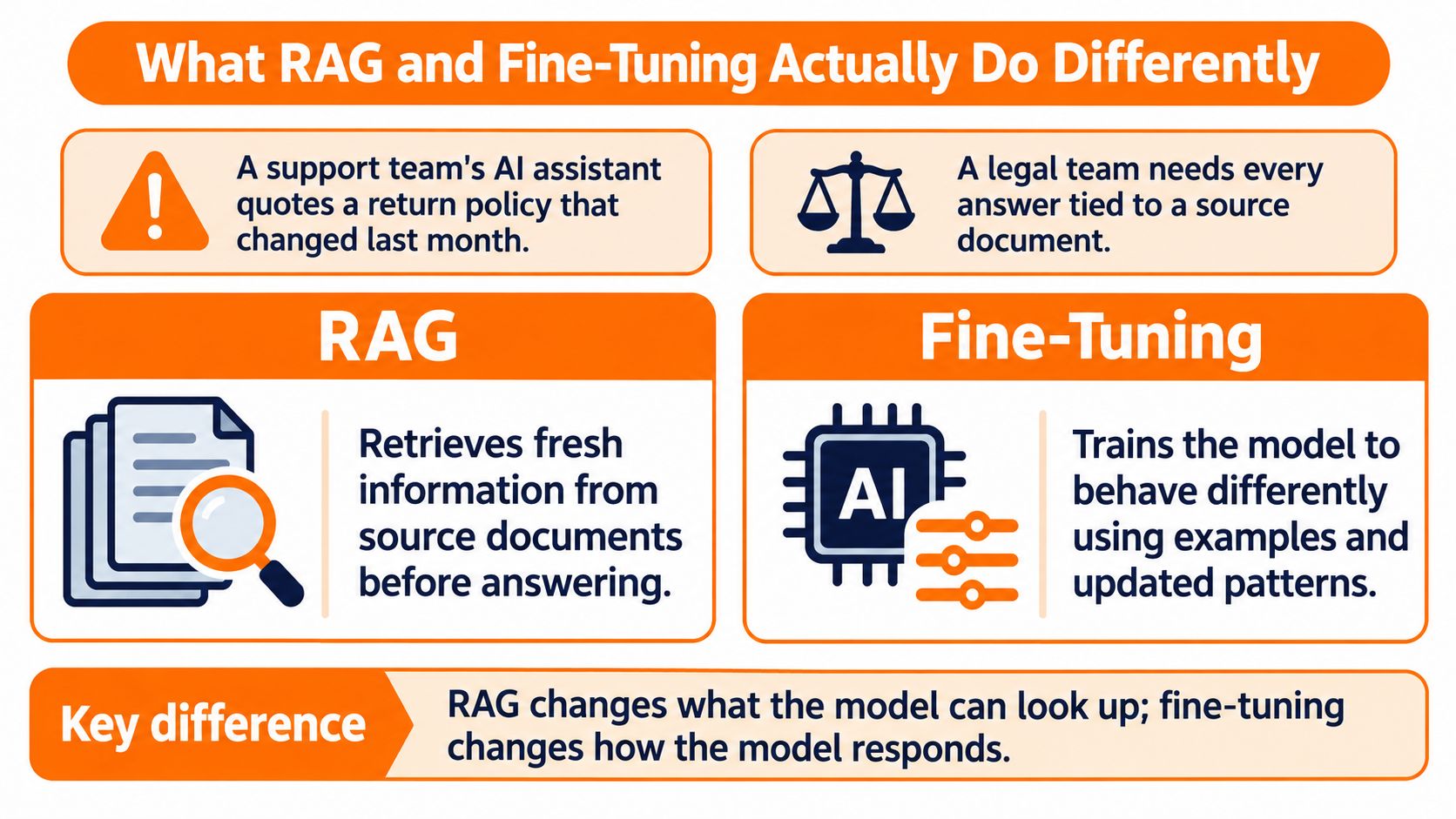
The foundational RAG paper combined a pretrained generator, a neural retriever, and a dense Wikipedia index, demonstrating how external memory could complement knowledge stored in model parameters. For a business, the important architectural consequence is that the knowledge collection can change without retraining the generator.
That doesn't make RAG a live connection to truth. Your team must ingest the revised policy, remove superseded material, preserve useful metadata, and verify that searches return the current passage. Citations are supported by the architecture, but engineers still need to ensure that each citation supports the answer.
Fine-tuning tackles a different problem. Say the assistant receives the correct policy but repeatedly omits the required eligibility fields or uses the wrong escalation language. Approved input-and-output examples can teach that response pattern more consistently than repeatedly extending a prompt.
This video provides another view of the distinction.
Don't confuse either capability with a complete product. You still need integrations, permissions, exception handling, and someone responsible when the output is wrong. Judge the alternatives against accuracy, total cost, and day-to-day operating burden, not the attractiveness of the demo.
Accuracy starts with identifying what the model is being asked to do. Finding an obscure product specification is a knowledge-access problem. Applying a stable classification scheme is a task-behavior problem. Treating both as generic model quality leads teams to spend money on the wrong fix.
In a study of low-frequency factual knowledge, fine-tuning improved performance across entity popularity levels, but RAG surpassed it by a large margin on the least popular knowledge. A RAG configuration without fine-tuning even outperformed fine-tuned models supplied with the top three retrieved documents in those experiments.
Fine-tuning still has a clear role in specialized tasks. In a code-completion comparison, fine-tuning increased average exact-match accuracy from 24.79% to 44.20%, while combining fine-tuning and retrieval consistently outperformed either technique alone. That's evidence for complementary responsibilities, not a promise that every enterprise assistant will achieve the same improvement.
Say a product assistant gives the wrong operating-temperature limit. Inspect the retrieved passages before scheduling training. If the correct datasheet never entered the context, work on ingestion, chunk boundaries, exact identifier matching, or ranking.
If the correct passage was present but the assistant selected an unrelated value, investigate how the generator uses evidence. If it selected the right value but returned an invalid response structure, you've found a behavior problem.
A single answer-accuracy score hides these distinctions. Score retrieval quality and answer quality separately, using questions from your own workflow. Include obscure identifiers, ambiguous wording, and cases where the system should say that the available evidence isn't sufficient. The useful result isn't just a better score. It's knowing which engineering change will improve it.
RAG isn't automatically cheaper because it avoids retraining. You pay for retrieval infrastructure, context processing, document updates, and the people who keep the pipeline reliable. Fine-tuning has visible preparation and training costs, but those aren't the whole comparison either.
An analysis of production cost trade-offs identifies additional input tokens and retrieval infrastructure as reasons RAG can cost more to operate than a base model. It also notes that parameter-efficient methods such as LoRA and QLoRA have reduced the historical cost barrier to fine-tuning.
Cost drivers by approach at production scale
| Cost driver | RAG | Fine-tuning |
|---|---|---|
| One-time setup | Ingestion pipeline, chunking and first index build | Curated training dataset and first training run |
| Monthly infrastructure | Vector database hosting and retrieval services | Hosting for the tuned model and versioned checkpoints |
| Per-query inference | Higher input cost from retrieved context | Usually lower when learned behavior replaces long instructions, subject to model and hosting choice |
| Data refresh | Re-indexing and embedding refreshes as documents change | Retraining whenever the target knowledge changes |
| Evaluation | Retrieval recall, groundedness and citation checks | Regression tests after every training run |
| Cost of wrong answers | Escalations when retrieval misses the right source | Escalations when behavior drifts or formatting breaks |
Build your comparison around one-time adaptation cost, monthly infrastructure and inference cost, data-refresh frequency, and the economic cost of incorrect answers or human escalation. Include engineering support and operational ownership. Our explanation of what MLOps involves helps make those ongoing responsibilities explicit.
Consider a hypothetical system answering the same stable classification request millions of times. Fine-tuning deserves serious evaluation because learned behavior may replace lengthy instructions and examples. But a dedicated endpoint that sits idle can erase that advantage, so model actual utilization and peak capacity.
A product catalog that changes every week creates a different calculation. Retrieval lets the team maintain the catalog as a source of record rather than turn every catalog release into a training project. Budget for failed ingestion, embedding refreshes, and verification after changes, not just database hosting.
Calculate cost per correct, policy-compliant answer by dividing the relevant delivery, operating, and remediation costs by answers that meet your acceptance criteria. Report human-assisted resolutions separately so a system doesn't appear cheap merely because support agents repair its mistakes.
Before approving the budget, answer the break-even question: What does a correct answer cost at your query volume, freshness requirement, and service level? Without that calculation, cheaper is only an assumption.
A response-time target belongs to the whole workflow, not just the model. RAG adds search and potentially reranking before generation, then asks the model to process retrieved context. A fine-tuned system can avoid that lookup on self-contained tasks, but hosting, queueing, model size, and output length still determine the user's experience.
Measure end-to-end latency under peak load. Record time spent retrieving, ranking, generating, validating, and waiting for downstream services. Don't remove useful evidence to make a latency chart look better while answer quality deteriorates.
RAG can enforce document permissions before retrieval. That requires identity-aware filtering, tenant isolation, and synchronized access rules. Filtering the final answer isn't an adequate substitute because unauthorized content may already have reached the generator or logs.
Fine-tuning requires a different precaution: screen training examples for personal and confidential information before they become training material. Decide what may enter the dataset, who approves it, and how the resulting model may be accessed. The distinction between local LLMs and cloud AI matters here because deployment location and external processing are separate decisions from adaptation technique.
Removing an outdated document from an index is a targeted content change. Correcting a fact embedded in model weights means a model-update process, potentially including retraining and regression testing.
The NIST AI Risk Management Framework connects trustworthy AI with accountability and transparency, and recognizes the need for human intervention when systems can't detect or correct errors. Translate that principle into operational records your engineers can use.
Evaluation, monitoring, and model operations continue after go-live. Assign a named owner for investigating incidents across application code, source data, retrieval, and model behavior. Otherwise, every component owner can declare their part healthy while users still receive incorrect answers.
Choose the lead approach from the workflow's bottleneck. Don't let a team's familiarity with vector databases or training frameworks decide the architecture.
IBM's comparison of RAG and fine-tuning makes the practical distinction between access to proprietary information and adaptation of domain-specific behavior. Use that distinction to make an initial decision, then validate it against your acceptance criteria.
Recommended approach by situation
| Situation | Lead approach | Why it fits |
|---|---|---|
| Support or policy answers that change every week | RAG | Knowledge updates by re-indexing, not retraining |
| Regulated Q&A that must show sources | RAG | Every answer can trace back to retrieved passages |
| Rare or obscure product facts with little training data | RAG | Retrieval performs strongly on low-frequency knowledge |
| Fixed structured output, such as forms or JSON fields | Fine-tuning | The format is learned into the model |
| High-volume classification or routing with stable labels | Fine-tuning | Repeated behavior with fixed categories |
| Code assistant that follows house style and queries private repositories | Both | Fine-tuning for conventions, RAG for current code and APIs |
For support and policy answers, appoint a content owner before building the assistant. Someone must decide which document is authoritative and when an old policy stops applying. For operational context, Vight's resource on rolling out AI at the service desk is useful when planning how automation fits into support work rather than treating it as a standalone chatbot.
For regulated Q&A, require evidence-backed answers and a defined escalation path. A citation doesn't authorize the assistant to make a legal or compliance decision. For obscure product facts, preserve model numbers, document versions, and units during ingestion so retrieval can distinguish nearly identical products.
For structured output, test schema-constrained generation and validation before investing in training. Fine-tuning becomes justified when field interpretation or response consistency remains below target. For classification and routing, include ambiguous requests and an explicit fallback category instead of forcing every input into a known label.
A private code assistant has separate needs. Current repository context tells it which interfaces exist; learned conventions can improve how it proposes changes. Evaluate those responsibilities independently.
A short FAQ with fixed answers may need neither approach. Search, decision rules, or a conventional form can be cheaper, easier to test, and safer to operate. We use AI where it creates measurable value and conventional software where that's the better engineering decision.
Write the use case in a sentence: The system must use this changing knowledge while consistently performing this behavior. Identify which half currently fails. That's your starting point, not a commitment to build the entire stack.
A hybrid system earns its place when different, measured failures need different controls. Adding components for the sake of a complete-looking architecture increases operating work without guaranteeing better results.
A security-focused hybrid study used a fine-tuned lightweight model to classify safe and unsafe queries and selectively route requests between local and external models. The useful principle is to assign each component a bounded responsibility: one handles classification, while retrieval and generation handle other tasks.
| Layer | Assigned job | What to measure |
|---|---|---|
| Retriever | Find authorized, relevant evidence | Recall of required passages |
| Reranker | Put useful evidence ahead of distractors | Relevance of selected context |
| Policy or safety classifier | Apply routing and handling rules | Missed unsafe requests and unnecessary blocks |
| Generator | Produce the required answer from permitted evidence | Grounded correctness and task completion |
| Post-generation evaluator | Check output before release | Detection of unsupported or noncompliant answers |
In a sensitive workflow, a classifier may route restricted requests to an approved local path and allow external processing only under defined rules. Enforce those rules with security boundaries. A model's routing prediction cannot replace access control or data-loss prevention.
Fine-tuning can target domain terminology, context use, or handling of noisy passages. RAG can supply current facts without requiring training to keep pace with changing organizational knowledge. Add either capability only when evaluation shows a specific failure it can address.
Each component adds tests, versioning, deployment controls, monitoring, and incident ownership. A reranker that slightly improves relevance but misses the latency target may make the system worse. An evaluator that sends acceptable answers to human reviewers can add cost without reducing risk.
RITE NRG's RiteWay approach combines architecture before generation, AI-accelerated execution, human approval gates, and production evidence. Senior engineers remain accountable for architecture, data, security, testing, and production quality, raising risks early and explaining trade-offs clearly.
AI agents can accelerate analysis, development, test generation, documentation, and migration work. They change delivery economics, not engineering standards. Add a layer only when its measured benefit justifies its implementation and operating costs.
Choose RAG, fine-tuning, or a combination by measuring which option meets the business requirement at an acceptable total cost. A useful evaluation should identify what to build, what to leave out, and which risks must be resolved before users depend on the system.
Define the business outcome and the cost of failure. Choose a workflow outcome, such as fewer support escalations, more completed reviews, or faster handling of qualified requests. Record what a wrong answer could trigger: rework, missed deadlines, unauthorized disclosure, or human review.
Build representative examples and a separate holdout set. For fine-tuning, start with a small set of representative examples, evaluate the result, and expand the training set if accuracy remains below target. Treat training examples and evaluation questions as separate sets. Have domain owners and engineers agree on what a good answer requires.
Label each failure by cause. Missing or incorrect context points to retrieval or source-quality work. Correct context followed by inconsistent behavior or formatting points to prompting, constrained output, or fine-tuning. Include integration failures and unclear business rules rather than assigning every error to the model.
Compare baseline, improved-RAG, and fine-tuned versions fairly. Use the same holdout questions and acceptance criteria. Record source versions, model versions, prompts, and configurations so the team can explain each result. Test a hybrid only when the evidence supports it.
Score quality and operational risk separately. Track retrieval recall, groundedness, citation accuracy, task completion, latency, privacy leakage, and cost per correct answer. Measure refusal behavior and human-escalation quality, too. The NIST generative-AI risk profile recommends adversarial testing and ongoing monitoring. Include poisoned documents, prompt injection, permission-bypass attempts, and sensitive-data exposure in release testing.
Ship the least expensive version that clears every required gate. Name the production owner, verify rollback, and agree which changes trigger retesting. A proof of concept and production system have different requirements. A promising demo does not establish that a system is ready for operational use.
Start with the evaluation set, not infrastructure procurement. Ask a domain owner to collect realistic questions and approved answers. Then have an engineer identify the evidence and behavior each answer requires. This turns an architectural debate into a testable delivery plan.
Set acceptance criteria before comparing approaches. Include the cost of operating each option, not only its build cost. If a custom model or local LLM is not needed, leave it out. Be direct about unresolved risks and reject unrealistic targets early.
Rite NRG's AI consulting and engineering brings together architecture, integrations, security, evaluation, and operational delivery around measurable business outcomes. Visit Rite NRG to book a free 30-minute scoping call. The call clarifies what should be modernized, automated, integrated, or left alone, whether the project is the right fit, and whether a custom model or local LLM is needed.
/ about the author
Written by the RITE NRG editorial team — the architects, engineers and delivery leads who build and operate AI-era software for our clients.
Strategy & Transformation
A practical, finance-ready framework for comparing AI and modernization investment with the current-state cost, realistic benefits, delivery risk and time to value.
Technology Talent & Teams
A decision-maker's guide to IT partnership models: what each model actually transfers to the partner, what it costs beyond the rate card, and how to match the model to your situation.
AI Consulting & Automation
A practical framework for choosing and deploying transport or logistics AI agents around real exceptions, reliable data and controlled operational authority.
More guidance: all insights articles
Tell us about the system or idea behind this article. We tell you honestly if it is a fit — and what a fixed-scope delivery could look like.