
Strategy & Transformation
How to Calculate ROI for AI and Software Modernization
A practical, finance-ready framework for comparing AI and modernization investment with the current-state cost, realistic benefits, delivery risk and time to value.
operationalwrocław--:-- cet
∕ insights / what-is-mlops.md
What Is MLOps
Learn what is MLOps in plain terms: the lifecycle, roles, deployment options and metrics that keep ML models reliable in production.
>_article.meta
MLOps is the engineering discipline that makes machine-learning models repeatable, observable and maintainable across their full lifecycle, from data to retirement. You're likely reading this because a model looked great in a demo, then became expensive, fragile or wrong after launch. That gap isn't a data science failure. It's an ownership gap, and it costs you time to market, product trust and revenue. This guide gives you a plain-language way to close it.
Say your team launches a demand forecasting model. In testing, it nails the numbers. Two months later, customer habits shift, a supplier changes its product codes, and an upstream feed starts sending values in a different format. The model still runs, so no alarm fires. Forecasts drift, stock decisions get worse, and nobody owns the investigation because nobody was assigned to watch.
That's the core lesson behind What Is MLOps as a business discipline. The model file was never the whole product. Your actual product includes data pipelines, features, serving infrastructure, monitoring, and the business conditions around all of them. When any piece changes, the result changes, even if your code doesn't.
The modern discipline traces back to the 2015 Google paper Hidden Technical Debt in Machine Learning Systems, which warned that ML systems build debt through boundary erosion between subsystems, undeclared data dependencies, system-level anti-patterns, and changes in the actual world. That's a wider warning than messy code. A model can stay accurate on old test data while its usefulness falls as users, markets and pipelines move.
Many teams learn the hard difference between an AI proof of concept and a production system. A proof of concept proves an idea can work. Production must prove it keeps working, safely, under change, with someone accountable when it doesn't.
If nobody can say who watches a model this week, you don't have a production system. You have a hopeful deployment.
Waiting makes the bill bigger. Silent degradation produces bad decisions, wasted spend and compliance questions you can't answer. It also erodes trust in the product team behind it.
Four questions matter from here. What does MLOps mean? How does the lifecycle work in practice? Who owns the model after launch? And how do you measure whether the investment pays off? Answer those clearly, and you replace fragile launches with faster, safer delivery.
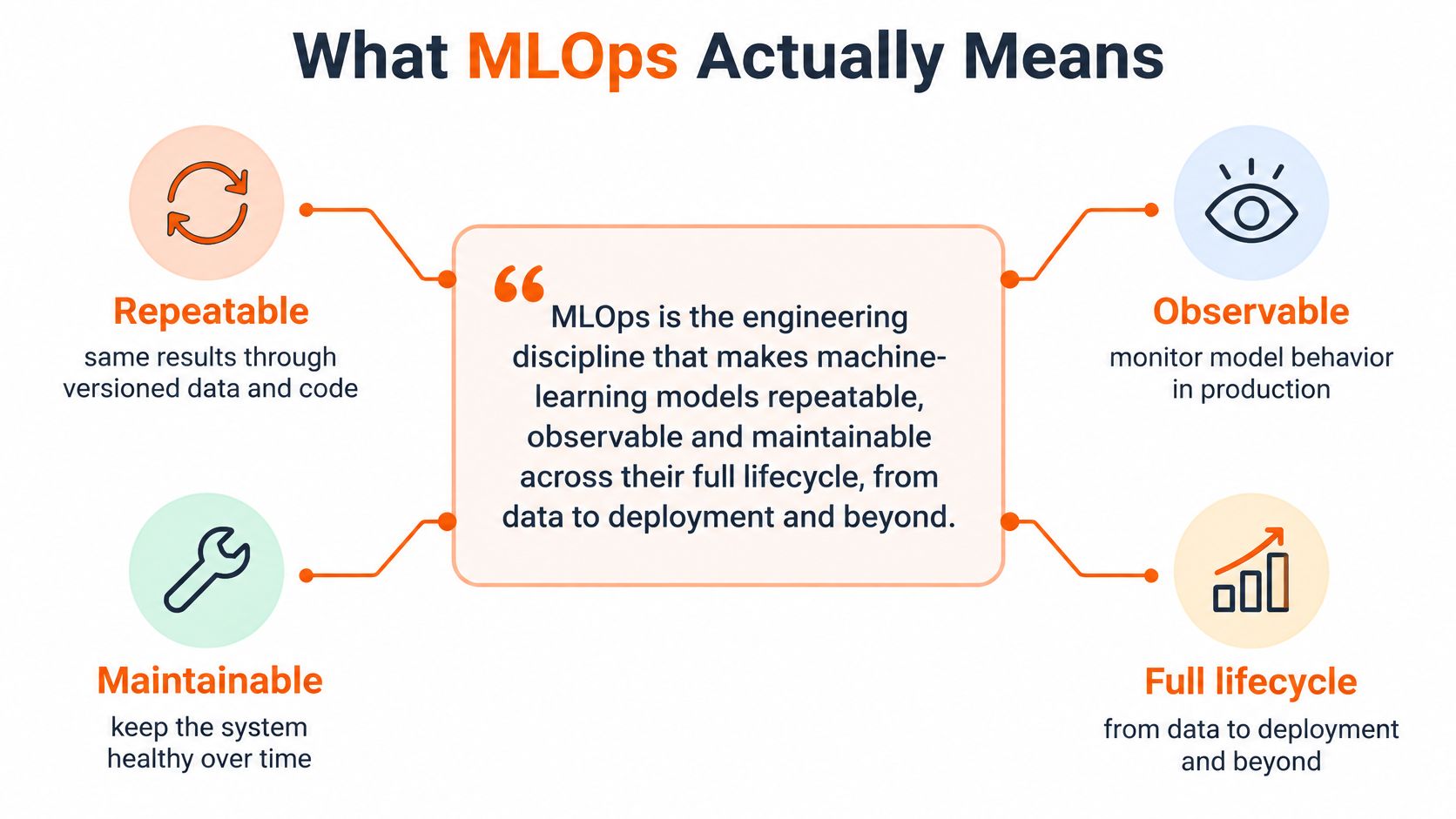
MLOps is the engineering discipline that makes machine-learning models repeatable, observable and maintainable across their full lifecycle, from data to retirement.
That definition is your anchor. A 2023 IEEE Access review defines MLOps as an approach combining machine learning, software engineering, and data engineering to productionize ML systems, including CI/CD automation, workflow orchestration, reproducibility, versioning of data, model and code, metadata logging, continuous training, and monitoring. In plain English, it's how you run ML like a serious product instead of a research artifact.
Think of DevOps as a well-organized kitchen with a fixed recipe. You version the recipe, test each dish, and serve it the same way every night. MLOps runs that kitchen when the ingredients themselves change every day. Training data shifts, feature pipelines evolve, hyperparameters get tuned, infrastructure scales, and real-world behavior moves.
That's why ordinary software delivery isn't enough. A normal app mostly depends on its code. An ML system depends on at least five connected elements:
Change one element without tracking the others, and you lose the ability to explain, reproduce or roll back a result. That's not a tooling detail. That's production risk.
You need this discipline whether you're running recommendation engines, fraud detection, demand forecasting, language tools or computer vision. The use cases differ, but the operating questions don't. Which data trained this version? Who approved it? What changed last week? How fast can you revert it?
Use this test today. If someone other than the model's author can't rebuild it, explain it and roll it back, it's deployed, but it isn't operated. MLOps closes that gap. It turns a clever model into a business asset you can ship, audit and improve without relying on one person's memory or laptop.
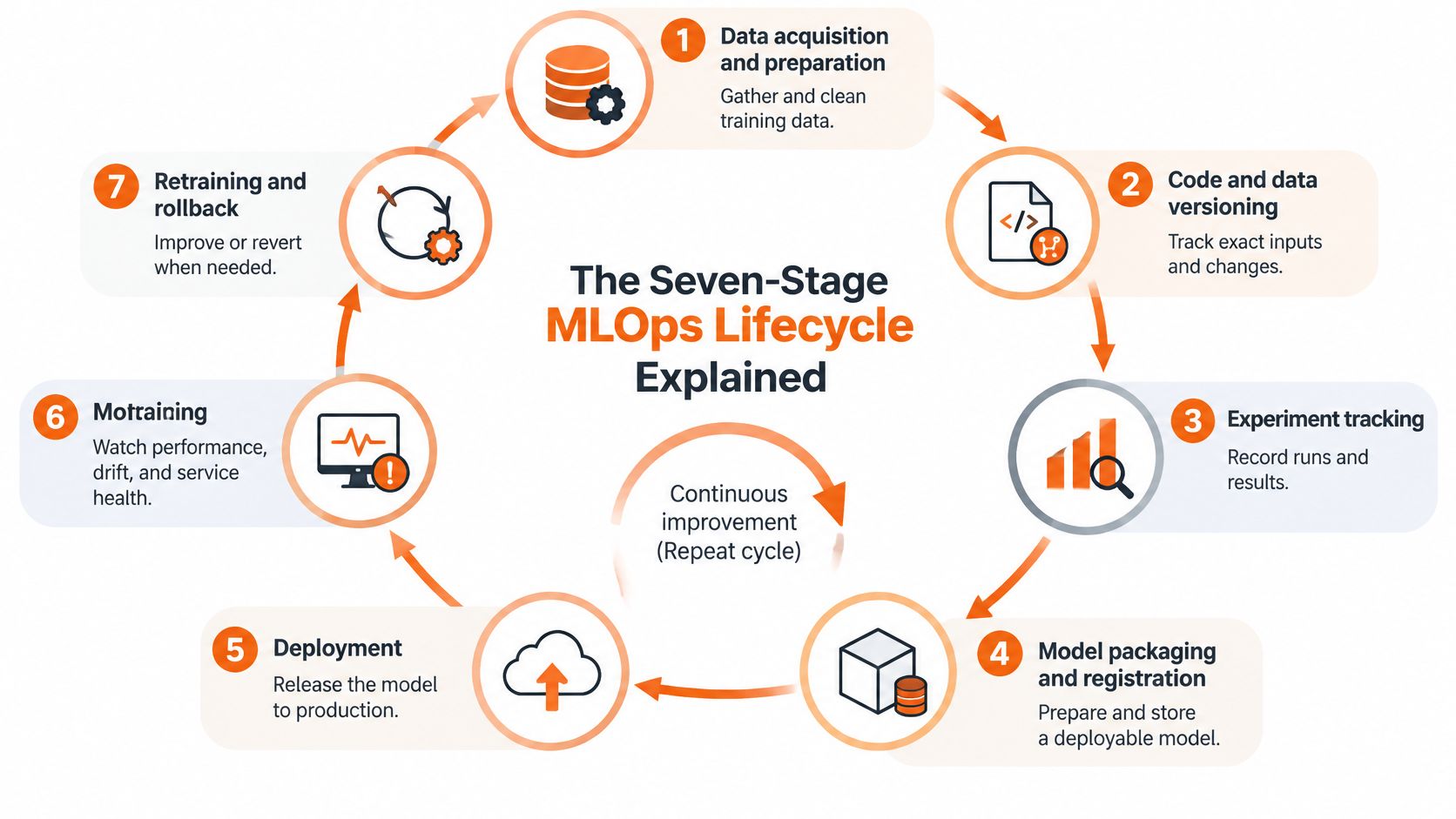
Treat the lifecycle as a loop, not a launch checklist. Monitoring feeds new data and retraining, and that feedback is what keeps the system useful. Use this table as your operating reference.
| Stage | What Happens | Output You Can Check | Common Failure |
|---|---|---|---|
| Data acquisition and preparation | Collect, clean and label source data | Versioned dataset with documented sources | Undeclared upstream data changes |
| Code and data versioning | Track every change to code, data and features | Reproducible commit history | Training cannot be rebuilt months later |
| Experiment tracking | Log runs, parameters and metrics | Comparable experiment records | Best result cannot be reproduced |
| Model training | Train on versioned inputs in a controlled environment | Model artifact with metadata | Hidden hyperparameter differences |
| Automated testing and evaluation | Validate data, features and performance against release gates | Pass or fail report before release | Gates skipped under deadline pressure |
| Deployment | Promote the approved model through staged release | Live endpoint or batch job | Manual, untraceable releases |
| Monitoring, retraining and rollback | Watch drift, quality and cost; retrain or revert when evidence requires it | Alerts, retraining triggers and a rollback plan | Alerts with no named owner |
Start with data you can defend. Document every source, store dataset versions alongside code commits, and fail the build when required fields or value ranges break. That's cheap insurance against silent feature changes.
For experiments, log parameters, metrics, dataset version and code version in tools such as MLflow. If a champion model can't be reproduced, don't promote it. During training, use a controlled environment, for example a pinned Docker image, so the same inputs produce a comparable artifact.
Testing needs a wider lens than software alone. A model can fail while every unit test passes, so validate data, features, model quality and serving behavior before release. Require a passing evaluation report for promotion. No report, no release.
Deployment should be staged and traceable. Promote approved artifacts from a registry, use shadow or canary release for risky changes, and keep the previous version ready. Manual copying of model files to production is a warning sign.
Visual use cases make the same point. The truck recognition insights from Faberwork are a useful reminder that image models live inside cameras, lighting, labels and field conditions, not just inside training code.
Finally, close the loop. Monitoring findings should trigger data fixes, retraining or rollback, and each stage needs a named owner and a stored artifact. That's the handover test. If a stage depends on memory, it will break under holiday cover, staff turnover or deadline pressure.
Don't assume the data science team owns the model after launch. They built it, but production needs decisions on service levels, retraining authority, rollback rules and budget. Those decisions stall when nobody holds them explicitly.
Here's how a live team discussion on model performance and deployment checks typically surfaces that gap.

Evidence backs the concern. A production-ML practitioner survey found monitoring model performance was the most frequently reported challenge, cited by 42% of respondents, followed by access to training data at 37% and reliable data pipelines at 34%. Automation alone won't fix that. You need durable ownership for data quality, model behavior and business outcomes.
| Role | Owns | Decides |
|---|---|---|
| Business owner | Outcome and acceptable risk | Retire the model and set the budget |
| Product owner | Priorities and release scope | Replace or retrain for the roadmap |
| ML and data engineers | Pipelines, features and retraining runs | Retrain within agreed limits |
| Operations lead | Infrastructure, alerts and incidents | Roll back during an incident |
| Risk or compliance contact | Regulated decisions and audit trail | Approve high-risk changes |
Complete this one-page sheet before go-live, and add an escalation path and review date for each role. Then separate technical monitoring from business monitoring. Latency, errors and drift need one threshold. Conversion, fraud losses, calibration and fairness usually need another.
Watch how an alert should flow. The operations lead confirms the signal, the business owner judges impact, and the engineering owner rolls back or retrains within agreed limits. The short video below is a useful prompt for rehearsing that conversation with your team.
Warning sign: if two teams each believe the other is watching the model, nobody is.
Start with one constraint question. Where can your data and models legally and practically run? Answer that before you debate brands, because it determines governance, latency, cost and the skills you need.
| Pattern | Best Fit | Main Trade-Off | Get Right First |
|---|---|---|---|
| Managed cloud | Fast start, elastic compute, few strict data-location rules | Vendor lock-in and data-residency questions | Portable model artifacts and a clear exit path |
| Hybrid | Sensitive data stays on premises while training or scale-out runs in cloud | Two environments to keep consistent | One model registry and one promotion process |
| On-premises | Strict security or data-residency rules, tightly coupled hardware | Heavier infrastructure and skills burden | Reproducible packages and offline tooling |
| Edge | Intermittent connectivity, low latency, models bound to devices | Limited monitoring and update channels | A remote update plan and local rollback |
A 2025 manufacturing case study of a low-volume optics manufacturer found security requirements that prohibited cloud-based platforms were the leading adoption challenge, among 13 adoption challenges including heterogeneous systems, manual deployment, unclear roles, skills shortages and difficulty creating reproducible packages. That's your reality check. Cloud-first isn't universal.
Don't buy a platform hoping it defines your process. Pick tools by job: orchestration to run pipelines, data and model versioning for reproducibility, experiment tracking to compare runs, a model registry as the single source of approved models, and monitoring for drift, quality and cost. Most production pipelines combine several categories. That's normal.
Reduce lock-in with portable model artifacts, documented feature definitions, and one promotion process across environments. If you're also modernizing the wider stack, you can compare cloud modernization partners against the same criteria instead of treating ML as a separate island.
Weigh every pattern against five things: governance, observability, latency, cost, and the skills your team has. The same discipline helps when you're deciding between local LLMs and cloud AI. Reliable operations under your real constraints beat a textbook cloud pipeline your team can't run.
MLOps earns its budget only when leaders can see improvement in numbers they already trust. Use delivery metrics and model health together. One without the other gives you a fast team shipping bad predictions, or a careful team shipping too slowly.
| Metric | What It Measures | Business Effect |
|---|---|---|
| Deployment frequency | How often production changes ship | Faster releases and more delivery capacity |
| Change lead time | Elapsed time from commit to successful production deployment | Quicker response to market needs |
| Change failure rate | Share of deployments that cause production failures | Less operational disruption |
| Failed deployment recovery time | How quickly service is restored after a failed deployment | Less downtime and smaller customer impact |
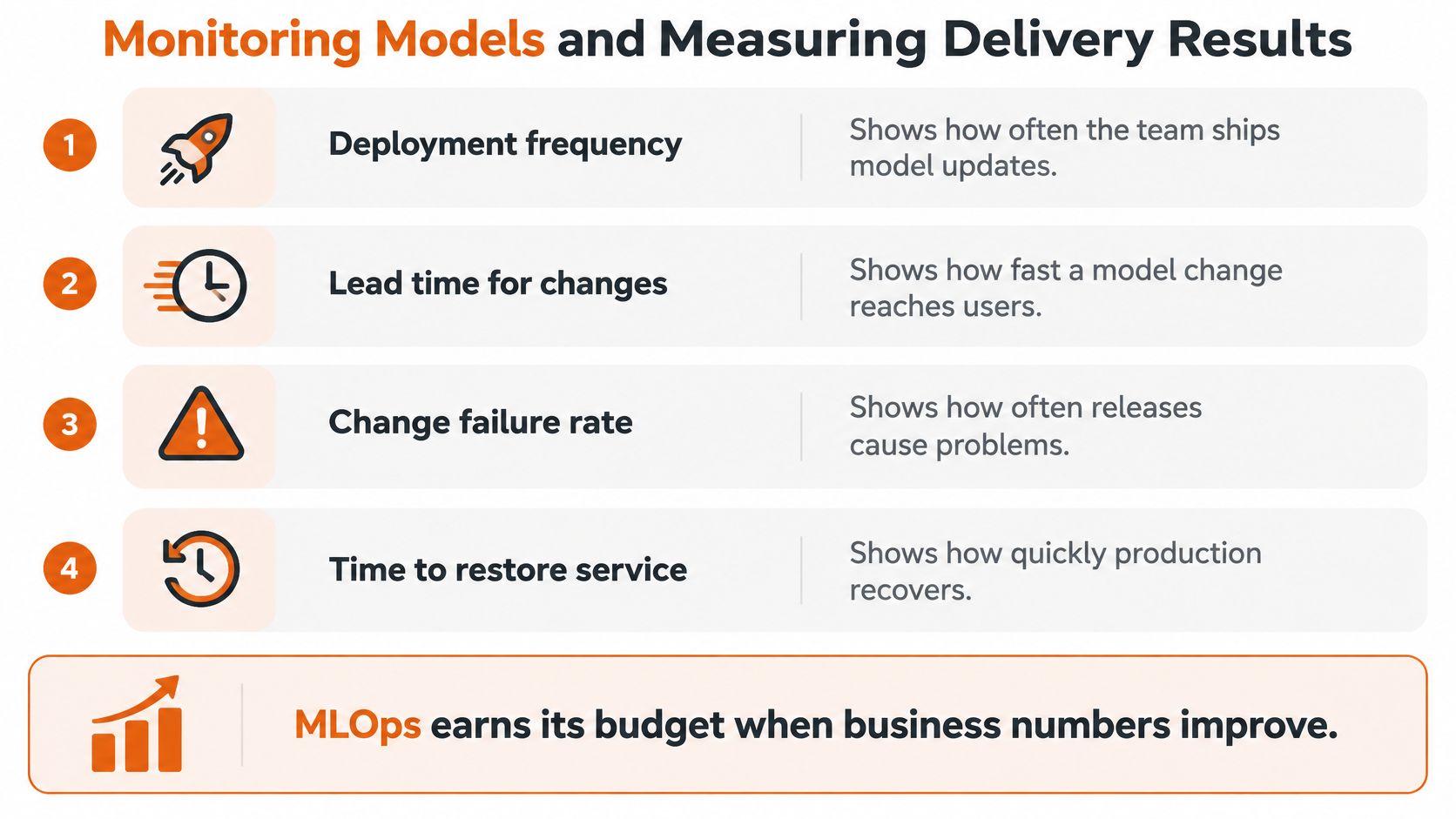
The DORA metrics guide defines deployment frequency as how often production changes are delivered, change lead time as elapsed time from code commit to successful production deployment, change failure rate as the percentage of deployments that cause production failures, and failed deployment recovery time as how quickly service is restored after a failed deployment. Track them across data, model and application releases, not just app code.
Beside delivery, monitor input data quality, drift, prediction quality, latency, serving cost, and the share of predictions sent to human review. Those signals tell you whether the system is still useful, not just available.
Keep the response loop simple. Measurable drift or rising errors trigger investigation. Validated degradation triggers a controlled change, such as rollback, shadow testing or retraining. Post-change evaluation confirms performance improved without fairness, security or compliance regressions.
Don't optimize speed alone. You'll raise failure rates. Don't optimize stability alone. You'll slow market response. Your target is faster, safer delivery, measured through throughput and instability together, with senior engineering accountability for both.
When a model drifts after launch, someone pays. Governance decides who, and how much warning they get. Strong MLOps produces evidence that a model is fit for its purpose, monitored in use, and changed under authority. Vague assurances won't satisfy executives, auditors or regulators.
NIST's AI Risk Management Framework organizes the work into four functions: Govern covers organization-wide policies, processes, accountability and communication; Map identifies context, intended purpose, stakeholders and potential impacts; Measure applies quantitative, qualitative or mixed methods to evaluate performance and risk; and Manage prioritizes and responds to identified risks throughout the lifecycle. Turn each into a checkable action before launch.
The European Commission summary of the EU AI Act states that high-risk AI systems must have risk-assessment and mitigation systems, high-quality datasets designed to minimize discriminatory outcomes, activity logging for traceability, detailed technical documentation, deployer information, human-oversight measures, and strong levels of security, cybersecurity and accuracy. High-risk obligations phase in on a defined timeline, so check the current dates against the official text instead of assuming you have years.
Translate that into engineering controls you can build now: versioned datasets, preserved evaluation results, logs for production decisions where legally permissible, documented limitations, and a named human reviewer for high-impact outputs. Teams building broader lifecycle controls for AI governance can align those controls with a practical AI governance framework for growing companies rather than inventing policy model by model.
AI-assisted delivery changes the economics of analysis, coding and testing. It doesn't lower the standard. Architects and engineers remain responsible for architecture, data, security, testing and production quality. Ask one direct question this quarter: which of your models would need this evidence before the EU AI Act's high-risk obligations apply? If the honest answer is "none, probably," write that down and file it. Owning that call is governance too.
Start with one model tied to one measurable business outcome. Not with a tool purchase. Not with a platform rebrand. One system, one owner, one result you can prove.
This is Extreme Ownership in practice. We identify risks early, move decisions forward, communicate transparently, and stay accountable for the complete result. Our Managed Technology Services run, protect and continuously improve production technology, and a managed service begins with assessment, a responsibility map, a transition plan, SLAs and escalation, and an improvement roadmap, in that order. We also tell clients when a custom model or local LLM is not needed. That honesty saves budget and avoids machinery you'll have to maintain.
Book one readiness conversation about one live or planned model. Bring the outcome, the owner and your current release numbers. You'll leave with a clearer first step you can take this week, and a realistic view of what to automate, assign or stop.
Ready to run ML like a business product instead of an experiment? We help CTOs and product leaders design MLOps ownership, monitoring and managed operations that keep models fast, safe and accountable after launch. Visit Rite NRG to start with a focused assessment of one model, one team and one measurable outcome.
/ about the author
Written by the RITE NRG editorial team — the architects, engineers and delivery leads who build and operate AI-era software for our clients.
Strategy & Transformation
A practical, finance-ready framework for comparing AI and modernization investment with the current-state cost, realistic benefits, delivery risk and time to value.
Technology Talent & Teams
A decision-maker's guide to IT partnership models: what each model actually transfers to the partner, what it costs beyond the rate card, and how to match the model to your situation.
AI Consulting & Automation
A practical framework for choosing and deploying transport or logistics AI agents around real exceptions, reliable data and controlled operational authority.
More guidance: all insights articles
Tell us about the system or idea behind this article. We tell you honestly if it is a fit — and what a fixed-scope delivery could look like.