
Strategy & Transformation
How to Calculate ROI for AI and Software Modernization
A practical, finance-ready framework for comparing AI and modernization investment with the current-state cost, realistic benefits, delivery risk and time to value.
operationalwrocław--:-- cet
∕ insights / how-to-build-an-mvp.md
Mvp Guide
Learn how to build an MVP that validates demand quickly without becoming disposable. A practical guide for SaaS founders, CTOs, and product teams.
>_article.meta
A two-person team ships a SaaS MVP in six weeks. A month later, 400 people have signed up, the database starts buckling, the webhook queue stalls, and customer support spends every morning explaining broken workflows. The launch looks successful from the outside. Internally, the product is one busy week away from a rewrite.
That outcome isn't caused by moving too quickly. It's caused by confusing small scope with low engineering standards. The right MVP launches with only the product surface needed to test a business assumption, but its critical path still has sound data handling, observable failures, controlled deployments, and a clear path to higher load.
This is how to build an MVP that gives you evidence quickly without becoming disposable code. The target isn't a polished version of the final platform. It's a focused experiment that can absorb real usage, reveal what deserves investment, and evolve without forcing the team to rebuild the foundation under pressure.
A founder launches a focused SaaS product, sees sign-ups climb, and assumes the hardest work is over. Then real users create unexpected data, retry failed requests, abandon workflows halfway through, and expect reliable behavior while the team is still changing the system. Launch momentum exposes the gap between proving demand and operating a product.
A demo can tolerate hardcoded assumptions and manual fixes. A live SaaS product cannot. Queries fail under real access patterns, webhooks stall when retries and idempotency were ignored, and support volume rises because the team never measured where users get stuck.
Practical rule: Build the smallest product that proves the business case, not the cheapest code that imitates the product in a demo.
An MVP is a controlled experiment, not a smaller finished platform. Its job is to test one customer hypothesis with enough engineering discipline to produce trustworthy evidence. Around 42% of startups fail because they build something the market doesn't need, according to MVP survival and success analysis. Validation matters, but speed alone does not protect a team from a costly rewrite. The MVP must also preserve the data, workflows, and feedback needed for the next product decision.
A fast MVP has fewer features, not fewer safeguards. Authentication, permissions, billing boundaries, error tracking, repeatable deployments, and backup recovery may stay invisible to customers, yet they determine whether the team can keep learning after usage increases.
Set these quality bars before release:
The common MVP window is roughly 8 to 16 weeks, and teams using MVP approaches have been reported to make around 30% more product changes than traditional teams, as described in MVP development benchmarks. Those benchmarks support a disciplined operating model: release a narrow slice, observe behavior, and change the product while learning remains inexpensive.
AI can shorten implementation for scaffolding, test generation, documentation, and routine transformations. Keep human review over authentication, permissions, billing, data migrations, and failure handling. Generated code can speed delivery, but unexamined assumptions still create the rewrite the MVP was meant to avoid.
Your first release should handle meaningful growth without immediate re-platforming. Do not solve every future scale problem. Do remove decisions that make ordinary growth dangerous.
Start with one sentence:
We believe [specific user] will [specific behavior] because [specific problem or value].
Then ask which part of that sentence, if wrong, kills the product. That is your riskiest assumption. Everything in the first cycle should help prove or disprove it.
A B2B invoicing tool might assume that freelancers will trust automated bank reconciliation enough to connect their accounts. A vertical CRM might assume that field representatives will log activities from mobile devices while moving between customer sites. A usage-based analytics product might assume that engineers will trust its data enough to pay for it.
These assumptions demand different evidence. The invoicing product needs confidence around trust, permissions, and reconciliation accuracy. The CRM needs proof that mobile logging fits the user's working rhythm. The analytics product needs users to compare the data with a trusted source and then act on it.
Turn the assumption into one primary user journey:
Every feature that doesn't support that journey is a candidate for removal. Don't add team workspaces, advanced dashboards, integrations, notification preferences, or elaborate settings because they make the product feel complete. Add them only when the evidence shows they remove a barrier to the core action.
The risk identification techniques guide is useful when a team needs to turn broad concerns into explicit risks, owners, and validation actions. That discipline prevents the founder's loudest opinion from becoming the roadmap by default.
Give the first discovery and validation cycle a fixed two to four week time box. The duration isn't a promise that the product will be ready. It's a forcing mechanism that stops indefinite research and makes the team decide what evidence is sufficient.
Set exit criteria before the cycle begins:
Validated-first teams that conducted 10 or more customer interviews reached product-market fit at 41%, compared with 14% for teams that built before validation. The same analysis reported stronger operating survival for the validated-first group at month 24. Treat those figures as directional evidence for sequencing discovery before expensive engineering, not as a guarantee. Customer validation and MVP success data explains the comparison.
The best MVP format depends on where uncertainty lives. Don't build a full application when a human-assisted workflow can test willingness to pay. Don't run a waitlist campaign when the fundamental question is whether users can complete a product action.
| Format | Time to Signal | Cost | Evidence Type | Best For |
|---|---|---|---|---|
| Concierge MVP | Fast | Low to moderate | Behavior, service value, willingness to pay | Testing a workflow before automation |
| Smoke test MVP | Fast | Low | Positioning, demand, message response | Testing whether an audience responds |
| Single-feature build | Moderate | Moderate | Product usage and completion | Testing a core in-product assumption |
| Prototype | Very fast | Low | Usability, comprehension, workflow preference | Testing interface and interaction design |
A concierge MVP gives users a software-facing experience while a person performs part of the work manually. For an invoice product, the team might review reconciliations behind the scenes. For an analytics product, an analyst might prepare the first report manually.
This format is powerful because it tests whether the outcome matters before automation consumes engineering capacity. It doesn't prove scalability, so track the manual steps and identify which ones must eventually become deterministic.
A landing page with targeted paid traffic can test positioning, audience interest, and willingness to join a waitlist or request a conversation. It can't prove that users will complete the product workflow. Treat signups as a signal about the message, not evidence of retention.
This is usually the right choice when the riskiest assumption sits inside the product experience. Build one complete journey, including authentication, data handling, errors, and the action that creates value. A narrow end-to-end product teaches more than a broad collection of disconnected screens.
A clickable Figma prototype or coded front end is appropriate when usability is the uncertainty. Use it to observe whether people understand the workflow and can predict the result. Don't use it to claim demand for a backend capability users have never experienced.
The decision rule is simple: choose the cheapest format that produces the behavioral evidence needed to confirm or kill the riskiest assumption. The startup MVP development guide offers additional context for matching MVP scope to the business question.
An MVP can attract signups and still teach you nothing. If you cannot see where users activate, complete the core task, receive value, or abandon the flow, every product decision becomes guesswork. Define the evidence required before launch and instrument the full journey from the first meaningful click.
Track five event categories:
Make activation concrete. “User is active” cannot guide an engineer or product manager. “Dashboard loaded with at least three connected sources” and “report generated and exported” identify observable events that the team can inspect, compare, and fix.
Use rolling weekly cohorts and decide the retention rule before reviewing performance. For this operating model, if fewer than 30% of activated users return in week two, stop adding scope and investigate the activation path. This is a decision rule, not an industry law. Change it only when the product's usage cycle makes weekly return behavior irrelevant.
Use broader benchmarks as reference points, not acceptance criteria. Healthy MVP signals can include 30% or more of new users completing the core action and 90-day retention above 40%. These figures should sit beside your own usage cadence and interview findings. A product with strong completion but weak repeat use may deliver a one-time benefit, while high retention with poor qualitative feedback can indicate habit rather than meaningful value.
| Event | What to Track | Validation Threshold |
|---|---|---|
| Sign-up started | Source, device, completion rate | Users reach the form from the intended acquisition path |
| Activation step reached | Required setup and time to completion | Users provide the input needed for the core journey |
| Core action completed | Completion, retries, abandonment | A meaningful share completes the primary action |
| Value moment hit | Output viewed, used, or exported | Users receive the promised outcome |
| Error or drop-off | Error type, screen, release, cohort | Every major failure has an owner and next action |
Run five structured interviews before launch with target users and 10 after launch with activated and churned users. Ask the same five questions, code responses into patterns, and connect each pattern to a product action. Interviews explain the numbers. They do not replace event data.
Ask what triggered the trial, which step felt hardest, when value became clear or failed to appear, what workaround the user used before, and what would make them return. Uxia's data driven design guide offers a practical framework for connecting observed behavior with product decisions.
Review qualitative and quantitative signals together each week. If users abandon after activation, inspect the workflow before adding features. If they complete the core action but do not return, test whether the promised outcome is strong enough or whether the use case occurs too rarely.
Write one weekly learning memo. Every insight must produce one shipped change, one explicit decision to leave the product unchanged, or one experiment with an owner and deadline. A growing wishlist is not a feedback loop. It is unprioritized work.
Team shape controls MVP cost more than most founders admit. A narrow scope still fails when nobody owns the cross-cutting work between features, such as authentication, billing, deployment, observability, and data protection.
Four models can ship a SaaS MVP in 2026:
| Team Model | Relative Cost | Speed to First Deploy | Senior Engineering Depth |
|---|---|---|---|
| In-house two-person team | Highest fixed commitment | Fast when aligned | Deep product context |
| Freelance assembly | Variable | Fast at task level | Uneven across system boundaries |
| Nearshore dedicated squad | Moderate | Fast with overlapping hours | Strong when led by a senior engineer |
| Build-Operate-Transfer | Moderate to high during setup | Fast with an established partner | Strong, with a planned ownership transition |
A CTO and full-stack engineer can move quickly because decisions stay close to the product. The risk is concentration. If one person owns architecture, security, infrastructure, and delivery, the team may ship a feature before anyone has challenged the system's weak points.
A lead engineer with specialists can be effective for a contained build. Freelance assembly becomes fragile when work crosses boundaries. Authentication, billing, deployment, and failure handling rarely fit neatly into separate tickets, and handoffs can leave nobody accountable for the complete result.
A dedicated team of three to four senior engineers working in overlapping time zones with US or EU stakeholders can compress feedback loops while providing broader coverage. Teams led from Latin America or Eastern Europe are often considered because their loaded rates can be roughly 40% to 60% lower than US hiring costs, as described in the team-model research for this audience. Treat that range as a planning reference, not a quote, because seniority, engagement structure, and specialization change the economics.
Build-Operate-Transfer works when the founder needs speed now but wants internal ownership later. A nearshore partner builds and operates the initial squad, then provides an option to convert that team into the company's internal engineering capability. The contract must define documentation, access, decision rights, and the handoff path before development starts.
For most seed-stage founders, a nearshore dedicated squad with one part-time in-house technical lead offers a practical balance of runway, accountability, and senior depth. Choose the lead engineer first. Then hire or contract around the gaps in architecture, product engineering, quality, and platform work.
AI belongs in your MVP only when it reduces a validated customer problem without making the core journey unpredictable. Adding a chat window because investors expect an AI feature is not product strategy. It's scope expansion with a new failure mode.
User-facing AI in the critical path introduces three problems:
The smarter default is AI-assisted delivery with a non-AI core product. Use agentic tools to draft boilerplate, generate test cases, propose SQL migrations, summarize interview transcripts, inspect logs, and accelerate documentation. Human engineers still own the architecture, security, testing, correctness, maintainability, and production readiness. AI changes delivery economics. It doesn't lower the quality bar.
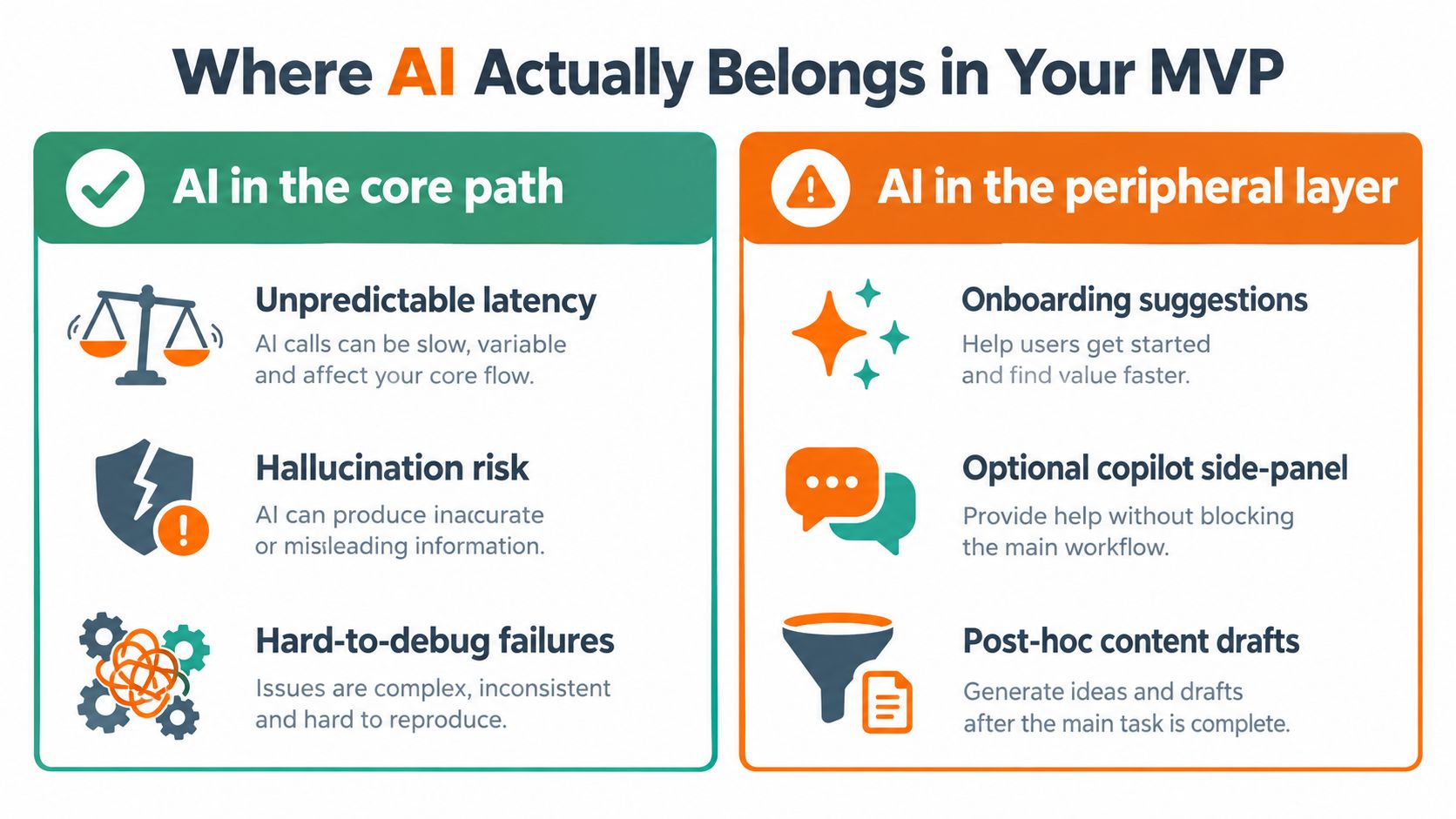
A narrow optional feature can work well when failure doesn't destroy the primary outcome. Good candidates include a summary over structured records, an onboarding suggestion, a draft response, or a copilot panel that users can ignore.
Give every AI feature a deterministic fallback. If a summary fails, show the underlying records. If a suggestion is poor, let the user continue manually. If the model is slow, don't block account creation or the core transaction.
If the product's value depends on AI, treat the model as a tier-one production dependency. Lock provider contracts, version prompts, log inputs and outputs responsibly, monitor quality, control permissions, and define an offline or rules-based fallback before launch. The AI proof of concept versus production system guide is a useful distinction for deciding whether a prototype has crossed into operational software.
A practical review should challenge the AI assumption from both directions. Ask whether the customer would still pay for the workflow without the model, and ask which exact model behavior creates value that deterministic software can't provide. If the answer is vague, keep AI behind the scenes.
Treat hardening as a pre-scaling audit, not a cosmetic polish pass. The question isn't whether the code is elegant. The question is whether the team can operate it, diagnose it, deploy it, and recover it when early traction creates pressure.
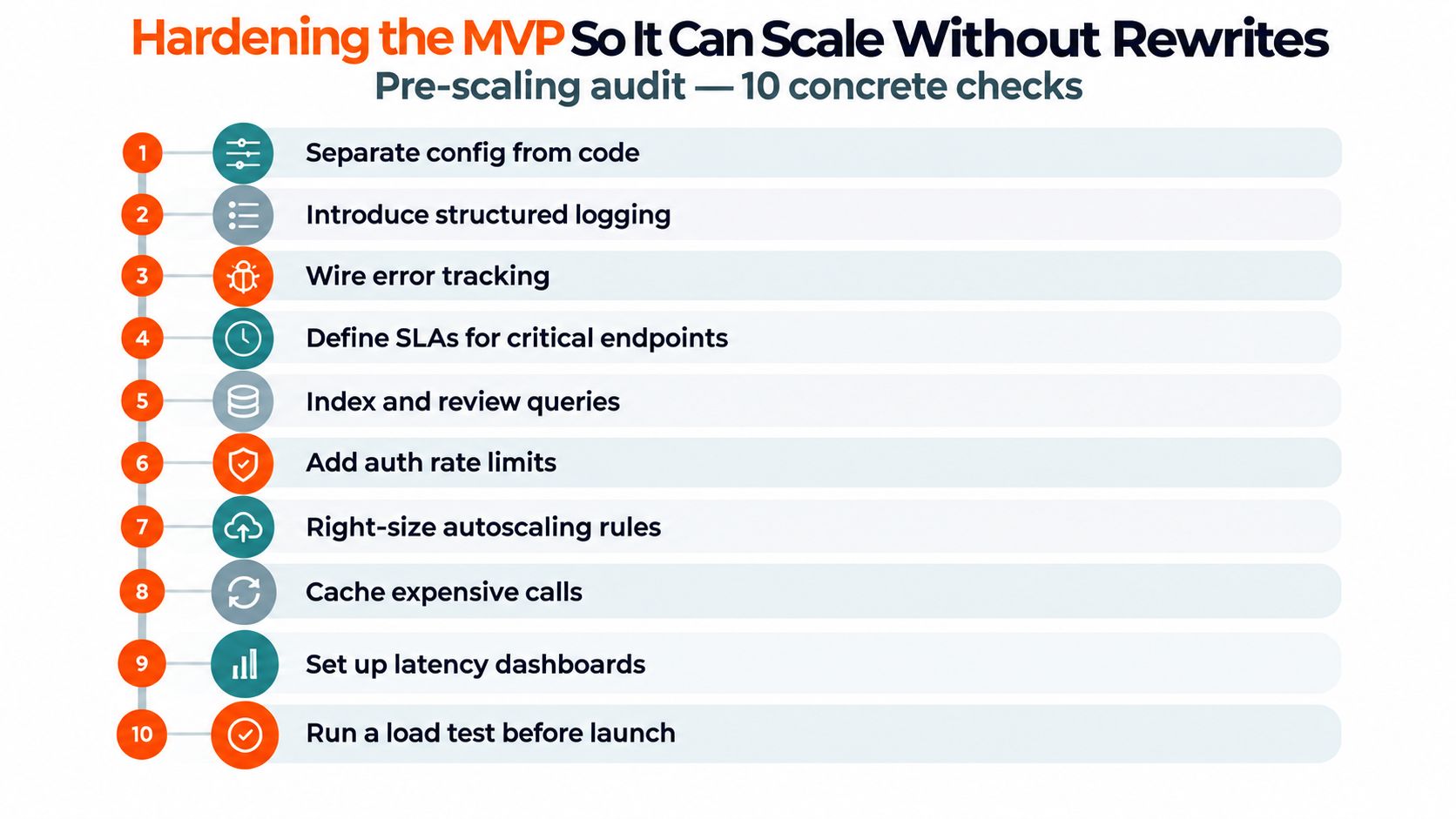
The most common mistake is sequencing these checks after the product gets busy. Hardening under customer pressure creates rushed migrations, emergency access changes, and fragile patches. Add the minimum viable operational discipline before launch, then deepen it as usage reveals the actual bottlenecks.
Before traffic
After the first 100 users
Before paid-plan launch
A validated MVP still needs a path to production quality. Failure analyses repeatedly identify weak post-launch iteration, premature scaling, and technical debt as reasons promising products collapse after initial traction. The operational standard is simple: if the team can't explain what happened during a failure and deploy a safe fix, the MVP isn't ready to become a business.
Rite NRG helps founders and product teams take an MVP from product vision through architecture, AI-assisted engineering, testing, deployment, and ongoing operation without treating production readiness as an afterthought. If you want a focused product that can learn quickly and grow without a forced rewrite, visit Rite NRG to discuss the riskiest assumption and the engineering path around it.
/ about the author
Written by the RITE NRG editorial team — the architects, engineers and delivery leads who build and operate AI-era software for our clients.
Strategy & Transformation
A practical, finance-ready framework for comparing AI and modernization investment with the current-state cost, realistic benefits, delivery risk and time to value.
AI Consulting & Automation
A practical framework for choosing and deploying transport or logistics AI agents around real exceptions, reliable data and controlled operational authority.
Industry Solutions
A practical roadmap for improving manufacturing systems and introducing AI without destabilising production, data integrity or operational control.
More guidance: all insights articles
Tell us about the system or idea behind this article. We tell you honestly if it is a fit — and what a fixed-scope delivery could look like.