

Strategy & Transformation
How to Calculate ROI for AI and Software Modernization
A practical, finance-ready framework for comparing AI and modernization investment with the current-state cost, realistic benefits, delivery risk and time to value.
operationalwrocław--:-- cet
∕ insights / hire-dedicated-development-teams.md
Hire Dedicated Development Teams
Learn how to hire dedicated development teams that deliver predictable outcomes. A strategic guide to vetting, onboarding, and managing senior engineers.
>_article.meta

Most advice about hiring dedicated development teams starts with hourly rates, team size, and the promise of faster delivery. That's the wrong starting point. Adding engineers doesn't automatically add capacity, and a low rate can become expensive when your product managers spend their time clarifying requirements, your architects repair weak decisions, and your internal team absorbs every integration problem.
The right question is whether an external team will improve your delivery system. Can it help you reach validated product outcomes faster, preserve technical ownership, reduce hiring friction, and make delivery more predictable without weakening security or quality? If the answer isn't measurable, you're not buying capacity. You're buying activity.
European labor data makes the constraint clear. Between 2012 and 2022, the number of ICT specialists in the European Union grew by 57.8%, exceeded 9 million people, and reached 8.8% of total employment. Yet 62.8% of EU companies still reported difficulty filling ICT vacancies. Poland's rate was lower at 46.5%, but it remained significant. These figures are documented in the Polish Economic Institute analysis of the European technology labor market.
The implication is straightforward. Software demand isn't the only problem. Access to qualified people with complementary skills is the bottleneck. A SaaS company may need architecture, backend engineering, quality assurance, DevOps, data, and security capability at the same time. Hiring each role independently creates a long sequence of sourcing, interviewing, negotiating, onboarding, and context-building. A dedicated team can provide an embedded engineering unit while your company retains product direction and operational ownership.
That makes nearshore and offshore delivery more than a cost-reduction tactic. It's a way to connect concentrated technical talent with a product roadmap that can't wait for every internal vacancy to close. Eurostat reported that more than 10 million people worked as ICT specialists in the EU in 2024, representing 5.0% of total employment, while the share increased by 1.6 percentage points between 2014 and 2024. The same data shows uneven access across countries and company sizes, with large companies much more likely than small businesses to maintain ICT functions. See the Eurostat ICT specialist employment data.
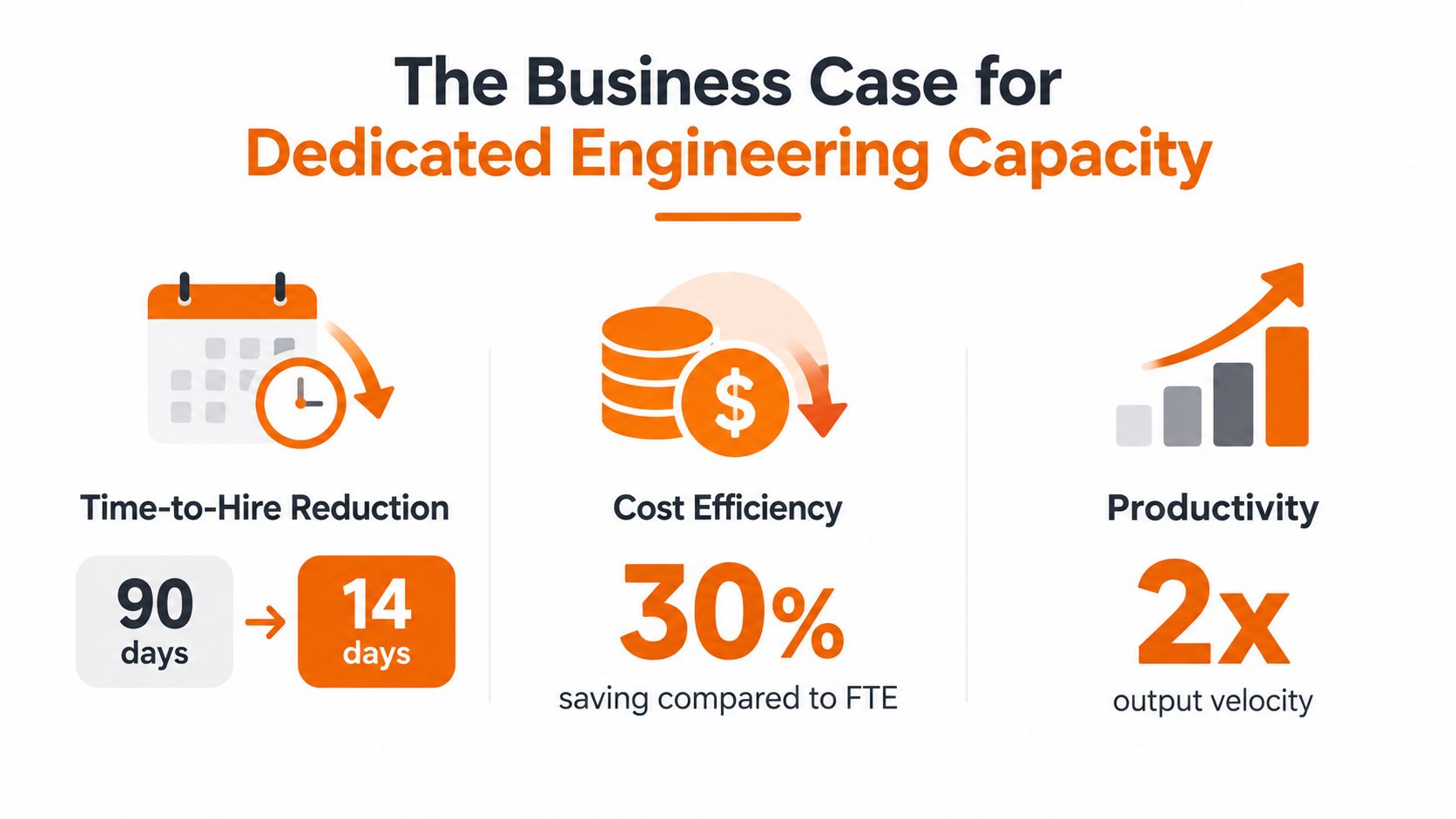
A useful team has a product mission, clear decision rights, and enough capability to move work from discovery to production. That usually means more than developers. It may include a product manager, technical lead, QA engineer, DevOps specialist, data engineer, or security expert, depending on the product risk and architecture.
The team should own a bounded product area rather than receive an endless queue of disconnected tickets. It should retain context, document decisions, participate in incident response, and challenge weak requirements before they become expensive rework.
Practical rule: Hire a team to own an outcome or product surface, not to fill an arbitrary number of seats.
Use a dedicated model when you need continuity and evolving product knowledge. Use fixed-scope delivery when the requirements are stable and the handoff is acceptable. Use individual staff augmentation when you already have strong technical leadership and need a narrow capability for a limited period.
For companies building AI-enabled products, the same principle applies. A fractional GTM AI engineer can help connect technical delivery with go-to-market experimentation, but the broader engineering system still needs clear architecture, security, testing, and ownership. For a deeper view of how nearshore teams fit into capacity planning, review this guide to nearshore software development.
A polished resume proves that someone has held a role. It doesn't prove that the proposed team can understand your architecture, make sound trade-offs, communicate under pressure, or stay accountable after launch.
Evaluate providers as a risk-control decision. Your process should produce evidence before you commit meaningful budget.
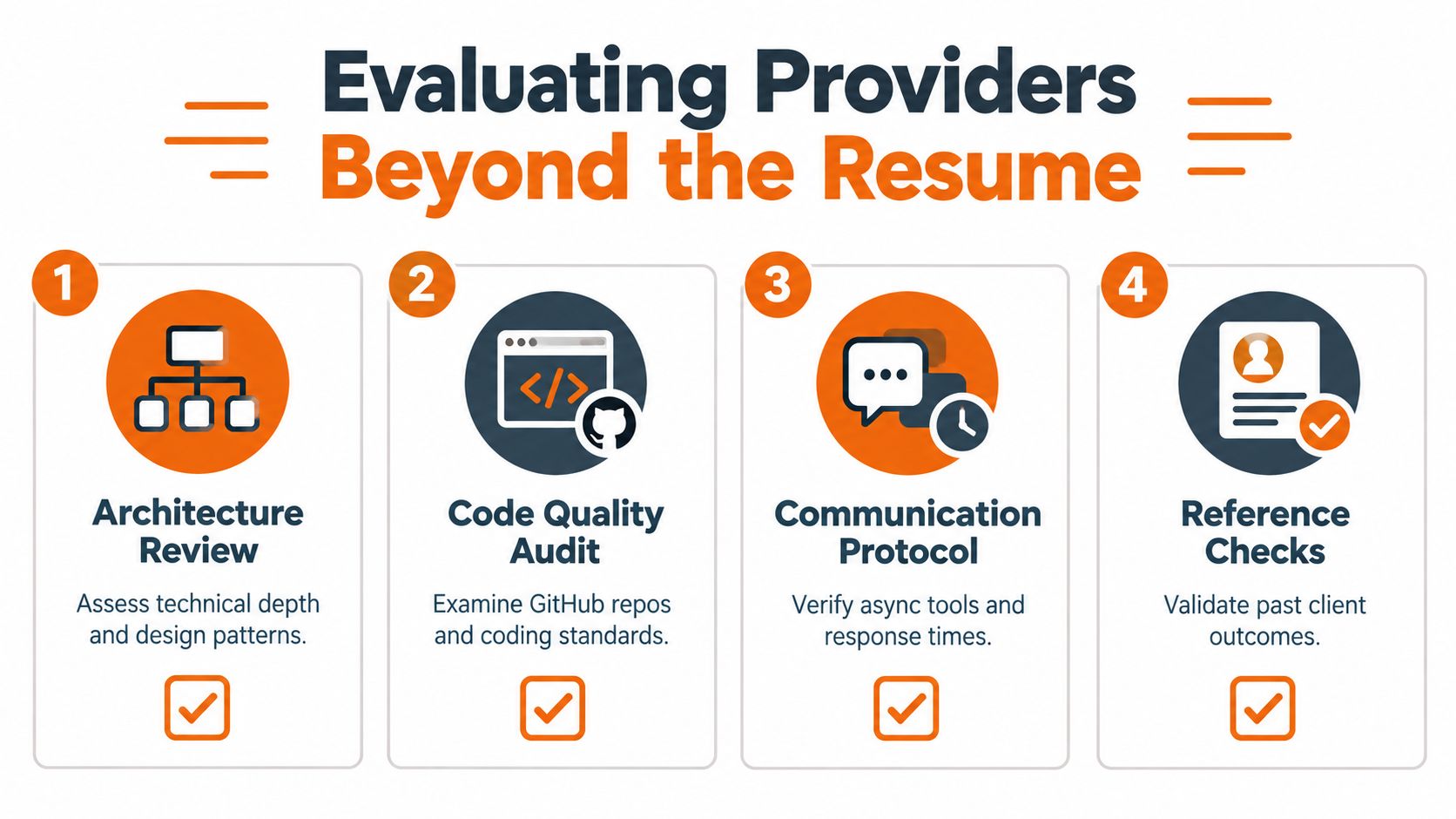
Run an architecture workshop using a realistic product problem. Ask the proposed technical lead to explain service boundaries, data ownership, failure handling, observability, deployment strategy, and the compromises they'd make under time pressure. Don't reward complexity. Reward clarity, reversibility, and an understanding of operational consequences.
Then review representative code. Look for test boundaries, naming, error handling, dependency management, documentation, and the way contributors structure pull requests. A code sample selected by sales tells you less than a live review of a production-like change, including the reasoning behind the implementation.
A security walkthrough should cover access control, secrets, data handling, dependency risk, auditability, and incident response. Ask who can approve releases, how vulnerabilities are escalated, and how the team preserves evidence when something goes wrong.
Use a written scorecard so a charismatic presentation doesn't outweigh weak controls.
The contract should reinforce the scorecard. Include named personnel, substitution rules, intellectual-property ownership, confidentiality, data handling, source-code access, audit rights, service levels, acceptance tests, and an exit plan. Release funding incrementally against demonstrable milestones instead of committing the entire budget before architecture and dependencies are understood.
Large IT initiatives carry serious forecast risk. One cited analysis reported that large projects averaged 45% over budget, 7% over schedule, and delivered 56% less value than predicted. Those figures appear in the analysis of government IT project performance. The lesson isn't that every external team will fail. It's that vague scope, unowned architecture, weak product ownership, and supplier dependence deserve active controls.
A provider should also challenge you. If the team agrees with every assumption in the sales process, expect the same behavior in production. For additional partner-selection criteria, use this resource on choosing a modern software development partner.
Watch the technical review as closely as the answer. This short provider-evaluation video can help frame the conversation, while the practical discipline of briefing a design studio for ROI offers a useful reminder that external partners need business context, not just task descriptions.
The hourly rate is visible. The integration cost is not.
After signing, your internal team must transfer product context, provision access, explain architecture, refine the backlog, review decisions, resolve blockers, manage incidents, and eventually receive knowledge back if the engagement ends. These activities consume management capacity whether the invoice labels them or not.
A dedicated team can increase engineering capacity while slowing the product down if nobody on the client side owns priorities and decisions. That's why you should compare delivery models using fully loaded economics, not rate cards.
First, estimate the cost of internal leadership time. Include product-owner availability, architecture reviews, code review, security approval, delivery management, and stakeholder communication. Second, estimate ramp-up cost. New engineers need access, context, working agreements, and enough product exposure to make safe decisions.
Third, measure the cost of coordination. Count recurring clarification, dependency management, handoffs, incident escalation, and rework caused by incomplete requirements. Fourth, account for quality risk through escaped defects, failed releases, remediation, and customer impact. Fifth, include exit or transfer cost, such as documentation, replacement staffing, operational handoff, and recovery of architectural knowledge.
This framework also helps compare a dedicated team with internal hiring and fixed-scope delivery:
| Decision factor | Internal hiring | Fixed-scope delivery | Dedicated team |
|---|---|---|---|
| Control of priorities | High | Limited after scope approval | High when governance is clear |
| Context retention | Builds internally | Often ends at handoff | Builds through continuity |
| Management demand | High during recruitment and ramp | High during specification and acceptance | Ongoing product and architecture involvement |
| Flexibility | Depends on hiring speed | Low after commitment | High within agreed capacity |
| Main risk | Recruitment and retention | Scope gaps and handoff failure | Weak client ownership and coordination |
Don't approve expansion because the team feels busy. Review evidence such as:
A 2025 LeadDev survey illustrates why measurement maturity matters. 26% of respondents couldn't quantify AI's impact on productivity, while 46% of respondents who could measure the effect reported gains above 10%. The results varied by team size and measurement maturity, as reported in the LeadDev AI Impact Report. The point extends beyond AI. If you can't define the baseline, you can't judge whether a team is improving delivery economics.
Your product owner must have decision authority. Your technical leader must have time for architecture and quality. Your vendor must expose problems early rather than hide behind utilization. For a closer comparison of operating responsibilities, see managed engineering teams versus client-managed teams.
AI changes the economics of software delivery. It doesn't remove the need for engineering judgment.
In a McKinsey study involving more than 40 developers across the United States and Asia, developers using generative AI tools completed coding tasks up to twice as fast and were 25% to 30% more likely to finish complex tasks within the assigned time frame. The study reported no quality sacrifice when developers and tools worked together, with AI-assisted code showing marginally better results for bugs, maintainability, and readability. Those findings are detailed in McKinsey's analysis of generative AI and developer productivity.
The practical conclusion is narrow and useful. AI agents can accelerate coding, refactoring, test creation, documentation, migration analysis, and investigation. Senior engineers still own architecture, data design, security, testing strategy, maintainability, and production readiness.
A responsible AI-native team defines where agents can act independently and where human approval is mandatory.
NIST's Generative AI guidance recommends establishing a test plan and response policy before developing highly capable models, using purpose-built testing environments, and monitoring cases where human operators or other systems override AI decisions. It also emphasizes documenting how public feedback informs design, deployment approval, monitoring, and decommissioning. These controls are described in the NIST Generative AI risk-management profile.
Don't measure AI success by lines of generated code. Measure validated outcomes, review quality, defect escape, delivery predictability, and production stability. Speed is a capacity lever. It isn't permission to transfer technical debt or security risk to the client.
A dedicated team shouldn't be added to a Slack channel and left to infer how your company makes decisions. It needs a deliberate operating model that connects people, technology, governance, and communication.
Start with one product owner and documented decision rights. Define who approves product priorities, architecture, security exceptions, releases, and production changes. Name escalation paths before the first incident, not during it. Establish shared acceptance criteria and one Definition of Ready and Definition of Done.
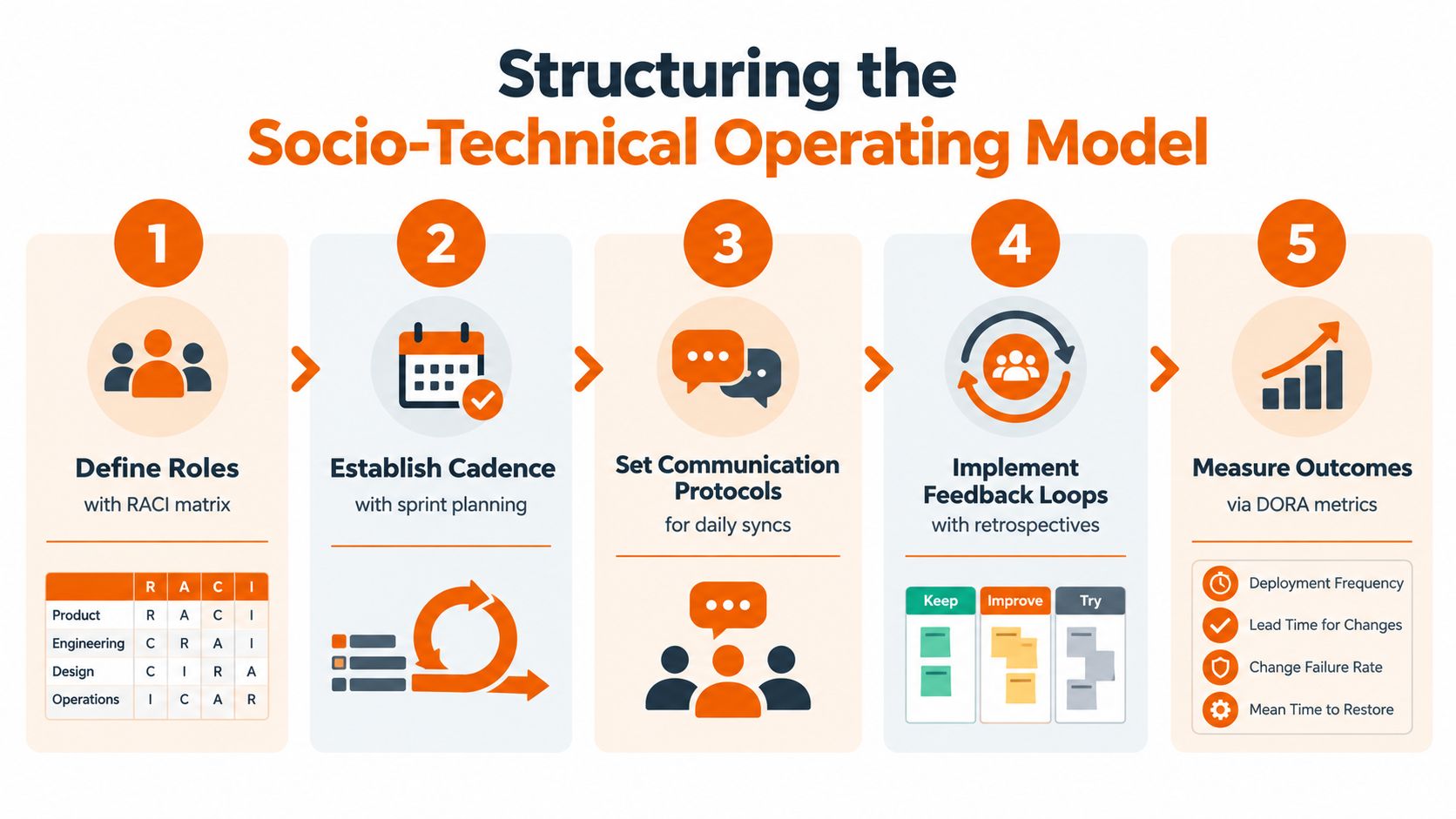
The team should work from one backlog, shared repositories, common CI/CD controls, and consistent quality gates. A cross-functional pod might include product, architecture, development, QA, DevOps, and security capability, either directly or through clearly defined shared roles.
Minimize work that requires several locations or teams to coordinate on the same change. Research on globally distributed software projects found that modifications requiring work across multiple sites took approximately 2.5 times longer than comparable work within one site. That finding is discussed in the distributed software development research.
Keep ownership of a service or bounded context in one team where possible. A vertically capable product pod can discover, build, test, deploy, and operate its area with fewer handoffs. This structure also makes accountability visible. When a defect appears, people know who owns the system behavior and who can change it.
Async communication is valuable for status, documentation, and routine updates. Synchronous communication earns its place when people need to make a decision, resolve integration risk, review a production issue, or get direct stakeholder feedback.
A practical rollout looks like this:
Research on 66 globally distributed software projects found no statistically significant outcome advantage for agile over structured processes. The process label matters less than governance quality, ownership, communication, and execution discipline. Synchronous communication and reduced stakeholder interaction remain recurring challenges in distributed Scrum projects, so don't treat collaboration time as waste. Treat it as an engineering control.
Headcount is an input. Business value comes from outcomes.
DORA separates delivery performance into throughput and instability. Change lead time measures the time from a change committed to version control until it reaches production successfully. Deployment frequency shows how often the team deploys. Change failure rate captures deployments that require immediate intervention, while failed-deployment recovery time measures how long recovery takes. These definitions are available in the DORA metrics guide.
Establish a baseline before the dedicated team starts changing the system. Agree on metric definitions, data ownership, reporting cadence, and the product outcomes the team is expected to influence. Review trends jointly with the partner rather than using metrics as a blunt ranking mechanism.
A faster lead time with rising change failures isn't progress. More frequent deployments with longer recovery time may indicate that the team is trading stability for activity. A larger team with deteriorating predictability may have a dependency, architecture, requirements, or decision-making problem.
DORA's later measurement model also includes deployment rework rate, the percentage of deployments representing unplanned bug-fixing work. That measure helps expose teams that appear productive while repeatedly repairing preventable failures. See the DORA metrics history for the broader measurement model.
A senior team practicing Extreme Ownership should act before the client has to escalate. It should identify risk early, challenge unrealistic scope, make decisions visible, and recommend changes to architecture, staffing, testing, or release strategy. That's the #riteway approach: high energy, transparent communication, proactive problem-solving, and accountability for the complete result, not just assigned tickets.
If two consecutive increments miss agreed quality or predictability targets, pause expansion. Run a root-cause review, correct the staffing, architecture, requirements, or communication problem, and scale only when the delivery system is healthy again.
Rite NRG provides senior nearshore dedicated development teams that can operate as an integrated extension of your organization, with engineering, product, design, QA, delivery, and AI-native capabilities. Visit Rite NRG to discuss a team structure built around predictable outcomes, accountable architecture, and measurable delivery rather than hourly rates alone.
/ about the author
Written by the RITE NRG editorial team — the architects, engineers and delivery leads who build and operate AI-era software for our clients.
Strategy & Transformation
A practical, finance-ready framework for comparing AI and modernization investment with the current-state cost, realistic benefits, delivery risk and time to value.
AI Consulting & Automation
A practical framework for choosing and deploying transport or logistics AI agents around real exceptions, reliable data and controlled operational authority.
Industry Solutions
A practical roadmap for improving manufacturing systems and introducing AI without destabilising production, data integrity or operational control.
More guidance: all insights articles
Tell us about the system or idea behind this article. We tell you honestly if it is a fit — and what a fixed-scope delivery could look like.