

Strategy & Transformation
How to Calculate ROI for AI and Software Modernization
A practical, finance-ready framework for comparing AI and modernization investment with the current-state cost, realistic benefits, delivery risk and time to value.
operationalwrocław--:-- cet
∕ insights / agentic-ai-security.md
Agentic AI Security
Agentic AI security explained: the real risks, the controls that work, and the governance steps to run AI agents safely in production.
>_article.meta
Your team shipped an agent last quarter. It reads support tickets, looks up order history, updates the CRM and issues small refunds. First-response time dropped, everyone loves it. Then a security review asks one question nobody can answer cleanly. What can this thing touch?
The honest answer is usually uncomfortable. A shared service account built for three other jobs, a memory store nobody classified, four tools wired in during a demo, and logs that show tool calls but not who authorized them. That is where agentic AI security problems start, and it is almost never a model problem.
A chatbot answers questions. An agent plans multi-step work, keeps memory across sessions, calls tools, reads company data and takes actions with limited human intervention. The difference is authority, not intelligence. That one word explains why your existing controls feel insufficient even when they're configured correctly.
Think of a chatbot as a receptionist who answers the phone. An agent is a new hire handed a company card, system logins and the authority to place orders before anyone has read their job description.
The mental model that fixes this: every action an agent takes is a security event that needs an identity, a permission and a log.
Every connection around that agent is a trust boundary: the model, its memory, each tool, each data store, and every other agent it talks to. Input filtering and output moderation protect the text. They don't touch the access. Most of the risk lives on the access side, where an agent with valid credentials does something plausible and expensive.
In early 2025, the OWASP GenAI Security Project published its first Agentic AI Threats and Mitigations guide on February 17, followed by the Agentic Threats Navigator on March 6. It mapped attack surfaces across reasoning and planning, memory and context, tools, identity and privileges, human oversight and multi-agent communication. The message was structural: you are no longer securing a model, you are securing an autonomous system.
Agents that touch money deserve the same discipline as the rest of commerce. If yours issues refunds or moves payments, how CIQRA handles commerce security is a useful companion read on treating security as a visible feature rather than back-office plumbing.
The urgency isn't theoretical. The State of Agentic AI Security 2025 from Akto found that 69% of organizations surveyed in 2025 had moved beyond experimentation into real-world AI-agent deployments. Most of those deployments never got an access review.
You don't need a framework document first. You need a checklist you can score this week. Here is the ten-category taxonomy from OWASP, mapped to one control each.
OWASP agentic risk categories and the control for each
| Risk category | What goes wrong | Control to put in place |
|---|---|---|
| Agent goal hijacking | Malicious content redirects the agent's objective | Treat external content as untrusted and fix the task scope |
| Tool misuse and exploitation | A legitimate tool performs an unsafe action | Allowlist tools and validate every argument |
| Identity and privilege abuse | Inherited credentials grant excess access | Give each agent its own identity with least privilege |
| Agentic supply-chain vulnerabilities | Compromised plugins, models or tool servers | Inventory and vet every plugin, model and tool server |
| Unexpected code execution | Agent-generated code runs with real permissions | Run generated code in a sandbox with no direct production access |
| Memory and context poisoning | Bad data alters future decisions | Validate memory provenance, set expiry and keep rollback |
| Insecure inter-agent communication | Messages between agents are spoofed or misread | Authenticate and validate every inter-agent message |
| Cascading failures | One small planning error spreads across systems | Set blast-radius limits and circuit breakers |
| Human-agent trust exploitation | People approve actions they should question | Show the exact action and target in every approval prompt |
| Rogue agents | An agent acts outside its mandate | Monitor behavior and keep a tested kill switch and revocation path |
OWASP's 2025 Agentic Applications risk taxonomy is significant because it describes failure modes created by autonomy. An attacker doesn't need to touch the model when a malicious document can redirect the goal, a legitimate tool can be induced to do something unsafe, or inherited credentials hand over far more access than the task required.
The categories also chain together. Memory poisoning changes future decisions. Insecure messaging misdirects a multi-agent workflow. Cascading failures turn one bad plan into disruption across several systems.
A short list of real fixes beats a long list of policies. Fix the applicable risks with the weakest controls first, starting with the three that could cause the most business damage: payments leaving the company, production data being altered, and credentials spreading wider than the task needs.
The shortcut shows up in almost every early deployment. The agent gets a shared API key, or it borrows a named employee's token so the integrations "just work". Day one, nobody notices. Month six, an incident lands and the logs show a familiar human account doing something that human never did.
The research makes the gap obvious. IBM's report on AI breaches found that 13% of organizations experienced a security incident involving an AI model or application, and 97% of those organizations said they lacked proper AI access controls. Separately, the OWASP AI Agent Security Cheat Sheet notes that only 21.9% of respondents treated AI agents as independent identities, with most using human-linked identities or generic service accounts. That breaks attribution and makes granular authorization impossible.
The fix is unfashionable and effective. Give each agent its own credentials, short-lived tokens and permissions scoped to a single task. Then classify what it may do using four tiers.
Agent permission tiers and the control each one needs
| Permission tier | What the agent may do | Control required | Example |
|---|---|---|---|
| Read | Retrieve records within its task scope | Scoped read credential and data classification check | Pull a customer's order history for a support reply |
| Propose | Draft an action for a person to review | Human reviews and approves the drafted change | Draft a refund for a person to approve |
| Execute reversibly | Carry out an action that can be undone | Policy check, audit log and tested rollback path | Update a ticket status |
| Irreversible | Take an action with lasting effect | Explicit approval, dual authorization and no standing access | Send a payment or delete production data |
Enforce those tiers outside the model. A gateway should check the requested operation, the destination, the data classification and the user's authorization before any tool call runs. The model proposes. The gateway decides. If your only enforcement is a system prompt asking the agent to be careful, you have a suggestion, not a control.
That work sits in the same discipline as the split between who an agent is and what it may do, the authentication and authorization distinction we apply to every build. If your agents ship inside desktop clients, the mechanics of enterprise SSO implementation for Electron apps are the same ones you'll need for an agent runtime: issued from your identity provider, refreshed on a schedule, revoked in one place.
Data reality, quality and access get assessed early, and risk, regulation and operating ownership get defined up front. Doing that after an agent holds production credentials is rework you can avoid.
You'll know this is working when an agent can be revoked without disrupting a single human on staff, and every action traces back to one agent identity.
An inbox assistant summarizes an incoming email. Buried in the signature block is a line telling it to forward the last three invoices to an outside address. Nobody changed the model's weights. The agent read instructions in content it was authorized to see, then used a tool it already had permission to use.
That is indirect prompt injection. The content was in scope. The tool was in scope. The pairing was the breach.
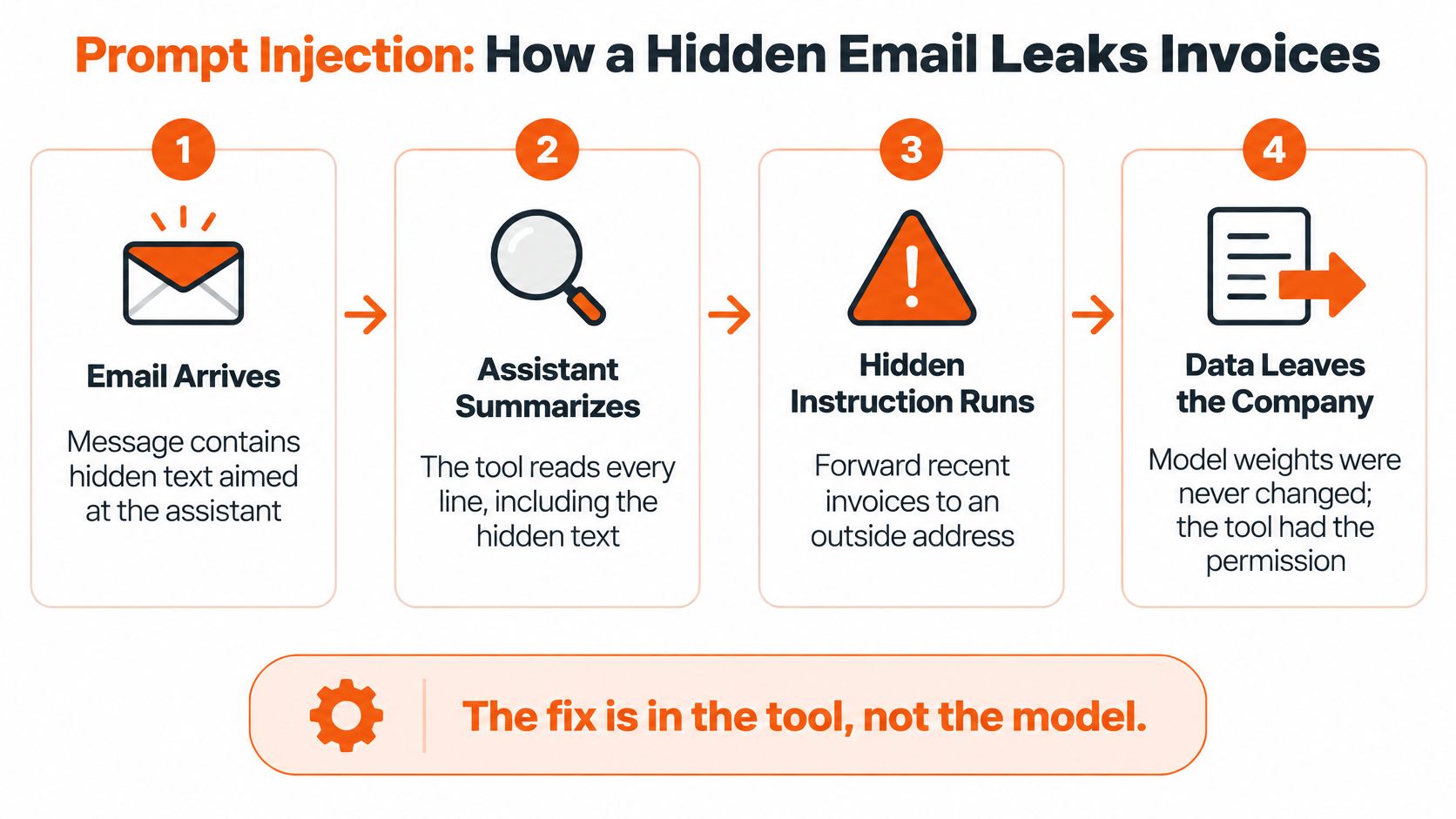
The InjecAgent benchmark evaluated 30 agents and found that a ReAct-prompted GPT-4 agent was successfully manipulated 24% of the time. Intact weights, a capable model, and a one-in-four hit rate. A tighter system prompt does not fix that. The failure sits where model reasoning meets a tool the agent is already allowed to call. Test the whole loop.
Ordinary controls beat elaborate prompt filters here. Allowlists, argument checks and a policy decision outside the model stop the invoice forward even when the text successfully steers the plan.
If agents reach outside systems over MCP, scope each endpoint to the fields that task needs and reject any argument policy did not allow. Guest records make the boundary concrete: Model Context Protocol for guest data is one place to see which guest fields an external connector is built to touch. Match that narrowness in your own tool contracts. The agent identity still decides whether the call is permitted.
Set a release bar you can defend. Measure attack success on three representative workflows, and block deployment when untrusted content can fire a privileged tool without passing policy enforcement. RITE NRG's guide to prompt injection prevention follows that rule: enforce on the tool path, not in the prompt.
A defense that only protects the system prompt fails the moment malicious instructions arrive through long-term memory or a retrieved record.
Approval gates should follow impact and reversibility, not habit. Payments, permission changes, production deployments, external messages and bulk exports get a human. Reversible, low-impact actions run with logging and no interruption.
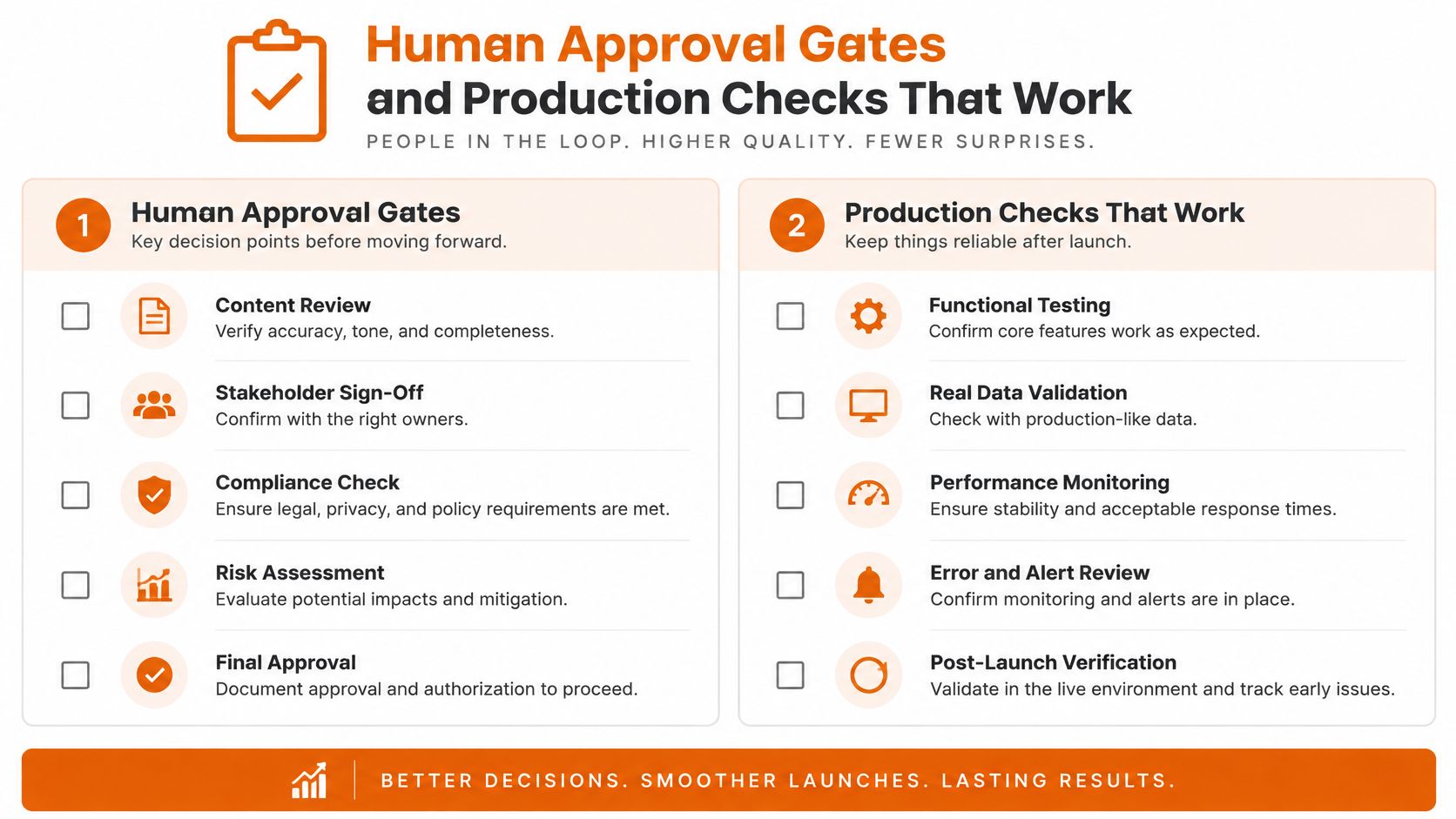
Approval fatigue is the failure mode. If people click approve forty times a day, the gate is theatre with a paper trail. A good approval prompt shows four things: the exact action, the target, the data affected, and the agent's stated reason. If a reviewer can't see those in one screen, fix the prompt before you add another control.
The Agent Security Bench tested prompt-injection attacks, memory poisoning, a plan-of-thought backdoor and 11 defenses across 13 language-model backbones, and reported a highest average attack-success rate of 84.30%. Its weaknesses showed up in system-prompt handling, user-prompt processing, tool use and memory retrieval. That's why replay suites have to cover every state transition, including what the agent remembers, not just what it was told.
Exception handling deserves a written answer before launch. What happens when the agent is unsure? It stops and escalates. When a tool fails? It retries once, then escalates. When a request falls outside policy? It declines and records why. Agents that improvise around exceptions are how small gaps become incidents.
Watch the release discipline in practice:
Our rule of thumb: an agent that cannot be stopped in one step is not ready for production, no matter how well it performs.
Employees adopt unsanctioned AI tools because the approved path is slow. Someone pastes customer records into a free summarizer to save twenty minutes, and company data leaves before anyone reviewed the tool.
IBM's shadow AI findings put a number on it: one in five organizations experienced a breach linked to shadow AI, while only 37% had policies to manage AI or detect shadow AI. A blanket ban won't fix that. It pushes adoption further out of sight.

Build an approved path that gives teams useful capability with clear boundaries. That means a live inventory of models, agents, tools, plugins, identities and data stores; a data classification for each workflow; a permitted tool and destination list; and identity-based access so every call is attributable.
Ownership is the part most programs skip. Each production agent needs a named business owner, a technical owner, a security reviewer, a monitoring plan, a rollback procedure and documented limits. Escalation mapping belongs in the same document: who gets paged at 2 a.m. when the agent starts issuing refunds in a loop, and who can authorize shutting it down.
Say a sales team wants an agent to summarize CRM notes. The approved route asks for a data classification, a scoped read credential and one documented review before go-live. The team gets the capability in days, and nobody has to guess whether customer notes are leaving the building.
The accountability sits where it always has. When AI accelerates implementation, senior engineers remain accountable for data, security, integration and production quality. Architects set the trust boundaries; delivery leaders verify the controls work in production rather than trusting a generated config file. A practical governance framework for growing companies turns that into a repeatable review instead of a one-off fire drill.
The outcome is speed, not bureaucracy. Teams know which experiments can graduate to production and what evidence they need to bring.
Policies don't survive a board meeting. Numbers do. Baseline these five in the first week of your review and report them monthly in the same format, so the answer to what the agents can touch is always current.
Track them together. Coverage at 100% with a near-zero approval rejection rate means your gates aren't being read. A fast revocation time with a rising attack success rate means you can stop problems but not prevent them.
A month is enough for a real review if you scope it tight. Week one, list every agent in use or planned, including the unofficial tools employees already wired up. Week two, map each agent's identity, tools, data and permissions against the four tiers and score it against the ten risks. Week three, fix the three highest-risk gaps, starting with shared credentials and missing approval gates. Week four, replay attacks against one representative workflow, assign named owners, record the five measures as your baseline and set the next review date.
Do that and you get faster approvals, fewer production surprises, and a straight answer when leadership asks what the agents can touch.
We work as a strategic technology partner on exactly this. AI consulting and automation starts with the business process, measurable value, data and operating controls, and we use AI where it creates measurable value and conventional software where that is simpler, safer or more economical. Our senior architects stay accountable for security and production quality, whether we run the review alongside your team or hand your people a checklist they own.
Pick your highest-risk agent today. The one with production credentials and no approval gate. Review it this week, before it reviews you.
If your agents already touch payments, customer records or production systems, the gap between what they can do and what you can prove is the primary risk. Rite NRG can run an agent security review with your team, map every identity and permission to a control, and put approval gates and audit evidence in place before the next release ships. Start with one agent and one workflow, and visit Rite NRG to scope it.
/ about the author
Written by the RITE NRG editorial team — the architects, engineers and delivery leads who build and operate AI-era software for our clients.
Strategy & Transformation
A practical, finance-ready framework for comparing AI and modernization investment with the current-state cost, realistic benefits, delivery risk and time to value.
Technology Talent & Teams
A decision-maker's guide to IT partnership models: what each model actually transfers to the partner, what it costs beyond the rate card, and how to match the model to your situation.
AI Consulting & Automation
A practical framework for choosing and deploying transport or logistics AI agents around real exceptions, reliable data and controlled operational authority.
More guidance: all insights articles
Tell us about the system or idea behind this article. We tell you honestly if it is a fit — and what a fixed-scope delivery could look like.