You're probably in the same place as most SaaS leaders right now. Product wants AI features in market fast. Sales wants a sharper story. Engineering wants clarity on what's safe to build. Legal wants fewer surprises. Everyone agrees AI matters, but nobody wants to be the team that ships a model customers stop trusting after the first ugly edge case.
That tension is exactly where responsible AI implementation either becomes a brake or a growth lever. I'm firmly in the second camp. If your team treats responsibility as a late-stage review, you'll slow down, create rework, and kill momentum. If you build it into delivery from day one, you move faster because decisions get cleaner, ownership gets sharper, and production risk drops before it becomes customer-facing pain.
The teams that win don't separate ethics from execution. They run a delivery model with extreme ownership, hard operational discipline, and zero appetite for vague accountability. That's the #riteway mindset. Own the outcome, surface risk early, and fix issues before they grow teeth.
From Risk Mitigation to Revenue Generation
Responsible AI implementation is still commonly framed as defence. That's too small. It's also bad product strategy.
If you build AI features that are traceable, explainable, and monitored, customers trust them faster. Internal teams approve them faster. Procurement friction drops. Rollouts get cleaner. That turns “responsible” from a governance label into a commercial advantage.
There's direct operational upside too. SaaS companies leveraging AI for operational efficiency can reduce routine task processing time by up to 40%, which translates into business value and faster time-to-market, according to NovusASI's analysis of AI in B2B SaaS offerings. That number matters because it reframes the conversation. The goal isn't “use AI”. The goal is to remove repetitive work, improve decision quality, and ship product value sooner.
What strong teams do differently
Weak teams ask, “Can we get this model live?”
Strong teams ask:
- What business decision is this model improving
- What failure mode would hurt trust fastest
- Who owns the decision if the model gets it wrong
- How do we prove value without opening a governance hole
That last question matters more than most founders realise. AI features don't just create product risk. They create operational exposure across support, sales, onboarding, and security reviews. If you're using models in workflow automation, customer scoring, support triage, or risk detection, you need practical controls around them.
For leaders thinking beyond product UX, this guide to AI insights for insider risk is worth your time. It's a useful reminder that AI governance isn't limited to model behaviour. It also affects how you detect operational threats inside the business.
Practical rule: Responsible AI implementation should earn its place on the roadmap by improving adoption, lowering review friction, and reducing avoidable rework.
The #riteway lens
The #riteway approach is simple. Don't wait for a compliance team to save the project later. Build ownership into the squad now.
That means product, engineering, data, and delivery leads agree early on three things:
| Decision area | Bad approach | #riteway approach |
|---|---|---|
| Business value | Launch a feature and hope usage proves the case | Define the workflow, user, and expected outcome before build starts |
| Risk ownership | Push ethical questions to legal at the end | Assign named owners inside delivery from sprint one |
| Delivery speed | Treat governance as extra process | Automate checks so the safe path is also the fast path |
Responsible AI implementation done properly doesn't slow innovation. It removes hesitation. That's how you get to revenue faster.
Assemble Your Responsible AI Governance Team
Checklists don't govern anything. People do.
The biggest governance mistake I see is this: a company writes AI principles, stores them in Confluence, then leaves delivery squads to interpret them alone. That's not governance. That's delegated ambiguity. In practice, it means the loudest person in the sprint decides what's acceptable.
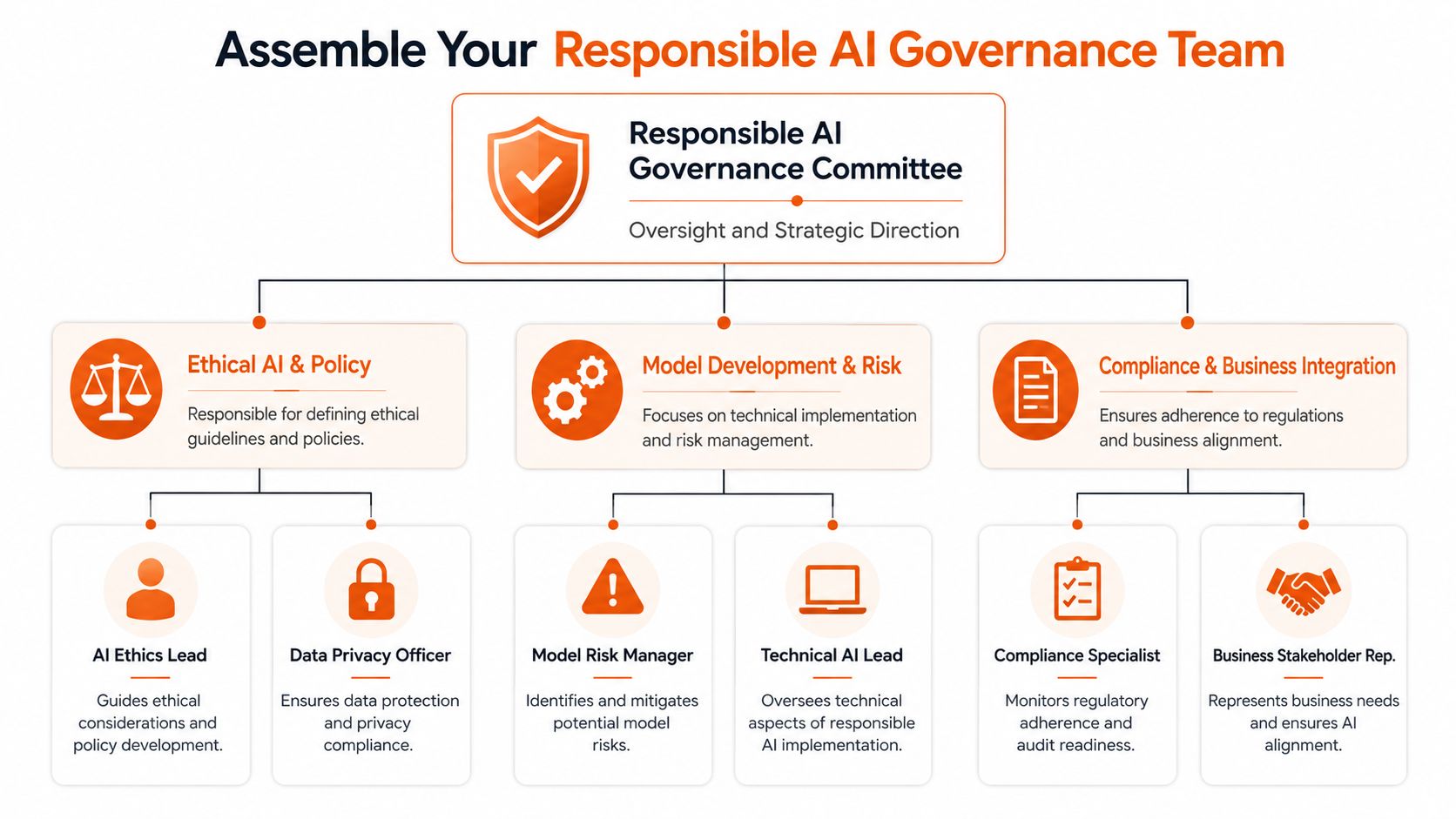
The fix is an embedded governance strike team with real authority. That matters because 63% of UK organisations lack formal Responsible AI roles with the authority to proactively influence development, a gap highlighted in techUK's professional mapping coverage via Montreal AI Ethics Institute. If nobody in delivery has the mandate to stop, challenge, or redesign a risky AI feature, then accountability is fake.
The three roles I'd put in every nearshore AI squad
You don't need a bloated committee. You need clear role design.
AI Ethics Champion
This person translates principles into delivery calls. They don't sit on the side-lines writing policy notes. They join backlog refinement, challenge high-risk use cases, and force clarity when a team tries to ship a vague “smart feature” with no defined user impact.
Their job includes:
- Decision framing: Flag where automated outputs influence pricing, access, ranking, or user treatment.
- Escalation ownership: Pull high-risk items to governance review before they become sprint commitments.
- Policy translation: Turn broad principles into practical rules developers can apply.
Data Steward
This role owns data fitness. Not just access. Fitness.
They should know where training data came from, what consent boundaries apply, what fields carry hidden bias, and where lineage breaks. If your model depends on stitched-together CRM, support, and product telemetry data, this person is your control point.
Model Validator
This person acts like an internal challenger. Their job is to ask, “Why should anyone trust this output?” They test assumptions, review edge cases, and insist on evidence before production.
I also want them to own release gates for high-impact models. No validator sign-off, no launch.
How these roles should work together
A lot of companies treat governance as separate from collaboration. That's backwards. Good governance depends on fast alignment between disciplines, which is why mature delivery teams invest in cross-functional collaboration habits that reduce hand-off failure.
A governance team should sit inside the delivery rhythm, not above it.
Use this operating cadence:
- During discovery: Ethics Champion and Product define where the AI feature affects user outcomes.
- During data prep: Data Steward confirms source integrity, consent boundaries, and representativeness.
- Before release: Model Validator checks fairness, explainability, and approval thresholds.
Reporting lines that actually work
Here's the rule. Governance roles must be authorized to challenge roadmap decisions, not just document them after the fact.
A simple model works best:
| Role | Primary concern | Reporting expectation |
|---|---|---|
| AI Ethics Champion | User impact, fairness, policy fit | Direct access to product and senior delivery leadership |
| Data Steward | Data quality, lineage, usage controls | Shared accountability with engineering and data leadership |
| Model Validator | Testing, transparency, release confidence | Authority to block production for unresolved risk |
That structure creates speed because decision rights are obvious. Nobody wastes two weeks figuring out who owns the hard call.
Fortify Data Pipelines Against Bias and Risk
Most responsible AI implementation failures start before a model is trained. They start in the pipeline.
Teams obsess over prompts, model selection, and feature engineering, then feed the whole stack with weak, inconsistent, badly labelled data. That's not an AI problem. That's a delivery failure. If your source data is messy, historically biased, or operationally brittle, your model will industrialise the mess.
The UK numbers make the point clearly. Only 43% of organisations believe their data quality is strong enough to support Responsible AI, while 51% of leading firms cite improving data quality as a top initiative to embed ethical principles, according to Experian's UK Responsible AI findings. If you want trustworthy outputs, data quality isn't a side task. It's the foundation.
Treat the pipeline like a product
Data pipelines deserve the same engineering discipline as customer-facing software. Version them. test them. document them. break them safely.
Here's the operating standard I'd enforce for any SaaS team building AI into product workflows:
- Audit source intent: Check why each dataset exists. Sales ops data, support tags, CRM notes, event telemetry, and usage segments were usually created for operational reporting, not model training.
- Define field-level risk: Mark sensitive attributes, proxy variables, and free-text inputs that may encode bias or privacy issues.
- Add automated quality gates: Use tools such as Great Expectations, dbt tests, or Monte Carlo to catch null spikes, schema drift, stale feeds, and inconsistent labels before training starts.
- Log lineage visibly: If nobody can trace a model feature back to its source, you've already lost control.
SaaS examples where bad data quietly breaks trust
Bias often hides in ordinary product data.
A lead scoring model can learn that deals from a certain segment close less often, when the actual issue is patchy historical sales coverage. A customer success model can rank users as “low engagement” because accessibility needs changed how they interact with the product. A support triage model can treat urgent complaints as low priority because past ticket labels were inconsistent.
That's why vendor scrutiny matters too. If you're using third-party enrichment, foundation models, or external data providers, run proper vendor due diligence before those dependencies shape your model behaviour.
Bad data doesn't just lower accuracy. It hardcodes old mistakes into new workflows.
A practical bias hardening routine
I'd run a standing routine every sprint for any AI-enabled feature in active development:
- Review data slices for missingness, outliers, and uneven representation across user groups.
- Inspect labels for human inconsistency, especially in support, moderation, and CRM workflows.
- Test proxy effects where seemingly harmless fields may correlate with sensitive characteristics.
- Balance carefully using resampling or synthetic data only when the team understands the trade-off.
- Escalate uncertainty instead of forcing the dataset through because a sprint deadline is close.
Where extreme ownership shows up
Teams with real ownership don't say, “Data gave us this”. They say, “We're accountable for whether this data is fit for the decision we're automating.”
That shift changes everything. It moves the conversation from passive consumption to active control. It also saves money, because cleaning a data foundation early is far cheaper than fixing biased outputs in production after customers have seen them.
Engineer Trust into Your Model Development Lifecycle
Responsible AI implementation lives or dies in the build process. If the model lifecycle doesn't include trust checks, the team is relying on hope.
That's a bad plan. With 80% of AI projects failing to deliver, common mistakes include treating AI as a siloed IT project and lacking predefined success thresholds. To mitigate this, practitioners must apply fairness metrics and enforce human-in-the-loop oversight, according to the OECD analysis of implementation challenges in government AI. The lesson applies directly to SaaS. If you don't define what “good enough” means before launch, the project drifts until confidence collapses.

Build quality gates into model work
Developers don't need more theory. They need release criteria.
For classic ML, I want explicit checks around feature stability, slice performance, threshold behaviour, and explanation quality. For LLM-powered workflows, I want prompt versioning, output policy checks, harmful response review, and a clear human escalation path.
Use interpretable methods where you can. When you can't, add explanation tooling. SHAP and LIME are practical options for surfacing feature contribution patterns. They won't make a weak model trustworthy on their own, but they help engineers, product managers, and reviewers understand what the system is using to decide.
What a strong validation routine looks like
I'd split validation into four lanes:
| Validation lane | What the team checks | Why it matters |
|---|---|---|
| Business fit | Does the output support the intended decision | Stops clever models solving the wrong problem |
| Fairness | Do outcomes vary in problematic ways across groups | Catches harmful asymmetry before release |
| Robustness | How does the model behave under noise, edge cases, and adversarial input | Prevents brittle production behaviour |
| Human review | When must a person validate or override the output | Keeps accountability attached to real people |
Delivery rule: If a model influences a high-impact decision, a person must own the final call path.
Define success before the first sprint
Most AI teams delay this because it feels constraining. It isn't. It's liberating.
If you define acceptance thresholds early, engineers know what to optimise for. Product knows when to cut scope. Stakeholders know what evidence they'll need to approve rollout. Without that clarity, every review becomes opinion-driven.
A short explainer on trustworthy AI practices helps frame the point:
Keep AI inside the product system
One more hard truth. If the AI workstream runs as a side experiment, it will behave like one.
Your model lifecycle should sit inside normal product and engineering operations. That means Jira tickets, pull request standards, QA evidence, approval logs, release criteria, and rollback readiness. Responsible AI implementation isn't a parallel process. It's product delivery with sharper controls.
Deploy with Confidence Using Responsible MLOps
A model that passed review in a notebook still hasn't delivered anything. Value appears when the team can deploy safely, repeatedly, and with full traceability.
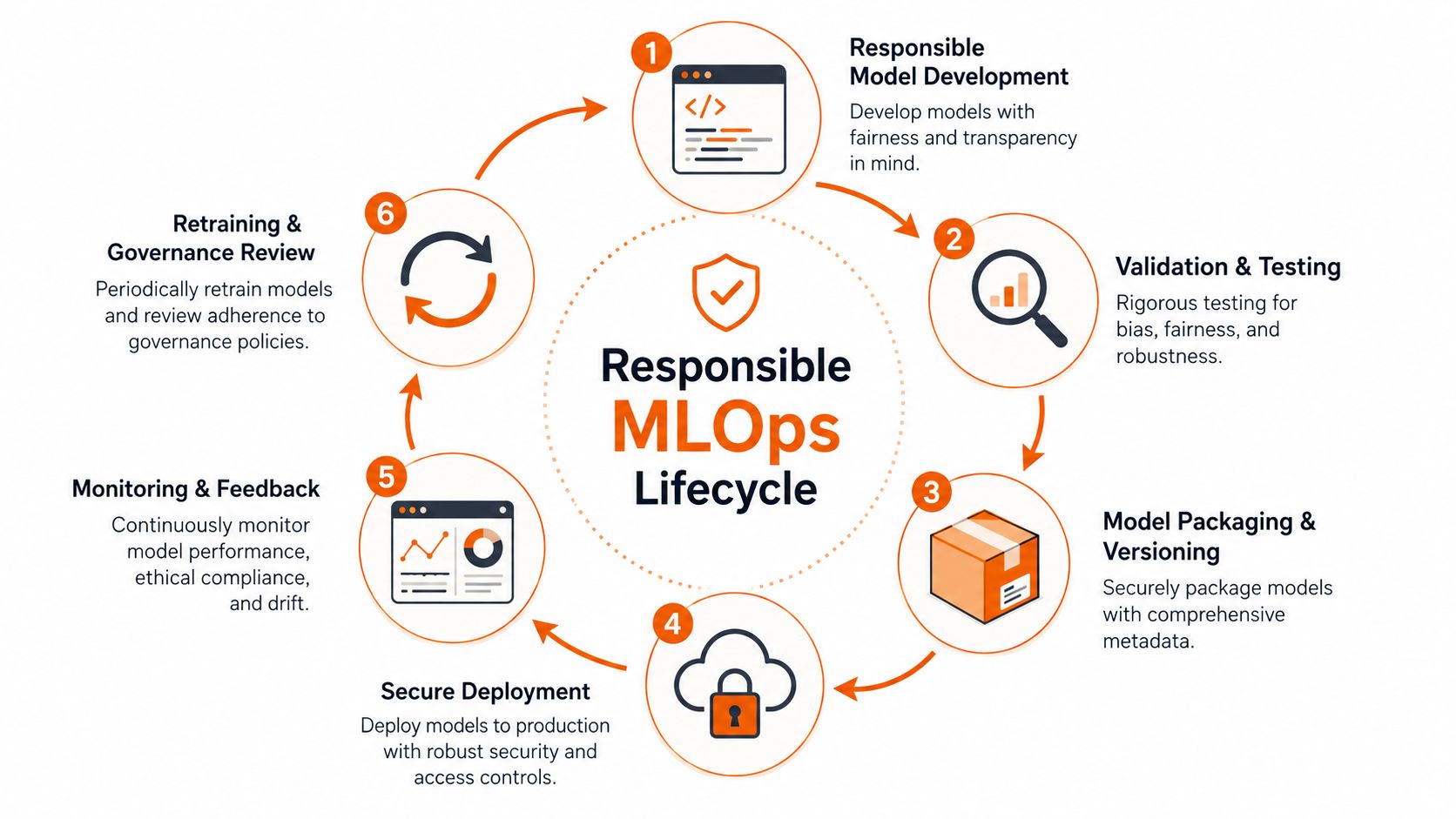
That's where responsible MLOps earns its keep. The point isn't ceremony. The point is to make the safe route the default route. When code, data, evaluation artefacts, approvals, and deployment records all move through one controlled system, the team stops relying on memory and heroics.
What belongs in the pipeline
A responsible MLOps pipeline should package more than model binaries. It should carry context.
I'd expect these controls as standard:
- Versioning across code and data: Use Git for code and a reproducible approach to datasets and feature sets so every release can be traced.
- Automated evaluation steps: Run fairness checks, reliability tests, and regression comparisons before promotion.
- Model metadata capture: Generate model cards or equivalent release records with intended use, limitations, approval status, and ownership.
- Access control: Lock down who can retrain, approve, deploy, or roll back models in production.
- Release strategy: Use canary deployment, phased exposure, or environment-based promotion instead of a blind full rollout.
Why automation matters
Manual governance fails under delivery pressure. Someone forgets a document. Someone approves in Slack. Someone pushes a “temporary” model fix after hours. Two sprints later, nobody can prove what changed.
Automation fixes that because it converts good intentions into system behaviour.
Consider the contrast:
| Deployment pattern | Operational result |
|---|---|
| Manual checks in meetings | Inconsistent evidence, fragile audit trail, slow hand-offs |
| Pipeline-enforced checks | Repeatable releases, clearer ownership, faster approvals |
| Ad hoc rollback plans | Longer incident recovery, more customer exposure |
| Versioned rollback paths | Safer experimentation and faster containment |
The practical toolchain mindset
The exact stack can vary. MLflow, Weights & Biases, Kubeflow, Azure ML, SageMaker, GitHub Actions, GitLab CI, ArgoCD, and feature flag systems can all support parts of this operating model. The names matter less than the behaviour.
Your pipeline should answer five questions instantly:
- What version is live
- What data informed it
- Who approved it
- What checks passed
- How do we revert it
If your team can't answer those five questions in minutes, deployment isn't under control.
Responsible MLOps as delivery acceleration
Teams often assume controls create drag. The opposite is usually true. Strong MLOps removes repetitive approval theatre and turns release confidence into a normal operational state.
That's the commercial payoff. You can ship AI features more often because each release is bounded, documented, and reversible. That confidence matters far more than one-off launch speed.
Implement Proactive Monitoring and Incident Response
A model can look excellent on launch day and still become a liability a month later.
Take a common SaaS scenario. Your team deploys an AI feature that prioritises inbound support tickets. Early results look strong. Then product usage shifts after a pricing change, support language patterns change, and the model starts downgrading cases that should be urgent. Nobody notices immediately because the dashboard only tracks throughput, not fairness, confidence drift, or escalation quality.
That's how trust gets damaged. Gradually first, then all at once.
The delivery teams that avoid this don't “monitor performance” in a vague sense. They instrument the model as if it were a revenue-critical service. That means watching input drift, output distribution changes, override rates, error clusters, and any user complaint patterns that suggest the model is no longer behaving within expectation.
The monitoring standard I'd set
A useful post-deployment setup should include:
- Trust indicators: Signals that show whether outputs remain believable and stable in real usage.
- Fairness checks: Scheduled comparisons across relevant user or workflow segments.
- Drift detection: Alerts for changing data shape, missing values, or shifts in language and behaviour.
- Operational ownership: A named person on point when an alert fires.
This matters because a lack of ongoing oversight is one of the biggest barriers to responsible AI. A five-step methodology emphasises monitoring tools for trust indicators and fairness metrics, yet 95% of UK pilots get stuck in “pilot purgatory” without them, according to ThoughtSpot's overview of responsible AI execution. Teams that want production value need the same rigour they'd apply to monitoring and observability in any other critical system.
Incident response has to be pre-written
When an AI incident happens, nobody should be improvising. The response path should already exist.
I'd want a simple runbook with these elements:
- Trigger definition so the team knows what counts as an incident.
- Owner assignment covering product, engineering, data, and business approval.
- Evidence capture including inputs, outputs, model version, affected workflow, and timeline.
- Containment action such as rollback, feature flag disablement, or human-only fallback.
- Post-incident review focused on root cause, control gaps, and release process fixes.
The first hour of an AI incident is won or lost by preparation done weeks earlier.
What proactive ownership looks like
The best teams don't wait for customers to report that something feels off. They define alert thresholds early, test rollback paths, and rehearse escalation. That's not paranoia. It's operational maturity.
Responsible AI implementation only becomes real when post-launch control is treated as part of delivery, not as support overhead.
Your Ultimate Compliance and Delivery Checklist
Often, teams don't fail because they lack principles. They fail because the principles never become repeatable delivery behaviour.
The UK government has set out five core principles for AI regulation: fairness, privacy, accountability, safety, and transparency, and it expects organisations to monitor AI behaviour and maintain a clear chain of human responsibility, as outlined in the UK responsible AI regulation summary. That's the right foundation. But for a nearshore SaaS team moving fast, those ideas need to show up as tasks, approvals, artefacts, and release checks.
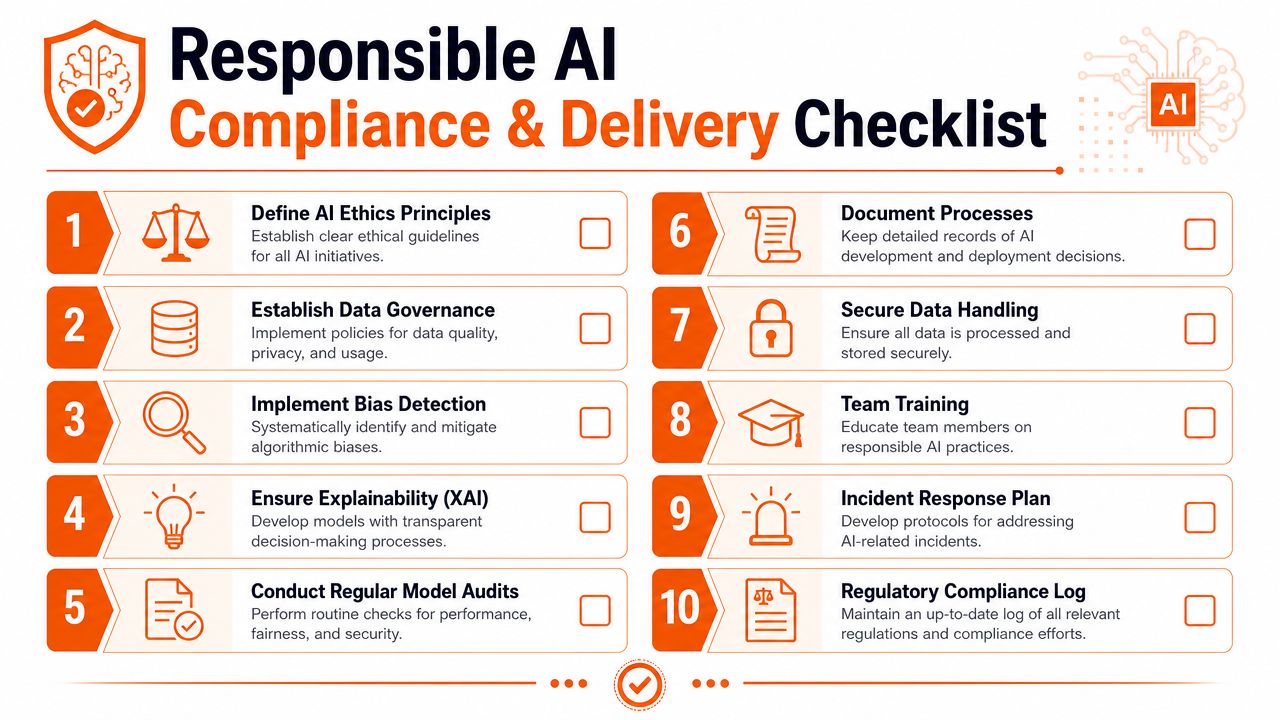
The checklist I'd put into your delivery board
Before kickoff
Define the use case clearly
State what decision the model informs, who is affected, and where a human must remain in the loop.Complete a privacy assessment
If you operate in contexts where personal data is involved, run a Data Protection Impact Assessment before build starts, not after architecture is locked.Name accountable owners
Assign responsibility for product outcome, data quality, validation, deployment, and incident response.
During discovery and build
Document allowed and disallowed behaviours
Don't just say “be fair”. Spell out what the model must never do in this workflow.Check data quality before training
Validate source suitability, lineage, consent boundaries, and known blind spots.Build explainability into review
Make sure stakeholders can understand why the model produced a given output, especially in high-impact workflows.Add bias testing to release criteria
If fairness checks fail, the release fails. No debate.
Checklist test: If an item can't be assigned, evidenced, and reviewed, it isn't part of your delivery system yet.
Before release and after launch
Use this simple release view:
| Delivery checkpoint | What must be true |
|---|---|
| Model approval | Validation evidence is complete and named reviewers have signed off |
| Deployment readiness | Rollback path, access controls, and production monitoring are in place |
| User transparency | Teams can explain intended use, limitations, and escalation paths |
| Operational review | Incident process exists and support teams know how to act on it |
Then keep going:
- Maintain documentation and audit trails
Record key model decisions, limitations, and release changes. - Train the people around the model
Support, product, QA, and ops teams need enough context to spot misuse or degradation. - Review live behaviour regularly
Responsible AI implementation doesn't end at release. Production is where your governance model proves itself.
The practical win here is simple. When compliance and delivery are integrated, teams stop bouncing between speed and control. They get both.
If you want a nearshore delivery partner that treats responsible AI implementation as a business outcome, not a box-ticking exercise, talk to Rite NRG. Their teams combine senior product and engineering capability with the #riteway mindset of extreme ownership, proactive communication, and fast, predictable delivery for SaaS platforms that need to move quickly without losing control.