Your board wants AI in the product now. Sales wants AI in the deck. Product wants AI in the roadmap. Engineering wants to ship before the next competitor does.
You're the one who has to live with the consequences.
That's why AI risk management matters. Not as a policy document. Not as a legal side quest. As a delivery discipline. If your team can't control model behaviour, data exposure, ownership, and escalation, you don't have speed. You have gamble-driven output dressed up as innovation.
The practical move is simple. Treat AI risk the same way strong SaaS teams treat uptime, security, and release quality. Build controls into the workflow, assign names to decisions, and connect every AI choice to a business result.
Your AI Mandate Is Here Are You Ready for the Risks
Most CTOs are already in the same situation. AI has moved from optional experiment to executive mandate, but the operating model around it is still shaky. Teams know the upside. Few teams have decided who owns what happens when the model gives the wrong answer, exposes the wrong data, or creates a customer-facing mess.
That gap is bigger than many leaders admit. Despite 30% of UK organisations explicitly naming artificial intelligence among their top three risks, over one-third of UK businesses remain dangerously unprepared to manage these AI risks, according to reporting on the UK research. That's not a knowledge problem. It's an execution problem.
Risk management is now a delivery function
If you still treat AI risk as something for compliance to review later, you're already behind. Good AI risk management makes delivery faster because it removes ambiguity. Teams move quicker when they know the red lines, the escalation path, the acceptable data sources, and the fallback when the model goes off track.
That's the core of the #riteway methodology. Extreme Ownership. High energy. Proactive communication. You don't wait for a post-mortem to discover that no one defined model approval, prompt handling, or output review. You define those rules up front, inside the delivery process, and you keep them light enough that the team uses them.
Practical rule: If an AI feature can affect customers, revenue, operations, or trust, someone in leadership must own the outcome by name.
Many technical leaders make a costly mistake, framing AI risk management as a speed tax. It isn't. Instead, the actual speed tax is rework, customer confusion, incident handling, and board-level panic after an avoidable failure lands in production.
The wait and see approach is the risky option
Doing nothing feels efficient for a sprint or two. Then the hidden costs appear. Product assumptions drift. Engineering teams bolt on third-party AI tools without shared standards. Support gets stuck handling inconsistent outputs. Legal enters late. Trust drops before anyone can point to a single root cause.
A broader policy discussion from Global Governance Media on AI is useful here, but for SaaS leaders the key takeaway is more direct: if you want fast innovation, you need control that works at team level, not theory that lives in a board pack.
Here's my view. The strongest AI teams don't avoid risk. They operationalise it. They turn unknowns into owned decisions, monitored systems, and commercial trade-offs. That's how you ship quickly without crossing your fingers.
A Practical AI Risk Taxonomy for SaaS Teams
Most AI risk frameworks are written for committees. Product and engineering teams need something they can use during backlog grooming, sprint planning, and release review.
Use four categories. They're easy to remember, and they force the conversation toward business impact rather than abstract theory.
For teams working with distributed delivery, the hidden risk is oversight. In the UK, 100+ SaaS projects rely on nearshore teams, and the lack of standardised AI literacy training and hands-on experience for decision-makers creates a critical oversight gap, as outlined in the UK Government's hidden AI risks toolkit. That's why a shared taxonomy matters. It gives everyone the same language.
A simple visual helps teams make this operational from day one:
Data and privacy risks
Start here because many SaaS teams get caught. Prompt content, uploaded files, support transcripts, and customer records all create exposure.
If your product team plugs a third-party model into onboarding flows, ask direct questions. What data enters the model? What gets stored? Who approved that path? Can you trace the source if a customer challenges the output?
Common examples include:
- Customer data leakage: Sensitive content appears in prompts, logs, or downstream analytics.
- Training contamination: Teams fine-tune or test on data they shouldn't have used.
- Access sprawl: Too many people can touch prompts, datasets, or model settings.
The commercial impact is straightforward. Privacy failures hit trust, increase support load, and drag leadership into remediation work instead of growth.
Model performance risks
The model worked in staging. Then real usage arrived.
This category covers drift, poor output quality, brittle prompts, hallucinated responses, weak retrieval, and failure on edge cases. In SaaS, these problems often show up as inconsistent user experience rather than dramatic system failure. That makes them more dangerous, not less.
Bad model behaviour rarely announces itself. It usually shows up first as confused users, longer support threads, and product teams arguing over whether the issue is “real”.
Use this quick rule of thumb:
| Risk signal | What it usually means for the business |
|---|---|
| Inconsistent answers | Customer confidence starts dropping |
| Slower or unstable output | Adoption stalls and workflows break |
| Wrong recommendations | Service delivery suffers |
| Silent degradation | Teams keep shipping without fixing the root issue |
Later in this section, it helps to ground that in workflow reality:
Operational and integration risks
AI systems deployed in production encounter considerable messiness. APIs change. Vendors update behaviour. Logging is incomplete. Monitoring is weak. CI/CD doesn't include model checks. No one knows what happens if the model endpoint degrades during peak usage.
This category includes dependency risk, release risk, scaling risk, and observability gaps. A feature can be technically live and still be operationally unsafe.
Ethical and reputational risks
Leaders often put this bucket last. Customers won't.
If an AI-powered feature produces unfair outcomes, gives opaque decisions, or behaves in ways users find deceptive, your brand takes the hit. The codebase won't defend you. The board won't care that the model vendor caused the issue. Your company shipped it.
The point of this taxonomy is ownership. Don't ask whether the team built the feature correctly. Ask whether the team owns the customer and business outcome. That's the standard that matters.
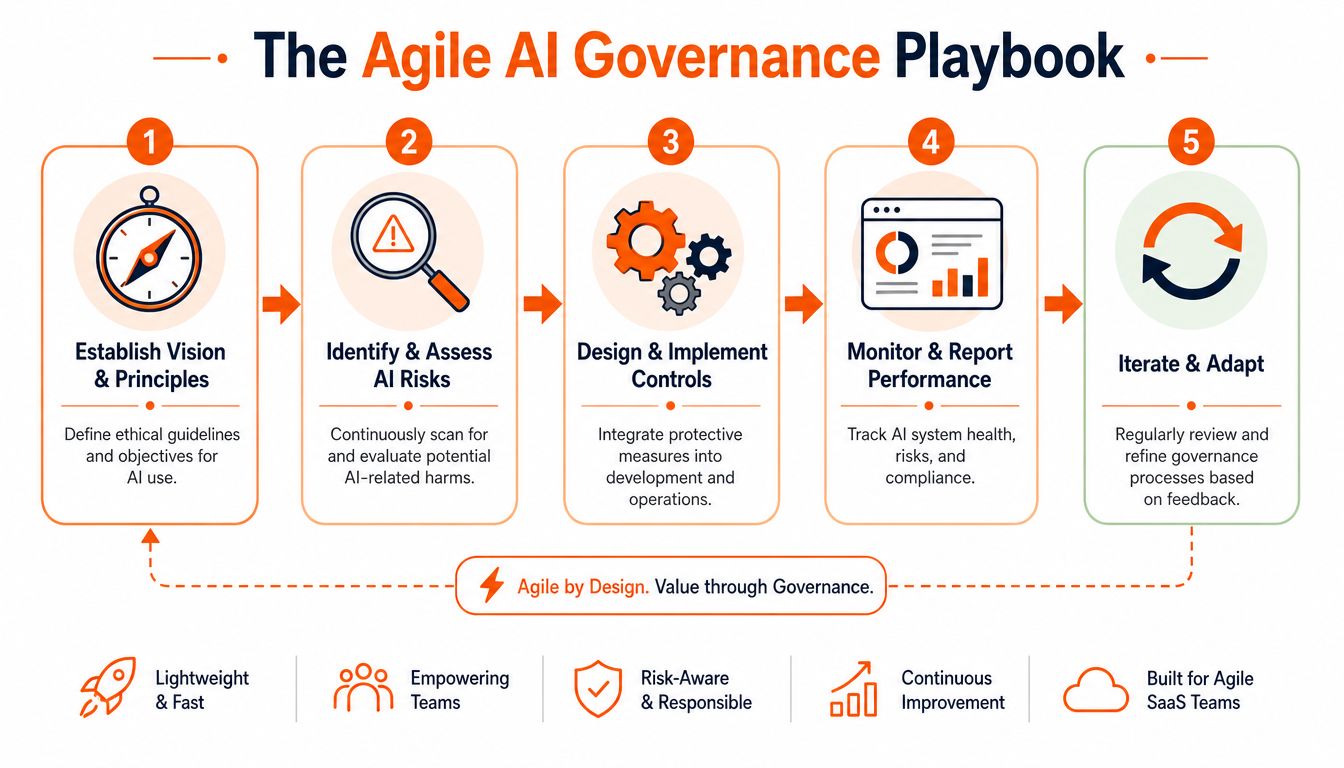
The Agile AI Governance Playbook That Wont Kill Your Speed
Heavy governance kills momentum because nobody uses it. Lightweight governance works because it sits inside normal delivery. That's the model worth building.
The UK Government's AI assurance guidance is clear on the direction of travel. It recommends quality assurance processes throughout the entire AI lifecycle, including named data management responsibility and clear governance milestones, with risks escalated quickly and managed through defined structures, as set out in the UK Government introduction to AI assurance.
That doesn't mean building a giant GRC machine. It means deciding who owns what, what your team won't automate, and where checks belong in the workflow.
Start with named ownership
If everyone owns AI risk, nobody owns it.
Assign one accountable owner for each live AI capability. Not a committee. A person. In practice, that often means a product leader owns customer impact, an engineering lead owns implementation quality, and a data or platform owner controls data handling. But one person must still carry final accountability for release readiness and incident response.
Many teams get sloppy. They document features, not decisions. Strong teams document both.
Define red lines before the sprint starts
Your team needs a short list of fixed guidelines. These aren't philosophical statements. They're operational rules.
Examples:
- Human review required: Outputs that affect contracts, pricing, eligibility, or high-impact customer decisions don't go out unchecked.
- Approved data only: Teams can't use ad hoc datasets or unreviewed customer material for testing and tuning.
- Escalation over improvisation: If a model behaves outside expected bounds, the team pauses and escalates instead of patching around it in production.
If you want a practical model for responsible delivery, this piece on responsible AI implementation is worth reading alongside your own governance work.
Put assurance inside delivery, not after it
A governance process that starts after development is already too late. The checks belong in normal engineering flow.
Use a simple cadence:
- Planning review: Identify the business outcome, the failure mode, and the owner.
- Build review: Confirm approved tools, libraries, prompts, and data paths.
- Test review: Validate expected behaviour, edge cases, and fallback handling.
- Release review: Confirm monitoring, alerts, rollback path, and support readiness.
- Post-release review: Check whether the feature is creating the intended business result.
Governance should answer one question fast: can this team ship safely today?
Empower people to raise concerns early
You won't catch hidden risks through tooling alone. Teams need permission to call out weak assumptions, unclear data handling, and unsafe release pressure.
That's where culture matters. An agile AI governance model only works if engineers, product managers, QA, and delivery leads know they're expected to speak up. Extreme Ownership is practical, not motivational. If someone spots a problem, they own surfacing it quickly.
That kind of culture increases speed because issues appear earlier, when they're cheap to fix. The opposite culture produces fake confidence and expensive surprises.
Embedding AI Risk Controls Directly into Your Sprints
A strategy deck won't protect your product. Sprint habits will.
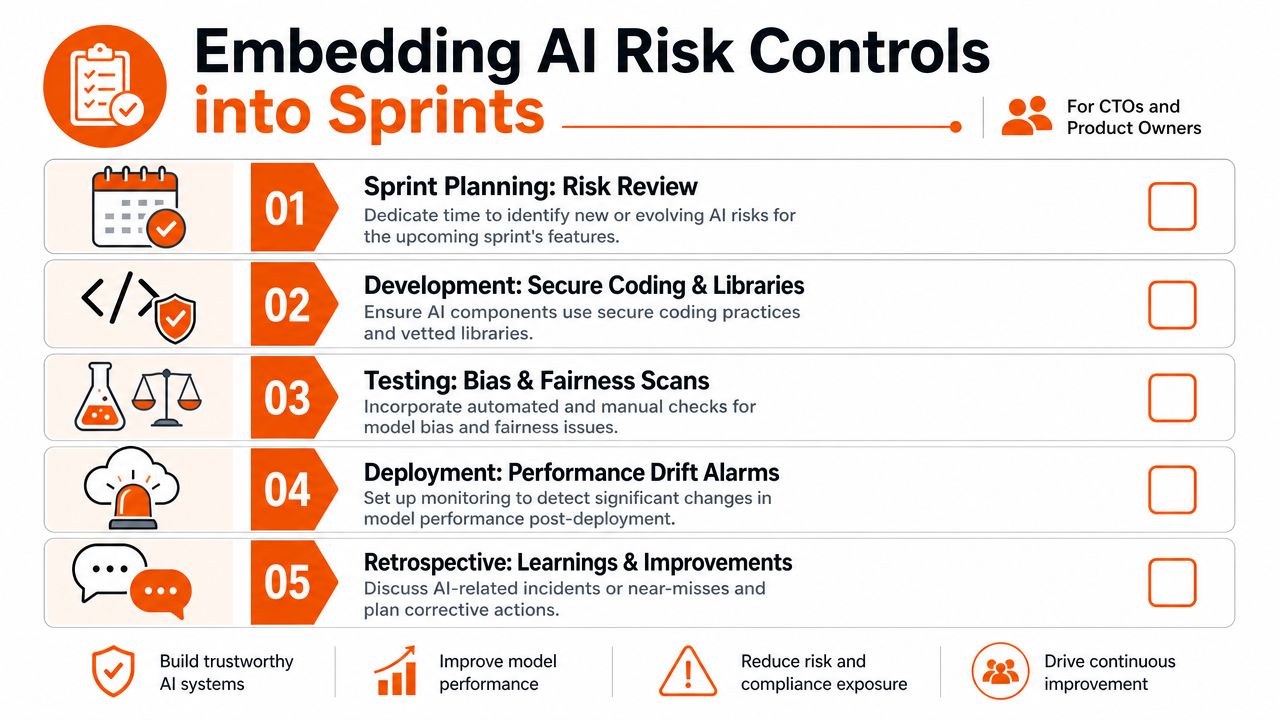
The fastest way to make AI risk management real is to place controls where work already happens. Don't create a parallel process. Add a few sharp checks to planning, build, test, release, and review. If the team has to leave its normal workflow to manage risk, adoption will collapse.
UK policymakers describe AI risk across three stages of the lifecycle: design, testing, and training; immediate deployment and usage; and longer-term deployment and diffusion, while also recommending clear red lines for where autonomous agents must not be used, according to the UK policy guide on strengthening resilience to AI risk. That maps neatly to sprint execution.
During sprint planning
Don't ask only what the feature should do. Ask what happens when it fails.
A short pre-mortem works well. Product, engineering, QA, and delivery spend a few minutes identifying likely failure points. Not every theoretical edge case. Just the most plausible ones tied to customer harm, service disruption, privacy, or trust.
Add risk stories to the backlog alongside feature stories. Examples include review tasks for prompt design, approval of data sources, fallback behaviour, or output validation criteria.
During development and CI/CD
Many teams still treat AI features like ordinary API integrations. They aren't. They need extra checks around outputs, dependencies, and data handling.
Use your existing pipeline, but extend it with AI-specific controls:
- Prompt and data review: Check that prompts, retrieval sources, and model inputs match the intended use.
- Library and dependency checks: Vet model SDKs, orchestration libraries, and connectors the same way you vet any production dependency.
- Output assertions: Add automated tests for harmful, empty, unstable, or off-policy responses.
- Fallback logic: If the AI component fails, the user journey still needs to work.
For teams tightening software delivery discipline overall, this guide to security in the software development life cycle fits naturally into the same sprint controls.
During demos and retrospectives
Most sprint demos only show the happy path. That's a mistake for AI-enabled features. Show failure handling too. Show what the product does when the model returns low-confidence output, irrelevant content, or a delayed response.
Retrospectives should also cover AI-specific near misses. Not just bugs that escaped. Also weak assumptions that got caught in time. Those are valuable signals.
If your sprint review only proves the feature works when conditions are perfect, you haven't tested the part that matters.
A lightweight five-step operating habit
This is the simplest routine I recommend for product teams:
- List the AI touchpoints in the sprint.
- Name the failure modes that matter to the business.
- Assign a human owner for each high-impact decision.
- Monitor live behaviour after release, not just technical uptime.
- Feed lessons back into backlog priorities and working agreements.
That rhythm keeps AI risk management close to real delivery. No giant framework. No theatre. Just repeatable habits that reduce surprises and protect velocity.
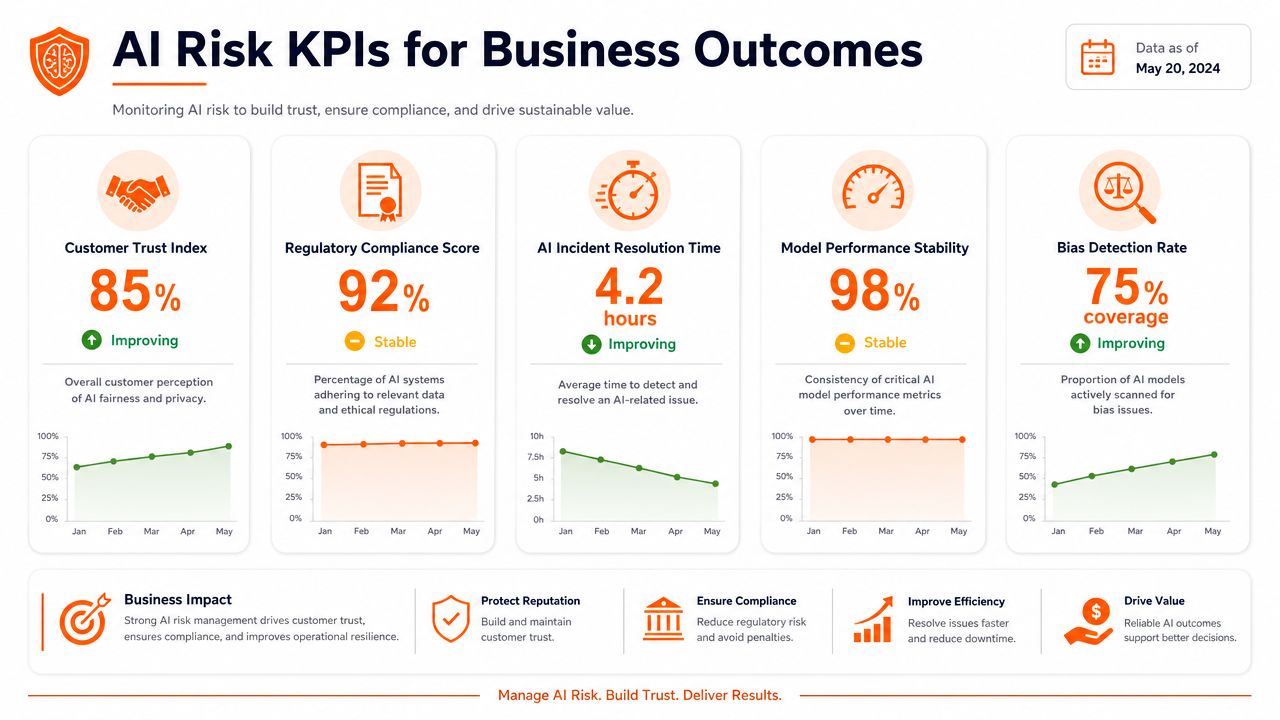
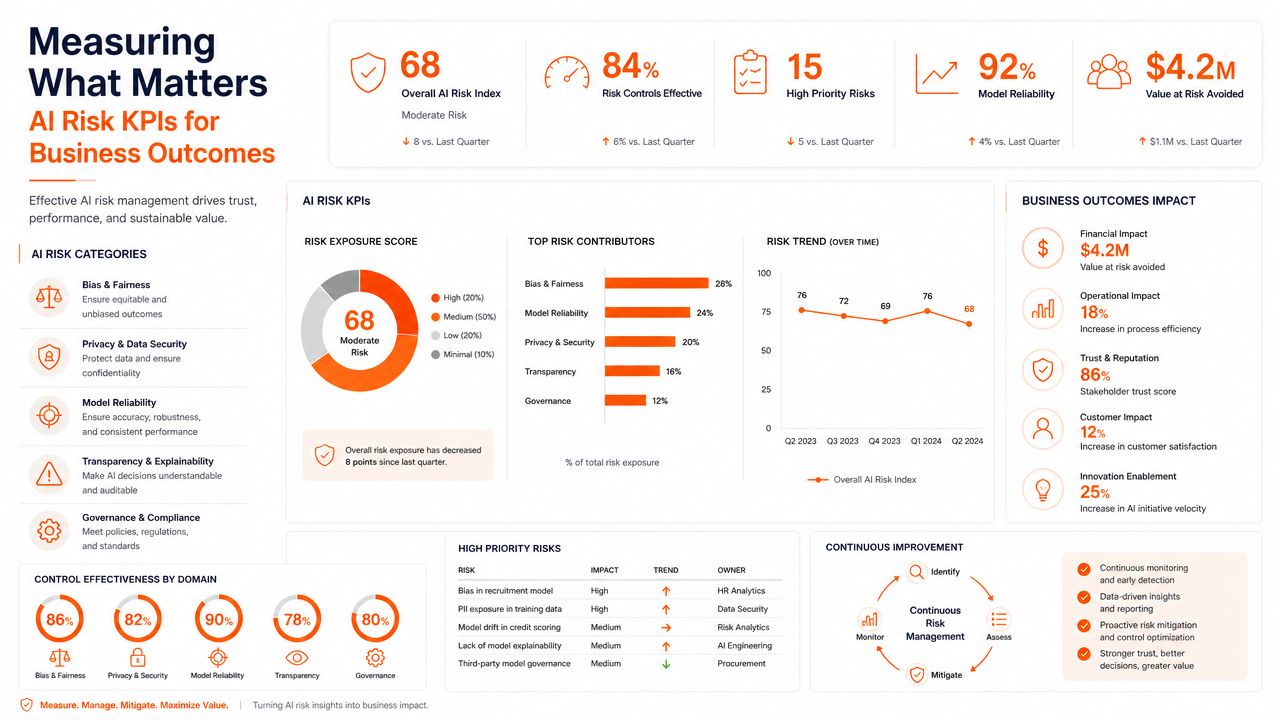
Measuring What Matters AI Risk KPIs for Business Outcomes
Most AI dashboards are built for specialists. CEOs, founders, and boards need something else. They need to know whether the product is trustworthy, controllable, and commercially safe.
That means connecting AI signals to business outcomes. Not obsessing over technical vanity metrics in isolation. A drift alert matters because it can affect service quality. A prompt leakage issue matters because it can hurt trust. Slower inference matters because it can damage conversion, retention, or support efficiency depending on the workflow.
Grant Thornton's analysis cuts to the point. Strong AI governance requires a centralized AI inventory, continuous model performance monitoring, and automated escalation workflows, and it also warns that the EU AI Act's high-risk system requirements are deferred to December 2027, creating a future compliance cliff for UK SaaS companies that still lack accessible oversight models, as discussed in Grant Thornton's AI oversight analysis.
The non-negotiable KPI set
You don't need a giant dashboard. You need a useful one. Start with a short set of measures that leadership can act on.
| KPI | Why it matters |
|---|---|
| AI inventory status | Shows which systems exist, who owns them, and where risk sits |
| Output quality threshold breaches | Flags customer-facing reliability issues |
| Escalation response status | Shows whether risky events are being handled quickly |
| Business incident linkage | Connects AI failures to support, churn, complaints, or service disruption |
| Data handling exceptions | Reveals where process discipline is breaking down |
Translate technical signals into commercial language
A model team might talk about retrieval quality, confidence thresholds, or latency patterns. Leadership needs the next line. What does that do to the customer journey, the support queue, the renewal conversation, or the delivery cost?
That's why I push teams to define every AI metric in two layers:
- Technical layer: What changed in the model, prompts, data, or behaviour?
- Business layer: What could this mean for trust, service delivery, cost, or brand?
If you're building AI into hiring or people-related workflows, it also helps to understand practical fairness checks. This guide for AI hiring compliance is a useful example of how operational measurement should connect to oversight rather than abstract ethics talk.
What founders should ask every month
Founders don't need a lecture on model architecture. They need a clean operating review. These are the questions worth asking:
- What AI systems are live right now, and who owns each one?
- Which features are showing unstable behaviour or rising exceptions?
- What incidents were escalated, and what changed afterward?
- Where are we exposed if regulators, enterprise buyers, or auditors ask for evidence?
A team that can answer those questions crisply is already ahead. A team that can't is building hidden operational debt.
Good measurement changes behaviour. It forces ownership, creates better release decisions, and gives leadership confidence to keep investing. This is the core purpose of AI risk KPIs.
From Risk Aversion to Risk Intelligence
A lot of leaders still frame AI risk management as defensive work. Something you do to avoid trouble. That view is too small.
In the UK context, AI risk frameworks explicitly require leaders to map technical AI usage to business outcomes such as brand damage, service delivery failure, and direct financial costs, starting with what could go wrong rather than with the algorithm itself, as explained in this practical UK guide to AI risks in business. That's exactly the right lens.
Risk intelligence creates better products
The strongest teams don't ship less because they manage risk well. They ship with fewer blind spots. They make sharper trade-offs. They know when to automate, when to keep a human in the loop, and when to reject a feature that looks clever but weakens the product.
That's the difference between risk aversion and risk intelligence.
Risk aversion says, “slow down until we feel safe.”
Risk intelligence says, “build enough control that we can move with confidence.”
Ownership is the actual differentiator
Most AI failures aren't caused by lack of ambition. They're caused by weak ownership. No one defines acceptable behaviour. No one tracks live performance against commercial outcomes. No one decides who can stop a release. Then everybody acts surprised when a feature creates support pain, customer distrust, or operational noise.
That's why a consulting mindset matters more than a vendor mindset. A real technology partner doesn't just deliver code. They challenge assumptions, expose risks early, and keep the team focused on outcomes. The same thinking sits behind modern agentic engineering, where systems and teams are designed around accountable action, not task completion.
The question isn't whether AI introduces risk. It does. The question is whether your operating model turns that risk into predictable delivery or recurring chaos.
Build the habit, not the theatre
You don't need a massive AI governance programme to get this right. You need a few things done consistently:
- Clear ownership: Every important AI capability has a named accountable leader.
- Lean controls: The team knows the red lines, review points, and escalation path.
- Business-linked measurement: Leadership can see impact in trust, service quality, and operational reliability.
- Fast feedback: Sprint habits catch weak assumptions before customers do.
That's how AI risk management becomes a growth enabler instead of a blocker. You stop reacting to incidents and start building a product organisation that can absorb AI safely, repeatedly, and at pace.
If you want a partner that brings senior engineering, proactive advisory, and the #riteway mindset of Extreme Ownership to AI-enabled SaaS delivery, talk to Rite NRG. We help tech leaders build fast without losing control, using nearshore teams, product-first thinking, and practical governance that keeps delivery predictable.