A 40-person SaaS company is preparing to double its headcount. By late evening, hiring managers are still chasing CVs, recruiters are trapped in scheduling email, and engineering leaders are watching delivery dates move because critical seats remain open. The problem isn't a lack of effort. The hiring operating model can't handle the volume.
Recruitment automation is the lever that removes repetitive work without handing judgement to a machine. Done properly, it gives recruiters more time for candidate conversations, gives hiring managers cleaner evidence, and gives founders a pipeline they can forecast instead of constantly firefight. Done badly, it creates opaque decisions, disconnected tools, and a faster route to compliance risk.
The UK market has already moved beyond experimentation. A CIPD-backed study reported that 31% of organisations used AI or machine learning in hiring in 2023, up from 16% in 2022, while 78% increased their use of technology in recruitment and onboarding during 2023. The REC also reported that more than 40% of UK recruiters were using AI, with a further 26% planning implementation in the following 12 months. (UK recruitment technology adoption evidence)
That pressure matters because slow hiring delays product work, weakens morale, and leaves revenue attached to roles nobody has filled. This guide gives you a practical definition, a stack map, a defensible ROI model, a pilot-to-scale plan, and governance rules that keep automation accountable.
Why Recruitment Automation Matters Now
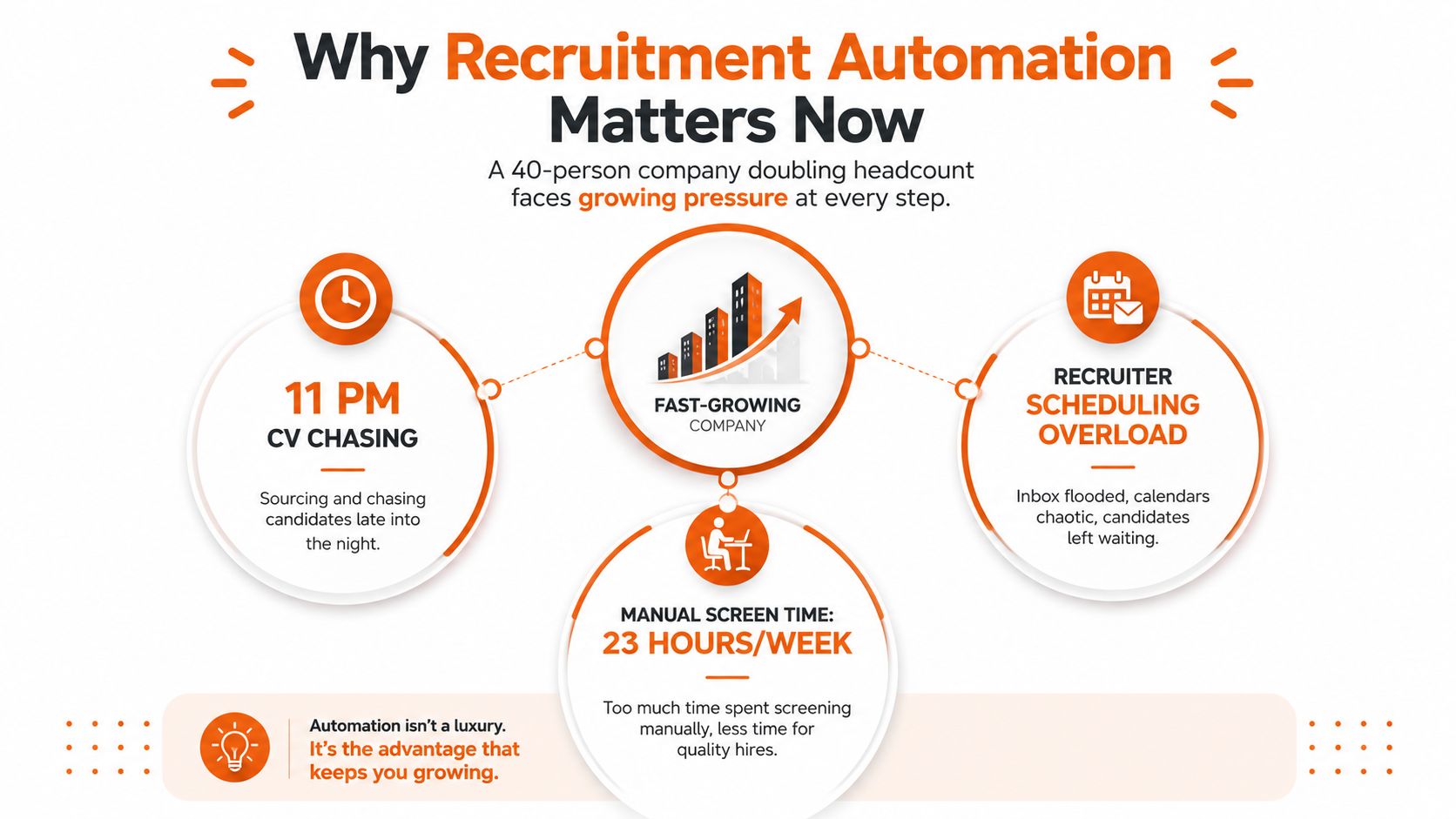
The 40-person product company doubling its headcount doesn't have a people problem. It has a throughput problem. Applications arrive faster than anyone can review them, interview panels exchange endless messages, and recruiters spend valuable hours updating systems instead of assessing talent.
At 11pm, a hiring manager is still asking whether a promising CV reached the recruiter. The recruiter is trying to coordinate five calendars. A candidate who applied days earlier is waiting for an acknowledgement, then moves on to a company that responds first. Meanwhile, an engineering vacancy remains open, and the team absorbs the work through longer days and postponed roadmap items.
The operating-model test: If hiring volume grows but every additional vacancy requires the same manual touches, your recruitment process won't scale.
UK evidence shows why teams are making the change. Recruiters using AI reported time savings, including up to 17 hours per week as CV formatting, compliance checks, and administrative work became automated. (UK recruiter time-saving evidence) A longer view also shows the progression from online job boards and electronic CVs to ATS platforms and AI-assisted screening. One UK survey reported ATS usage among 70% of enterprise-size businesses, compared with 20% of small and medium-sized businesses. (History of recruitment technology in the UK)
Start with the business constraint, not the software catalogue. If application review is the bottleneck, automate triage. If scheduling is consuming recruiters, automate calendar coordination. If your team can't explain where candidates disappear, fix instrumentation before adding AI.
The engineering talent shortage makes this more urgent for SaaS companies. A useful change-management perspective is available in the PEO Metrics HR change guide, particularly for teams that need to connect process adoption with organisational outcomes.
What Recruitment Automation Actually Means
Recruitment automation is software and AI that handles repeatable hiring work across the journey from sourcing to onboarding. It can trigger a candidate acknowledgement, search a talent pool, summarise a CV, route an interview request, collect documents, or update an ATS record.
The important distinction is assistive automation versus fully automated decision-making.
Assistive automation recommends. A model ranks candidates against a structured rubric, a recruiter reviews the reasoning, and a hiring manager makes the decision. Scheduling software can find a shared time across several calendars and send the invitation without removing human judgement from the process.
Fully automated decision-making is different. If a system rejects a candidate or determines a shortlist solely through automated processing, it may produce a legal or similarly significant effect. The ICO's definition of automated decision-making in recruitment makes human review, explainability, and audit trails essential where candidate outcomes are affected.
The workflow layer
A serious implementation is a pipeline architecture, not a chatbot bolted onto a careers page. It connects:
- Triggers: An application, referral, interview outcome, or completed document starts the next action.
- Rules: Eligibility, routing, reminders, and escalation logic keep work consistent.
- AI scoring: Models summarise or rank against criteria that the team defined in advance.
- Integrations: The ATS, HRIS, calendar, email, identity, and onboarding systems exchange controlled data.
- Human checkpoints: Recruiters and hiring managers own judgement-heavy decisions.
- Audit trails: The organisation can see which data entered a decision, what the system produced, and who approved the outcome.
For a practical grounding in the system-of-record layer, see this guide to mastering ATS in 2026 from Eztrackr.
The six components below are ATS, sourcing, screening, scheduling, onboarding, and analytics. Their value depends less on the number of features than on data quality, process design, integration discipline, and governance.
The Core Components of a Modern Hiring Stack
Treat the stack as an operating system for hiring. Each component must own a job, consume reliable data, integrate cleanly, and move an outcome that leadership can see.
| Component | Function | Key Integrations | Metric Moved |
|---|---|---|---|
| ATS | Holds candidate records, stages, feedback, and compliance history | HRIS, careers site, job boards, identity systems | Pipeline visibility and time-to-hire |
| Sourcing automation | Distributes roles, rediscovers talent, and drafts targeted outreach | Talent CRM, professional networks, email, ATS | Qualified replies and source-to-screen conversion |
| Screening automation | Applies knockout questions, structured scorecards, and AI-assisted ranking | ATS, assessment tools, interview platform | Time-to-screen and screen-to-interview conversion |
| Interview scheduling | Coordinates candidates, panels, rooms, and reminders | Calendars, video conferencing, ATS | Scheduling cycle time and candidate drop-off |
| Onboarding automation | Manages offers, checks, documents, and provisioning tasks | HRIS, payroll, compliance, IT service management | Offer acceptance and readiness on day one |
| Analytics and reporting | Shows funnel health, bottlenecks, and cohort outcomes | ATS, HRIS, finance, delivery dashboards | Forecast accuracy and quality-of-hire |
The ATS is the source of truth, not a passive filing cabinet. It should record requisition approval, candidate stage, interview evidence, consent, and disposition reason. If sourcing and screening tools create parallel records, your reports will look precise while describing different populations.
Sourcing automation works best when it combines job distribution with talent rediscovery. A SaaS company hiring a backend engineer, for example, can search prior applicants, identify relevant skills, draft personalised outreach, and route responses into the same pipeline. The metric isn't outreach volume. It's the number of qualified conversations generated per recruiter.
Screening needs stricter boundaries. Define the scorecard first, including essential skills, evidence standards, and knockout criteria. Then let AI assist with ranking or summarisation while a human reviews rejection decisions.
Scheduling is often the safest first use case because it removes coordination without deciding suitability. Onboarding then extends the same workflow into offers, right-to-work checks, document collection, and access provisioning. For structured forms and controlled data collection, teams can review HIPAA compliant data collection patterns from Kiwiform, while still checking their own UK privacy and employment requirements.
Analytics closes the loop. Connect hiring data to delivery capacity, so a CTO can see whether open roles are delaying a client pod or product milestone. If conversational interfaces are part of the design, keep the chatbots in recruitment discussion tied to handoff rules and measurable response quality, not novelty.
The Business Case and ROI You Can Defend
The cost of an unfilled role isn't just an agency invoice. It includes delayed product work, overloaded engineers, recruiter time spent on coordination, and the opportunity cost of a candidate who accepts another offer.
Build the case from the work you can remove. Automation can reduce repetitive scheduling, CV handling, status updates, and document collection. It can also improve recruiter capacity by allowing the same team to process more qualified candidates without adding administrative headcount.
UK Bullhorn data reported that firms using automation filled 64% more vacancies, submitted 33% more candidates per recruiter, automated more than 20,000 communications and tasks per firm each year, and saved an estimated 2.5 million employee hours in a single year. (Bullhorn UK automation evidence) The same UK-specific evidence reported that recruiters saved about 18% of their workweek, while 66% said AI helped identify candidates they might not otherwise have considered. (UK recruiter productivity evidence)
Use those figures as market evidence, not as a promise for your business. Your defensible model should use your own baseline.
ROI by automation layer
| Automation Layer | Time Saved | Cost-per-Hire Reduction | Quality Impact |
|---|---|---|---|
| Sourcing | Repetitive search and outreach work | Fewer external sourcing touches | Broader, more consistent pipeline |
| Screening | Manual CV review and initial triage | Lower recruiter effort per screened candidate | More consistent evidence against criteria |
| Scheduling | Calendar coordination and reminders | Less administrative work per interview | Faster candidate movement |
| Onboarding | Document chasing and task routing | Fewer manual handoffs | More consistent readiness |
| Analytics | Manual reporting and reconciliation | Less time spent producing reports | Earlier visibility of pipeline leakage |
Calculate the result with a simple formula:
(Vacancy-days saved × daily productivity cost) + (Recruiter hours reclaimed × hourly cost) − (Tooling + integration cost)
Then add quality measures that stop the team optimising for speed alone. Track time-to-hire, cost-per-hire, quality-of-hire through 90-day retention, offer acceptance, and pipeline conversion. A faster rejection process isn't a win if it removes strong candidates. A larger shortlist isn't a win if hiring managers spend more time reviewing irrelevant profiles.
The founder-level question is straightforward: can the hiring engine support growth without adding administrative effort in direct proportion to headcount? If the answer is no, recruitment automation belongs in the operating plan, not just the HR software budget.
Implementation Roadmap From Pilot to Scale
Don't begin with an enterprise rollout. Begin with one workflow where the pain is visible, the owner is accountable, and the outcome can be measured.
Phase one targets one flow
During Weeks 1 to 3, choose a high-volume, high-friction step, usually sourcing or scheduling. Record the baseline: how long candidates wait for a screen, how many recruiter hours each requisition consumes, where handoffs fail, and how often records need correction.
Set a small number of gates. You might define time-to-screen below 48 hours or reduce recruiter hours per requisition by 30% as internal targets, but use them as pilot criteria rather than market benchmarks. Name the process owner and technical sponsor before anyone evaluates vendors.
Phase two pilots and learns
During Weeks 4 to 8, run the workflow with one business unit and one role family. The hiring manager owns the quality bar, the talent lead owns the candidate process, and the technical sponsor owns integrations, access, logging, and data handling.
Don't change the scorecard halfway through the pilot unless you document why. Capture candidate feedback, recruiter exceptions, system failures, and every manual intervention. A pilot that exposes the limits of a tool has still delivered useful information.
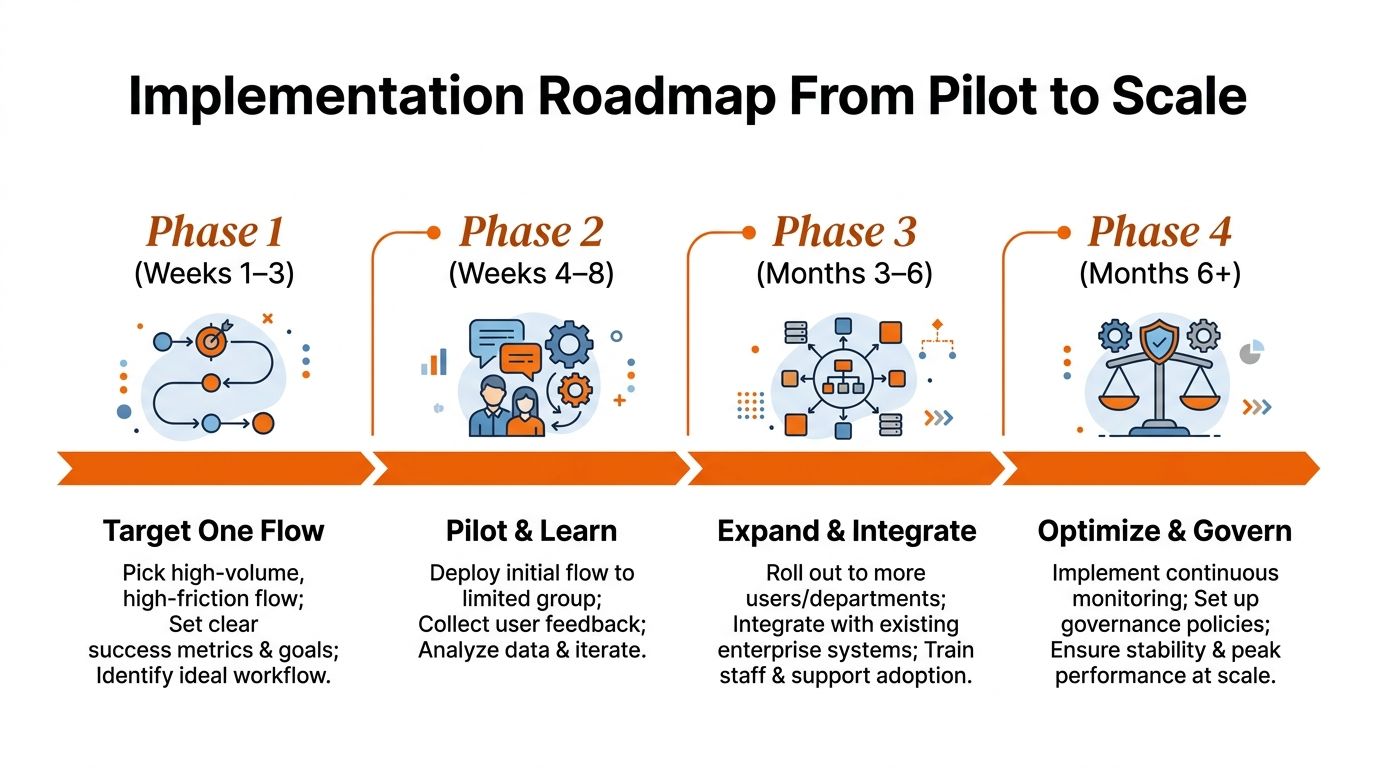
Phase three expands the connected flow
During Weeks 9 to 16, add adjacent activities such as structured screening and onboarding. Connect analytics so the team can see where candidates stall, which sources produce qualified applicants, and how long each approval takes.
The target isn't maximum automation. It's a clean handoff between stages, with clear ownership when the system can't resolve an exception.
Phase four governs the model
From Week 17 onwards, scale only after the earlier gates hold. Rationalise vendors, formalise data export rights, document escalation routes, and establish a quarterly review cadence.
At every gate, ask three questions:
- Did the metric move without hidden manual work?
- Did candidate and recruiter trust hold?
- Did the integration remain clean and auditable?
If any answer is no, stop and recalibrate. The right partner brings delivery discipline to those decisions, rather than treating software activation as project completion.
Pitfalls, Risk, and How to Govern Automation Well
Automation doesn't remove accountability. It makes accountability easier to lose unless the design forces people to retain it.
Bias amplification
Historical hiring data can encode historical preferences and discrimination. A model trained on that data may reproduce the pattern while presenting its output as objective.
Use defined criteria, diverse validation data, documented model behaviour, and regular bias audits. Keep a human review on every rejection decision. The UK government's responsible AI in recruitment guidance frames AI hiring as a governed business process requiring attention to fairness, transparency, and legal compliance.
Candidate trust
Candidates can accept automation for quick acknowledgements and scheduling. They become sceptical when a system appears to judge them without explanation or offers no route to challenge an outcome.
Tell candidates where AI assists, what a human reviews, and how they can ask for clarification. Set response-time service levels that automation improves, then route unusual cases to a named person. Your interviewing best practices should reflect the same principle, structured evidence for consistency and human conversation for judgement.
Vendor lock-in and integration debt
Point solutions attached to a fragile ATS create duplicated records, inconsistent consent histories, and reporting gaps. Require open APIs, usable data export, clear ownership of candidate records, and an exit clause before procurement approval.
The ICO's recruitment work found that some employers believed their tools provided decision support, while their actual use involved solely automated decisions without meaningful human involvement. (ICO recruitment automation findings) That gap is a design failure, not merely a training issue.
Governance rule: Separate recommendation, approval, and rejection permissions in the system. Log inputs, outputs, overrides, and the person responsible for the final decision.
Good governance also includes change management. Recruiters need to understand which tasks disappear, which judgements remain theirs, and how the team will handle model errors. Otherwise, staff will work around the system, and the business will pay for both the software and the old manual process.
Rite NRG in Practice and What You Can Steal From It
Rite NRG applies AI across sourcing, screening, scheduling, and onboarding for its delivery teams and SaaS clients. The useful lesson isn't a particular tool. It's the way recruitment data connects to delivery planning.
A nearshore engineering talent pool can use automated shortlisting to surface candidates against defined skills and cultural-fit criteria. Recruiters still conduct the human conversations, while structured scoring rubrics reduce interview drift between interviewers. Shared dashboards give engineering and HR the same view of time-to-hire, pipeline status, and likely team availability.
That connection changes the operating model. A new client pod can follow a repeatable onboarding playbook instead of starting from a blank page. Delivery leaders can see whether hiring is likely to affect a planned ramp. When project priorities shift, the organisation can identify which skills are already available and where a new search is required.
Copy the mechanics, adapt the constraints
- Copy rubric-driven interviews: Define evidence before the interview and require structured feedback after it.
- Copy instrumented sourcing: Record source, stage movement, response, and handoff data instead of relying on recruiter memory.
- Copy single-pane analytics: Let technical and people leaders work from the same pipeline definitions.
- Adapt data residency: Review where candidate data is processed, stored, and transferred before selecting an AI provider.
- Adapt the talent model: Nearshore delivery can provide flexibility, but it must fit time zones, communication habits, employment requirements, and client expectations.
- Retain human trust: AI can shortlist and summarise. It shouldn't conduct the relationship that convinces a strong engineer to join.
Rite NRG's wider delivery model includes nearshore software teams, platform development, technology and delivery consulting, and Build-Operate-Transfer support for R&D centres in Poland. Those services are relevant when recruitment automation needs to connect with engineering capacity, not sit as an isolated HR experiment.
The trade-off is clear. A partner can accelerate implementation and bring reusable operating patterns, but your organisation still owns data decisions, candidate communications, and governance. Treat that ownership as a capability to build, not something to outsource.
Your Next Move and How to Start This Week
You don't need a transformation programme to begin. You need a narrow problem, a baseline, and one accountable owner.
Five actions for the next five working days
- Instrument current hiring: Record actual time-to-hire, time-to-screen, recruiter hours per requisition, candidate drop-off, and the number of manual handoffs. Don't clean the data until after you understand where it breaks.
- Choose one bottleneck: Pick sourcing, screening, scheduling, or onboarding. Choose the step that consumes the most repeatable effort, not the step that looks most impressive in a demo.
- Write a one-page brief: Define the workflow, required integrations, human decision points, data access, audit requirements, baseline metrics, target metrics, and exit criteria.
- Run focused demos: Ask vendors to execute your workflow against your brief. Require them to show exception handling, data export, human override, and reporting, not just the happy path.
- Assign ownership and a date: Name the hiring leader, technical sponsor, and decision-maker. Set a decision date and a pilot review date before implementation begins.
This is Extreme Ownership in practice. The team owns the outcome, not the software. High energy matters because pilots lose momentum when nobody drives the next decision. Proactivity matters because integration risks, candidate concerns, and weak data should surface before scale, not after a launch has created organisational dependence.
The Rite NRG method: Own the result, move early, surface risk, and keep the work connected to delivery capacity.
Hiring is a system you operate, not a tool you buy. The leaders who redesign that system this quarter will set a stronger hiring standard for the next twelve months. Pressure-test the roadmap against real numbers, real candidate journeys, and real engineering constraints, not slideware.
Rite NRG offers nearshore software delivery teams, technology and delivery consulting, Platform Development, and Build-Operate-Transfer support, with AI embedded across recruitment and delivery workflows. Visit Rite NRG to pressure-test your recruitment automation roadmap and connect hiring capacity to predictable SaaS delivery.