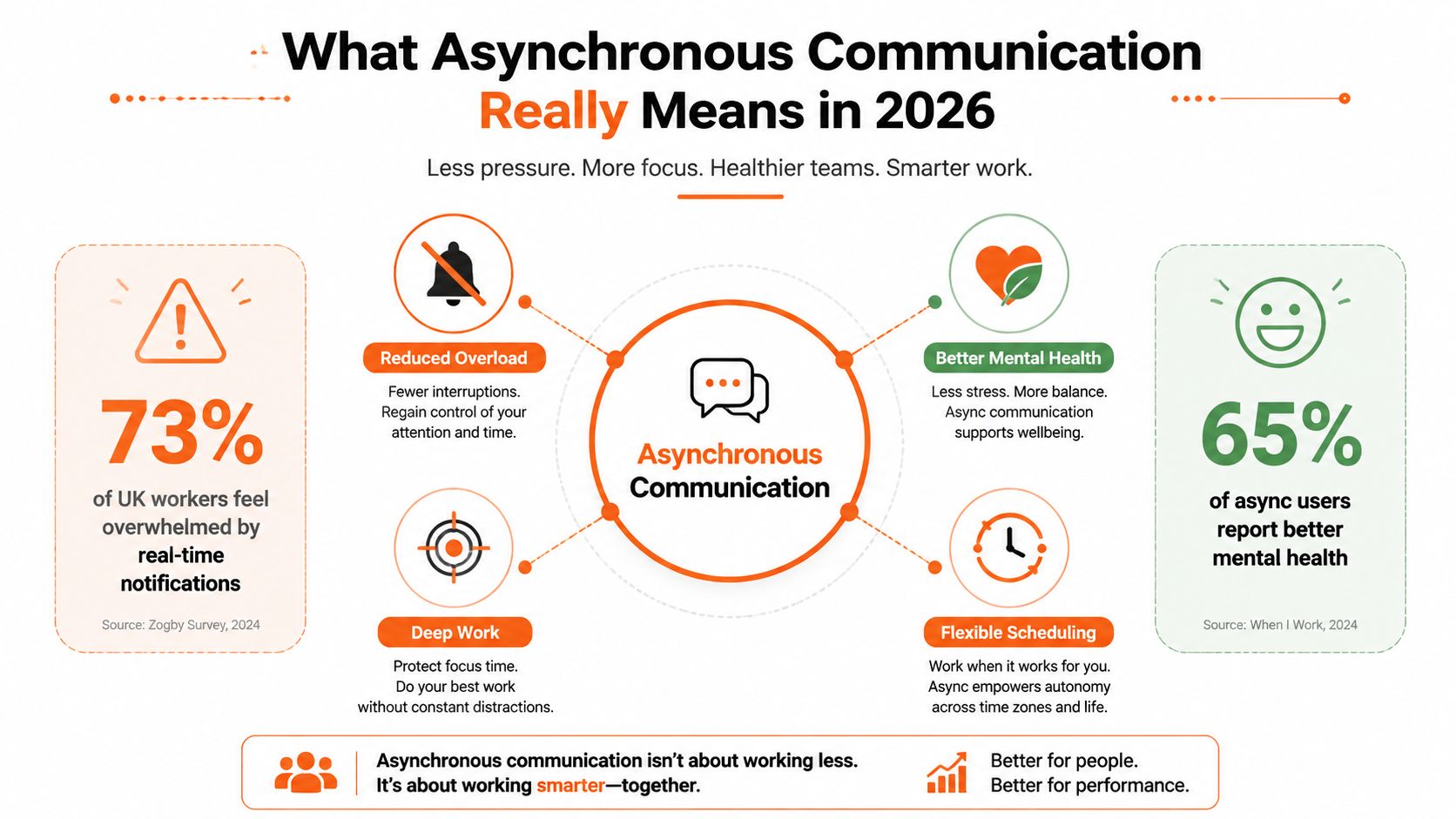
73% of UK workers feel overwhelmed by real-time notifications, yet 65% of workers who use asynchronous practices report better mental health. The delivery opportunity is clear: replace constant interruption with an operating model that protects focus, records decisions, and keeps work moving across borders.
Asynchronous communication isn't a retreat from collaboration. It's a deliberate way to make ownership, context, and response expectations visible, so a product team can deliver without forcing everyone into the same call or chat thread. Done properly, it gives leaders a sharper view of cycle time, decision latency, delivery risk, and team health.
The #riteway approach starts with Extreme Ownership, high energy, and proactive execution. A capable partner shouldn't provide a list of skills. It should anticipate the next dependency, write down the decision, surface the risk, and keep the outcome moving.
What Asynchronous Communication Really Means in 2026
The UK data points to a practical contradiction. A UK survey of 1,000 workers found that 73% feel overwhelmed by daily notifications and real-time communication demands. Yet among workers already using asynchronous practices, 65% say async has improved their mental health. The issue isn't communication itself. It's the assumption that useful communication must happen immediately.
Asynchronous communication means structuring work so the person creating a message and the person consuming it can operate on different clocks. The work relies on written briefs, decision logs, task records, recorded walkthroughs, and explicit ownership. Synchronous coordination works differently. Everyone needs to be present at the same moment for the conversation, clarification, or decision to advance.
The operating vocabulary
A mature async team uses a small set of terms consistently:
- Owner: The person accountable for moving the work to an outcome, not merely posting an update.
- Expected response window: The time by which a response, review, or approval is needed.
- Decision artefact: The durable record showing what was decided, why it was decided, and who made the call.
- Escalation rule: The condition that moves an issue from async discussion to a live conversation.
Consider a request arriving at 4:55pm local time. In a weak system, the recipient feels compelled to answer instantly, the sender waits in a chat window, and nobody knows whether the task is owned. In a strong system, the request sits in a visible queue, names the owner, states the desired outcome, and sets a response window. The recipient can begin when ready, and the rest of the team can see what happens next.
AI-assisted summarisation and mature SaaS workflows can make this model easier to operate, but automation doesn't create accountability. Someone still needs to write a clear brief, make the decision, and update the record. Teams that want a reliable trail can also use tools to track action items from meetings rather than trusting memory after the call.
How Async Workflows Actually Function Day to Day
A typical synchronous cycle starts with a stand-up. One person raises a dependency in Slack, another suggests a quick call, and the call produces a verbal agreement. Someone later sends an email summarising what they think was decided. The team has spent time coordinating, but the decision may still lack an owner, rationale, deadline, or link to the work it affects.
The async equivalent begins with a written brief in a shared document or project record. The owner states the problem, desired outcome, constraints, and decision required. Stakeholders receive explicit asks and a response deadline. Comments stay attached to the relevant paragraph or task, and the owner records the final decision with its rationale.
A status update then moves to the team channel, preferably in a thread organised around the project rather than a person. A pre-recorded video can provide nuance for a product walkthrough, while a structured handoff gives the next contributor enough context to continue without scheduling a call.
| Stage | Synchronous Pattern | Asynchronous Pattern |
|---|---|---|
| Request | Verbal ask in a meeting or direct message | Written brief with owner and outcome |
| Clarification | Live back-and-forth | Threaded questions beside the artefact |
| Decision | Group agreement in a call | Decision record with rationale |
| Handoff | Spoken summary or follow-up email | Linked task, context, acceptance criteria, and next action |
| Status | Recurring meeting update | Scheduled written update in a public channel |
| Escalation | Immediate call | Live discussion only after written context is exhausted |
The quality shift matters. In a live discussion, the most confident or senior speaker can dominate. In a written workflow, the clearest rationale has a better chance of shaping the decision. That doesn't mean every disagreement belongs in a thread. Conflict resolution, sensitive conversations, onboarding rituals, and high-stakes design reviews still benefit from real-time interaction.
Leaders building distributed routines can use this async work and communication guide alongside a clear internal playbook. For broader remote collaboration practices, teams can also review remote team collaboration best practices, then adapt the channel rules to their own delivery graph.
The Business Outcomes Async Communication Unlocks
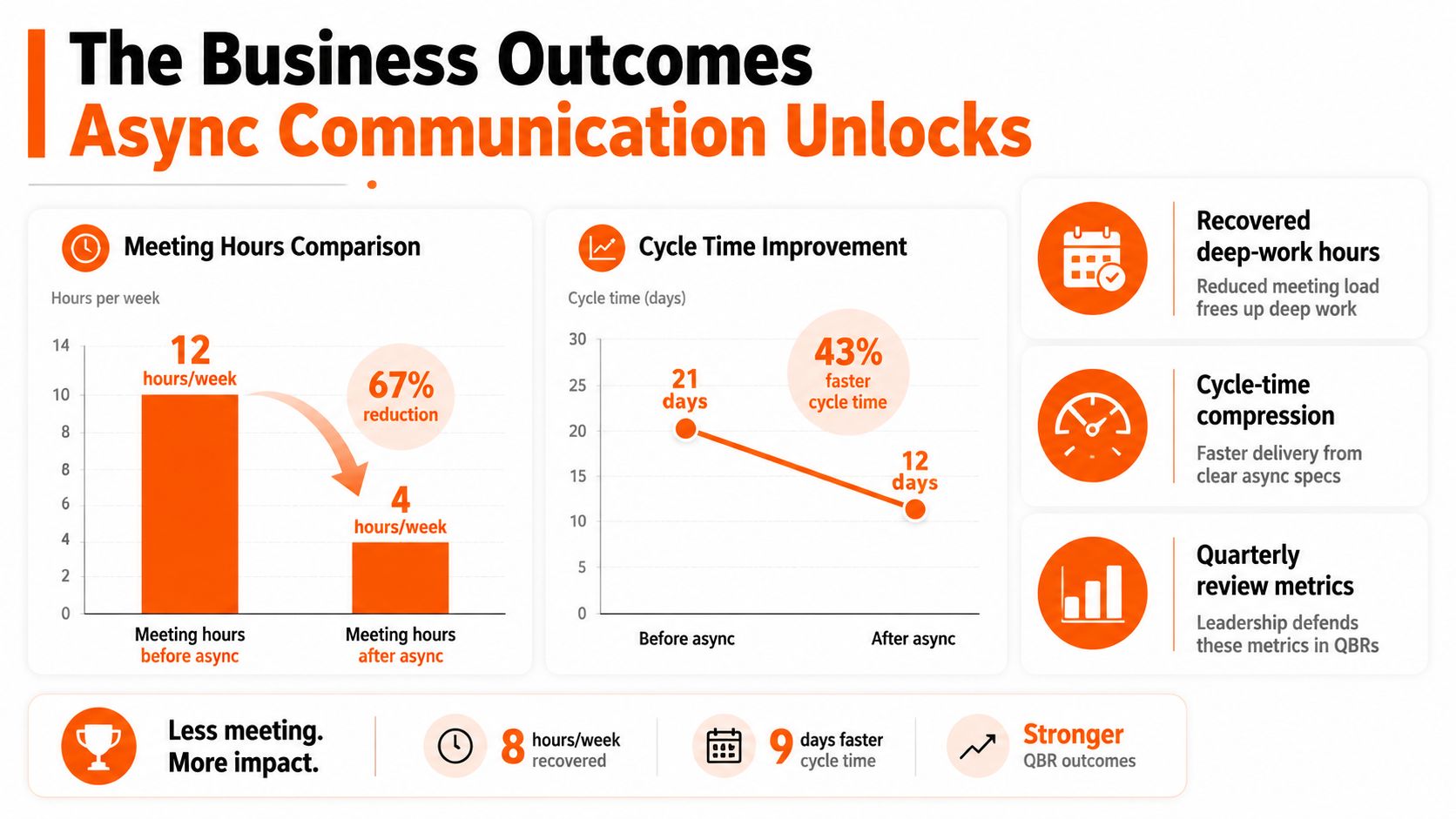
Leadership teams don't defend a communication style in a quarterly review. They defend delivery outcomes. Async earns its place when it helps the organisation reduce unnecessary meetings, protect deep work, shorten decision latency, and make delivery more predictable.
A UK workplace resource links asynchronous communication with deeper focus, greater output, fewer unnecessary meetings, and more control over the working day in its discussion of async communication in the workplace. The mechanism is straightforward. When a team replaces routine status calls with written updates, people recover attention for discovery, engineering, customer work, and quality review.
What to measure
Track the operational chain, not message activity:
- Meeting load: Review recurring meeting hours and whether each meeting produces a necessary outcome.
- Deep-work capacity: Ask whether engineers and product specialists have protected blocks for high-value work.
- Cycle time: Measure how long an item takes from ready to released, then inspect where waiting occurs.
- Decision latency: Record the time between a decision request and an usable decision.
- Support responsiveness: Compare response windows with customer-facing service expectations.
- Knowledge retention: Check whether a new contributor can find the context behind a decision without booking extra meetings.
Clear response rules also improve performance. A peer-reviewed study in the Journal of Applied Psychology found that daily communication quality was associated with daily performance and burnout, while supervisors who set clear communication expectations, including expected email response times, were positively associated with performance during remote-work transitions. The practical lesson is simple: silence isn't autonomy when nobody knows what happens next.
Async also expands the talent model. A nearshore partner operating in shared or overlapping business hours can contribute without the long delay associated with a distant handoff, while written artefacts protect focus across the overlap. But the model only works when the team commits to the discipline. Half-adopted async creates slower decisions, scattered documentation, and more private messages than a well-run synchronous team.
For the information layer, leaders should establish communication transparency as an operating expectation, not a cultural slogan.
Real-World Use Cases for Distributed and Nearshore Teams
Async becomes valuable when it removes a specific wait. The strongest use cases have a clear input, a durable artefact, and an outcome someone can inspect.
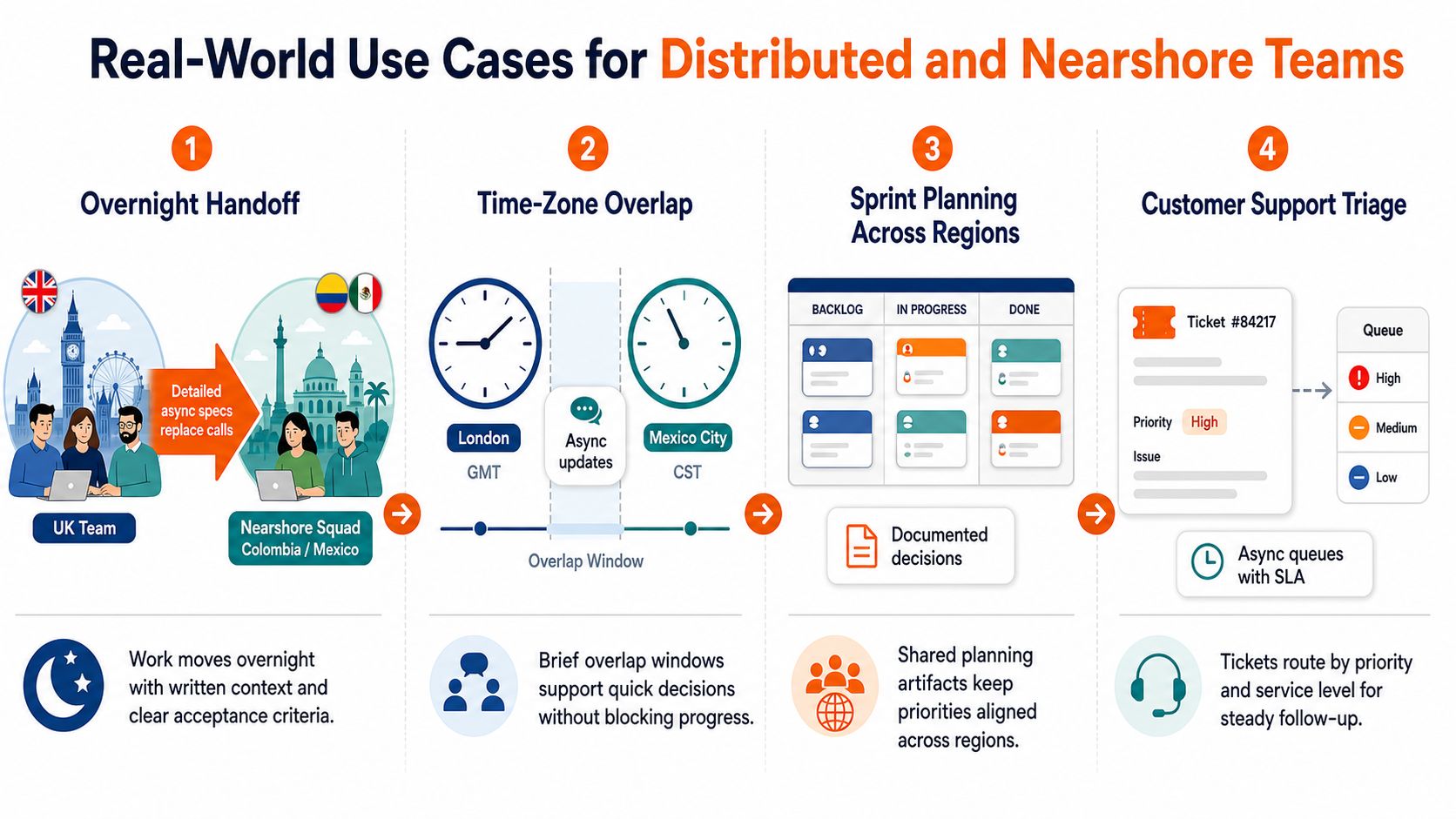
A UK product team handing work to a nearshore squad in Colombia or Mexico might finish its day with a product brief, technical constraints, acceptance criteria, open questions, and a named owner. The nearshore team starts with context instead of waiting for a morning stand-up. The outcome to watch is cycle time for the handoff and the number of clarification loops required before implementation begins.
A platform group spread across Lisbon, Austin, and Buenos Aires can use design records, linked issues, and pull requests to merge work without a single live merge window. The input is a proposed change. The artefact is a reviewed design document connected to implementation work. The outcome is lower decision latency and fewer blocked reviews.
Customer support presents a different pattern. Instead of pinging an engineer in Slack, an agent adds the ticket to a documented triage queue, attaches reproduction details, records severity, and names the next action. Engineering responds in the ticket thread, preserving the reasoning for future cases. The useful measure is mean time to resolution, alongside the reliability of the service-level response.
An executive review can follow the same logic. A product leader circulates a decision memo with the options, recommendation, financial or customer implications, and explicit approval request. Executives comment before a short live session, if one is needed. The result is lower decision latency and a more durable record of why the organisation chose a direction.
Nearshore delivery strengthens these patterns because overlapping business hours create room for fast clarification without turning every dependency into a meeting. The team gets both focus and useful overlap. That combination is particularly effective when a partner demonstrates Extreme Ownership, anticipates blockers, and prepares the next artefact before someone asks.
Practical rule: Write the artefact first. Escalate to a live conversation only when the written context has been tested and remains insufficient.
The operating pattern is repeatable across discovery, build, review, and support. The location of the team matters less than whether the next person can understand the work and act without waiting for a private explanation.
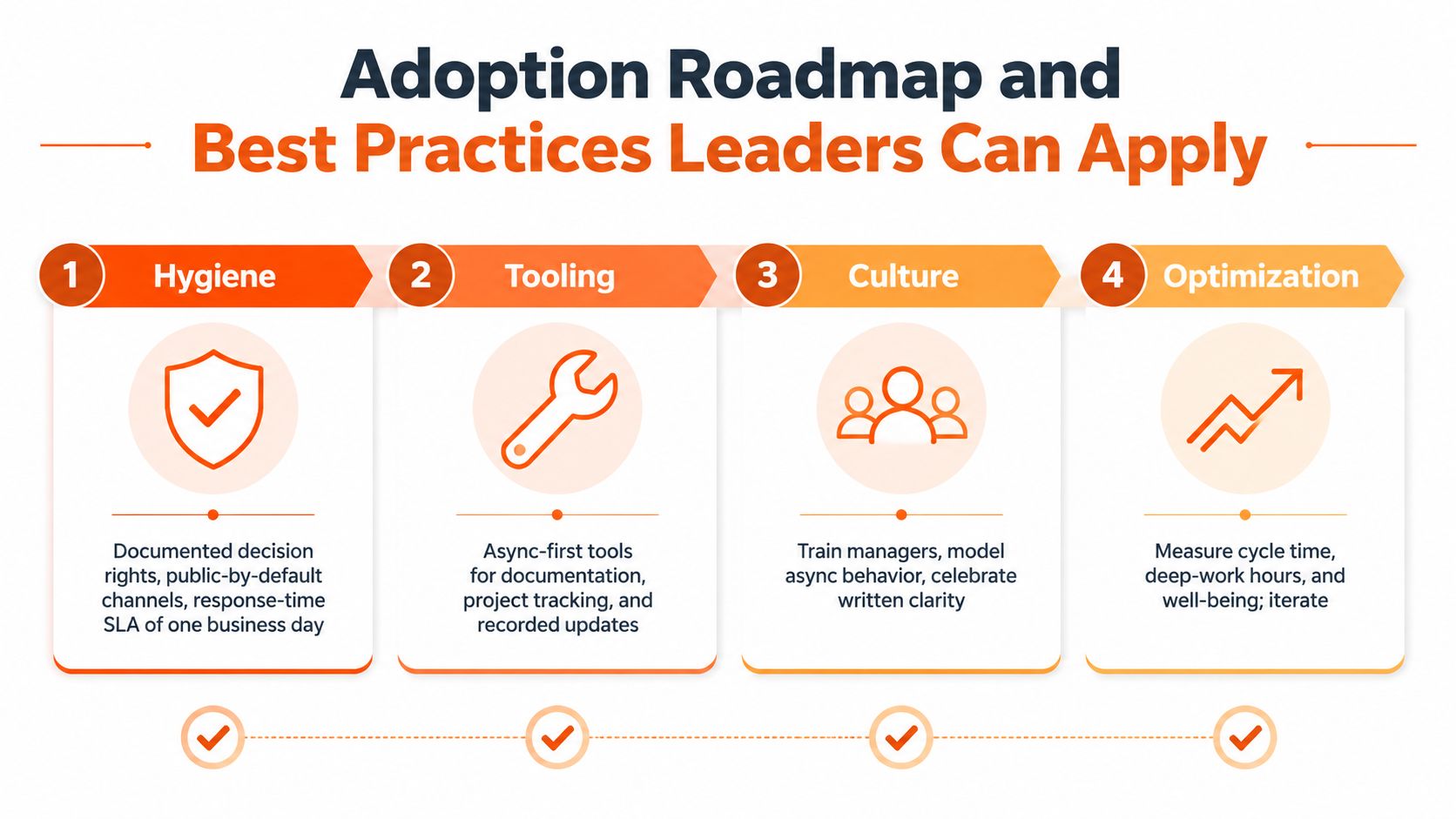
Adoption Roadmap and Best Practices Leaders Can Apply
Adoption should be managed as a capability build, not a software rollout. Leaders need to establish the rules, raise the quality of written work, replace low-value rituals, and then inspect whether the operating model improves delivery.
Stage one builds hygiene
Start with the minimum structure:
- Define decision rights: Name who decides, who advises, and who must be informed. The failure signal is a thread where everyone comments but nobody closes.
- Make channels public by default: Put project updates in searchable team spaces rather than private DMs. The failure signal is repeated questions because the original context is inaccessible.
- Set a one-business-day response-time SLA: Use it for normal requests, with a separate urgent route. The failure signal is people treating every notification as an emergency.
Stage two improves craft
The next capability is writing that allows another person to act.
Require an RFC, design document, or Loom walkthrough before asking a group for input on a complex change. The owner must state the decision needed, alternatives considered, risks, and deadline. The anti-pattern is a vague message that says “thoughts?” without context or a defined decision.
Every artefact should link to the task, source material, and eventual decision. That practice turns documentation into delivery infrastructure rather than administrative overhead.
Stage three establishes cadence
Replace recurring status meetings with written weekly check-ins and threaded async stand-ups. Each contributor reports progress, next action, risk, and help required. The delivery leader owns the cadence, while each workstream owner owns the accuracy of its update.
Keep live sessions for decisions that need dialogue, relationship building, and difficult conversations. If a meeting produces no written outcome, the cadence is failing.
Stage four adds governance
Review meeting load, after-hours activity, decision latency, and team sentiment monthly. Assign each metric to a named leader and inspect trends alongside delivery performance. Governance fails when leaders measure message volume instead of whether decisions and work move faster.
Use knowledge transfer best practices to strengthen the record behind the work. Adoption stalls when leaders keep using Slack DMs as the default channel. The final practice is visible modelling: leaders must write decisions publicly, respect response windows, and stop rewarding instant replies.
Tooling and Workflow Patterns That Hold Up at Scale
An async stack needs fewer tools than many teams expect. It needs clear jobs for each tool, firm defaults, and a rule that every meeting produces a written outcome.
| Category | Core Job | Common Misuse | Scaling Pattern |
|---|---|---|---|
| Written-first hubs | Preserve durable context in Notion, Confluence, or Slab | Treating the wiki as an unowned storage dump | Give each domain an owner, use page templates, and link documents from active work |
| Threaded discussion | Handle coordination in Slack, Twist, or Teams channels | Using DMs for decisions or mixing unrelated topics | Organise channels by project or topic, keep replies threaded, and summarise closed threads |
| Decision capture | Connect decisions to Linear, Jira, or GitHub issues and pull requests | Leaving rationale in chat while the ticket holds only a status | Link the decision record, implementation task, review, and outcome |
| Async media | Explain nuanced workflows through Loom, Vidyard, or Grain | Recording long videos without a written summary | Add a short purpose statement, timestamps, transcript, and requested action |
The workflow pattern should match the delivery shape. Product squads often benefit from a channel-per-project model, where discussion, updates, risks, and links gather around an initiative. Platform groups often prefer a doc-per-decision model, because one architectural choice can affect many services and teams.
Both models need tagging conventions. Use consistent labels for decisions, risks, approvals, and requests. Put the owner and response window near the top of the message or document, not buried in prose. Keep the source of truth in the project system, while chat points people towards it.
A team of more than fifty people can't depend on tribal knowledge or perfect memory. It needs searchable records, predictable locations, and a clear archive policy. If a meeting is unavoidable, the organiser should publish the purpose beforehand and add the decision, actions, and unresolved risks afterwards.
Rite NRG is one example of a nearshore software delivery partner that combines senior engineering teams, product-first delivery, consulting, and AI-supported processes for SaaS work. The relevant lesson isn't the number of tools. More software doesn't create async maturity. Fewer, sharper defaults do.
Common Pitfalls and How to Avoid Them
Async fails when leaders remove meetings without replacing the coordination system those meetings provided. The result isn't autonomy. It's expectation drift, missing context, delayed decisions, and a growing dependence on private messages.
Expectation drift creates invisible queues
If nobody knows whether a message needs an answer today or later, every request feels urgent. Add a response window to each meaningful ask, define the urgent route, and make the owner visible. Apply the rule within a sprint by rewriting active requests that lack an owner or deadline.
Pushing decisions into async without assigning a decision-maker creates the same problem. A thread can contain excellent analysis and still remain stuck. The owner must close the discussion, record the rationale, and state what happens next.
Documentation can still lose the plot
A team can produce many pages and preserve very little knowledge. Treat documentation as useful only when it helps another person make a decision or complete work. Link the brief to the task, the task to the implementation, and the implementation to the outcome.
Measure the queue, not the noise. Message volume says little about whether the organisation is deciding and delivering.
Equity needs active design
The ONS reports that hybrid working reached 28% of working adults in Great Britain in early 2025, while access is uneven across worker groups. Hybrid work is more common among full-time and more highly educated workers, whereas lower-skilled and poorer workers are less likely to benefit, as set out in the ONS evidence on demographic gaps in hybrid work.
That gap changes the leadership question. Async may improve autonomy for people with flexibility, but it can also affect visibility, inclusion, and promotion risk for workers who can't shape their schedules around digital collaboration. Rotate live office hours across regions, publish decisions openly, and judge contribution by outcomes and documented work rather than presence in chat.
Don't turn async into a cost-cutting excuse for eliminating every live interaction. Trust building, sensitive feedback, conflict resolution, and shared design thinking still need human contact. The right model protects focus while preserving the moments that make a team feel like a team.
Metrics to Track and the Nearshore Partner Edge
A delivery leader should be able to tell whether async is improving throughput, quality, and well-being without relying on impressions. Track a compact operating set and assign an owner to each metric.
| Metric | What It Measures | Target Direction |
|---|---|---|
| Cycle time | Time from ready work to completed outcome | Down, without quality regression |
| Decision latency | Time from decision request to recorded decision | Down |
| Deep-work hours | Protected time for concentrated delivery work | Up, with sustainable boundaries |
| On-call interruptions | Unplanned disruptions during support or engineering work | Down |
| Documentation coverage ratio | Proportion of important work with usable context and decisions | Up |
| Team sentiment pulse | Whether people experience clarity, control, and manageable communication load | Improve or remain stable |
Review cycle time and decision latency in delivery governance. Review interruption counts and documentation coverage with engineering and product leads. Review sentiment and after-hours activity with people managers. A metric without an owner becomes a dashboard decoration.
Network quality also shapes the experience. Ofcom's UK home broadband measurements recorded the lowest median 24-hour latency for full-fibre packages at 4.9 to 7.3 ms, compared with typically 12.5 ms for FTTC and about 24 ms for ADSL2+, according to its home broadband performance measurements. Even async workflows depend on responsive access to documents, repositories, tickets, and cloud development environments.
Operational systems also need to tolerate delay and unreliable delivery. UK cellular-network research found that current 4G could deliver packets in under 500 ms in most cases, while TCP offered better reliability and UDP lower latency with packet-loss risk, as described in the UK cellular network performance assessment. For distributed delivery, that supports retries, decoupled acknowledgements, and transport choices based on whether consistency or speed controls the workflow.
A nearshore partner such as Rite NRG can compress cycle time when shared or overlapping time zones combine with proactive ownership. The partner finishes discovery with a decision-ready brief, begins build with linked acceptance criteria, and hands review back through a documented pull request. No daily stand-up needs to carry the whole system. The artefacts do the work, while high-energy collaboration remains available when a real decision or human conversation demands it.
The FCA offers a useful public-sector model for explicit response expectations. It aims to answer emails, web forms, and webchats within 2 working days, and letters within 5 working days, according to its service standards. The principle applies well beyond public services: define the expected response, publish the route, and stop making people guess.
Rite NRG offers nearshore software delivery, technology and delivery consulting, dedicated teams, platform development, and Build-Operate-Transfer support for organisations that need predictable product execution. Visit Rite NRG to discuss an async-first delivery model built around senior teams, proactive ownership, shared time zones, and measurable outcomes.