Your product team is spread across cities, countries, and time zones. Slack is busy, Jira is full, everyone attends the stand-up, yet a release still slips because nobody knows who owns the integration decision. You don't have a remote-work problem. You have an operating-model problem.
Distributed team management works when ownership, context, delivery signals, and security travel reliably between people who aren't sharing an office. The Rite NRG #riteway lens adds a sharper standard: Extreme Ownership, high energy, and proactivity must show up in hiring, daily execution, incident response, and eventual team transfer. The outcome isn't more activity. It's predictable value delivery, faster decisions, fewer avoidable escalations, and a team that can operate without founder intervention.
What Distributed Team Management Means for SaaS Leaders
A release is ready, but the integration decision is still waiting in a private chat. Product, engineering, and operations each hold part of the context, while nobody owns the final call. That failure comes from the operating model, not the map.
Distributed team management defines how people coordinate, decide, protect systems, and deliver outcomes when proximity cannot fill information gaps. Apply the Rite NRG #riteway lens throughout the model: Extreme Ownership, high energy, and proactivity should shape hiring, execution, incident response, and eventual team transfers.
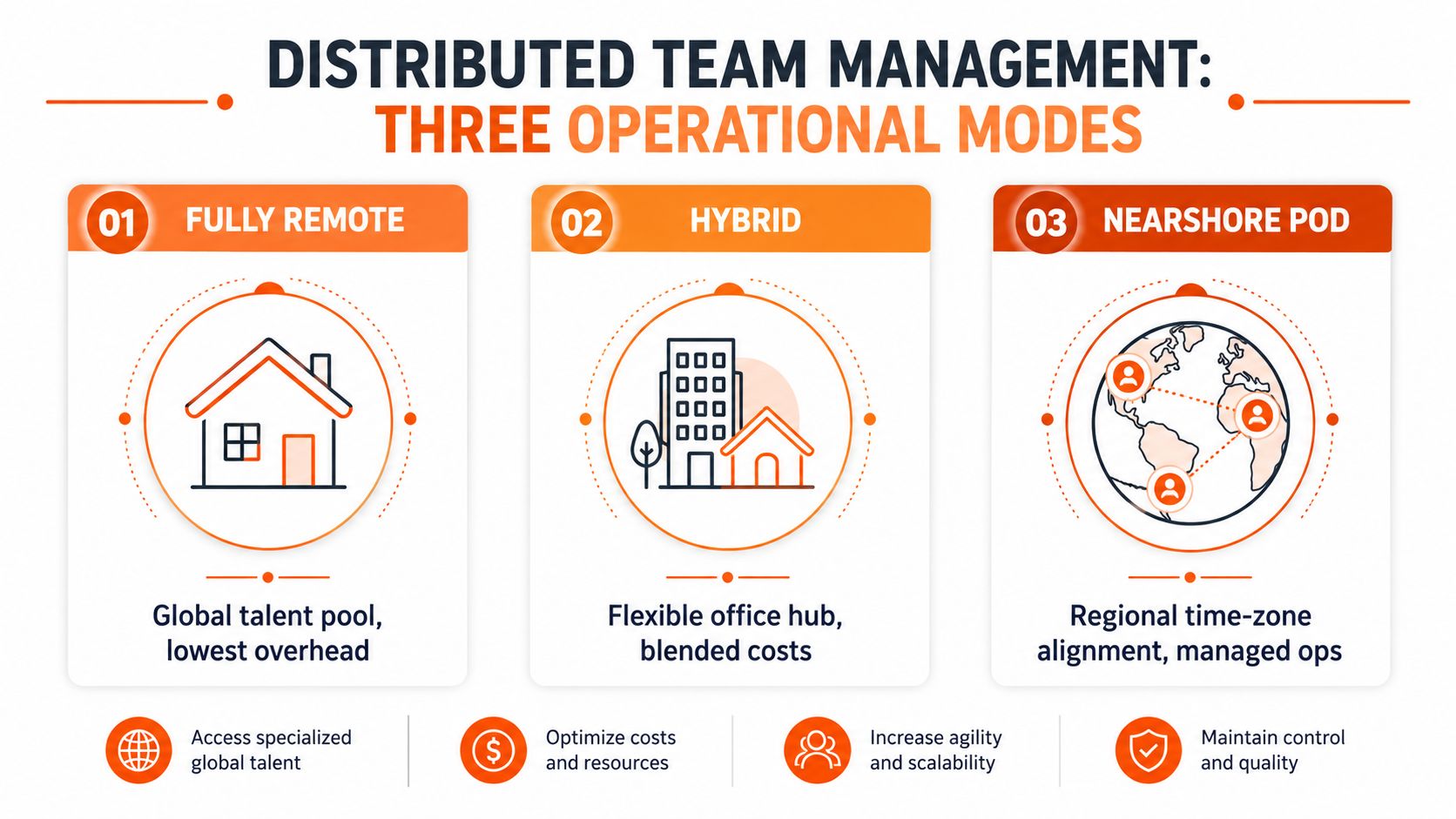
Choose the operating model deliberately:
| Model | Advantage | Trade-off |
|---|---|---|
| Fully remote | Broadest talent access and low office overhead | Requires stronger written context and deliberate collaboration |
| Hybrid | A physical hub with flexible remote participation | Can create unequal access to information and visibility |
| Nearshore pod | Regional time-zone alignment with managed delivery capacity | Needs explicit integration with your product and engineering leadership |
The model affects cost, control, and time-to-hire. It does not remove the need for structure. Build that structure around three pillars:
- Ownership boundaries: Give every workstream one accountable owner, clear decision rights, and an inspectable outcome.
- Time-zone engineering: Set collaboration windows, handoff rules, and escalation paths around real local working hours.
- Durable decisions: Maintain a decision log that preserves context after meetings and prevents the same debate from reopening.
“Slack and hope” creates an illusion of visibility, rather than a management system. Engineers wait for answers, duplicate work, or act on incompatible assumptions. An ownership-first model assigns each engineer a measurable outcome, a defined interface with adjacent teams, and permission to act before a blocker becomes a crisis.
The founder role changes with this design. Spend less time managing through hallway conversations and more time writing context, clarifying trade-offs, and reviewing delivery signals. Hiring requires more deliberate evaluation because culture cannot travel by osmosis across separate offices. That upfront work buys fewer late-night firefights.
Use one test: if the team can make and explain sound decisions without a founder on every call, you have built distributed operations rather than a video-call culture wearing a remote hat.
Hiring and Onboarding for High-Ownership Distributed Teams
Distributed delivery magnifies weak hiring decisions. A technically capable engineer who waits for instructions, hides ambiguity, or communicates poorly can slow an entire value stream. Hire for ownership behaviour, not a list of technologies.
Use this funnel:
- Written scorecard: Define the role by outcomes, decision rights, collaboration interfaces, and the evidence required at the end of the first quarter.
- Async exercise: Ask candidates to design a small feature or diagnose a delivery problem in writing. Score clarity, assumptions, trade-offs, and next actions.
- Culture-add interview: Test how they handle disagreement, incomplete information, and a missed commitment. You're looking for accountability without blame.
- Paid trial sprint: Give the candidate a properly scoped piece of work with a real review loop. Don't use unpaid production labour.
- Decision review: Compare evidence against the scorecard. Charisma shouldn't override weak ownership signals.
Score four signals directly:
- Ownership evidence: Do they describe what they personally changed, measured, and learned?
- Written clarity: Can another engineer act on their update without a follow-up call?
- Conflict handling: Do they surface risks early and propose options?
- Time-zone reliability: Do they honour agreed collaboration windows and leave useful handoff notes?
Red flags include camera-off participation used to avoid engagement, vague retrospectives, and blame language such as “they didn't give me what I needed” without an attempted escalation or recovery plan.
Make onboarding a product
Your onboarding experience is the first product you ship to a new hire. If it's disorganised, you're signalling that delivery will be disorganised too. Use a 30-60-90 plan:
- Days 1 to 30: Read architecture and product material, shadow key workflows, meet the delivery partners, and ship one small, clearly bounded deliverable.
- Days 31 to 60: Pair with one senior engineer, own a larger slice, and contribute to a design or incident review.
- Days 61 to 90: Own a roadmap slice, publish the delivery plan, and present results with risks and next actions.
Keep three artefacts ready: a one-page role charter, a first-ticket template with context, acceptance criteria, owner, and escalation route, and a buddy checklist covering access, architecture, rituals, and customer context. If you need specialist capacity without weakening this bar, hire dedicated AI automation engineers through a process that still tests communication and accountability. Your remote onboarding playbook should be reusable, not recreated for every hire.
Communication Rituals and Async Workflows
Communication fails when teams confuse frequency with usefulness. A calendar full of stand-ups can still leave decisions invisible and blockers unresolved. Build a three-tier cadence that moves routine information to writing and reserves meetings for judgement, collaboration, and learning.
The first tier is async. Every working day, each person posts three bullets in a shared document:
- Yesterday: What changed or shipped?
- Today: What outcome will move forward?
- Blocker: What decision, dependency, or risk needs attention?
Any change crossing two services gets an RFC. Use a compact structure: context, options, decision, consequences. File the decision record within 24 hours of the decision, including the owner and review trigger. This creates a searchable operating memory instead of forcing new joiners to reconstruct history from chat.
The second tier is selective sync:
- A 30-minute weekly demo and retrospective for customer value, delivery evidence, and improvement actions.
- A 45-minute engineering review for architecture, reliability, and cross-service risks.
- A monthly strategy huddle for priorities, capacity, and trade-offs.
The third tier is on-demand. A war room must have a declared owner, a specific incident or decision, and an end time. Without those constraints, urgent meetings become permanent status rituals.
Replace status theatre with visible evidence
A public dashboard should answer who owns each commitment, what has shipped, what is blocked, and which risks need a decision. Pull status from GitHub, CI, incident tooling, and the project tracker rather than asking people to narrate activity repeatedly.
Protect focus with a meeting-free policy: don't schedule syncs before 10 a.m. or after 4 p.m. in any member's local time. That rule may reduce overlap, but it prevents one region from carrying the collaboration burden. Practical guidance on keeping frontline teams in sync can help non-engineering teams adopt the same discipline, while async communication practices give your written workflows a consistent standard.
Every recurring meeting must justify its existence once a quarter. If the dashboard and written workflow answer the same questions, cut the meeting.
Tooling, Integrations, and Security Boundaries
Treat your toolchain as the operating system of the team. More subscriptions won't fix unclear ownership, but a small, integrated stack can make delivery state visible without demanding constant interruption.
Start with one tool in each category:
- Chat surface: Slack or Microsoft Teams, with pinned async-first norms and channel ownership.
- Document hub: Notion or Confluence, with one source of truth for architecture, decisions, runbooks, and operating policies.
- Project tracker: Linear, Jira, or Shortcut connected to GitHub, with ownership and acceptance criteria on every meaningful item.
- Code source: One authoritative repository structure with branch protection and review rules.
- Delivery pipeline: One CI/CD path with environment parity, repeatable checks, and clear rollback ownership.
Then connect the system. GitHub should update Linear in both directions, Sentry should route actionable alerts to Slack, PagerDuty should manage the on-call rotation, and Loom should support async walkthroughs for complex context. Add a lightweight time-zone dashboard before anyone accidentally books a 3 a.m. meeting.
Draw the security boundary before the first commit
Security must be designed for distributed access, contractors, personal devices, and handoffs. Enforce SSO, require hardware keys, protect staging and production through a VPN or zero-trust gateway, and store secrets in a managed vault. Apply RBAC to every repository and data store, then run a quarterly access review that removes stale permissions.
Decide your BYOD policy, endpoint patching standard, backup discipline, and offboarding sequence before a new contributor receives production access. Heavier process slows day-one velocity. It also reduces the chance of discovering in week twelve that a contractor laptop exposed a customer key.
Security rule: Convenience can be temporary. Access must be deliberate, auditable, and reversible.
Measure outcomes instead of visible activity
Don't replace office presenteeism with Slack presence, ticket counts, or meeting attendance. Use a balanced scorecard and review it monthly, with a qualitative retro explaining what the numbers can't reveal.
| Lens | Signals to inspect |
|---|---|
| Engineering health | Lead time for changes, deployment frequency, change failure rate, MTTR, and the DORA trend over time, pulled automatically from GitHub and CI |
| Delivery outcomes | Roadmap commitment ratio, sprint goal attainment, and on-time feature flags against published OKRs |
| Quality and reliability | Escaped defects per release, P1 incident count, customer-reported regressions, and critical-path test coverage |
| People health | eNPS or a short pulse survey, retention at 6 and 12 months, and calibrated peer feedback |
The trade-off is clear. Optimising only for DORA can starve product discovery, while pure velocity can hide burnout and quality debt. Weight the four lenses deliberately, and stop measuring anything you won't act on.
UK evidence reinforces the need for this discipline. The Parliamentary Office of Science and Technology notes that there is no agreed objective productivity measure for homeworking surveys, and that much of the evidence relies on self-reported assessments (POST parliamentary evidence). Define productivity for each value stream, compare delivery evidence over time, and use sentiment as context rather than proof.
Nearshore Partnerships and Build-Operate-Transfer Done Right
A nearshore partner creates advantage only when you build an operating capability, not when you send a queue of tickets to an external team. The #riteway approach puts Extreme Ownership into the engagement itself. The partner owns delivery mechanics, raises risks early, and works with enough energy to keep decisions moving.
Consider a SaaS platform adding a nearshore pod. In the Build phase, the client and partner co-author a one-page operating manual covering roles, rituals, code review expectations, security controls, escalation paths, and the definition of done. The pod starts with small, well-scoped releases and weekly demos. A fixed scope works well for discovery sprints because it creates a clean boundary around the question being answered.
During Operate, the partner takes responsibility for feature streams and joins the on-call rotation. The client doesn't manage every task. Instead, both sides inspect outcomes, risks, quality signals, and customer impact while a named shadow lead learns to run the team. Time-and-materials with a cap can suit this phase because scope will evolve, but the financial boundary remains explicit.
During Transfer, the team moves repositories, CI configuration, runbooks, access ownership, and operational knowledge to the in-house organisation or follow-on partner. Run a 60-day parallel period before declaring the handover complete. Each asset should pass a checklist covering documentation, access rotation, and knowledge-transfer sessions.
The contract should match the phase: fixed scope for discovery, capped time-and-materials for build, and a transition retainer for transfer. BOT is slower and more expensive than keeping a perpetual vendor, but it converts external capacity into permanent capability and protects negotiating power. Use this Build-Operate-Transfer model as a planning reference, not as a substitute for named owners and acceptance gates.
The transfer sequence is easier to govern when you can see it, but the operating manual remains the source of truth.
Common Pitfalls and How to Fix Them
Distributed teams rarely fail because one tool is missing. They fail because the operating model permits ambiguity to repeat.
| Failure mode | Early warning signal | Seven-day fix |
|---|---|---|
| Time-zone-blind planning | One region repeatedly receives late handoffs | Create a protected overlap window and move handoff work into written checklists |
| Orphaned decisions | Decision-log entries stop within two weeks | Make the decision owner a required field in the tracker and audit unresolved items |
| Doc decay | Engineers ask questions answered in the runbook | Assign document ownership to the relevant service owner and review the highest-use pages |
| Async theatre | Updates exist, but blockers still surface in meetings | Require each blocker to name an owner, next action, and response deadline |
| Trust erosion | Missed deadlines arrive without an earlier risk signal | Add a delivery-risk field and reward early escalation rather than optimistic reporting |
| Vendor lock-in | Only the partner can deploy or explain a critical service | Start a shadow-lead plan and rotate documentation, access, and release responsibilities |
| Culture drift after transfer | New owners follow tasks but not the original decision principles | Run joint retrospectives and publish the operating manual before the parallel run ends |
Every fix forces a trade-off. Tightening work-in-progress limits reduces flexibility, but restores focus. Rotating on-call across regions reduces handoff friction, but requires a seniority floor and proper runbooks. Making decisions public can feel slower at first, yet it prevents repeated debates.
Use this triage logic: if work is blocked, inspect ownership and dependencies before buying a tool. If incidents cluster around one region, inspect handoffs and on-call design. If delivery looks fast but customer defects rise, rebalance the scorecard. If the team cannot explain how work gets done, rewrite the operating manual.
Your 90-Day Rollout Plan
Don't attempt a company-wide transformation before you can prove the model on one value stream. Choose a product area with a clear customer outcome, appoint one accountable owner, and publish the experiment in a shared document.
Days 1 to 7
Instrument the baseline for cycle time, decision latency, on-call MTTR, and the async read ratio. Define each metric before collecting it, then assign one accountable owner per workstream. The decision gate is simple: if you can't identify the owner or retrieve the data consistently, fix instrumentation before changing rituals.
Days 8 to 30
Publish hiring scorecards and the first three async templates: an RFC, an incident review, and a weekly status update. Stand up one daily 25-minute overlap window for decisions that require live collaboration. Cut two meetings and replace their status questions with a public dashboard.
At the end of this phase, inspect whether blockers are visible earlier and whether decisions survive handoffs. If the team still depends on private messages for critical context, stop and redesign the information flow.
Days 31 to 60
Onboard the nearshore or BOT partner against a shared definition of done. Enforce SSO and audit trails before granting meaningful access, then run a tabletop incident across regions. Review delivery outcomes, security exceptions, handoff quality, and the partner's evidence of ownership.
The gate here is capability, not enthusiasm. If only one person can deploy, explain the architecture, or respond to an incident, you haven't built a resilient distributed team.
Days 61 to 90
Review the scorecard, promote rituals that improve decisions, and sunset rituals that only report activity. Publish version one of the operating manual, assign its owners, and lock the BOT transfer checklist if transfer is in scope.
At day 90, choose one of three paths: scale the model to another value stream, redesign the weak control, or stop the experiment. Don't push through missing evidence. A deliberate redesign costs less than institutionalising a delivery system that relies on heroics.
Rite NRG helps SaaS founders build outcome-focused nearshore engineering teams, establish distributed delivery systems, and plan Build-Operate-Transfer R&D centres with clear ownership from hiring through handover. Visit Rite NRG to discuss the operating model, team structure, and delivery controls you should put in place this week.