74% of remote onboarding fails, and more than half of remote employee turnover happens within the first 100 to 120 days. That means onboarding remote teams is a delivery risk, not an HR side quest.
If you treat onboarding like a culture welcome and nothing else, new hires miss context, miss access, and miss the first real window to become productive. In a distributed team, that failure shows up as delayed shipping, confused decisions, and avoidable attrition. The fix is simple in principle and demanding in practice, use Extreme Ownership, assign a named owner to every handover, and run onboarding like a delivery process with checkpoints, SLAs, and measurable outcomes.
Why Onboarding Remote Teams Is a Delivery Risk, Not an HR Task
The most dangerous myth in distributed work is that onboarding is mainly about making people feel welcome. That's part of it, but the business outcome is what matters. Strong onboarding is linked with 82% better new-hire retention and 70% higher productivity in widely cited benchmarks, and those gains matter because remote and hybrid work stayed structurally important after 2020 for knowledge teams that need fast ramp-up and low attrition (HiBob onboarding statistics).
When remote onboarding fails, the cost is visible fast. New hires don't know who owns what, they don't know where decisions live, and they spend their first weeks waiting instead of shipping. For UK employers, that is a direct delivery problem, not a soft people problem.
Extreme Ownership changes the operating model
The #Riteway Method works because it removes ambiguity. Every handover has an owner. Every access request has an owner. Every first-week dependency has an owner. That is what Extreme Ownership means in practice, not a slogan but a delivery standard.
Practical rule: if nobody can name the person responsible for a task by the end of the week, onboarding is already slipping.
That's also why a consulting mindset beats a vendor mindset. A vendor delivers tasks. A strategic partner designs the workflow so the team can ship. If you want a useful starting point for automation, Andy's onboarding automation guide is a solid reference for thinking about onboarding as a process rather than a welcome email.
Pre-Hire Preparation Before Day One
Day one is too late to start onboarding remote teams. The work begins before the hire signs in, because remote workers can't absorb gaps by walking to someone's desk. If access, paperwork, and role context aren't ready, the first week turns into admin drag instead of delivery.
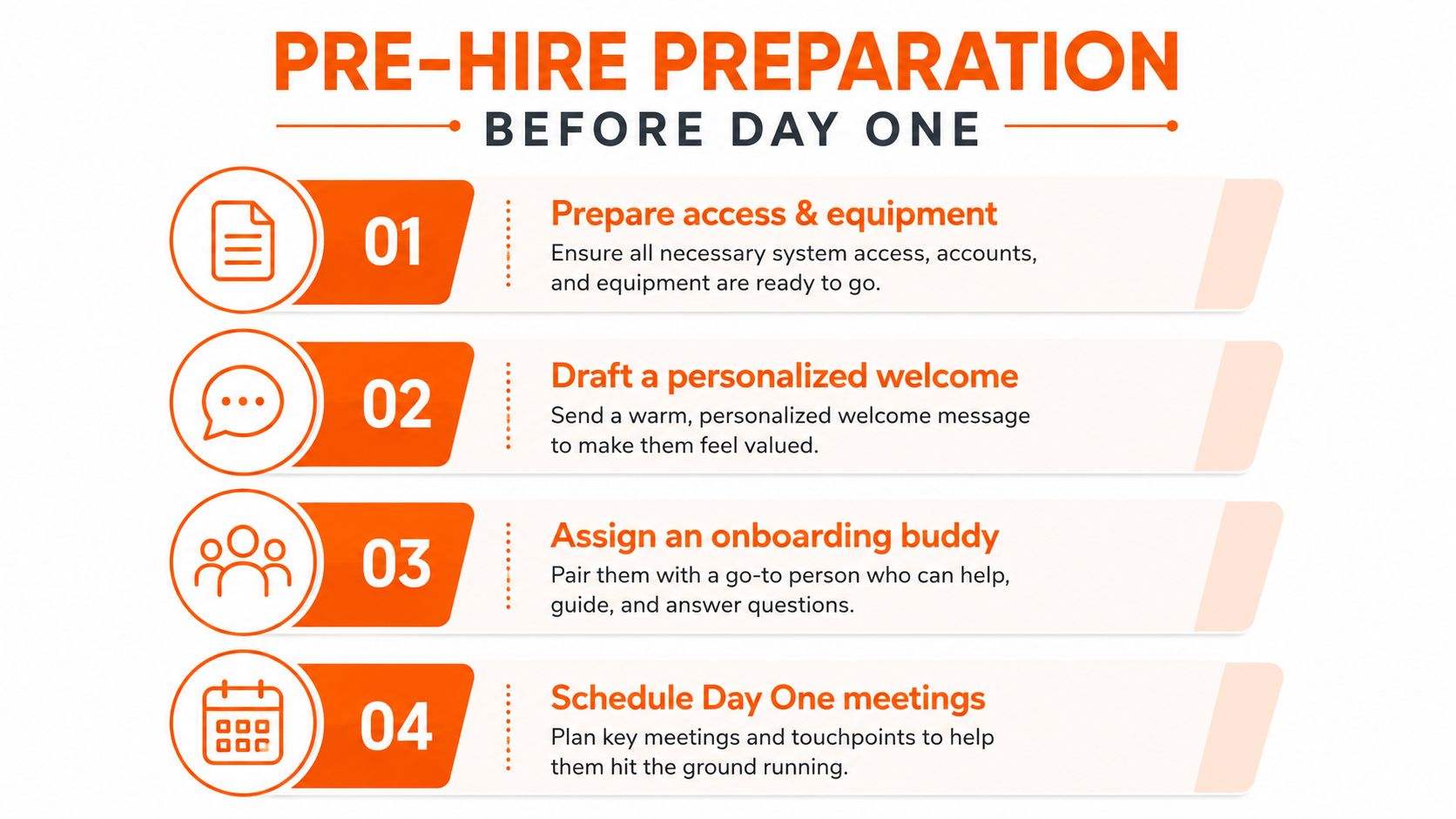
Build the pre-hire checklist like a launch plan
Start with equipment and access. Hardware needs to be tracked, shipped, and confirmed. Accounts for code, docs, chat, and project tools need to be provisioned before the first login. Remote onboarding guides consistently flag equipment shipping, HR forms, and collaboration-system access as prerequisites, not optional extras (WorkBright remote onboarding best practices).
Then prepare the documentation. A new hire should be able to self-serve across time zones, which means a searchable onboarding hub, role notes, and written SOPs. GitLab's remote handbook is useful here because it treats onboarding as a staged sequence, with clear written material and repeated check-ins rather than a single information dump (GitLab onboarding handbook).
For nearshore engineering teams, compliance is part of the same checklist. UK employers need right-to-work checks, payroll setup, and employment documents ready before day one. The government's Employer Checking Service and online right-to-work process sit inside that operational flow, not outside it (ClickLearn remote employee onboarding).
Assign ownership before the hire joins
Every item needs a named person attached to it. If IT owns laptops, HR owns documentation, and the hiring manager owns the first task, then nothing gets lost in a grey zone. That's the difference between a smooth start and a week of chasing.
A remote hire should never be the person discovering missing access. They should arrive to a ready environment.
For a practical hiring workflow that supports this model, the remote developer hiring guide is a useful internal reference for aligning recruitment, onboarding, and delivery readiness. The point is simple. By the time the new hire joins, the work environment should already be live, the first task should already be defined, and the team should already know who owns the next step.
The First 72 Hours That Set the Trajectory
The first 72 hours are where momentum is either protected or destroyed. If the new hire spends those three days waiting for access, asking the same questions twice, or guessing who to contact, you've already created friction. Remote onboarding should feel calm, direct, and prepared.
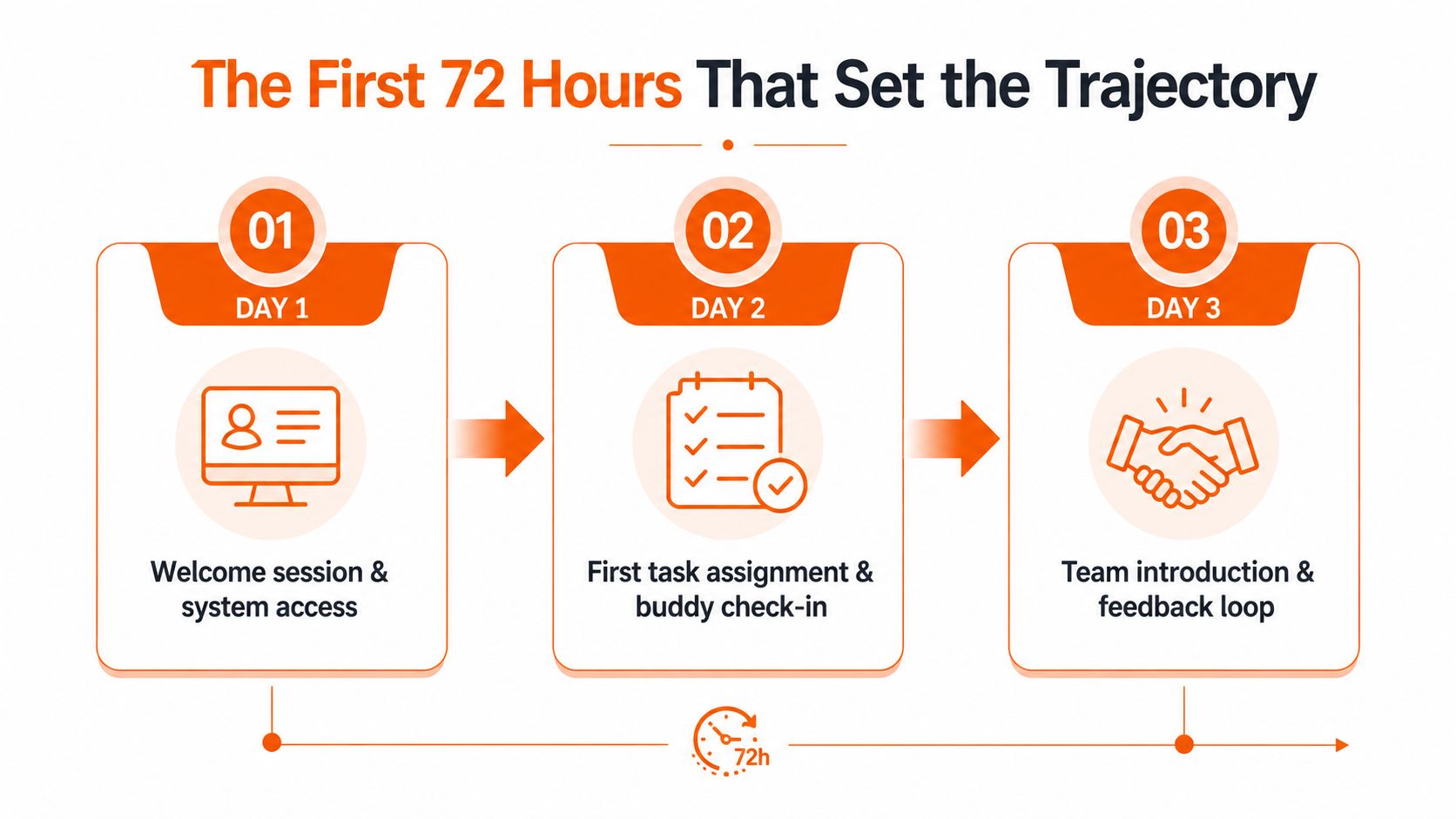
Day 1 is about clarity, not inspiration
The welcome flow needs to answer three questions immediately. Who owns this onboarding. What can the hire access right now. What should they do first. That sounds basic, but remote teams lose time when these answers are buried in informal chat threads.
The buddy assignment matters because it gives the new hire one human anchor. Not a group. Not a vague “reach out if needed.” One person. That buddy owns practical questions, points the hire to the right docs, and makes the first week feel navigable.
Day 2 should remove friction fast
Tool access confirmation comes next. The hire should be able to open the systems they need, move through the onboarding hub, and start the first meaningful task without waiting on another approval chain. Remote onboarding research shows how often this breaks down, with 63% of remote hires feeling undertrained, 60% feeling disoriented, 39% saying they got the right support, and 18% saying they got none at all (HiBob onboarding statistics). Those are not soft signals. They are operational risk.
Day 3 should prove contribution is possible
The first meaningful task should be small enough to complete, but real enough to matter. In engineering teams, that might be a low-risk ticket, a documentation update, or a contained bug fix. In nearshore handovers, the outgoing team member should walk through live systems, codebase structure, and current priorities in a synchronous session, not dump a folder and disappear.
If your team works across multiple schedules, calendar alignment for multiple ventures is worth reading because onboarding fails quickly when overlap windows are poorly managed. The goal in the first 72 hours is not inspiration. It is confidence, access, and one visible win.
30 60 and 90 Day Milestones With Measurable Outcomes
The 30, 60, and 90 day model only works if each checkpoint maps to business value. Generic “how do they feel” reviews are weak. You need milestones that show whether the hire is ramping, contributing, and becoming autonomous.
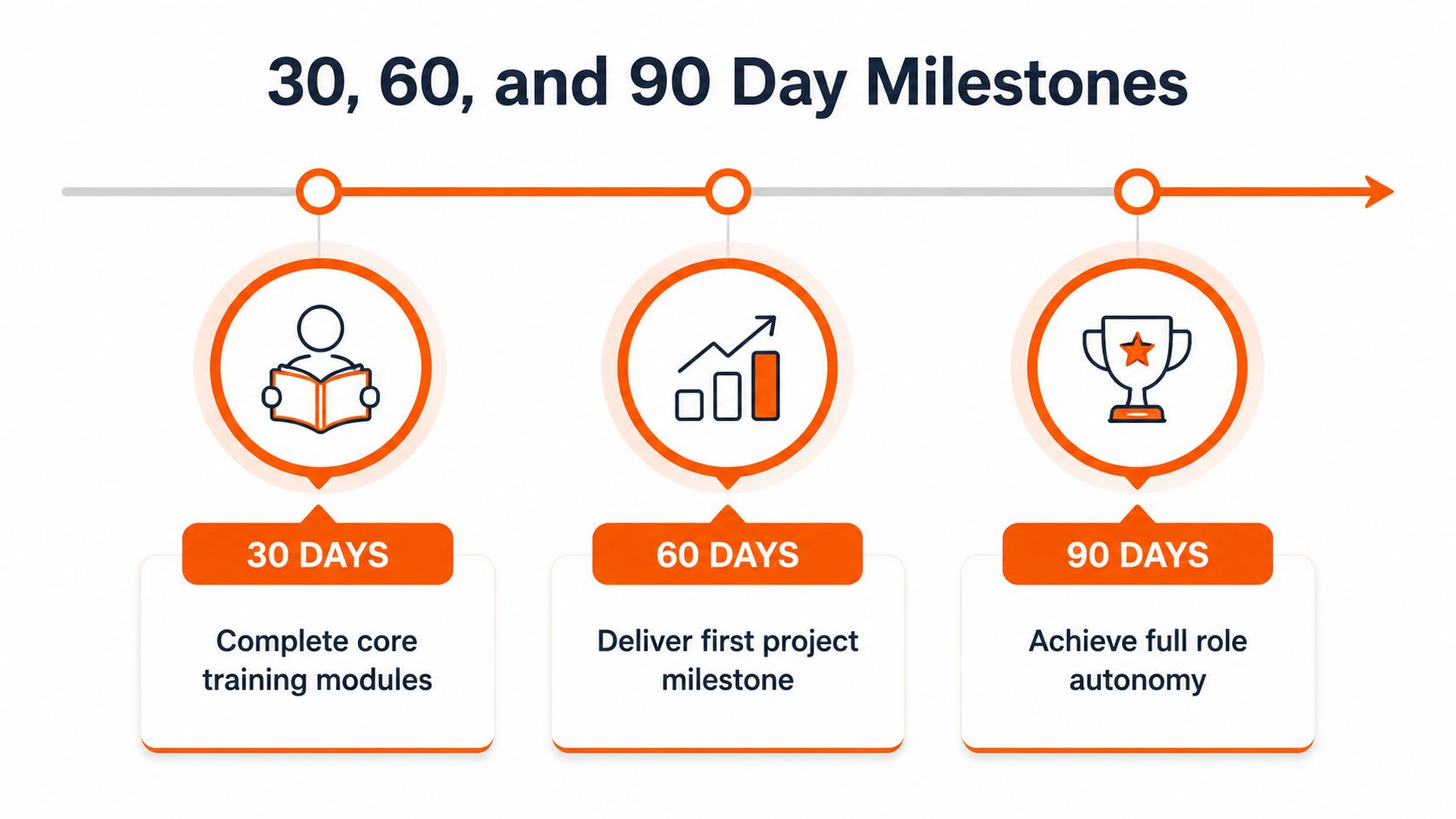
What good looks like by day 30
By day 30, the new hire should own independent tickets and have shipped their first feature or meaningful deliverable. They should know the code paths, the meeting cadence, and the documentation standard. That is the point where onboarding stops being a guided tour and becomes active contribution.
What good looks like by day 60
By day 60, the hire should be leading a small feature delivery end to end. They should be able to take a scoped piece of work, coordinate the dependencies, and move it through review without hand-holding. This is when you start seeing whether the team's documentation and communication norms are usable.
What good looks like by day 90
By day 90, the hire should contribute to an architectural decision or own a production incident response in their area. That does not mean they know everything. It means they can operate with judgment, ask the right questions, and act without waiting for constant direction.
The compliance-heavy side of onboarding often gets ignored in generic advice, so it's useful to pair milestone thinking with structured training design. If you're trying to launch a certification program, the logic is similar. Define the outcome, publish the criteria, and make progress visible.
Benchmark mindset: if a milestone cannot be measured, it is not a milestone, it is a hope.
The retention angle matters too. The first 90 days sit inside the highest-risk window for churn, and onboarding data shows why the conversation should focus on ramp time and delivery output, not just morale. When you track the first meaningful commit, first shipped ticket, and team velocity contribution, you get a real picture of whether the hire is becoming an asset or consuming manager time. For teams that build products, that distinction is everything.
Communication Rhythms and Nearshore Tooling Setup
Distributed teams do not fail because they have too little communication. They fail because communication is unstructured, undocumented, and owned by nobody. The fix is a clear rhythm, a clear tool stack, and explicit rules for when to go async and when to get people in the same call.
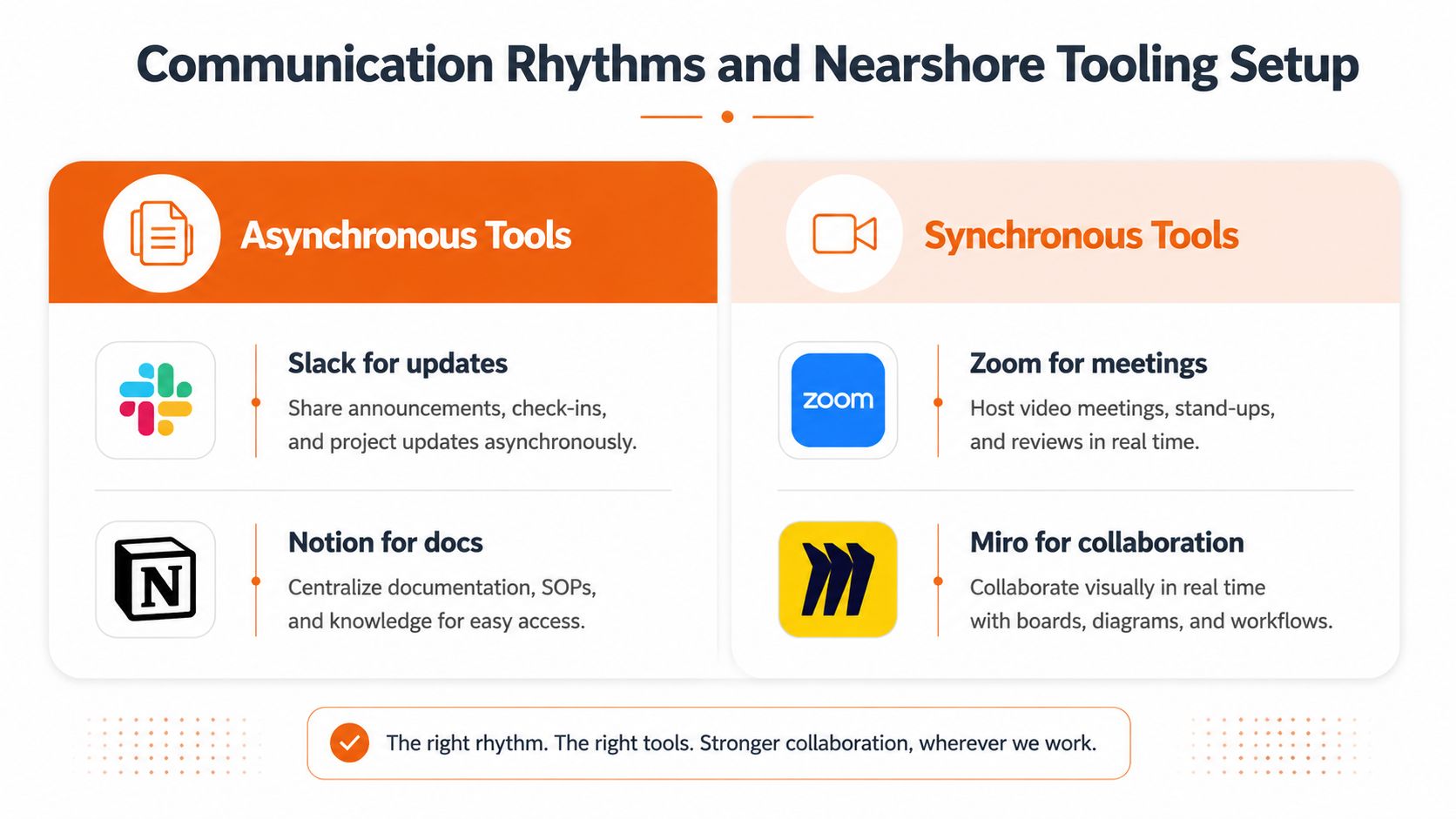
Use async for record, sync for decisions
Slack is for fast updates. Notion is for durable documentation. Zoom is for discussion when nuance matters. Miro is for collaborative working sessions. That split keeps knowledge from living in a single person's head and prevents every question from becoming a meeting.
Extreme Ownership shows up in communication norms. Every meeting needs an owner. Every decision needs to be written down. Every handover needs a response expectation. That is how you create predictability in a nearshore setup where overlap can be limited.
Set the cadence before work starts
Daily stand-ups should stay short and focused on blockers, active work, and dependency risk. Weekly syncs should review delivery, not drift into status theatre. Async documentation should capture decisions, not just activity. GitLab's remote onboarding approach makes the same point through written modules and open access to key materials, which is why it scales across time zones (GitLab onboarding handbook).
For teams juggling multiple calendars, the practical issue is overlap. Not every conversation deserves a meeting, but the right conversations need a planned overlap window. That is especially true for handovers, incident reviews, and first-week support. If you want a deeper operational view of distributed collaboration, best practices for remote team collaboration is the internal piece I'd point teams to.
Pick tools that support handover, not heroics
A lot of teams over-invest in chat and under-invest in written context. That creates dependency on whoever is online, which is exactly what remote onboarding should eliminate. A searchable onboarding hub, clear ticket ownership, and written SOPs keep work moving when people are not in the same time zone.
Rite NRG uses this same logic in delivery work, especially where teams need a partner who can help structure collaboration rather than just fill seats. That's the level of operational thinking remote teams need if they want onboarding to support shipping, not just orientation.
Common Onboarding Pitfalls and How to Fix Them
The first failure mode is delayed access and compliance gaps. You can see it early when a new hire is waiting on a laptop, blocked on a login, or unable to start because forms and checks were left until the last minute. In remote work, delay compounds because there's no desk-side shortcut.
The fix is boring but essential. Build a pre-day-one checklist, assign an owner to each item, and confirm completion before the hire starts. That checklist should include equipment, account provisioning, HR paperwork, and right-to-work administration. If any of those are missing, the launch is not ready.
The second failure mode is knowledge debt
Knowledge debt starts when the team assumes “they'll pick it up as they go.” That's how remote hires end up piecing together systems from random messages, stale docs, and interrupted calls. The result is slower delivery and more avoidable mistakes.
A proper handover documentation process fixes this by making knowledge explicit, searchable, and owned. The handover should include current priorities, decision history, system context, and the next actions the hire is expected to take. If the handover can't be read by someone who wasn't in the room, it's not complete.
The third failure mode is isolation
Remote hires can disappear socially before they fail technically. They stop asking questions, attend meetings without speaking up, and drift into low-confidence execution. That's usually a sign that the team gave them information but didn't build belonging or trust.
The fix is a buddy, a manager with a real first-90-day cadence, and visible response norms. A new hire should know who replies quickly, where decisions live, and how to escalate blockers. Remote onboarding research shows how often this goes wrong, with 74% of employees calling their remote onboarding a failure and 20% leaving within 90 days (Berkeley remote onboarding PDF). That makes early support a retention lever, not a nice-to-have.
The team that documents well and responds fast makes onboarding feel calm. The team that improvises makes it feel risky.
If you want onboarding remote teams to support real delivery, stop treating it as a welcome package. Run it as an operating system, with ownership, checklists, clear milestones, and explicit handovers. That is how you reduce ramp time, protect retention, and turn new hires into contributors instead of passengers.
If you want a remote onboarding model that is built for delivery, not theatre, work with Rite NRG. We help teams structure handovers, set ownership, and build nearshore delivery workflows that get people contributing fast. Visit Rite NRG to talk through your onboarding process and tighten the path from hire to impact.