
Most delivery risk management fails long before a project misses its date. It fails when leaders accept a green dashboard that hides weak ownership, external dependencies, uncertain estimates, and business outcomes nobody has defined. The National Audit Office briefing on major government projects found that 37 of 106 major government projects due to deliver in the next five years were rated red or amber-red, meaning delivery was in doubt or unachievable unless action was taken.
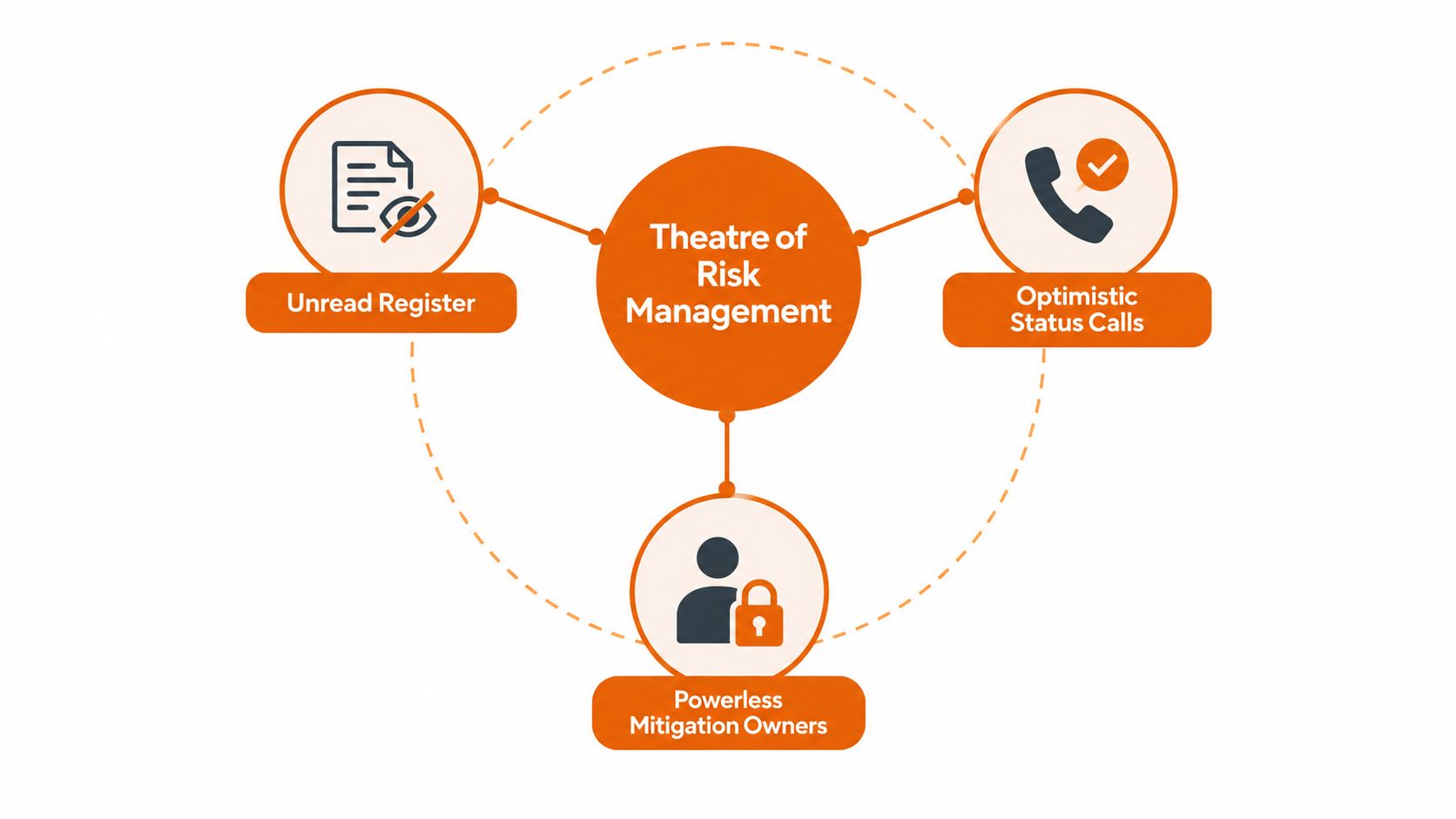
That isn't a software statistic, but it exposes the same management failure SaaS teams face. Risk reviews become theatre, while revenue commitments, time-to-market, customer trust, and investor confidence remain unmanaged. The answer is a control system built on Extreme Ownership, high energy, proactivity, and measurable business outcomes, not another colour-coded spreadsheet.
Why Most Delivery Risk Management Fails Before It Starts
Most risk registers aren't management tools. They're storage systems for uncomfortable information. Teams add a concern, assign a colour, mention it in a weekly call, and then move on without giving anyone the authority, budget, or decision rights needed to change the outcome.
The failure starts with framing. A delivery risk isn't merely a task that might slip. It's a condition that can damage a commercial result. A delayed integration can push revenue recognition into a later period. An unclear product decision can waste engineering capacity and weaken a launch. A fragile supplier can turn a routine release into a customer-facing outage.
Practical rule: If a risk doesn't connect to a business decision, it probably isn't being managed.
The UK government has treated risk management as a lifecycle activity for years. Its Government Functional Standard GovS 002 risk management guidance requires risks to be identified, assessed, responded to, monitored, and reported throughout a portfolio, programme, or project. It also calls for named owners, assessment of impact, likelihood, and proximity, with contingency held at the appropriate delivery level.
That standard matters because ownership must sit close to authority. A product manager who can identify scope risk but can't remove features isn't an owner. A technical lead who can see architecture risk but can't secure time for remediation isn't an owner either. They're observers.
Treat risk as a trade-off
A CFO doesn't describe every financial concern as red, amber, or green and then hope the board notices. Finance weighs exposure against investment, timing, and return. Delivery leaders should do the same.
For every material risk, ask:
- What business outcome is exposed? Revenue, adoption, retention, compliance, margin, or investor confidence.
- What decision changes the exposure? Reduce scope, add capacity, replace a supplier, change the architecture, or accept the risk.
- Who can make that decision? Name the person, not the department.
- What evidence proves the risk is reducing? Define an exit condition before spending begins.
The UK government also embeds risk thinking into assurance checkpoints, including Gate 4 readiness reviews, which require understanding of current, anticipated, and emerging risks, a RAID log, and residual-risk tracking. That approach is more useful than a passive register because it forces leaders to ask what remains exposed after mitigation.
The #riteway Methodology applies the same principle to SaaS delivery. Extreme Ownership means someone actively drives each risk to a decision. High energy means the team surfaces bad news early instead of protecting a status report. Proactivity means acting on weak signals before a customer, board member, or investor discovers the problem first.
The Eight Delivery Risks Every SaaS Team Must Classify
You can't mitigate what you haven't classified. A building project makes this obvious. The drawings define scope, the critical path defines schedule, inspections protect quality, and the supply chain determines whether work can continue. SaaS delivery has the same structure, even when the materials are code, data, cloud services, and decisions.
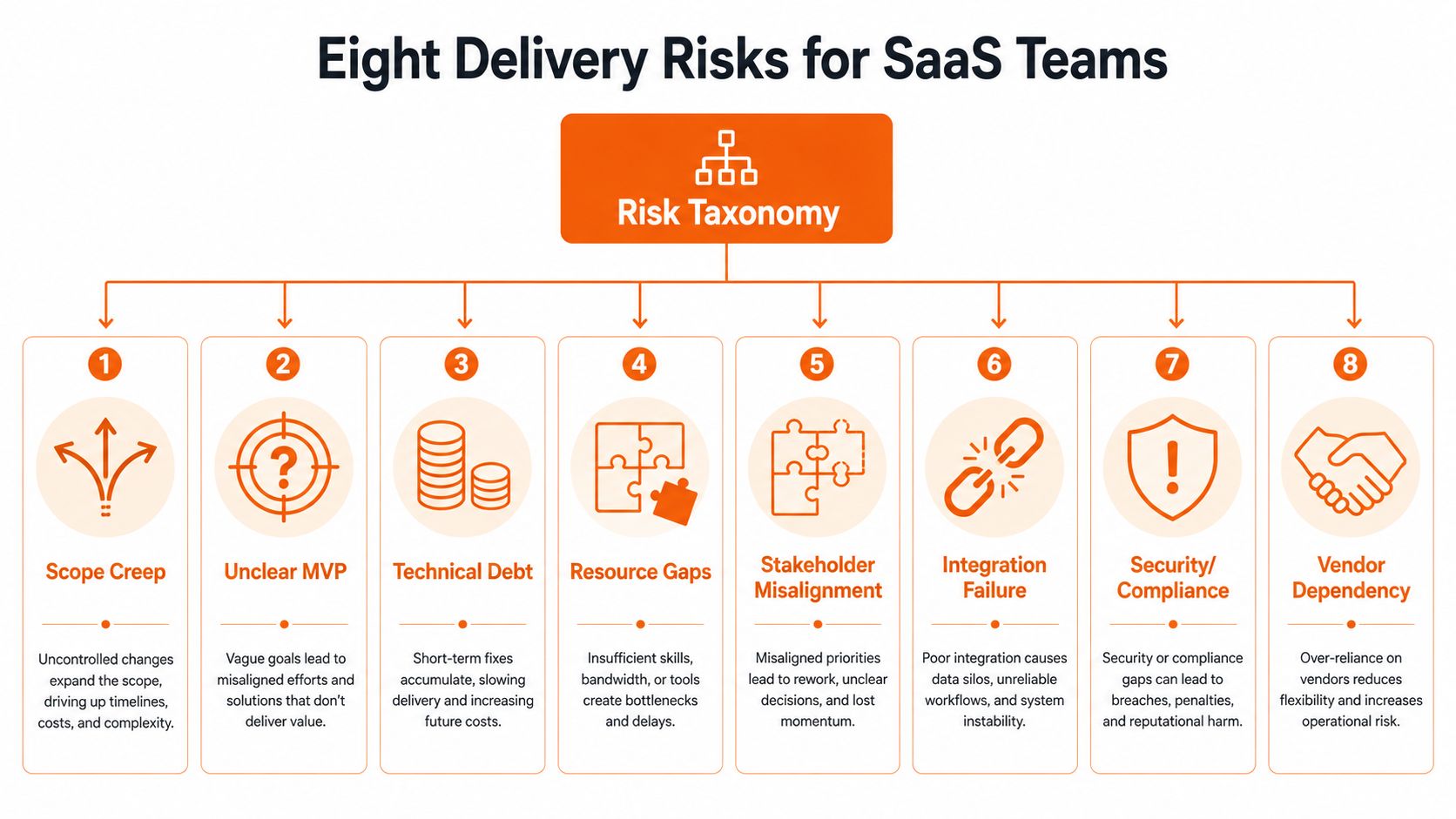
Use this taxonomy in retrospectives and planning sessions. Tag each concern once, then look for clusters rather than treating every symptom as a separate problem.
Scope risk is uncertainty about what the team must deliver, especially when the MVP has no firm boundary. The symptom is repeated reprioritisation and late acceptance criteria. Watch for a growing difference between committed and approved work.
Schedule risk appears when deadlines ignore dependencies, discovery, or integration work. The symptom is a chain of “small” slips that consumes the release buffer. Track the critical path and the age of blocked items.
Quality risk is the chance that defects escape into environments where they affect customers or operations. Rising production incidents, failed acceptance tests, and repeated regressions are direct signals.
Talent risk emerges when one person holds critical system knowledge or when attrition outpaces knowledge transfer. Look for unreviewed changes, unavailable subject-matter experts, and work that only one engineer can complete.
Vendor risk covers third-party reliability, contractual constraints, lock-in, and weak service visibility. API changes, slow support, unclear escalation routes, and missed supplier commitments should trigger review.
Technical-debt risk is the delivery drag created by architectural decay, fragile tests, obsolete dependencies, or shortcuts that make future changes slower. Cycle time rises while teams spend more effort making safe changes.
Security risk includes breach exposure, secret sprawl, excessive permissions, vulnerable dependencies, and insecure release practices. A security issue becomes a delivery issue when it blocks launch or forces emergency remediation.
Compliance risk covers audit findings, data residency obligations, privacy requirements, and regional operating rules. The symptom is late legal or security involvement, when changing the product is most expensive.
For schedule planning, teams should pair this classification with a practical software timeline planning guide. Estimation can't remove uncertainty, but it can expose assumptions about discovery, dependencies, integration, and validation before those assumptions become commitments.
Classification also makes conversations faster. “The release feels risky” is vague. “The release has vendor risk because the payment API contract is unverified” gives a team something it can own, test, and fund.
Choosing the Right Risk Assessment Framework
No assessment framework is universally correct. Each one makes some risks visible and hides others, so the right choice depends on the decision at hand.
| Framework | Best For | Blind Spot | Typical Cadence | Decision It Enables |
|---|---|---|---|---|
| Risk register | Auditability, ownership, and traceability | Emerging signals can disappear between updates | Weekly or at material change | Who owns the response and what action is open |
| Heatmap | Executive discussion and portfolio comparison | Coarse scoring can hide timing and dependency detail | Weekly or monthly | Where leadership should focus attention |
| RAG scoring | Fast status communication | Teams can accumulate “status debt” and protect amber ratings | Weekly | Whether work needs escalation |
| Failure mode and effects analysis | Safety-critical and compliance-critical paths | Too heavy for short iterative delivery cycles | At design change or control review | Which failure modes deserve preventive controls |
A risk register pays for itself when accountability and audit trail matter. It works well for decisions that require clear ownership, mitigation history, and residual-risk tracking. It doesn't reliably surface a new signal unless someone updates it.
A heatmap is useful in a steering committee because executives can understand concentration quickly. Its weakness is precision. Two risks may share the same colour while having very different detection windows, reversibility, or customer consequences.
RAG scoring is efficient, familiar, and often necessary for portfolio reporting. It also invites political behaviour. Teams may keep a risk amber because red triggers scrutiny, while leaders mistake stable reporting for stable delivery.
Failure mode and effects analysis earns its overhead when failure has serious safety, regulatory, or operational consequences. It forces structured thinking about causes, effects, controls, and detection. Applying it to every small sprint creates documentation burden without better decisions.
The best framework is the cheapest one that changes the decision you need to make.
Compose a lightweight stack. Use a register for ownership, a heatmap for executive focus, and targeted failure analysis for critical paths. Add RAG only when a leadership audience needs a consistent escalation language. The framework should serve the operating model, not become the operating model.
Prioritising Risks So the Top Three Get Funded
A long risk list creates false comfort. It gives everyone something to report and nobody enough focus to fix the problems that can damage the business. Prioritisation should turn uncertainty into funded action.
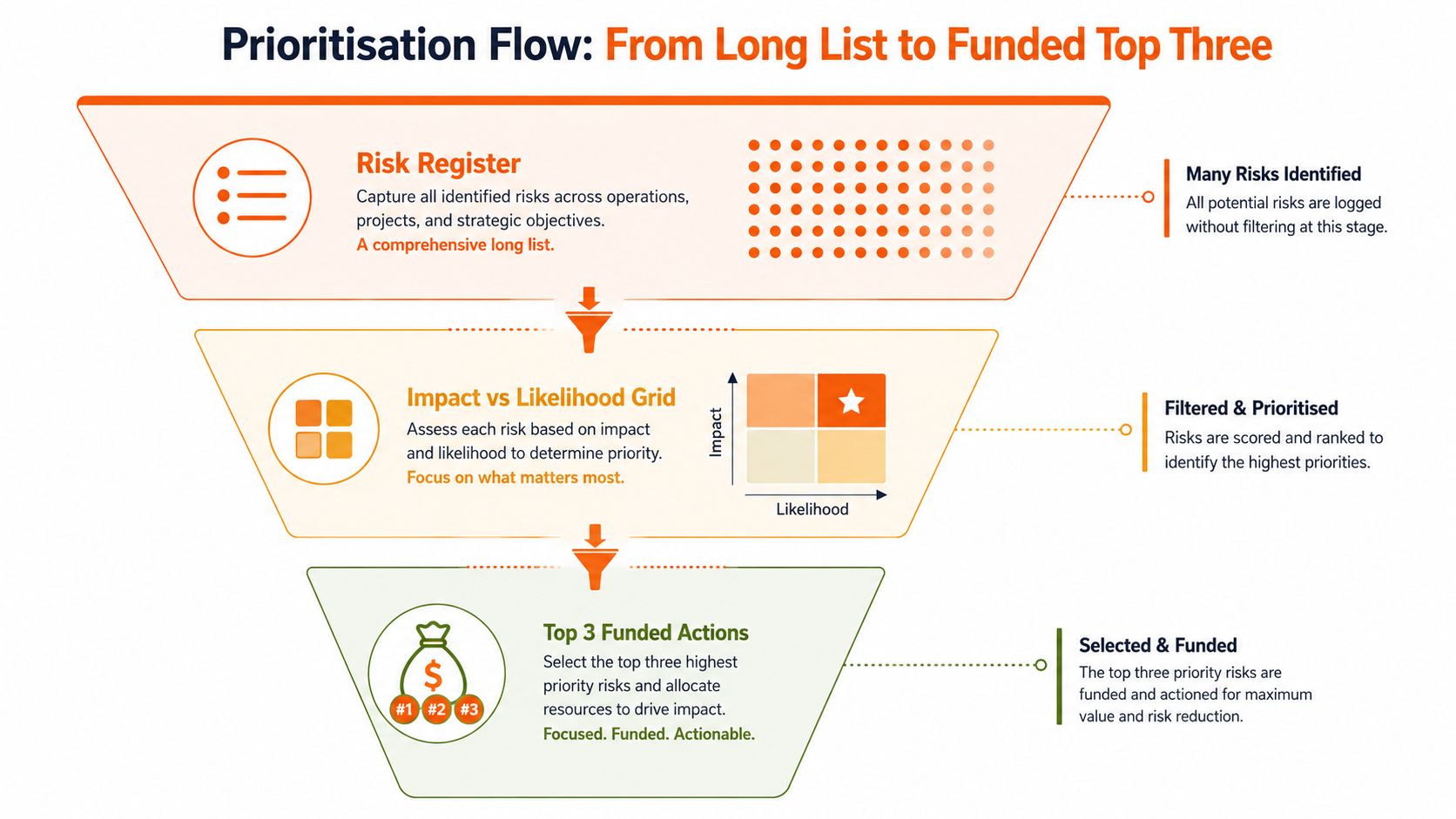
Start with impact versus likelihood, but don't stop there. Add time-to-detect. A risk discovered during sprint planning may be cheap to change. The same risk discovered after release can involve customer support, rollback, contractual exposure, and reputational damage.
Use a practical funding flow
Score exposure. Rate business impact and likelihood using a consistent scale. Link impact to revenue, customer commitments, adoption, compliance, or strategic timing.
Add detection timing. Rank risks higher when the team won't discover them until production, customer acceptance, or a dependent supplier failure.
Apply a customer-first weighting. A defect affecting a customer workflow deserves more attention than internal inconvenience, even if the internal issue creates more noise.
Test mitigation economics. Reject controls that cost more than the loss they reasonably prevent. Prefer controls that reduce several connected risks at once, such as contract tests that protect schedule, quality, and vendor dependency.
Fund only the top three. Every funded action needs a named owner, a budget ceiling, and a 30-day exit criterion. The criterion must prove risk reduction, not merely prove that a meeting occurred.
Suppose a team logs ten risks. Three receive funding: a payment integration contract test, a knowledge-transfer sprint for a critical service, and a release-scope reduction. Each owner reports evidence within 30 days. The remaining risks stay visible, but they don't consume scarce capacity without a clear case.
Extreme Ownership becomes operational. The owner doesn't promise to “keep an eye on” the risk. They define the next decision, secure the support required, and show whether the exposure has fallen.
Mitigation Playbook for High-Risk Delivery Workstreams
Consider an Order Management platform that has started hitting latency cliffs as volume rises. The commercial team has committed to a larger customer rollout, but the platform's architecture, release process, and supplier dependencies haven't caught up. The response shouldn't be a heroic weekend. It should be a sequence of controls with observable exit conditions.
Start by stopping scope from moving
The product lead introduces a feature freeze and uses MoSCoW prioritisation to separate must-have customer outcomes from attractive additions. The trigger is any new feature request that threatens the rollout path. The exit condition is an approved release scope with acceptance criteria and no unreviewed additions.
Schedule risk needs a different intervention. The team breaks vendor discovery into fixed-price milestones, with contractual consequences for supplier slippage. The trigger is a dependency without verified effort, ownership, or acceptance evidence. The exit condition is completed discovery, accepted deliverables, and a credible dependency plan.
For a broader explanation of controls and response patterns, teams can use this risk mitigation strategy for SaaS delivery as a reference point.
Build capacity while reducing concentration
The platform depends on a small group of engineers who understand its order orchestration logic. A Build-Operate-Transfer arrangement adds a nearshore team that operates alongside the internal engineers, then transfers capability through paired delivery, documentation, and deliberate ownership changes.
The trigger is a critical service with a single point of failure or an unresolved skills gap. The exit condition is internal staff completing agreed changes without relying on the original specialist, supported by reviewed runbooks and successful handover sessions.
Technical debt gets a strangler-fig treatment. The team places new behaviour around the old component, routes traffic gradually, and gates each refactor through CI/CD. The exit condition isn't “architecture improved”. It's a safer boundary, passing automated checks, and a measured reduction in the legacy path that blocks change.
Make quality and security release controls
Automated regression suites run on every merge, with the release blocked when critical customer journeys fail. The trigger is a repeated escaped defect or a change in a high-risk order flow. The exit condition is a stable test suite covering the agreed journeys and a release decision based on evidence.
Security shifts left through static application security testing, secret scanning, dependency review, and runtime observability. The trigger is an unresolved security finding in a release path or unexplained runtime behaviour. The exit condition is remediation or explicit risk acceptance by the authorised owner.
Compliance work starts before the launch gate. The team maps required controls to the product's operating processes, prepares evidence, and closes findings as part of delivery rather than treating audit as a final inspection. The exit condition is an evidence pack that reviewers can verify without reconstructing months of delivery history.
Transfer knowledge as part of delivery
Paired programming and codified runbooks address the risk that the new team can ship code but can't operate the product. The trigger is any operational procedure known only through informal conversations. The exit condition is a second engineer performing the procedure from the runbook and completing it successfully under review.
This is the difference between activity and mitigation. A workshop is activity. A verified handover is mitigation. A dashboard is activity. A release gate tied to customer outcomes is mitigation.
Governance Communication and AI-Driven Delivery Signals
Governance should make decisions faster, not create more meetings. A strong operating rhythm gives engineers and executives the same underlying numbers, then gives each forum a clearly bounded decision right.
The weekly delivery review should last 30 minutes and follow a fixed agenda. Review DORA metrics, changes in the risk heatmap, blocked-item count, and AI-flagged anomalies from delivery and product telemetry. Useful signals include rising defect clusters, slipping cycle time, unusual deployment behaviour, and a sustained drop in team sentiment captured through approved stand-up analysis.
AI doesn't replace judgement. It identifies patterns humans may miss when information is spread across Jira, GitHub, CI/CD, incident tools, and customer feedback. The delivery lead still validates the signal, explains its business implication, and assigns the response.
| Forum | Cadence | Attendees | Key Inputs | Decision Right |
|---|---|---|---|---|
| Delivery review | Weekly | Product, engineering, delivery, QA | DORA metrics, risk deltas, blockers, AI signals | Escalate, replan, or assign mitigation |
| Steering committee | Monthly | Executive sponsor, product, finance, technology, delivery | Budget, scope, vendor performance, residual risk | Approve funding, scope trade-offs, or risk acceptance |
| Portfolio review | Quarterly | Leadership and portfolio owners | Strategic outcomes, investment position, delivery confidence | Reprioritise initiatives and capacity |
Each review produces an artefact. The weekly meeting updates the action log and dashboard. The steering committee records decisions, budget changes, and accepted residual risks. The portfolio review changes investment priorities or stops work that no longer supports the strategy.
Escalate on thresholds, not emotion
A red signal should have a defined route. The delivery owner first validates the evidence, then escalates to the person with authority to change scope, funding, supplier terms, or staffing. If no decision is made within the agreed window, the issue moves to the steering committee.
The UK government Project Delivery standard reinforces this governance principle by requiring contingency to sit at the appropriate level and be authorised through change control. Contingency isn't a team free-for-all. It is controlled funding for known uncertainty.
Delivery KPIs That Actually Predict Outcomes
Velocity and burndown answer whether a team completed planned work. They don't answer whether the company is closer to revenue, adoption, retention, or a viable launch. A dashboard full of story points can still describe a failing product.
The UK government Digital, Data and Technology Playbook says requirements should be set at the outset and tested through approval stages so progress can be measured towards an appropriate solution and value for money can be demonstrated. That is the right standard for SaaS teams too. Delivery output matters only when it advances an intended outcome.
| Vanity Metric | Decision-Useful KPI | Question It Answers |
|---|---|---|
| Story points completed | Cycle time and lead time | Can we reach customers predictably? |
| Lines of code | Escaped defect rate and change failure rate | Are changes safe and valuable? |
| Hours logged | Deploy frequency and MTTR | Can we release and recover reliably? |
| Burndown percentage | Forecast accuracy | Are commitments honest? |
| Features shipped | Revenue or adoption proxy by release cohort | Did the release change customer behaviour? |
Read three signals together. Schedule tells you whether the outcome can arrive when promised. Quality tells you whether shipping will create avoidable operational cost. Customer impact tells you whether the work deserves continued investment.
If schedule is slipping while quality worsens, hold or reduce scope. If quality is stable but customer adoption remains weak, investigate product value rather than adding capacity. If customer impact is strong and delivery is controlled, invest in scaling the path.
The software delivery metrics guide can help teams build a more decision-oriented measurement system. The test is simple: if a KPI can't change a decision before the quarter ends, it belongs in analysis, not on the executive dashboard.
Nearshore Partners and AI in Action Two Delivery Stories
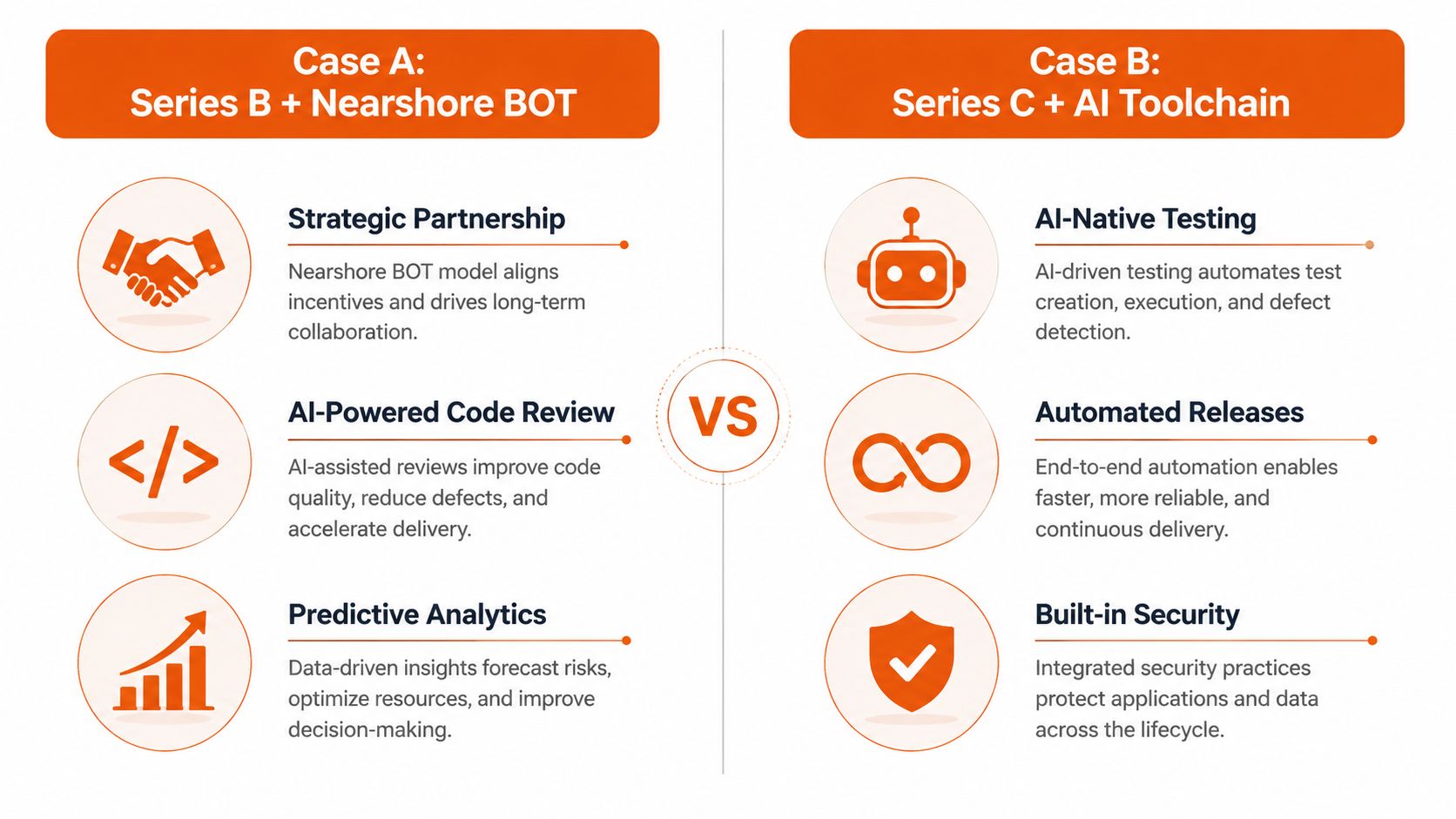
One delivery model produces predictable control through shared ownership. Another produces cost visibility while hiding delivery exposure. The difference isn't geography alone. It is the operating model around the team.
Case A with nearshore ownership
A Series B SaaS company preparing for EMEA expansion pairs with a nearshore Build-Operate-Transfer partner. The partner joins the existing rituals, takes ownership of selected workstreams, and builds internal capability rather than creating a permanent external dependency.
AI-assisted code review highlights risky changes, while predictive delivery analytics flag a release trending overdue. The team responds early, removes low-value scope, and strengthens the quality gates around the affected path. The flagged-overdue release is compressed by four weeks, deployment frequency rises threefold, and the risk register moves from 22 open items to six managed ones, as reported in the UK IT project management industry report.
The result isn't “more developers”. It is a clearer system of ownership, earlier signals, and decisions tied to commercial timing. Teams evaluating this model should use a structured nearshore partner selection guide that tests communication, technical ownership, handover capability, and governance fit.
Case B with fragmented execution
A comparable company chooses a low-cost offshore vendor without shared delivery rituals. Internal leaders ignore technical-debt signals, automated quality gates aren't in place, and vendor performance is discussed only after deadlines move.
The apparent saving becomes a missed renewal and a write-down. The problem isn't that outsourcing automatically creates risk. The problem is that nobody built a control system capable of seeing, owning, and reducing it.
UK supply-chain evidence makes the external-dependency issue harder to dismiss. The 2025 Cyber Security Breaches Survey found that only 14% of businesses reviewed risks from immediate suppliers and just 7% reviewed wider supply-chain risks. For SaaS teams dependent on cloud services, APIs, and open-source components, supplier governance is both a security control and a delivery control.
Rite NRG offers nearshore dedicated teams, platform development, delivery consulting, and Build-Operate-Transfer R&D centres in Poland, with AI-supported processes used to surface delivery signals and coordinate work. Visit Rite NRG to discuss a delivery-risk review, a senior nearshore team, or a Build-Operate-Transfer model designed around your product outcomes.