A risk mitigation strategy is a structured plan to identify, prioritise, and control threats to business outcomes, especially delivery, security, and continuity. In the UK, that matters because 43% of businesses and 30% of charities reported a cybersecurity breach or attack in the previous 12 months, and the average annual cost of cyber crime was estimated at £1,205 for businesses overall, rising to £10,830 for medium businesses and £16,690 for large businesses (UK Cyber Security Breaches Survey 2025 summary).
If you're shipping SaaS, modernising a legacy platform, or trying to get an MVP out without embarrassing your investors, you're already doing risk mitigation whether you call it that or not. The question is whether those controls are owned, monitored, and tied to product goals, or whether they're buried in a spreadsheet nobody trusts.
What Risk Mitigation Strategy Really Means for SaaS Teams
A founder ships a feature with a strong demo, then the release starts wobbling in staging because a third-party API is flaky, the auth flow breaks under load, and no one has ownership of rollback. That is a delivery and business-risk problem that was left without clear ownership.
The plain-English definition
Risk mitigation strategy means you identify the threats that can hurt delivery, security, revenue, or continuity, then you choose controls that reduce their likelihood or impact. In SaaS, that covers product risk, engineering risk, vendor risk, compliance risk, and release risk, because each one can delay shipping and erode customer trust.
The important shift is this: mitigation is not a document for auditors. It's a working system that shows the team what could go wrong, who owns the response, what “good” looks like, and how you will know the control is still doing its job after the next change.
A practical way to say it to your team is simple, we use risk mitigation to keep product delivery predictable, service reliable, and customer commitments realistic. That line is blunt for a reason. Vague language gets ignored, especially when deadlines are close and the release queue is already crowded.
Why SaaS teams need a living system, not a checklist
Static risk lists fail because software changes too fast. A new dependency, a release train, or a vendor swap can invalidate yesterday's assumptions, which is why the strongest teams treat mitigation like an operating rhythm, not a one-off workshop. The old habit of logging a risk and moving on leaves founders exposed when the next deadline arrives.
Practical rule: if a risk does not have an owner, a control, and a review date, it is not mitigated. It is just documented.
For teams building under pressure, ownership matters more than polished wording. Extreme Ownership in delivery means somebody accepts responsibility for the outcome, not just the task. If vendor decisions are part of the risk picture, a clear vendor due diligence process belongs in the same conversation as product planning and delivery control. If you want a useful template for scoping delivery and proving why a risk matters, explore R&D claim resources alongside your product and delivery planning.
In practice, the stronger SaaS teams connect risk mitigation to shipping cadence. They tie it to sprint planning, release readiness, incident response, and vendor management, then ask a simple question every time, does this control still protect the outcome we care about? If the answer is no, the control needs work.
Why Risk Mitigation Is a Board-Level Priority in the UK
A SaaS founder can ignore risk until the first serious incident lands in the board pack. At that point, the issue is no longer a delivery concern, it is a governance failure. UK boards are expected to identify principal risks, decide how much risk they are willing to carry, and monitor internal controls on an ongoing basis, not just at year end when the paperwork is due (FRC guidance via NIST publication).
Why the UK context changes the conversation
UK boards are not just looking for evidence that risks were recorded. They want proof that the business can keep shipping, keep serving customers, and keep control when something goes wrong. That is why risk mitigation belongs in delivery governance, not in a separate document that nobody revisits.
The current UK cyber picture makes that point hard to ignore. The UK Government's Cyber Security Breaches Survey 2025 shows that breaches and attacks remain common across organisations, and phishing is still the most frequent attack type (UK cyber risk summary). For SaaS founders, the takeaway is straightforward. A breach hits uptime, customer trust, sales momentum, support capacity, and investor confidence at the same time.
If your product serves UK customers, mitigation is part of the business model. Boards expect continuity, and they expect evidence that continuity is being protected with real controls, not vague assurances.
Governance has pushed risk far beyond finance
The UK governance model has expanded risk oversight well beyond finance and audit. After the 2008 financial crisis, risk management became more embedded in corporate governance, and the Modern Slavery Act 2015 added another layer by requiring larger organisations to publish annual slavery and human trafficking statements (historical governance context). The point is simple. Risk now spans cyber, supply chain, compliance, and resilience, so board oversight has to do the same.
For software businesses, that broadening is practical. Cloud providers, payment processors, outsourced engineering teams, and data-processing partners all sit inside the risk picture. A weak vendor review can become a delivery failure just as quickly as a bad code change, which is why our vendor due diligence guide belongs in the same planning discussion as release control and product scope.
The right response is tighter prioritisation, clearer control ownership, and evidence that stands up in a board meeting. Senior teams running SaaS, MVP, or legacy-modernisation work need a mitigation approach that links risk actions to delivery outcomes and commercial outcomes. That is what keeps senior nearshore teams, AI-enabled review loops, and product leadership aligned on the risks that threaten the business.
The Four Core Risk Treatment Options Explained
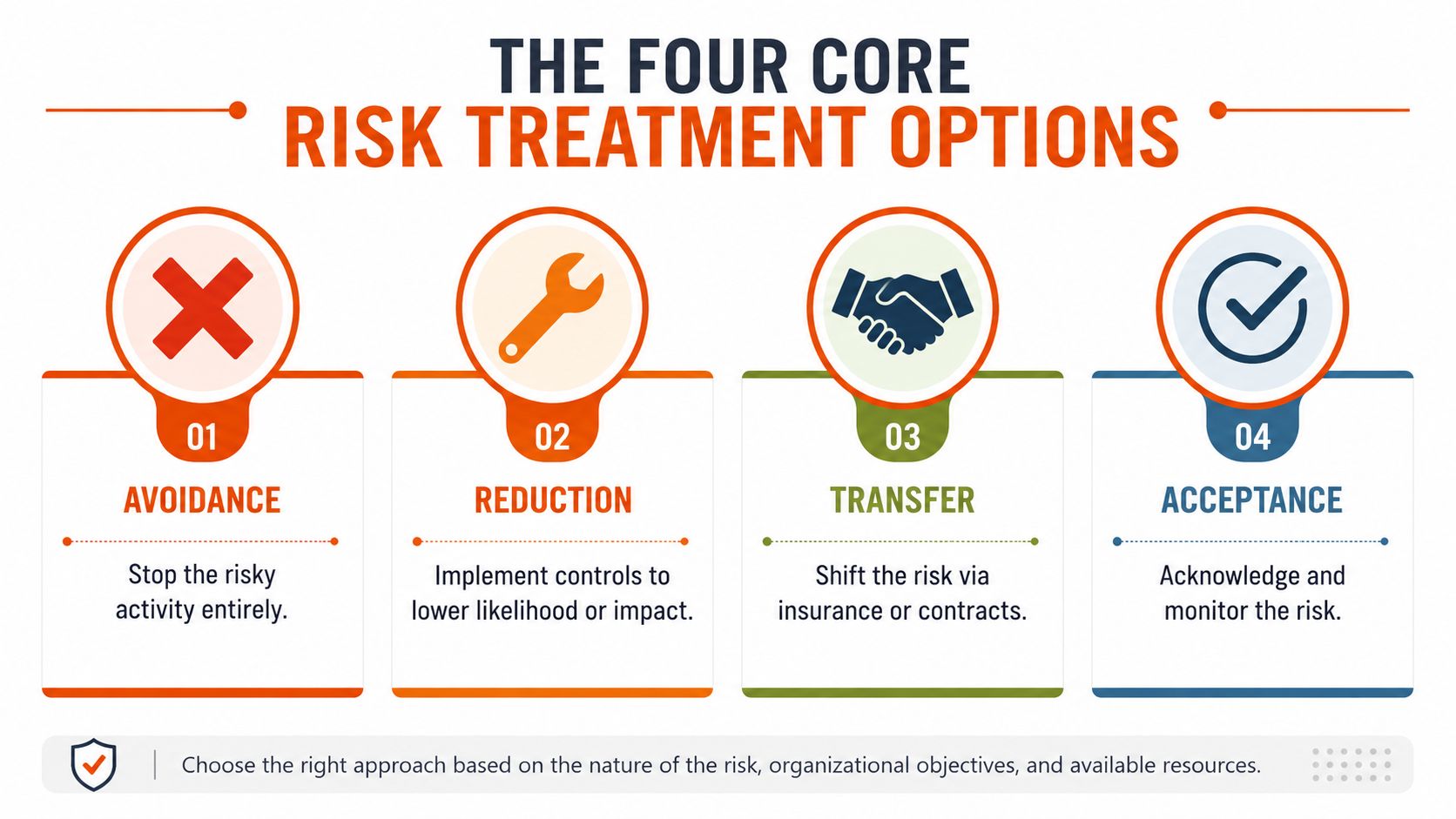
Teams often say they're mitigating risk, but they're usually mixing four different choices without being honest about the trade-offs. The four options are avoidance, reduction, transfer, and acceptance, and each one has a place when you're making delivery decisions under pressure.
Choosing the right treatment
Avoidance is the cleanest choice when a risk is too expensive or too dangerous to carry. If a legacy integration is so brittle that it threatens launch stability, the right call may be to remove the dependency altogether rather than patch around it.
Reduction is what most SaaS teams use most often. You keep the activity, but add controls, such as layered authentication, isolation boundaries, better test coverage, feature flags, or release gates, so the likelihood or impact drops. The key is discipline, because a weak control that nobody checks isn't mitigation.
Transfer shifts part of the exposure to another party through contracts, insurance, or defined vendor responsibilities. That can help, but don't fool yourself into thinking transfer removes operational responsibility. If a vendor fails, your customers still call you.
Acceptance is the honest choice when the risk is real but the cost of fixing it is worse than living with it for now. That only works if the risk is visible, tracked, and reviewed, not buried in a backlog.
Match treatment to business criticality
A sane prioritisation model starts with two questions, how bad is the outcome, and how likely is it to happen? Once you answer those, you can decide whether to avoid, reduce, transfer, or accept. That approach fits the iterative mitigation model used by DNV and MITRE, which describes mitigation as identifying, analysing, prioritising, implementing, and continuously monitoring controls until residual risk is acceptable (iterative risk mitigation approach).
Direct advice: don't “reduce” everything by default. Some risks should be removed, some should be contractually shifted, and some should be accepted because they're small and well understood.
For product and engineering leaders, the rule is simple. High-severity risks tied to revenue, security, or service continuity deserve strong controls and clear ownership. Lower-severity risks can stay in acceptance, but only if someone revisits them during planning and release reviews.
The mistake I see most often is pretending that a generic control is the same as a real treatment plan. It isn't. A real plan tells you why this option won, who owns it, and how you'll know it's still effective after the next sprint.
How to Design and Implement a Mitigation Plan
A mitigation plan works when it lives inside delivery, not beside it. If your team has to leave Jira, Confluence, and release planning behind every time it wants to review risk, the process will die fast.
Start with identification, then force prioritisation
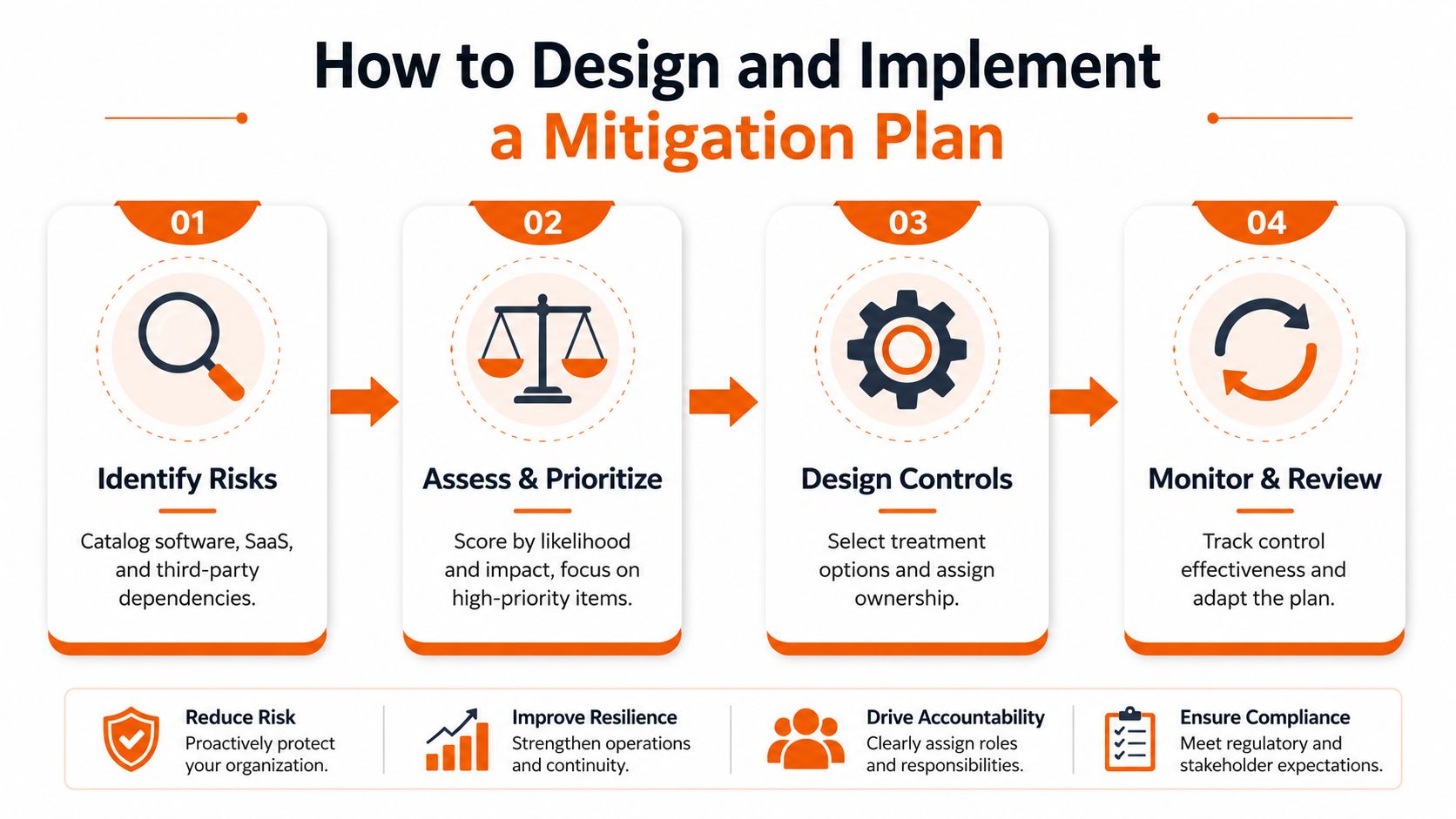
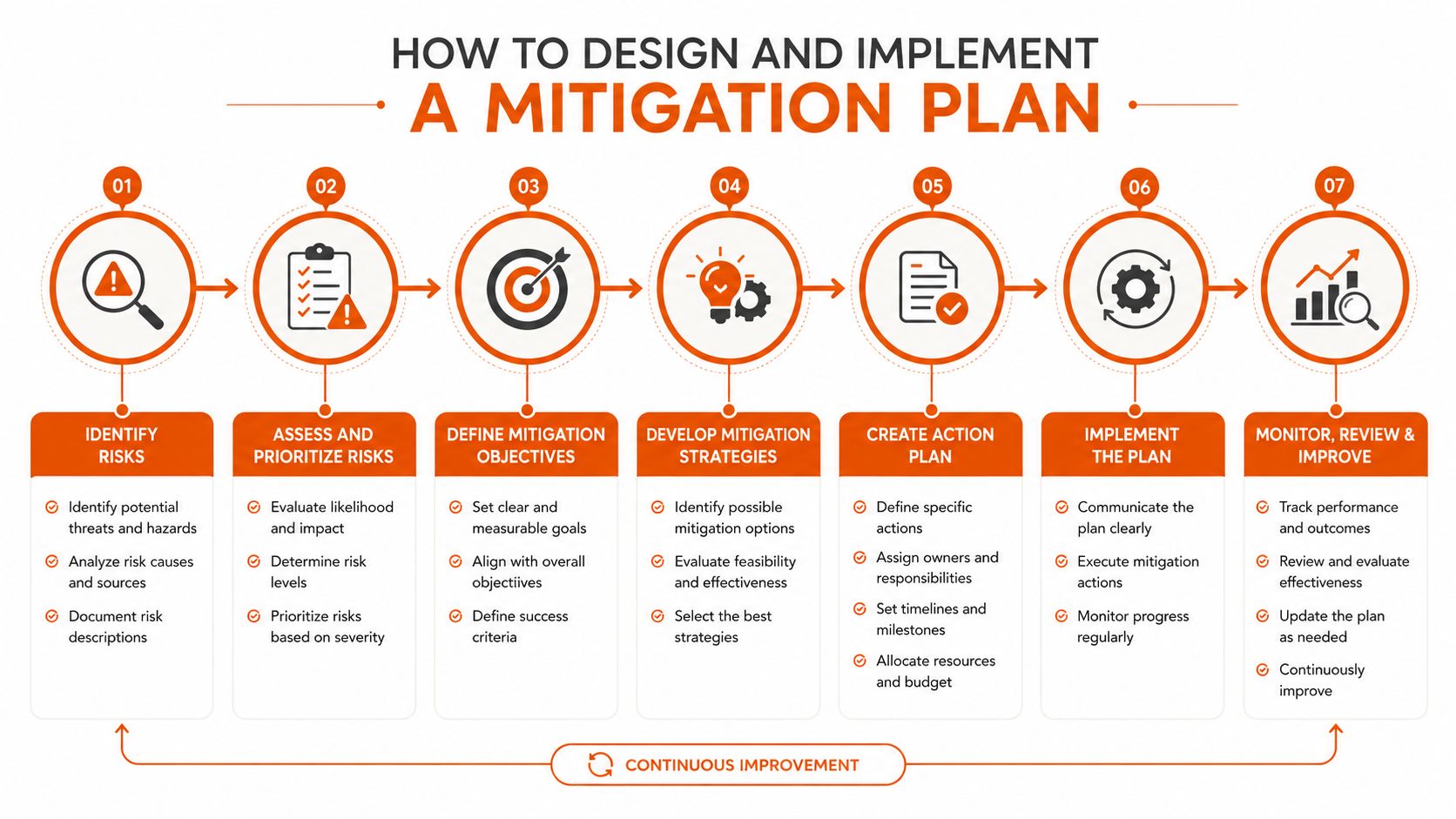
Begin by listing the risks that can break delivery, security, or continuity. That includes critical dependencies, weak release points, unknown vendor exposure, unclear ownership, and architectural choices that create single points of failure. For SaaS teams, the goal isn't to catalogue everything, it's to surface the risks that can hurt the business.
Next, assess likelihood and impact, then rank the list. The rankings don't need to be fake precision, but they do need to be consistent enough that the team can compare risks and decide what deserves attention first. If the list can't support prioritisation, it won't support decision-making.
Assign ownership and define the control
Every meaningful risk needs a named owner, a treatment choice, and a control that can be checked. A control is only useful if someone can verify whether it's working. For example, if the risk is third-party downtime, ownership might sit with the platform lead, and the control might be graceful degradation plus a tested fallback path.
Extreme ownership matters. Senior teams don't pass risk sideways and hope it disappears. They take the issue, name the decision-maker, and make the trade-off visible. That is how you keep momentum without pretending the problem isn't there.
Build monitoring into delivery rituals
Risk review should sit inside sprint planning, backlog refinement, release readiness, and vendor reviews. That keeps the plan alive. If a control stops working after a change, you want to find out before customers do.
Practical rule: a mitigation plan is finished only when the team knows how it will detect control failure.
If you need a partner that approaches delivery this way, Rite NRG is one option among several nearshore teams that combine senior engineering, product-first thinking, and AI-supported processes to surface risks early in delivery.
The cleanest mitigation plans make evidence easy to review. That means the team can show what changed, who approved it, what control was added, and when the control will be checked again. That's what turns risk work into a repeatable delivery advantage.
Practical Examples and Templates for Real Projects
A good risk framework only becomes useful when it fits the mess of real projects. MVP launches, nearshore delivery, and legacy modernisation all carry different risks, but they all need the same discipline, visible ownership, clear treatment, and a simple way to make decisions under pressure.
A founder pushing an MVP to market usually cares about speed, but speed without control creates avoidable rework. A CTO modernising a legacy platform cares about stability, but stability without prioritisation becomes paralysis. A nearshore delivery lead has to balance both, which is why good templates matter.
Here's the sort of structure I'd use on day one:
| Risk | Likelihood | Impact | Treatment | Owner | Control Status |
|---|---|---|---|---|---|
| Authentication failure during launch | High | High | Reduction | Platform Lead | Monitored |
| Vendor API instability | Medium | High | Transfer and reduction | Delivery Manager | Needs review |
| Slow release approvals | Medium | Medium | Reduction | Product Owner | In progress |
| Legacy data migration defect | High | High | Avoidance or reduction | Engineering Lead | Not started |
That table is simple on purpose. It forces the team to decide what matters, who owns it, and whether the control exists yet. If your project can't support this level of clarity, the delivery risk is already too high.
Use the right artefact for the conversation
A risk register is for ownership and action. A heatmap is for executive conversations, because it helps leaders see what sits in the danger zone. A control ownership model is for execution, because it tells delivery teams who is responsible.
The most effective teams don't use these artefacts as theatre. They use them to drive decisions about scope, sequencing, and vendor dependence. If you're scoping prototypes, the examples in Rite NRG's prototype guidance are useful because they keep the conversation anchored on what should be validated early, not what looks impressive in a slide deck.
A sensible template for investors or delivery partners is straightforward, risk, why it matters, current control, owner, next review date, and decision needed. That's enough to keep everyone honest without drowning the team in ceremony.
Common Risk Mitigation Mistakes and How to Avoid Them
The biggest risk mitigation failure I see is fake progress. Teams fill in a spreadsheet, call it governance, and then keep shipping as if the control environment will somehow hold itself together.

The anti-patterns that keep showing up
Unowned controls are the first problem. If nobody is accountable, the control drifts until it fails. Static registers are next, because they don't change when architecture, vendors, or release scope changes. Checkbox mitigation is another trap, where the team documents activity but never tests whether the risk has dropped.
Third-party exposure is often the blind spot. Teams trust vendors because the contract looks neat, then discover too late that the dependency is operationally critical. That's where senior nearshore teams can help, because they tend to surface these handoffs earlier and challenge weak assumptions before they become incidents.
Why AI-enabled delivery helps, if the team uses it properly
AI should not replace judgement. It should help the team spot patterns sooner, flag dependency changes, and cut the time it takes to review evidence. Used well, it gives delivery leads more signal, not more noise.
The value is early visibility. If AI-supported workflows can surface a missing owner, an overdue control review, or a pattern of release defects, the team can act before the issue lands in production. That's useful only if someone still makes the decision and owns the outcome.
The control that isn't reviewed becomes a liability with paperwork.
The fix is blunt. Keep the register live, connect it to delivery events, review controls at sprint and release level, and make ownership explicit. If a risk can't be tied to a real control and a real person, it shouldn't be in the category of mitigated risk yet.
Measuring Success and Making Risk a Competitive Advantage
Risk mitigation is working when delivery gets calmer, not louder. You should see fewer surprises in release cycles, stronger customer confidence, and less time spent fighting avoidable incidents.
For software leaders, the best measures are the ones tied to business outcomes. Track whether controls are being reviewed, whether known risks are closing, whether incidents are dropping, and whether the team is shipping with fewer emergency interventions. If you already use software delivery metrics, connect them to risk controls instead of treating the two as separate dashboards.
What good looks like in practice
A healthy mitigation programme gives you cleaner go-live decisions. It also gives investors and enterprise buyers a better story, because you can show that delivery is disciplined and resilience is managed deliberately, not left to chance.
The right reporting language is business language. Say which risks threaten revenue, which threaten uptime, which threaten compliance, and which threaten customer trust. That framing helps leaders choose where to invest, instead of reacting to whichever issue is loudest this week.
The strongest teams turn risk work into a commercial advantage. They win trust faster because they can explain how they'll protect the product after launch. They also make product decisions faster, because they've already defined the guardrails that keep delivery from drifting into chaos.
Bottom line: risk mitigation is not overhead when it protects predictability. It's a growth control.
If you want SaaS delivery that's built around ownership, transparent collaboration, and early risk visibility, talk to Rite NRG. They help teams plan, build, and scale software with nearshore engineering, AI-supported processes, and delivery discipline that keeps risk tied to outcomes.
If you're ready to make delivery more predictable, Rite NRG can help you build a mitigation approach around senior engineering, product-first decisions, and proactive ownership. Reach out if you want a team that treats risk as part of delivery, not a separate admin exercise.