
You know the feeling. The roadmap looked clean in the planning meeting, the team shipped what got agreed, and then the churn calls started telling a different story. A handful of customers kept asking for the same fix, support kept closing the same tickets, sales kept hearing the same objection, and nobody had joined those signals into a single decision-making system.
That is the core problem with most customer feedback loops. Teams treat them like a survey program, not an operating model. The result is predictable, product work drifts away from live customer pain, and every quarter burns more time on re-prioritisation than on shipping.
In a regulated UK context, this is not a soft process problem. The Financial Conduct Authority's DISP rules already make complaints handling a time-bound control, with a final response within 8 weeks and complaints data published twice a year. That creates a hard standard for what “closing the loop” should look like in any serious business, even outside regulated sectors. The discipline is simple, whoever owns the loop owns the learning, and whoever owns the learning owns the outcome.
Why Most SaaS Roadmaps Miss What Customers Actually Want
The classic failure mode is brutally familiar. The founder sits in a planning session with a polished backlog, the PM has a neat prioritisation score, and support has a pile of unresolved pain points that never made it into roadmap language. The team then ships confidently, only to discover that the feature set solved internal assumptions, not customer friction.
That happens because many teams collect feedback without building a decision system around it. They capture comments, maybe send a quarterly survey, maybe skim a dashboard, and call that “listening”. It isn't listening if no one is accountable for turning the signal into a product decision.
Ownership is the difference between signal and theatre
A closed customer feedback loop is not a nice-to-have CX exercise. It is a revenue-protection mechanism because it stops your roadmap from being built on stale assumptions. The #riteway lens is unforgiving here, Extreme Ownership means the person who owns the loop owns the outcome, not just the intake.
That matters in SaaS because product, support, success, and sales each see a different slice of reality. If those slices never get stitched together, the roadmap gets hijacked by the loudest internal voice or the most recent executive opinion. The loop exists to force truth back into prioritisation.
The UK has already normalised this mindset at a system level. The UK Customer Satisfaction Index from the Institute of Customer Service has tracked customer experience since 2008 and is published twice a year, giving businesses a recurring benchmark rather than a one-off pulse check, with sector scores often differing widely across the economy UKCSI overview. That rhythm is the right mental model for product teams too, feedback should be measured, reviewed, and acted on on a steady cadence, not whenever Slack gets noisy.
If the roadmap can't be defended against live customer signal, it's not a roadmap. It's a guess with slideware around it.
For teams trying to structure the research side of that process properly, user research methods are only useful when they feed a decision, not when they produce a deck that dies in a folder. Build the loop around decisions, not curiosity.
The Four Stages Every Customer Feedback Loop Must Have
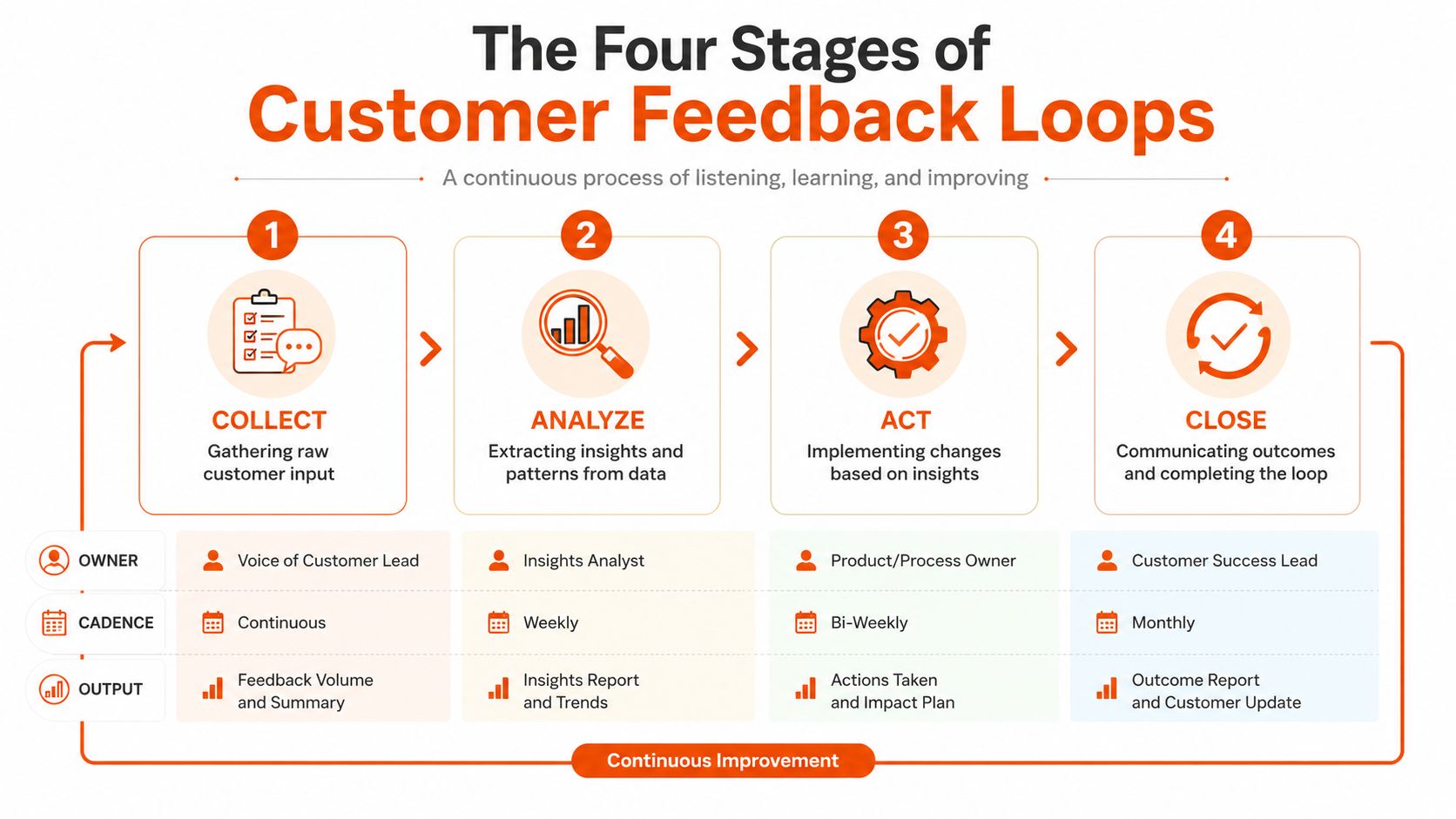
A feedback loop has four stages, collect, analyse, act, close. Miss one owner, and the loop slows down. Miss one cadence, and the signal goes stale. Miss proof of impact, and the whole exercise turns into noise. The commercial test is simple. Does this process improve retention, create expansion, speed activation, or reduce churn? If it does not move one of those outcomes, it is not a working loop.
Collect without overcomplicating it
Collection should capture raw input with context attached. You need to know who said it, where it came from, what they were doing, and why it surfaced now. A tagged support ticket, a product event, a sales note, or a CSAT reply can all be valid inputs, but they only become useful when they enter the same system.
The mistake is treating collection as volume. Volume without structure just creates noise, and noise does not help a team make better calls about retention, activation, or expansion. Start by defining the few customer decisions the loop must inform, then collect only the feedback that can change those decisions.
Analyse into patterns, not opinions
Analysis is where teams either get sharp or get lost. The output should be a prioritised brief, not a wall of comments. Pattern detection matters because one customer request is anecdote, three different channels saying the same thing is a product decision waiting to happen.
For teams that want a tighter method, effective product feedback strategies show the same discipline. Organise the signal into a ranked problem statement, then connect each pattern to a business outcome. A complaint about onboarding friction is not just a UX note, it is a threat to activation and the revenue that follows it.
Act and close with proof
Action means someone ships, changes, or fixes something customers would notice. Close means the customer hears back, directly, with a clear explanation of what changed or what will not change and why. A loop that never reaches the customer is just internal processing dressed up as empathy.
Practical rule: if the customer would not recognise the outcome, the loop has not closed.
The UK Customer Satisfaction Index model is useful as a reference point because it forces teams to treat feedback as something that must be measured, reviewed, and acted on with discipline. That mindset lines up with the UK feedback loop guide UK feedback loop guide, which frames feedback as an operational routine rather than a one-off reaction. The same standard should apply inside SaaS. Show what changed, show what improved, and tie it back to the commercial result.
The UK service assessments and feedback loops UK service assessments and feedback loops reinforce that bar by pushing teams to connect user feedback to evidence of improvement, not sentiment. That is the standard. Not “we listened”, but “we changed this, and this is the effect”.
Instrumenting the Loop Across Product, Support, and Sales

Start with 2 to 3 channels, not ten. If you try to collect everywhere at once, ownership fragments and the team gets buried before the first change ships. The first rule is response discipline, acknowledge feedback within 48 hours, even if the issue cannot be fixed yet, and keep the initial survey to 3–5 questions so people finish it 48-hour response guidance.
Pick channels that already carry customer intent
Use the channels where customers already expose friction and buying intent. In-app prompts work for feature-specific moments, support tags expose repeated pain, sales calls surface objections and switching triggers, and community threads show which issues are turning into public patterns. Spread yourself across every possible outlet and you dilute the signal.
A simple starting mix looks like this.
| Channel type | Best use | What to capture |
|---|---|---|
| In-app | Feature friction and activation blockers | Event name, user state, task context |
| Support | Repeat problems and urgency | Ticket tag, severity, resolution path |
| Sales calls | Objections and buying risk | Verbatim phrasing, competitor mentions |
| Email or micro-surveys | Relationship feedback | Short response, segment, timing |
That structure keeps the loop tied to evidence, and evidence is what lets you connect feedback to retention, expansion, activation, or churn. If you cannot explain why a channel exists, it does not belong in the system.
Design the handoff before you collect more
The biggest trap is collecting feedback with no action path. Monday's guidance is blunt about this, if a question cannot trigger a response or be communicated back within 48 hours, reject it 48-hour response guidance. That standard is right for early-stage teams too.
A seed-stage SaaS should have only the minimum instrumentation needed to prove it can act. One place where feedback lands. One owner for each channel. One weekly review cadence that turns raw input into work. Anything more ambitious before that is bureaucracy with better branding.
For teams choosing tooling, compare customer feedback software after you have decided the workflow. Tool first, process second is how teams buy dashboards they never use. If you are putting AI into the loop, keep it inside a controlled process and separate from customer-facing judgment, as covered in responsible AI implementation.
Where AI Supercharges the Loop and Where It Breaks Trust

AI belongs in the analyse and triage stages. It is strong at clustering themes, scoring sentiment, and routing large volumes of feedback into buckets humans can read. It is also the fastest way to break trust if you let it improvise customer-facing language or infer meaning that isn't there.
Use AI to move faster, not to disappear
The right pattern is simple. Let AI auto-tag support by feature, surface churn-risk phrases from sales calls, and draft a first-pass weekly product brief from raw inputs. Then require a human to make the call on priority and customer communication.
That keeps the loop fast without making it impersonal. In B2B especially, buyers can tell when a response was generated to clear a queue rather than solve their issue. They do not need a theatrical apology. They need proof that someone accountable understood the problem and acted on it.
Draw a hard line around human ownership
AI is weak at nuance when the commercial context is messy. It can over-cluster unrelated complaints, smooth over urgency, or produce a response that sounds polite but misses the core issue. That is why the human role cannot be optional in prioritisation or closure.
The guardrail is straightforward. AI can suggest, rank, and summarise. Humans decide, approve, and reply. If the loop contains a customer-facing message, a named owner should sign off before anything goes out.
For teams building responsibly, responsible AI implementation is the right companion reading because the principle is identical, automate the repeatable work, keep judgement with people. That is how you gain speed without hollowing out the relationship.
The #riteway approach is not anti-AI, it is pro-accountability. Use the machine to compress the queue. Keep the human where trust is on the line.
Proving the Loop Works With KPIs That Survive a Board Meeting
A feedback loop only earns budget when it moves a commercial metric. If the work does not change activation, retention, expansion, or churn, it is just reporting volume. That is why the KPI stack has to be small, consistent, and hard to argue with.
Track the few metrics that drive decisions
Use a tight dashboard and keep it honest.
| Feedback Loop KPI Reference | Metric | What it measures | Target cadence | Owner |
|---|---|---|---|---|
| 1 | Response latency | How quickly customer input gets acknowledged | Weekly | Support or CX lead |
| 2 | Decision-to-ship time | How long it takes to turn insight into a shipped change | Weekly or bi-weekly | Product lead |
| 3 | Roadmap linkage | How much roadmap work traces back to cited feedback | Monthly | PM or product ops |
| 4 | Commercial outcome | Whether the change influenced activation, retention, expansion, or churn | Monthly | Product, CS, or revenue owner |
That table is the spine. Everything else is decoration unless it helps answer one question, did the loop create value. Review it on a 30-day cadence, because that is long enough to show movement and short enough to catch bad habits before they calcify.
Tie improvements to evidence, not cheerleading
Teams that build for retention should treat customer retention strategies as a measurement problem, not a slogan exercise. If a feedback-driven change reduces support burden, speeds task completion, or improves follow-through, capture the effect in the review.
A board does not care that the loop feels responsive. It cares whether the loop changed customer behavior in a way that supports the business. Every change needs a named business outcome and a baseline, or the conversation turns into process theatre the moment priorities tighten.
Board-safe rule: if a metric cannot change a decision, do not put it on the board slide.
Use service assessment guidance as the model here. It demands measurable success criteria and user evidence, and that is the standard SaaS teams should hold themselves to as well.
The Five Mistakes That Quietly Kill Customer Feedback Loops
The failures are always more mundane than teams expect. The loop does not usually die in a dramatic incident. It dies because nobody owned a survey, nobody read the dashboard, and everyone assumed someone else would close the loop.

The five failure patterns to kill immediately
- Surveys with no owner, assign one person who is responsible for follow-up and escalation.
- Dashboards nobody reads, tie the view to a weekly operating review and a decision.
- Loops that stop at “we've noted it”, require a customer reply and an internal action.
- Over-automation that strips empathy, keep humans on the customer-facing edge.
- Treating feedback as a quarterly event, move to a regular review cadence instead.
The most common mistake is ownership drift. A PM expects support to chase it, support expects product to sort it, and the customer hears nothing. That is exactly where the #riteway principle matters, there is no loop without a named owner, because diffusion is how accountability dies.
Another subtle killer is analysis paralysis. Teams over-label, over-segment, and over-discuss before they have chosen the few problems worth solving. The fix is not more reporting. The fix is sharper prioritisation, fewer channels, and a shorter path from signal to decision.
Then there is the classic closed-loop failure. Teams announce a fix internally and never tell the customer who raised it. That is a missed trust-building moment, and worse, it wastes the best proof point you have that feedback matters. If customers never see the effect of their input, they stop contributing useful input.
Your 30/60/90-Day Customer Feedback Loop Rollout
The fastest way to make this real is to start small and stay disciplined. In the first 30 days, define the three business decisions the loop must inform, choose 2 channels, and lock the review cadence. In a SaaS team, that usually means one product surface, one support source, and one owner who can unblock decisions.
Days 31 to 60 should be about one end-to-end pilot. Run the loop, measure decision-to-ship time, and assign owners to collect, analyse, act, and close. Don't broaden the scope until the pilot has produced a change the customer can feel.
Days 61 to 90 is where you scale carefully. Add the second loop, use AI-assisted triage where it removes repetitive work, and publish the first internal impact report with the business outcome tied to each change. That report should read like operating evidence, not a victory lap.
The operating standard to hold everyone to
- One loop owner, because shared ownership usually means no ownership.
- One weekly review, because drift starts when review becomes optional.
- One customer reply, because a loop that ends internally is incomplete.
- One business metric, because sentiment without outcome is noise.
A good delivery partner doesn't just set this up and walk away. It challenges the team to defend each decision against live customer signal and keep the loop honest when the roadmap gets crowded. That is the consulting mindset in practice, advisory that improves how the business thinks, not just how the software ships.
Start the first loop in the next sprint. If your team wants a delivery partner that brings senior engineering, product-first thinking, and the kind of ownership that keeps feedback tied to revenue outcomes, visit Rite NRG and talk about how to build a loop your customers can feel.