Your sprint plan is slipping. The nearshore team says the backlog isn't clear, your product lead says the vendor is waiting to be told what to do, and finance has just flagged an auto-renewal nobody wanted. Delivery slows down, trust drops, and suddenly a relationship you thought would accelerate growth is creating drag.
That's the moment most founders start asking what vendor management is.
The short answer is simple. Vendor management is the discipline of turning outside suppliers into accountable contributors to your business outcome. In software, that means much more than procurement, rate cards, or invoice approval. It means setting the commercial, operational, technical, and governance conditions that make delivery predictable.
If you run a SaaS company, this matters more than is often realized. Your vendors often shape release speed, product quality, compliance exposure, and customer trust. Treat them like a back-office admin task and you'll get passive execution. Lead them like integrated partners and you'll get momentum.
Beyond Procurement What Vendor Management Really Means
A lot of teams still reduce vendor management to three things. Pick a supplier, sign a contract, and chase updates when something goes wrong. That approach fails fast in software delivery because product work changes every week. Requirements move, risks surface, dependencies pile up, and decisions need owners.

What is vendor management? It's the operating model you use to select, onboard, direct, measure, and if needed replace external partners without losing control of your roadmap. In a high-stakes SaaS environment, that's not admin. That's leadership.
The scale of the UK market makes that obvious. Vendor management is a strategic necessity for governing relationships with entities that collectively control a significant portion of the UK's service delivery infrastructure, with the Managed Service Providers market alone comprising 12,867 active firms as of March 2025 and generating an estimated £51 billion in revenue, according to UK government research on the managed service providers market.
The founder mistake that causes most problems
Founders often hire a software partner for capability, then manage them like a freelancer. They send tasks. They review tickets. They expect outcomes to emerge on their own.
They won't.
A serious vendor relationship needs shared goals, hard accountability, direct communication paths, and someone on both sides who owns delivery end to end. That's the difference between activity and progress.
Practical rule: If your vendor can complete tasks but can't explain the business goal behind them, you're not managing a partner. You're renting capacity.
The standard that actually works
The strongest vendor relationships run on Extreme Ownership. That means nobody waits to be chased. Risks are surfaced early. Trade-offs are made in the open. Delivery isn't framed as “we built what you asked for” but as “we moved the product towards the result you need”.
That's the #riteway methodology in practice. High energy. Proactivity. Ownership that goes past the statement of work.
Here's what that looks like in real terms:
- Shared outcomes: Tie the relationship to launch goals, release confidence, customer impact, or platform stability.
- Clear operating rhythm: Set review cadences, escalation routes, and decision owners from day one.
- Mutual transparency: Make blockers, delivery risks, and missed assumptions visible early.
- Outcome-based leadership: Expect the vendor to challenge weak requirements, not just build to spec.
Vendor management starts when procurement ends. If you want faster releases and fewer surprises, treat it as a growth lever.
The Complete Vendor Management Lifecycle
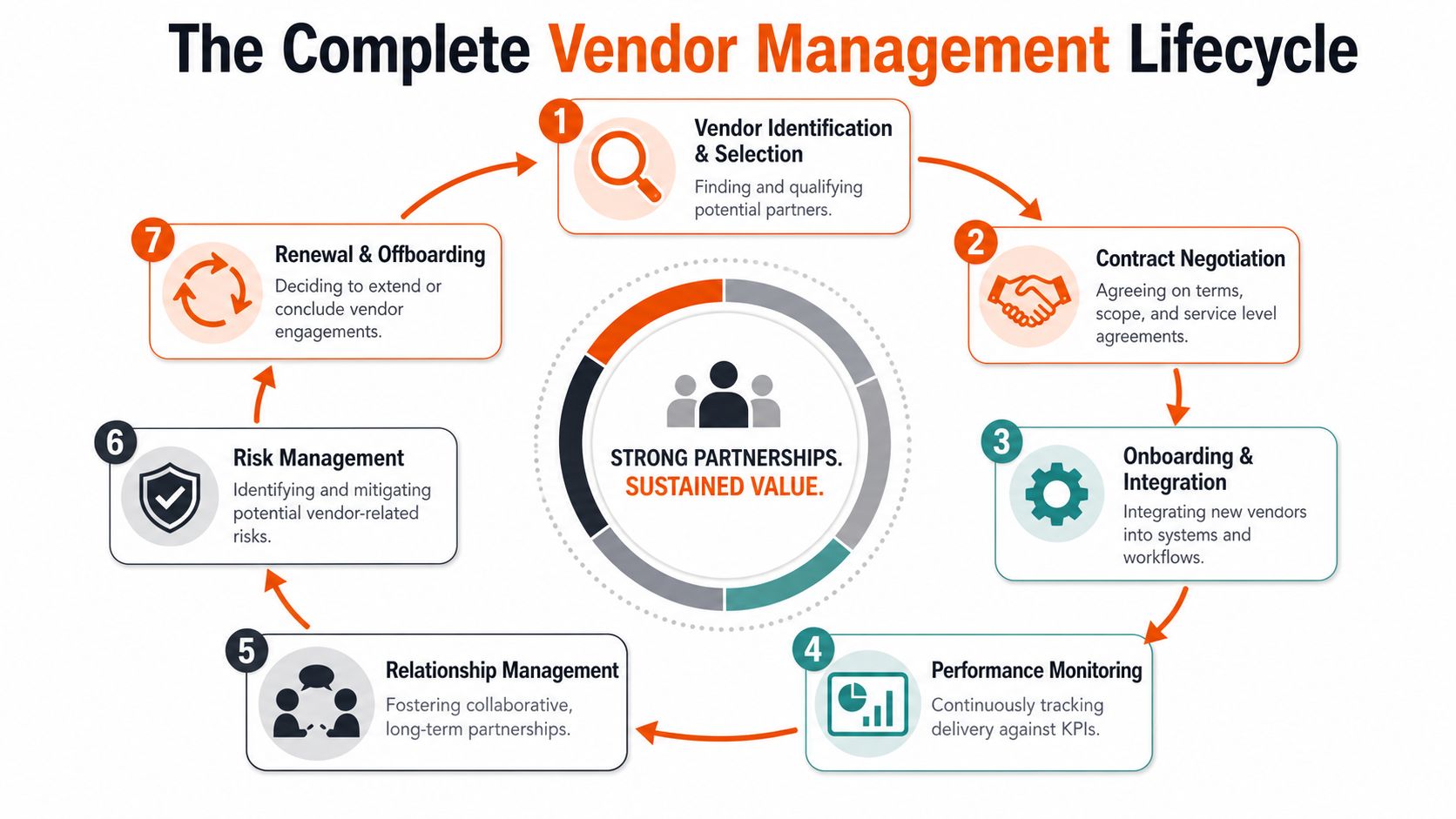
Vendor management isn't a linear checklist. It's a loop. The best companies keep moving through selection, onboarding, measurement, adjustment, and renewal with intent. When one stage is weak, the rest become expensive.
Start with selection, not shopping
Don't choose a software partner the way you'd choose office supplies. Cost matters, but it's not the lead variable. You're choosing a team that will influence architecture, release quality, and product pace.
For high-risk vendors, especially software partners, best practice requires a quantitative vendor scorecard weighting 5–7 core criteria, specifically prioritising cybersecurity posture and technical capability, with a 1–5 scoring scale to create a quantifiable basis for comparison, as outlined in this UK guide to vendor management best practices.
That's a useful baseline. Keep the scorecard tight. If every criterion is “important”, none of them are.
A practical shortlist usually includes:
- Technical capability: Can they solve the engineering problem, not just present a polished sales team?
- Cybersecurity posture: Ask for evidence, not assurances.
- Product thinking: Will they challenge assumptions that damage time-to-market?
- Communication quality: Are they concise, direct, and transparent under pressure?
- Delivery ownership: Do they manage outcomes or wait for instructions?
- Team continuity: Will the people you meet do the work?
If you need a sharper evaluation process, this guide on vendor due diligence for software partners is a useful companion.
Onboarding decides whether momentum starts or stalls
Most vendor problems begin in the first few weeks. Access isn't ready. The roadmap is vague. Internal owners are unclear. Nobody has defined what “done” means.
A strong onboarding phase covers more than credentials and intros. It should align the vendor on product goals, architecture constraints, team rituals, and decision authority. Give them access to the same context your internal team uses. That includes backlog logic, customer priorities, technical debt realities, and release expectations.
The first month should create clarity, not dependency. If the vendor still needs basic context repeated after kickoff, onboarding failed.
Contract for outcomes, not optimism
Weak contracts create avoidable arguments. Strong contracts reduce friction because both sides know what performance looks like.
Your agreement should cover scope boundaries, acceptance criteria, escalation routes, ownership of code and documentation, and measurable service expectations. For software delivery, that means plain-English terms that a product lead, engineer, and commercial owner can all interpret the same way.
A contract should answer these questions:
- What outcome are we paying for
- How will delivery quality be assessed
- What happens when assumptions change
- Who owns the artefacts, data, and knowledge created
- How do we exit without disruption
Later in this article, I'll break down the contract clauses that matter most.
Here's a visual overview of the lifecycle in motion.
Performance monitoring is where management becomes real
This is the stage most companies underbuild. They track ticket output and call it control. That's not enough. A software delivery partner should be measured on business-relevant performance, not just motion inside Jira.
Use a lightweight but disciplined review system:
| Lifecycle stage | What to watch | Why it matters |
|---|---|---|
| Active delivery | Sprint predictability, defect patterns, unblock speed | Protects roadmap confidence |
| Product collaboration | Requirement challenge quality, solution input, decision turnaround | Improves outcome quality |
| Commercial control | Scope change handling, burn visibility, approval discipline | Prevents budget drift |
| Risk oversight | Security, compliance, access hygiene, dependency flags | Reduces unpleasant surprises |
Relationship management is a leadership task
A software vendor shouldn't feel external in the moments that matter. In planning, incident response, release readiness, and architectural change, they need enough context to act with judgement.
That doesn't mean giving away control. It means building a relationship where the partner can contribute at the level you need. Teams with a consulting mindset don't just execute tasks. They help you make better delivery decisions.
Offboarding should be planned on day one
If your vendor relationship ended next month, could another team continue cleanly? Could your internal staff pick up ownership? Could you retrieve code, documentation, credentials, and operating knowledge without chaos?
If the answer is no, the lifecycle is incomplete. Mature vendor management always includes a clean exit path.
Governance Models and KPIs That Drive Results
Not every vendor deserves the same attention. If you manage a strategic software delivery partner with the same light touch you use for a low-risk transactional supplier, you're inviting avoidable failure. Good governance starts with one decision. Tier your vendors by business impact.
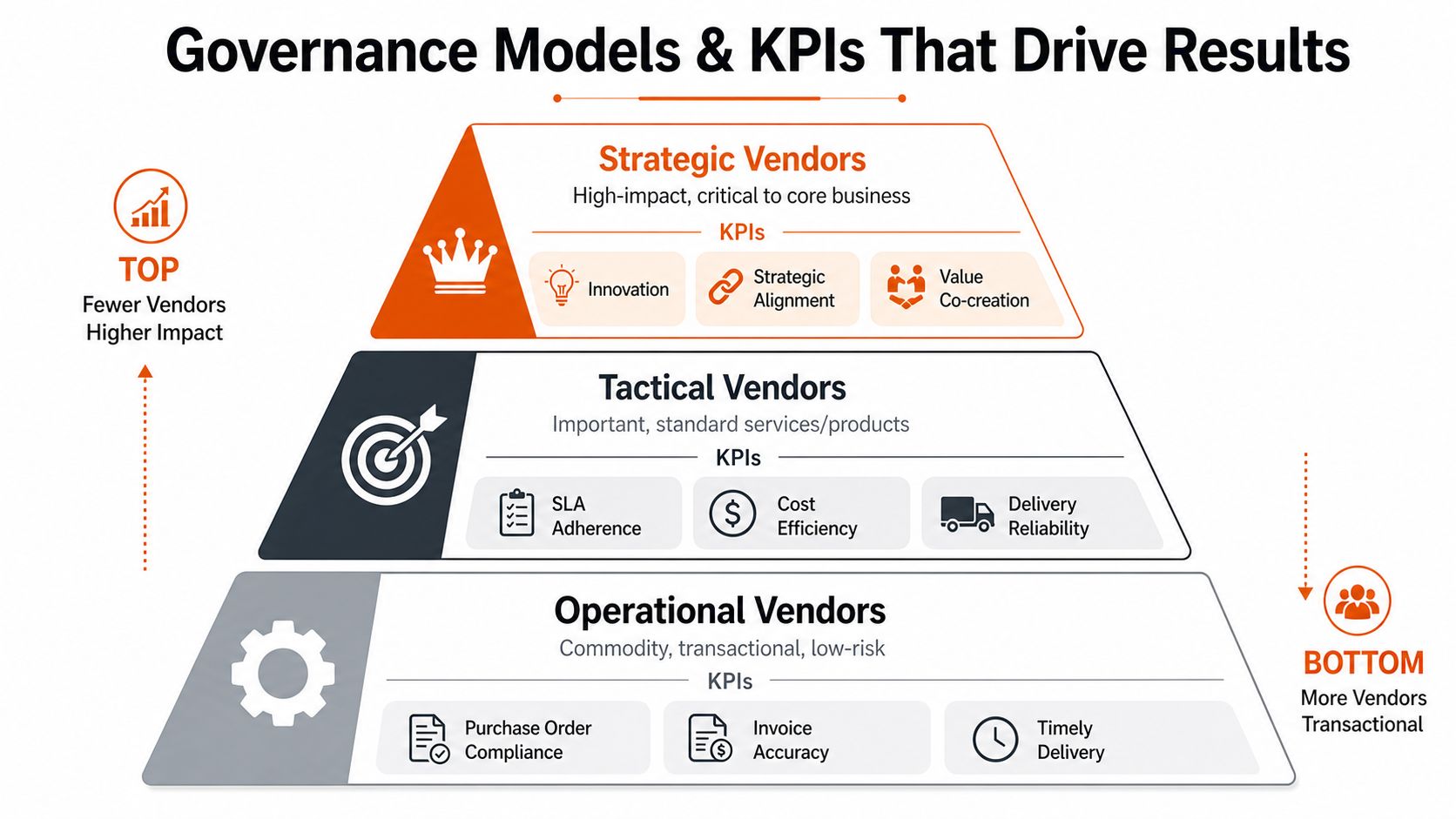
A sensible operating model separates vendors into strategic, tactical, and operational groups. Strategic vendors affect product delivery, revenue-critical systems, compliance exposure, or customer experience. Tactical vendors support important functions but don't shape the business at the same level. Operational vendors are largely transactional.
Match oversight to risk and value
You don't need the board in every vendor review. You do need cadence and structure.
A recommended framework sets monthly operational reviews for Tier-1 strategic suppliers, quarterly executive reviews for high-spend Tier-2 vendors, and semi-annual pulse checks for the long tail, according to this vendor performance framework. That's the right direction because management effort should follow consequence.
Use this as a starting point:
| Vendor tier | Typical profile | Governance rhythm | Primary owner |
|---|---|---|---|
| Strategic | Core software delivery, platform, security-critical services | Monthly operational review | CTO, VP Engineering, or Product leader |
| Tactical | Specialist implementation or functional support | Quarterly executive review | Functional manager |
| Operational | Commodity services and low-risk suppliers | Semi-annual pulse check | Procurement or operations |
Track KPIs that expose control, not vanity
Most vendor scorecards are too polite. They focus on SLA compliance in a way that hides whether the partnership is helping the business move faster or safer.
For software delivery, useful KPIs usually sit in four groups.
Delivery control
These show whether the team can execute with consistency.
- Commitment reliability: Do agreed priorities move through the system as expected?
- Escalation quality: Are issues raised early with options attached?
- Lead time stability: Is work flow getting more predictable or more chaotic?
Product outcome
These show whether the vendor understands the point of the work.
- Release readiness: Can you ship with confidence, without last-minute recovery work?
- Requirement challenge quality: Does the team improve decisions before effort is spent?
- User-facing impact: Are delivered changes helping the experience you care about?
Commercial discipline
Weak control results in significant expense. For consulting vendors, a budget variance over 10% in either direction indicates scope management problems, and a variance exceeding 20% on more than one consecutive engagement signals a pattern of poor delivery control, based on this KPI framework for vendor performance.
That's why I advise founders to review budget variance alongside change requests and delivery assumptions, not in isolation.
Governance and risk
This category is often neglected until there's a security incident or an awkward compliance review.
A strategic vendor scorecard should also capture documentation hygiene, access management, security evidence, incident reporting discipline, and whether critical decisions are being recorded in a way your team can reuse.
If a vendor is doing important work but leaving weak documentation, they're creating hidden cost for your future team.
AI-heavy delivery environments need extra attention here. If you're using vendors or partners that build with autonomous tooling, SpecStory on AI agent governance is worth reading because it frames the oversight problem in a practical way. The core lesson applies directly to vendor management. Capability without governance is a liability.
The Rite Way A Framework for Extreme Ownership
Most vendor relationships fail subtly before they fail visibly. Meetings still happen. Status reports still arrive. Tickets still move. But ownership fades. The vendor waits for instruction, the client assumes someone else is driving, and delivery loses force.
That passive model is common. It's also weak.
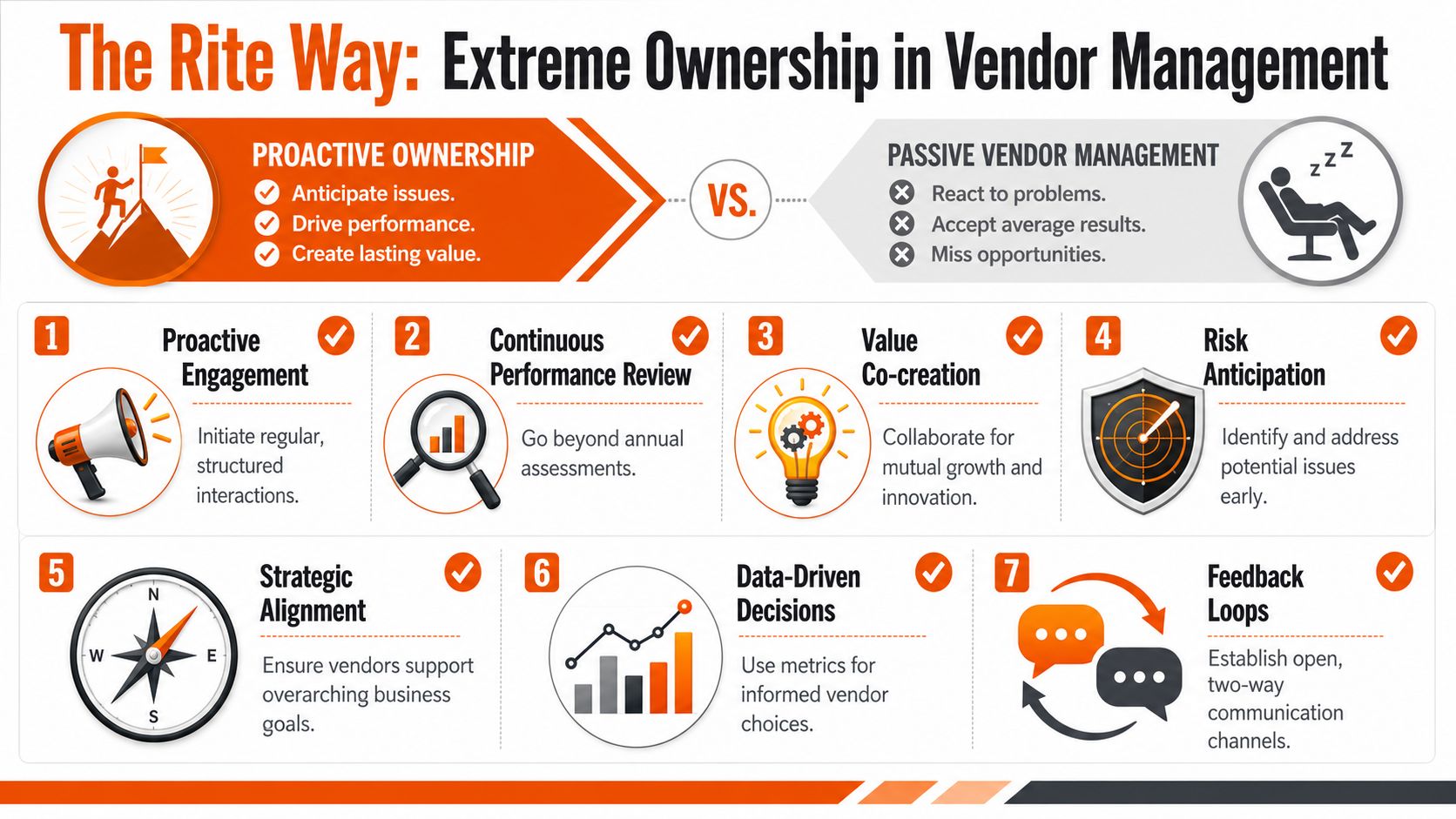
A better approach is Extreme Ownership. The idea is straightforward. Everyone involved acts like the result belongs to them. Risks are spotted early. Ambiguity gets challenged. Problems don't wait for the next steering committee.
Why passive management is expensive
The data on third-party oversight is blunt. Legal and compliance leaders have historically spent only 27% of their total effort on identifying risks with vendors over the course of ongoing relationships, leaving 73% of potential third-party vulnerabilities unaddressed, according to these vendor risk statistics.
That's exactly why “set and forget” doesn't work. In software delivery, risk doesn't sit still. It compounds through missed assumptions, undocumented architecture choices, access sprawl, and delayed escalation.
What Extreme Ownership looks like in practice
This isn't motivational language. It's a working standard.
Own the outcome, not just the output
A strong partner doesn't hide behind completed tickets. They connect their work to release confidence, product learning, technical resilience, and business priorities.
Surface risks before they hit delivery
You shouldn't discover dependency blockers, weak requirements, or security concerns at the point they become expensive. The right partner raises them while there's still room to act.
Bring energy to problem-solving
Low-energy vendors wait to be managed. High-energy teams turn uncertainty into options. They propose trade-offs, tighten scope when needed, and keep movement going.
Operator's view: If your vendor only speaks in updates and never in recommendations, they're acting as labour, not as a delivery partner.
Build feedback loops into the relationship
Ownership grows when feedback is normal, fast, and specific. That means regular retrospectives, decision reviews, and shared accountability for what improves next.
A practical way to formalise this is through a transition model that hands over capability, not just deliverables. The Build-Operate-Transfer model for software teams is useful here because it structures ownership growth from the start instead of treating handover as an afterthought.
The cultural standard matters
Many vendor evaluations often stay too shallow. Teams assess skills but ignore behaviour under pressure. That's a mistake.
For high-stakes product work, you need people who communicate clearly, escalate fast, challenge weak thinking, and stay accountable when conditions change. A vendor can have strong engineers and still be the wrong partner if they lack ownership culture.
The #riteway methodology captures that standard well. High energy. Proactivity. Consulting mindset. Extreme Ownership. Those aren't soft traits. They are the behaviours that keep delivery predictable when plans shift.
Managing Nearshore Software Delivery Partners
Nearshore software delivery needs a different management model from ordinary supplier relationships. A classic vendor provides a bounded service. A nearshore product team often works inside your planning, engineering, and release flow every week. That changes the management job completely.
If you treat a nearshore partner like a distant outsourcer, you'll create friction. If you treat them like an integrated product unit with clear commercial and legal boundaries, you'll move faster with less chaos.
The legal and operational issues you can't ignore
Generic vendor guides usually mention IR35 and GDPR, then stop there. That's not enough for a SaaS founder using an embedded software team.
UK-specific data shows that 42% of SMBs face legal penalties due to inadequate IR35 checks during vendor onboarding, according to this UK-focused vendor management guide. The same source also points out that most guidance still doesn't provide a proper framework for continuous ownership models.
That gap matters. A nearshore engineering team can look operationally like an extension of your internal function. If your onboarding, contract structure, and management practices don't reflect that reality, you increase legal and compliance exposure.
How to manage nearshore partners properly
Don't run this relationship as a stream of isolated tasks. Run it as a governed, integrated operating model.
Define team boundaries clearly
Spell out who owns architecture, product direction, release approval, quality standards, and people management. Ambiguity here creates political tension and delivery hesitation.
Protect data sovereignty deliberately
Make sure access, hosting assumptions, environments, and data handling responsibilities are explicit. “We're GDPR compliant” is not a management system. You need practical controls, named owners, and documented flows.
Avoid pseudo-employment patterns
Be careful how you onboard individuals versus teams, how you assign authority, and how the commercial arrangement is structured. The safer route is usually a clear business-to-business model built around service outcomes, governance, and independent supplier responsibility.
Build for continuous ownership
The strongest nearshore relationships don't depend on a heroic founder, one architect, or a single project manager. They create reusable knowledge, shared routines, and clear operating visibility.
A useful decision lens is the comparison between nearshore and offshore software delivery models. The key issue isn't geography on its own. It's how well the partner can integrate into your product cadence without introducing communication lag, compliance confusion, or diluted ownership.
Nearshore works best when the team feels close enough to act with context, but structured enough to stay accountable as an external partner.
What founders should insist on
For a nearshore software partner, I'd insist on the following from the outset:
- Documented onboarding checks: Cover IR35-sensitive setup questions, access controls, and security responsibilities.
- Integrated rituals: Include the team in planning, backlog refinement, retrospectives, and release review.
- Visible ownership: Every critical workstream needs a named owner on both sides.
- Knowledge continuity: Code, decisions, and runbooks should stay accessible to your business, not trapped in a vendor silo.
- Commercial clarity: Make change control, handover expectations, and IP ownership unambiguous.
Nearshore can be a serious advantage for fast-moving SaaS teams. But only if you manage the relationship as a strategic delivery system, not a cheaper resourcing channel.
Essential Tools and Contract Templates for Success
You don't need an oversized procurement stack to manage vendors well. You do need a system. If contracts live in one inbox, performance notes sit in Slack, risk documents sit in Google Drive, and renewal dates survive only in someone's memory, you don't have vendor management. You have scattered admin.
The tool categories that actually help
The most useful setup usually combines a few categories:
- Vendor management system: A central place for supplier records, ownership, review dates, and risk status.
- Contract lifecycle management: Version control, approvals, obligations, renewals, and clause visibility.
- Work management platform: Jira, Linear, or Azure DevOps for delivery visibility and backlog discipline.
- Documentation hub: Confluence, Notion, or SharePoint for decision logs, runbooks, and architecture context.
- Communication layer: Slack, Teams, and structured meeting notes so discussions turn into accountable actions.
- Reporting dashboard: A simple scorecard that pulls together delivery, commercial, and risk indicators.
The point isn't tooling for its own sake. The point is creating one operating picture that leaders can trust.
The SLA clauses that protect you
For software delivery and managed technology relationships, your SLA needs precision. Mature IT vendor management frameworks mandate that Service Level Agreements define precise, measurable metrics such as response times and resolution rates, and include explicit penalties for non-performance and strict Security Breach Notification requirements to directly reduce operational risk, as explained in this guide to IT vendor management and SLA design.
That should shape how you draft every important agreement.
Use this mini-template as a starting point:
| Clause area | What to define in plain English | Why it matters |
|---|---|---|
| Service levels | Response times, resolution expectations, delivery windows | Stops vague accountability |
| Non-performance | Service credits, penalties, remediation obligations | Creates consequences |
| Security incidents | Notification timing, contact path, information required | Reduces incident confusion |
| Data ownership | Who owns code, documentation, and operational data | Prevents lock-in |
| Portability | Format and timing for handover of assets and knowledge | Makes exit possible |
| Governance | Meeting cadence, escalation path, review obligations | Keeps the relationship active |
Keep contract language usable
If a clause only makes sense to legal, it won't guide delivery behaviour. Write service expectations in plain English and test them with the people who will run the relationship. Product, engineering, legal, and finance should all be able to interpret the same clause the same way.
Contracts should reduce ambiguity during pressure, not create a new debate when something goes wrong.
That's the benchmark. Measurable, enforceable, readable.
Mastering Vendor Handovers and Strategic Offboarding
A vendor relationship ending isn't a failure by default. Sometimes the work is complete. Sometimes the capability needs to move in-house. Sometimes the business has outgrown the original setup. Mature companies plan for that early and execute it cleanly.
Poor offboarding creates lasting damage. Code is hard to interpret, credentials aren't properly transferred, documentation is patchy, and nobody can explain why key decisions were made. That's not an exit problem. That's weak vendor management surfacing late.
What a clean handover includes
A proper handover should cover operational control, not just file transfer.
Transfer knowledge, not just artefacts
Code repositories and documents matter, but so do architectural decisions, deployment habits, support routines, and unresolved risks. The incoming team needs working context.
Revoke and reassign access carefully
Handle environments, credentials, admin rights, and third-party integrations with discipline. Sloppy access changes create unnecessary exposure.
Confirm ownership of IP and data
Before offboarding starts, there should be no doubt about who owns the codebase, product documentation, infrastructure definitions, and delivery records.
Treat offboarding as a strategic capability
Founders usually focus on starting fast. Smart operators also focus on ending well. If you can swap vendors, absorb a team in-house, or move a capability into a new structure without disruption, your business is stronger.
A Build-Operate-Transfer approach is one of the clearest signs of that maturity. It forces you to think beyond delivery into long-term control. You're not just buying execution. You're building an asset your company can fully own.
Here's the standard I recommend:
- Plan exit terms at contract stage
- Keep documentation current throughout delivery
- Avoid single points of knowledge
- Run handover as a managed transition, not a final meeting
- Audit access, dependencies, and support responsibilities before closure
Vendor management is only complete when continuity survives change. If your business can retain knowledge, preserve control, and keep shipping after a handover, you've built the right system.
If you want a nearshore software delivery partner that treats vendor management as a strategic discipline, not an admin function, Rite NRG is worth a look. They help SaaS teams build faster with senior engineers, product-first delivery, and a consulting mindset rooted in Extreme Ownership.