You're probably in the middle of it right now. A stakeholder wants a launch date. Engineering wants more time. Sales has already hinted at a feature that isn't scoped. Someone says AI should make delivery faster, but nobody can explain by how much or where that speed will come from.
That's where expectation management usually breaks down. Not because people are careless, but because too many teams treat it like a soft skill instead of an operating system.
We don't.
The fastest way to learn how to manage expectations is to stop thinking about it as diplomacy. It's delivery design. If you define value badly, plan vaguely, communicate lazily, hide risk, and report progress with hand-wavy updates, expectations will drift. Then trust goes with them.
High-stakes SaaS delivery needs something stronger. It needs outcome-first thinking, shared ownership, and a team that acts early instead of explaining late. That's the #riteway mindset. High energy. Extreme Ownership. No passenger mentality.
Stop Building Features and Start Delivering Value
Most delivery problems start before a single sprint begins. The team accepts a shopping list of features, turns it into tickets, and starts moving. Everyone feels busy. Nobody asks the hard question: what business result are we trying to create?
That's how feature factories are born.
In the current UK climate, that approach is reckless. UK business confidence fell to -14.6, its lowest level since late 2022, and there are 5.7 million private sector businesses navigating that pressure according to the ICAEW Business Confidence Monitor. When confidence is that low, shipping output without proving value isn't ambition. It's waste.
Define the outcome before the scope
If you want to know how to manage expectations properly, start by separating output from outcome.
| Focus | Output thinking | Outcome thinking |
|---|---|---|
| Success measure | Features shipped | Business result achieved |
| Planning question | What can we build? | What moves the metric that matters? |
| Stakeholder language | Tasks, tickets, deadlines | Retention, conversion, activation, margin |
| Delivery risk | Busy team, weak result | Smaller scope, stronger impact |
A founder doesn't buy “three integrations and a dashboard”. They buy faster onboarding, lower churn, or a stronger case for the next funding round. A product leader doesn't need more code for its own sake. They need movement against a commercial goal.
That means every initiative needs a North Star outcome and a short list of proof points. Not vanity metrics. Not “platform improvements” as a catch-all. Clear business intent.
Use the #riteway filter
We use a simple filter when pressure rises.
- Name the business outcome. Better retention, lower support burden, faster market entry, stronger conversion from demo to paid.
- Challenge the requested feature. Ask whether it directly serves that outcome or just feels productive.
- Cut anything ornamental. If it doesn't change the business result, it waits.
- Translate technical work into commercial language. Stakeholders shouldn't need to decode engineering priorities.
Practical rule: If a work item can't be connected to a business outcome in one sentence, it's not ready for commitment.
Many non-technical founders get trapped by hidden complexity. If you need a grounded explanation of how internal shortcuts undermine product progress, this piece on technical debt for non-technical founders is worth your time.
A useful way to sharpen this conversation is to work through a real value proposition canvas. It forces the team to connect product choices to customer pains, gains, and buying logic instead of pretending every feature is equally strategic.
Kill the “build first, align later” habit
Weak expectation management often sounds harmless:
- “Let's get started and refine as we go.” That usually means nobody agreed on success.
- “We'll know more once the team gets into it.” Fair, but only if uncertainty is made explicit from day one.
- “We promised the feature set.” Promising a feature set without tying it to value is how teams hit scope and still miss the point.
Good delivery teams don't wait for confusion to appear. We design against it early. That's Extreme Ownership in practice. We don't just accept the brief. We pressure-test whether the brief deserves to exist in its current form.
Co-Create Your Blueprint for Predictable Delivery
The old client-vendor model still ruins good projects. One side writes scope. The other side estimates it. Then both sides spend months discovering what should have been discussed in the first workshop.
That model has to go.
Predictable delivery comes from co-creation, not hand-off. If expectations are going to hold under pressure, the roadmap must be built jointly, challenged jointly, and owned jointly.
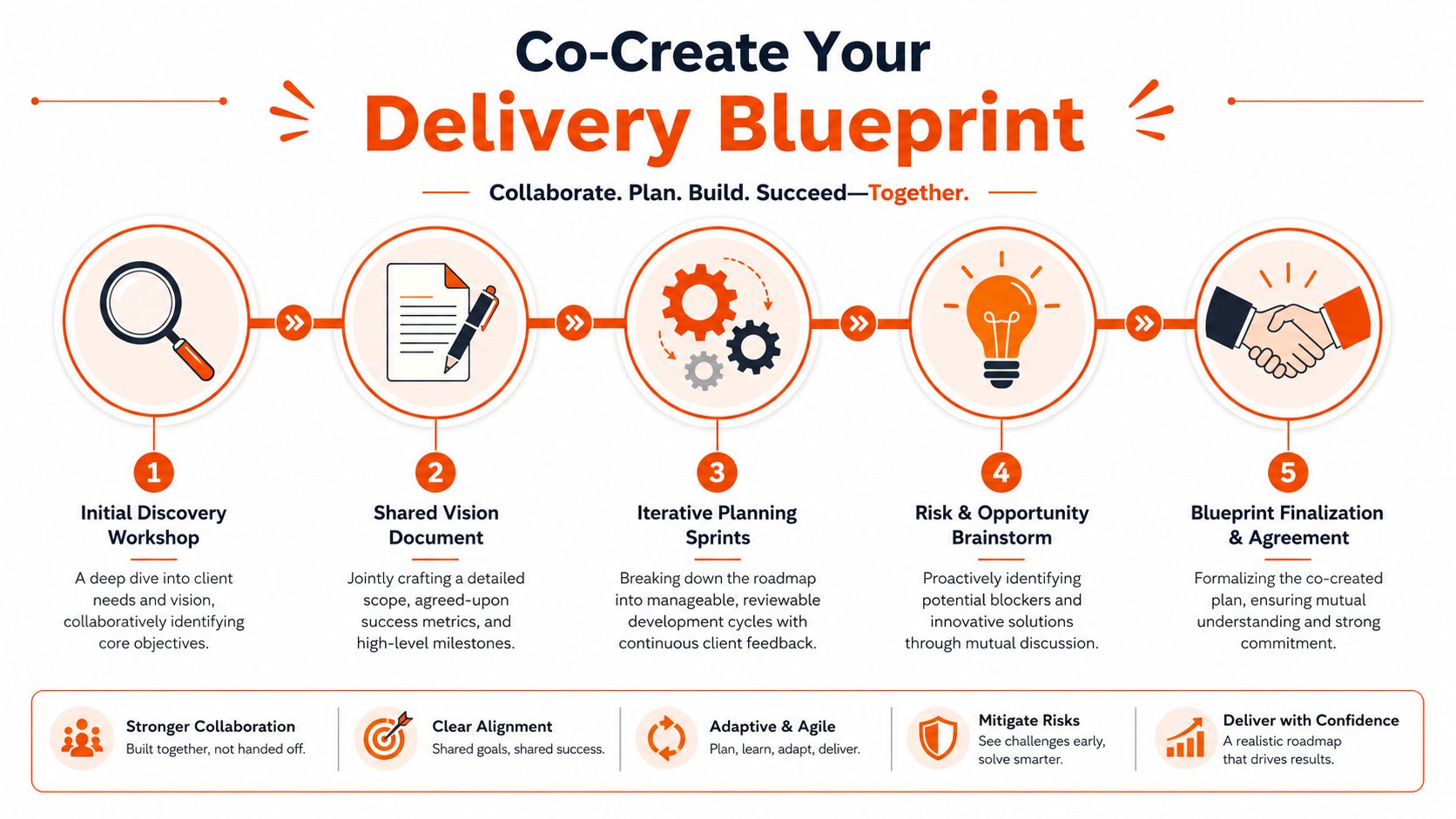
Build the roadmap with the people who will live with it
A useful blueprint has five parts.
Discovery with tension, not politeness
The first workshop shouldn't be a ceremonial kick-off. It should expose assumptions. What does leadership think is urgent? What does product think is realistic? What does engineering know is risky?
If those views differ, good. You've found the material that usually causes later conflict.
A shared definition of success
Write down what success looks like in operational terms. Not inspirational language. Not “improve user experience”.
Use statements such as:
- “This release must reduce onboarding friction for a defined user path.”
- “This phase must make legacy handover safe enough for controlled change.”
- “This MVP must be credible enough for buyer demos and investor scrutiny.”
When a roadmap gets tense, this document becomes the referee.
Iterative planning instead of fake certainty
You don't need a fantasy-perfect master plan. You need a roadmap with enough detail for the next decision and enough honesty about what still needs discovery.
That's why we prefer smaller planning horizons, explicit assumptions, and regular replanning. Teams that want mature delivery habits should study a strong DevOps maturity model, because planning quality improves when delivery mechanics improve.
Confront the AI speed gap early
There's one modern expectation trap that too many teams ignore. 62% of senior leaders believe AI will drastically speed up delivery, but only 28% of engineering teams feel their workflows are integrated to support that level of acceleration, according to Korn Ferry's UK insight on balancing expectations and business realities.
That gap matters because it changes behaviour before work even starts.
If leadership assumes AI has already compressed timelines, the roadmap is distorted from day one.
The fix is direct conversation. Ask three questions in the planning room:
- Where is AI already embedded in the workflow? Recruitment, coding assistance, testing support, documentation, triage, analysis?
- Where is AI still aspirational? If it isn't operational yet, it can't be used to justify aggressive promises.
- What still requires senior human judgement? Architecture, trade-offs, stakeholder alignment, and risk ownership don't disappear because a tool is fast.
Turn scope into a living agreement
A roadmap should behave like a contract on principles, not a prison sentence on guesses.
Use change rules upfront:
- Fixed outcome, flexible implementation
- Transparent trade-offs when scope moves
- Shared visibility on risks, dependencies, and decisions
- No silent assumptions
That last one matters most. Silent assumptions are where expectation gaps breed. If something is important, write it down, assign an owner, and revisit it on purpose.
Master Proactive Communication and Cultural Nuances
Often, teams don't have a communication problem. They have a false-confidence problem. Everyone thinks communication is happening because meetings exist, updates are sent, and a chat channel is active.
Then the stakeholder says, “I didn't realise that was at risk.”
That sentence tells you the system is broken.
Communication needs cadence and intent
A healthy delivery partnership uses different channels for different jobs. Not everything belongs in a status call.
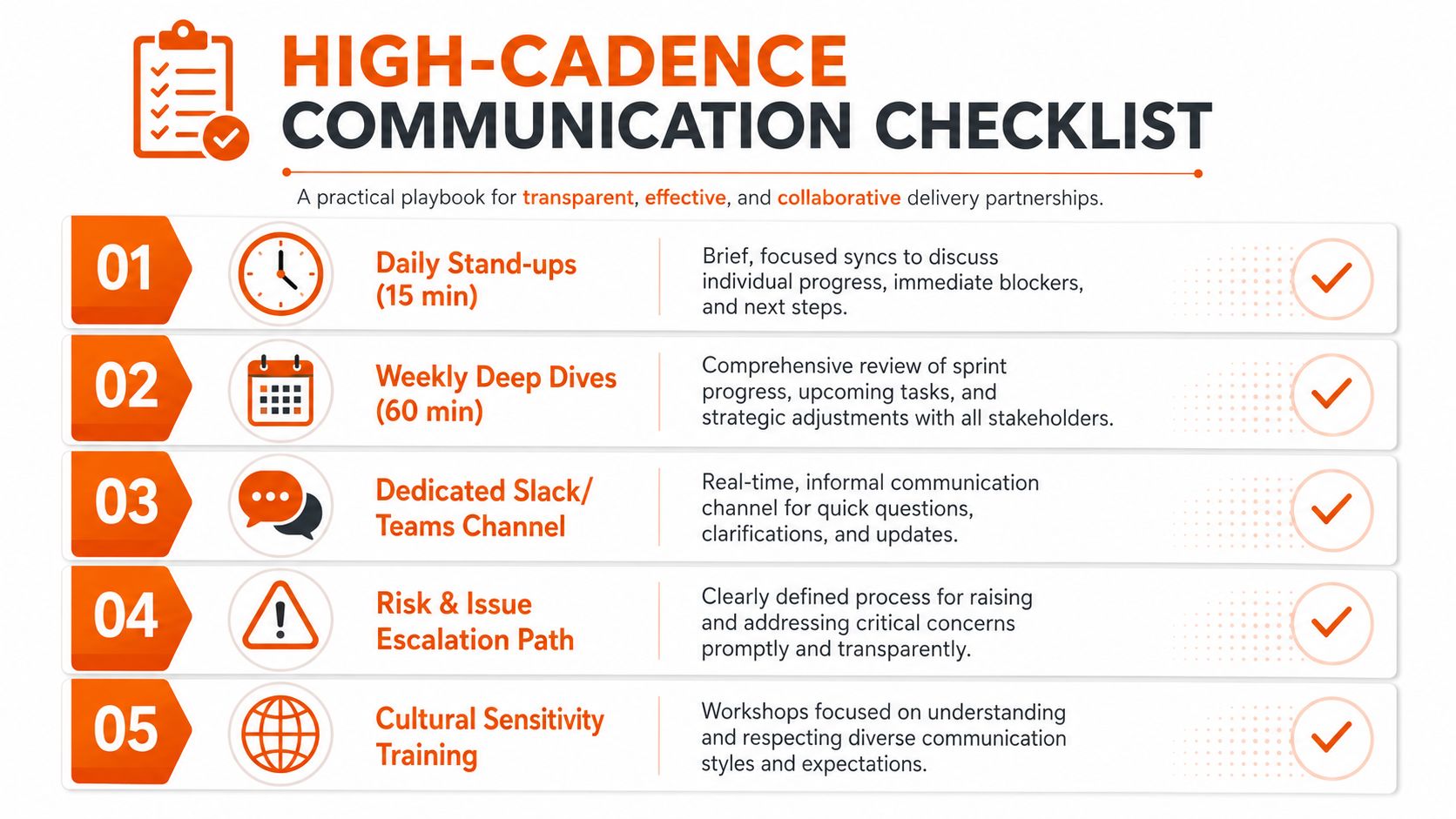
Here's a practical cadence that works:
- Daily syncs for execution. Fast check on blockers, ownership, and immediate next steps.
- Weekly working sessions for decision-making. Review progress, scope pressure, and open risks.
- Async updates for visibility. Written summaries prevent drift and let people absorb detail without another meeting.
- Escalation paths for genuine issues. Don't bury a critical dependency in a Friday notes doc.
A lot of teams would improve overnight if they made their communication model explicit. A strong stakeholder communication approach gives every participant the same expectations about who hears what, when, and why.
What proactive communication sounds like
Generic advice tells teams to “be transparent”. That's weak. Teams need language they can use.
A weak update:
“We're making progress, but there are some blockers.”
A useful update:
“The integration path is viable, but one dependency is putting the agreed timeline at risk. We have two options. Reduce scope in this release or hold the date and accept more implementation risk. We recommend reducing scope.”
That's expectation management. Clear state. Clear consequence. Clear recommendation.
Here's another one.
Instead of:
- “We should be fine.”
Say:
- “We're on track for the current objective, but only if decision X is made by Thursday.”
Instead of:
- “The team is working through it.”
Say:
- “The issue is contained, ownership is clear, and the next update will confirm whether rollback or fix-forward is the safer path.”
Nearshore friction is cultural before it is logistical
Generic guides often fall short. They talk about time zones, meeting etiquette, and documentation, but they ignore the core issue in nearshore delivery. When managing nearshore teams in Poland, 57% of UK companies report stakeholder friction over cultural, not just logistical, differences. Success requires bridging unspoken UK communication norms, a nuance missed by 73% of generic expectation management guides, as noted in this discussion of managing expectations with global teams.
That rings true in practice.
A UK stakeholder may expect proactive risk surfacing, softer language around disagreement, and regular narrative updates even when work is technically under control. A senior Polish engineer may assume that if nobody raises concern, the current plan stands, and that direct technical clarity is more useful than managerial framing.
Neither side is wrong. But if you don't bridge that gap, both sides think the other is underperforming.
A simple comparison helps:
| Situation | Typical UK expectation | Common nearshore interpretation |
|---|---|---|
| Emerging risk | Raise it early, even if incomplete | Raise it once technically confirmed |
| Status update | Include narrative and confidence level | Share concrete task progress |
| Silence in meetings | Possible hidden concern | Agreement or no objection |
| Seniority | Strategic anticipation | Technical autonomy |
This video expands on the human side of high-quality collaboration:
Build one team culture on purpose
The fix isn't more process. It's cultural onboarding.
- Spell out communication norms. Define what “proactive” means in practice.
- Make risk surfacing a requirement. Don't leave it to personality.
- Teach stakeholders how the engineering team communicates. This reduces misreading.
- Use written summaries after key meetings. They remove ambiguity fast.
Working rule: Don't assume seniority equals cultural fit. If the norms aren't named, they don't exist.
Embrace Extreme Ownership to Surface Risk Early
Teams that hide risk don't protect trust. They destroy it on a delay.
Extreme Ownership starts with a blunt idea. If a problem can affect delivery, it belongs in the open. Not when it's fully diagnosed. Not after a deadline slips. As soon as it becomes material.
That mindset is more than instinct. It aligns with how stronger businesses operate. The average UK management practice score rose from 0.51 in 2020 to 0.57 in 2023, reflecting wider adoption of structured practices such as KPI tracking and proactive problem response, according to the UK management upward trend analysis.
Risk is not bad news. It is a decision point
Weak teams report risks like confessions. Strong teams report them like operators.
That means every surfaced risk should come with three things:
- What's happening now
- What it affects if untouched
- What decision or action is needed
If you only raise alarms, you create anxiety. If you package risk with options, you create control.
Operator mindset: “We found a risk early enough to shape the outcome. Here are the choices.”
What ownership looks like in real delivery
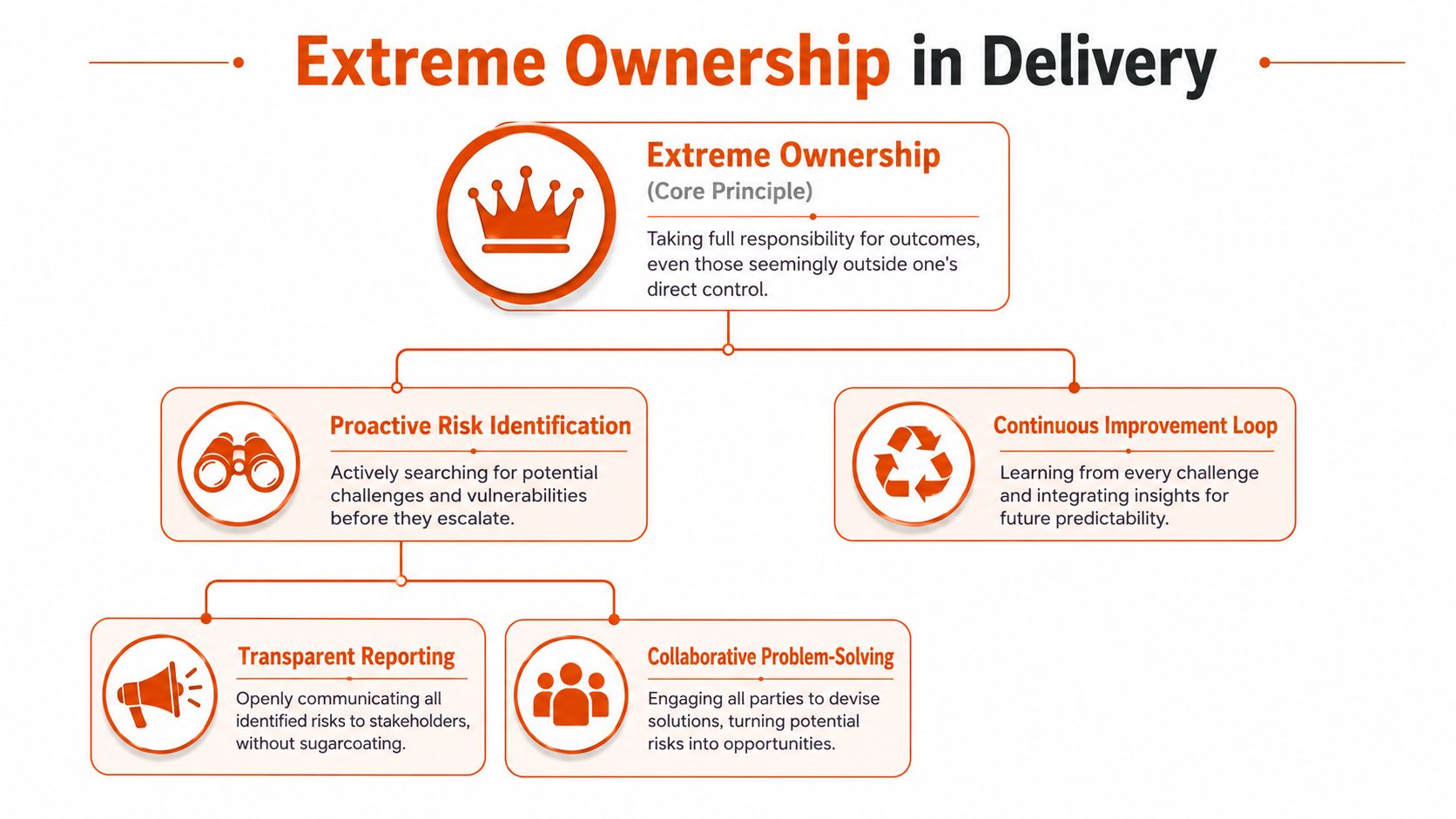
Extreme Ownership is not motivational wallpaper. It's behaviour. You can see it in how a team handles uncertainty.
In scope
The team notices that a “small” feature request changes workflow logic across multiple parts of the product. They don't squeeze it in unnoticed. They flag the trade-off and force the priority call.
In technology
The team discovers a legacy dependency that could slow implementation. They don't disappear into a technical cave. They explain the risk in business language and propose a path that protects delivery confidence.
In team dynamics
A key stakeholder gives conflicting instructions to product and engineering. The team doesn't work around it in silence. They surface the contradiction and ask for alignment before ambiguity turns into rework.
Replace blame with control
A blame culture creates delayed truth. People spend energy protecting themselves instead of protecting the outcome.
A high-performance culture does the opposite:
- It rewards early visibility
- It treats uncertainty as manageable
- It expects recommendations, not drama
- It makes ownership collective, even when the trigger came from one area
That's why proactive teams feel calmer under pressure. They don't pretend risk has vanished. They've built a mechanism for catching it early.
Use a simple risk format
If your team needs a practical format, keep it short:
| Risk element | What to write |
|---|---|
| Signal | What we've observed |
| Impact | What business outcome may be affected |
| Confidence | How certain we are |
| Options | What can be done now |
| Recommendation | What we think should happen |
That format keeps conversations sharp. It also stops “raising a concern” from becoming a vague emotional act. Risk becomes operational. That's where trust grows.
Use Data Driven Dashboards to Measure What Matters
If progress reporting depends on mood, confidence will always swing harder than reality.
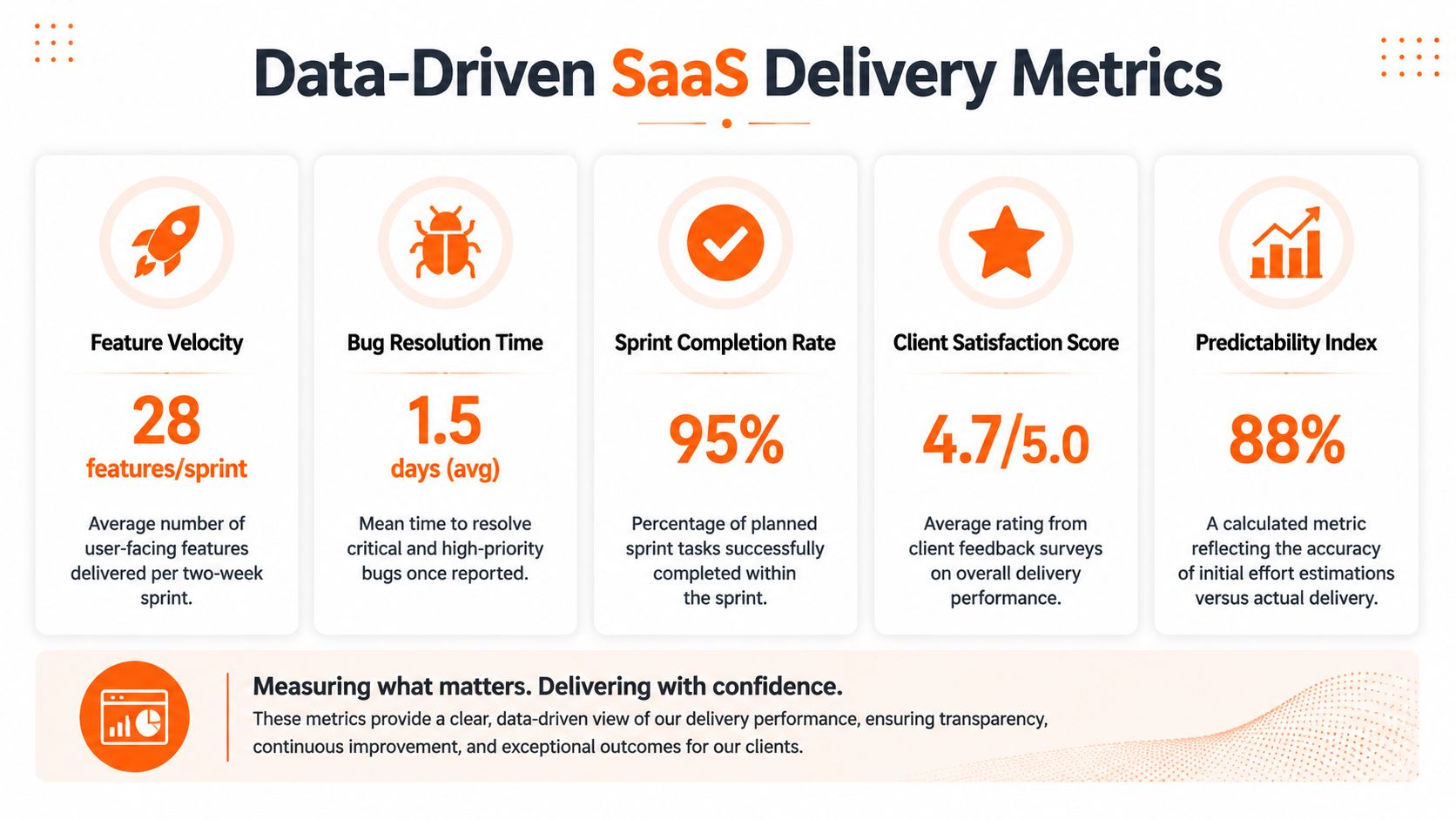
That's why dashboards matter. They turn delivery into something people can inspect, not interpret. They also necessitate an essential discipline. The team has to agree on what “healthy” means.
Stop worshipping speed
A lot of teams still optimise for visible motion. More tickets closed. More releases announced. More activity in the board.
That's a trap.
A critical mistake is prioritising speed over stability. Expert teams focus on lowering Change Failure Rate and Mean Time to Restore because those metrics build trust, while raw velocity can hide quality issues and unstable releases, as explained in this software delivery guidance on delivery performance.
Velocity has its place. But velocity without stability creates deceptive progress. Stakeholders hear “fast”. Customers experience “fragile”.
Translate engineering metrics into business language
DORA-style metrics matter because they explain delivery health in ways that map to business outcomes.
Deployment Frequency
This tells you whether the team can move in small, controlled increments. Frequent deployment usually means less batch risk and faster learning.
Business translation: we can respond to market feedback without waiting for giant release events.
Lead Time for Changes
This tracks how long it takes work to move from idea to production. Long lead times usually point to bottlenecks, approval friction, unclear ownership, or brittle systems.
Business translation: we can't adapt quickly enough when priorities shift.
Change Failure Rate
This shows how often releases cause problems. It's one of the cleanest indicators of delivery maturity because it exposes whether speed is being bought with instability.
Business translation: our releases either reinforce trust or erode it.
Mean Time to Restore
MTTR reveals how quickly the team recovers when something breaks. Recovery capability matters just as much as prevention.
Business translation: when something goes wrong, do we contain damage fast or let disruption spread?
A dashboard should answer one leadership question clearly: “Can this team deliver change safely and predictably?”
Build a dashboard people actually use
Most dashboards fail because they try to impress instead of clarify.
Keep yours practical:
- Show trends, not snapshots. One good week means very little.
- Put engineering and product on the same view. Delivery health and business priorities must sit together.
- Highlight exceptions. The dashboard should surface where attention is needed.
- Review it live. A dashboard nobody discusses becomes decoration.
A useful dashboard also changes behaviour. Teams stop arguing in abstractions. Stakeholders stop asking for reassurance and start asking better questions.
For example:
| Weak question | Better question |
|---|---|
| Are we on track? | Which metric is creating the biggest delivery risk right now? |
| Why is this taking so long? | Where is lead time expanding and what's causing it? |
| Can we go faster? | What happens to failure risk if we compress this timeline? |
That's how to manage expectations without turning every meeting into an emotional weather report. Data doesn't remove judgement. It gives judgement something solid to stand on.
Your Playbook for Predictable High-Energy Delivery
Expectation management is not a side task for project managers. It is how serious teams protect outcomes.
The playbook is straightforward, but it only works if you apply it with discipline.
The #riteway operating model
Start with business value. If the team can't explain why the work matters commercially, the scope is already weak.
Co-create the roadmap. Don't let one side promise and the other side absorb the consequences.
Communicate with intent. Use cadence, clarity, and written follow-through so nobody has to guess.
Surface risk early. Extreme Ownership means we don't wait for certainty before we act responsibly.
Measure what predicts healthy delivery. Stability and recovery matter more than performative speed.
What this changes in practice
When teams work this way, expectation management stops being defensive. It becomes a growth tool.
You make cleaner trade-offs. Stakeholders trust updates because they're concrete. Engineering gets room to be honest without sounding obstructive. Product decisions improve because everyone is working from the same reality.
That matters because delivery pain is expensive. In the UK, 82% of businesses experience project delays costing an average of £107,000 annually, and a practical response includes trunk-based development, automated CI/CD, and transparent dashboards to make speed and stability more predictable, based on this research on UK software project delays.
The standard has to rise
If you're still relying on vague status updates, oversized scope, and optimism disguised as planning, expectations will keep breaking under pressure.
Raise the bar:
- Tie work to outcomes
- Challenge assumptions early
- Make communication operational
- Treat risk as a shared responsibility
- Use dashboards as the source of truth
- Design for predictable delivery, not heroic rescue
Good expectation management doesn't slow delivery down. It removes the confusion that slows everything down anyway.
That's the whole point. Better alignment doesn't create bureaucracy. It creates momentum you can trust.
If you want a delivery partner that brings senior thinking, nearshore execution, and the kind of proactive ownership that keeps SaaS delivery predictable under pressure, talk to Rite NRG. We help teams move faster without losing control.