
Your product roadmap is clear. Your release calendar isn't. One sprint ends with a smooth deployment, the next gets derailed by a flaky test suite, a last-minute infrastructure change, or a security sign-off that nobody planned for. You start every week asking the same question: can this team ship predictably, or are we still guessing?
That's the moment when a DevOps maturity model becomes useful. Not as a consulting buzzword. Not as another scorecard for the engineering wall. It matters because maturity determines whether your business can turn product decisions into revenue, retention, and trust without drama every single release cycle.
Founders often treat DevOps as a tooling problem. It isn't. It's an ownership problem. If your developers, platform engineers, QA, and product leads don't operate with shared responsibility for flow, reliability, and recovery, the fanciest pipeline in the world won't save you. Strong delivery comes from Extreme Ownership. People own outcomes, not tickets. Teams prevent failures instead of normalising them.
Beyond Unpredictable Releases
If your releases feel unpredictable, the issue usually isn't effort. It's system design. Teams work hard, yet delivery still feels like a black box because handoffs are unclear, automation is partial, and nobody has a trusted baseline for performance.
That creates business drag fast. Sales can't commit confidently. Product can't plan launches with conviction. Investors hear “we're nearly there” too often. A weak delivery system turns strategy into waiting.
The real cost of low maturity
A low-maturity setup usually looks familiar:
- Manual release steps: Someone still triggers critical parts of deployment by hand.
- Siloed accountability: Development ships code, operations stabilises later, security reviews at the end.
- Slow feedback loops: Bugs show up too late, and root causes stay murky.
- Heroic recovery: The team celebrates firefighting instead of eliminating recurring failure patterns.
None of that scales. It burns leadership attention and makes every launch riskier than it should be.
Predictable delivery is a business capability. If you can't forecast release quality and speed, you can't forecast growth with confidence either.
A good DevOps maturity model gives you a practical way to regain control. It shows where your delivery engine is fragile, where work is getting stuck, and what has to change first. Done properly, it stops the endless cycle of “try another tool, hope for a better outcome”.
What founders should expect from the model
You don't need a theoretical framework that looks impressive in a slide deck. You need one that answers blunt questions:
- How fast can we move from idea to production?
- How often do releases create incidents?
- How quickly can the team recover when something breaks?
- Where are we losing time in handoffs, approvals, and rework?
That's why maturity matters. It converts delivery from gut feel into an operating system for growth.
What Is a DevOps Maturity Model Really
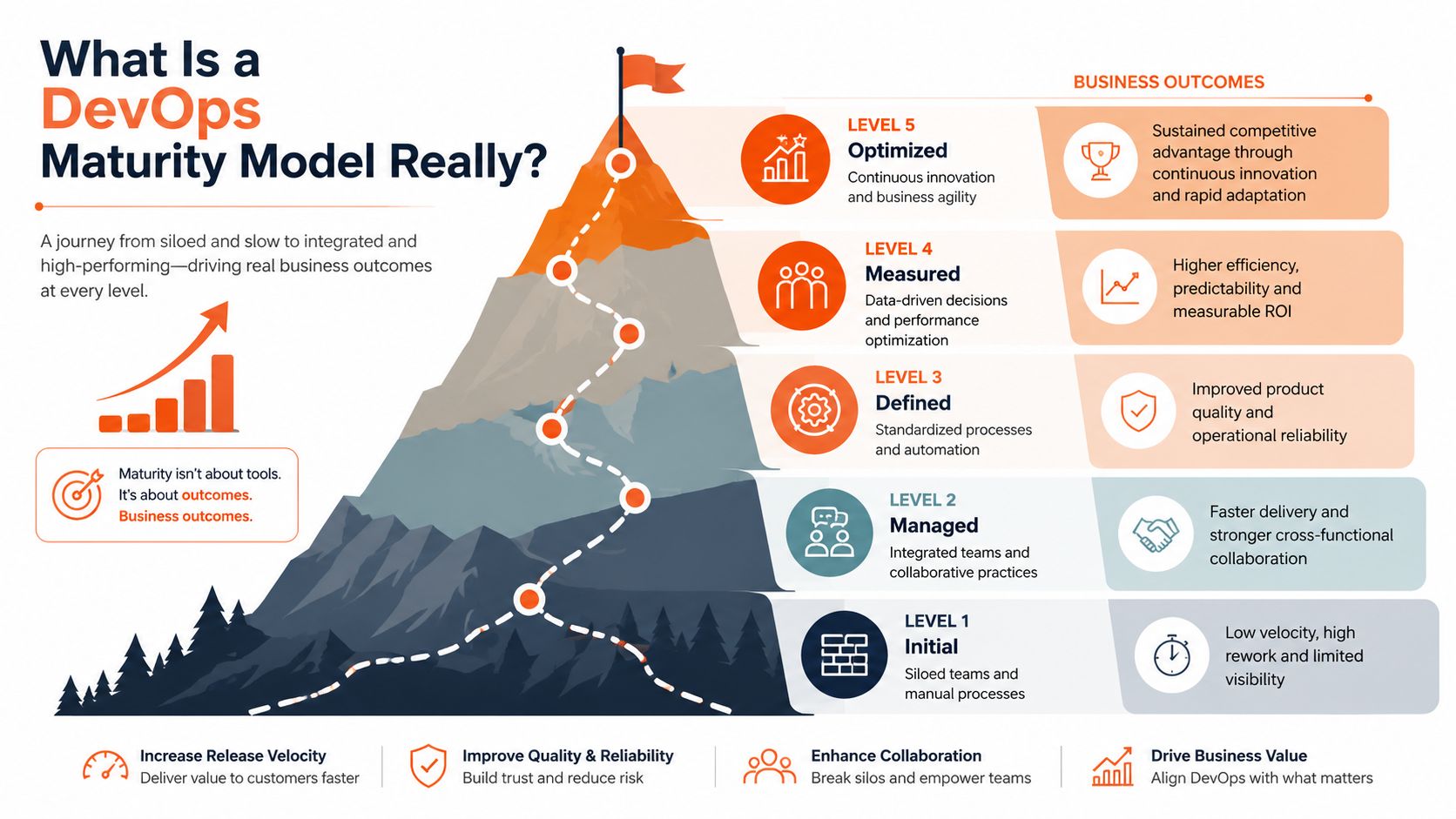
A DevOps maturity model is a roadmap for delivery performance. It tells you where your team is today, what strong looks like next, and which changes will improve business outcomes instead of generating more engineering theatre.
The best analogy is a race car. A fast car doesn't win because it has expensive parts scattered around the garage. It wins because the engine, tyres, aerodynamics, telemetry, and driver all work as one system. DevOps maturity is the same. Tools matter, but integration, discipline, and feedback matter more.
Parts don't create performance
A lot of teams say they're “doing DevOps” because they use GitHub Actions, Kubernetes, Terraform, Datadog, Jira, or Azure DevOps. That's not maturity. That's a stack.
Maturity shows up when those parts support a coherent operating model:
- Culture: teams share responsibility for release quality and recovery
- Automation: repetitive work gets codified instead of repeated manually
- Measurement: leaders use delivery data to make decisions
- Collaboration: product, engineering, platform, and security work in flow, not in queues
You can buy tools in a week. You build maturity by changing how the team behaves under pressure.
Practical rule: Don't measure maturity by how much software you've installed. Measure it by how reliably the business can ship valuable change.
A strong framework also avoids a common trap. It doesn't obsess over output alone. It focuses on business-relevant capabilities. As Plandek's guide to engineering leaders' DevOps measures argues, DevOps maturity should be measured against Flow/throughput, Reliability/recovery, Developer experience, and Governance, with high-maturity teams tracking lead time, cycle time, flow efficiency, and batch size to expose where work stalls.
What maturity changes in practice
When a team climbs the maturity curve, the visible changes are straightforward.
| Capability | Low maturity behaviour | High maturity behaviour |
|---|---|---|
| Flow | Work waits in queues and approvals | Work moves in smaller, cleaner batches |
| Reliability | Releases create stress and surprise | Releases are routine and observable |
| Recovery | Incidents depend on heroics | Recovery follows prepared, repeatable paths |
| Governance | Compliance appears late and blocks progress | Controls are built into delivery early |
That's why I push founders to stop seeing DevOps as an engineering side quest. It's part of company design. If your delivery engine is disciplined, the business can experiment faster, learn faster, and compound value faster.
The cultural layer most teams miss
The final piece is mindset. A mature team doesn't ask, “Who owns this failure?” after the outage. They ask, “Why did our system allow this to happen, and how do we prevent the next one?” That shift is the essence of Extreme Ownership.
Without it, maturity stays cosmetic. With it, the model becomes a machine for speed, resilience, and trust.
Choosing Your North Star Common Maturity Models
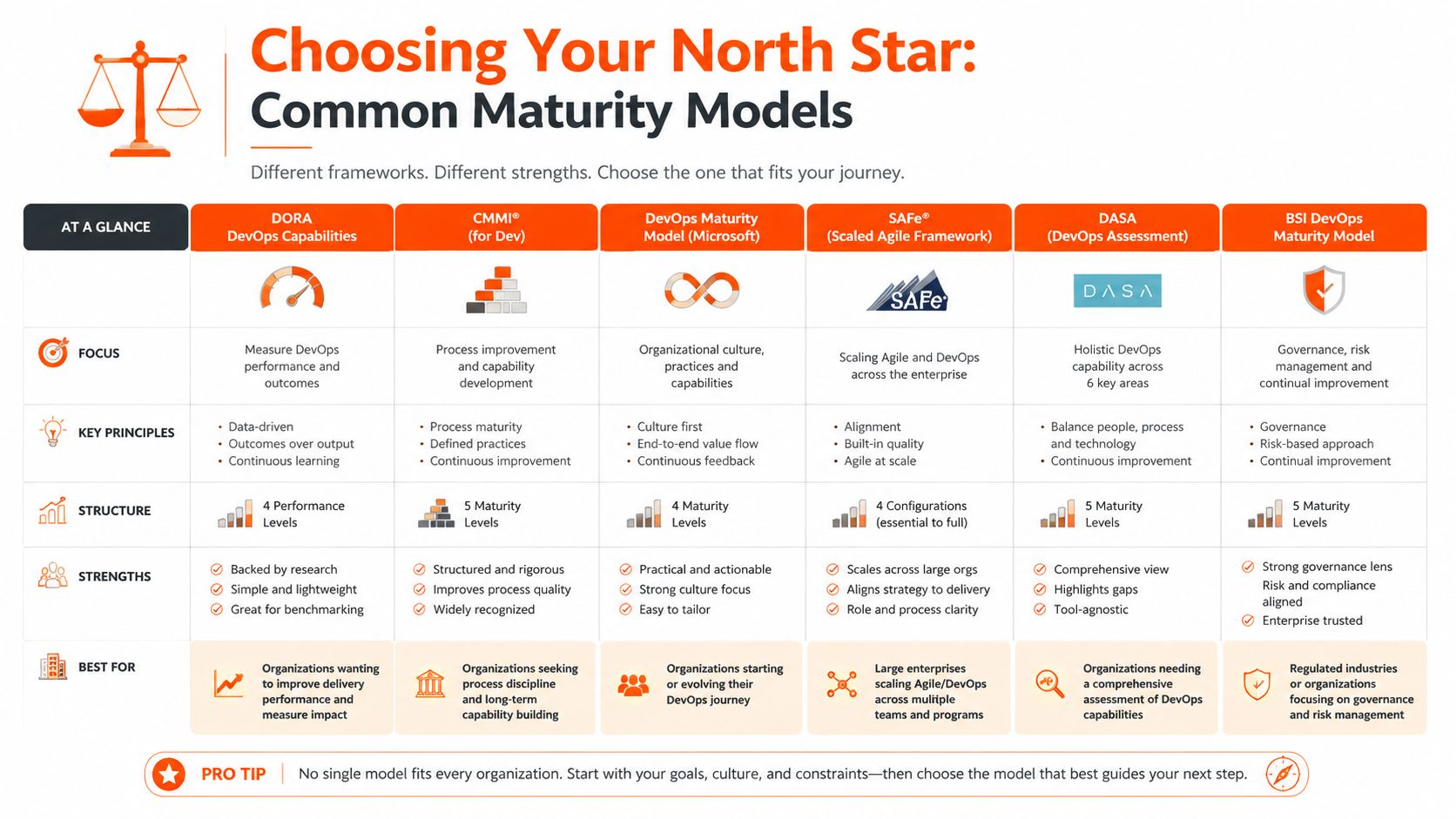
Not every maturity model helps a founder make better decisions. Some are useful for broad organisational improvement. Others are better if you need a sharper answer to one commercial question: can this team ship quickly without breaking the product?
The classic five-stage model
The traditional model usually runs through stages such as Initial, Repeatable, Defined, Managed, Optimised. It's helpful if you need a structured transformation path across a larger organisation. It gives leadership a language for standardisation, process discipline, and operational consistency.
That said, it can become bureaucratic if your company is still in aggressive product growth mode. Founders don't need maturity theatre. They need signal.
If your organisation already uses process-heavy frameworks, it's worth contrasting DevOps maturity with broader capability approaches like the CMMI maturity model in software delivery. That comparison usually reveals whether you need more governance, more flow, or both.
Why DORA tends to be more useful for SaaS
DORA is stronger when you want operational truth fast. It focuses leadership on delivery outcomes rather than process documentation. That's why it's often the better north star for a product-led SaaS business.
A Future Processing article on DevOps maturity models cites a 2025 UK-specific study showing that 68% of British enterprises using the DORA-based DevOps maturity model fail to improve Deployment Frequency after one year of adoption because they focus on tools rather than flow. That's the warning founders need to hear. A framework only works when it changes how work moves.
The right model should answer business questions, not decorate internal reports.
Which model fits which business need
Use the choice below as a practical filter:
- Choose a five-stage model when you need a transformation roadmap across multiple teams, formal operating standards, and clearer progression across the organisation.
- Choose DORA-first thinking when speed, stability, and continuous learning matter more than document-heavy maturity scoring.
- Blend both if you're scaling and need outcome metrics at team level with clearer governance at organisational level.
A pure checklist model can tell you whether teams have adopted certain practices. It often won't tell you whether customers feel the benefit. DORA closes that gap better because it pushes leaders to inspect actual delivery behaviour.
My recommendation
If you're a new SaaS founder, start with an outcome-driven lens. You need a model that keeps the company honest about release speed, service stability, and recovery capability. Once that's working, layer in broader operational governance where it helps.
That order matters. Flow first. Bureaucracy later, and only where it earns its place.
How to Accurately Assess Your DevOps Maturity Level
Maturity is often misjudged because teams rely on opinion. Someone fills in a survey, leadership agrees things are “improving”, and the organisation moves on without confronting the delivery data. That's how weak systems survive.
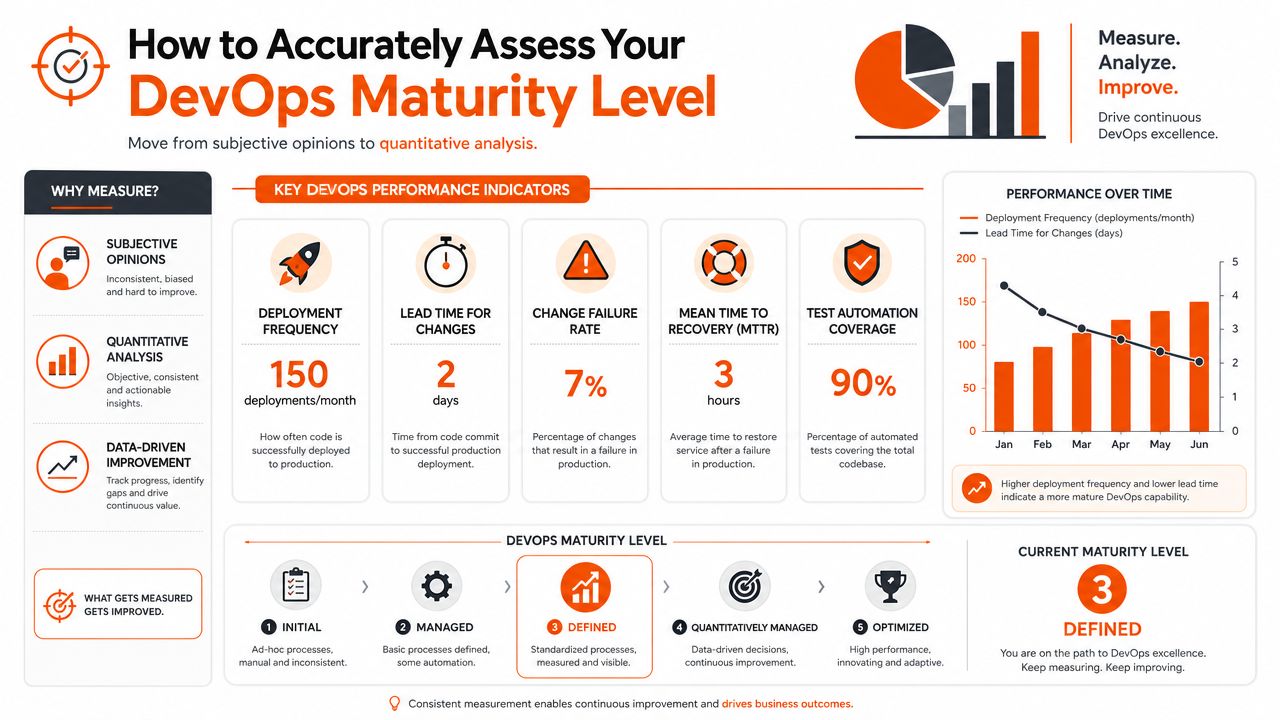
Start with evidence. Pull data from your version control system, CI pipeline, deployment platform, incident tooling, and backlog flow. If GitHub, GitLab, Jira, Azure DevOps, Jenkins, CircleCI, Argo CD, or PagerDuty already hold the truth, use them.
Use hard delivery data first
The benchmark gap in the UK is already stark. According to the 2024 DX DevOps Benchmark summary from DX, only 14% of software organisations in the UK have reached the highest Elite level, while 42% remain at the Novice stage. The same source states that UK Novice teams have a median Lead Time for Changes of 15 days, while Elite teams achieve under 1 hour.
Those numbers matter because they turn maturity from a vague aspiration into an operational benchmark. If your lead time still stretches across days or weeks, you're not dealing with a minor optimisation issue. You've got a system problem.
Here's the blunt rule. Measure what the business feels:
- Lead time for changes: How long it takes to get a validated change into production
- Deployment frequency: How often you can release safely
- Change failure rate: How often releases create incidents or require remediation
- Mean time to restore: How quickly the team recovers service after failure
Don't trust self-reported maturity alone
Self-assessments still have a place. They can reveal friction, confusion, and misalignment. But they should support the data, not replace it.
For teams tightening engineering discipline, continuous integration practices that remove waiting and rework are often the first place to inspect. If builds are unstable, tests are slow, or branches live too long, your maturity score will be fiction no matter what the survey says.
If you can't trace an assessment result back to delivery data, treat it as a hypothesis, not a conclusion.
A practical baseline workshop should review evidence from a recent period and ask:
- Where does work wait longest?
- Which release steps still depend on individuals?
- What usually causes rollback, incident response, or urgent patching?
- Which approvals protect the business, and which ones merely create delay?
A useful explainer on the subject sits below, and it's worth watching with your delivery leads before you run the assessment.
What an honest assessment produces
An accurate assessment doesn't just label you. It gives you a ranked improvement backlog. You should leave with a clear view of your biggest constraints, your highest-risk manual points, and the shortest path to better flow.
That's what real maturity work looks like. Less opinion. More signal. More ownership.
Your Roadmap to Elite Performance The Rite NRG Way
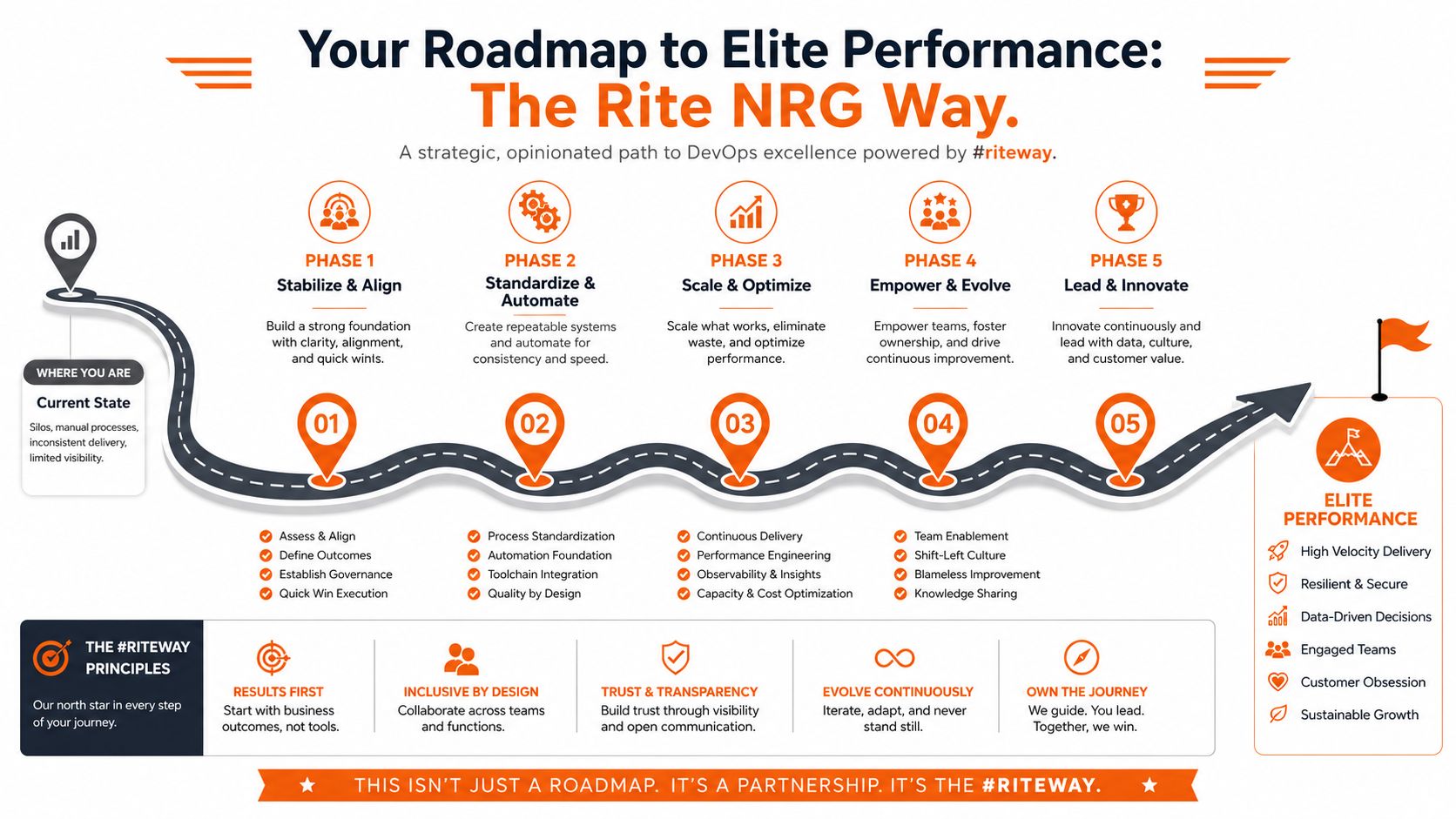
Elite performance isn't a tooling upgrade. It's a leadership decision. The team has to move from reactive delivery to owned delivery, where engineers, QA, DevOps, and product all treat release quality as their job from the start.
That's the heart of the #riteway methodology. High energy. High accountability. No hiding behind job boundaries. If a release fails, the team doesn't blame handoffs, vendors, or “the process”. They fix the system that allowed the problem through.
Step one is ownership, not automation
Many leaders start by buying more tooling. Start by changing expectations instead.
The TXMinds article on DevOps maturity and DORA metrics highlights the operational benchmark that matters here: High Performers maintain a Change Failure Rate of 0–15%, while Low Performers exceed 30%. That range is more than a number. It reflects whether a team prevents failure or gets better at reacting to it.
A roadmap built on Extreme Ownership usually follows this sequence:
- Stabilise responsibility: Assign end-to-end ownership for services, not fragmented ownership by department.
- Reduce batch size: Ship smaller changes so failures are easier to detect and reverse.
- Automate repeat pain: Prioritise the repetitive tasks that slow releases or introduce inconsistency.
- Tighten feedback loops: Surface build failures, test regressions, and production issues quickly enough to act before they spread.
Teams become elite when they stop treating incidents as surprises and start treating them as design feedback.
Build maturity through strategic phases
You don't need to transform everything at once. You need the right sequence.
| Phase | Strategic shift | What leaders should demand |
|---|---|---|
| Early | Move from siloed work to shared ownership | Clear service owners and visible release workflow |
| Emerging | Replace manual repetition with automation | Consistent build, test, and deployment paths |
| Structured | Use metrics to guide behaviour | Review flow, failure, and recovery in leadership cadence |
| Advanced | Embed quality and resilience into delivery | Fast detection, fast rollback, fast learning |
| Elite | Optimise for predictable business outcomes | Delivery becomes routine, scalable, and trusted |
At the talent level, this also changes how you hire. Strong DevOps engineers don't just manage Kubernetes clusters or CI pipelines. They think in systems, trade-offs, resilience, and throughput. If you want a feel for that profile, this Blockchain Jobs listing for a senior DevOps engineer working with Kubernetes is a useful reference point for the kind of ownership-heavy capability mature teams need.
What leaders must enforce
Three standards separate serious maturity efforts from cosmetic ones:
- No orphaned failure. Every incident gets an owner, a root cause, and a prevention path.
- No hidden queue. Work in review, security approval, staging validation, or release prep must be visible.
- No vanity automation. Automate what improves flow, reliability, or recovery. Ignore the rest.
That's the route upward. Ownership first. Automation second. Measurement throughout.
Common Pitfalls and Quick Wins on Your Journey
Most DevOps maturity programmes don't fail because the team lacks intelligence. They fail because leaders chase the wrong problem first. They obsess over tool selection, platform redesigns, and certification language while the actual blockers stay untouched.
One of the most damaging blind spots is compliance. A Rishabh Software article on DevOps maturity models points out a frequently overlooked issue: UK-specific security and compliance regulations such as GDPR and NIS2 can alter maturity progression, yet generic models treat security as a universal pillar and miss how regional bottlenecks can stall movement between phases. That matters even more if you're building or extending teams in Poland for UK clients.
Pitfalls that slow teams down
These are the patterns I'd challenge immediately:
- Tool-first thinking: Buying another platform won't fix unclear ownership or bloated batch sizes.
- Vanity metrics: If leadership celebrates activity but ignores flow and recovery, maturity stalls.
- Late security involvement: Security added at the end becomes a release blocker instead of a delivery capability.
- Ignoring cultural resistance: Teams will preserve old habits if leaders don't reset expectations.
- Treating every team the same: A core product squad, a platform team, and a maintenance team don't need identical maturity targets.
Generic maturity advice often breaks at the point where regulation, customer commitments, and team structure collide.
Quick wins that create momentum
You don't need a giant transformation plan to make progress. Start where friction is obvious and measurable.
- Map the release path: Write down every step from merge to production. Hidden queues show up fast.
- Automate one painful gate: Pick the test pack, approval step, or environment setup that repeatedly delays releases.
- Make work visible: Use Jira, Linear, GitHub, or Azure DevOps boards to expose waiting time, not just task status.
- Review incidents for prevention: Don't stop at “service restored”. Ask what control should have caught the issue earlier.
- Bring security into planning: If compliance affects your market, involve security in backlog shaping and release design.
The right standard for progress
A healthy maturity journey should feel sharper, not heavier. Teams should spend less time coordinating and more time delivering. Leaders should gain better visibility without creating fear. Security should become part of the route, not a roadblock at the end.
If your maturity work adds meetings, reports, and dashboards but doesn't improve release confidence, you're doing theatre. Cut it back and return to the basics: ownership, flow, reliability, governance.
Partnering for Predictable Delivery and Growth
A DevOps maturity model is valuable because it ties engineering practice to business performance. It gives founders a way to assess reality, identify friction, and build a delivery engine that can support growth without constant firefighting.
The path is straightforward. Assess with real delivery data. Build a roadmap around ownership and flow. Remove the blockers that keep work trapped in queues. Treat reliability and recovery as commercial capabilities, not technical side notes.
For security-sensitive teams, partner selection matters as much as tooling. If you're strengthening governance alongside delivery, this guide on how to pick a pentest partner is a useful reference for evaluating security support with the same level of rigour you'd apply to engineering partners.
The same logic applies to delivery advisory. If you need outside support, don't hire a body shop and hope for transformation. Work with people who can challenge your operating model, tighten your release system, and help your team build stronger habits. That's the difference between extra capacity and actual lasting benefit. A good starting point is understanding what strong DevOps consulting services for scaling software delivery should look like in practice.
The companies that win here aren't the ones with the most complicated toolchains. They're the ones that build teams with ownership, discipline, and urgency. They ship with confidence because their system is designed for it.
If you want to build a delivery engine that ships faster, recovers cleaner, and scales with confidence, talk to Rite NRG. They work as a strategic delivery partner, not a CV supplier, bringing senior engineering teams, product-first thinking, and the ownership mindset needed to turn DevOps maturity into real business performance.