You know the engineer I mean.
They rescue the release on Thursday night, cut through a knotty integration nobody else wanted to touch, and somehow get the client smiling again by Friday morning. Then you discover they skipped the handover notes, hard-coded a shortcut that nobody approved, and annoyed the two steadiest people on the team.
That person is not rare. In delivery teams, they show up early, often, and usually when the situation is critical. If you lead products, platforms, or MVP builds, you've probably already got one. If you don't, you may be trying to hire one without admitting it.
Handled badly, the lovable rogue creates culture debt, process debt, and avoidable delivery risk. Handled well, they create momentum that slower teams never catch. The job of a strong CTO or founder isn't to flatten that personality into corporate beige. It's to point it at the right problem, put hard rails around it, and demand ownership for outcomes.
That One Brilliant Engineer Who Breaks All the Rules
A CTO calls me when the same pattern starts repeating. One engineer keeps pulling off miracles. Incidents get resolved faster when they jump in. Stalled features suddenly move. Clients trust them because they sound confident and act decisively.
But every win comes with a bill.
The ticket trail is patchy. The team can't tell whether the engineer is being heroic or reckless. Delivery starts depending on one person who treats process as a suggestion. That stops being charming when your roadmap depends on predictability.

In British culture, everyone already knows this character. Del Boy Trotter is one of the clearest examples of the lovable rogue. The trope has real staying power. Only Fools and Horses reached 24.3 million peak viewership, and a 2020 YouGov poll named it the UK's favourite sitcom with 22% of votes from 2,000 respondents, as noted in the lovable rogue overview.
Why tech teams keep creating this character
Software delivery rewards people who move first, cut through ambiguity, and take responsibility when everyone else is still discussing options. That's useful. It can also become dangerous when the same person decides that version control hygiene, architecture review, or stakeholder alignment are beneath them.
Practical rule: A lovable rogue becomes a business asset only when their freedom is tied to accountability.
The mistake leaders make is treating this person as either a genius to protect or a problem to remove. Both reactions are lazy. The first creates dependency. The second throws away firepower you may badly need.
The better move is more disciplined. Recognise the pattern. Separate impact from theatre. Then decide where that energy belongs.
The real management challenge
This isn't about personality. It's about delivery shape.
Some engineers improve systems by making them orderly. Others improve systems by attacking bottlenecks with speed and nerve. You need both. The lovable rogue matters because they often surface in the exact places where product risk, stakeholder pressure, and technical ambiguity collide.
If you can channel them, they become a competitive advantage. If you can't, they become the person your whole team works around.
Decoding the Lovable Rogue in Your Engineering Team
The simplest way to understand a lovable rogue engineer is this. They're a rally driver, not a city driver.
On a brutal course with poor visibility, changing terrain, and no time to hesitate, they're magnificent. Put the same person in a slow, rule-heavy environment with lane discipline and patient signalling, and they'll drive everyone mad.
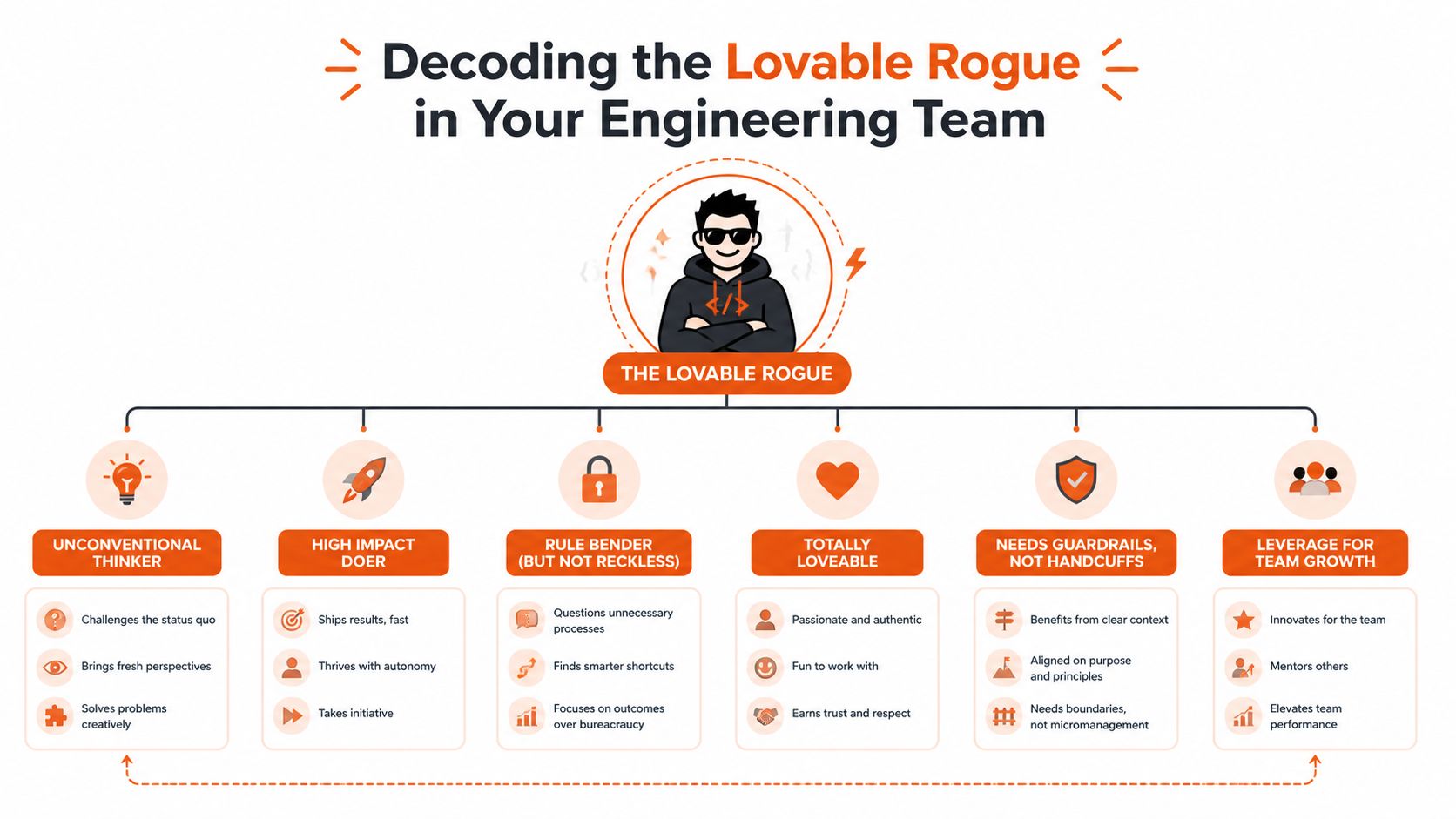
What they actually look like at work
You don't spot a lovable rogue by job title. You spot them by behaviour under pressure.
- They move before they're asked. They don't wait for perfect tickets. They see a client problem, a delivery blocker, or an ugly handoff and they jump in.
- They care about outcomes more than ceremony. If a ritual doesn't help ship, de-risk, or clarify, they want it gone.
- They improvise well. Ambiguous requirements and messy systems don't freeze them. Those conditions often energise them.
- They influence sideways. People follow them because they sound certain and make progress visible.
- They resist control when the control feels hollow. They can respect standards, but they won't tolerate bureaucracy that exists only to protect someone's comfort.
- They usually have a personal code. They may bend process, but they often draw hard lines around quality, client trust, or technical integrity.
The difference between a rogue and a liability
This matters. Plenty of leaders confuse a rogue with a brilliant jerk. They are not the same.
A brilliant jerk breaks trust. A lovable rogue breaks routine. One poisons teams. The other frustrates teams while still trying to win for them.
Use this quick filter:
| Signal | Lovable rogue | Liability |
|---|---|---|
| Motivation | Wants the mission to succeed | Wants to be seen as smartest |
| Reaction to feedback | Pushes back, then adapts if the case is strong | Dismisses or undermines |
| Impact on others | Creates friction but also momentum | Creates fear, silence, and churn |
| View of ownership | Takes responsibility when things go wrong | Blames process, people, or constraints |
| Relationship with rules | Challenges weak ones | Ignores all of them |
If they leave a mess and then help clean it up, you've got a rogue. If they leave a mess and explain why it isn't their fault, you've got a problem.
Don't guess. Assess behaviour properly
Structured behavioural assessment offers a key advantage. Many teams over-index on CV keywords and under-read working style. A tool like the Synopsix people intelligence platform is useful because it helps leaders separate high-ownership mavericks from low-discipline ego players before they do damage.
You don't need everyone to be process-perfect. You do need to know who needs autonomy, who needs constraints, and who should never own a critical path alone.
The High-Stakes Gamble Unpacking the Risks and Rewards
A lovable rogue is not a quirky HR footnote. They're a portfolio decision.
You are choosing to accept volatility in exchange for acceleration. Sometimes that's exactly the right trade. Early-stage product work, recovery projects, urgent migrations, and ugly vendor handovers often need someone willing to cut through noise and create movement.
Sometimes it's the wrong trade. If your team is already carrying fragile architecture, trust issues, and weak documentation, another forceful improviser can push a stressed system over the edge.
The upside leaders secretly want
Founders and CTOs often say they want discipline, but what they really need in a crunch is someone who can produce decisive movement.
A strong lovable rogue can do a few things exceptionally well:
- Break deadlock: They stop endless analysis and force a decision.
- Create delivery energy: Teams often move faster when someone models urgency and ownership.
- Find unconventional paths: They will test a route others ignore if it gets the product shipped.
- Win confidence externally: Clients and stakeholders respond to people who sound accountable and action-oriented.
That upside is real. It can be the difference between an MVP that reaches market and one that dies in internal debate.
The downside leaders usually pay later
The bill arrives in slower, less glamorous ways.
- Process debt builds up: The team starts relying on undocumented tribal knowledge.
- Methodical engineers disengage: Good people hate cleaning up after avoidable improvisation.
- Quality risk spreads: Fast fixes become hidden constraints in later releases.
- Leadership loses visibility: Delivery starts depending on personality rather than system health.
If that sounds familiar, strengthen your operating model before negative effects multiply. Good software project risk management practices matter most when one person can move faster than the rest of your governance.
The Lovable Rogue Balance Sheet
| Rewards (Catalyst for Growth) | Risks (Source of Chaos) |
|---|---|
| Creates urgency around business outcomes | Skips the breadcrumbs others need to maintain pace |
| Solves ambiguous problems fast | Leaves architecture and process gaps behind |
| Challenges stale assumptions | Triggers friction with steady operators |
| Pulls stakeholders out of pessimism | Encourages hero culture if left unchecked |
| Pushes MVP scope toward what matters now | Can weaken long-term maintainability |
A rogue is valuable when they compress time without inflating future cost beyond what the business can absorb.
When to lean in and when to say no
Back them when the work is messy, the timeline matters, and you have enough leadership maturity to set guardrails. Don't back them when the team is already tired, trust is weak, and core systems need consistency more than flair.
This is why some lovable rogues become folklore inside companies and others become expensive cautionary tales. The difference isn't raw talent. It's whether leadership made a conscious trade instead of drifting into dependency.
A Founder's Guide to Hiring Rogue Potential
Don't hire for swagger. Hire for constructive rule-breaking in service of outcomes.
Most founders get this wrong because they're seduced by confidence, war stories, and fast answers in an interview. That's how you recruit a self-mythologising cowboy. You want something rarer. A person who challenges weak systems, protects customer outcomes, and still accepts accountability when their judgement is tested.

Ask for evidence, not charisma
Behavioural interviews expose the difference quickly. Use questions that force the candidate to reveal motive, judgement, and cleanup discipline.
Try questions like these:
- "Tell me about a time you broke a team rule to get a better client outcome." Listen for whether they understood the trade and whether they owned the consequences.
- "Describe a situation where process slowed delivery. What did you change?" Strong candidates improve the process. Weak ones just complain about it.
- "What's the last decision you made that created extra work for you because it was still the right call?" Ownership shows up when someone accepts personal cost.
- "When have you pushed back on a product, engineering, or stakeholder decision?" You're looking for judgement with backbone, not defiance for sport.
- "Tell me about a mess you created and how you repaired trust afterwards." If they can't answer this candidly, don't hire them.
Watch for the anti-pattern
A real rogue can usually explain three things clearly. Why they acted. What boundary they respected. How they stabilised the team afterwards.
A brilliant jerk usually can't. They tell stories where everyone else was slow, wrong, political, or beneath them.
Hire the candidate who talks about outcomes, trade-offs, and repair. Pass on the one who only talks about being right.
Drop the stereotype
There's another hiring mistake worth calling out. The lovable rogue is culturally coded as male far too often. That's not harmless shorthand. It narrows who gets recognised for the same strengths.
Analyses of BBC-adapted books found rogue-like antiheroes skew 85% male, as discussed in this writing analysis of the archetype. In hiring, that bias can make leaders overlook women who show the exact same traits of ownership, initiative, and productive challenge.
If your interview loop equates rogue potential with a specific performance style, you'll miss talent. Focus on behaviours. Ownership. Proactivity. Judgement under pressure. Respect for the mission.
If you're refining the role itself, tighten the brief before you start outreach. This guide on how to hire dedicated developer talent is a useful reminder that hiring quality starts with role clarity, not CV volume.
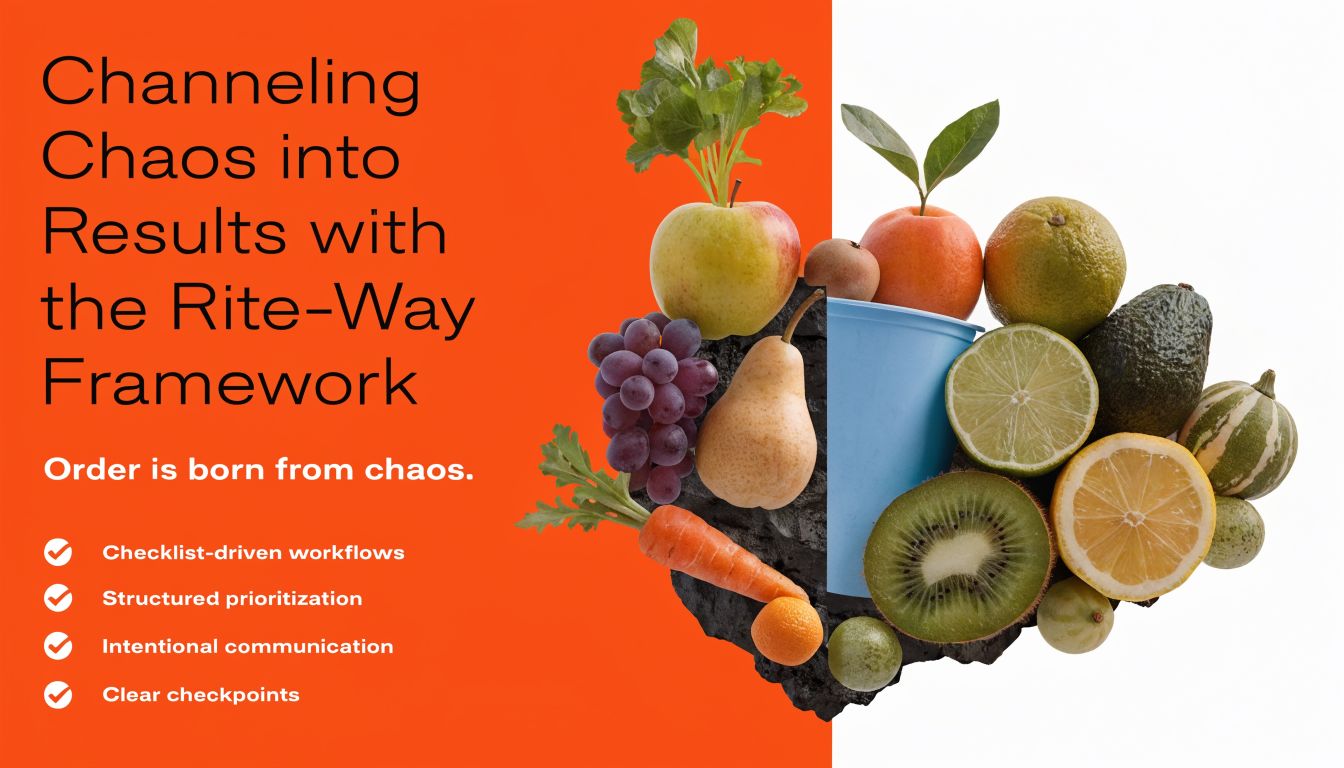
Channeling Chaos into Results with the Rite-Way Framework
Trying to tame a lovable rogue with more process is usually a losing move. They don't become better by being smothered. They become better when freedom is paired with uncompromising accountability.
That's the core of the #riteway approach. Extreme Ownership. High energy. Proactivity. Not as slogans, but as operating constraints. The model works because it gives the rogue what they want most, room to act, while making the business outcome and boundary conditions impossible to dodge.
Start with their code, not your frustration
Many lovable rogues operate from a personal code. They may reject formalism, but they usually care a great deal about something concrete: protecting users, delivering on promises, building elegant solutions, or refusing mediocrity.
That matters because managers often misread their resistance as immaturity when it's misalignment.
Psychological analysis around this archetype points to the role of internal moral frameworks. Related discussion notes that 41% of non-violent offenders cite childhood adversity in UK Ministry of Justice 2025 data, which can foster adaptability and a personal code separate from formal rules, as referenced in this discussion of writing lovable rogues. In management terms, the useful takeaway isn't to romanticise rule-breaking. It's to recognise that some high-agency people respond better to principles than to bureaucracy.
Build the containment field
Here's the management model I recommend.
Define the mission in business terms
Don't say, "tidy this service." Say, "reduce the release blocker, protect customer trust, and keep the onboarding milestone on track."Set immovable boundaries
No breaking production. No bypassing security review where customer risk is involved. No private side deals with stakeholders. No undocumented architectural decisions on critical paths.Give them a bounded arena
Let them choose the route inside those rails. That's where their speed appears.Make ownership visible
Every shortcut gets logged. Every trade-off gets stated. Every deviation has an owner and a follow-up action.Pair them with a stabiliser
The best counterpart is not another rogue. It's a calm operator who respects speed and protects continuity.
What leaders must do consistently
A lovable rogue needs a manager with backbone. Not a bureaucrat. Not a fan.
Useful habits overlap strongly with the broader habits of a successful project manager, especially around clarity, follow-through, communication rhythm, and visible accountability. Those habits stop high-energy contributors from turning into lone-wolf bottlenecks.
Use this checklist in live delivery:
- Review outcomes, not theatre: Judge them on shipped value, reduced risk, and team reliability.
- Call out collateral damage early: Don't wait until resentment hardens.
- Reward cleanup: If they fixed the problem and documented the path, say so.
- Escalate repeated boundary breaches: Charm doesn't excuse pattern failure.
The right operating model turns a loose cannon into a guided missile.
Integrating Rogues into Nearshore and MVP-Focused Teams
This personality type can be excellent in nearshore delivery and MVP work. It can also blow holes in both if you leave expectations vague.
For MVPs, the lovable rogue often shines because early products need ruthless prioritisation. They hate waste, they move quickly, and they usually have strong instincts for what can wait. That's useful when the team is drowning in feature ideas and the commercial window is narrow.
For nearshore teams, the challenge is different. Distance magnifies ambiguity. If a rogue senses uncertainty in communication, they'll fill the gap themselves. Sometimes that's brilliant. Sometimes it creates misalignment across client, product, and engineering.
The integration checklist that works
Use a tighter operating cadence from day one.
- Clarify who decides what: Spell out decision ownership for scope, architecture, release, and stakeholder communication.
- Document intent, not just tasks: A rogue works better when they understand why the work matters.
- Run short feedback loops: Frequent demos and check-ins stop unilateral interpretation from drifting too far.
- Name the cultural rules explicitly: Don't assume they understand the team's norms around escalation, disagreement, or handover quality.
- Use them to challenge assumptions carefully: They can be excellent at exposing stale client thinking if someone senior frames the conversation properly.
Where they fit best
In a nearshore setup, I like lovable rogues in discovery-heavy streams, rescue work, prototype acceleration, technical due diligence, and the rough edges of MVP definition. I don't put them in total control of core governance or leave them unsupervised on business-critical handoffs.
If you're building through a distributed model, your delivery design matters as much as the talent. This guide to nearshore service delivery is worth reading because it reinforces the part many teams skip: structure creates speed.
The goal isn't to suppress the lovable rogue. It's to place them where their impatience improves momentum, not where it corrodes trust.
If your team has a lovable rogue, or you need senior engineers who bring ownership without creating chaos, Rite NRG is built for that challenge. They help SaaS teams ship faster with senior nearshore delivery talent, product-first thinking, and a working model grounded in extreme ownership, proactive communication, and predictable outcomes.