Your operations lead already knows the pain. Stock count week arrives, lift trucks get redirected, supervisors pull reliable people off value-adding work, and half the building slows down so someone can confirm what should have been visible in the system all along. By the time the count is finished, some of the data is already stale.
That's why interest in drones in warehouse operations keeps rising. Not because drones are flashy. Because manual cycle counting is a weak operating model in fast-moving facilities. It's slow, disruptive, and too dependent on scarce labour.
The mistake I see most often is treating warehouse drones as a hardware purchase. That's the wrong lens. The drone is only the front-end sensor. The primary project is data capture, exception handling, WMS integration, and operational control. If those pieces aren't designed properly, you haven't built an automation capability. You've bought an expensive flying camera.
The End of the Manual Stock Count
At 6:30 on a Sunday, the warehouse is technically open and operationally half-frozen. Counting has blocked one aisle. A supervisor is chasing a stock discrepancy that started with a missed scan three days ago. Someone is waiting for access equipment to verify a pallet position that should already be confirmed in the system. The WMS record exists, but nobody trusts it until a person checks the rack.
That is the actual cost of manual stock counting. It does not just consume labour. It breaks flow, delays decisions, and exposes a bigger problem. Your warehouse systems are not getting timely, reliable inventory data.
Warehouses that adopt drones successfully do not treat them as flying gadgets. They treat them as part of a controlled inventory data pipeline. The drone captures evidence. Software classifies it. The WMS receives an update or creates an exception. A person steps in only when the system cannot resolve the mismatch on its own. That is the operating model worth paying for.
What changes when the count becomes autonomous
Autonomous counting shifts inventory control from scheduled disruption to routine verification.
Instead of waiting for a full count window, the operation can run targeted scans by aisle, location, SKU class, or exception type. That gives inventory teams fresher data and gives operations teams fewer interruptions. It also forces a discipline many warehouses lack. You need clean location masters, consistent barcode placement, clear exception rules, and a reliable path into the WMS or data platform. Without that foundation, the drone just finds problems faster than your team can process them.
That is why software delivery matters more than flight capability. If scan results land in a dashboard no one uses, you have not improved inventory control. If they trigger tasks, reconcile against system records, and attach image evidence to disputes, you have.
Manual stock counting uses experienced warehouse labour to compensate for weak system visibility.
Retail has already dealt with the same issue in a different setting. The RFID in retail strategic guide is a useful comparison because it shows how better data capture changes execution, replenishment, and exception handling. The same principle applies in warehouses. Better sensing only pays off when it plugs into the systems that run the business.
The operational advantage
Do not position drones as labour replacement. Position them as a way to stop spending skilled labour on confirmation work that software and automation should handle first.
- Reduce disruption: Run inventory checks with less interference to picking, putaway, and replenishment.
- Improve safety: Cut unnecessary high-rack verification work before a person and a lift truck get involved.
- Speed up investigations: Image-backed exceptions are easier to resolve than handwritten notes and delayed recounts.
- Increase count frequency: Smaller, targeted scans produce better control than large, periodic stock counts.
That is why manual stock counts are on borrowed time. The winning model is not faster counting. It is a warehouse where inventory data moves into enterprise systems quickly enough to support decisions while work is still happening.
The Business Case for Autonomous Scans
At 6:30 a.m., the night shift has finished, pick waves are building, and a supervisor is still waiting on a manual rack check before releasing a customer order. That delay is the business case.
The wrong buying question is, "Should we buy drones?" The right one is, "Which inventory control failures are costing us money, service level, and management time every week?" Autonomous scans make sense when they cut those failures inside a live operation and feed the result back into the systems that run replenishment, exception handling, and fulfilment.
As noted earlier, warehouse operators are already using indoor drones for inventory checking. That point matters less than many vendors suggest. The hard part is not proving a drone can fly an aisle. The hard part is turning scan output into trusted system action without creating a new layer of manual review.
Here's the visual used to align finance, operations, and technology around the case for change.
The commercial case is simple. Better inventory visibility cuts wasted labour, shortens investigations, and improves order confidence. It also reduces avoidable work at height. Those benefits only show up when the scan result reaches the WMS, gets matched to a location or license plate, and triggers a clear follow-up process.
What actually drives ROI
ROI comes from system design and process discipline, not from the aircraft itself.
- Fewer paid hours spent on low-value verification: Experienced warehouse staff stop climbing, recounting, and confirming inventory that should be validated by automated scans first.
- Less operational interruption: Scan schedules can be built around quiet windows, reducing conflict with picking, putaway, and replenishment.
- Faster exception handling: Teams investigate a smaller set of identified mismatches instead of checking broad areas blindly.
- Better safety control: The first pass on high-rack discrepancies happens through machine vision and flight automation, not a person on access equipment.
- Stronger inventory governance: Each scan can create a time-stamped record with image evidence, which improves auditability and dispute resolution.
That is why smart buyers look past the drone category and discover AI automation opportunities across the full inventory workflow. The biggest gains come from combining autonomous capture, rules-based exception routing, and decision support in one operating model.
Where projects succeed or fail
Buyers get distracted by flight demos because they are easy to understand. Integration debt is less visible, and it is usually what kills value.
If the drone platform cannot map scans cleanly to your location master, item identifiers, and exception states, you do not have an inventory solution. You have airborne data collection with a manual clean-up problem attached. That is expensive. It also creates distrust fast, because warehouse teams will stop using any tool that produces ambiguous discrepancies or forces them into spreadsheet reconciliation.
This video helps because it shows warehouse drone systems in operation rather than as a concept.
Practical rule: If a vendor cannot explain how exceptions move from scan result to warehouse action, they are not selling an operational solution. They are selling theatre.
The board-level view
A strong internal proposal positions autonomous scans as inventory control infrastructure with measurable operating impact.
| Business concern | What autonomous scans improve |
|---|---|
| Labour pressure | Fewer manual verification hours on repetitive count activity |
| Fulfilment reliability | Earlier detection of stock mismatches before they affect orders |
| Safety exposure | Less routine checking at height with people and lift equipment |
| Operational continuity | Scheduled scans that fit around live warehouse activity |
| Data quality | Better evidence and cleaner reconciliation between physical stock and system records |
That framing gets support because it connects the technology to cost, service, safety, and control. Drones in warehouse operations create value when they are implemented as part of an enterprise workflow, not treated as a standalone gadget.
Core Warehouse Drone Use Cases
There are plenty of ideas floating around the market, but only a small number of warehouse drone use cases are fully mature. If you want ROI, stay disciplined. Focus on the workflows that already map to a clear operating problem.
Autonomous cycle counting
This is the strongest use case by far.
The drone flies indoor routes without GPS, moves through aisles, captures images of pallet or bin locations, and feeds those images into a process that compares physical evidence with system records. That's useful because it targets a stubborn problem: inventory accuracy in places that are tedious, slow, or awkward for people to verify manually.
An industry benchmark often cited in the UK logistics context says a single warehouse drone can scan a 300-foot-long by 30-foot-high aisle in just over 5 hours, which is described as almost twice as fast as manual cycle counting in this warehouse cycle counting benchmark.
That number matters, but not in the way many buyers think. It doesn't mean a drone can suddenly survey your entire building overnight. It means autonomous counts can outperform manual counting in the right conditions, especially where rack height and repetitive verification make labour-intensive counting painful.
How the workflow looks in practice
A sensible cycle count routine usually follows this pattern:
- Select target zones based on inventory risk, high racks, disputed locations, or scheduled count policy.
- Launch the scan during quiet operating hours so the drone can move with less interference.
- Capture evidence through images and location-aware navigation.
- Identify mismatches between what the system expects and what the drone records.
- Send exceptions to people for investigation and correction.
That last step is where operational maturity shows up. Strong teams don't ask drones to replace judgement. They use drones to narrow the list of locations that need human attention.
Inspection and surveillance
This is the use case many executives assume is easy. It isn't.
In theory, indoor drones can inspect high-level infrastructure, rack faces, lighting, or hard-to-reach areas without ladders or lifts. In practice, the evidence base is much weaker here than it is for inventory management. Public coverage is far more convincing on counting stock than on routine warehouse inspection programmes.
That doesn't mean inspection has no place. It means you shouldn't build the business case around it unless you've got a clear, repeated task with a clear owner and a defined response process.
If the warehouse can't answer who reviews inspection findings, how they're logged, and who signs off action, the use case isn't ready.
The use cases to avoid in early pilots
The biggest mistake is trying to prove everything at once.
- Picking by drone: Power and payload limits make this a poor early bet.
- Broad building surveillance: It sounds exciting but often lacks an operational response model.
- General-purpose autonomy: Narrow tasks win. Vague ambition loses.
A short decision table helps.
| Use case | Maturity | Best fit |
|---|---|---|
| Cycle counting | Strong | High racks, repetitive inventory verification |
| High-level inspection | Selective | Specific, structured inspection routines |
| Intralogistics movement | Weak for now | Not a recommended starting point |
For most operators, drones in warehouse settings should begin with one disciplined job: count stock in the places your people least want to count manually.
Understanding the Drone Tech Stack
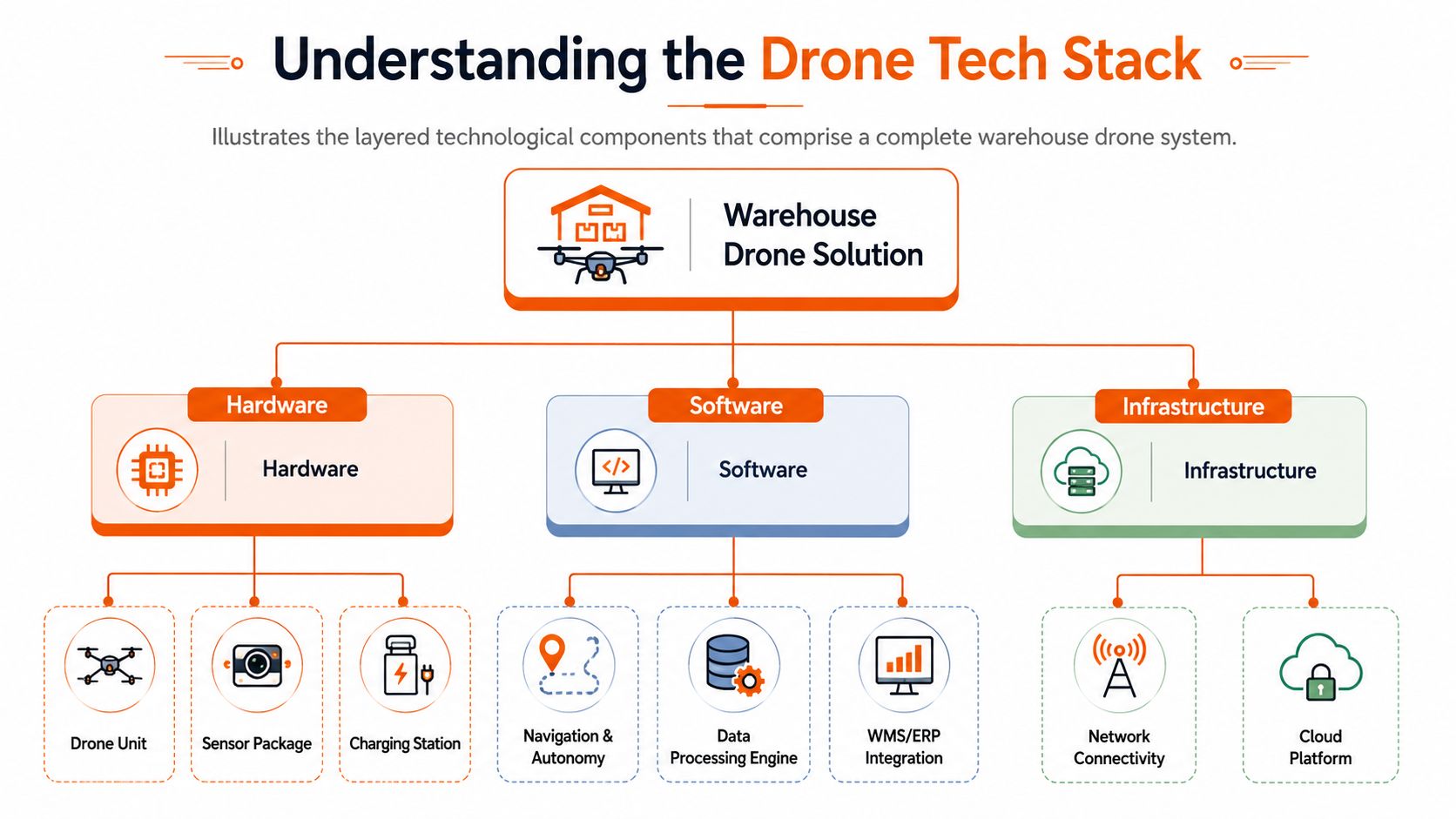
Most failed warehouse drone projects don't fail because the drone can't fly. They fail because leaders underestimate the stack around it. This is not one device. It's a layered system made of airborne hardware, indoor positioning, image processing, connectivity, orchestration, and enterprise integration.
The easiest way to understand it is to treat the drone as one node inside a broader operational platform.
Hardware that matters
Buyers often obsess over airframe design. That's not where the primary decision sits. In indoor inventory work, the critical hardware choices are about stability, sensing, and charging discipline.
The drone needs to fly reliably in constrained aisles, hold position near racking, and collect usable images. That means the sensor package matters more than any flashy payload claim. Cameras are central. Localisation hardware is central. Docking or charging design matters because every interruption becomes an operational cost.
A practical stack usually includes:
- Drone unit: Compact enough for narrow aisles and stable enough for repeatable scans.
- Sensor package: Cameras first. In some environments, additional sensing improves localisation and obstacle awareness.
- Charging station: Essential if you want scheduled operations rather than manual babysitting.
Software does the heavy lifting
The drone is the collector. The software is the system.
Navigation and autonomy software decides how the drone moves indoors without GPS. Data processing software determines whether images can be turned into usable inventory evidence. Fleet management controls missions, schedules, logs, and operational status. Integration services pass outputs into the systems your business already trusts.
For technical leaders, a geospatial mindset is particularly helpful. If you work with digital location layers, indoor positioning, or mapped operational contexts, this breakdown of geospatial data is a useful reference point because warehouse autonomy depends on location intelligence more than most buyers expect.
Infrastructure is where pilots get exposed
A clean demo can hide weak infrastructure. Live operations won't.
Indoor drone systems depend on dependable network coverage, stable mission scheduling, storage for image and scan outputs, and enough local or cloud processing to turn raw captures into decisions. If Wi-Fi coverage drops in steel-heavy aisles, if upload queues back up, or if mission logs aren't accessible to supervisors, the system starts leaking trust.
Strong drone programmes are built by operations, software, and infrastructure teams together. Not by procurement alone.
What technical leaders should ask vendors
Don't ask only about flight. Ask about stack boundaries.
- Where does localisation happen? Onboard, edge, or elsewhere?
- How are missions managed? Through a fleet console, custom workflow, or local control layer?
- What gets stored? Raw images, extracted identifiers, exception records, or all three?
- How is failure handled? Connectivity loss, incomplete scans, poor image quality, aborted routes.
That's the right level of scrutiny. In drones in warehouse programmes, hardware gets attention. Software architecture determines whether the system survives first contact with operations.
The WMS and SaaS Integration Blueprint
Value is won or lost.
A warehouse drone that captures images but doesn't fit your WMS workflow is useless. It may produce interesting data, but it won't improve operations. The goal is not scanning, but systematic exception resolution inside the tools your warehouse already runs on.
A useful model comes from how indoor inventory drones are described in practice. They are most valuable as a data-collection layer. They fly without GPS, use cameras and localisation, upload images to a WMS for comparison against stock records, and support an exception-detection workflow where mismatches are generated for human review in this technical explanation of warehouse drone workflows.
The right architecture
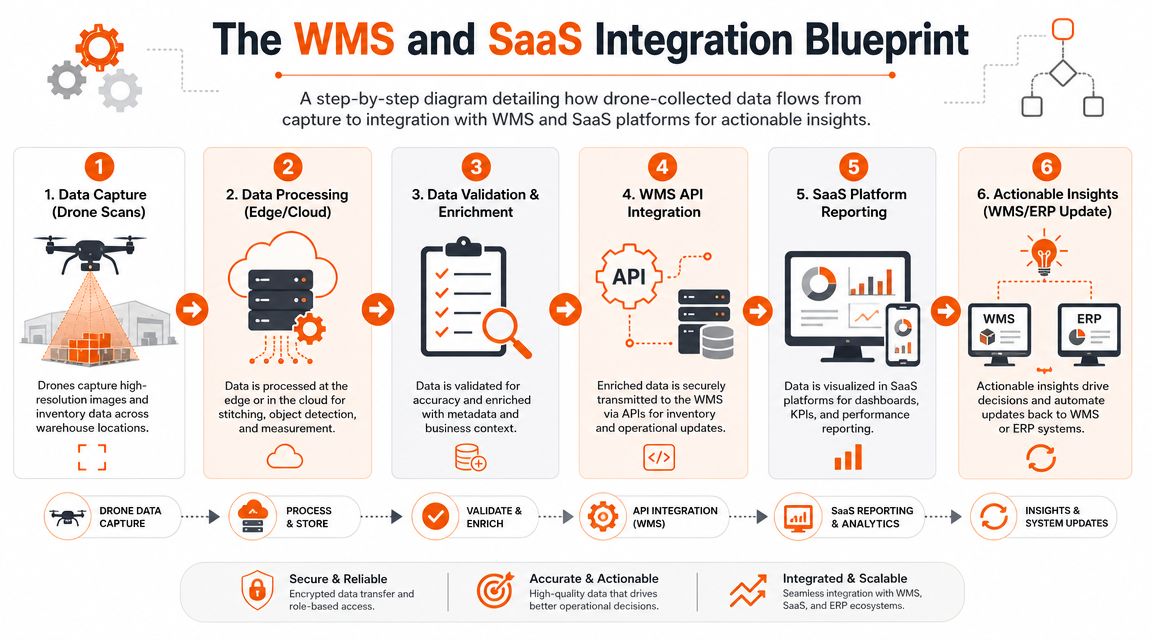
If I were advising a warehouse operator from scratch, I'd avoid direct point-to-point chaos and build around a controlled pipeline.
Capture
The drone collects image evidence and location context.Process
Edge or cloud services classify, extract, and structure the data.Validate
Business rules check whether the result is complete enough to trust.Integrate
The validated event moves into the WMS or ERP through APIs or a managed middleware layer.Resolve
Exceptions are assigned to warehouse users with clear ownership.Report
SaaS dashboards and operational reports show trend lines, recurring mismatch zones, and unresolved cases.
What the WMS must actually do
Many teams assume WMS integration means “send the scan data over”. That's too shallow. The WMS needs to support operational action.
Your workflow should answer these questions:
- What counts as a mismatch? Wrong SKU, missing pallet, unreadable label, empty location, duplicate record.
- Who gets the task? Inventory control, shift supervisor, replenishment lead, or quality team.
- What evidence is attached? Image, location identifier, mission timestamp, confidence flag.
- What closes the case? Manual confirmation, stock adjustment, relabelling, recount, or incident escalation.
SaaS is the multiplier
SaaS reporting matters because it lets leadership see whether the drone programme is improving warehouse control. A decent reporting layer highlights repeat offenders, unstable zones, problematic labels, and count backlog. That's how a drone initiative becomes a process improvement engine instead of a siloed automation experiment.
A clean integration blueprint also makes vendor changes less painful. If the flight system changes later, your WMS-facing exception model doesn't need to collapse with it.
The smartest design choice is to keep the drone-specific logic narrow and keep the operational workflow enterprise-owned.
Common integration mistakes
A lot of teams burn months here. Usually for avoidable reasons.
| Mistake | Business consequence |
|---|---|
| Raw scan dumps into the WMS | Users ignore noisy data |
| No exception workflow | Supervisors get information, not action |
| No audit trail | Inventory corrections become hard to trust |
| Tight vendor lock-in | Future changes get expensive and slow |
This is the section most hardware-first buyers skip. It's also the section that determines whether drones in warehouse operations create real inventory control or just another disconnected dashboard.
Your Pilot and Rollout Roadmap
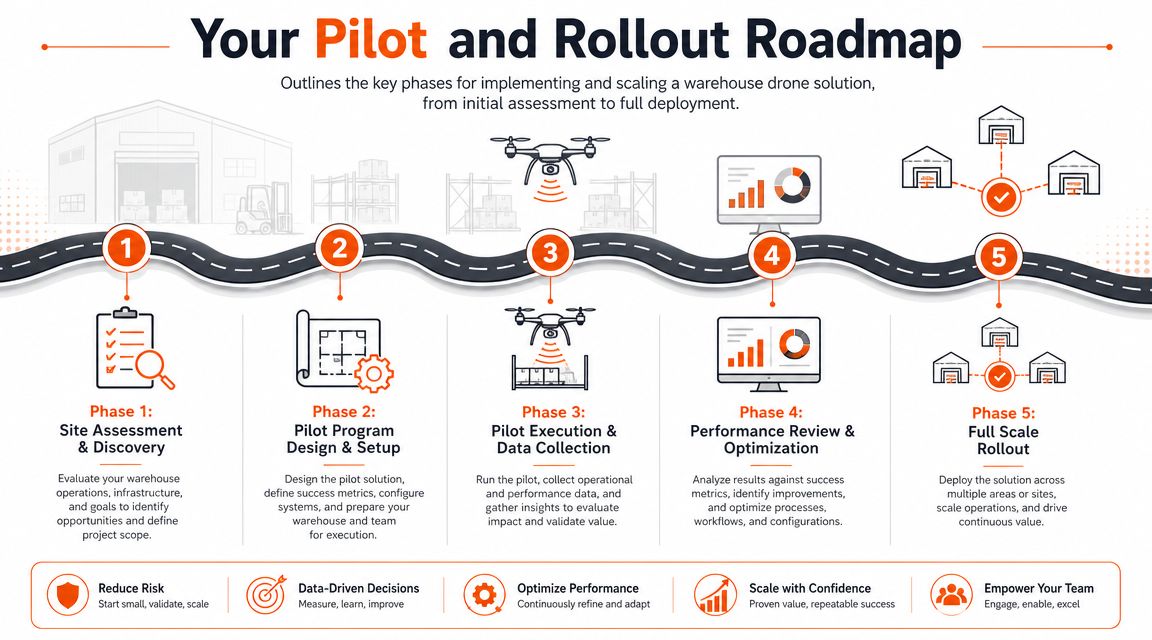
A pilot should prove operational value fast. It should not try to validate every future ambition. The strongest warehouse automation programmes start narrow, produce evidence, and expand only after the operating model is stable.
That discipline matters even more for drones. For many UK operators, the practical question is whether drones are worthwhile in sites that aren't large, purpose-built distribution centres. The strongest evidence still points to inventory management as the best-fit use case, while intralogistics is not yet entirely feasible because of power and payload limits in the ETH Zurich whitepaper on warehouse drone operations.
Phase one and two
Start with a site assessment, then design a pilot around one warehouse problem.
A strong assessment reviews aisle geometry, rack height, label quality, network coverage, and the maturity of your WMS exception process. If those fundamentals are messy, the pilot will tell you more about operational disorder than drone capability.
The pilot design should stay narrow. One zone. One workflow. One success model.
If your team needs a disciplined way to frame scope, owners, assumptions, and acceptance criteria, this guide to proof of concept documentation is worth using before a vendor ever shows up onsite.
Phase three and four
Run the pilot in real warehouse conditions, not in a sanitised demo window.
That means using actual labels, actual stock records, and actual operational constraints. Let the system hit the awkward realities: mixed SKU heights, partial obstructions, low-light conditions, and real shift patterns. Then optimise the workflow, not just the flight path.
Track outcomes qualitatively and operationally:
- Count burden: Are teams spending less effort on manual verification?
- Exception usefulness: Are the alerts actionable or noisy?
- Workflow adoption: Do supervisors trust the outputs enough to use them?
- Interruption level: Does the pilot fit around normal warehouse activity?
Phase five
Scale only when three things are true.
First, the scan outputs are dependable enough to drive human action. Second, the WMS process for handling discrepancies is clean. Third, the building has enough infrastructure discipline to support repeated operation.
Pilot success isn't “the drone flew”. Pilot success is “the warehouse changed a routine because the system proved useful”.
A practical rollout sequence usually looks like this:
- Expand by aisle type: Roll out first in similar rack environments.
- Expand by workflow confidence: Scale where label quality and process discipline are already decent.
- Expand by operating window: Add overnight or weekend scan schedules once supervision and support are stable.
That's the #riteway approach in spirit, even if you never use the label. Start small. Own the outcome. Learn fast. Scale what works.
Navigating Risks and Regulations
This is the part too many vendors treat as an afterthought. That's reckless.
Drones in warehouse operations introduce real operational risk. They move in constrained spaces, rely on power-limited airborne hardware, and interact with inventory records that affect fulfilment, finance, and customer trust. If your governance is sloppy, the pilot may still look impressive. The rollout won't survive.
One vendor has argued bluntly that warehouse drones cannot work in a lights out warehouse and must be constantly monitored to avoid damage risks. A peer-reviewed risk perspective also highlights the need for formal risk assessment, especially in the first phase of rollout, in this discussion of warehouse drone limitations and oversight.
The myths worth killing early
The biggest myth is full autonomy.
Indoor autonomy is real in a narrow sense. That doesn't mean the operating model is hands-off. Someone still owns supervision, incident handling, mission review, failed scans, and equipment health. If your plan assumes the warehouse can just switch on drones and walk away, the plan is wrong.
Another myth is that regulation doesn't matter indoors. Aviation rules may not map neatly onto every indoor warehouse scenario, but safety governance still matters. So do insurance, liability, floor access rules, and internal operating controls.
Where projects usually go wrong
The dangerous failures are usually boring, not dramatic.
- Weak supervision model: Nobody is clearly responsible when missions fail or anomalies appear.
- Poor network coverage: Flights may be fine, but data transfer and control reliability become unstable.
- Messy master data: The drone surfaces errors the warehouse isn't equipped to resolve.
- Wrong pilot choice: Teams start with a use case that sounds exciting instead of one that fits operations.
- Underestimated battery and charging constraints: The schedule looks elegant on paper and messy in the building.
What good governance looks like
A serious deployment has operational guardrails from day one.
| Risk area | Control approach |
|---|---|
| Safety | Formal risk assessment, route rules, supervised operations |
| Data quality | Defined exception workflow and evidence retention |
| Operational reliability | Mission logging, fallback process, support ownership |
| Change management | Training for supervisors and inventory control users |
Good warehouse automation doesn't remove responsibility. It sharpens it.
If you take an extreme-ownership mindset, this section becomes a strength rather than a blocker. You identify failure modes early, assign owners, and design controls before the system earns political resistance. That's how serious operators handle automation.
Accelerate Your Vision with a Partner
Warehouse drone initiatives don't break down because the idea is weak. They break down because the delivery model is weak. Too many companies buy hardware before they've designed the software workflow, the integration layer, the rollout logic, or the governance model.
That's why you need a delivery partner, not a device reseller.
The right partner helps you decide where drones fit, how the WMS should consume scan results, what SaaS reporting belongs around the workflow, and how to build a rollout sequence that operations teams will trust. They also understand that this is an IoT and enterprise software problem as much as a robotics one. If you're shaping the broader architecture around connected assets, telemetry, and business workflows, this perspective on internet of things consulting is the right lens.
What strong partnership looks like
You want a team that can do four things well:
- Challenge bad assumptions: Especially around autonomy, ROI, and unrealistic pilot scope.
- Own integration delivery: Because the business value sits in the WMS, ERP, and reporting layers.
- Move fast without chaos: Pilot speed matters, but so do supportability and governance.
- Translate technical choices into business outcomes: Every design decision should map back to labour, safety, accuracy, or operational continuity.
Why this matters now
Warehouse leaders don't need more hype. They need a clear route from experiment to dependable capability.
That route requires product thinking, senior engineering judgement, operational empathy, and proactive ownership. The #riteway mindset fits this kind of work because it rewards energy, clarity, and accountability. It doesn't wait for the warehouse team to discover problems late. It surfaces risks early, fixes the integration issues that usually get ignored, and keeps momentum focused on outcomes.
The opportunity is real. But only if you treat drones in warehouse operations as part of a connected enterprise system, not a novelty in the rafters.
If you're exploring warehouse drone integration, inventory automation, or a pilot that delivers business value, Rite NRG can help you design the software, data flows, and delivery model behind it. From proof of concept to WMS integration and scalable SaaS reporting, the team brings senior engineering, product-first thinking, and the kind of proactive ownership that keeps complex automation projects moving.