

Strategy & Transformation
How to Calculate ROI for AI and Software Modernization
A practical, finance-ready framework for comparing AI and modernization investment with the current-state cost, realistic benefits, delivery risk and time to value.
operationalwrocław--:-- cet
∕ insights / what-is-nearshore-outsourcing.md
Nearshore Outsourcing
What Is Nearshore Outsourcing. Discover what nearshore outsourcing really means for SaaS teams. Learn the differences from offshore, benefits, risks, and how
>_article.meta
A SaaS company can reach product-market fit and still lose momentum because its engineering team can't keep up. Feature requests compete with bug fixes, platform work gets postponed, and every new customer adds pressure to an architecture that was built for an earlier stage of the business. Investors want faster growth, but hiring another senior engineer locally may take too long, cost too much, or produce no viable candidate at all.
That's where nearshore outsourcing deserves a more serious look. The question is not whether another country offers lower developer rates. The underlying question is whether an external team can increase delivery capacity, preserve decision speed, reduce execution risk, and take responsibility for production outcomes. Nearshore outsourcing is a delivery-model decision, not a discount code.
A founder sees the warning signs before the financial model does. The roadmap is full, the sales team is promising capabilities to new customers, and the engineering backlog contains a mixture of strategic work and painful maintenance. The CTO knows which platform decisions need attention, but the team spends its days responding to incidents, reviewing pull requests, and negotiating which feature gets delayed.
Suppose the company adds local headcount. That sounds sensible, but it creates a second queue. Recruiting takes management time, senior candidates have multiple options, and new hires need product context before they can make independent decisions. Meanwhile, the existing team still owns onboarding, architecture reviews, and production support. Hiring can increase capacity eventually, but it may not solve the immediate bottleneck.
The founder's actual problem is usually not a shortage of people in the abstract. It's a shortage of reliable engineering capacity that can become productive without weakening quality.
A nearshore team can help when the company needs to develop a new product area, modernize a service, clear a defined backlog, or establish a longer-term R&D capability. The provider's location matters because the team can participate in the same working day, but proximity alone isn't enough. The partner must bring senior technical judgment, clear ownership, and the discipline to surface risks before they become expensive.
For a company deciding between embedded specialists, a dedicated team, or partner-owned delivery, this practical comparison of staff augmentation, dedicated teams, and project delivery can help clarify who should manage the work and who should own the result.
The business test: Don't ask how many engineers a provider can supply. Ask which production outcome those engineers will own, how quickly they can contribute, and how you'll know the work is ready.
Nearshoring gives a scaleup access to an international engineering market while keeping collaboration close to home. Product managers can clarify requirements during the workday. Architects can review decisions before implementation spreads across the platform. Engineers can pair on a difficult integration instead of leaving questions in an overnight handoff.
The model also creates room for a blended strategy. Keep product direction, critical architecture, and core domain knowledge inside the company. Use a nearshore team to expand delivery capacity around a well-defined stream of work. Over time, that team can remain partner-managed, become client-managed, or form the foundation of a dedicated R&D center.
The failure mode is equally clear. If leadership delegates a vague problem to a low-accountability supplier, the company may receive more activity without more progress. Nearshore outsourcing works when the partner accepts responsibility for decisions, quality, communication, and the complete result, not only for completing assigned tickets.
Nearshore outsourcing means transferring business processes, especially software and IT work, to an external provider in a geographically or temporally nearby country. A common practical definition places the provider within roughly five hours of the client's time zone, which creates substantial overlap during the working day. The model differs from onshore outsourcing, where the provider operates in the same country, and offshore or farshore outsourcing, where the provider may be separated by many time zones and greater cultural or travel distance. These distinctions are documented in research on the development of the nearshore concept and its early use in software services, including its emergence in the late 1990s (research on nearshore outsourcing definitions and history).
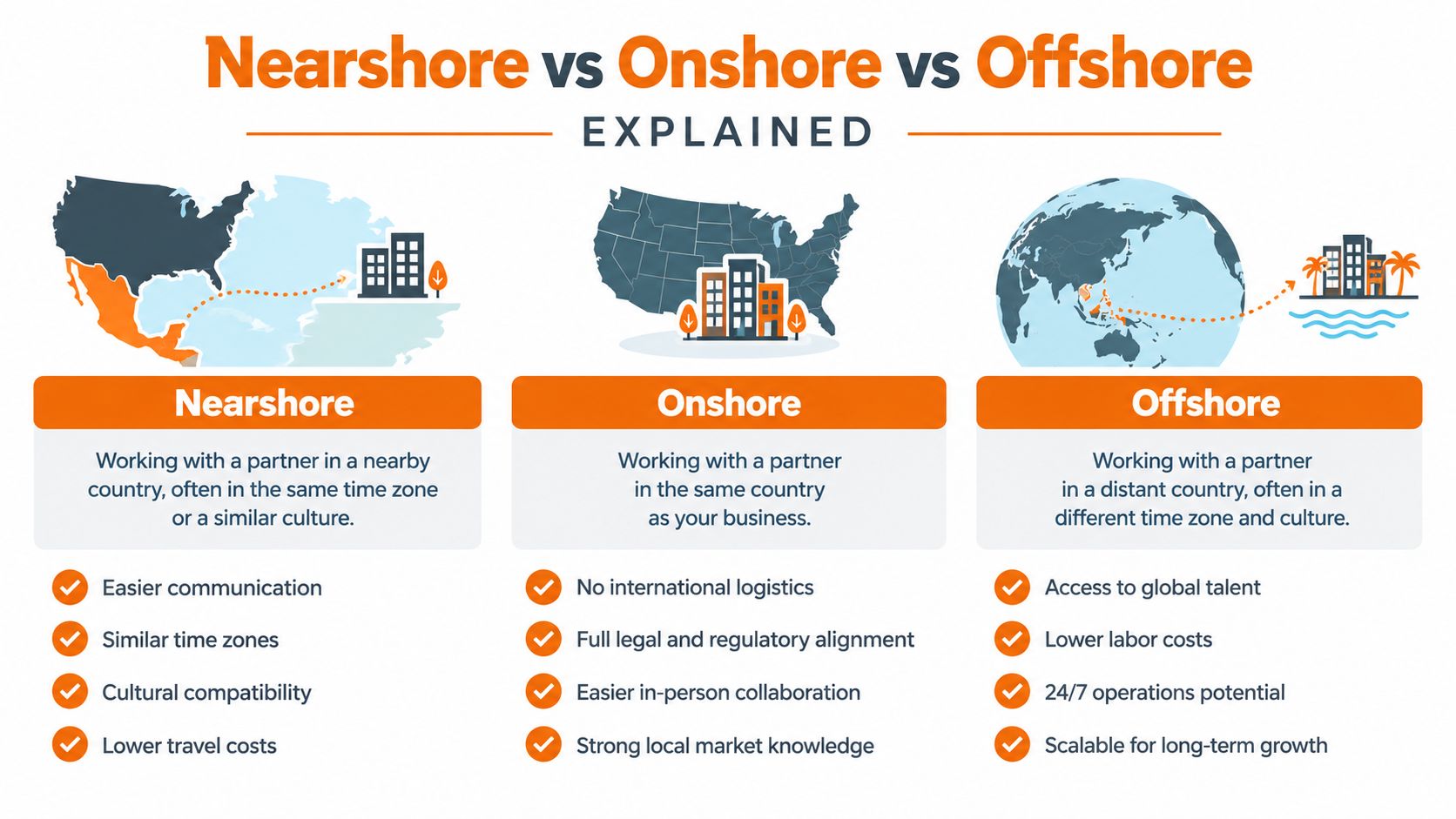
A useful comparison looks beyond geography.
| Factor | Onshore | Nearshore | Offshore |
|---|---|---|---|
| Provider location | Same country | Nearby foreign country | Distant foreign country |
| Working-day overlap | Usually complete | Usually substantial | Often limited |
| Travel | Simplest | Relatively practical | More difficult |
| Communication | Shared national context | Potentially strong cultural and language alignment | Greater variation |
| Coordination model | Mostly synchronous | Synchronous with planned handoffs | More dependent on asynchronous work |
| Cost logic | Local labor market | Regional labor arbitrage plus proximity | Primarily distant labor arbitrage |
Nearshore doesn't mean “close enough” in a vague sense. A team in an adjacent or compatible time zone can schedule architecture reviews, backlog refinement, pairing sessions, and incident response within the same business day. That changes the operating model. Product managers get answers while decisions still matter, and engineers can resolve dependencies before they block the next increment.
Offshore delivery can work for stable, modular tasks with clear specifications and limited dependency risk. It becomes harder when a SaaS company is still discovering the product, responding to incidents, or modernizing a platform with hidden coupling. Those situations require frequent judgment, not just the transfer of completed work.
Nearshore teams also need language proficiency and communication habits that support direct escalation. A small time-zone difference won't fix unclear ownership, weak documentation, or a team that waits for permission on every decision. Buyers should evaluate time-zone overlap, maximum travel time, language capability, and escalation coverage together. Regional scheduling details can vary, so a resource explaining South America UTC offsets and DST is useful when assessing calendar overlap for distributed teams.
The distinction is practical. An onshore team offers maximum proximity but may face a narrower local talent pool and higher local costs. An offshore team may offer lower headline rates but require more asynchronous coordination. A nearshore team sits between those models, trading some geographic distance for access to international talent while protecting real-time collaboration.
The right choice depends on the work. If a provider can't explain how its location improves decisions, feedback, and accountability, proximity is being used as a sales label rather than as a delivery advantage.
Nearshore outsourcing is not automatically cheaper. The useful comparison isn't a developer's salary or a provider's hourly rate. It's the fully loaded cost of delivering an accepted production increment, including recruiting, engineering management, onboarding, tooling, travel, transition, governance, defect correction, and knowledge transfer.
European labor costs illustrate why headline comparisons can mislead. Eurostat-based comparative data reported for 2025 placed average ICT employer labor cost in the European Union at approximately €48.20 per hour, with reported averages of about €24.00 in Bulgaria, €34.90 in Czechia, and €71.70 in Ireland (comparative nearshore software development rates). Those figures describe employer labor cost, not a complete outsourcing price. Provider margin, delivery leadership, security controls, travel, and transition still need to be added.
Poland shows the same principle from another angle. One Eurostat-citing report places average labor cost at approximately €11 per hour in Poland, compared with €28.50 per hour across the European Union, and estimates average Polish software-developer compensation at about €16 per hour (outsourcing software development to Poland). That differential can support additional capacity, but it doesn't guarantee equivalent project savings.
A cheaper team becomes expensive when it creates rework. Weak acceptance criteria, inconsistent architecture, slow reviews, and unresolved operational ownership all increase the cost of reaching production. The provider may still report completed tickets, while the client pays for corrections, delays, and internal oversight.
Track the delivery economics around outcomes:
Procurement rule: Request the assumptions behind the price. Ask who supplies technical leadership, who manages delivery, what the client must provide, and what happens when a named engineer leaves.
Labor prices are rising in Central and Eastern Europe, which reduces the historical gap for some roles (research on European outsourcing markets and changing cost advantages). Scarce architects, AI engineers, cybersecurity specialists, and platform engineers may command rates close to local market levels. That isn't a problem if their judgment prevents expensive failures. It is a problem when buyers expect every role to be priced like general development capacity.
The strongest business case combines cost with risk reduction and speed. A nearshore partner earns its place when the company gains capacity without adding disproportionate management overhead, when senior engineers prevent rework, and when the team helps the business release valuable capability sooner. The correct question is not, “What's the lowest rate?” It's, “What will this delivery model cost to operate, and what business result will it produce?”
AI changes the economics of software delivery, but it doesn't change who is accountable when a system fails. AI agents can accelerate analysis, implementation, test creation, documentation, migration work, and repetitive investigation. They can't own your architecture, understand every contractual data obligation, or approve a production change on behalf of your company.

A responsible AI-native nearshore team gives every generated artifact a place in an accountable workflow. Architects remain responsible for system boundaries and technical trade-offs. Engineers remain responsible for code behavior and maintainability. Security specialists remain responsible for access, data handling, threat reduction, and release controls. Someone with authority must approve the production decision.
A 2026 research framework for autonomous software testing reported 89.6% lower governance-related risks, along with 94.3% governance accuracy, 96.5% artifact reliability, 94.2% compliance accuracy, and 90.8% explainability (research framework for autonomous software testing). Those results support higher testing and documentation throughput, not the idea that generated output validates itself. Governance, traceability, and human approval remain central.
Nearshore accountability becomes concrete when the engineering workflow includes security from the beginning. A multi-case study identified recurring practices including penetration testing, static-analysis integration, false-positive handling, secure-code suggestions, unit testing, and code reviews (study of security activities in AI-supported software engineering).
Those practices serve different purposes:
The #riteway methodology applies the same standard to delivery leadership. Teams show Extreme Ownership, communicate with energy and clarity, identify risks early, and move decisions forward instead of hiding behind task boundaries. A partner shouldn't say, “That wasn't in my ticket,” when an integration failure threatens the release. It should explain the risk, propose options, assign the decision, and stay accountable for the result.
The right AI-native model is therefore not “more code, faster.” It is more validated progress with senior engineering control. Ask providers to demonstrate where AI tools are used, how prompts and proprietary data are handled, how generated code is reviewed, and who signs off on architecture, security, testing, and production quality.
Treat provider selection as a business-risk assessment. A polished sales presentation tells you very little about how a team handles a failed deployment, a departing engineer, a security incident, or an ambiguous product decision.
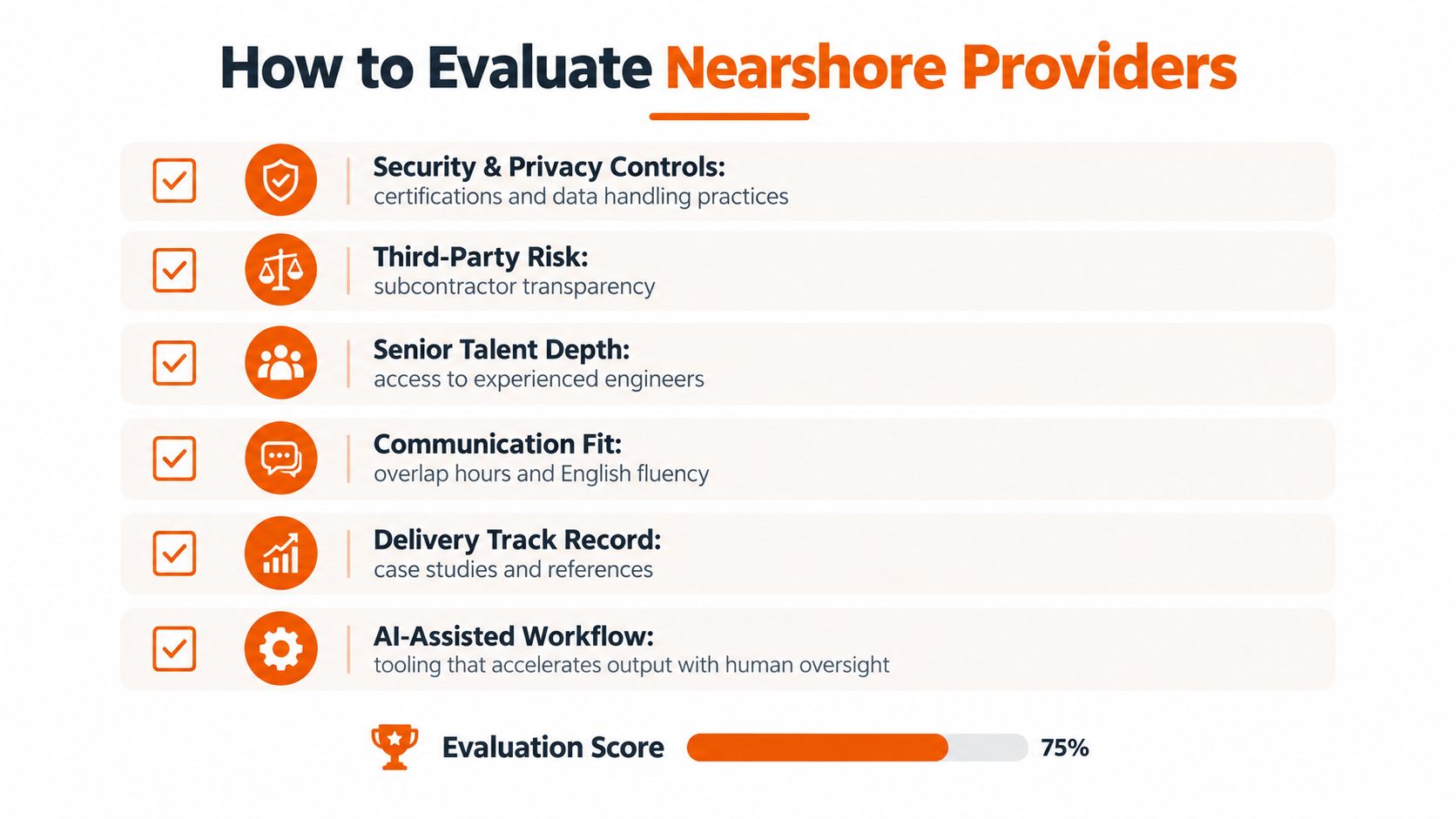
Start with six questions and require evidence rather than assurances.
Security and privacy: Ask how the provider applies least-privilege access, identity management, secure development, data residency, data deletion, and source-code protection. Confirm incident notification deadlines, audit rights, and continuity procedures in the contract.
Third-party exposure: Require disclosure of subcontractors and clarify who remains accountable if another company or contractor touches your systems. A useful companion resource on sourcing compliance for contractors can help procurement and legal teams examine contingent-workforce controls.
Senior talent depth: Request named architects and technical leads, not only a stack of resumes. Ask how the provider handles replacement, how much direct access you'll have to senior decision-makers, and whether the proposed people have worked on systems with comparable operational demands.
Communication fit: Test real working behavior during evaluation. Run a technical workshop, ask candidates to challenge an assumption, and observe whether they clarify risks or just agree. Confirm overlapping hours and escalation coverage in writing.
Delivery evidence: Speak with references who can discuss production ownership, difficult trade-offs, defects, and team continuity. A case study selected by the provider is useful, but an unfiltered reference conversation is more revealing.
AI-assisted workflow: Ask which tools accelerate analysis, development, testing, and documentation. Then ask how the team preserves traceability, reviews generated artifacts, protects proprietary information, and prevents uncontrolled technical debt.
Third-party risk deserves particular attention. A 2025 benchmark reported that 46% of organizations experienced data or privacy breaches involving third-party vendors (third-party cyber readiness research). Nearshore proximity may improve meetings, but it doesn't remove the risk created when external engineers access production systems, customer data, source code, or AI tooling.
Your agreement should define ownership of code and documentation, access approval, subcontractor use, security responsibilities, incident handling, replacement terms, acceptance criteria, and exit support. It should also state who owns the operational result after launch. If the answer is unclear, the engagement is already under-governed.
Use this guide to choosing a modern software development partner as a prompt for deeper evaluation, then turn the criteria into a scorecard that your CTO, product leader, security owner, and finance lead can review together.
A provider that avoids specific answers is a warning sign. So is a low rate that depends on unnamed junior staff, a promise of instant scale without a staffing plan, or a contract that makes replacing poor performers difficult. Before signing, run a small, outcome-based pilot with clear acceptance criteria and measure communication, quality, decision speed, and ownership alongside delivery volume.
Nearshore outsourcing makes sense when your business needs more engineering capacity, faster decisions, or specialized capability without accepting uncontrolled delivery risk. It fits SaaS companies scaling an MVP, teams modernizing legacy systems, enterprises building a European R&D capability, and companies seeking AI, data, platform, or cybersecurity expertise.
It's a poor fit when the product direction is undefined, nobody on the client side can make technical decisions, or leadership expects a provider to compensate for missing ownership. In those cases, hire internal leadership first or choose a partner-managed engagement with explicit responsibility for delivery.
Use three tests:
A practical playbook for managing distributed teams can strengthen the collaboration model, but the principle is simple. Choose nearshore for better total economics and lower execution friction, not because a map makes a provider trustworthy.
Rite NRG helps companies plan, build, modernize, scale, and operate business-critical technology through senior nearshore engineering teams and AI-native delivery. Visit Rite NRG to discuss your capacity bottleneck, define an accountable delivery model, and identify the right next step.
/ about the author
Written by the RITE NRG editorial team — the architects, engineers and delivery leads who build and operate AI-era software for our clients.
Strategy & Transformation
A practical, finance-ready framework for comparing AI and modernization investment with the current-state cost, realistic benefits, delivery risk and time to value.
AI Consulting & Automation
A practical framework for choosing and deploying transport or logistics AI agents around real exceptions, reliable data and controlled operational authority.
Industry Solutions
A practical roadmap for improving manufacturing systems and introducing AI without destabilising production, data integrity or operational control.
More guidance: all insights articles
Tell us about the system or idea behind this article. We tell you honestly if it is a fit — and what a fixed-scope delivery could look like.