

Strategy & Transformation
How to Calculate ROI for AI and Software Modernization
A practical, finance-ready framework for comparing AI and modernization investment with the current-state cost, realistic benefits, delivery risk and time to value.
operationalwrocław--:-- cet
∕ insights / saas-product-development.md
Saas Product Development
A tactical guide to SaaS product development from idea to scale. Real frameworks on MVPs, team models, tech stacks, and metrics for founders and CTOs.
>_article.meta
The popular advice is simple: hire a few developers, build an MVP, and launch quickly. That advice is incomplete enough to be dangerous. SaaS product development isn't a coding sprint. It's a sequence of commercial, architectural, and delivery decisions that either reduce risk or compound it.
The UK is already a serious SaaS market, with estimated sector turnover of £128.8bn, £62.8bn in investment, and annual growth of 11.0%, according to UK SaaS sector data from The Data City. Tracxn records 32,229 UK SaaS startups, including 4.43K funded companies that have collectively raised $78.2B, alongside 24 unicorns, 1.55K acquisitions, and 293 IPOs in its dataset (Tracxn's UK SaaS startup analysis). You're not entering an empty category. You're entering a market where buyers have options, investors expect evidence, and weak delivery economics become visible quickly.
I've seen teams spend months polishing a backlog that never had a buyer, then blame engineering when adoption stalls. The right approach is more demanding and more practical: define the outcome, validate the riskiest assumptions, choose a team that can execute, build an architecture that won't force an expensive rewrite, and run delivery with Extreme Ownership, high energy, and proactive risk management. That's the #riteway methodology in action.
“Hire a few developers and ship in three months” sounds lean. In practice, it often hides four unanswered questions: who exactly buys, which problem matters, what evidence proves demand, and what must the product become after launch. Developers can implement a badly chosen feature just as efficiently as a valuable one. Speed without decision quality only gets you to the wrong destination sooner.
The first failure point is an undefined ideal customer profile. If the team can't name the buyer, the user, the triggering event, and the job they're trying to complete, every feature becomes a negotiation. The second is a vanity backlog. Founders add integrations, dashboards, permissions, and automation because the product feels more credible with them, while the riskiest commercial assumption remains untested.
A third break occurs when the founder becomes product manager, sales lead, solution architect, and delivery controller at the same time. Decisions slow down, acceptance criteria remain vague, and engineers fill the gaps with assumptions. The fourth is premature stack selection. Choosing Kubernetes, microservices, or an AI provider before understanding the product's core workflow creates complexity before the business has earned it.
UK public-sector technology delivery offers a useful warning. The UK Government's 2025 review rated only 9% of major technology programmes Green, while digital and data projects were 60% more likely to be Red than non-technology projects (Fairgrove's summary of the review). SaaS founders should take the operational lesson, not copy public-sector bureaucracy: use short, measurable gates, expose risk early, and review live evidence rather than relying on milestone theatre.
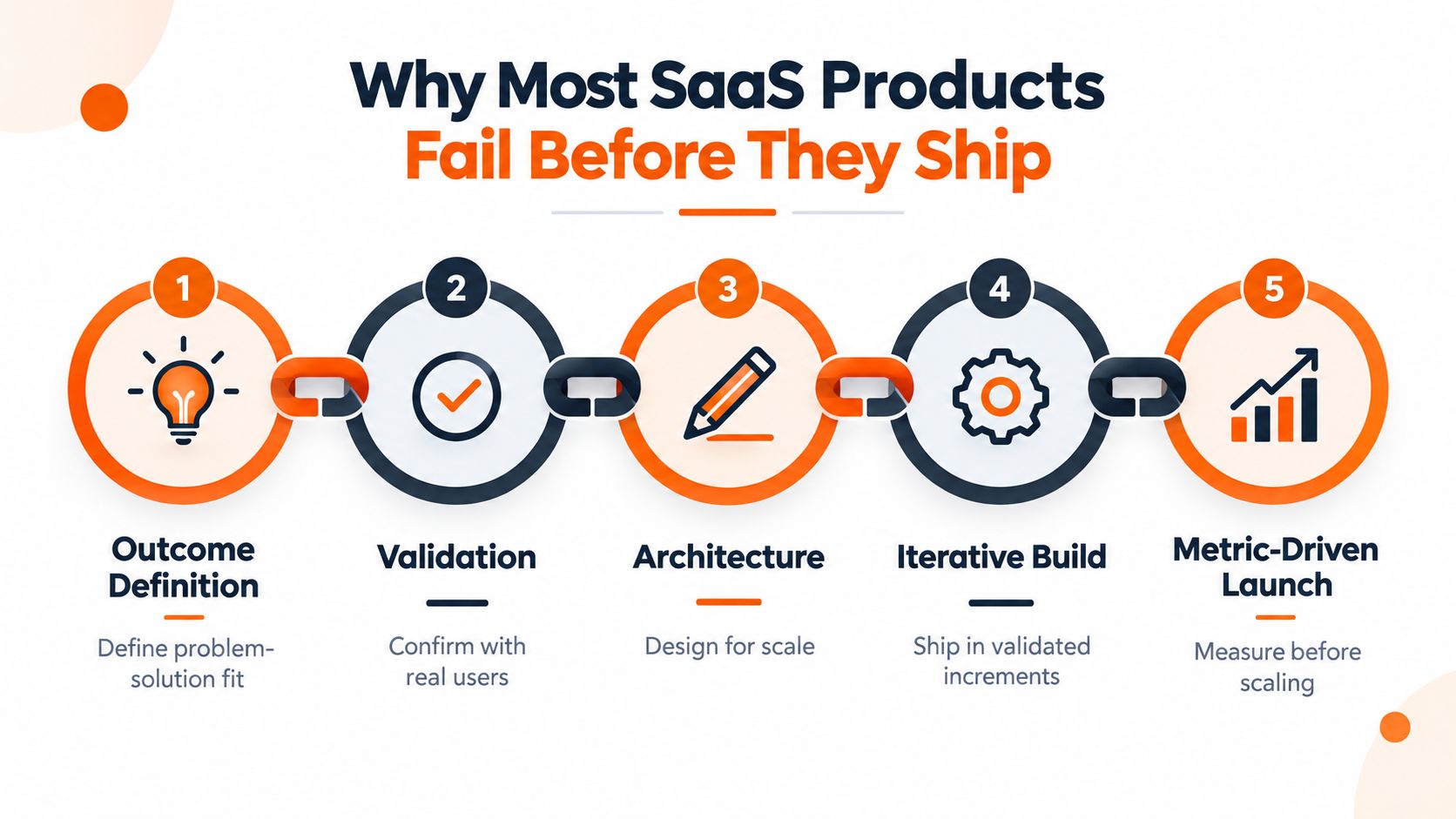
The seven decisions ahead are straightforward: discovery, MVP scope, team model, technology and architecture, delivery operations, metrics, and risk cadence. Shipping code is the easy part. Deciding what deserves to be shipped is where products survive or die.
Discovery should produce decisions, not presentation slides. Run a focused three-to-four-week sprint with an engineering handoff at the end. The deliverable must state what to build, what to exclude, which assumptions threaten delivery, and what evidence would change the plan.
Start with a one-sentence problem statement. Define the ICP through firmographics and Jobs to Be Done, not broad labels such as “SMEs” or “enterprise teams”. Name the user, economic buyer, workflow trigger, current workaround, cost of inaction, and buying constraint. If the buyer cannot explain why they would act now, the urgency assumption is weak.
Interview eight to twelve prospective customers with open questions. Ask about the last time the problem occurred, the response, everyone involved, the cost of the workaround, and the reason they kept or abandoned existing tools. Do not pitch the solution during the interview. Leading questions create polite agreement instead of evidence of demand.
Classify every assumption as desirability, viability, feasibility, or usability. Score opportunities with a simple RICE-V variant:
| Assumption | Risk Type | Confidence (1-5) | Cost to Validate | Downside if Wrong | Gate Decision |
|---|---|---|---|---|---|
| The target operations lead owns the problem | Desirability | ||||
| The buyer will fund the proposed workflow | Viability | ||||
| Required data is accessible through available systems | Feasibility | ||||
| A new user can complete the core job without assistance | Usability |
Choose the cheapest credible test for each risk. Use a prototype for workflow comprehension, usability, or willingness to change. Build a working slice when you need evidence from live usage, integration behaviour, production data, or a commercial transaction. A clickable prototype can show whether users understand a workflow. It cannot prove that data arrives reliably or that a buyer will renew.
Use three decisions: kill, pivot, or persevere. Kill the concept when interviews reveal no urgent problem and prospects will not commit to a next step. Pivot when the pain is real but the buyer, workflow, or proposition is wrong. Persevere when a defined ICP repeats the problem, accepts the proposed value, and agrees to test a narrow solution.
The handoff should be a strategy brief covering the problem, target users, assumptions, prototype evidence, non-goals, architecture risks, release metrics, and acceptance criteria. Include data dependencies and any AI-related feasibility questions early, because weak data quality or unclear model behaviour can change delivery economics later. Engineering must be able to scope from the brief. If it cannot guide a planning session, discovery is unfinished.
An MVP isn't just version one. It's the smallest credible test of the riskiest commercial bet. That distinction changes every planning conversation. A feature belongs in the MVP only when it helps a target user complete the core job, gives the business a revenue signal, or tests a material feasibility risk.
Use three axes for every candidate: validation risk, build effort, and revenue signal. A low-effort feature with no learning value is still waste. A difficult feature that proves the central buying assumption may deserve early investment, provided the team defines a narrow experiment around it.
A useful pre-seed MVP often contains only three to five user stories:
Defer or kill secondary dashboards, broad integrations, advanced permissions, custom themes, complex reporting, multi-region infrastructure, and speculative AI automation. These may become valuable later, but they shouldn't distract from proof that the product solves a painful problem.
| Feature Candidate | Validation Risk | Build Effort (weeks) | Revenue Signal | V1 / V2 / Kill | Owner |
|---|---|---|---|---|---|
| Core workflow completion | High | Direct | V1 | Product | |
| Buyer approval or export | High | Direct | V1 | Product | |
| Advanced analytics dashboard | Medium | Indirect | V2 | Product | |
| Custom branding | Low | Weak | Kill | Design | |
| Enterprise SSO | Market-dependent | Strong for enterprise | V1 or V2 | Engineering | |
| Broad third-party integrations | High | Unclear | V2 | Engineering | |
| Predictive AI recommendations | High | Unproven | Kill until validated | Product |
The supplied stage benchmarks provide a useful planning frame: a pre-seed MVP may take 8-12 weeks and cost $40-80k, while a seed-stage build may take 14-20 weeks and cost $150-300k, as set out in the brief. Treat these as planning ranges, not promises. State the assumptions behind them, including engineering capacity, infrastructure spend, design and product involvement, QA coverage, and contingency for unknowns.
Acceptance criteria should describe observable behaviour: the user can complete the workflow, the system records the event, failed integrations retry safely, permissions prevent unauthorised access, and the team can measure activation. Release only when the team can answer three questions:
A small MVP with a clear kill rule beats a large MVP with impressive screenshots. The point is not to look finished. The point is to make the next business decision cheaper and better informed.
Team structure is a capital allocation decision. Founders often compare hourly rates while ignoring management overhead, hiring delay, rework, and the cost of keeping senior people busy with low-value coordination. The best model depends on stage, control requirements, proprietary advantage, and how long the delivery capability must remain in place.
In-house teams make sense when capital is healthy, the product's defensibility depends on proprietary engineering culture, and the company can support product, design, QA, platform, and security leadership. You get direct control over priorities, context, and long-term ownership. You also absorb recruitment, management, benefits, tooling, and bench risk.
UK employers continue to struggle with senior technology hiring. A 2025 UK labour-market survey found 75% of IT firms reported difficulty finding qualified candidates, with cloud engineers, DevOps engineers, full-stack developers, product managers, and UX/UI product designers among the difficult roles (Experis' 2025 UK digital skills analysis). Hiring a complete senior team can consume the runway you intended to use for validation.
A nearshore Dedicated Team gives a founder a stable product pod under one contract, usually combining senior engineering, product management, design, and QA. It fits seed-to-Series-A companies with a substantial build ahead, especially when speed and cost per sprint matter more than adding permanent headcount immediately.
The model only works when the team owns outcomes rather than tickets. Require a shared backlog, direct communication with decision-makers, transparent delivery reporting, and a clear mechanism for changing scope. Rite NRG is one example of a nearshore partner offering Dedicated Teams, platform development, consulting, and Build-Operate-Transfer delivery.
BOT suits scale-ups and enterprises that want to establish a delivery centre in a lower-cost region and later absorb it. The provider helps build the team and operating model, then transfers capability to the client. You trade short-term governance overhead for long-term ownership and margin control.
| Dimension | In-House | Nearshore Dedicated Team | Build-Operate-Transfer |
|---|---|---|---|
| Best fit | Funded product with a long-term proprietary moat | Pre-PMF and seed-to-Series-A delivery | Scale-ups, enterprises, and new geographies |
| Control | Direct | Contractual and operational | Increasing over time |
| Time to capability | Constrained by hiring | Faster access to an assembled pod | Gradual capability formation |
| Primary trade-off | Hiring cost and management load | Partner dependency | Transition and governance overhead |
| Exit planning | Internal by default | Contract termination and handover | Planned transfer |
| Critical negotiation point | Retention and ownership | IP, control, overlap, and exit | Transfer rights, hiring, compliance, and operations |
Before signing, negotiate control, IP ownership, time-zone overlap, and exit clauses. Pre-product-market-fit teams should generally choose a Dedicated Team. Post-PMF companies with funding should build in-house selectively and use nearshore specialists where demand is uneven. Enterprise product groups and new regional operations should evaluate BOT when the capability must ultimately belong to them.
Choose boring technology with deliberate extension points. The stack should help the team validate the product, protect customer data, and absorb future AI or data requirements without forcing a rewrite. It shouldn't exist to impress an architecture review.
For the frontend, use Next.js or Remix on React, with strict TypeScript and a component library such as shadcn/ui. This gives designers and engineers a shared language and reduces visual drift. For the backend, keep languages limited. TypeScript with NestJS works well when the team wants one language across the product. Python with FastAPI is a strong alternative when data and machine-learning workflows are central.
tenant_id column and row-level security policies keeps tenant boundaries explicit.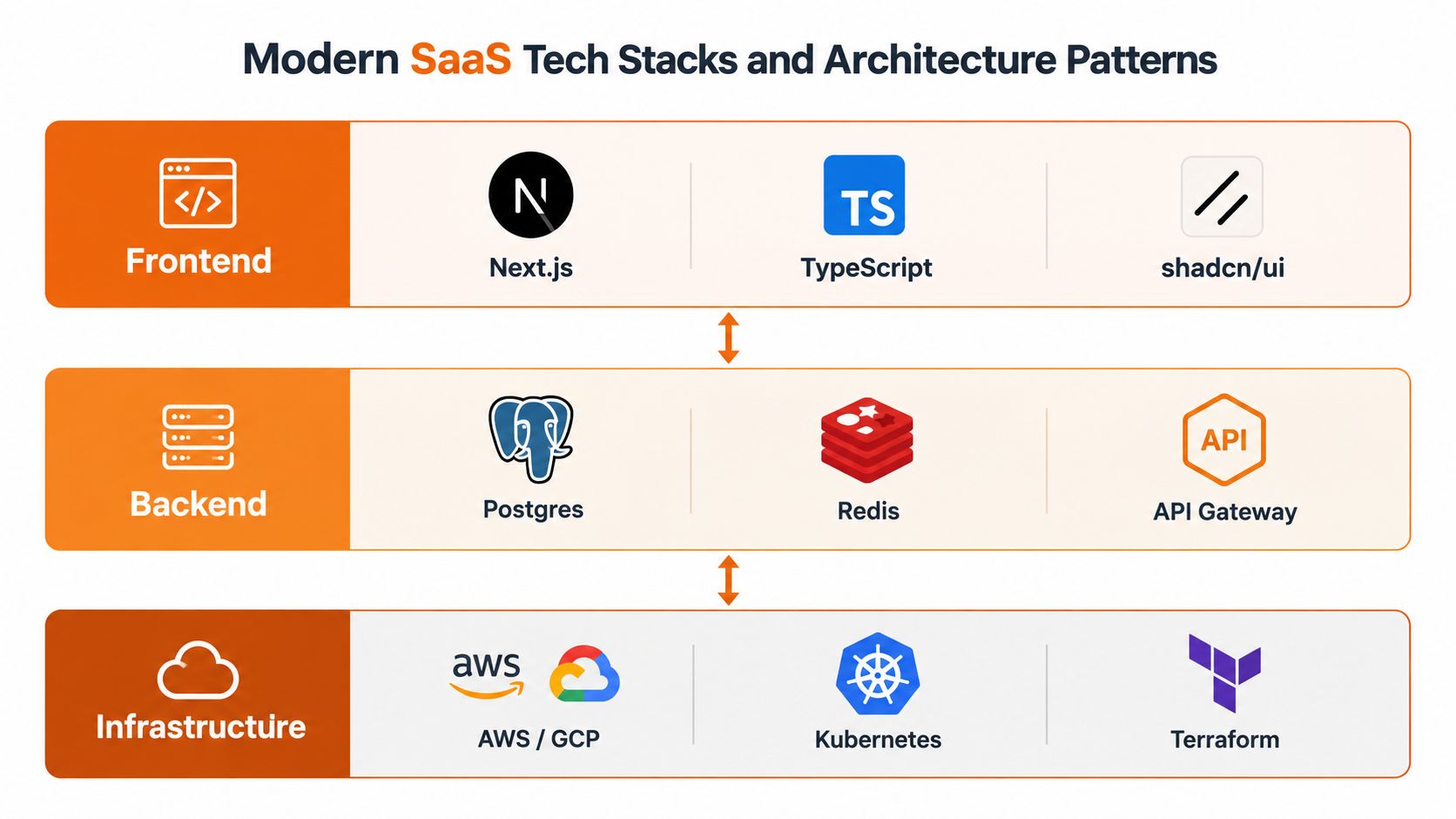
Keep embeddings, prompts, and model calls behind a thin AI abstraction. Provider changes should be configuration work, not a cross-codebase refactor. Store model inputs and outputs with appropriate privacy controls, define evaluation cases, and separate the AI data path from core transactional decisions until reliability is proven.
Use event-driven services for asynchronous work, feature flags independent of deploys, idempotent webhooks, and a strict API contract. A payment webhook that fires twice must not create two entitlements. A queue retry must not duplicate a customer action.
Avoid microservices until the organisation has crossed 50 engineers or proven domain boundaries, as specified in the planning brief. A modular monolith is usually the better starting point. Separate the data plane, where customer workflows run, from the control plane, where tenants, billing, permissions, configuration, and operational policies live.
A Thursday afternoon release exposes whether your delivery system is real. The application passes CI at 2 p.m. A database migration locks a table for nine minutes, checkout fires the same webhook twice, and a prospect's security team sends a penetration-test report that evening. These aren't three unrelated problems. They're symptoms of a pipeline that treats deployment, reliability, integration safety, and security as separate checklists.
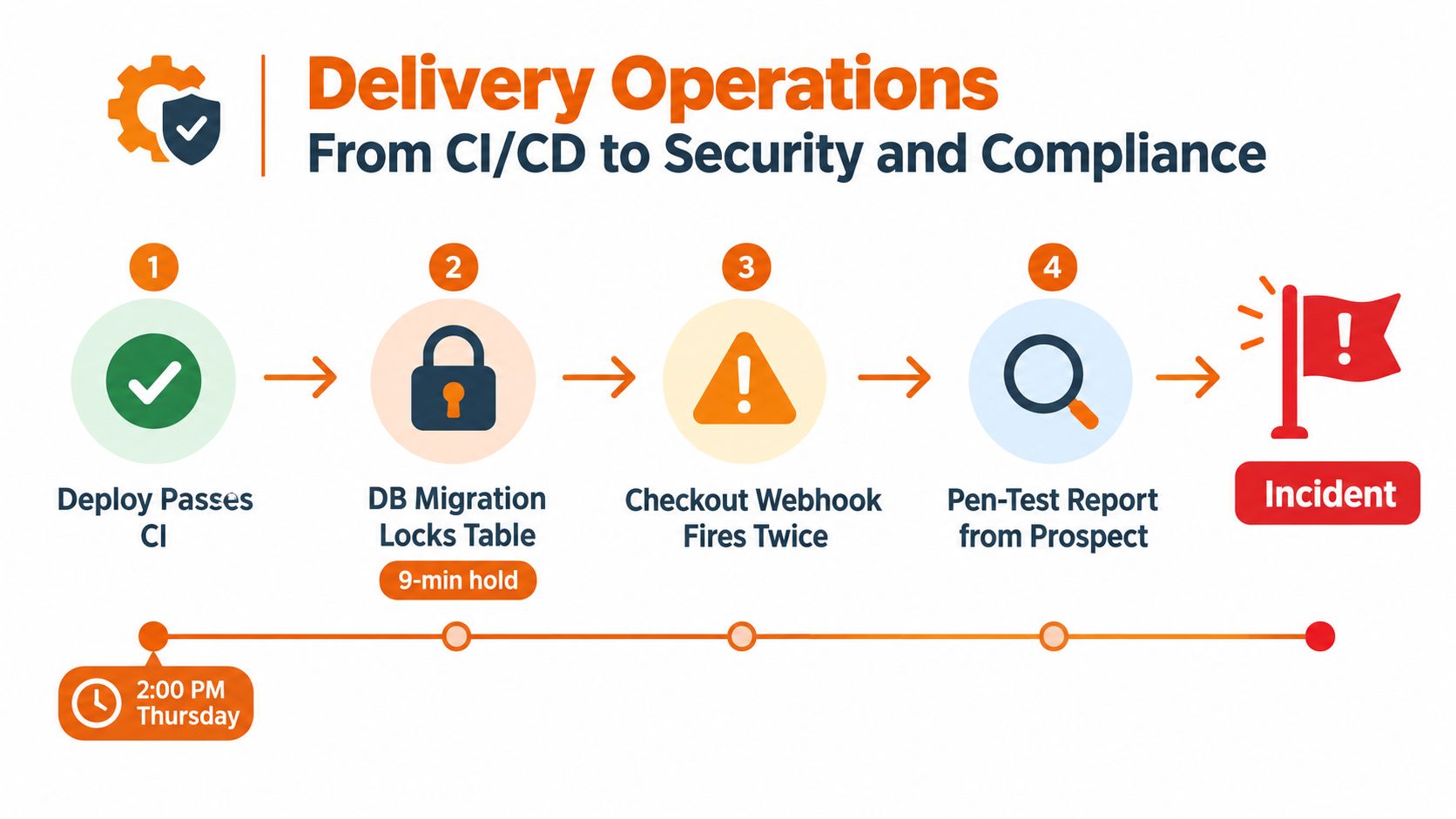
Use trunk-based development with pull-request checks for unit, integration, contract, and security tests. Create ephemeral preview environments for each pull request. Release progressively behind feature flags, and connect automated rollback to service-level objectives rather than waiting for a customer complaint.
QA should move left without becoming a separate department that blocks delivery. Playwright end-to-end tests should cover the critical customer path, contract tests should protect service boundaries, and synthetic monitoring in staging should reflect production traffic shapes. Every external dependency needs timeout, retry, idempotency, and failure-handling behaviour.
Security and compliance also belong in the MVP architecture. Start with SSO where the target buyer requires it, audit logs, secrets management, access controls, dependency scanning, and a vulnerability remediation SLA. SOC 2 Type II can require 6-12 months of evidence collection, according to the delivery assumptions in the brief, so waiting until a large prospect asks for it creates avoidable sales friction.
GDPR, HIPAA, PCI, and FedRAMP can change data flows, hosting choices, logging, retention, access, and vendor selection. The cheapest path is often to choose a cloud provider and third-party services that already hold relevant certifications, then document your own controls around them. That doesn't remove your obligations. It reduces the amount of infrastructure you must prove and operate yourself.
Treat the delivery pipeline as a product with owners, support expectations, and feedback loops. Establish on-call rotations, error budgets, change advisory review at the appropriate scale, and a blameless post-mortem template that creates backlog actions. #riteway means Extreme Ownership after the deployment, not just confidence before it. The team owns the customer outcome, the recovery plan, and the prevention work.
A dashboard doesn't create discipline. A named owner and a forced decision do. Every SaaS metric should answer one question: what will the team do differently because this number moved?
Set a North Star around the customer job, such as weekly active accounts completing the core workflow. Add input metrics that explain movement: activation rate, time to first value, expansion revenue ratio, and successful workflow completion. Report lagging commercial metrics to investors and leadership, including ARR, NRR, CAC payback, and gross margin. Don't let any metric exist without an owner.
| Metric | Stage | Owner | Decision It Triggers |
|---|---|---|---|
| Time to first value | MVP | Product | Simplify onboarding or remove friction |
| Activation rate | MVP and early growth | Product and design | Change the first-use workflow |
| Weekly active accounts | MVP and growth | Product | Reassess core value delivery |
| Expansion revenue ratio | Post-initial traction | Commercial and product | Prioritise packaging or expansion features |
| NRR | Scale-up | Commercial leadership | Investigate retention and account growth |
| CAC payback | Funded growth | Marketing and finance | Adjust acquisition spend or channel mix |
| Gross margin | Scale-up and enterprise | Finance and platform | Rework infrastructure or pricing |
| ARR | Investor reporting | Founder and finance | Reforecast growth and funding needs |
Build loops rather than a linear funnel. A content loop attracts a relevant audience, product-led onboarding converts attention into activation, and usage-driven expansion turns successful workflows into broader account adoption. Instrument the handoffs. You need to know which content creates qualified conversations, which onboarding step predicts value, and which usage pattern precedes an upgrade.
Protect product capacity as a commercial expense. A 2025 analysis of UK SaaS businesses reported average R&D spend at 12% of revenue versus a 28% industry average, while upsell and expansion revenue averaged 18% versus 37% industry average (the cited UK SaaS R&D and expansion analysis). The same analysis suggests a practical target of roughly 25% of revenue for R&D, 30% for upsell and expansion revenue, and upsell CAC around 55% of new-customer CAC. Use those figures as strategic reference points, not as a substitute for your own unit economics.
UK CIO evidence reinforces why this discipline matters. One survey reported that only 45% of software projects delivered or exceeded expected ROI, while large businesses ran an average of five major software projects a year at more than £2.2 million each (SME Web's report on UK CIO software ROI). The same report says organisations most often measured ROI through productivity improvements, new business, optimised processes, reduced hiring need, and customer satisfaction. Define your outcome before the build, measure it after release, and let the result control the next investment.
Rite NRG offers advisory-led SaaS product development, senior nearshore Dedicated Teams, platform engineering, and Build-Operate-Transfer delivery for founders, scale-ups, and enterprises. If you need to turn a risky product idea into a measurable MVP or strengthen an existing platform for AI, data, security, and scale, visit Rite NRG and start a delivery conversation.
/ about the author
Written by the RITE NRG editorial team — the architects, engineers and delivery leads who build and operate AI-era software for our clients.
Strategy & Transformation
A practical, finance-ready framework for comparing AI and modernization investment with the current-state cost, realistic benefits, delivery risk and time to value.
AI Consulting & Automation
A practical framework for choosing and deploying transport or logistics AI agents around real exceptions, reliable data and controlled operational authority.
Industry Solutions
A practical roadmap for improving manufacturing systems and introducing AI without destabilising production, data integrity or operational control.
More guidance: all insights articles
We can help you apply this thinking to the systems and teams you actually have.