

Strategy & Transformation
How to Calculate ROI for AI and Software Modernization
A practical, finance-ready framework for comparing AI and modernization investment with the current-state cost, realistic benefits, delivery risk and time to value.
operationalwrocław--:-- cet
∕ insights / hire-an-app-developer.md
Hire An App Developer
Hire an app developer with confidence. Define requirements, compare freelancers, in-house and nearshore teams, evaluate skills, and avoid costly hiring
>_article.meta

Only 31% of software projects were successful in one CHAOS benchmark, while 46% were challenged and 19% failed outright, according to the ACM summary of the CHAOS findings. That makes hiring an app developer a business-risk decision, not an administrative task. You aren't buying code. You're buying faster time to market, controlled rework, stronger product quality, and a credible path from roadmap to production.
The wrong hire can leave a SaaS founder with an attractive prototype and no maintainable product. It can leave a CTO carrying architecture, security, testing, and delivery risk that should have been owned by the person or team building the system. The right hire creates capacity and makes hard decisions earlier, when they're still cheap to change.
A missed launch usually starts before deployment. An unclear role, an unrealistic MVP, weak technical evaluation, or a developer who can close tickets without owning the surrounding system creates delivery risk early. Production exposes that risk later, when rework, delays, and architecture changes cost more.
The commercial stakes are substantial. One estimate values the app development market at USD 264.96 billion in 2025, growing at a 15.18% CAGR through 2031, according to Mordor Intelligence's app development market analysis. Mobile and web products now influence reliability, release speed, customer experience, and competitive position. Hiring therefore determines more than who writes code. It determines who carries technical decisions and delivery accountability.
Practical rule: Hire for the risk you need removed, not the programming language you need listed.
A poor hiring decision also consumes internal capacity. Technical interviews require senior attention, and a weak hire keeps that same attention tied up in clarification, review, rework, and incident response. The cost is lost roadmap momentum as well as the contract or salary.
Assess candidates against evidence of ownership. Ask how they have handled ambiguous requirements, production failures, testing gaps, security decisions, and changing priorities. Require work samples or structured technical exercises that expose judgment, not just familiarity with a framework. A senior engineer should explain trade-offs, identify failure modes, and set a delivery plan that the business can inspect.
Choose the sourcing channel only after defining the risk profile. An individual freelancer may suit a contained feature, while a nearshore team may provide broader delivery coverage. Either option needs a clear owner, measurable milestones, and an escalation path. If you need a wider view of available talent, you can connect with active developers and compare candidates against the outcomes your product requires.
The safest hire makes delivery risk visible early and assigns accountability before problems reach production.
A job title such as “mobile app developer” is not a delivery plan. It leaves candidates guessing whether they will own architecture, build screens, integrate APIs, manage app-store releases, or repair an unstable production codebase.
Define the outcome first. Write the role backward from the business result you need to prove, then assign responsibility for the decisions that can put that result at risk.
Your brief should answer four questions:
Separate essential competencies from preferred experience. Architecture, data, security, testing, integration, and production ownership belong in the first group when the application supports important business operations. A particular framework can sit in the second group if a capable engineer can learn it without increasing delivery risk.
Hiring data supports prioritising experienced capability. HackerRank's Developer Skills Report 2025 reports year-over-year hiring activity up 22% for lead developers and 19% for senior developers, compared with 9% for junior hiring, while entry-level hiring is nearly flat at 7%. Senior software development postings also represented 69.3% of postings in Q1 2026, according to You-Source's 2026 hiring snapshot.
That evidence does not mean every MVP needs a large team. It means a small headcount does not remove technical risk. One senior generalist can work well when the product has a narrow scope, a stable backend, and a founder who makes decisions quickly. Choose senior coverage across architecture, mobile or web delivery, backend integration, quality assurance, security, and deployment when those responsibilities would otherwise sit with no clear owner.
Use one test: which failure costs more, paying for senior oversight you do not need every day, or discovering late that nobody owns the technical decisions connecting the system? Select the hiring model that removes that specific risk.
The sourcing model changes more than your invoice. It determines how quickly you can start, who carries delivery accountability, how much context stays with the company, and what happens when the roadmap changes.
A freelancer can be a strong fit for a narrow, well-specified task. An in-house hire builds durable product context and internal capacity. A senior nearshore team gives a founder or scale-up access to multiple disciplines without waiting to build a complete department. None is universally correct. The wrong match is expensive because it creates a gap between what the business needs and what the engagement can reliably provide.
| Criteria | Freelancer | In-House | Nearshore Team |
|---|---|---|---|
| Speed to first commit | Often fast for defined work, dependent on availability | Slower because recruiting and notice periods add lead time | Fast when the partner has available senior capacity |
| Total cost of ownership | Lower visible cost, but supervision and rework can increase the real cost | Salary, benefits, recruiting, management, and internal tooling | Partner fee, with broader delivery capability and less internal hiring overhead |
| Code ownership | Must be defined contractually and operationally | Naturally retained by the company | Retained by the company when IP, repositories, and handover terms are explicit |
| Quality accountability | Usually concentrated in one person | Shared between the employee and internal leadership | Can sit with the partner if architecture, QA, delivery, and escalation are included |
| Scaling flexibility | Limited by one person's capacity | Strong over time, but hiring takes time | Strong for adding specialists or changing team shape |
| Best fit | Small, bounded feature or prototype | Long-term product ownership and institutional knowledge | MVP delivery, modernization, or cross-functional execution under time pressure |
A solo freelancer can produce a cheap MVP that appears complete until the first change request exposes missing tests, unclear data boundaries, and tightly coupled screens. The issue isn't that freelancers lack skill. The issue is that one person may be asked to perform product analysis, architecture, implementation, testing, security review, deployment, and support without enough challenge or redundancy.
A scale-up facing a fixed launch window has a different problem. It may need a product engineer, an architect, QA capability, and delivery coordination in weeks rather than quarters. In that situation, an experienced nearshore team can provide broader coverage while the CTO retains strategic ownership. A practical overview of the trade-offs between staffing and delivery models is available in this comparison of staff augmentation, dedicated teams, and project delivery.
Recent 2026 pricing guidance places simple apps around USD 15,000 to USD 60,000, MVPs or business applications around USD 50,000 to USD 250,000, and enterprise or AI-heavy systems above USD 500,000, while a survey-based estimate places many mid-sized projects between USD 30,000 and USD 100,000, as summarized in this 2026 software development cost analysis. Those ranges are broad because scope, platform, integrations, quality requirements, and AI usage change the delivery shape.
For a constrained prototype with a clear handoff, start with a vetted freelancer. For a product you expect to operate and evolve, hire in-house when building institutional capability is a priority. For a time-sensitive MVP, complex modernization effort, or product with several technical risk areas, choose a senior nearshore or dedicated team when the cost of fragmented ownership is higher than the partner fee.
A good hiring decision can still fail under a weak contract. The agreement should make ownership, acceptance, change control, communication, escalation, security, and post-release responsibility unambiguous before implementation begins.
Fixed-scope, fixed-price delivery works when the release boundary is clear and acceptance criteria are testable. It transfers more schedule and cost risk to the delivery partner, but it doesn't make uncertainty disappear. If your requirements are immature, the contract will either contain a large contingency or create disputes when the product changes. For a founder with investors watching a committed release, a fixed-scope production delivery can be the right model when the scope has been properly shaped.
Time and materials fits discovery, evolving products, and work where technical findings will change the plan. You gain flexibility, but you need strong reporting and active product ownership. Require visible progress through completed outcomes, not a report that only lists hours.
Dedicated teams work when your roadmap is continuous and you need persistent engineering capacity. Define who owns technical decisions, who manages performance, how team members can be replaced, and how knowledge is documented.
Build-operate-transfer suits companies that want to establish a capability before taking full ownership. The partner builds and operates the team or platform, then transfers people, documentation, systems, and operating knowledge according to an agreed plan.
Contract for decisions and deliverables, not activity.
Payment milestones should connect to verifiable outcomes. A milestone might require a tested feature in a shared environment, documented integration behavior, approved security controls, or a release candidate that meets the definition of done. Don't release payment solely because a developer logged a set number of hours.
Have legal counsel review intellectual property assignment, repository access, third-party licenses, confidentiality, data protection, security obligations, warranty terms, termination rights, and handover requirements. Code ownership is not protected by good intentions. Your contract should state who owns source code, infrastructure definitions, test suites, documentation, design assets, and generated materials.
For a deeper treatment of when fixed-price work is appropriate, review when fixed-price software development works.
Ask every prospective partner:
The contract should make responsible behavior easy. If nobody can explain how a risk is raised, recorded, and resolved, the agreement is incomplete.
Resume review is a poor proxy for production capability. HackerRank reports that only 10% to 19% of phone-screened candidates typically advance to onsite interviews, and cites a resume-only screening false-positive rate of up to 50%, according to its Tech Recruiting Benchmark Report. A polished CV can identify relevant experience. It can't prove that a candidate can make sound decisions under ambiguity.
Use a structured funnel with a written rubric before you meet candidates.
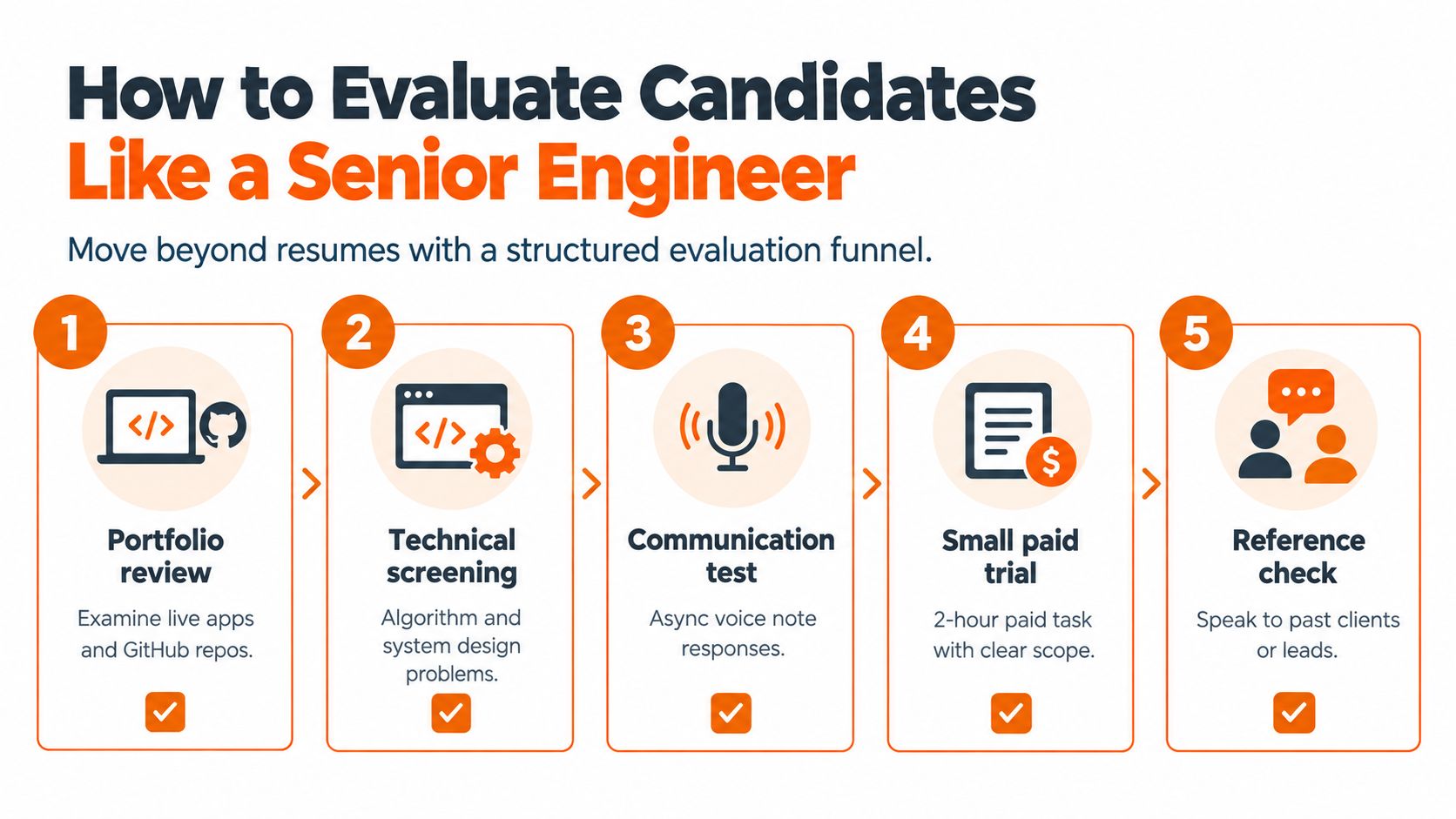
Start by defining competencies for the role. A senior app developer may need to demonstrate architecture, platform judgment, data modeling, integration design, security awareness, automated testing, observability, release management, and communication. Score each competency against observable behavior, not instinct.
Then use a short asynchronous work sample. Give the candidate an ambiguous product requirement, a small existing codebase, or a design that contains a deliberate trade-off. Ask them to explain:
A good exercise measures thinking as well as implementation. Don't turn it into unpaid production work. A small paid trial with a clear scope gives both sides useful evidence and respects the candidate's time.
Ask for a specific production incident. What failed, how did the candidate isolate the cause, who did they inform, what fix did they ship, and what changed afterward? Ask about a scope change that threatened the release. Strong candidates describe trade-offs, escalation, and consequences. Weak candidates describe only the code they wrote.
Use the same questions and scoring rubric for each finalist. HackerRank reports that structured technical screening can reduce average time-to-hire from about 45 days to 28 days, improve offer acceptance from roughly 70% to 78% to 82%, and support 1-year retention above 78%, based on its benchmark report linked above. The value of structure isn't bureaucracy. It's faster decisions with less bias and better evidence.
Keep searching when the evidence doesn't meet the bar. A delayed hire is painful. A developer who passes a vague interview and fails during integration is worse because they consume team capacity while moving the product backward.
AI changes the economics of software delivery. It can accelerate analysis, boilerplate implementation, test generation, documentation, migration work, and repetitive engineering tasks. It doesn't remove architecture, security, data, testing, or production accountability.
The hiring mistake is to treat AI fluency as a substitute for engineering judgment. A candidate who generates code quickly but can't explain its assumptions may create technical debt faster than a slower developer who understands the system. The right target is judgment amplified by AI, not speed replacing judgment.
The Rite NRG perspective on AI coding tools and AI-native software delivery reflects this distinction. An AI-native team can use agents throughout delivery while senior architects remain responsible for system boundaries, database design, integrations, security, testing, and production quality.
The UK's Home Office engineering guidance requires AI-assisted output to receive human review and approval before production, says AI-assisted code must meet the same security expectations as human-written code, and requires testing before merge or deployment, as set out in its guidance on using AI in engineering. Treat those controls as a baseline, regardless of whether you hire a freelancer, an internal engineer, or a consultancy.
Ask candidates and partners:
For AI-enabled systems, convert expectations into testable requirements. OWASP's AI Security Verification Standard provides a community-driven catalogue of security requirements that can inform specifications and automated checks. Encode architecture rules, data-handling policies, observability requirements, and non-functional standards into the delivery process instead of leaving them in informal conversations.
AI may let a strong engineer cover more ground. It doesn't make an inexperienced engineer senior. Hire the person who can challenge generated output, reject unsafe shortcuts, and explain why the production system should work.
Walk away when a candidate can't explain how they test, secure, deploy, or monitor what they build. Other warning signs include a portfolio that collapses under technical questions, resistance to a paid work sample, vague answers about ownership, and promises that contain no measurable definition of done.
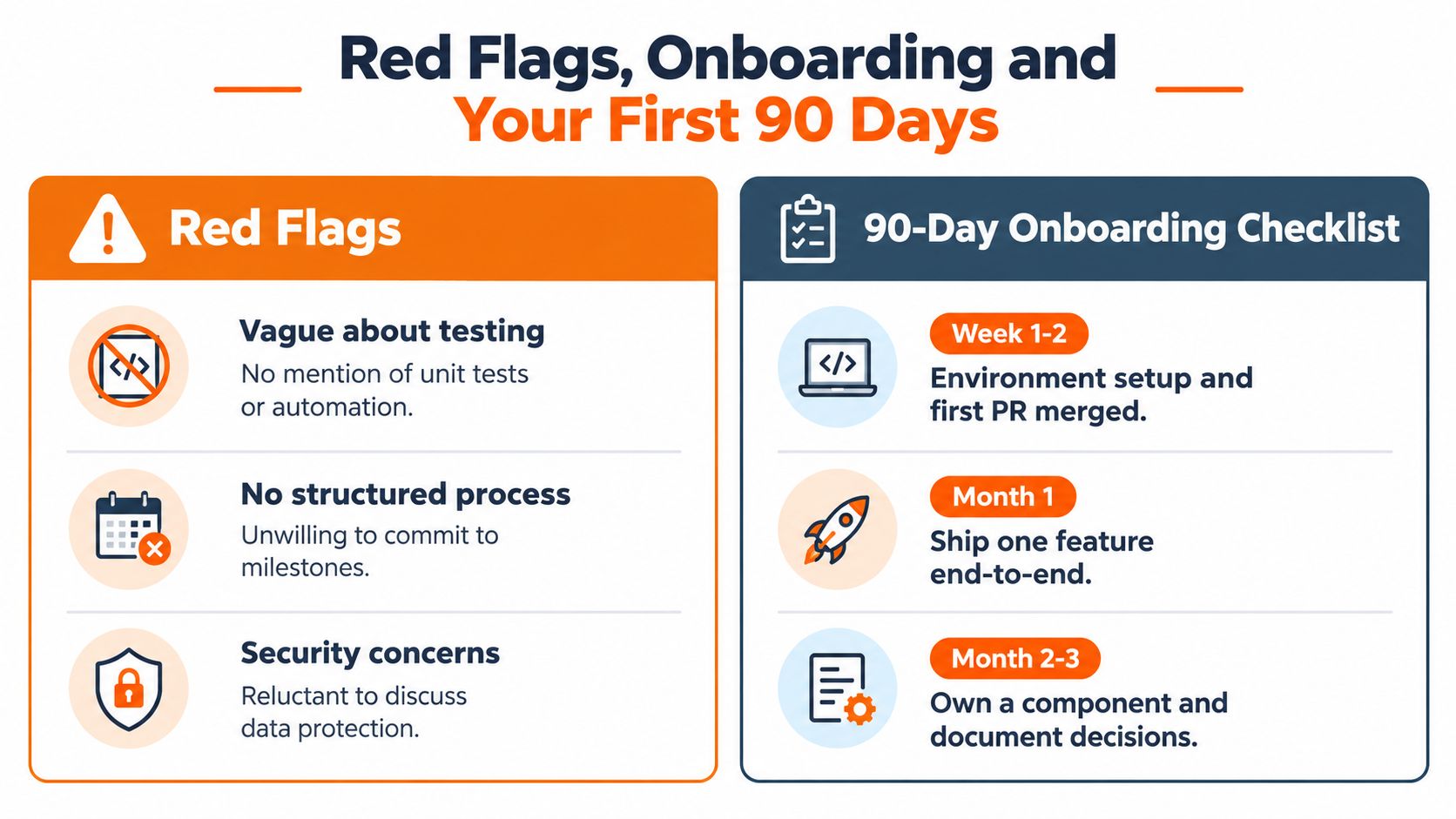
Weeks 1 and 2 should establish access, environments, architecture context, delivery rituals, and the first merged pull request. The developer should know who makes product decisions, where risks are recorded, and what quality gates apply.
By the end of the first month, the team should ship one feature end to end. That means requirements, implementation, tests, review, deployment, monitoring, and feedback. Don't measure onboarding by meetings attended. Measure it by safe progress through the delivery system.
During months 2 and 3, the developer should own a component or meaningful product area and document the decisions that shape it. The team should review roadmap risk, technical debt, dependencies, and release readiness with the same directness used during hiring.
Deloitte's guidance on multi-party collaboration and AI consulting emphasizes shared outcomes, clear ground rules, open communication, and visibility into progress. Those principles apply whether you're working with one developer or a complete delivery team. Senior accountability means someone challenges assumptions, raises risks early, and stays responsible for the result beyond an assigned ticket.
Hire an app developer only after you can state the outcome, risk profile, decision rights, and proof of capability you require. Then use a structured evaluation, a protective contract, explicit AI controls, and a 90-day delivery rhythm to turn the hire into measurable progress.
Rite NRG helps startups, scale-ups, and established businesses plan, build, modernize, and operate business-critical software through senior engineers, dedicated teams, and fixed-scope delivery. Visit Rite NRG to discuss the app delivery model that fits your roadmap, risk tolerance, and ownership goals.
/ about the author
Written by the RITE NRG editorial team — the architects, engineers and delivery leads who build and operate AI-era software for our clients.
Strategy & Transformation
A practical, finance-ready framework for comparing AI and modernization investment with the current-state cost, realistic benefits, delivery risk and time to value.
AI Consulting & Automation
A practical framework for choosing and deploying transport or logistics AI agents around real exceptions, reliable data and controlled operational authority.
Industry Solutions
A practical roadmap for improving manufacturing systems and introducing AI without destabilising production, data integrity or operational control.
More guidance: all insights articles
We can help you apply this thinking to the systems and teams you actually have.