

Strategy & Transformation
How to Calculate ROI for AI and Software Modernization
A practical, finance-ready framework for comparing AI and modernization investment with the current-state cost, realistic benefits, delivery risk and time to value.
operationalwrocław--:-- cet
∕ insights / digital-transformation-roadmap.md
Digital Transformation Roadmap
Build a digital transformation roadmap that delivers business value. Stages, KPIs, MVP and migration patterns, timeline template and risks.
>_article.meta
Your leadership team has approved the transformation budget. Product has a backlog full of customer requests. Engineering is already busy keeping legacy systems alive, while finance wants a credible path to revenue, efficiency, and controlled investment. Everyone agrees that the business must move faster. Nobody agrees on what should happen first.
That's where a digital transformation roadmap earns its keep. Not as a decorative timeline of cloud migrations, AI pilots, and software releases, but as a disciplined system for turning business ambition into measurable value. The roadmap should tell people what to change, why it matters, who owns the result, and what evidence justifies the next investment.
A SaaS company can approve a bold platform strategy and still deliver no business result. The board funds transformation, the CTO chooses a modern architecture, and product builds a large backlog. Six months later, teams are debating integrations, customer workflows remain fragmented, and every department is reporting activity instead of impact.
The gap sits between decision and delivery. Deloitte's UK research found that 30% of respondents say they lack a digital transformation strategy to a large extent. It also identified legacy-system dependency at 37%, funding difficulty at 33%, insufficient data at 31%, and departmental silos at 31%. Business-model disruption was the biggest monetisation challenge for 38% of respondents, while UK organisations trailed global peers by eight percentage points on value creation across 12 technologies. The findings are detailed in Deloitte's UK analysis of value from digital transformation.
The lesson is direct. A strategy document can be accurate and still fail when nobody owns dependencies, decisions, adoption, or the commercial result.

A delivery team may ship an API, automate a workflow, or release a customer portal. Those are outputs. The outcome could be faster onboarding, higher retention, stronger customer relationships, increased revenue, or lower operating friction.
Fujitsu's UK survey makes the distinction clear. Respondents identified a stronger relationship with customers as the biggest benefit at 50.0%, followed by increased revenue at 46.1%, stronger product competitiveness at 31.6%, and improved efficiencies or reduced cost at 27.6%. The figures appear in Fujitsu's UK digital transformation survey report.
The roadmap must measure changed business behaviour, not completed technical work.
Use that rule to set priorities. Start with the customer or operational constraint blocking value, then select the smallest MVP that can test the assumption. Do not prioritise a technology category because it sounds current. Prioritise the workflow, decision, or experience that the investment must improve. A platform migration earns its place only when it supports that result.
The #riteway Methodology starts with Extreme Ownership. Every major outcome needs a named owner who can coordinate product, engineering, operations, finance, security, and external partners. That owner does not perform every task. They resolve ambiguity, expose integration risk, and escalate issues before they become deadline crises.
A consulting partner should work the same way. Nearshore Dedicated Teams can extend delivery capacity, but they must operate against the same outcomes, decision rights, and acceptance criteria as the internal team. The partner should challenge an oversized MVP, expose a dependency, question a weak KPI, and recommend the next practical move without waiting for a perfect brief. Integration-first execution keeps the roadmap connected to real systems instead of isolated prototypes.
A value-first roadmap has four characteristics:
This structure lets teams ship quickly while keeping investment under control. The roadmap becomes a delivery system for business value, not a catalogue of technical work.
Start with the business problem, not the technology category. “Adopt AI” isn't a transformation vision. “Help service teams resolve customer issues with less manual investigation while protecting trust” gives product, engineering, operations, and finance something they can act on.
Write the vision as a change in business performance. Define the customer or employee experience that must improve, the economic value the organisation expects, and the constraints that cannot be compromised. Security, regulatory obligations, service continuity, and data ownership belong in the first conversation, not in a late-stage approval queue.
The UK government's cross-government roadmap offers a useful reference point. Its June 2022 roadmap set a 2025 vision around six missions, including transforming 50 of the Top 75 government services to a “Great” standard and growing the Government Digital and Data profession to 6% of total Civil Service headcount. The official digital and data roadmap shows how service quality, capability, data, and operating conditions belong in one transformation ambition.
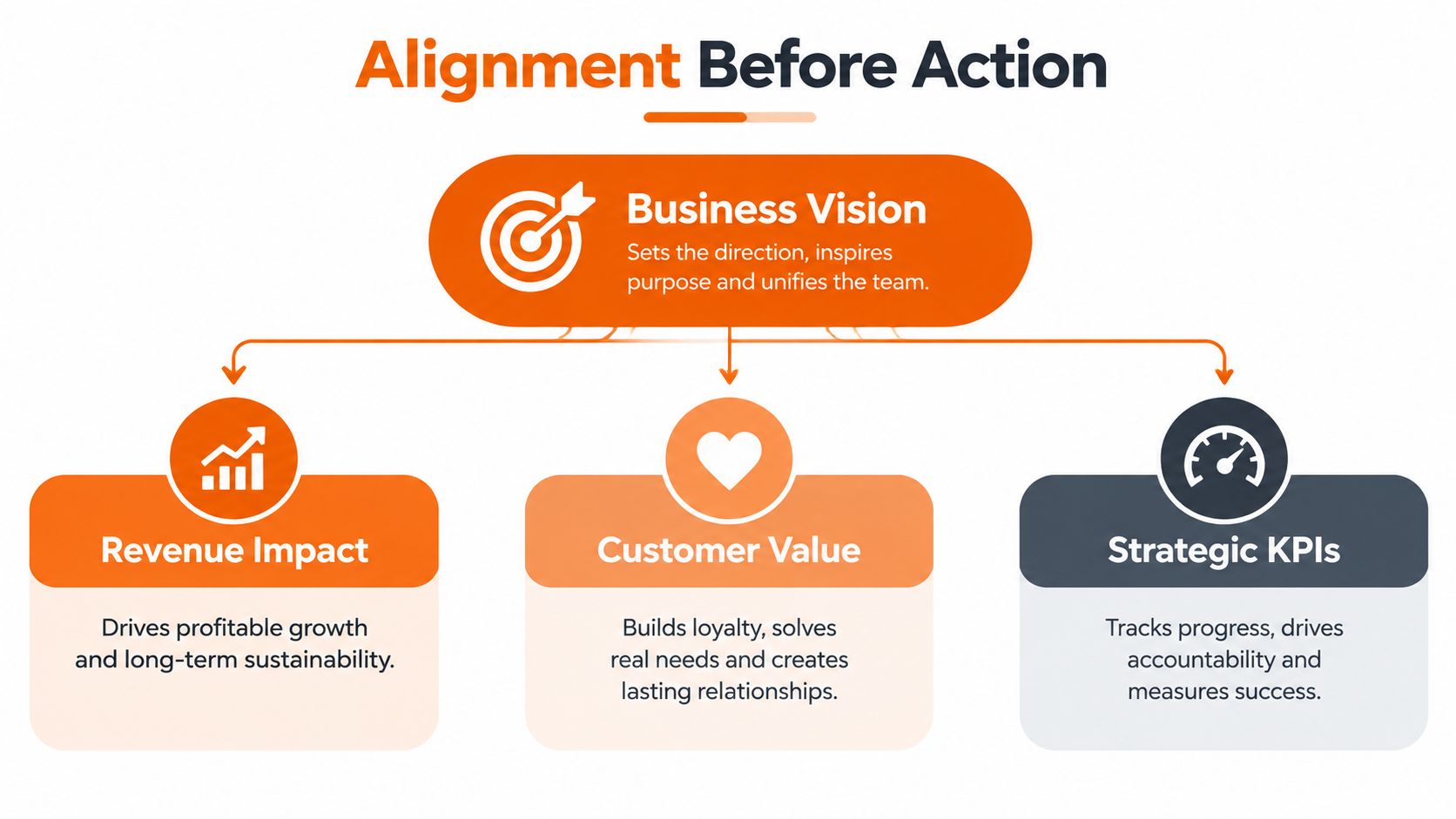
Run a focused workshop with the people who control outcomes and dependencies. Keep it practical:
The UK Digital, Data and Technology Playbook makes the same governance point in a different context. Governance and ethos need to be right at the start because they shape how outcomes are developed and delivered.
Use a KPI chain rather than a dashboard full of disconnected numbers. Start with the business outcome, define the customer or operational behaviour that should create it, then select a leading indicator and a lagging indicator.
For example, a subscription business trying to improve onboarding might define:
Every KPI needs a baseline, an owner, a review date, and a decision attached to it. If the result is weak, the steering group should know whether to adjust the product, change the operating process, revisit the architecture, or stop the initiative.
Set a governance cadence that matches the risk. The Cabinet Office roadmap recommends progress reviews every six months, and it identifies more than £1 billion in efficiency savings through digitisation by eliminating paper-based processes. Those details are documented in the UK government's roadmap for digital and data. Your organisation may need more frequent delivery reviews, but the principle stands. Leaders should review outcomes, risks, funding, and capability, not just status colours.
A useful roadmap has a sequence, but it isn't a rigid promise that every activity will happen exactly as first drawn. Treat it as a chain of evidence. Each phase should reduce uncertainty, deliver something useful, or create the conditions for the next investment.
Begin with a current-state audit across customer journeys, operating processes, applications, data flows, integrations, security controls, delivery capability, and supplier dependencies. Interview the people who operate the process every day. Architecture diagrams alone won't reveal the manual workaround that keeps a critical customer journey alive.
Your discovery output should identify:
Give every finding an owner and a proposed action. A discovery document without decisions is just a more organised form of uncertainty.
Prioritise initiatives using value, urgency, feasibility, dependency exposure, and risk. Don't allow a senior stakeholder to push an initiative to the top because it uses a fashionable technology. If the organisation can't explain the customer or commercial result, the initiative isn't ready.
Define the MVP as the smallest release that can test a meaningful business hypothesis. It may need enough integration to operate in a real workflow, but it shouldn't attempt to modernise every surrounding system. Set explicit exit criteria, such as validated user behaviour, acceptable operational performance, security approval, and evidence that the process can scale.
Integration-first execution matters. If the bottleneck is identity, billing, data synchronisation, or a legacy workflow, building more front-end functionality won't create progress. Map the interfaces early, test the riskiest connection in the MVP, and keep a manual fallback where that protects learning without creating unacceptable operational risk.
Organise delivery around thin vertical slices. A slice should connect the user experience, business logic, data, integration, controls, and operational support needed to test the outcome. Product managers, engineers, designers, operations specialists, and business owners should see the same evidence.
Use short delivery cycles, regular demonstrations, and a decision log. AI-powered processes can help surface delivery risks, identify patterns in defects or dependencies, and automate repetitive coordination work, but accountable people still make the decisions. Tools can flag risk. They can't own the consequence.
A senior nearshore Dedicated Team can help when speed and continuity matter more than assembling isolated specialists. The practical test is whether the team understands the product context, joins existing ceremonies, communicates directly, and takes responsibility for outcomes. Rite NRG describes teams that can integrate into client workflows within 1–2 weeks, a claim presented in the publisher information for this article. Treat that as a delivery option to validate during discovery, not a substitute for clear ownership.
Modernisation should protect customer continuity. Use a strangler approach when you can place a new capability around a stable legacy core, routing selected journeys to the new service while you retire old functionality gradually. Use phased migration when data, compliance, or operational risk requires controlled movement between environments.
Create a migration runbook before production change. Include data reconciliation, rollback conditions, monitoring, support ownership, user communications, and supplier responsibilities. The roadmap must show how the business will operate during transition, not only what the target architecture looks like.
Scale only after the MVP proves its value and operating model. Expand the capability, automate repeatable controls, improve performance, and retire duplicated processes. Keep the KPI chain from the alignment stage visible, because scale without measurement turns a validated experiment into an expensive habit.
A practical timeline might move from discovery into MVP definition, then into iterative release, controlled migration, and optimisation. The exact calendar depends on your systems, risk, and team capacity. What matters is that every phase has a milestone, an owner, an exit condition, and a decision about the next investment.
Choose the delivery model around the business decision you need to make, not around a preferred staffing label. A founder testing a market needs rapid learning and close product feedback. An enterprise replacing a core platform needs migration control, operational resilience, and a transition plan that protects existing customers.
A Dedicated Team fits a product with an evolving backlog, persistent integration work, and a need for shared context. The team joins the operating rhythm and carries knowledge from MVP through migration and scale. A nearshore team can provide senior delivery capacity sooner than local hiring when the market is constrained, while avoiding a permanent structure before the model is proven.
Fixed-scope delivery suits a well-defined capability with stable requirements, clear acceptance criteria, and limited dependency risk. It gives stakeholders a firm boundary and clearer commercial control. It becomes a poor fit when discovery is incomplete, because changes outside the agreed boundary create delivery friction and change requests.
Build-Operate-Transfer serves organisations that want to establish an R&D centre in Poland, build the operation with a partner, and later take ownership of its people, processes, and management model. The value comes from deliberate capability creation. Treat transfer as a designed operating transition, not an administrative handover. Define knowledge ownership, leadership responsibilities, hiring expectations, and continuity measures from the start.
MVP-first releases should be the default where customer demand, workflow adoption, or commercial value remains uncertain. They expose assumptions early and limit the cost of being wrong. A big-bang release fits situations where regulation, physical infrastructure, or tightly coupled architecture requires a coordinated launch, but it demands stronger validation before release and leaves less room to correct course.
| Pattern | Best For | Speed vs Control Trade-off | Key Risk to Manage |
|---|---|---|---|
| Dedicated Team | Evolving SaaS products and ongoing transformation | High speed through continuity, with shared control over priorities | Weak ownership or poor integration into the client organisation |
| Fixed-scope delivery | Stable requirements and bounded capabilities | Clear control over scope, less flexibility as needs change | Change requests and misunderstood acceptance criteria |
| Build-Operate-Transfer | Establishing an R&D centre in Poland | Faster capability formation, with planned long-term control | Incomplete knowledge transfer and unclear transfer ownership |
| MVP-first release | Uncertain customer or commercial hypotheses | Faster learning, with narrower initial functionality | Defining an MVP that cannot validate the intended business outcome |
| Big-bang release | Highly coupled or constrained launches | Coordinated control, slower feedback and higher exposure | Discovering critical defects or adoption problems too late |
| Strangler migration | Replacing selected legacy capabilities gradually | Incremental speed while preserving service continuity | Duplicate logic, data inconsistency, or neglected retirement work |
| Phased migration | Sensitive data and operationally critical platforms | Stronger change control, slower transformation pace | Migration fatigue and prolonged coexistence between systems |
For legacy platforms, choose according to business risk and the outcome the roadmap must deliver. Retain a stable core when it still provides reliable value. Wrap it with defined interfaces when that creates a safe route to new customer or operational experiences. Replace a component when its cost, risk, or limitations block the target outcome.
Put integration first in the technical sequence. Confirm identity, data exchange, billing, reporting, permissions, and operational ownership before expanding the feature backlog. An attractive front end cannot compensate for unreliable interfaces or unclear responsibility between systems.
Nearshore senior teams often suit organisations that need experienced delivery immediately, face a constrained hiring market, or want to scale a product group without committing to a permanent structure too early. Local hiring may fit better when long-term internal ownership, close domain proximity, or a regulated operating model requires permanent capability.
Vendor handover requires its own workstream. Capture architecture decisions, deployment responsibilities, runbooks, incident ownership, access requirements, and unresolved risks. Before the outgoing supplier steps away, the incoming team should demonstrate that it can deploy, monitor, support, and recover the system. Clear ownership is the acceptance criterion for the handover.
A transformation can pass every product demo and still fail in production. Customer data may not reconcile, billing events may arrive late, staff may lack access, and nobody may own recovery when a dependency breaks. Treat those conditions as delivery risks from the start, not as post-launch support work.
Legacy dependency needs an explicit decision. Retain a stable platform when it still delivers reliable business value. Wrap it with defined interfaces when that creates a controlled route to new customer or operational experiences. Replace a component when its cost, risk, or limitations prevent the target outcome.
The evidence cited earlier on digital transformation barriers reinforces the same response: rationalise the estate, map dependencies, assign shared data ownership, and give cross-functional leaders authority to resolve conflicts. A roadmap becomes predictable when these decisions have named owners and review points.
Put integration stories in the MVP backlog. Confirm identity, data exchange, billing, reporting, permissions, and operational ownership before expanding the feature list. Assign an owner to every critical interface, document data contracts, test failure paths, and agree how the business will recover when a dependency is unavailable.
Keep a risk register with the trigger, impact, owner, mitigation, and next review date. If an integration can invalidate the business hypothesis, test it before polishing the interface.
“Digitise first and train later” creates an operating gap. The Productivity Institute's UK evidence on advanced digital technologies and platforms highlights the relationship between technology adoption and skills. A roadmap without reskilling, change management, and role redesign leaves the organisation unable to capture the value of the new system.
Create training around real work. Pair new tools with guided workflows, office hours, process owners, and feedback loops. Explain which tasks will disappear, which responsibilities will expand, and how managers will assess quality after the change.
Nearshore Dedicated Teams can help when experienced delivery capacity is needed quickly or the product group must scale without a permanent structure immediately. Choose internal hiring when long-term ownership, close domain proximity, or a regulated operating model requires permanent capability. Either model needs clear accountability for outcomes, not just allocated engineering capacity.
Communication should help people act. Use a weekly delivery rhythm for blockers and decisions, regular product demonstrations for evidence, and executive reviews for value, risk, and investment. Keep decisions visible, record unresolved issues, and escalate before a missed dependency becomes a missed release.
AI can support recruitment, delivery coordination, and operational monitoring by surfacing patterns earlier. Human accountability must remain in place for hiring, architecture, security, performance, and customer impact. #riteway means proactive action, not automated responsibility.
Don't start by buying a roadmap tool. Start by creating the minimum decision set that lets a delivery team move.
Complete these items with named owners:
The UK government's digital infrastructure provides a useful reminder that transformation includes foundations as well as service redesign. Superfast broadband coverage rose from 58% of UK premises in 2011 to over 97% today, while gigabit-capable coverage increased from 8% in July 2019 to over 67% now. The official strategy set targets of at least 85% gigabit coverage by 2025 and 99% by 2030, as documented in the UK Digital Strategy. A separate government report said that between July and December 2025, more than 100,000 hard-to-reach premises were upgraded, and 88% of UK premises had access to gigabit-capable broadband, up from 46% in September 2021. Treat infrastructure milestones as dependencies that can determine whether a service roadmap is viable.
In the first 30 days, complete discovery, confirm ownership, baseline KPIs, and test the riskiest integration. By 60 days, the team should have a validated MVP direction, a prioritised backlog, an agreed architecture, and visible delivery evidence. By 90 days, leadership should be deciding whether to scale, adjust, pause, or stop based on customer, operational, and commercial signals.
The right team is more than a list of skills. You need people who communicate early, challenge weak assumptions, understand the business context, and stay accountable when the plan meets reality. Rite NRG provides advisory, Dedicated Teams, platform development, and Build-Operate-Transfer support for organisations that need to connect strategy with reliable software delivery.
Start with the outcome, prove the riskiest assumption, and earn the next investment.
Rite NRG helps SaaS and enterprise teams turn transformation goals into executable roadmaps, MVPs, integration plans, and scalable delivery teams. Start a focused discovery conversation by visiting Rite NRG, and bring the business outcome that your current roadmap still hasn't delivered.
/ about the author
Written by the RITE NRG editorial team — the architects, engineers and delivery leads who build and operate AI-era software for our clients.
Strategy & Transformation
A practical, finance-ready framework for comparing AI and modernization investment with the current-state cost, realistic benefits, delivery risk and time to value.
AI Consulting & Automation
A practical framework for choosing and deploying transport or logistics AI agents around real exceptions, reliable data and controlled operational authority.
Industry Solutions
A practical roadmap for improving manufacturing systems and introducing AI without destabilising production, data integrity or operational control.
More guidance: all insights articles
We can help you apply this thinking to the systems and teams you actually have.