

Strategy & Transformation
How to Calculate ROI for AI and Software Modernization
A practical, finance-ready framework for comparing AI and modernization investment with the current-state cost, realistic benefits, delivery risk and time to value.
operationalwrocław--:-- cet
∕ insights / digital-product-strategy.md
Digital Product Strategy
Master digital product strategy with a founder-focused playbook covering vision, MVP delivery, nearshore teams, and AI-enabled roadmaps
>_article.meta
You've probably seen this failure pattern. A founder presents a polished product strategy deck, the roadmap is tidy, the market story sounds convincing, and the engineering plan looks credible. Investors nod politely, then ask the questions that matter: Who owns the launch? Who carries the revenue number? What happens when churn rises or a migration slips?
Those questions expose the gap between a strategy document and a strategy that can run a business. A deck can describe ambition, but it can't make a decision, resolve a trade-off, or take responsibility for an outcome.
That distinction matters more in the UK digital economy, where the digital sector contributed nearly £151 billion to the economy in 2019 and represented 9% of the national workforce, with growth since 2015 almost three times stronger than the total UK economy in real terms, according to the UK Digital Strategy. Digital product strategy is now an economy-scale discipline. It needs clear ownership, commercial accountability, and delivery mechanics that turn intent into shipped, monetising software.
The founder had spent weeks preparing the investor presentation. The deck ran to 47 slides, with a clean total addressable market chart, a confident product roadmap, and a Gantt chart that suggested every dependency had been tamed.
The room stayed engaged. Nobody challenged the product vision. Nobody disputed that the problem existed. Yet the meeting ended with polite nods instead of a cheque.
The questions had moved beneath the slides. Who owns the launch? Who decides which enterprise request gets rejected? What happens if churn hits the plan? Who is accountable when the customer migration slips a quarter? Which leader can stop a feature that no longer supports the commercial goal?
The deck couldn't answer because it wasn't the strategy. It was a transcript of decisions that had never been made.
A useful digital product strategy tells people which customer problem matters, why it matters commercially, what the company will build, and who has authority to change direction. It also explains how the team will deliver the product with enough speed, reliability, and operational visibility to support the business model.
That makes strategy practical. The artefact might be a short narrative, an outcome-based roadmap, a set of financial assumptions, or a decision log. Those artefacts are useful, but they're by-products of an operating model.
Practical rule: If the strategy doesn't name the owner of an outcome, it hasn't reached operating level.
The #riteway Methodology starts with Extreme Ownership, high energy, and proactive problem-solving. That doesn't mean one person makes every decision. It means every important result has a named owner, every dependency is surfaced early, and the team treats delivery risk as a business problem rather than somebody else's ticket.
Vision without a delivery operating model is a story. Strategy with one becomes a business.
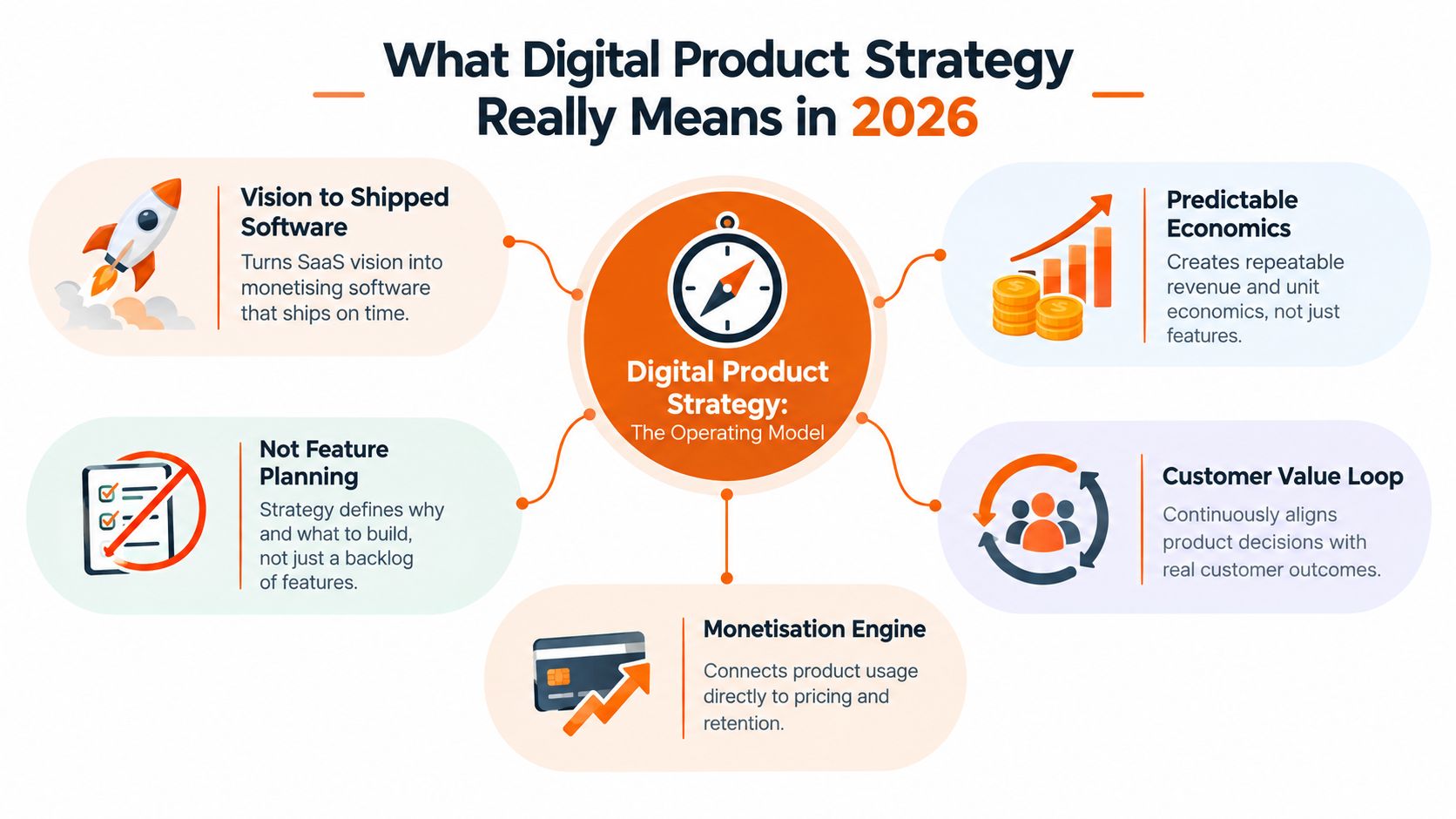
Digital product strategy is the operating model that turns a SaaS vision into shipped, monetising software with predictable economics. It isn't a feature list, a discovery backlog, or a roadmap presentation designed to create the appearance of certainty.
Feature planning asks what might be built. Discovery investigates what users need. A roadmap communicates intended direction. Strategy decides which inputs receive investment, who owns the decision, what capability is required, and which business outcome justifies the work.
That discipline has become more demanding. AI tooling has reduced the effort required to produce software, nearshore delivery has matured into a practical extension of internal teams, and buyers expect product value to improve continuously rather than arrive in occasional release events. More building capacity doesn't automatically create more value. It makes prioritisation, quality control, security, and commercial judgement more important.
The UK public sector shows the scale of this shift. Its modern digital government roadmap brings together products, platforms, and transformation initiatives in a whole-of-public-sector action plan running to 2030. The State of Digital Government Review reports approximately £26 billion in public-sector technology spending in 2023, equal to about 5.9% of total RDEL, while digital and data spending per FTE was 78% lower than peer benchmarks. The lesson isn't that organisations need to spend more. They need reusable platforms, stronger standards, better telemetry, and delivery systems that convert investment into outcomes.
A working strategy keeps three questions connected:
Ignore the first lens and you build unwanted software. Ignore the second and you create a popular cost centre. Ignore the third and your promises outrun the team's ability to deliver.
Treat strategy as a quarterly set of bets with named owners. Each bet should state the customer outcome, the commercial assumption, the capability required, the evidence that will change your mind, and the person who can make the call. A document stored in a shared drive ages. An operating rhythm learns.
Most strategy frameworks describe components. Strong teams turn each component into a decision contract. The question isn't whether a document exists. The question is what decision the document enables and who carries the consequence.
Vision belongs to the founder. It should anchor the company's category position and long-term revenue ambition without pretending that the route is already known. The founder decides what kind of business the product is meant to become and which opportunities sit outside that ambition.
Market belongs to product leadership. Product leaders define the ideal customer profile, the initial wedge, the buyer and user relationship, and the conditions under which the team will expand. A broad market statement creates permission to build anything. A sharp wedge creates useful constraints.
UX belongs to design and product together. Their contract is to set the bar for activation, trust, comprehension, and retention. Good UX work doesn't merely make the interface attractive. It removes friction between a user's first interaction and the value the business needs the user to experience.
Technology belongs to engineering leadership. The technology decision contract covers architecture, data models, security, reliability, integration surfaces, and the appropriate AI surface area. Engineering leadership should explain which shortcuts are safe, which create future lock-in, and which platform capabilities need funding now.
Metrics belong to the leadership team jointly. The leadership group names the north star, leading indicators, guardrails, and owners. A product manager shouldn't carry a revenue outcome without commercial authority. An engineering leader shouldn't own reliability metrics without the resources to address them.
Roadmap ownership sits with product, with engineering veto rights. Product decides which bets matter and in what sequence. Engineering can veto a sequence that creates unacceptable security, reliability, or operational risk. That isn't bureaucracy. It's a protection against promising an outcome the system can't support.
| Component | Owner | Primary Artefact | Decision Unlocked |
|---|---|---|---|
| Vision | Founder | Strategic narrative | Which business are we building? |
| Market | Product leadership | ICP and wedge definition | Who gets priority? |
| UX | Design and product | Experience principles and journeys | What trust and activation bar must we meet? |
| Tech | Engineering leadership | Architecture and capability plan | What must the platform support? |
| Metrics | Leadership team | KPI tree and guardrails | How will we judge value? |
| Roadmap | Product, with engineering veto rights | Outcome-based roadmap | Which bets come first? |
The #riteway approach adds Extreme Ownership to this model. Owners don't wait for perfect information or hide behind a process boundary. They make the best decision available, publish the assumption, and proactively bring the right people into the next review.
The artefact matters because it makes the decision visible. It doesn't matter because a strategy document is valuable.
MVP versus platform isn't a debate about engineering taste. It's a sequencing decision.
An MVP should test a sharp commercial and customer hypothesis with a single persona, a focused workflow, and infrastructure the team can replace if the evidence says the proposition is wrong. The team should be able to test the hypothesis in under eight weeks. That speed only works if the scope is narrow.
Two things aren't disposable: observability and authentication. You can replace an early application structure. You shouldn't lose the ability to understand usage, diagnose failure, control access, or investigate operational behaviour.
A founder should consider moving beyond MVP mechanics when the product begins to carry structural obligations. The signals include:
These are decision triggers, not automatic architecture mandates. A product with complex tenant isolation may need a stronger data model earlier. A simple workflow product may stay on a replaceable foundation longer.
| Signal | Stay on MVP | Graduate to Platform |
|---|---|---|
| Customer profile | One persona and a narrow workflow | Multiple customer types with shared capabilities |
| Data | Simple, well-understood records | Multi-tenant access, permissions, lineage, and portability |
| Integrations | Limited validation connectors | Integrations become part of revenue or retention |
| Operations | Manual intervention remains manageable | Reliability and support load constrain growth |
| Architecture | One deployable unit supports learning | Boundaries, ownership, or scaling require separation |
Invest in a proper data model when customer data has become a durable product asset, not merely because the codebase feels untidy. Split services when separate scaling, security, ownership, or release needs justify the operational cost. Migrate when the current foundation blocks a critical outcome. Refactor in place when the product still has a coherent boundary and the team can improve it without creating a second system to maintain.
Before approving a platform bet, ask:
Premature platform work consumes cash and attention while hiding the more uncomfortable problem, weak product evidence. MVP isn't a religion. It's a phase. Platform isn't a badge of maturity. It's a response to repeatable demand and operating complexity.
Strategy collapses when the delivery model can't support it. A founder can make excellent product decisions and still miss the market if the team communicates poorly, waits for decisions, or treats every risk as a late-stage surprise.
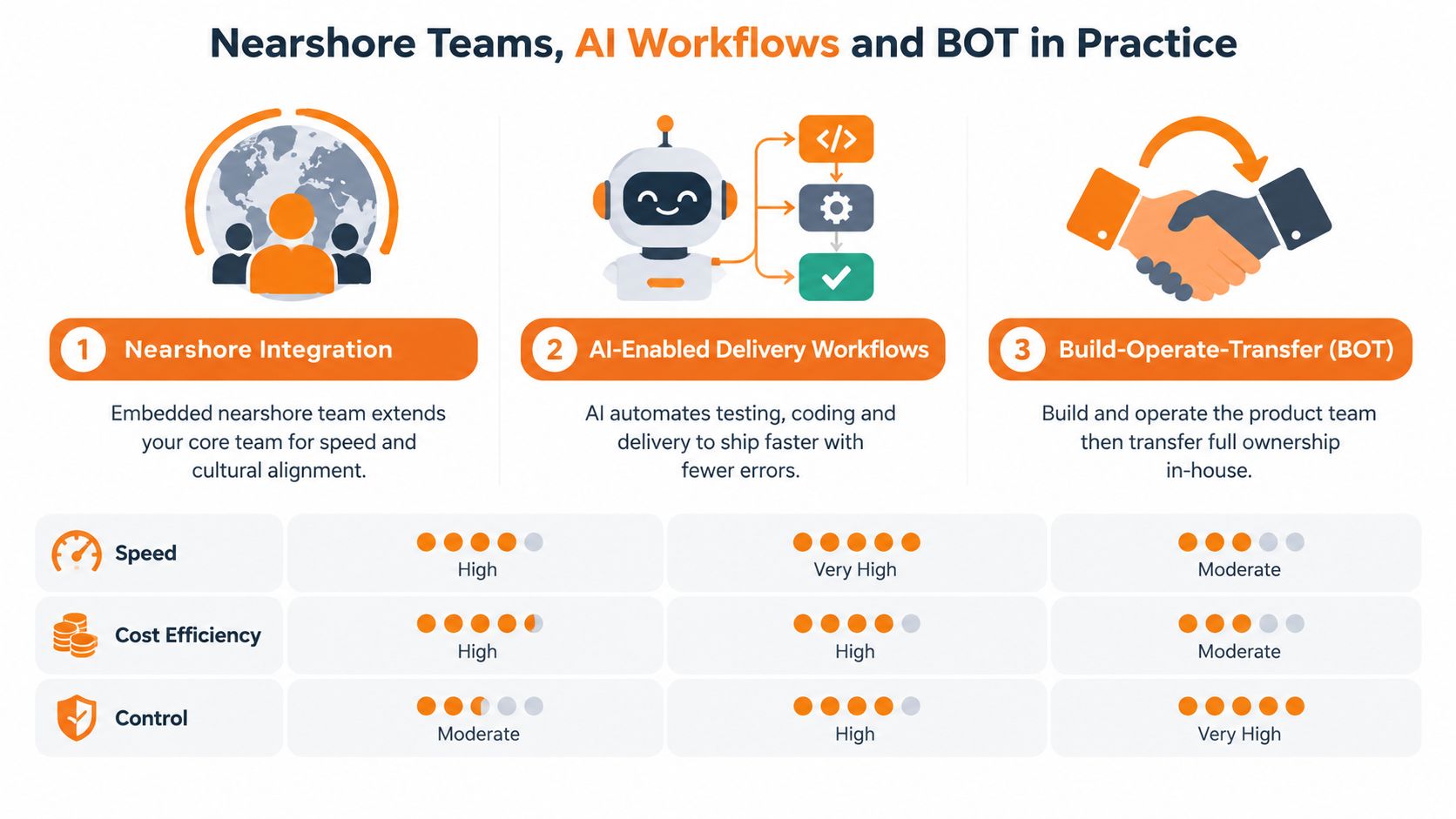
Three operating models are especially useful for scaling SaaS: nearshore integration, AI-enabled delivery workflows, and Build-Operate-Transfer.
Nearshore works when the external team behaves like part of the product organisation, not a queue of ticket processors. Set a timezone overlap target of at least five hours, establish a daily decision channel, run a weekly product and risk review, and give the squad ownership of outcomes. Hiring twelve disconnected contractors often creates more coordination work than hiring one accountable squad with a product, engineering, and delivery rhythm.
AI can shorten cycle time in practical places. Use it to draft requirements from validated discovery notes, identify gaps during code review, generate QA cases from acceptance criteria, and synthesise customer interviews into themes for human review. AI becomes theatre when teams use it to generate more backlog items, produce unverified code, or replace customer judgement with fluent text.
Delivery rule: Automate the repeatable work, not the accountability for the decision.
Build-Operate-Transfer fits a different need. A founder uses BOT when the objective is to acquire a durable capability and transfer it in-house, not add temporary capacity. The typical arc runs 18 to 24 months, with handover artefacts covering architecture, hiring, operating procedures, ownership maps, security controls, delivery metrics, and institutional knowledge.
Treating BOT as outsourcing creates cultural risk. The transferred team may optimise for the vendor relationship instead of the client's product, while internal leaders remain unprepared to own hiring, performance, and technical direction. The model works when capability transfer is designed from the start.
A short decision matrix helps:
| Model | Best fit | Main advantage | Main risk |
|---|---|---|---|
| Nearshore integration | You need embedded senior capacity | Speed with cultural and timezone alignment | Weak ownership if the squad receives only tickets |
| AI-enabled workflows | You have repeatable delivery tasks | Faster analysis, review, testing, and synthesis | Unverified output and false confidence |
| Build-Operate-Transfer | You need to build an internal capability | Deliberate transfer of people, systems, and knowledge | Handover fails if ownership is postponed |
The delivery partner should be more than a list of skills. The right team brings energy, flags risk before escalation, and takes responsibility for the result.
Strategy ownership is moving upward because revenue accountability is moving upward. A 2025 product-management survey found that 36% of respondents said senior leadership defines product strategy, up from 31% in 2024. The same survey reported that 39% considered product strategy the most important area of investment and that 43% of product executives were accountable for revenue, as discussed in the product management survey analysis.
Those figures should challenge a common founder assumption: hiring a Head of Product will solve strategy drift. It won't, if the founder keeps all commercial decisions, engineering controls delivery capacity, and product receives responsibility without authority.
At seed and Series A, founders usually carry the product vision, market thesis, major customer commitments, and final prioritisation calls. That can work because the decision loop is short.
As the company grows, the executive team and board need clearer portfolio and revenue accountability. Product leadership can own prioritisation and cross-functional execution, but it needs authority to reject requests and alter sequencing. Engineering needs authority to reject unsafe or operationally unrealistic commitments. Commercial leaders need to connect customer demand with actual revenue quality, not pass every request into the roadmap.
Before delegating strategy, answer three questions:
If the answer to any question is “the team” or “everyone”, the answer is nobody. Diffuse ownership is the most expensive failure mode in scaling SaaS because it makes every problem negotiable and every decision slow.
Use decision rights to prevent that drift. The founder owns the destination. Product leadership owns the sequence of bets. Engineering leadership owns technical integrity. Cross-functional teams own discovery evidence, delivery quality, and feedback loops. Senior leaders remain accountable for the commercial result.
That is what Extreme Ownership looks like in practice. It doesn't centralise every task. It makes responsibility impossible to misunderstand.
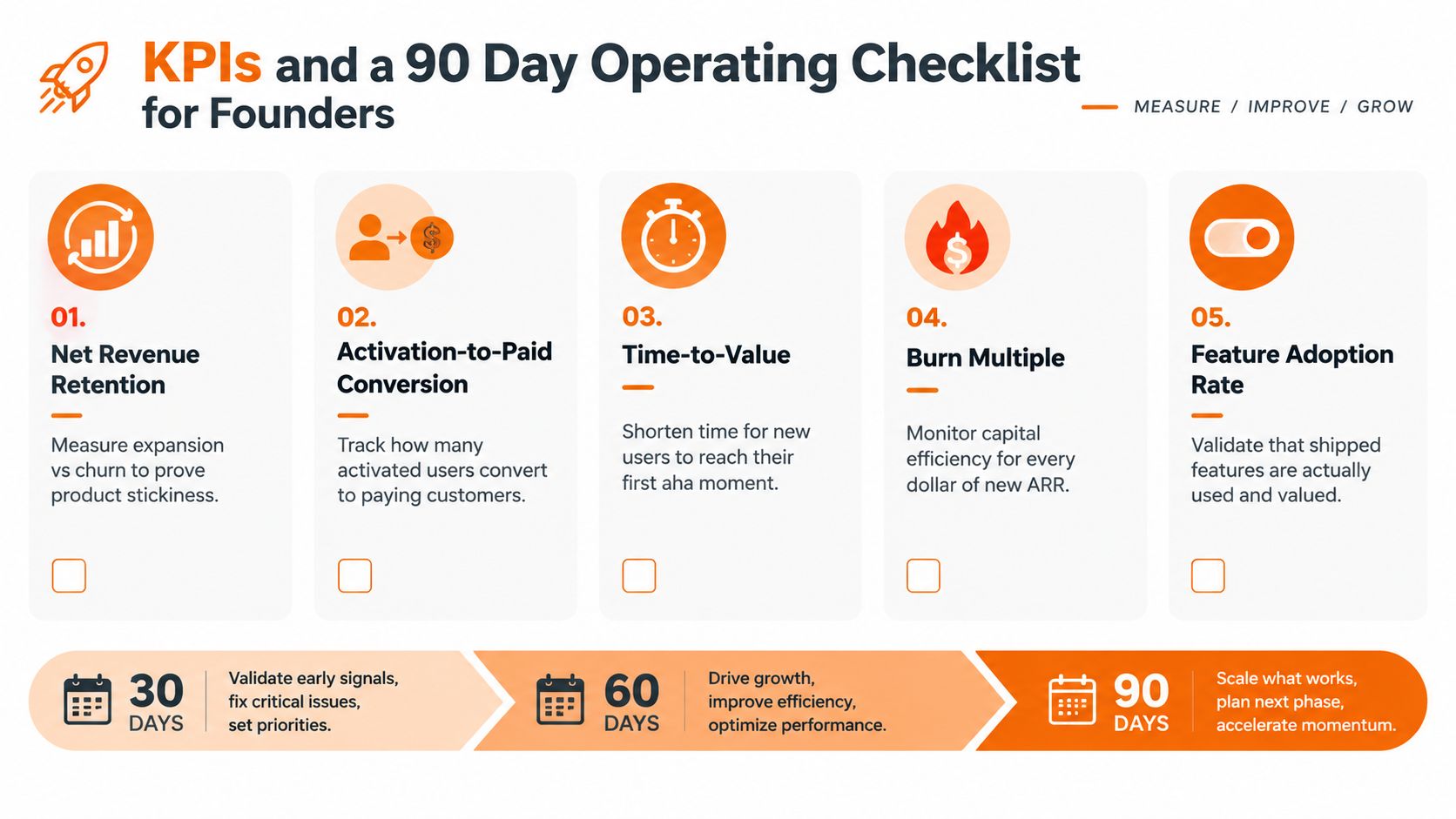
A strategy becomes real when the leadership team can review it without debating what success means. Founders should personally own five SaaS KPIs: net revenue retention, activation-to-paid conversion, time-to-value, gross margin, and roadmap predictability.
Each metric should connect to one of the six strategy components:
The UK Government's Business Data Use and Productivity Study found that only 7% of businesses using digital data said it contributed across product or service improvement, data-driven products for sale or licensing, and internal efficiency or cost reduction. A further 22% said data supported both product or service improvement and internal efficiency. The implication is direct: collecting data isn't enough. Leaders must connect it to decisions and outcomes.
Days 1 to 30
Days 31 to 60
Days 61 to 90
The weekly cadence should stay simple:
The UK Government's project business-justification guidance requires objectives to be SMART, outcomes to be clearly defined and approved by key stakeholders, and leading and lagging indicators to have clear owners, as set out in its business justification guidance. That is the right standard for SaaS founders too.
A strategy without measurement and cadence is a deck with a deadline. A strategy with named owners, commercial KPIs, proactive delivery mechanics, and a weekly decision rhythm can guide a company through uncertainty without pretending uncertainty has disappeared.
Rite NRG offers discovery and strategy advisory, senior nearshore delivery teams, AI-powered workflows, platform development, and Build-Operate-Transfer R&D centres for SaaS companies that need to connect product decisions with predictable delivery. Visit Rite NRG to discuss your product strategy, delivery model, or next platform decision with a team that treats outcomes as its responsibility.
/ about the author
Written by the RITE NRG editorial team — the architects, engineers and delivery leads who build and operate AI-era software for our clients.
Strategy & Transformation
A practical, finance-ready framework for comparing AI and modernization investment with the current-state cost, realistic benefits, delivery risk and time to value.
AI Consulting & Automation
A practical framework for choosing and deploying transport or logistics AI agents around real exceptions, reliable data and controlled operational authority.
Industry Solutions
A practical roadmap for improving manufacturing systems and introducing AI without destabilising production, data integrity or operational control.
More guidance: all insights articles
We can help you apply this thinking to the systems and teams you actually have.