

Strategy & Transformation
How to Calculate ROI for AI and Software Modernization
A practical, finance-ready framework for comparing AI and modernization investment with the current-state cost, realistic benefits, delivery risk and time to value.
operationalwrocław--:-- cet
∕ insights / difference-between-quality-control-and-quality-assurance.md
Difference Between Quality Control And Quality Assurance
Learn the difference between quality control and quality assurance with goals, tools and SaaS examples to choose the right approach for faster delivery.
>_article.meta
A release is scheduled for Friday. By Thursday afternoon, the team is still finding broken acceptance criteria, inconsistent environments and defects that should have been visible much earlier. Testing intensifies, the launch slips, engineers start reworking completed features, and customer-facing teams lose confidence in the date.
That pattern usually isn't a testing problem alone. It's a quality operating model problem. SaaS teams confuse quality assurance, which builds reliable ways of working, with quality control, which checks whether a completed output meets its requirements. The result is predictable: QC carries the burden that QA should have prevented, and delivery speed collapses under late rework.
For founders and CTOs, the difference between quality control and quality assurance is therefore a commercial decision. It affects release confidence, engineering capacity, customer trust, compliance exposure and the cost of changing direction. The right approach combines proactive process ownership with disciplined release verification.
A product team can have an impressive automated test suite and still ship late. Suppose a team builds a billing workflow from an ambiguous requirement. Engineers implement different interpretations, product approves a partial flow, and testers discover at the end that refund rules, permissions and audit expectations were never defined.
The team may call this a QC failure because testing found the issue. In reality, the first failure happened earlier. The team lacked a clear quality standard, acceptance criteria and shared ownership of the requirement. QC correctly exposed the defect, but it couldn't prevent the rework created by weak QA.
QC is essential at the release boundary. It verifies that the product behaves as specified, records defects and protects customers from known failures. But if a team waits until the final testing window to discover unclear specifications, unstable test data or missing non-functional checks, QC becomes a bottleneck rather than a safety net.
The business pays in several ways:
The UK government's quality statistics guidance draws the distinction clearly. Quality assurance anticipates and avoids problems in inputs and methods, while quality control responds to observed problems after they're found. That principle applies directly to SaaS delivery.
The #riteway methodology treats quality as an ownership issue, not a department hand-off. Extreme Ownership means product, engineering, design and testing teams own the quality of the outcome together. High energy matters too, but proactivity matters more. A team that raises a risk during discovery is creating value earlier than a team that reports the same risk after release preparation.
The practical decision is simple. Use QA to make the work easier to do correctly, then use QC to prove the resulting product is safe to release. The rest of this guide turns that distinction into delivery decisions for SaaS teams.
Quality assurance is the planned, systematic process that creates confidence outputs will meet defined quality criteria. The UK government project-delivery standard defines QA as a systematic process for providing confidence that outputs will match those criteria, while QC monitors specific results to verify compliance and remove causes of unsatisfactory performance. You can read Rite NRG's practical perspective on quality assurance processes for a delivery-focused application of the same idea.
QA operates upstream. It shapes requirements, working agreements, review practices, environments, risk controls and acceptance criteria before the team produces the final work. In software, that can include a definition of ready, design review, coding standards, threat modelling, CI rules and an agreed approach to accessibility or performance.
Quality control is the inspection and verification discipline. QC examines a specific output, such as a feature build, release candidate, migration or production change, and checks it against documented expectations. Testing, inspection, review, defect logging, regression analysis and release sign-off all sit within QC.
The key differentiator: QA designs the conditions for quality. QC checks whether the delivered result meets those conditions.
Ownership differs, but not in the simplistic way many teams assume. QA belongs to the whole delivery system because every team decision can introduce or prevent risk. QC may be performed by dedicated testers or quality engineers, but product owners, developers and release leaders still own the decision to resolve, accept or escalate a defect.
The UK statistical guidance describes QA as aiming to get outputs right first time through credible assumptions, suitable methods and correct production processes. QC responds to observed errors and checks the result against documented criteria. That makes QA a specification-setting and process-design activity, while QC is an evidence-gathering and exception-handling activity.
A test that fails because a requirement is contradictory points to a QA weakness. A test that fails because the implementation violates a clear requirement points primarily to a QC finding and an engineering defect. Both deserve action, but they require different responses.
The UK government publication workflow described in the quality statistics guidance uses distinct checking stages, including table cross-checks, proof-reading, publication sign-off and post-publication review. The lesson for SaaS teams is direct: quality isn't one final activity. It's a sequence of designed controls followed by focused verification.
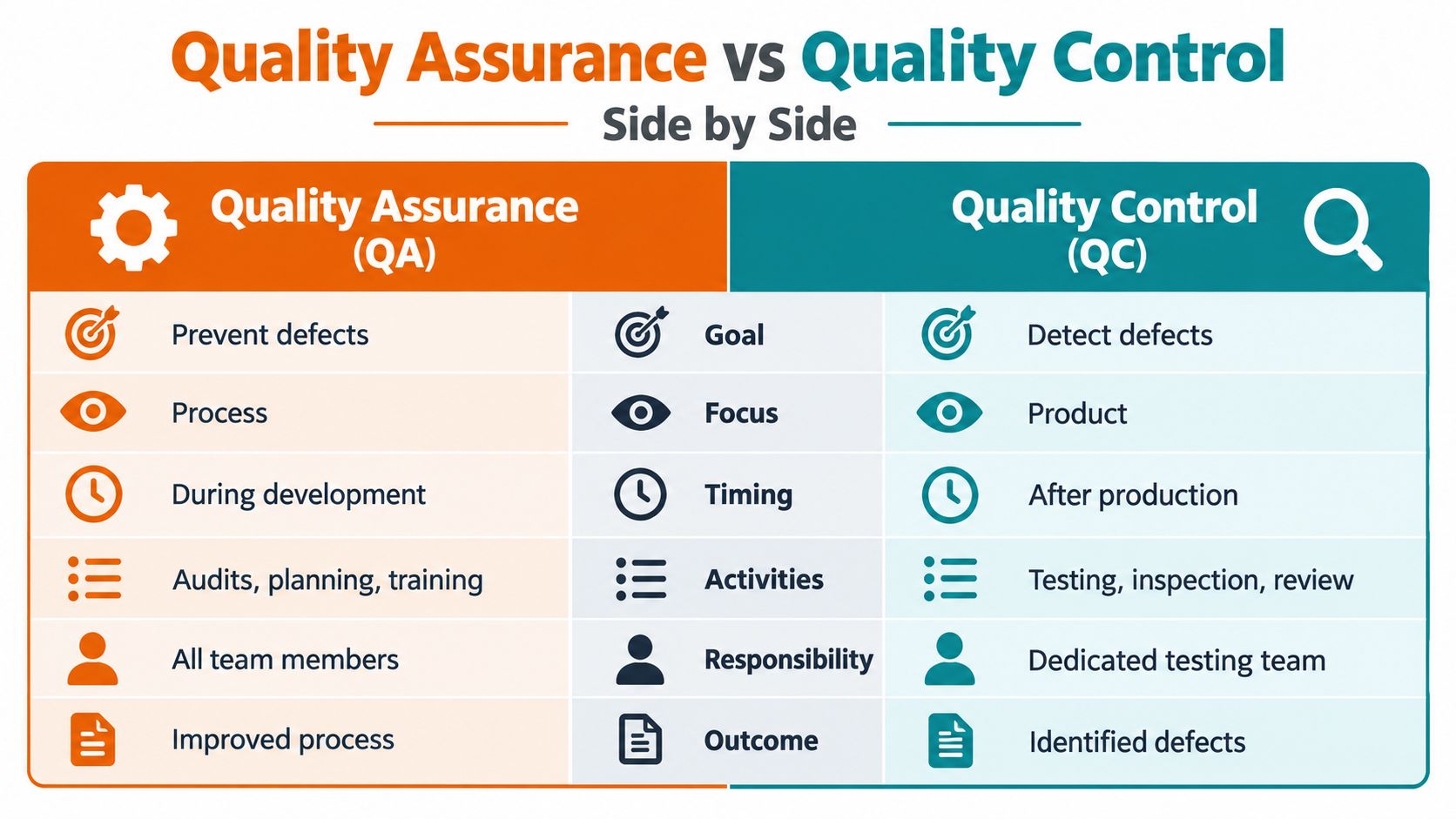
The most useful comparison isn't “proactive versus reactive” in isolation. Product leaders need to know what each discipline changes, who owns it, when it operates and how it affects business performance.
| Criterion | Quality Assurance | Quality Control |
|---|---|---|
| Primary goal | Prevent defects by designing reliable delivery practices | Detect defects in a specific output before release |
| Main focus | Processes, standards, assumptions and risk controls | Product behaviour, conformance and observed results |
| Best timing | Discovery, planning and throughout development | Test, release and post-production review |
| Typical activities | Acceptance criteria, audits, peer practices, training and process reviews | Automated tests, exploratory testing, inspection, regression and sign-off |
| Ownership | Shared across product, engineering, design and operations | Often led by testers or quality engineers, with release ownership retained by leadership |
| Useful evidence | Defined standards, approved requirements, review records and risk decisions | Test results, defect reports, environment evidence and release approval |
| Business impact | Reduces rework and makes delivery more predictable | Protects customers and limits the chance of defective releases |
QA answers questions such as:
A strong QA model gives engineers fewer ambiguous decisions to make during implementation. It also makes escalation faster because the team has already agreed what acceptable quality means.
QC answers a different set of questions:
QC should produce evidence, not theatre. A green dashboard isn't enough if the wrong scenarios were tested or the environment doesn't represent production. Conversely, a defect report without severity, reproduction steps and business impact doesn't help a release owner make a decision.
QA reduces the number of problems created. QC reduces the number of problems released.
The two disciplines should feed each other. A recurring defect in permissions may trigger a QC test enhancement, but it should also prompt a QA review of requirements, design patterns, coding practices and review coverage. Teams that only add another test often detect the same class of failure without improving the system that produced it.
For deeper technical context, the distinction between implementation-focused and behaviour-focused testing is useful in this guide to white-box and black-box testing.
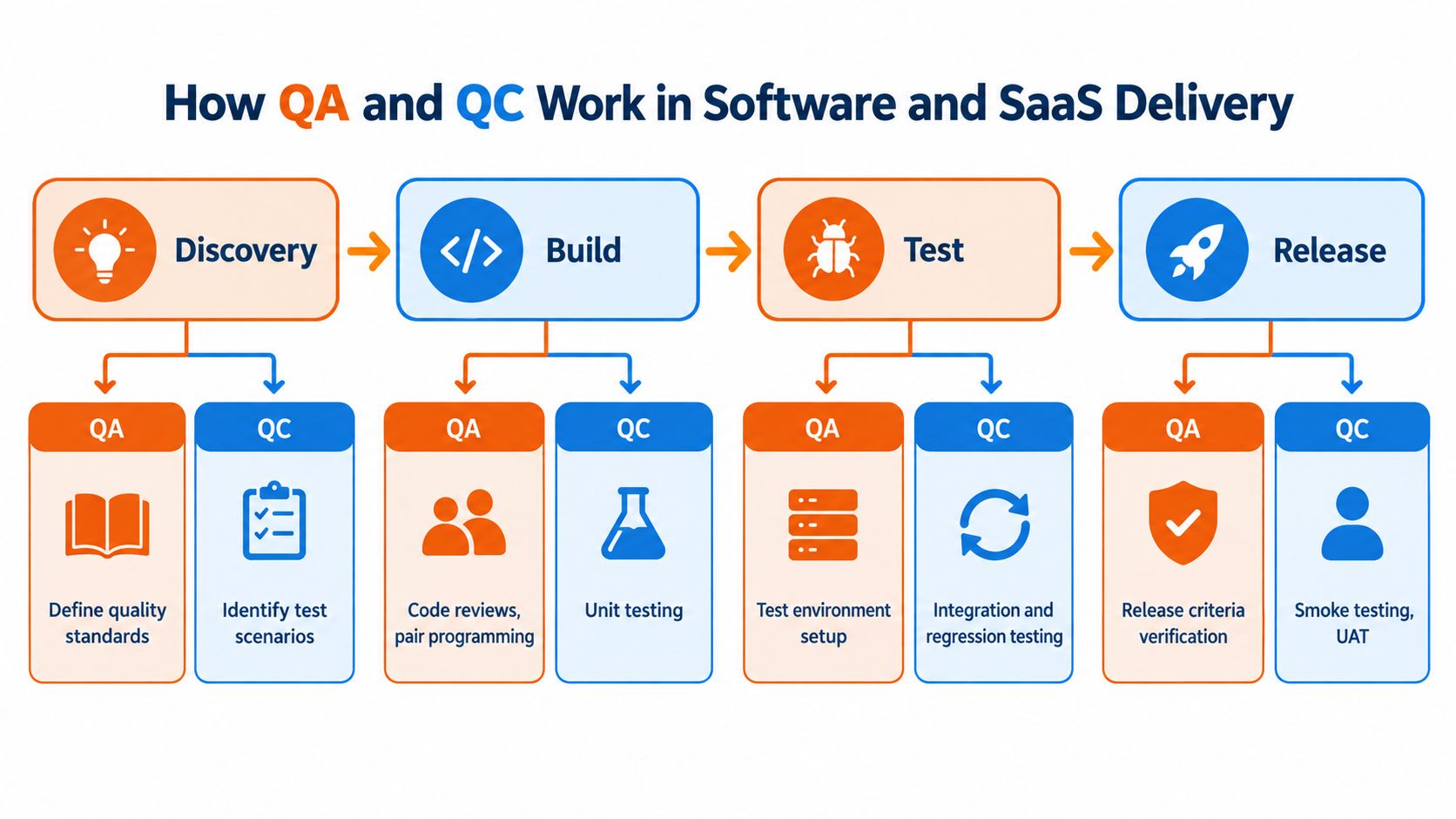
SaaS quality starts before a ticket reaches a developer. At discovery, QA turns product intent into a shared quality model. The team defines acceptance criteria, edge cases, data assumptions, supported environments and non-functional expectations. Product and engineering can then identify delivery risks before those risks become code.
A definition of ready prevents incomplete work from entering a sprint. It might require a measurable outcome, user permissions, failure states, analytics expectations and a testable acceptance statement. A threat model or data review can expose privacy and security risks before the team commits to an implementation path.
During build, QA includes peer review practices, coding conventions, branching rules, CI quality gates and observability requirements. These controls don't replace engineering judgement. They make good judgement repeatable across a distributed team.
QC starts testing the actual output. Developers can run unit tests, quality engineers can exercise integration paths, and product representatives can validate the user journey. Code review can contribute to both disciplines, depending on its purpose. A review that enforces a defined engineering standard supports QA, while a review that inspects a completed change for a defect is QC.
A mature QC approach covers more than happy-path functional testing. It includes regression testing, exploratory checks, migration verification, performance checks and release smoke tests. In regulated or sensitive products, privacy, accessibility, security and audit evidence must be visible in the release decision.
UK quality engineering expectations are moving in this direction. The share of respondents expecting automation in quality engineering rose from around 40% to nearly 70%, according to the UK quality engineering research cited by Bonafide Research. The same source notes that GDPR has normalised privacy considerations and that sustainability has become a visible quality-engineering priority. Automation should therefore extend beyond functional checks where risk demands it.
The underlying requirement problem remains serious. In the Capgemini UK World Quality Report, 51% of UK respondents said requirements are always or almost always clearly defined, and 60% said the QA tools and methods they need are always sufficient and available. Those figures describe a delivery precondition, not a testing failure. If requirements and tools aren't adequate, adding more end-stage execution won't solve the root problem.
Track QA signals such as requirement readiness, review completion, risk closure and recurring root causes. Track QC signals such as defect severity, regression outcomes, escaped defects, release-gate results and time to verify a fix. Keep the measures tied to outcomes, including release predictability, customer-impacting incidents and rework.
When teams need to improve defect conversations, resources such as these bug report interview questions can help leaders assess whether candidates think in terms of reproduction, impact and actionable evidence.
Don't choose QA or QC as if one replaces the other. Choose where the next unit of quality effort will create the greatest business benefit.
A new product build usually needs stronger QA emphasis. The team is still establishing architecture, standards, acceptance patterns and working agreements, so preventing inconsistency has more value than inspecting every output at the end. Scaling teams need the same discipline. Without shared practices, each new contributor creates another variation in how requirements are interpreted, code is reviewed and releases are verified.
QC deserves greater emphasis when the product is stable and the immediate risk sits in the output. A hotfix, data migration, legacy modernisation or urgent integration needs focused verification against known behaviours and failure modes. The team should narrow the release scope, define explicit gates and preserve an audit trail of what was tested.
| Delivery context | Primary emphasis | Leadership decision | Business outcome |
|---|---|---|---|
| New product build | QA | Establish standards and acceptance criteria before scale | Less rework as the product evolves |
| Rapid team growth | QA | Standardise practices and ownership | More consistent delivery across contributors |
| Hotfix or migration | QC | Verify affected journeys and rollback conditions | Reduce release-specific customer risk |
| Regulated workflow | Both | Design controls and retain evidence | Support dependable compliance decisions |
| Investor-ready launch | Both | Combine process confidence with release proof | Present a credible, controlled product |
Regulated sectors require a joined-up model. The UK government's National Quality Infrastructure guidance describes conformity assessment as verification that a product, service, process or system meets specified requirements, including testing, inspection and certification. Certification can provide valuable evidence, but teams still need internal QA and QC controls that reflect the actual product risk.
The same principle appears in the UK Ministry of Defence's Government Quality Assurance guidance. Government QA involves systematic, regular monitoring of a supplier's QMS, processes and products to provide confidence that contractual requirements are met. AQAPs invoke ISO 9001 or BS EN 9100 with NATO-specific requirements, but they aren't certification standards and don't require certified QMS status.
Decision rule: Put QA where uncertainty is being created. Put QC where release risk needs evidence. Put both where failure affects trust, compliance or revenue.
Quality shouldn't arrive as a new bureaucracy layer. Build it into the path the team already follows.
Start with a small set of essentials:
For teams building or maintaining continuous integration practices, the objective isn't to run more checks for their own sake. It's to move trustworthy feedback closer to the moment a change is made.
Automate repeatable regression checks, keep exploratory testing focused on risk, and define defect thresholds before release pressure arrives. A release gate should show what passed, what failed, what remains open and who accepted the residual risk.
AI can help surface risk across requirements, code changes, test coverage and operational signals, but it shouldn't replace accountable judgement. Use it to prioritise attention, not to disguise uncertainty.
Nearshore teams can support this model when they integrate into the same ceremonies, dashboards and ownership boundaries as the core team. Rite NRG provides dedicated software delivery teams, product development, technology and delivery consulting, and Build-Operate-Transfer support, with AI-assisted workflows used across recruitment, delivery and operations. For a broader perspective on scaling quality operations, this guide to scaling QA with Fluidwave offers another useful reference.
Your QA and QC balance should reflect four realities: product maturity, release frequency, compliance exposure and team distribution. A young product with unclear requirements needs process discipline first. A mature platform with frequent changes needs strong automated verification and release evidence. A regulated product needs both from the start.
UK audit regulation shows how seriously this shift is being taken. The Financial Reporting Council issued ISQM (UK) 1 in July 2021, and it became effective on 15 December 2022, replacing ISQC (UK) 1, as documented in the FRC's ISQM (UK) 1 guidance. The linked standards cover the system of quality management, engagement quality review and audit quality management. The direction is unmistakable: organisations are expected to design and operate systems that prevent failures, not inspect work after the fact.
ISO 9001:2015 provides a recognised QMS framework. UK government guidance explains that a QMS helps organisations manage processes so customer and stakeholder requirements can be achieved, while certification controls surrounding processes but doesn't guarantee product quality. That distinction is vital for SaaS founders. A certificate won't rescue unclear requirements, weak ownership or missing release evidence.
Rite NRG's delivery model combines product-first thinking, senior nearshore teams and AI-powered processes. The company states that its approach can help clients ship up to 50% faster while retaining quality and control, as described in its publisher information. Consider a Build-Operate-Transfer model when long-term quality ownership, hiring, compliance and operational capability need to move inside your organisation.
Choose the partner that will challenge weak assumptions, expose risk early and own outcomes with you. A list of skills isn't a delivery strategy. Extreme Ownership, high energy and proactive communication are what turn QA and QC into predictable growth.
Rite NRG can help you design the QA controls, QC release gates and senior nearshore team your SaaS roadmap requires. Visit Rite NRG to discuss dedicated teams, end-to-end platform delivery, technology consulting or a Build-Operate-Transfer path for lasting quality ownership.
/ about the author
Written by the RITE NRG editorial team — the architects, engineers and delivery leads who build and operate AI-era software for our clients.
Strategy & Transformation
A practical, finance-ready framework for comparing AI and modernization investment with the current-state cost, realistic benefits, delivery risk and time to value.
AI Consulting & Automation
A practical framework for choosing and deploying transport or logistics AI agents around real exceptions, reliable data and controlled operational authority.
Industry Solutions
A practical roadmap for improving manufacturing systems and introducing AI without destabilising production, data integrity or operational control.
More guidance: all insights articles
We can help you apply this thinking to the systems and teams you actually have.