

Strategy & Transformation
How to Calculate ROI for AI and Software Modernization
A practical, finance-ready framework for comparing AI and modernization investment with the current-state cost, realistic benefits, delivery risk and time to value.
operationalwrocław--:-- cet
∕ insights / custom-enterprise-software-development.md
Custom Enterprise Software Development
Learn how custom enterprise software development delivers measurable outcomes, from MVP to scale, with proven delivery models and partner checklist.
>_article.meta
Your off-the-shelf stack looked sensible when the company was smaller. Now every important workflow crosses several systems, the data doesn't reconcile cleanly, and a product decision takes weeks because nobody can see the full operational picture. Your CTO is weighing another SaaS subscription against a custom build, while the board wants a credible route to value, not a technical shopping list.
That's the point where custom enterprise software development needs to be treated as a business-outcome delivery system. The question isn't whether your team can produce code. It's whether the platform will shorten a revenue process, reduce operational friction, protect critical data, improve adoption, or make future change cheaper and safer.
A SaaS company can outgrow its CRM, billing platform and workflow tools without any single product failing. Customer records get duplicated, teams export data into spreadsheets, and staff coordinate work manually because integrations do not reflect the actual process. The business pays for software, yet still pays for the gaps between systems.
An enterprise CTO may face the opposite problem. A legacy platform contains valuable business logic, but slows releases and makes new integrations risky. Replacing it all at once creates delivery and continuity risk. Continuing to patch it increases dependency on fragile components and scarce internal knowledge.
Custom software earns its place when it changes those economics. It can encode workflows that differentiate the organisation, connect systems through shared data rules, and give leaders control over the roadmap. The platform still needs a clear operating model. Users must adopt it, operational teams must trust its outputs, and executives must measure whether it improves the baseline.
The commercial signal in the UK is substantial. The UK enterprise software market outlook projects growth from about USD 19.27 billion in 2025 to USD 46.19 billion by 2033, with a 11.8% CAGR. ERP software represented 30.36% of revenue in 2025, pointing to continued spending on core systems, integration-heavy programmes and modernisation, alongside standard SaaS subscriptions.
A serious delivery partner starts with measurable questions:
The #riteway methodology applies Extreme Ownership, high energy and proactive problem solving to these questions. In practice, the team defines the target outcome, assigns clear ownership, tests assumptions early, surfaces bad news quickly and resolves decisions before uncertainty becomes rework. Consulting-led judgement stays connected to delivery evidence, rather than leaving business leaders with a feature list and an unresolved risk register.
That standard separates a skills supplier from a partner accountable for value. The build is successful only when it improves a measured business result and remains supportable after launch.
Custom enterprise software is an operating facility designed around your organisation's workflows, security requirements, data ownership and growth path. Its value comes from how well it supports the way the business creates, delivers and controls work, not from the size of its feature list.
The distinction starts with workflow fit. A configured SaaS product asks teams to adapt processes to the vendor's model. A custom platform starts with how work moves through the organisation, including approvals, exceptions, ownership rules and integrations. The delivery team must still challenge unnecessary preferences and keep ordinary capabilities standard. The full build-versus-buy comparison belongs in the next section. Here, the priority is understanding what the platform must control.
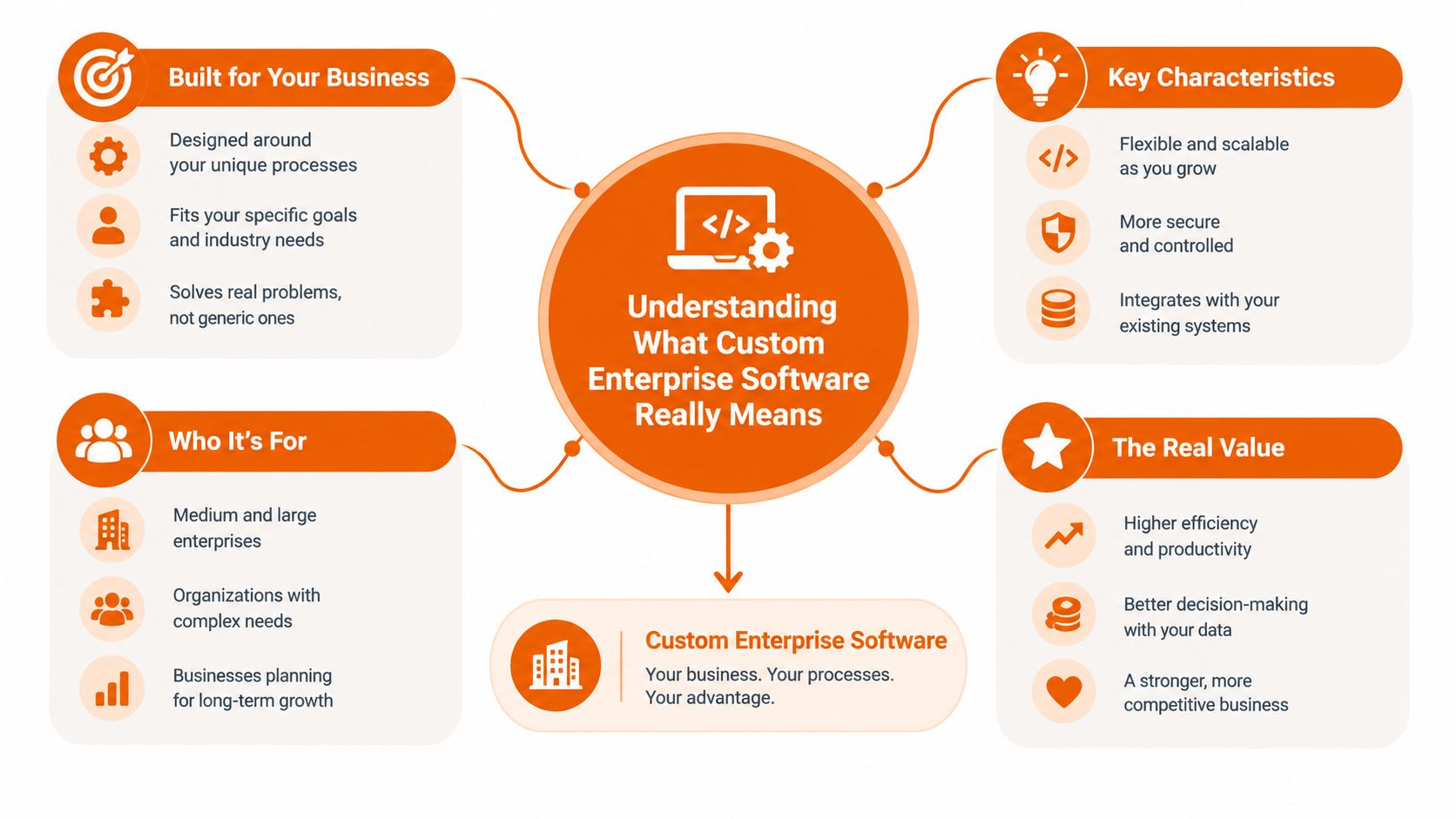
A custom platform connects several decisions that should be governed together:
The UK has a strong technical base for this work. The Office for National Statistics data on business R&D records £10.3 billion contributed by the software development product group to business R&D performed in 2024, equal to 18.5% of total UK business R&D. Buyers should therefore expect engineering teams to demonstrate disciplined architecture and quality practices, not just fast feature production.
Outcome over output: A completed backlog is not a business result. The platform must improve a process that leadership can observe, measure and defend.
Consulting-led decisions keep the build tied to that outcome. Under Extreme Ownership, the team assigns decision owners, tests assumptions early, exposes delivery risk quickly and connects technical choices to measurable value. That operating discipline is what turns custom development into a business-outcome delivery system rather than a feature-production exercise.
The build-versus-buy decision gets distorted when teams compare licence fees with development estimates and stop there. The true comparison includes process fit, integration work, ownership, change speed, security accountability and the cost of keeping an unsuitable system alive.
| Decision Criteria | Custom Enterprise Software | Off The Shelf Software |
|---|---|---|
| Business impact | Aligns workflows to the operating model and differentiating processes | Delivers standard capability quickly |
| Total cost of ownership | Requires deliberate investment in delivery, hosting, support and evolution | Often begins with simpler procurement, then accumulates licences, add-ons and workarounds |
| Flexibility | Roadmap and priorities remain under the organisation's control | Roadmap depends on the vendor's product direction |
| Integration burden | Integrations can be designed around the organisation's data model | Pre-built connectors may help, but exceptions often require workarounds |
| Security control | Architecture, access and release practices can be designed for the risk profile | Security posture and update timing are partly dependent on the supplier |
| Speed to value | Slower to validate if discovery and scope are weak, faster to improve a unique workflow once the foundation is sound | Fastest route to common capability, but not necessarily to an effective end-to-end process |
| Ownership | The organisation can control the intellectual property, roadmap and operating model | The vendor retains control of the product and commercial terms |
Choose off-the-shelf software when the capability is common, differentiation is limited and the vendor's workflow fits without damaging adoption. Finance, identity, collaboration and basic support functions often belong in this category, provided integration and data requirements are clear.
Choose custom when the software directly affects your proposition, operational advantage or ability to scale. A manufacturer with complex production logic, a financial services business with specialised decision rules, or a SaaS company building a product customers will pay for shouldn't outsource its defining workflow to a generic configuration.
Blended architecture is often the most commercially sensible path. Buy the stable commodity services, then build the orchestration, user experience, domain logic and analytics that connect them into a coherent operation.
Don't ask, “Can we build this feature?” Ask, “Which option gives us the strongest control over the result?” That reframes procurement around value and makes hidden debt visible.
The comparison is useful only if it produces a decision. Set a baseline for cycle time, error handling, adoption, cost or revenue contribution, then assess each option against that baseline. If nobody can explain how success will be recognised after launch, the organisation isn't ready to approve either route.
Predictable delivery is a connected value chain. Discovery should reduce uncertainty, architecture should preserve options, the MVP should test the riskiest assumptions, and scaling should extend a product that users have already proved they need.
Start with users, workflows, systems and business measures. Map where work stalls, where data changes hands, which integrations are unavoidable and which constraints are regulatory or operational. The output shouldn't be a decorative requirements document. It should be a prioritised decision record with an outcome hypothesis, delivery risks, a thin vertical slice and clear acceptance criteria.
Extreme Ownership shows up here through uncomfortable questions. Who owns the business decision? Which assumption could invalidate the investment? What must be demonstrated before the team expands scope? A consulting-led team answers these questions before developers build a large surface area.
Select architecture based on the product's actual constraints and the organisation's ability to operate it. A modular monolith may be more responsible than distributed services when the domain is still changing. Cloud-native infrastructure can support elastic growth and independent operations, but it also introduces platform responsibilities that someone must own.
Security belongs in the architecture. The UK government's cyber-sector capability analysis estimated 1,141 UK firms providing software security services in 2026, up 19% from the prior baseline, and identified 791 assessed organisations with secure-development capability. The same analysis recorded 942 public-sector cyber contracts worth £931 million in 2024. Secure-by-design engineering is therefore tied to delivery credibility and procurement, not just late-stage compliance.
A strong MVP tests the smallest complete journey that can produce evidence. It should include the data, permissions, integration and operational path needed for a real user to achieve the intended result. Cutting quality practices to appear faster moves uncertainty into production.
Use AI-powered processes where they improve throughput without weakening judgement. AI can assist with discovery synthesis, test generation, documentation, code review and risk detection, while senior engineers remain accountable for architecture, security and product trade-offs. Automated tests, continuous integration and continuous delivery preserve momentum by making each change easier to verify.
After the first validated release, track business measures alongside technical health. Review adoption, process completion, support demand, data quality and operational incidents. Weekly demos, transparent backlogs and proactive risk reviews keep executives close to the evidence and give the team permission to change direction before sunk cost dictates the roadmap.
Maintenance isn't a handover event. It's the operating model that keeps the platform secure, useful and adaptable as customers, regulations and internal processes change.
A SaaS founder with a clear roadmap needs a different delivery model from an enterprise replacing a core platform or building a permanent R&D centre. Choose based on the business outcome, decision rights and internal capacity required to deliver it.
A dedicated nearshore team fits a SaaS founder or CTO who has product direction in place and can own priorities internally. You keep roadmap control while adding senior engineers, product support, QA and delivery capability. Shared working hours and cultural proximity reduce feedback friction, and the team can scale within 1–2 weeks, according to Rite NRG's delivery information.
This model depends on active product decisions and clear technical ownership. Assign an internal owner who can resolve trade-offs, approve priorities and keep the team connected to measurable product outcomes. Without that involvement, added capacity becomes expensive motion rather than useful progress.
End-to-end delivery suits organisations that need one accountable partner across analysis, design, engineering, quality, infrastructure and maintenance. Fewer handoffs can improve execution, but accountability must be explicit. Agree who owns the roadmap, architecture decisions, security approvals and acceptance of business outcomes before work begins.
Use this approach for a new production platform, a stalled application recovery or a legacy modernisation programme. It is particularly effective when fragmented responsibility would delay decisions or leave critical risks without an owner.
Consulting-led delivery is the right starting point when the problem remains unclear. A senior partner can assess the current estate, define a target operating model, sequence modernisation and determine whether a custom, commercial or blended architecture supports the intended result.
Use diagnosis to protect the investment. Before committing to a large build, require clear decision criteria, an outcome-led sequence and a documented view of the trade-offs. The partner should advise, not replace executive ownership.
Build-Operate-Transfer suits an enterprise that wants a durable R&D centre without creating hiring, compliance and operational infrastructure from scratch. The partner establishes the centre, builds delivery capability and prepares the organisation to assume ownership.
Long-term control depends on the transfer plan. Define leadership, recruitment, knowledge management, governance and commercial exit conditions at the outset. Otherwise, the centre may remain dependent on the partner instead of becoming an owned capability.
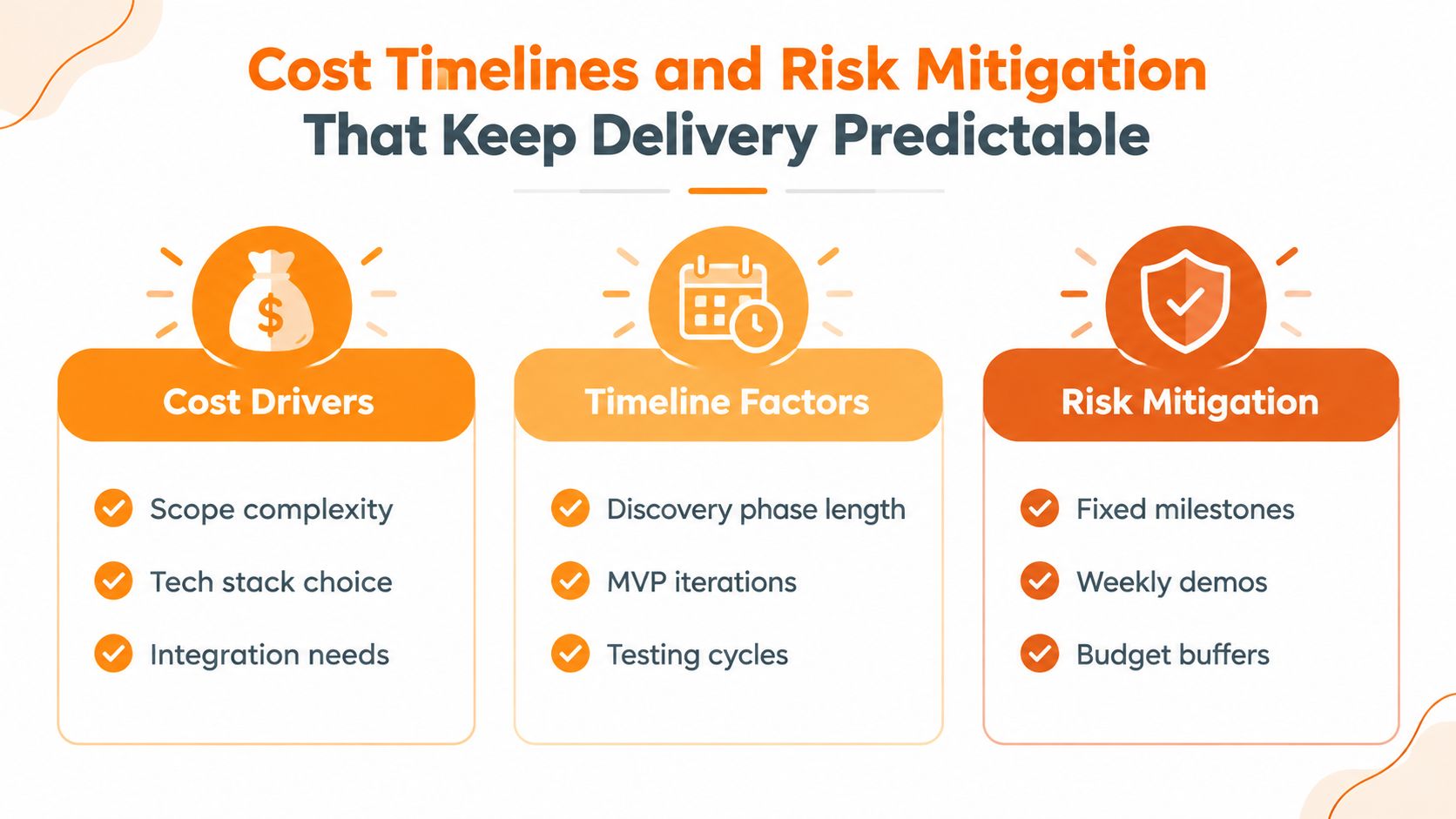
Match the model to the constraint:
Select the model that gives a named group authority to make the decisions your outcome depends on. That is Extreme Ownership in practice. The delivery model should make responsibility visible, connect decisions to business value and give leaders a clear way to intervene when risk changes.
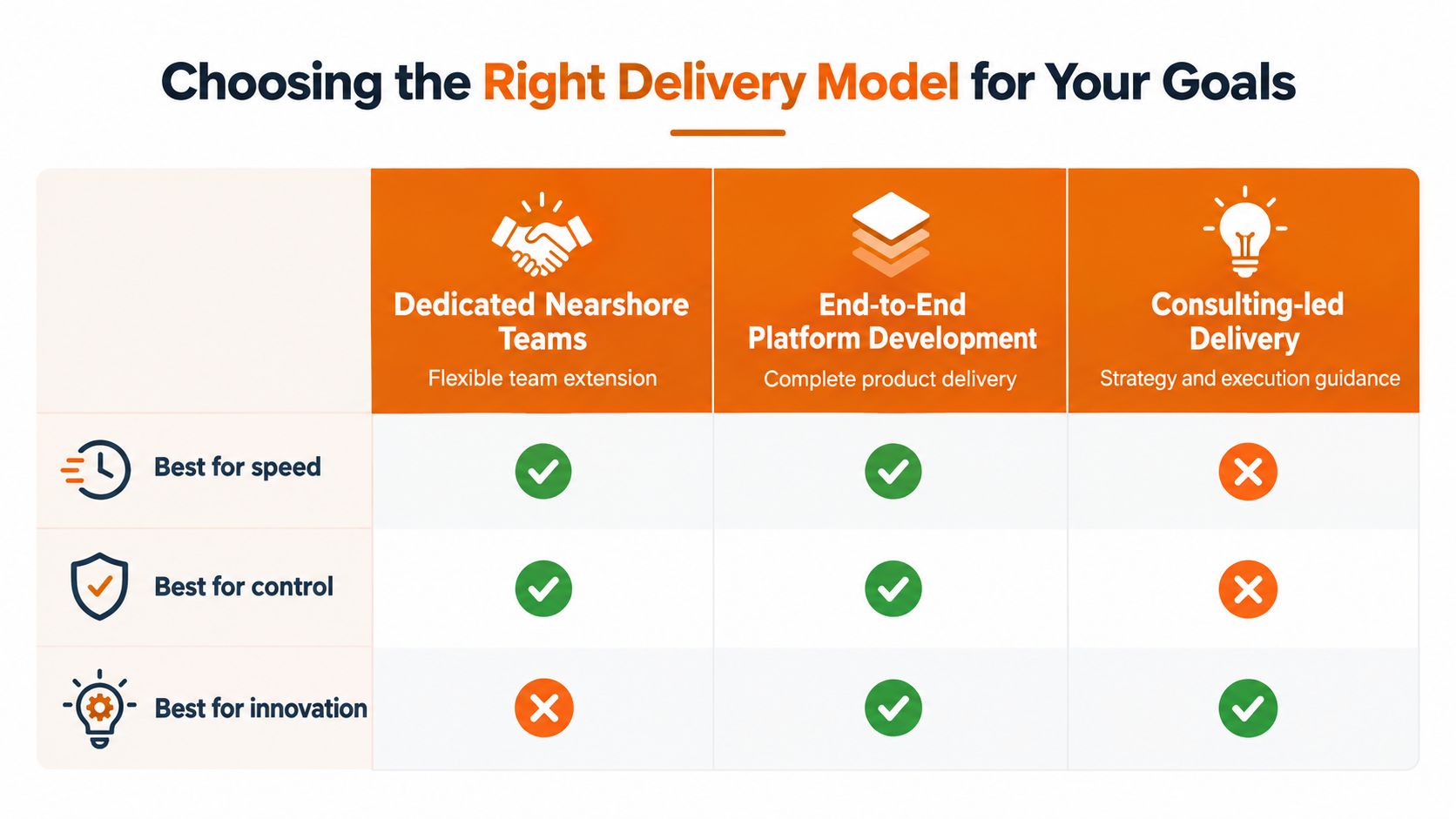
No responsible partner can price custom enterprise software from a feature count alone. Scope complexity, integration depth, data migration, compliance, user groups, operational resilience and team seniority all change the work. A credible estimate makes those drivers explicit and shows which assumptions would move the plan.
Your first control is discovery. Break the initiative into outcome-led increments, identify the riskiest integration, validate the most important user journey and define what won't be built yet. Use fixed milestones for decisions and demonstrations rather than pretending the entire future scope is perfectly knowable.
Treat quality, security and delivery management as part of the investment. The UK public-sector evidence base shows what happens when governance fails. A UK Parliament evidence pack on outsourced IT contracts reported that, across a sample of outsourced contracts worth £29.5 billion, 30% were terminated prematurely and completed projects accumulated £9.0 billion in overruns, equal to 30.5% of contract value.
Those figures aren't a forecast for your project. They're a warning against weak accountability. Assign a senior technical owner, a business sponsor and a delivery lead. Review scope, risks, dependencies and spend every week. Keep a budget buffer for unknowns rather than hiding uncertainty inside an optimistic estimate.
Fast delivery comes from shortening feedback loops, not skipping thinking. Weekly demos expose misunderstandings while they're still cheap to correct. Automated regression testing protects completed work, while continuous delivery makes small releases easier to observe and reverse.
Threat modelling should influence architecture before sensitive workflows are built. Secure coding standards, dependency scanning, environment separation, access controls and release governance should be visible in the delivery plan. The team should also define a rollback approach, monitoring signals and ownership for incidents before launch.
A parliamentary source cited a survey finding that only 13% of all IT projects were successful, while IT development projects had a success rate of less than 1%, as reported in this UK Parliament briefing. That's why a delivery partner must own more than sprint output. Every milestone should connect to a business decision, a validated behaviour or a measurable operational improvement.
Practical rule: If a risk has no owner, no trigger and no response, it isn't being managed. It's being postponed.
A VC-backed SaaS company racing to validate a product may need a focused nearshore team, a thin vertical slice and firm product governance. A scale-up modernising a legacy platform may need consulting first, followed by incremental replacement around stable domain boundaries. An enterprise building an R&D centre in Poland may choose Build-Operate-Transfer to combine immediate delivery with long-term ownership.
The delivery model should follow the business outcome. The operating principles stay consistent:
Start with a short outcome brief. Name the business problem, current baseline, target behaviour, critical users, integrations and unacceptable risks. Ask potential partners to challenge the brief, show how they would validate it and state what they would refuse to build before the evidence supports it.
Choose a team that treats delivery as accountable business execution. The right partner creates faster learning, safer decisions and measurable value, with Extreme Ownership applied to outcomes rather than ticket volume.
Rite NRG provides dedicated nearshore teams, end-to-end platform development, consulting-led delivery and Build-Operate-Transfer R&D centres in Poland for organisations modernising legacy systems or building SaaS platforms. Discuss your outcome, delivery risks and team model through Rite NRG's consulting services, and define a controlled, accountable programme for the next software investment.
/ about the author
Written by the RITE NRG editorial team — the architects, engineers and delivery leads who build and operate AI-era software for our clients.
Strategy & Transformation
A practical, finance-ready framework for comparing AI and modernization investment with the current-state cost, realistic benefits, delivery risk and time to value.
AI Consulting & Automation
A practical framework for choosing and deploying transport or logistics AI agents around real exceptions, reliable data and controlled operational authority.
Industry Solutions
A practical roadmap for improving manufacturing systems and introducing AI without destabilising production, data integrity or operational control.
More guidance: all insights articles
We can help you apply this thinking to the systems and teams you actually have.