
Strategy & Transformation
How to Calculate ROI for AI and Software Modernization
A practical, finance-ready framework for comparing AI and modernization investment with the current-state cost, realistic benefits, delivery risk and time to value.
operationalwrocław--:-- cet
∕ insights / cto-consulting-services.md
CTO Consulting Services
Discover how CTO consulting services turn strategy into measurable business outcomes, from architecture reviews to delivery optimisation and AI-native
>_article.meta
Your roadmap says the new product, platform migration, and AI initiative should all move this quarter. The budget is approved, the teams are busy, and delivery dates keep slipping because no one has enough senior technical capacity to resolve competing priorities, architecture risks, and production trade-offs. Adding more developers won't fix a leadership bottleneck.
Effective CTO consulting services connect business goals to technical decisions and stay accountable through delivery and handover. The test isn't whether a consultant produces a polished strategy deck. It's whether your organization makes better decisions, ships reliably, reduces avoidable risk, and knows who owns the system after launch.
Gartner's July 2025 forecast put worldwide IT spending at $5.43 trillion in 2025, with IT services projected to reach approximately $1.69 trillion. The same forecast revised down an earlier estimate, underscoring why technology investment needs disciplined prioritization and flexible planning, not just bigger budgets (Gartner's worldwide IT spending forecast).
The useful way to buy consulting is to start with a business constraint, establish how you'll measure it, and name the person accountable for moving it. Then select the kind of leadership and delivery support that fits your situation, with a clear route from assessment to production ownership.
A plan can be strategically sound and still fail in delivery. Perhaps your SaaS team is late on a customer commitment because its services are hard to change. Perhaps a manufacturer needs to modernize an aging operational platform, but nobody can confidently explain what a migration could disrupt. Or perhaps your executives want an AI feature before the company has agreed which data it can use or who approves its output.
In each case, the first question isn't “Which technology should we buy?” It's “What business result is blocked, and what decision is blocking it?” That distinction matters. A tooling purchase may add another system to maintain, while a senior technical leader can help expose the actual constraint: architecture, risk ownership, delivery flow, or a missing decision-maker.
Write down the result in terms the business can recognize: release a product capability sooner, stabilize a critical service, make modernization risk visible, or establish a viable operating model for AI. Choose measures that match the problem. For delivery, that may mean tracking lead time and deployment reliability. For a production issue, it may mean clarifying recovery responsibilities and service expectations. Don't promise savings or speed before you've established a baseline.
Then assign an accountable senior partner to investigate the constraint, recommend a path, and help the team execute it. The partner should explain trade-offs in plain language, surface risks early, and keep decisions moving. If your starting point is a hard-to-change platform, use a structured legacy system modernization guide for CTOs to frame the assessment around dependencies, risk, and business continuity.
A useful test: If a consulting engagement can end with a roadmap but no named owner for the next decision, it hasn't solved the leadership problem.
Good CTO consulting turns executive intent into decisions, delivery, and operational responsibility. The sections below offer a working definition, a service map, a way to compare engagement models, a practical approach to AI governance, and an evaluation framework you can use before choosing a partner.
A CTO consultant is a senior technology leader brought in when the business needs better outcomes, not just more software. The role is to understand the commercial objective, test the assumptions behind the proposed solution, and guide the technical and organizational work needed to deliver it.
That work often begins with decisions that don't fit neatly into a vendor's product pitch. Should a regulated workload run in a particular cloud environment, or would that create unnecessary operational exposure? Is an AI feature ready to touch customer data, or does it need more work on access controls, evaluation, and human review? After a production incident, what evidence will restore confidence in the system and its owners?
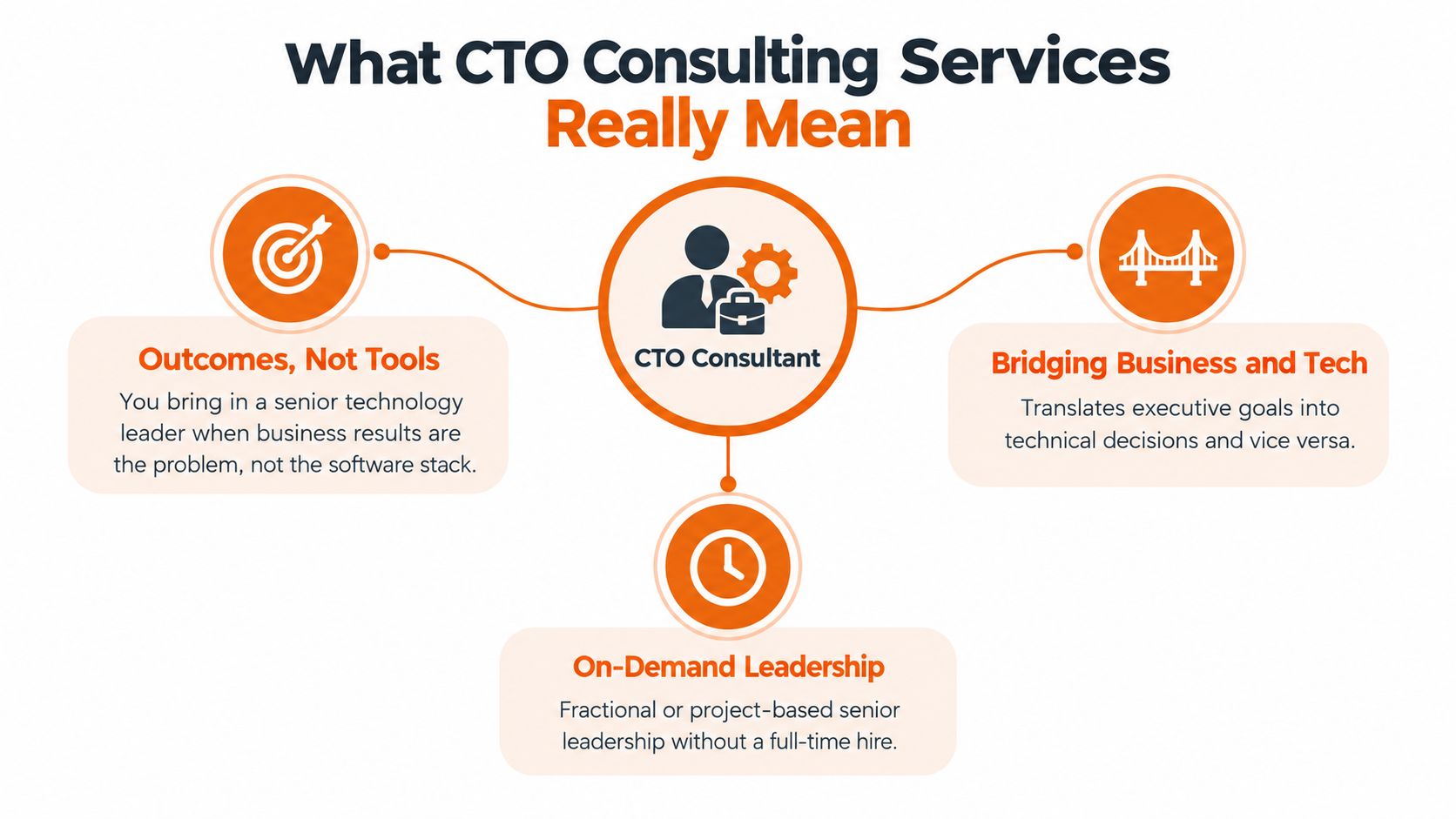
A strategic partner doesn't accept a list of requested tools and turn it into a statement of work. They question assumptions respectfully, explain the trade-offs, and take responsibility for the decisions and delivery work they own. That means communicating risks while there's still time to act, not after a deadline or release has failed.
AI-native engineering is part of this model, but it doesn't lower the bar for production software. Agents can accelerate analysis, coding, testing, documentation, and migration work. Experienced architects and engineers still own the architecture, data decisions, security controls, test quality, and behavior of the production system.
The responsibility needs to remain clear when a consultant's work reaches production. NIST's Secure Software Development Framework calls for roles and responsibilities to be defined across the software lifecycle, including for external participants, and for security design, tests, results, and unresolved issues to be documented (NIST's Secure Software Development Framework).
A useful mental model is simple: CTO consulting is senior accountability applied to a business problem. The consultant may advise, embed with your team, lead a defined delivery, or help operate what gets built. The engagement should make clear what success means, who owns each important decision, and what operational responsibility remains after launch.
The label “CTO consulting” covers different kinds of work. Don't buy a broad promise when you can identify the specific decision or delivery constraint you need help with.
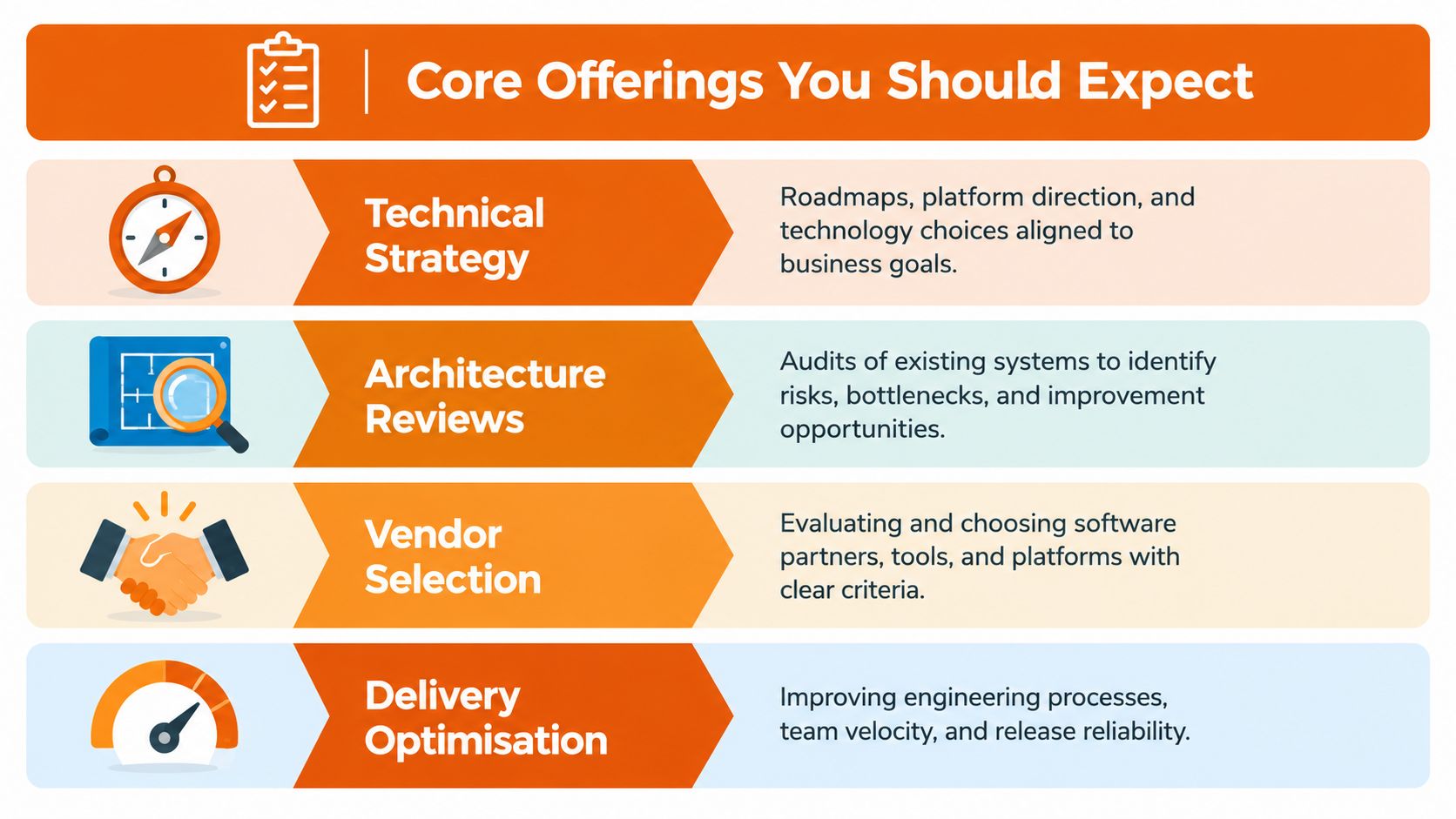
Technical strategy connects the product roadmap to platform choices, investment priorities, and delivery capacity. A SaaS company planning new customer capabilities may need to decide whether its current architecture can support the roadmap or whether teams need to change sequencing and platform direction. A strong strategy is specific about decisions and dependencies, not just desired future technologies.
Architecture reviews examine how the existing system behaves and where risk or constraints sit. A modernization review might map dependencies, deployment pathways, data flows, security assumptions, and operational ownership. The result should help leaders choose a safe path forward, not leave them with a diagram that nobody uses.
Vendor selection is a decision exercise, not a product tour. A manufacturer weighing software or integration partners should compare options against its actual requirements: how each handles existing systems, who owns support, what data and interfaces are involved, and what happens if the relationship ends. Ask prospective vendors to demonstrate the work that matters to your operating model.
Delivery optimisation finds the constraint that prevents a team from shipping dependable changes. Measure throughput and instability separately. The 2024 DORA framework includes change lead time, deployment frequency, failed-deployment recovery time, change-failure rate, and deployment rework rate; together, they help distinguish slow delivery from unreliable delivery (2024 DORA report announcement). A team that ships more often but struggles to recover from failed changes may need better release controls, not pressure to ship even faster.
If customers are waiting for a product capability, investigate roadmap choices and delivery flow. If a migration feels risky, start with architecture and dependency mapping. If teams are stuck between competing platforms or integrators, define the decision criteria before vendor demonstrations begin.
For operational resilience, examine how teams detect issues, recover service, and communicate ownership. Fivenines' operational excellence playbook offers a useful companion perspective on connecting operational practices to dependable service. The right consulting brief names the business problem first, then identifies which service can help solve it.
Choose an engagement model based on the work your organization needs to own, the senior capability it already has, and how quickly it must move. A strategy assignment can help executives make a hard investment decision. It won't substitute for an engineering leader who can work with teams on architecture and delivery.
| Engagement Model | Best For | Ownership Outcome |
|---|---|---|
| Advisory | Leaders who need an independent assessment, strategy, or decision support | Client owns execution; consultant clarifies options, risks, and priorities |
| Embedded consulting | Teams that need senior technical leadership alongside their existing staff | Responsibilities are shared and explicit; internal leaders retain durable ownership |
| Dedicated Teams | Organizations needing a sustained engineering team for product development or modernization | Client and delivery partner agree on team governance, delivery responsibilities, and knowledge transfer |
| Build-Operate-Transfer (BOT) | Companies establishing a regional engineering operation that they intend to run themselves | Partner builds and operates the capability, then transfers agreed responsibilities to the client |
| AI-native delivery | Teams seeking to accelerate defined engineering work with agentic AI and senior review | Delivery partner owns agreed outputs; client retains agreed product and operational decisions |
Use advisory when your internal team can execute but needs a sharper assessment or experienced challenge before committing. Pick embedded consulting when decisions and delivery are intertwined, such as scaling a product team or unblocking a modernization effort. A Dedicated Team can add sustained engineering capacity, but only if the client and partner agree on decision rights, communication, and how knowledge will remain available.
A BOT model suits organizations building a regional engineering center with a planned transition to direct ownership. Before you commit, settle the transfer conditions: which processes, documentation, people responsibilities, systems access, and operational measures must be in place for the handover to be meaningful.
Model choice also depends on speed, control, cost predictability, and the organization's ability to absorb knowledge. Avoid treating “fixed scope” as a substitute for accountability. Define what the partner will deliver, how changes are handled, and who takes over when the work is in production. For help weighing partnership structures, use this guide to choosing an IT partnership model.
A serious engagement should produce more than meetings and recommendations. Ask for a current-state assessment, target architecture where appropriate, a prioritized roadmap, a delivery baseline, agreed AI governance rules if agents are involved, and an explicit handover plan. Those artifacts give your team a basis to challenge progress and continue operating after the consulting partner's role changes.
AI can change the cost and pace of software work. It doesn't make generated code production-ready, and it doesn't remove the need for experienced engineers. A team that treats AI output as finished work is accepting risk without measuring what it gains.
McKinsey estimates that generative AI could affect software-engineering productivity by the equivalent of 20% to 45% of current annual spending on the function. It also describes a reported 30% to 40% productivity increase among IBM Software developers using generative AI. Those estimates support testing AI in real workflows, not assuming that generated output can bypass review, security controls, or production accountability (McKinsey on generative AI and software-engineering productivity).
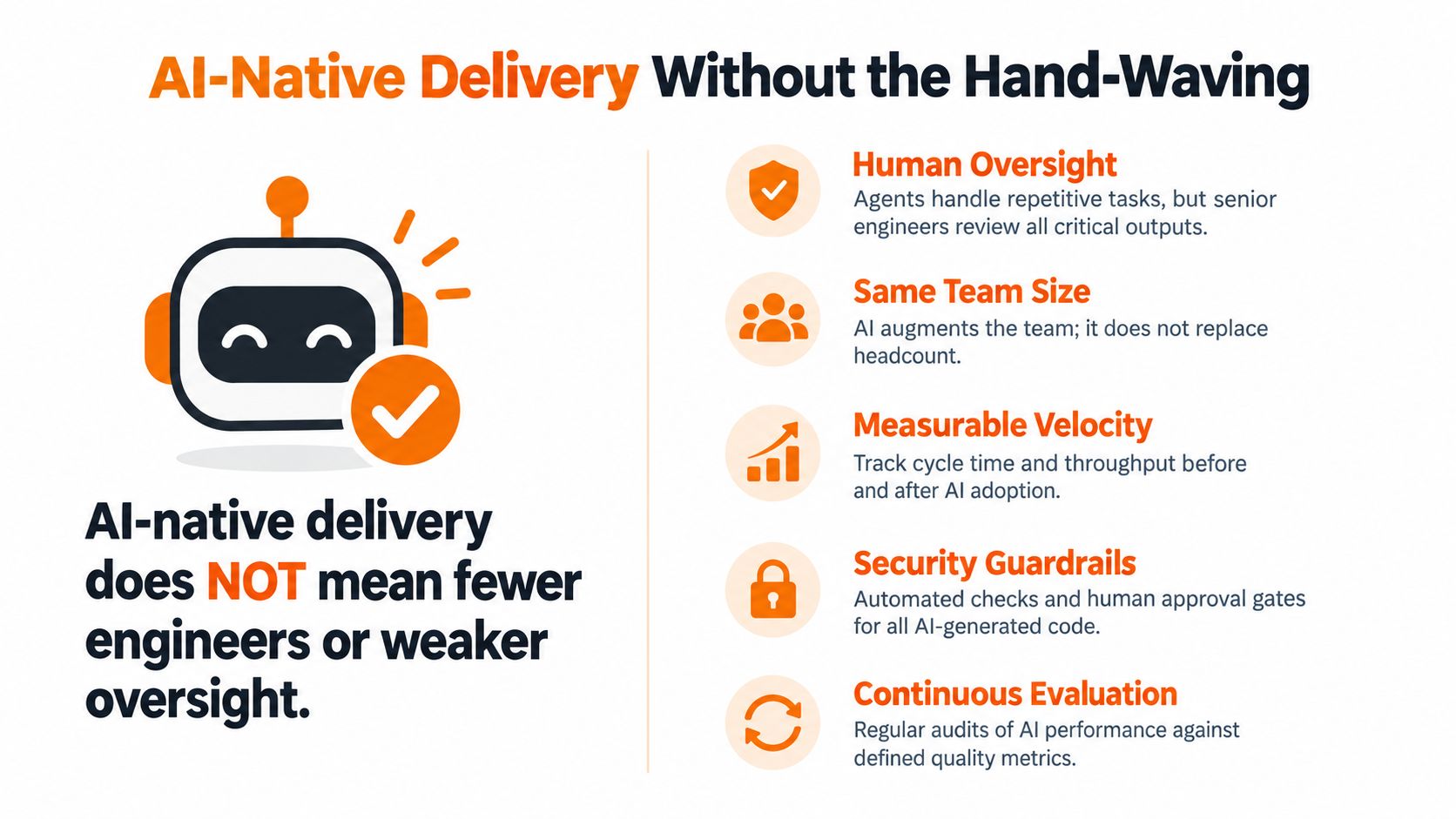
A workable governance model says what agents may do, what needs human approval, and how the team verifies results. Agents can help with repetitive analysis, documentation, test generation, migration tasks, and coding within defined boundaries. Senior engineers should review consequential changes to architecture, sensitive data handling, access control, security, and production behavior.
NIST's AI Risk Management Framework calls for documented human oversight, evaluation methods, and assessment of system security and resilience. It also sets expectations for deployed systems to operate safely within organizational risk tolerance and fail safely (NIST AI Risk Management Framework guidance). In practice, that means recording which tools contributed to work, keeping review evidence, running automated tests and security checks, and maintaining a rollback path.
The frustration is real: Stack Overflow's 2025 Developer Survey covered more than 49,000 developers across 177 countries; 84% said they use or plan to use AI tools, while only 33% trusted their accuracy. The survey also found that 66% were frustrated by AI solutions that were almost right and 45% said debugging AI-generated code took more time than expected (Stack Overflow survey findings on AI-generated code). More adoption is not proof that a team can safely cut senior review.
For a practical discussion of controls around agentic systems, see this guide to agentic AI production safety gates. Then assess your own process against the AI coding tools and AI-native software delivery guide.
Before approving an AI delivery model, ask: Which changes can agents make without approval? Who reviews security-sensitive work? How are AI contributions and test results recorded? What happens when evaluation fails? How are rework and technical debt handled in a fixed-scope contract?
An accountable partner should answer those questions plainly. Watch delivery outcomes and software quality together, rather than treating code volume or tool adoption as evidence of business value.
A provider can sound credible in a presentation and still leave your team with vague deliverables, unclear accountability, and a difficult handover. Evaluate the people who will make decisions and do the work, not just the firm's pitch.
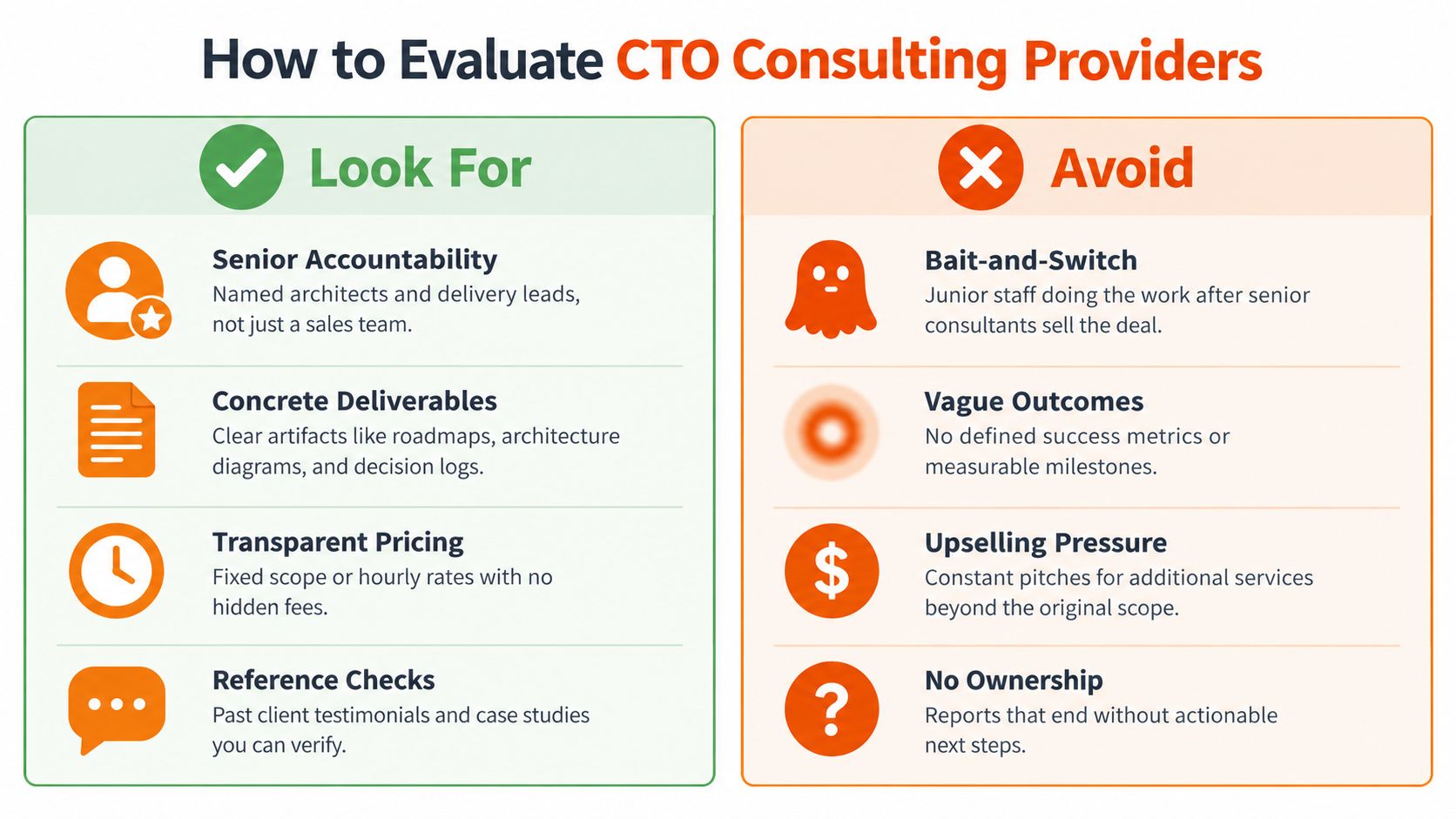
Start with the named senior staff. Who will assess the architecture, lead delivery, review risks, and speak with your executives? Ask to meet the people assigned to the work and establish how much authority they have to move decisions forward. A sales lead who disappears after signing isn't senior accountability.
Then test the proposed outcomes. Ask what artifacts you'll receive, how delivery will be measured, and how often the team will share progress and risks. References should be relevant to your situation, such as platform modernization, product delivery, production recovery, or a team transition. Ask past clients what happened after launch and whether ownership was clear.
Security and AI governance need specific answers. Ask how the team handles sensitive data, reviews AI-generated work, documents evaluation, and manages unresolved risks. For Dedicated Teams or BOT, discuss location and time-zone coverage, language, team scalability, intellectual property, data handling, and the process for transitioning responsibilities back to your organization.
Rate each area as clear, needs clarification, or unacceptable. Don't let a high score in one category hide a serious gap in production responsibility.
Warning signs include vague success criteria, a tool-led pitch without a business case, senior experts who won't be involved after the sale, and fixed-scope work with no discussion of risk or change. For production work, insist on exit criteria: who monitors, patches, and responds to incidents, and what evidence confirms the client can operate the system. Don't sign until the answers are specific.
A strong first month creates clarity and a basis for action. The partner should agree on the business outcome with your leadership, learn how the system and teams work, and make delivery and operational risks visible.
Start with one agreed measure. Establish a delivery baseline that fits the constraint, then map the architecture, dependencies, security concerns, and ownership gaps that could affect the outcome. Use that evidence to prioritize a near-term roadmap, assign decision owners, and identify what the team can deliver without creating unacceptable operational risk.
Before implementation expands, agree on how changes are reviewed, how production behavior will be monitored, and what needs to be documented for handover. If the consultant will remain involved in operations, define the service responsibilities. If your team will take over, make knowledge transfer a deliverable, not a closing-week promise.
The working relationship should feel direct: senior engineers in the room, trade-offs explained while choices are still open, and risks raised early. As the work progresses, review the agreed measures and adjust priorities when evidence shows the original plan needs to change.
Your next step is straightforward. Write one measurable outcome on a single page, include the constraint you believe is blocking it, and use the evaluation scorecard to invite two or three providers to respond. Ask each one who will own the work from the first architecture decision through production handover. The right team brings more than technical skills. It takes responsibility for the complete result.
Rite NRG provides AI-native technology consulting, software engineering, modernization, dedicated teams, and managed technology services, with senior engineers accountable for delivery and production quality. If you need a partner to turn a technical priority into a clear plan and an owned path to production, visit Rite NRG to discuss the outcome you need.
/ about the author
Written by the RITE NRG editorial team — the architects, engineers and delivery leads who build and operate AI-era software for our clients.
Strategy & Transformation
A practical, finance-ready framework for comparing AI and modernization investment with the current-state cost, realistic benefits, delivery risk and time to value.
Technology Talent & Teams
A decision-maker's guide to IT partnership models: what each model actually transfers to the partner, what it costs beyond the rate card, and how to match the model to your situation.
AI Consulting & Automation
A practical framework for choosing and deploying transport or logistics AI agents around real exceptions, reliable data and controlled operational authority.
More guidance: all insights articles
Tell us about the system or idea behind this article. We tell you honestly if it is a fit — and what a fixed-scope delivery could look like.